Introduction
The North/South border of England has been widely discussed in linguistics, not least by this publication (Wales Reference Wales2000). More recently, however, the (East) Midlands has become a focus of sociolinguistic attention, interrupting the concept of the North/South divide. Natalie Braber has been particularly prolific in raising the East Midlands’ profile (2014, 2015, 2016). Nevertheless, the (East) Midlands largely remains a linguistic grey area, with Upton (Reference Upton2012, 267) theorising that it is a ‘transition zone’ from northern to southern linguistic features. This theory could be interpreted as the Midlands having little linguistic identity of its own. However, Braber (Reference Braber, Cramer and Montgomery2016) found that people, specifically teenagers, local to the East Midlands felt that they could discern differences between the accents and dialects of Leicestershire, Nottinghamshire and Derbyshire, the three counties most often included within the East Midlands, giving examples that ‘indexed’ (Silverstein Reference Silverstein2003) locations across these counties to a local ear. My research tested the concept that people living in the north of the East Midlands could identify local voices by conducting dialect recognition activities in the East Midland town of Chesterfield, North East Derbyshire. The results indicate that of the many factors that influence local dialect recognition in this region, the widespread belief that more standard ‘posh’ pronunciation belongs to the south of the East Midlands, moving northwards along a gradual geographical trajectory towards a ‘broad’ pronunciation in the north of the region, presides. It is this belief that I have termed the ‘scale of northern-ness’, which, despite some corrolation with Upton's (Reference Upton2012) transition zone theory, contributed towards some misidentification of local voices. The results highlight that, for the North Derbyshire participants, ‘northern is better’.
Location and the Chesterfield (linguistic) identity
Although Chesterfield is administratively part of the East Midlands, its proximity to South Yorkshire, and the North, make residents’ regional identity somewhat ambiguous. Chesterfield is just 12 miles from Sheffield, South Yorkshire. It takes ten minutes to travel from Chesterfield to Sheffield by train. Nottingham is 26 miles away, and Derby, Chesterfield's county capital, is 29 miles away. Figure 1 is a map of Derbyshire, which shows the council district of Chesterfield in relation to Sheffield, Derby and Nottingham.
Map of Derbyshired Districts set against Ordnance Survey background (Derbyshire Observatory Reference Observatory2024).

The physical proximity to South Yorkshire/the North may have the effect of Chesterfield locals feeling greater allegiance with their more northerly neighbours. It is also possible that they develop a ‘hybrid identity’, switching between feeling more Northern or more Midlander depending on the situation (Llamas Reference Llamas, Llamas and Watt2010, 235–6). Chesterfield's connection with Yorkshire/the North is reinforced by local news reporting: anecdotally, most houses in Chesterfield receive local news from BBC Look North (Yorkshire), while a minority receive BBC East Midlands Today. Braber (Reference Braber2014, 4) suggests that local news media has a role in ‘representing and constructing regional identity’. She notes that areas that do not receive BBC's East Midlands Today might be considered outside of the ‘core’ East Midlands’ area (Braber Reference Braber2014).
Conversely, Chesterfield residents’ proximity to Sheffield and the North may lead to a sense of ‘heightened diversity’ (Britain Reference Britain, Llamas and Watt2010, 200), where Chesterfield locals express a greater Midlander identity than other people who live more securely within the East Midland region. Braber's (Reference Braber2014) research with East Midland teenagers used dialect and perceptual mapping to establish that, of the teenage participants from across the East Midlands, Chesterfield teens identified most strongly as Midlander (personal correspondence 2015).
Chesterfield's linguistic identity had scarcely been analysed prior to my own research, save for an undergraduate dissertation (Le Baigue Reference Le Baigue2010). However, its border location should make it a town of some interest, with research finding that Derbyshire voices are dissimilar to others across the East Midlands. For example, Jansen and Braber (Reference Jansen and Braber2020) wanted to test the theory of the East Midlands as a linguistic transition zone. They focussed on the FOOT /ʊ/ - /STRUT /ʌ/ split (Wells Reference Wells1982a) across Derbyshire, Nottinghamshire and Leicestershire. Wells (Reference Wells1982b, 349) explains that the linguistic North is found where there is no longer a FOOT-STRUT split, for example in ‘book’ and ‘buck’: in the North of England ‘book’ and ‘buck’ are largely homophones, but this is not true of large parts of the South. Jansen and Braber (Reference Jansen and Braber2020) found that whilst Derbyshire speakers retained the lack of the FOOT/STRUT split, common to northern varieties of English, there was evidence of ‘the northward movement of the phonemic split’ across the other two counties (ibid, 792). These findings would suggest that there is some evidence for Upton's (Reference Upton2012) theory of the geographical transition of northern to southern linguistic features in Leicestershire and Nottinghamshire, in terms of the FOOT/STRUT divide, with Derbyshire the exception and seemingly more rooted in the linguistic north.
Dialect recognition
There is the assumption in Perceptual Linguistics that people can best recognise the accents and dialects of proximal locations (Williams et al. Reference Williams, Garrett, Coupland and Preston1999, 345). However, several mitigating factors have been highlighted over the years, including life experience of respondents, and the level popular appeal of their home region.
Teenagers have been found to be less adept at dialect recognition than adults (Williams et al. Reference Williams, Garrett, Coupland and Preston1999). This could be due to life experience reducing familiarity with accents. However, there has also been the suggestion that in dialect recognition tasks, teenagers are particularly susceptible to affective factors, such as the likability or popularity of an accent or location. Braber (Reference Braber2015) believed that negativity surrounding Nottingham in the press, frequently portrayed as a violent city, may have led to Nottinghamshire voices remaining unidentified (or ‘unclaimed’) in her dialect recognition research by Nottinghamshire teenage participants. In a similar study with Nottingham-based participants aged above 55, Hind (Reference Hind2019) found that their more secure regional identity may have led to greater local dialect recognition.
Arguably, the East Midlands as a whole receives little positive attention. This contrasts Yorkshire, with Sheffield well known for its musical and sporting heroes. Montgomery (Reference Montgomery, Cramer and Montgomery2016) described the effect of ‘cultural prominence’ of a location, where further away places, and their accents, become more recognisable due to media attention, citing the increased national awareness of Manchester as a dialect area due to media coverage (Montgomery Reference Montgomery, Cramer and Montgomery2016, 201). Linking back to the (un)popular appeal of Nottingham, described by Braber (Reference Braber2015), one Chesterfield male stated in interviews that, in contrast to Nottingham and Derby, ‘the North is better, isn't it?’ Perhaps the greater cultural prominence of Yorkshire/the North would lead to Sheffield voices being claimed by Chesterfield (teenage) residents?
Method
For Task 1, I wrote a script and recorded four younger females in their twenties, each from Chesterfield, South Derbyshire, Nottinghamshire and Sheffield, reading it aloud. I wrote this short passage with the intention of encouraging readers to produce local features of their accent. Twenty-four participants from Chesterfield, from three different age groups, listened to the recordings and selected where the speakers were from, knowing that each speaker was from one of the four locations. Four older males (over the age of 56) from the same locations read out the same script, and again participants decided where they were from. Participants were encouraged to write below their answers why they chose each location. For Task 2, participants listened to the same speakers answering questions about local vocabulary, in the same order. They then selected again where they thought they were from, giving reasons. The questions included:
• Are there any words or phrases typical of the town/city you're from?
• What do people in your town/city call a bread roll?
• What do people in your town/city call the passage between two houses?
• You want to thank a stranger, but don't know their name. What would people from your town/city say? (e.g, ‘Thanks, Pal’).
Each speaker gave their own unscripted answers in Task 2, resulting in less formal speech.
Findings
The main findings from the two local dialect recognition tasks, and some theories surrounding them, are as follows:
1) In both Tasks 1 and 2, the two Sheffield speakers are the most accurately identified duo by Chesterfield respondents.
After Task 1, 79% of Chesterfield respondents connected the Sheffield younger female with Sheffield. The older Sheffield male was recognised by half of the Chesterfield respondents in the same task. After Task 2, they remain the most correctly identified pair.
Given the four possible answers to Task 1, one would expect a roughly even distribution of results should the participants have been randomly allocating their answers. For the younger female, there was a significant difference in the proportions opting for each accent. A P-value of < .001 was calculated for the younger female recognition, and 0.04 for the male, suggesting that both results are significant. In other words, the identification of both Sheffield speakers by Chesterfield participants in Task 1 is greater than chance, which suggests that Sheffield speakers are identifiable to a Chesterfield audience by accent alone, even in a formal context.
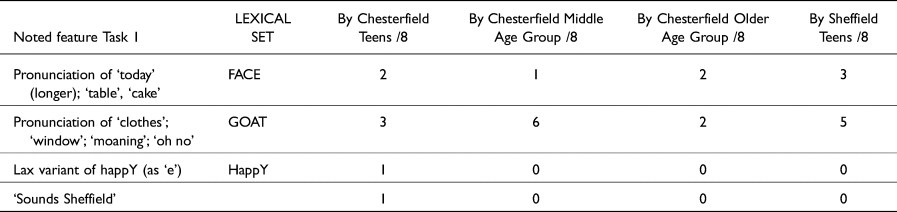
The comments written by participants during the test give insight into why the Sheffield speakers were correctly identified. Table 1 collates the main reasons given when correctly connecting the younger female with Sheffield in Task 1, the formal reading task, by four groups of respondents. These comments were entirely voluntary, however, with not all participants choosing to give a reason for why they connected each voice with a specific location.
Reasons given for the Sheffield younger female's correct allocation by age group after Task 1

Table 1 shows that for each group of respondents there was a maximum number of eight people who may have given a response per cell. It can be seen that the younger Sheffield female's GOAT vowel (Wells Reference Wells1982a) was highly recognised as a marker of Sheffield speech by Chesterfield's middle age group of participants and Sheffield teens. Six out of a possible eight middle age Chesterfield respondents highlighted the GOAT vowel of the Sheffield female speaker, and five out of a possible eight Sheffield teens. For example, one middle age female respondent from Chesterfield recognised the Sheffield female because she sounded similar to her Rotherham friend, writing that this was especially true in the way the Sheffield female pronounced ‘clothes’. A Chesterfield teen noted the Sheffield female's ‘long pronunciation’ in words like ‘moaning’: the teen was most likely referring to ‘moan’ being realised by the Sheffield female as something approximating ‘mern’ [mɵːn] (Finnegan Reference Finnegan2011). There was quite a rich array of reasons given throughout Tasks 1 and 2 for the connection of place and recording, with the older age group the least likely to elaborate: this can be noted in Table 1, where the older age group volunteered the least reasons.
Differences in pronunciation were noted by participants, as above for the two Sheffield speakers, but the intuition of respondents seem to have also played a part. One middle age female participant from Chesterfield stated that the Sheffield male ‘elongates the vowels’ in a similar way to the Chesterfield accent, but that it is more Yorkshire/North sounding, and therefore places him in Sheffield. This provides some evidence for the scale of northern-ness affecting deductive processes in these tasks.
It is of interest to note that the two Sheffield speakers were best recognised, but not claimed, by the Chesterfield respondents. In other words, they recognised the voices, but did not connect them with Chesterfield voices. The high recognition rate of the Sheffield voices suggests that their linguistic features differ from the others in the sample; the East Midland voices.
2) Task 2's vocabulary questions did not significantly improve the accuracy of identification;
Looking as a whole, there are 73/192 correct answers for Task 1 (38%) and 76/192 for Task 2 (39.5%) by all Chesterfield participants. There were 79 changes made from Task 1 to Task 2, with only 21 changes from incorrect response to correct (27%), 18 from correct to incorrect (23%), and 40 from incorrect to incorrect (50%). These data suggest that Task 2, the vocabulary and free speech activity, may have only confirmed or confused answers from Task 1, the formal reading activity, and did not significantly improve the overall accuracy of total results.
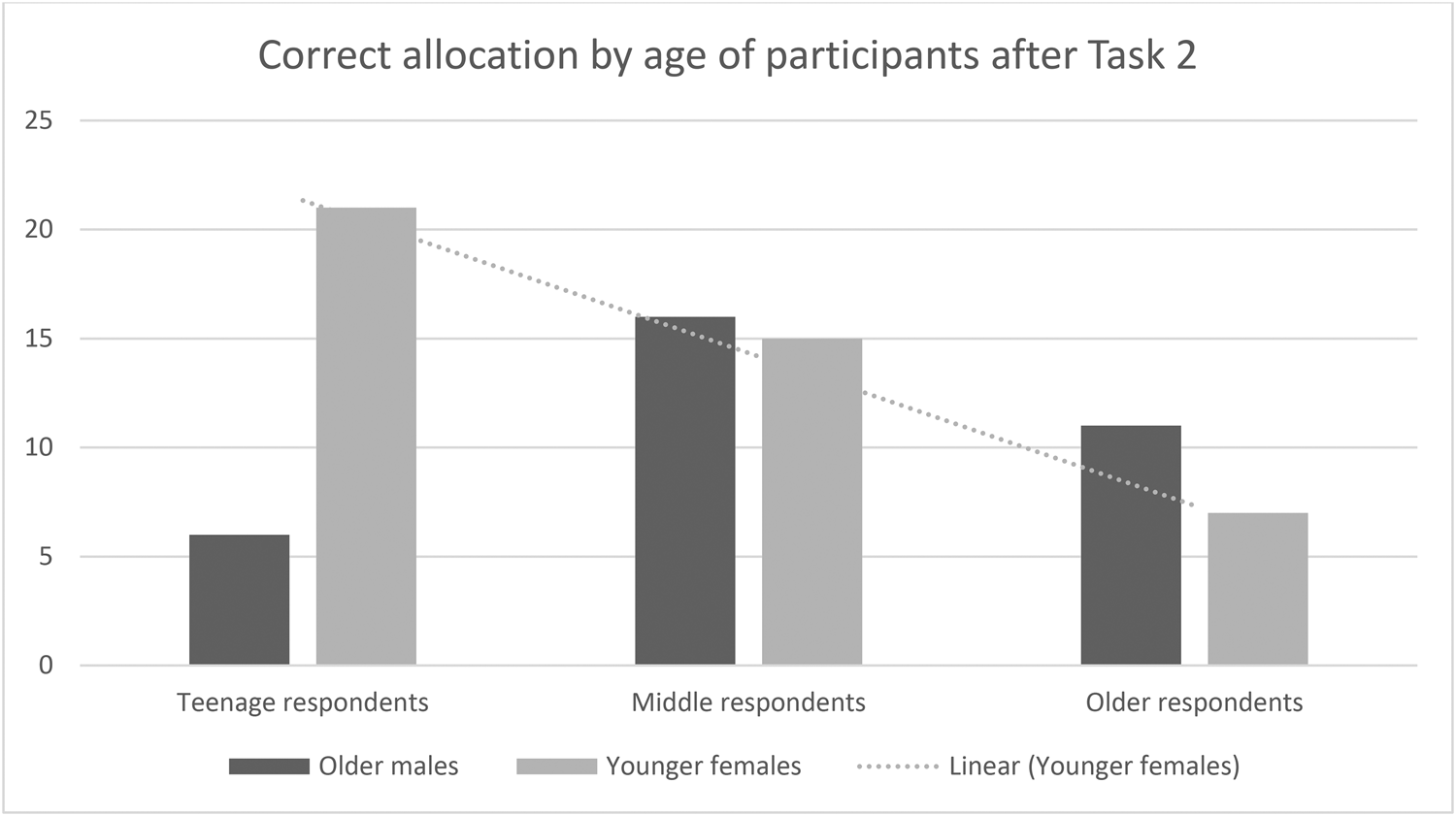
Furthermore, there was a very similar trend in Tasks 1 and 2, with the Task 2 results illustrated in Figure 2: the number of correct younger female allocations gradually declines after both tasks as the Chesterfield respondents get older, and the older male correct allocations peak with the middle age group. This is suggestive of generational distance affecting dialect recognition: for example, teenage respondents are best at recognising voices that are closer in age to them.
3) In Task 1, the South Derbyshire speakers, and Nottinghamshire male speaker, were not easily identified by Chesterfield participants;
The South Derbyshire female is the only one of the four females to not have been correctly allocated by a significant proportion after Task 1. For the older male, there is an equal majority between South Derbyshire and Chesterfield from the Chesterfield respondents, but Nottinghamshire is not far behind after Task 1. The main reason given for placing both speakers in Derbyshire (Chesterfield and S. Derbyshire) by all respondents, including Sheffield teens, is their MOUTH vowel. One teenage male respondent from Chesterfield stated that ‘abaht’ is ‘typical of Derbyshire’, and he correctly placed the older male in South Derbyshire. For the same reason, another teenage respondent incorrectly placed the younger female in Chesterfield. Her ‘familiar’ sounding voice led many of the respondents into connecting her with several of the possible locations. One Chesterfield respondent correctly placed the female in South Derbyshire after Task 1, as her accent was ‘similar to Chesterfield, but sounds slightly different – not as heavy a Derbyshire accent as Chesterfield’. One respondent stated that she could place the South Derbyshire female voice in Chesterfield, Nottinghamshire or South Derbyshire, but ‘I wouldn't say Sheffield’. This provides some evidence for the similarity of East Midland accents.
Correct allocation by age of Chesterfield participants after Task 2 /64.

As for the Nottinghamshire older male, most Chesterfield respondents connected him with either Chesterfield or South Derbyshire rather than Nottinghamshire, which was the least popular choice. Due to the Chesterfield respondents’ ‘dialect image’ (Inoue Reference Inoue and Preston1999, 162) of Nottinghamshire voices equating to ‘standard’ or ‘posh’, this speaker created confusion. For example, one Chesterfield respondent incorrectly placed the Nottinghamshire male in Chesterfield, as she felt his accent was similar to the South Derbyshire male's, but ‘stronger’. As she felt that accents become ‘stronger’ the further north one travels, she placed him in a location geographically further north.
4) In Task 1, the Chesterfield male speaker was significantly misidentified as having a Nottinghamshire accent by Chesterfield participants.
After Task 1, half of the Chesterfield respondents connected the older Chesterfield male with Nottinghamshire. Moreover, Chesterfield was the least popular choice. This is the same for Task 2, but the figures levelled out a little more with some respondents changing their answer from Task 1. After Task 1, the p-value of Chesterfield respondents choosing Nottinghamshire for the Chesterfield male is 0.040, suggesting that the choice made by respondents was more than chance.
Some comments from Chesterfield respondents suggest that because the older male was the last male to be heard, they had only one option left and so decided that he must be from the least known place: Nottinghamshire. Despite one respondent choosing South Derbyshire for the Chesterfield male, she wrote after Task 2 that she thought he actually sounded more northern, even though she did not change the location. Another respondent wrote that because this male had the ‘least distinctive’ accent, he chose Nottinghamshire. Perhaps because this male voice was the last of the older males to be heard, the nature of the task combined with the voice not fitting the respondents’ dialect image of a Chesterfield voice led to his misallocation.
Discussion
I put forward that ‘the scale of northern-ness’ is particularly involved in the deductive processes of the Chesterfield ‘borderland’ audience, where the degree of northern-ness may have particular salience. The South of England has commonly been referred to as ‘posh’ when northern English respondents reside near to the disputed North/South border in England (Montgomery Reference Montgomery2012, 654). However, in both my study and Le Baigue's (Reference Le Baigue2010) undergraduate dissertation, Chesterfield respondents gave the ‘posh’ label to a proximal location: South Derbyshire, which is within the same county as Chesterfield, and Nottinghamshire, which is a neighbouring county. This connects with Upton's (Reference Upton2012) theory that the East Midlands is a transition zone from northern to southern linguistic features. However, the ‘posh’ stereotype connected with more southern areas of the East Midlands led to incorrect answers, where the empirical reality of an authentic accent did not align with the social stereotype (Boughton Reference Boughton2006).
The scale of northern-ness used by Chesterfield respondents to place Sheffield and East Midland locations in relation to Chesterfield has parallels with Montgomery's (Reference Montgomery2012, 654) findings that those who live in areas close to Northern/Southern English borderland areas tend to place the North/South border further south than those who are more securely positioned in the North in a phenomenon he calls ‘shifting’. In other words, in Montgomery's map tasks, those who lived in disputed territory, in the Midlands, tended to value a more northern status over southern. With the Chesterfield respondents, it seems that anyone who sounded remotely southern, or more RP, was distanced, and those who sound more northern, but not necessarily Yorkshire, were claimed.
Montogomery (Reference Montgomery2012) theorised that there are several barriers to local accent recognition. One barrier to local accent recognition in the north of the East Midlands may be the historical divide between Chesterfield and South Derbyshire/Nottingham due to the mining strikes of the 1980s. Pearce (Reference Pearce2009, 189) states that animosity forms an important part of identity, with identity and language sharing a relationship. The ripples of animosity towards South Derbyshire and Nottinghamshire displayed by Chesterfield mining families in the 1980s may still be felt today, although the source of ill feeling may now be unknown. There is a sense of distain towards these two locations at times in the data, which may underlie the ‘posh’ label: These locations are posh, different, and other, perhaps because they did not strike when Chesterfield and South Yorkshire miners, largely, did. This, along with their largely Conservative politics, could be another reason why ‘posh’ voices are largely connected with Nottinghamshire, because ‘posh’ is seemingly undesirable to the Chesterfield audience.
Conclusion
To summarise, local dialect recognition in the East Midlands may be affected by the belief in a scale of northern-ness, particularly in the north of the region, where there seems to be the perception that northern is better. Yet, despite the Sheffield voices being the most northerly in the sample, and the most recognisable to a Chesterfield audience, these voices were rarely claimed or connected with Chesterfield. The perception of the East Midlands as a transition zone led to some misidentification of voices, especially with the Nottinghamshire and Chesterfield older males, whose voices did not adhere to the widespread dialect image of ‘broad’ more northerly accents, and ‘posh’ southerly voices in the East Midland region. One limitation of the research is the relatively small number of participants: 24 from Chesterfield, and eight from Sheffield. Larger scale research across the East Midlands/South Yorkshire would help to confirm these findings and make them generalisable. The results of this research suggest that future dialect recognition tasks should consider the generational distance between the age of the speaker and respondent as a possible barrier to dialect recognition, along with historical alliances and conflicts.
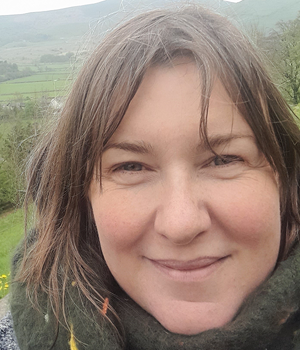 CLAIRE ASHMORE last year, successfully defended her PhD thesis at Sheffield Hallam University entitled ‘The Chesterfield Accent and Dialect: Borderland Identity, Perceptions and Production’. During her studies, Claire engaged with Chesterfield locals to inform her largely perceptual research, and she currently enjoys sharing her findings with a more general audience. She hopes that her results will contribute towards an oral history exhibition in the town. She is also interested in expanding her studies further along the North/Midland border, but hopes in the near future to incorporate the West/East Midland split in her research. Recently, Claire returned to her previous career in TESOL at The University of Nottingham, and combines this with caring for her two young boys. Email: claire.ashmore@ymail.com