





1. Introduction
With the increasing dominance of English as the global language of academia and business, universities in non‑English‑speaking countries have increasingly adopted English‑medium instruction (EMI) as a key strategy for enhancing international visibility and competitiveness in recent decades. This has contributed to attracting faculty and students from overseas, further reinforcing a paradigm shift in international mobility within global higher education (Baty Reference Baty2023; Xu Reference Xu2021). Among the rising players, South Korea (henceforth Korea) has emerged as a popular study‑abroad destination, driven in part by the global reputation of its top‑ranked universities, which has become one of the major draws for international students (OECD 2024; QS 2026). Similar to many other universities in non‑English‑speaking countries striving to strengthen and secure their positions in the global rankings, internationalization of higher education in Korea also meant introducing a language policy other than its national language to cater to an international audience (Byun et al. Reference Byun, Chu, Kim, Park, Kim and Jung2011; Jon et al. Reference Jon, Lee and Byun2014). EMI policy has thus served as a conduit for enhancing Korea’s international profile from the start and to this date (see Bolton et al. Reference Bolton, Ahn, Botha and Bacon–Shone2023).
However, only recently have there been studies questioning EMI’s efficacy in sustaining internationalization, given that its expansion has largely been driven by top‑down educational policies (Macaro et al. Reference Macaro, Curle, Pun, Jiangshan and Dearden2018; Williams Reference Williams2023). With the growing presence of degree‑seeking international students in Korean universities, issues surrounding student retention and dropout prevention have become increasingly salient in recent years (Jung and Kim Reference Jung and Kim2018). Although institutional factors, including admissions and language support, are integral to international students’ academic experiences, relatively less attention has been paid to the role of EMI policy in shaping their academic experiences. Against this backdrop, the present study adopts a multi‑layered analytical approach to examine international students’ lived experiences of EMI in Korean higher education, with particular attention to how integration and marginalization are produced through policy and practice. The study investigates the extent to which EMI policy serves the interests of degree‑seeking international students from diverse backgrounds by examining whether the policy promotes or constrains equitable access to courses that meet their academic needs.
2. Background
This section begins by contextualizing EMI in Korea’s higher education. It then introduces the theoretical frameworks that guide the analysis and reviews previous research relevant to the study.
2.1 Overview of internationalization and EMI in Korea’s higher education
Attracting international talent has been a central agenda in Korea’s higher education policy, aimed at enhancing global competitiveness and countering the steady decline in the school‑age population (Choi Reference Choi2024; Jung Reference Jung2024). This reflects the government’s strategy to preemptively secure a skilled future workforce and strengthen national competitiveness through aggressive internationalization initiatives designed to reverse brain drain and expand international student enrollment (Bolton et al. Reference Bolton, Ahn, Botha and Bacon–Shone2023; MOE 2023).
According to the Korean Education Development Institute (2024) census, the number of international students in both degree and non‑degree programs at Korean universities more than doubled in just a decade, from 91,332 students in 2015 to 208,962 students in 2024. More revealing is the number of international student enrollments in degree programs consistently surging over the past decade. While a large proportion of international students come from neighboring Asian countries, recent years have witnessed a significant uptick in the student population from non‑Asian regions. As one of the strongest economies in Asia, Korea’s unprecedented economic development, together with the rising global popularity of K‑culture, has attracted growing numbers of international populations seeking education and career opportunities, thereby cementing its status as an appealing destination.
Central to Korea’s higher education internationalization strategy has been the importance of adopting a language policy to suit international students. English functioning as a dominant currency for both economic and academic prestige rendered it an obvious choice as a medium of instruction for many universities (Bowles and Murphy Reference Bowles and Murphy2020; Fenton–Smith et al. Reference Fenton–Smith, Humphreys and Walkinshaw2017). EMI has therefore become a top‑down response to internationalization, making it a recurrent practice in Korean higher education ever since the turn of the century (Byun and Kim Reference Byun and Kim2011). The growing prevalence of EMI reflects a broader neoliberal shift in higher education (Park Reference Park, Flubacher and Percio2017; Rahman and Hu Reference Rahman and Hu2025). Universities are increasingly expected to compete on a global scale, attract international students, and tailor their curricula and language policy to meet market demands. In this regard, English is indisputably a constant in the equation of internationalization in Korean higher education. Nevertheless, the choice of EMI itself should not be taken for granted, as ‘internationalization covers an area more closely linked to institutional policy, which does not necessarily concern the English language, even if this is in fact often the case’ (Costa and Mariotti Reference Costa, Mariotti, Bowles and Murphy2020, 230).
2.2 Theoretical frameworks
The study draws upon a multi‑layered analytical approach to examine how integration and marginalization are produced and reproduced in international students’ lived experiences of EMI in Korean higher education. Grounded in Spolsky’s (Reference Spolsky2004) framework of language policy, the analysis draws on Bourdieu’s (Reference Bourdieu1991) linguistic capital and symbolic power and Fricker’s (Reference Fricker2007) epistemic injustice to account for the conditions shaping these experiences.
Language policy is a complex construct that is a product as well as a manifestation of ideologies and values associated with language(s) in a specific context (Wright Reference Wright2016). It encompasses a set of principles established by governments and institutions in making language choices and shaping language use. Spolsky’s (Reference Spolsky2004) framework of language policy – comprising practices, ideologies, and management – offers a useful lens for illuminating the complexity of the choice of medium of instruction in higher education, given that ‘language policies adopted by universities condition the access to knowledge for students’ (Gazzola and Wickström Reference Gazzola and Wickström2017, 3). In this sense, language policy is not merely a linguistic decision but presupposes intentions shaped by multiple and even competing perspectives. The presence of a language policy, however, may not guarantee implementation, nor does implementation necessarily result in success, as policy may not align with actual language practices. Such discrepancies may arise from tensions between top‑down initiatives and the bottom‑up practices embedded within linguistic communities (Cogo and Jenkins Reference Cogo and Jenkins2010; Rahman and Hu Reference Rahman and Hu2025; Ricento and Hornberger Reference Ricento and Hornberger1996). Understanding the degree of alignment – or misalignment – between management efforts and actual practice requires attention to the underlying language ideologies and unequal distribution of capital at play (Tollefson Reference Tollefson and Ricento2006).
Among the different forms of capital, Bourdieu (Reference Bourdieu1991) conceptualizes linguistic capital as the value intertwined with the mastery of the so‑called legitimate language, which functions as a key instrument in asserting symbolic power. Language, in this sense, operates as a form of currency that shapes how individuals are perceived and how power is exercised in the linguistic market. This perspective foregrounds the socially constructed value of language and its role in structuring access to participation, recognition, and legitimacy, while a lack thereof may reinforce inequity and marginalization within institutional contexts. From this viewpoint, universities implementing EMI policy can be understood as a specific type of linguistic market (Abrar–ul–Hassan Reference Abrar–ul–Hassan2021; Webb et al. Reference Webb, Schirato and Danaher2002). When situated in a non‑English‑speaking environment, such as Korea, EMI classrooms constitute a nested linguistic market that operates within a broader national linguistic market. In this type of context, linguistic capital does not solely refer to the ability to communicate in the medium of instruction but to the possession of institutionally valued linguistic resources. Here, Korean, which is the official language, functions as a legitimate linguistic currency that can be translated into additional forms of linguistic capital and symbolic power. For example, students whose linguistic resources do not conform to these dominant norms and beliefs may experience symbolic violence, placing them at a disadvantage. In this process, they may internalize exclusion and marginalization rather than recognizing them as structural outcomes of institutional language practices (Samuel Reference Samuel2013).
This can be further understood by referring to Fricker’s (Reference Fricker2007) notion of epistemic injustice, which refers to a form of injustice related to knowledge that occurs when people are wronged in their capacity as knowers. She further notes that even in the absence of any specific social agency actively excluding them from democratic participation, exclusion nonetheless occurs, indicating the operation of social power. This arises when people are unfairly treated or disadvantaged in their ability to understand, interpret, communicate or have their experiences recognized as legitimate knowledge. She distinguishes two primary forms of epistemic injustice: testimonial injustice and hermeneutical injustice. Testimonial injustice is related to a credibility deficit caused by prejudice on the part of the hearer. It occurs when the speaker’s words are taken less seriously due to ingrained assumptions related to characteristics such as class, nationality or linguistic and cultural background. This may operate unconsciously and need not be the result of deliberate discrimination. Speakers who are subject to testimonial injustice may find their accounts discounted, making it difficult for their experiences to be acknowledged as legitimate knowledge. As a result, their testimony is not afforded the epistemic trust it deserves, thereby silencing their voices within knowledge‑producing contexts.
Hermeneutical injustice arises when there is a gap in shared interpretive resources, which puts certain people at an unfair disadvantage in making sense of their experiences. In such cases, speakers may lack the conceptual tools necessary to articulate their experiences, and hearers may lack the interpretive frameworks required to understand them. In other words, this gap of not having enough shared experiences can prevent their experiences from becoming intelligible within dominant discourses. In this sense, epistemic injustice operates as a lived manifestation of symbolic power, demonstrating how it not only regulates participation but also shapes whose knowledge is heard, trusted and rendered meaningful within academic practices (Williams and Stelma Reference Williams and Stelma2022). Taken together, these perspectives provide a nuanced lens for examining how EMI within higher education internationalization agendas can inadvertently engender equity‑related challenges that shape international students’ access to education appropriate to their academic needs and, in turn, their academic integration or marginalization.
2.3 Previous studies
In contexts where English is widely viewed as instrumental to the internationalization of higher education, EMI is often perceived as a means of acquiring symbolic capital (Bourdieu Reference Bourdieu1991). As reported by Molino et al. (Reference Molino, Dimova, Kling and Larsen2023), ideologies that foster positive attitudes toward EMI are typically associated with the perceived benefits of English proficiency, access to up‑to‑date academic knowledge and enhanced competitiveness in the global job market. Moreover, with world university rankings becoming an increasingly influential factor, many universities have intensified their efforts to expand and refine EMI on an unprecedented scale to enhance global visibility, engendering an international campus that attracts international faculty and students (Bowles and Murphy Reference Bowles and Murphy2020; Jenkins and Mauranen Reference Jenkins and Mauranen2019).
Although EMI continues to serve as a major pull factor for international student recruitment, only recently have there been studies that have drawn attention to the challenges associated with studying in non‑English‑speaking environments (e.g., Choi Reference Choi, de Wit, Minaeva and Wang2022; Galloway et al. Reference Galloway, Numajiri and Rees2020; Jung and Kim Reference Kim, Fenton–Smith, Humphreys and Walkinshaw2017; Wan and Gao Reference Wan and Gao2020). Anderson (Reference Anderson, Jenkins and Mauranen2019) distinguished between temporary, non‑degree‑seeking students as part of the ‘old internationalization’ and degree‑seeking students from abroad as the ‘new internationalization’, highlighting the important roles of the latter. While there are only a handful of studies situated in Asian, non‑English‑speaking contexts regarding this perspective, this line of research has begun to gain momentum, revealing how the growth of EMI has taken divergent forms depending on local sociolinguistic and policy landscapes. In China, for instance, Wang (Reference Wang2017) identified a policy vacuum in EMI implementation, noting that international students’ linguistic needs were assumed rather than empirically examined. Issues of exclusion and inequality, urging for a more inclusive approach to alleviate marginalization, were also highlighted (Han and Dong Reference Han and Dong2024). In Taiwan, Lin and Lin (Reference Lin, Lin, Su, Cheun and Wu2021) underscored the importance of addressing the diverse linguistic backgrounds of international students to promote equitable participation. In the Korean context, Jon (Reference Jon2012) and Byun et al. (Reference Byun, Chu, Kim, Park, Kim and Jung2011) documented linguistic discrimination and unequal access to academic support among international students, revealing a persistent gap between policy and practice and, in some cases, experiences of discrimination (Byun and Jung Reference Byun and Jung2019).
Despite the growing number of EMI studies, the existing literature has largely focused on Korean students’ perspectives, with international students included only as peripheral participants whose contributions merely supplement the main analyses (Jon and Cho Reference Jon and Cho2024; Williams and Stelma Reference Williams and Stelma2022). As a result, little is known about how EMI policies translate into practice for degree‑seeking international students and how these students navigate EMI within their academic trajectories. The literature reveals a notable gap in understanding how Korean universities accommodate diverse international student populations and whether EMI policy aligns with their lived experiences (cf. Muller Reference Muller2025). As degree‑seeking international students are becoming core members of the academic community and key stakeholders in the internationalization of Korean higher education, understanding how they interpret and respond to these language policies warrants closer analytic attention (cf. Jon et al. Reference Jon, Lee and Byun2014; Jung Reference Jung2025). To gain a deeper understanding of how EMI policy operates within this tension, the present study seeks to explore the following research question: How is EMI policy implemented in practice, and to what extent does it align with degree‑seeking international students’ lived academic experiences?
3. Methodology
This section presents the methodology adopted for the study. It proceeds by describing the research site and participants, followed by the data sources, collection and analysis procedures, and the rationale for employing a qualitative thematic approach.
3.1 Research site
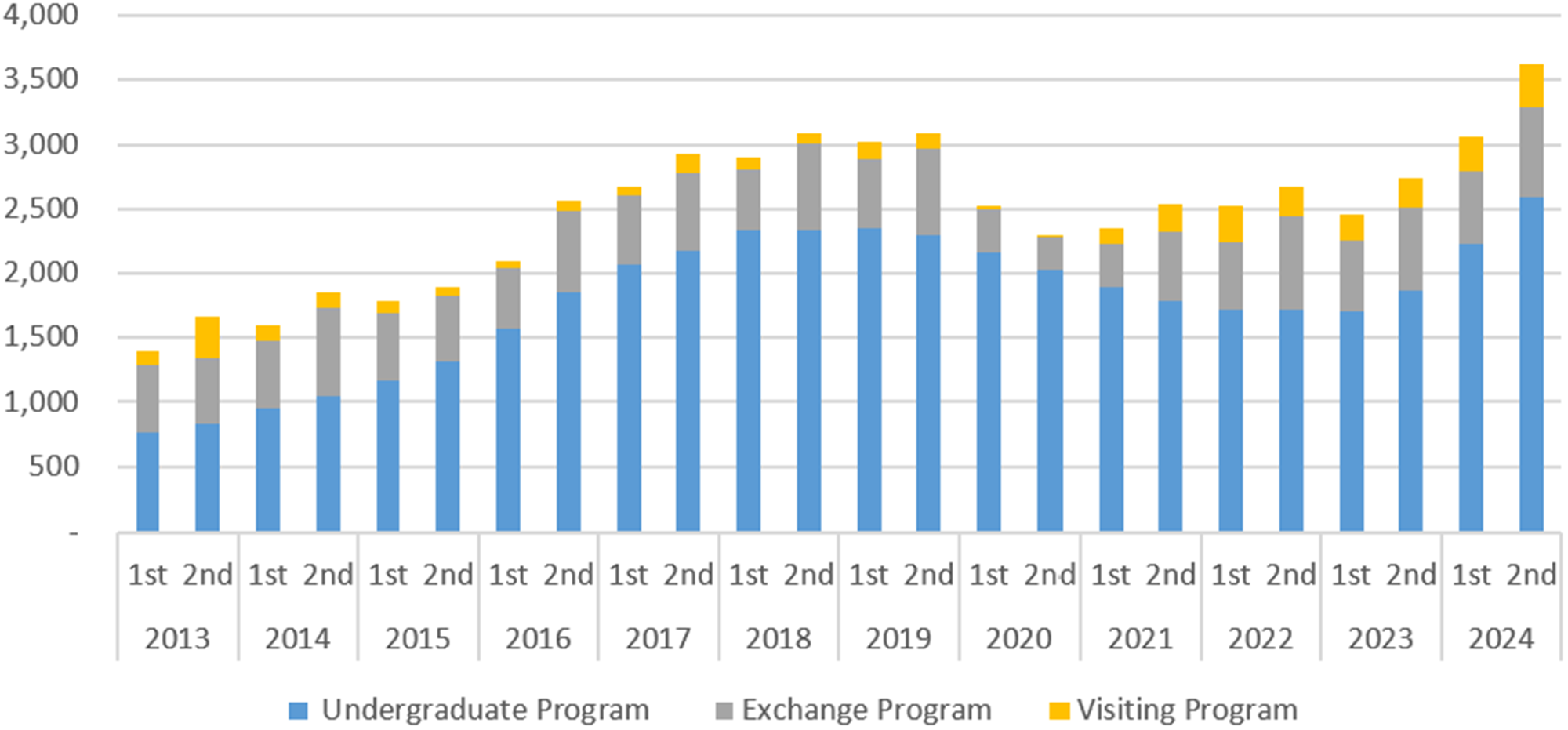
The university chosen for analysis is a top‑tier comprehensive university located in Seoul. It has been well known for being at the forefront of aggressively implementing EMI policy in the early 2000s to promote internationalization (see Byun et al. Reference Byun, Chu, Kim, Park, Kim and Jung2011; Park Reference Park, Flubacher and Percio2017). Established in 1905, it has a total of 66 departments with 19,454 undergraduate students, of which 2,592 are degree‑seeking international students, accounting for 13.32% of the total undergraduate student population as of 2024.Footnote 1 Moreover, unlike the past when the majority of the international population consisted of non‑degree students in exchange/visiting programs, the proportion of degree‑seeking international students in the undergraduate program currently makes up 71.4% of the entire undergraduate international student population, as shown in Figure 1.
International student enrollment (2013–2024).

1 Long description
Stacked bars compare first- and second-semester enrollment in undergraduate, exchange, and visiting programs from 2013 to 2024. Undergraduate students form the largest group throughout, followed by exchange students, while visiting students constitute the smallest group. Despite a temporary decline during the COVID-19 pandemic, international undergraduate enrollment increased by 241.1%, from 760 students in 2013 to 2,592 in 2024. Degree-seeking international students enrolled in the undergraduate program constitute 71.4% of the total undergraduate international student population.
According to the university’s internal report, this growth has been driven by the university’s strategic diversification of international students. Despite a temporary decline during the COVID‑19 pandemic, enrollment increased by 241.1%, from 760 to 2,592, and the number of countries represented rose by 66.7%, from 57 to 95, over the 2013–2024 period.
3.2 Participants
A total of 12 participants whose ages ranged between 20 and 26 (M = 22.42, SD = 1.68) were recruited through the researchers’ social networks to meet the study’s criteria. To obtain insightful data, participation was limited to full‑time undergraduate degree‑seeking international students enrolled during the 2024 academic year who had attended the university for more than one year and had taken EMI courses. Given the inherent diversity of the international student population, purposive sampling was used to maximize variation in participants’ English and Korean proficiency and academic disciplines to examine how different repertoires shaped their EMI experiences. Prior to data collection, informed consent was obtained from all participants for participation and publication. To protect participants’ privacy and ensure anonymity, code numbers were assigned as presented in Table 1.
Participant demographics

Table 1 Long description
Twelve participants (S1–S12) represent nine nationalities and diverse majors. Language proficiency is reported in English, Korean, or both. Participants had completed 2–8 semesters and 2–41 EMI courses. The proportion of completed courses taught through EMI ranges widely, from 4.17% for S12 to 93.18% for S1. The highest proportions are reported by S1 (93.18%), S3 (82.93%), and S2 (81.48%); the lowest by S12 (4.17%), S11 (5.56%), and S10 (12.50%).
a This refers to the language proficiency participants demonstrated to meet the university’s admission requirement and does not correspond to separate degree programs or curricula.
3.3 Data collection procedures and analysis
As Ferguson (Reference Ferguson, Rubin, Jernudd, Gupta, Fishman and Ferguson1977, 9) put it, ‘All language planning activities take place in particular sociolinguistic settings, and the nature and scope of the planning can only be fully understood in relation to the setting’. Examining language policy‑related documents pertinent to the study helped establish a baseline for the study, with interviews serving as the primary focus and online questionnaires supplementing the interview findings. In order to examine the university’s language policy and its interface with language ideology, the primary focus here was to make an ‘explicit and observable effort by [the university] that has or claims authority over [the students] in the domain’ (Spolsky Reference Spolsky2009, 4). Therefore, the initial step involved broad observations within the specific context. Information pertaining to EMI policy available in printed and electronic materials such as websites, university handbooks, admission guides, compiled data and reports was examined with particular emphasis on the medium of instruction (Bowen Reference Bowen2009) to define the scope of the study. This approach was vital, as language policy is rarely explicitly stated in documents.
Semi‑structured interviews were designed to foster a collegial atmosphere, allowing participants the flexibility to freely voice their opinions and experiences regarding EMI that they themselves perceived to be salient to share. The interviews were more than just a research instrument; they were conceived as ‘a site or topic for investigation itself’ (Talmy Reference Talmy2010, 132) to unveil themes that were important to the participants. Prior to the interviews, an online background questionnaire was administered to facilitate more productive and focused engagement in the interview. In addition to a pool of pre‑set questions, follow‑up questions were asked during the interview to capture the complexity of their lived experiences. Participants were also asked to bring in a list of completed courses to provide insights into their course choices related to the medium of instruction. All interviews were conducted individually by one of the researchers to ensure consistency. Interviews were held in either English or Korean, depending on which language the participants were most comfortable with. Each interview lasted around 30 minutes and was audio‑recorded and transcribed.
Given the study’s aim to develop an in‑depth understanding and interpretation of the language policy and practice in a specific context, the nature of the study was primarily qualitative (Casanave, Reference Casanave, Paltridge and Phakiti2015). Data collection and analysis proceeded iteratively. Recruitment ceased when no new themes emerged from successive interview transcripts, indicating that inductive thematic saturation had been achieved. The final sample of 12 participants was therefore considered sufficient to provide a nuanced understanding of international students’ EMI experiences (cf. Guest et al. Reference Guest, Bunce and Johnson2006; Hennink and Kaiser Reference Hennink and Kaiser2022).
As members of the university community, the two researchers were mindful and took deliberate steps to manage subjectivity. Holliday’s (Reference Holliday, Paltridge and Phakiti2015, 52) ‘mak[e] the familiar strange’ approach to data collection and analysis was employed to maintain validity and trustworthiness. Central to the process was gradual focusing, which enabled the researchers to adopt a stranger’s point of view. The data were initially analyzed independently by each researcher and subsequently subjected to iterative reviews of the transcripts to identify recurring patterns grounded in students’ firsthand accounts. Three major themes were determined and interpreted in relation to the aforementioned theoretical framework.
4. Document analysis
To understand how de facto language policies are reflected, language entry requirements stated in admission guides for international students from 2016 to 2024 were examined. The case university currently offers international applicants two language‑based admission tracks: Korean‑track, which requires the designated level of Korean‑language proficiency, and English‑track, which requires English‑language proficiency. These tracks refer solely to the language requirements for admission and do not represent separate degree programs. Nevertheless, students entering through the English‑track generally expect to complete much of their coursework through EMI, whereas those entering through the Korean‑track typically rely on KMI courses. Regardless of the language track, students enroll in their respective degree programs, in which the medium of instruction is determined at the individual course level. In principle, students can choose courses offered through either EMI or KMI. However, given the uneven implementation of EMI, it is questionable whether the case university provides international students with little or no Korean proficiency with sufficient opportunities to pursue their studies through EMI and, consequently, to integrate fully into the academic community.
EMI courses are heavily concentrated in major‑specific subjects, while a majority of general education electives, especially compulsory ones, continue to be offered through KMI. This is somewhat misleading in the broader university context and suggests that completing a degree mostly through EMI remains difficult. As Korean remains the dominant language of administration, students who primarily wish to study through EMI continue to face institutional disadvantages. In this context, linguistic capital extends beyond one’s English competence to the possession of institutionally recognized and legitimized linguistic resources. Those who lack proficiency in either Korean or English – the forms of legitimate competence – may experience the devaluation of their capital, despite meeting the formal institutional requirements. Different language tracks, in this sense, may not only embody divergent language ideologies but also reproduce an uneven distribution of linguistic capital, thereby potentially rendering them subject to symbolic violence.
Figure 2 shows a decline and plateau in the numbers and proportions of EMI courses at the university over the past decade, which has continued to the present despite the increasing number of international students presented in Figure 1. As of Fall 2024, approximately 22% of undergraduate courses were offered through EMI. This prolonged stagnation reflects the university’s seeming indifference toward expanding EMI offerings. The university also requires all students to complete three to ten EMI courses, depending on their major, underscoring EMI’s institutional importance. Despite offering EMI courses, the proportion of EMI courses varies significantly across colleges, ranging from 2.3% in Medicine to 75.5% in International Studies.
EMI course offerings by semester (2013–2024).

Figure 2 Long description
Bar and line chart showing the number and proportion of EMI courses by semester from 2013 to 2024. Both measures declined and subsequently plateaued over the past decade. By Fall 2024, approximately 22% of undergraduate courses were offered through EMI, indicating prolonged stagnation in EMI provision.
Meanwhile, recent admissions data indicate a growing demand for EMI among international students. The percentage of applicants submitting a standardized English score to demonstrate their language ability increased from 29.8% in Fall 2023 to 41% in Fall 2024. This trend implies that many applicants lack Korean proficiency and expect to enroll in EMI courses, highlighting a potential mismatch between the quantity of EMI course offerings, which appear to have plateaued prematurely, and growing student demand.
5. International students’ lived experiences with EMI
Regardless of their language track and major, most participants viewed EMI as a strategic stepping stone to acquiring disciplinary knowledge while enhancing their global and academic competitiveness. This shared perception was evident in both the pre‑interview survey and the interviews, with participants identifying EMI as a major pull factor in choosing the university (M = 5.92, SD = 1.27, on a 7‑point scale). However, these positive expectations were overshadowed by the practical realities of studying through EMI, as participants encountered challenges that hindered their academic integration, as discussed below.
5.1 Shattered expectations of English‑track students
One of the main themes that emerged from the interviews was when students’ expectations were not met. Due to the limited availability of EMI courses, the prestige and legitimacy associated with English proficiency were not fully recognized within the institutional context. While students admitted via the Korean‑track were generally satisfied with EMI offerings in terms of quantity, those who entered via the English‑track were relatively unified in their dissatisfaction, as they assumed that there would be a sufficient number of EMI courses available. They expressed frustration over academic struggles stemming from the limited availability of EMI courses, which constrained their course enrollment options.
The following illustrates a case in which international students were treated differently from their Korean counterparts in mainstream academic settings, constituting a form of epistemic injustice that operated as a barrier to academic progression. Like other English‑track interviewees, S3 pointed out the notable lack of EMI courses, as not all of the required courses were available in English, expressing deep resentment about the situation.
(1) I wanted to study sociology, but now I kind of regret it. It is upsetting but there is nothing I can do now. I am confused as to why [the university] accepted me. ( . . . ) so it’s a bit complicated, but if I can take courses in English I’d rather take more semesters than have to struggle again. ( . . . ) it was disappointing because I had no option. (S3, Botswana, English‑track)
A similar case was also pointed out by S2, who had previously been led to think that students could complete their major studies without knowledge of academic Korean. Students relying on EMI were constrained by repetitive or insufficient course offerings, which often required them to take courses out of sequence or extend their studies. As a result, they experienced overloaded or underloaded course schedules, incurred additional tuition costs and faced delayed graduation. Some were even compelled to enroll in unwanted English language courses to fulfill credit requirements despite already being fluent. These structural constraints contributed to confusion, poor academic performance and, ultimately, regret over their decision to apply to the case university.
Some participants also criticized the university’s policy of allocating an additional quota of seats exclusively to exchange students, perceiving it as discriminatory toward degree‑seeking international students. As illustrated by S4, this contributed to a sense of relative deprivation and broader perceptions of systemic inequities on campus.
(2) We are kind of like left out because we are like in the grey area because ( . . . ) it’s for exchange students and what about us? ( . . . ) when exchange students come, they would get like all the things and they would be like oh this is a good university. (S4, India, English‑track)
Echoing this concern, S2 and S3 noted that the quota policy may have resulted in the unintentional marginalization of degree‑seeking international students. With limited EMI options and unexpected challenges, S1, S2, S3, and S4, for instance, had no choice but to take KMI courses despite their limited Korean proficiency. They were largely self‑taught, relying on translations passed down by their predecessors who had faced similar struggles. Rather than seeking preferential treatment, they expressed frustration that the university had failed to provide equitable learning opportunities by not offering EMI versions of existing KMI courses despite repeated demands. While English competence constitutes a valuable linguistic capital that provides access to participation and legitimacy in EMI courses, a structural impasse created by a Korean divide reflects epistemic injustice, contributing to academic marginalization.
5.2 Korean‑track students’ difficulties in navigating EMI courses
In contrast to those who experienced a Korean divide in Section 5.1, students on the other end of the spectrum – those who had entered the university through the Korean‑track and were comfortable with Korean but struggled with English – faced an English divide in EMI due to their limited English proficiency, which negatively affected their academic performance. Some Korean‑track students noted that the graduation requirement to complete a number of EMI courses posed a burden. The following illustrates a pertinent example of epistemic marginalization, where students’ academic difficulties arose from disparities in English proficiency. S11 expressed a desire for EMI offerings to be tailored to varying levels of English proficiency.
(3) Not all international students are comfortable with English. There are a lot of international students who are more willing to take KMI courses. I would be thankful if there were EMI courses offered based on varying levels of proficiency. (S11, China, Korean‑track)
S5 also shared the experience of observing other international students struggle with their English skills in EMI classes, although this was not the case for S5. It was also noted that Korean‑track students had struggled engaging in English discussions held in class and expressed a lack of confidence. As such, those who preferred taking KMI courses also wanted their voices to be heard as they too faced challenges, albeit from a different perspective. While EMI may benefit those with strong English proficiency, it can inadvertently marginalize international students who struggle with English. This raises important questions about who truly benefits from EMI and whether such policies contribute to educational equity.
5.3 English‑proficient Korean‑track students turning to EMI courses
This section shows another divide even among Korean‑track students. While students such as S10, S11, and S12 primarily took KMI courses because Korean was their stronger foreign language, other students admitted through the Korean‑track opted for EMI courses due to their relatively higher English proficiency. Although some participants met the Korean language requirement for admission, English remained their stronger language and was therefore preferred for academic learning. Realizing that the university offered a range of, albeit limited, EMI courses, these students became more inclined to take EMI courses, as doing so helped them relieve academic pressure and improve their overall grades. For instance, S5, who initially planned to take all courses in Korean, eventually switched to EMI after facing difficulties keeping up with KMI courses and feeling insecure about academic Korean. S6, another Korean‑track student, described choosing EMI courses for similar reasons, noting the opportunity to leverage linguistic capital and thus engage more confidently in EMI settings.
(4) Me and my friends are trying to avoid Korean classes because we didn’t get that high grades using Korean in Korean classes. ( . . . ) Students from Malaysia are more comfortable learning through English. ( . . . ) One of my friends got like probably all A+ or all As. I guess the English courses helped a lot. (S6, Malaysia, Korean‑track)
Like other Korean‑track students, S9, despite meeting both language requirements for admission, struggled to keep up with courses conducted in academic Korean. To cope, S9 recorded lectures, engaged in self‑study, and was occasionally permitted to write exam answers in English. Because English remained the stronger academic language, S9 eventually switched from KMI to EMI courses.
(5) To say that I have no difficulty at all it would be like I’d be lying because I am still struggling with the Korean classes. ( . . . ) It’s not easy. [Being able to take EMI courses] feels like an escape from those Korean classes. (S9, Indonesia, English‑/Korean‑tracks)
As such, EMI courses offered a greater sense of comfort for Korean‑track students whose English was stronger than their Korean, as they were seen as a way to avoid the heavier demands of KMI courses. This preference was further reinforced by the pressure to graduate on time.
6. Discussion
Findings derived from the analysis of degree‑seeking international students’ firsthand accounts offer valuable insights into the current discrepancies between EMI policy, practice, and reality. The university’s EMI offerings are an unequivocal pull factor (cf. Jon et al. Reference Jon, Lee and Byun2014; Wan and Gao Reference Wan and Gao2020) that led them – regardless of their language track and preference – to choose the case university as their study abroad destination. As much as EMI has facilitated opportunities for reinforcing the university’s global presence, it has also posed significant challenges that necessitate recalibrating the status quo. It became evident that the university’s current EMI policy does not align with students’ expectations, as they encountered realities that diverged from what they had anticipated.
Given the heterogeneous composition of the international student body, orientations toward the medium of instruction are not uniform but are shaped by students’ diverse linguistic backgrounds, academic goals, and motivations for studying in Korea. On the one hand, English is perceived as a pathway to global mobility and a natural extension of their academic repertoires; on the other hand, Korean is essential for local academic success and social integration (Byun and Jung Reference Byun and Jung2019). These divergent orientations highlight how linguistic capital and investment are unevenly distributed (Bourdieu Reference Bourdieu1991), causing language divides and producing differentiated opportunities and constraints. The findings suggest that linguistic capital operates in domain‑specific ways within the university. English proficiency may generate capital within EMI classrooms, yet this capital is not readily convertible in Korean‑mediated academic and administrative contexts, resulting in only partial access to institutional resources. Conversely, students with strong Korean proficiency but limited English competence may be rendered illegitimate within EMI, despite possessing institutionally valued linguistic resources. Furthermore, this varying valuation of linguistic capital and competing language ideologies embedded in institutional internationalization policies (Wang Reference Wang2017) may possibly deepen inequities, positioning them at the periphery of academic engagement (Williams Reference Williams2023).
Another salient challenge concerns epistemic injustice in relation to the uneven distribution and limited scope of EMI courses across disciplines. Due to assumptions about their language proficiency or academic competence in English and Korean, international students’ voices may be perceived as less credible, even when their insights are as valid as their Korean counterparts’. This constitutes testimonial injustice, as their testimony is unjustly devalued on the basis of prejudice (Fricker Reference Fricker2007). At the same time, they were also subject to hermeneutical injustice. They struggled to render their experiences intelligible within institutional norms of knowledge production, encountering epistemic barriers that engendered frustration and exclusion from the university’s epistemic community. Their accounts indicate that they were not recognized as credible knowers capable of raising legitimate questions. Constraints due to repetitive and insufficient course offerings and the prolonged plateau in EMI provision seem to have further exacerbated challenges for students struggling with linguistic insecurities (cf. Bouchard Reference Bouchard2024), which may, in fact, undermine the university’s efforts at international diversification. These structural limitations illustrate how institutional arrangements and resource allocations can inadvertently reproduce inequities.
The analysis also reveals that the current EMI policy is not pragmatically attuned to contemporary internationalization trends, where degree‑seeking international students are beginning to outnumber those in non‑degree programs. Structural limitations in shared meaning‑making prevent their experiences from being fully recognized, not because they lack validity, but because the institutional framework lacks adequate interpretation to render them intelligible (Fricker Reference Fricker2007). This is counterintuitive given that regularly enrolled – not exchange – students directly contribute to tuition revenue (Jeung Reference Jeung2024). These findings are in line with previous studies emphasizing the importance of prioritizing degree‑seeking students as they are long‑term members of the academic community as well as potential future international ambassadors (Anderson Reference Anderson, Jenkins and Mauranen2019; Byun and Jung Reference Byun and Jung2019). The inflexible EMI policy appears to run counter to the interests of these students, and without strategic adjustments, the university risks perpetuating a stagnating system that undermines sustainable internationalization.
To bridge these gaps, a bottom‑up approach that integrates international students’ perspectives is essential, together with a clear and coherent roadmap for EMI from the outset of their studies. Recognizing that international students cannot be expected to attain full academic English or Korean proficiency upon matriculation, EMI course offerings should provide greater flexibility and diversity in academic trajectories, moving beyond a monolithic EMI policy. Moreover, adopting a more reflexive approach that acknowledges the uneven distribution and convertibility of linguistic capital is imperative. To guarantee equitable access, institutional efforts should extend beyond merely expanding EMI course offerings to establishing mechanisms that validate diverse linguistic repertoires and strengthen shared interpretive resources (Rahman and Hu Reference Rahman and Hu2025; Williams and Stelma Reference Williams and Stelma2022). Continuous monitoring of course offerings and quality assessment are also essential to reducing language‑based inequities and ensuring that EMI policy remains responsive to students’ evolving needs (Jon and Cho Reference Jon and Cho2024). Finally, universities should place greater emphasis on supporting degree‑seeking international students as long‑term stakeholders, thereby fostering a more inclusive and sustainable EMI environment for students from diverse backgrounds.
7. Conclusion
By exploring the lived experiences of degree‑seeking international students from diverse linguistic and disciplinary backgrounds, the study offers a reflective analysis of the current EMI policy within the situated institutional context. Their integration into, or marginalization by, the EMI policy and practice was brought to light through the analysis. The significance of this study lies in assessing how well the university’s EMI policy aligns with the demands of its international stakeholders and its pursuit of genuine internationalization, which may have been overlooked. It also captures the perspectives of a heterogeneous student population whose varied backgrounds and motives form an intertextual narrative, contributing to the growing strand of research that examines EMI policy through the lens of international students.
As the study focused on a small sample within a single academic setting and may not represent international students across other universities, where institutional characteristics and challenges vary (Doiz et al. Reference Doiz, Lasagabaster, Sierra, Doiz, Lasagabaster and Sierra2013), the findings should not be interpreted as providing a comprehensive picture of EMI experiences in South Korean higher education. Nevertheless, it yields important implications for future research and for the development of more inclusive and equitable EMI policies and practices. The proportion of international students is on the rise, bringing new challenges to existing policies. The concerns identified at one of Korea’s top‑tier universities could also emerge in other institutions in non‑English‑speaking regions adopting EMI. Thus, future EMI research should examine student diversity not only in terms of language proficiency but also students’ rights to legitimate participation in learning. Greater awareness of these dimensions is necessary to ensure that language barriers do not hinder learning.
Korea’s higher education has never been as international as it is today. As the international student population continues to diversify, their presence and influence are likely to become more pronounced. They are, without a doubt, adding a new dimension to internationalization in higher education. It is crucial to be pragmatic and resourceful in orchestrating an inclusive environment where academic access and equity are embedded at the core of language policy, enabling international students to thrive and fully engage in meaningful learning experiences (Jung Reference Jung2025). The study, in this light, advocates broadening the horizons of EMI policy to capture its inherent complexities and pursue optimization so as to segue into embracing student diversity on campus. Ultimately, EMI policy must be continuously re‑examined to ensure it mitigates academic dissonances, considers whose interests it serves (Tollefson Reference Tollefson and Ricento2006), and remains contextually grounded and responsive to the evolving realities of internationalization.
Declaration
The authors declare that they have no financial or non-financial interests, affiliations, or competing interests that could be perceived as influencing the content of this manuscript.

SUN–HEE KIM is an invited professor in the Department of English Language and Literature at Korea University and a lecturer in the Division of General English at the University of Seoul, South Korea, where she teaches academic English and communication courses. She holds a BA in Business Administration and earned both her MA and PhD in English Linguistics from Korea University. Before pursuing graduate studies, she worked in the corporate sector, an experience that sparked her interest in intercultural communication. Her research interests lie primarily in discourse studies, with a particular focus on how speakers from diverse linguistic and cultural backgrounds use English as a medium to express their orientations toward identity construction and intercultural engagement. Email: cherryjoy@korea.ac.kr

HIKYOUNG LEE is a professor in the Department of English Language and Literature at Korea University. Prior to joining KU, she was an assistant professor in the Department of English at Mississippi State University. She holds a BA in English and an MA in English Linguistics from Korea University, as well as an MSEd in TESOL and a PhD in Linguistics from the University of Pennsylvania. Her primary research interests include sociolinguistics and TESOL. She has been actively engaged in academic service and currently serves as Co‑President of the Pan‑Pacific Association of Applied Linguistics. At Korea University, Dr. Lee has held several senior administrative positions and currently serves as Dean of the College of Liberal Arts. Email: hleeku@korea.ac.kr


 Open access

