1. Introduction
Spelling variation is something that all English users often come across and Australians are no exception. The Langscape 1 surveyFootnote 1 conducted in 1998 examined a number of lexemes with more than one spelling in a number of varieties of English including Australian English (AusE). This study presents the results of two later surveys that were conducted online in 2005 and 2013 and included a selection of the lexemes also examined in the Langscape survey. The present study concentrates on two types of spelling variation: the spelling of the classical digraphs ae/oe as in aesthetic and diarrhoea and the preservation of e before suffixes as in likeable and judgement. The purpose is to see if the spelling of ‘the extra letter’ is preferred or whether the simpler spellings are becoming more common in Australian English. The possible American English (AmE) influence also comes into question as it has been shown by previous research that Americans are more likely to use the shorter spellings than either British English (BrE) or Australian English users (see, for example, Peters Reference Peters1998 for the results of the first Langscape survey).
2. Material for the study
The material for this study comes from two online questionnaires that I deployed in 2005Footnote 2 and 2013. The first of these included several language-related focus areas, with spelling being one of them. The second questionnaire was shorter, and focused on a specific selection of features of spelling and pronunciation. In order to concentrate on the more colloquial end of Australian English usage, the informants were asked to choose which of the alternative test sentences, pronunciations, or spellings they would be most likely to use in their everyday conversation/writing.
The questionnaires were distributed to Australians through mailing lists and discussion forums on the Internet at first, but the most effective way proved to be through my Australian friends and acquaintances.Footnote 3 For the first questionnaire, a handful of responses were also returned in hard copy, mainly by the older respondents. I received altogether 115 responses for the first questionnaire, of which 98 were included in the study, while the second questionnaire provided 108 responses, of which 89 were relevant. Some responses had to be excluded because the respondents were not Australian-born or they had not completed the questionnaire. As with the Langscape 1 survey, the population of respondents in 2005 survey comprises rather more females (61) than males (37), and thus the findings are weighted slightly towards the female preferences. However, in the 2013 survey males (66) clearly outnumber females (23). In both questionnaires, the respondents' age range varies from 16 to 72 and the majority have a university education (except, of course, the youngest respondents who had only been through high school). Although responses came from all around Australia, they will be dealt with as a unified sample of Australian English in this study. That is, no regional differences will be accounted for.
For this study, the respondents were grouped into four age groups as was done in the Langscape 1 survey in 1998. The groups are as follows: Age 1 (aged 10–24), 10 respondents in 2005 and 18 in 2013; Age 2 (25–44) 55 and 32; Age 3 (45–64) 29 and 33; and Age 4 (65+) 4 and 6. As the Age 4 group has a noticeably low number of respondents in both surveys, it does not provide reliable comparisons with the other age groups. Overall, the number of respondents is not very high, and thus the results of this study can only be interpreted as indicative of the spelling trends in contemporary Australia.
3. Results of selected spelling features in Australian English
3.1 Digraphic spellings ae/oe
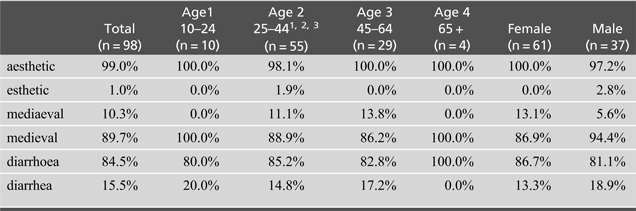
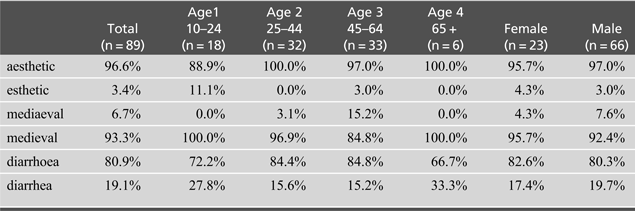
In order to examine the spelling of words with the classical digraphs ae/oe, three lexical items were included in the questionnaires: aesthetic/esthetic, mediaeval/medieval and diarrhoea/diarrhea. Fowler (Reference Fowler1926: 11) suggests that it would be desirable to use the simple e spelling for all the words that ‘have begun to waver between the double letter & the simple e’. In American English writing this dropping of the extra letter is common usage, while in British English the digraphic spelling is commonly retained. According to Australian English usage guides, the use of the simple e spellings is increasing for words with both ae and oe digraphs in Australian English (Murray-Smith, Reference Murray-Smith1987: 14, 229; Peters, Reference Peters1995: 24, 536). However, the position of the digraph influences the choice of the alternative spelling. Medieval, for example, is usually spelt with just e, but especially if the digraph (be it ae or oe) is at the beginning of a word, as in aesthetic, the digraphic spelling is still used in Australian English (Style Manual 2002: 83–84). This is confirmed by the present study for ae as Tables 1 and 2 show.
Classical digraphs and simple e spellings by age and gender in 2005

1 One male informant gave no answer for mediaeval.
2 One male informant gave no answer for aesthetic.
3 One female informant gave no answer for diarrhoea.
Classical digraphs and simple e spellings by age and gender in 2013
The digraphic spelling is the preferred variant for both aesthetic and diarrhoea, but with medieval the simple e spelling is clearly preferred in both surveys. However, according to the 2013 survey results, the use of the digraphic spellings has slightly decreased for all the lexemes under investigation. Although the differences between age groups are not great, the results especially from the later survey show that overall the younger informants are increasingly using the simple e spellings. The gender difference seems to be reversed, as in 2005 the female respondents reported use of the digraphic spellings more often than did males across the board – a tendency that was also noticed in the Langscape 1 survey (Peters, Reference Peters1998: 9) – whereas in 2013 it is the males that use more digraphic spellings for two of the lexemes aesthetic and mediaeval. However, the differences are not great here either.
3.2 Preservation of e before suffixes
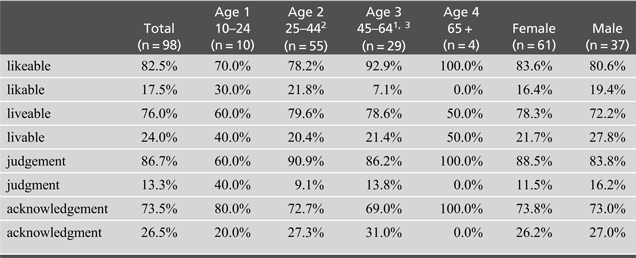
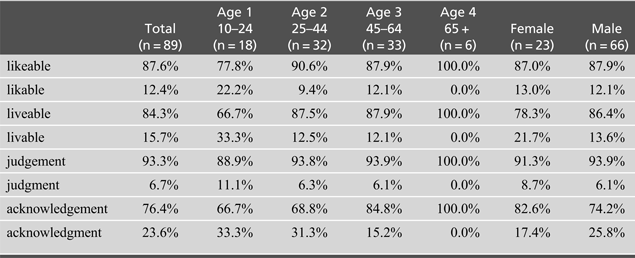
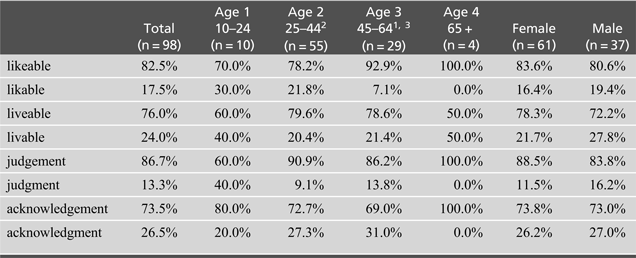
Fowler (Reference Fowler1926: 368) gives a general rule about the spelling of the mute e: ‘When a suffix is added to a word ending in mute e, the mute e is dropped before a vowel, but not before a consonant.’ Two lexical items representing both of these cases were included in the present study: likeable and liveable for the first and judgement and acknowledgement for the second. The Style Manual (2002) recommends the spellings without the extra e for the -able words, as this adds regularity. The e-less forms are also given priority with the suffix -ment in the Macquarie and the Australian Oxford dictionaries (Style Manual 2002). However, despite these recommendations, the forms with e are still in the majority, as Tables 3 and 4 show.
Use of e before suffixes by age and gender in 2005
1 One male informant gave no answer for likeable.
2 One male informant gave no answer for liveable.
3 One female informant gave no answer for liveable.
Use of e before suffixes by age and gender in 2013
The results of the two online questionnaires reveal that the e-forms are preferred for all the lexical items (as they were in the Langscape 1 survey [Peters, Reference Peters1998: 11]) and, in fact, the use of the e-forms has increased for both of the -able and -ment categories. This is in line with the second part of Fowler's general rule but against the recommendations of the Australian dictionaries. As for the different age groups in both surveys, the general tendency is for the younger generation to use more e-less spellings than do the older generations, although they too still clearly prefer the e-forms. This is contrary to the overall findings of the Langscape survey, in which it was the youngest respondents who showed the highest percentages of e-forms (Peters, Reference Peters2001: 12). Notably, however, the use of the e-forms has also increased among the youngest respondents from 2005 to 2013, with acknowledgement being the only exception in both surveys. The differences between genders are again not great as regards to their preferred spellings, but although the use of the e-forms has increased for both genders, it is the male respondents who are even more likely to use the e-forms in 2013 (acknowledgement being the only exception again). This is parallel to the results of the digraphic spellings, which also showed an increase in the use of the longer spellings for males.
5. Conclusion
In the light of this study the spellings with ‘the extra letter’ are still the preferred usage for the majority of Australians for the lexemes under investigation in two online surveys in 2005 and 2013. The one exception to this is medieval that is clearly more often used without ‘the extra letter’, while the digraphic spellings were still clearly preferred for the other two lexemes, aesthetic and diarrhoea. As for the preservation of the e-form before a suffix, the second part of the Fowler's general rule, i.e. that the e is retained before a consonant, is not only applied to suffixes beginning with a consonant (-ment) but also to those beginning with a vowel (-able) in present-day Australian English.
Changes from the Langscape 1 survey in 1998 are not great, and the overall results are very much in line with each other. However, some changes have occurred, with medieval presenting the clearest case of this. The use of the simple e spelling for medieval has significantly increased, from 57% in 1998 (Peters, Reference Peters1998: 10) to 90% in 2005 and 93% in 2013, and diarrhea seems to be moving in that direction as well with a change from 10% for diarrhea in 1998 (Peters, Reference Peters1998: 10) to 16% in 2005 and 19% in 2013. As for the other set of lexemes, this study showed an increase in the use of the e-forms between 2005 and 2013, which is in line with the overall results from the Langscape project. These results, then, indicate that ‘the extra letter’ is still going strong in present-day Australian English for these lexemes. Although the use of the forms with ‘the extra letter’ decreases with age in both surveys for most of the lexemes under investigation, the fact that there has been an increase in the use of the e-forms for the second set of lexemes among the youngest respondents from 2005 to 2013 does not support the hypothesis that Australian English is moving towards the simpler spellings that are considered to be more typical of AmE usage. Rather, it suggests that the e-forms are certainly not disappearing from the use of Australians in the near future.
Acknowledgements
The research reported here was supported by the Academy of Finland Centre of Excellence funding for the Research Unit for Variation, Contacts and Change in English at the Department of Modern Languages, University of Helsinki.
 MINNA KORHONEN is a doctoral student at the Department of Modern Languages at the University of Helsinki, Finland. Her research interests include Australian English, sociolinguistics, language variation and change and language attitudes. She is also interested in different data-collecting methods for sociolinguistic research. Her dissertation deals with sociolinguistic variation in present-day Australian English. Email: minna.k.korhonen@helsinki.fi