





1. Introduction
Jealousy and envy are emotions that pervade human experience and are expressed across countless languages. The present study focuses on the use of semantically related vocabulary in English. While contemporary English offers a rich repertoire of expressions for these emotions, their historical development, conceptual structuring and lexical diversity have received comparatively little systematic attention. This study addresses that gap by tracing the diachronic evolution of relevant vocabulary and by situating present‑day usage within a broader historical trajectory.
The Historical Thesaurus of the Oxford English Dictionary (henceforth HTOED) serves as the primary source for collecting and analysing jealousy‑ and envy‑related terms attested throughout the history of English. The present paper draws on a dataset of 95 lexical items and meanings retrieved from HTOED. The compilation of the Historical Thesaurus, initiated in 1964 at the University of Glasgow and incorporated into the OED in 2009, is based largely on OED data but reorganizes it semantically, grouping lexical items according to their meanings rather than alphabetically (Kay et al Reference Kay, Sylvester, Wotherspoon, Kay and Sylvester2001, 173). This semantic structuring makes it possible to identify lexical clusters, conceptual associations and historical patterns that remain obscured in dictionary‑based or intuition‑driven approaches.
HTOED arranges lexical entries chronologically within semantic fields, enabling researchers to trace the emergence, persistence and decline of particular expressions. Published in two volumes, the first contains the thesaurus itself, while the second provides an index of most entries. A searchable digital version is available via OED Online, linking each HTOED entry to the corresponding OED evidence. This integration allows for detailed exploration of etymology, semantic development and historical usage contexts. As Allan and Kay (Reference Allan, Kay, Kytö and Pahta2016, 222) observe, the combination of HTOED’s semantic organization with the OED’s documentary depth creates a uniquely powerful resource for historical lexical research, particularly when supplemented with corpus data that provide insights into usage patterns, frequency and register variation.
Most research on emotion concepts has focused on synchronic analysis, often within the framework of Conceptual Metaphor Theory. Scholars such as Kövecses (Reference Kövecses2000, Reference Kövecses2006, Reference Kövecses2010, Reference Kövecses2020) have examined conventionalized expressions (e.g. love lasts forever, I am crazy about you) and mapped metaphorical patterns across a wide range of emotions, including ‘anger’, ‘love’, ‘lust’, ‘happiness’, ‘pride’ and ‘shame’. While this work has been foundational, it typically relies on contemporary data and linguistic intuition, leaving the historical dimension underexplored. Moreover, methodological concerns have been raised about Conceptual Metaphor Theory’s dependence on introspection, its tendency to generalize across irregularities, and the limited empirical evidence on which many analyses rest (Kövecses Reference Kövecses, Handl and Schmid2011, 23; Fusaroli and Morgagni Reference Fusaroli, Morgagni, Fusaroli and Morgagni2013).
Only a small number of studies adopt a diachronic perspective. Geeraerts and Grondelaers (Reference Geeraerts, Grondelaers, Taylor and MacLaury1995) trace cultural and metaphorical traditions of ‘anger’ across centuries; Tissari (Reference Tissari2003) investigates changes in the conceptualization of ‘love’ from Early Modern to present‑day English, drawing on digital corpora and the then‑incomplete Historical Thesaurus; Geeraerts and Gevaert (Reference Geeraerts, Gevaert, Sharifian, Dirven, Yu and Niemeyer2008) analyse Old English ‘anger’ expressions; and Underhill (Reference Underhill2012) explores how socio‑political and cultural factors shape concepts such as ‘love’, ‘hate’, ‘war’ and ‘truth’ across European languages. These studies demonstrate the value of diachronic approaches but also highlight the scarcity of systematic, lexically grounded research on the historical development of emotion concepts. Notably, jealousy and envy – despite their cultural salience and moral complexity – have received even less diachronic attention than emotions such as ‘anger’ or ‘love’.
Responding to these gaps and methodological concerns, the present study adopts a systematic, thesaurus‑based methodology to investigate the concepts of ‘jealousy’ and ‘envy’. Its primary aim is to provide a historically grounded account of how these notions have been semantically represented over time – an aspect largely neglected in previous scholarship. Jealousy‑ and envy‑related terms were extracted from HTOED (winter 2025), and OED evidence was consulted to trace their origins, semantic developments and contextual usage. To connect these diachronic findings to present‑day English, the study also incorporates data from contemporary corpora, including balanced corpora of British and American usage (BNC, COCA) as well as corpora reflecting informal and conversational registers (Movie and TV Corpus, Soap Corpus, Spoken BNC 2014). This allows for an assessment of current frequency, distribution, collocational behaviour and semantic tendencies. This triangulated approach – HTOED, OED and modern corpora – offers a comprehensive perspective on both historical continuity and contemporary relevance.
2. Jealousy- and envy-related terms in HTOED
In HTOED, the semantic classification of jealousy‑ and envy‑related terms is arranged under the hierarchy ‘the mind > emotion > jealousy and envy’, with the mind as the major domain, encompassing words and senses relating to emotions, and jealousy and envy forming a distinct subdomain. As previously emphasized, the number of jealousy‑ and envy‑related terms amounts to 95 lexical items. The material is subdivided into general terms (Table 1), jealousy‑related vocabulary (Table 2) and envy‑related vocabulary (Table 3). This subdivision is not provided by HTOED itself but was established for the purposes of the present analysis. The categories were defined on semantic grounds, drawing on the meanings and pragmatic–contextual uses of the lexical items as evidenced in the OED quotations and in corpora of modern English. These categories will be discussed in turn, beginning with the general terms that capture ‘jealousy’ or ‘envy’ in a broad, non‑differentiated sense.
General terms related to jealousy or envy

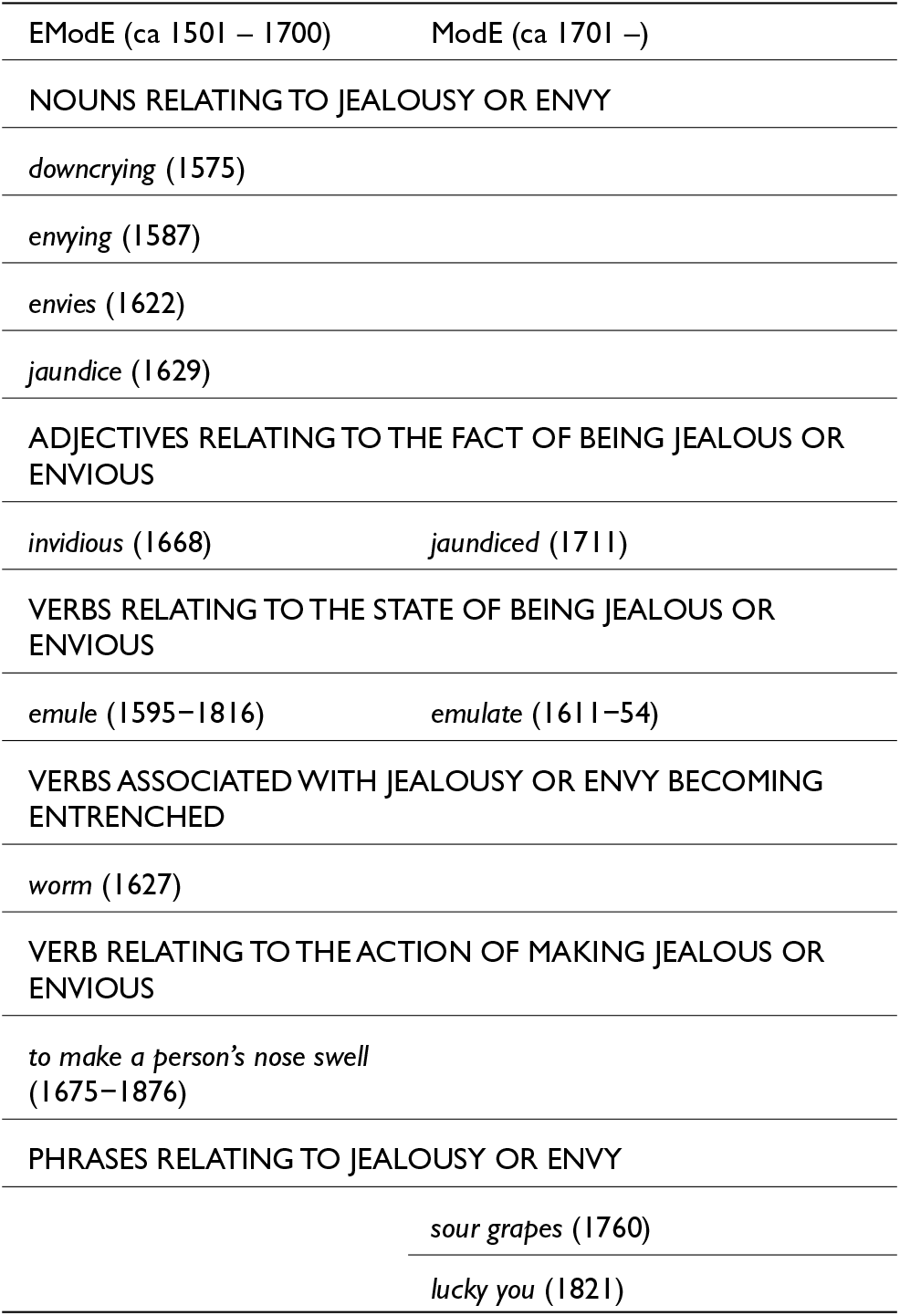
Table 1 Long description
The table lists words and phrases connected to jealousy or envy, grouped by part of speech and split between Early Modern English and later Modern English. In the noun category, Early Modern English includes downcrying, envying, envies, and jaundice, while the later period shows no noun entries. For adjectives, Early Modern English has invidious, and the later period adds jaundiced. For verbs describing the state, emule appears in Early Modern English and emulate appears in the later period, with overlapping date ranges indicating both forms were used across time. Early Modern English also includes worm as a verb linked to jealousy or envy becoming entrenched, and the phrase “to make a person’s nose swell” for causing jealousy or envy; neither has a later-period counterpart listed. In phrases, only the later period contributes entries, adding sour grapes and lucky you. Dates in parentheses indicate attested usage spans, and blanks likely reflect no examples recorded in this dataset rather than proof the terms were never used.
Jealousy

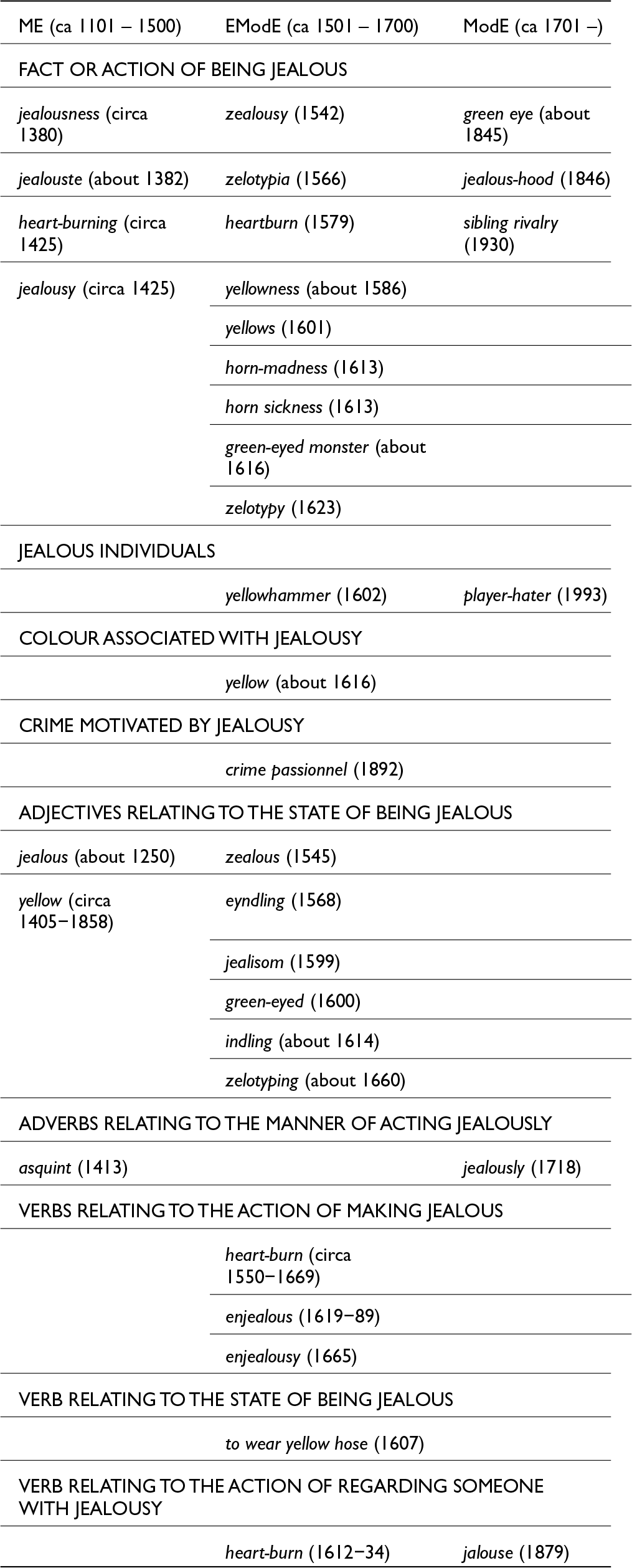
Table 2 Long description
The table lists English words and phrases connected to jealousy, grouped by meaning (such as the feeling, jealous people, related colors, crimes, and parts of speech) and arranged across Middle English, Early Modern English, and Modern English with approximate first dates. For the core sense “being jealous,” Middle English includes early forms like “jealousness,” “jealouste,” “heart-burning,” and “jealousy,” while Early Modern English adds variants such as “zealousy,” “zelotypia,” “heartburn,” and several figurative expressions. Early Modern English shows a strong cluster of imagery linking jealousy to yellow and to “horn” motifs, including “yellowness,” “yellows,” “horn-madness,” “horn sickness,” and “green-eyed monster,” alongside “green-eyed.” Modern English introduces later figurative and social terms, including “green eye,” “jealous-hood,” “sibling rivalry,” and the slang label “player-hater.” Adjectives appear earliest with “jealous” in Middle English, then broaden in Early Modern English with forms like “zealous,” “jealisom,” and “zelotyping,” while the adverb “jealously” is recorded in Modern English. Verb forms are mainly Early Modern English (for example “heart-burn,” “enjealous,” and “to wear yellow hose”), with a later Modern English verb “jalouse.” Dates are approximate and the table is selective, so it indicates attested vocabulary and shifts in imagery rather than complete usage frequency.
Envy

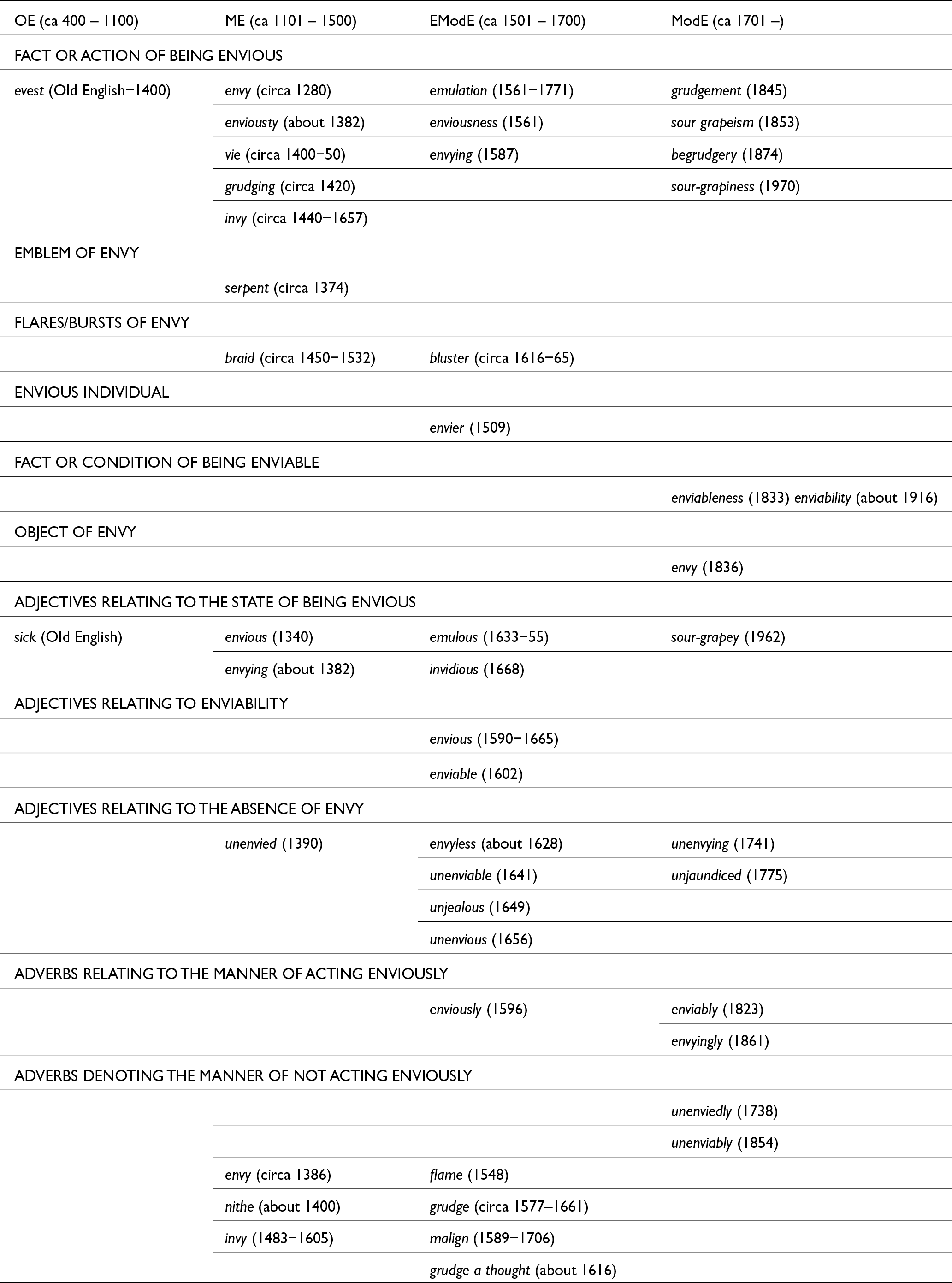
Table 3 Long description
The table lists English words related to envy, grouped by meaning (such as being envious, an envious person, or absence of envy) and arranged across four historical periods from Old English to Modern English. For the core sense “fact or action of being envious,” Old English includes “evest,” while Middle English introduces “envy” around 1280 and later forms like “enviousty,” “vie,” “grudging,” and “invy.” Early Modern English adds alternatives and near-synonyms such as “emulation,” “enviousness,” and “envying,” and Modern English contributes newer coinages including “grudgement,” “sour grapeism,” “begrudgery,” and “sour‑grapiness.” A few categories are sparse: the “emblem of envy” appears only as “serpent” in Middle English, and “envious individual” is represented by “envier” in Early Modern English. Terms for being enviable appear mainly in Modern English, including “enviableness” and “enviability,” and “envy” is also listed as an “object of envy” in Modern English. Adjectives show a shift from Old English “sick” and early “envying” to Middle English “envious,” Early Modern “emulous” and “invidious,” and later slang-like “sour‑grapey.” Words marking absence of envy and adverb forms are mostly later, with items like “unenvied,” “envyless,” “unenvying,” “enviously,” “enviably,” and “unenviedly.” Some entries include approximate dates and ranges, and a few cells are blank, so the table indicates attested examples rather than a complete inventory for each period.
2.1 General terms related to jealousy or envy
As shown in Table 1, HTOED includes 12 general terms related to ‘jealousy’ or ‘envy’ that are not assigned to a specific subcategory. They were first attested in HTOED in Early Modern and Modern English. The dates listed after the lexical entries in the tables indicate the earliest recorded uses as documented in the OED.
The lexical items listed in Table 1 include four nouns ‑ downcrying, envying, envies and jaundice ‑ and two adjectives, invidious and jaundiced. They relate to broader attitudes of disparagement, resentment, or hostile comparison. These items are grouped together because, in the senses recorded in the OED, they do not denote jealousy or envy as discrete emotions but rather broader evaluative attitudes associated with them, such as disparagement, resentment, or hostile comparison. For example, downcrying denotes the act of ‘belittling a person or thing’ (OED), while envies refers to ‘[i]nstances of envy; envious feelings, jealousies; rivalries’ (OED), capturing the competitive or resentful stance that may accompany envy. Another illustrative case is jaundice, a term originally borrowed from French as early as 1303 to denote ‘[a] morbid condition caused by obstruction of the bile, and characterized by yellowness of the conjunctiva, skin, fluids, and tissues, and by constipation, loss of appetite, and weakness’ (OED). Over time, the word also developed a range of transferred meanings, alluding ‘to the colour and reputed yellow or disordered vision of jaundiced persons’ (OED). The adjective invidious, meaning ‘envious, grudging, [or] jealous’ (OED), has become rare in modern English.
Two verbs relate to the state or being jealous or envious: emule and emulate, the latter used transitively in the sense ‘to desire to rival’ (OED) and, by extension, ‘to be jealous of, envy, or feel a grudge against’ (OED). Under ‘become embedded (of jealousy or envy)’, the verb worm is listed, used figuratively of jealousy or envy insinuating itself into a person’s mind or affairs. HTOED also records one expression under ‘make one jealous or envious’: to make a person’s nose swell, an obsolete idiom. Finally, HTOED has two phrases expressing jealousy or envy: sour grapes, drawing on the fable‑derived metaphor of dismissing something as undesirable when it cannot be attained, and lucky you, an acknowledgement of another’s good fortune often tinged with envy, with lucky me functioning as its ironic counterpart (see OED).
A comparison with corpora of modern usage shows that the OED‑listed senses of these items are not uniformly preserved. The older, rivalry‑based meanings of emulate and the figurative use of worm (‘to insinuate itself’, of jealousy or envy, see OED) are only marginally or no longer attested in contemporary corpora, whereas the evaluative and affective uses of envy, jealousy, and the idiomatic expressions sour grapes, lucky you and lucky me remain well represented. The corpus evidence is provided below.
Invidious and jaundiced remain current but have shifted towards evaluative, often academic or journalistic registers, typically describing attitudes rather than emotions (e.g. ‘an invidious comparison’ (cf. ‘Biblical Passages About VP Debate ‑ Blogcritics Politics’, 2012, COCA); ‘a jaundiced view’ (cf. Richmond, E. [1993]: Love of My Heart, BNC)).
Emulate has largely lost its older sense of rivalry or envy and now denotes positive imitation, while envy and jealousy themselves have become the dominant, general‑purpose terms for the affective domain. This development is reflected in contemporary usage, as illustrated in the following examples:
(1) ‘Teaching is as much art as it is science [ . . . ] There is no one, easy way to teach all kids. There is no system that will work for all students and can be easily emulated by all teachers.’ (‘A Superwoman for Kenya, but America – Blogs – Chicago Sun‑Times’, 2012, COCA)
(2) ‘I let envy and jealousy get the best of me, but . . . I learned my lesson.’ (‘90210, Blue Naomi’, 2011, TV Corpus)
(3) ‘I think this is just jealousy (.) of my years and years and years of success (.)’ (Spoken BNC 2014)
Expressions such as sour grapes and lucky you remain productive, though the latter has developed a wider pragmatic range, often functioning as a lightly ironic or playful remark rather than a marker of genuine envy. This is illustrated in the following example:
(4) ‘My father had often urged me to try some of his marijuana, but I had never accepted, just as I had refused even to look at the cocaine that he kept in his dressing room.’ ‘Lucky you,’ the senator said ruefully.’ (Cornwell, B. [1990]: Crackdown, BNC)
2.2 Jealousy-related terms
In addition, HTOED comprises 36 terms for jealousy, attested across Middle, Early Modern and Modern English.
HTOED comprises 16 nouns related to ‘jealousy’, ranging from jealousness, heart‑burning and yellowness, to horn sickness, green‑eyed monster and sibling rivalry. Among these, heart‑burning stands out as a metaphorical expression, used to denote ‘[a]n angry and embittered state of mind, felt but not openly expressed; rankling jealousy, resentment, or discontent’ (OED). Yellowness again reflects the colour traditionally associated with jealousy, long regarded as indicative of bodily disease or poor health, and subsequently transferred to the emotional domain. The term has fallen out of use in contemporary English (see OED). Horn‑sickness may be classified as a slightly humorous term for metaphorical condition, employing the conceptual frame of bodily disorder to characterize an emotional disturbance. Rather than denoting an actual illness, it figuratively encodes jealousy as a destabilizing or afflictive state (see OED). According to OED, it has also become obsolete. Green‑eyed monster is a widely established metaphorical expression that entered broader English usage through Shakespeare’s Othello, where it functions as a synonym for jealousy; see:

Sibling rivalry is a comparatively recent jealousy‑related term, denoting ‘[r]ivalry arising from jealousy between siblings; an instance or example of this’ (OED). The expression has been attested in English since 1930 (see OED).
Two nouns referring to jealous individuals are yellowhammer and player‑hater. Of these, yellowhammer originally denoted a species of bird characterized by its yellow plumage, and was later extended as a slang term for ‘[a] jealous husband’ (OED). This figurative use has since fallen out of modern English (see OED). Player‑hater, originating in African‑American slang and denoting ‘[a] person who is jealous of the success of others’ (OED), is the most recent jealousy‑related term in the present dataset. According to OED, it has been attested since 1993. Further jealousy‑related subfields include yellow as a colour associated with jealousy, and with crime passionnel, a French‑derived term denoting a crime motivated by jealousy, as in:

HTOED records eight adjectives synonymous with ‘jealous’, ranging from early formations such as jealous itself to colour‑based or figurative extensions like yellow and green‑eyed, the latter popularized by Shakespeare (see OED). Historical variants such as indling and zelotyping further illustrate the nuances in the lexical expression of jealousy.
HTOED also records two adverbs relating to the manner of acting jealously. The earlier term, asquint (1413), is used of ‘various mental attitudes, of which averted, oblique, sidelong, or furtive glances’ (OED). The later form jealously (1718) refers to actions characterized by jealousy in its modern senses, notably ‘watchful care for preservation; with apprehension of rivalry, or (esp[ecially]) of loss or damage’(OED).
There are also verbs relating to the action of making someone jealous, such as such as heart‑burn in its causative sense ‘to make jealous, envious, or resentful’ (OED), and enjealousy, ‘to plunge into or provoke to jealousy’ (OED). One verb is related to the state of being jealous: to wear yellow hose (also attested in variant forms such as to wear yellow shoes) is an allusive idiom drawing on yellow as the colour traditionally associated with jealousy. Examples from OED are:


Two verbs further denote acts of regarding someone with jealousy. These include heart‑burn, meaning ‘to regard or treat with jealous hatred’ (OED), and jalouse, used to mean ‘to regard with jealousy’ (OED) or, in a related sense (1881), ‘to begrudge jealously’ (OED).
In corpora of present‑day English, only a small subset of these jealousy‑related nouns and expressions remains in active use, while many of the historically attested items have become obsolete or survive only as literary or humorous archaisms. Green‑eyed monster continues to function as a recognizable, though stylistically marked, allusion to Shakespeare, typically appearing in playful, literary, or self‑consciously dramatic contexts, as in:
(9) ‘What? Wow, you’re jealous. Not jealous. Cora, the green‑eyed monster.’ (Alleluia! The Devil’s Carnival [2016], Movie Corpus)
Sibling rivalry has developed into a fully conventionalized psychological and sociological term and is now one of the most productive jealousy‑related nouns in this semantic field, as in:
(10) ‘Tammy: Really? I thought you had a one‑sided sibling rivalry with Richard since birth.’ (Guiding Light [2003], Soap Corpus)
(11) ‘Get it? Let me try. Uh, snookums, I used to have sibling rivalry with the kids in my foster homes, okay?’ (Shameless [2019], COCA)
By contrast, items such as heart‑burning, yellowness, horn sickness, and yellowhammer have almost disappeared from modern usage, as reflected in the corpora studied, their metaphorical mappings no longer transparent to contemporary speakers. More recent formations like player‑hater retain currency primarily in colloquial, culturally specific registers and have undergone semantic broadening, often referring to general negativity or antagonism rather than jealousy alone. Examples include:
(12) ‘Sir. Sir. Can you please . . . ? What a player‑hater. You’re hating on me, buddy.’ (The Even Stevens Movie [2003], COCA)
(13) ‘What’s that? – You’re a player‑hater. What, you think I’m jealous?.’ (Fastlane [2003], TV Corpus)
Colour‑based expressions such as green‑eyed remain familiar but are largely restricted to fixed phrases, most often in the aforementioned expression green‑eyed monster, while yellow as an index of jealousy seems to have lost its earlier symbolic force, according to the contextual usages revealed by the corpora under analysis. French‑derived crime passionnel persists in legal, journalistic and literary discourse, though typically as a marked, foreignizing expression.
(14) ‘She may have been killed earlier in the evening. Judging by her clothing. I believe she’s from a good family. Her murder would seem to be a misadventure of a crime passionnel.’ (Shields, J. [2001]: The Fig Eater: A Novel, COCA)
Overall, in the corpora consulted, the modern lexicon of jealousy is dominated by the core terms jealousy, jealous, envy and envious, with most historical variants either obsolete or confined to highly specific stylistic niches.
2.3 Envy-related terms
Furthermore, HTOED comprises 47 terms for envy, attested across Old, Middle, Early Modern and Modern English.
The envy‑related vocabulary in HTOED displays a particularly rich interplay of metaphor, emotion and social evaluation. HTOED records a number of synonyms and near‑synonyms of ‘envy’, ranging from evest, enviousty and grudging to emulation and sour‑grapiness. Of these, evest and enviousty have become disused in present‑day English (see OED). According to OED, grudging originally denoted ‘murmuring, grumbling, complaint’ before it developed its transferred meanings of ‘reluctant or unwilling action’ and ‘the cherishing of ill‑will, resentment, or envy’. Several further nouns belong to additional envy‑related subfields. Examples include braid and bluster, both obsolete terms referring to flares or bursts of envy, as well as the metaphorical animal term serpent, used as ‘a symbol of envy, jealousy, malice, or wiliness’ (OED). One noun, envier, denotes an ‘envious individual’, while enviableness and enviability represent the subcategory ‘fact or condition of being enviable’. The noun envy has also been attested in OED since 1836 in the sense ‘object of envy’:

HTOED also documents several adjectives relating to the state of being envious, beginning with sick (Old English, used of strong emotions including envy) and envious (1340). Early derivatives such as envying (about 1382) and later formations like emulous (1633–55), invidious (1668) and sour‑grapey (1962) illustrate the breadth of envy‑related description. Additional subcategories include adjectives relating to enviability, notably envious and enviable. Several negated forms, including envyless, unjealous, unenvious and unenvying, relate to the absence of envy. A small set of adverbs is also recorded with the meaning ‘enviously’: enviously itself, as well as, enviably and envyingly. Two additional adverbs express the absence of envy: unenviedly and unenviably.
HTOED further lists several verbs under the subfield ‘be envious’. One of the earliest, nithe (about 1400), denotes the intransitive act of feeling envy (see OED). Later figurative uses such as flame (1548) describe a person as burning with envy. The verb grudge (circa 1577–1661) appears both transitively (‘to envy someone’) and intransitively (‘to be envious’) (OED), with the related obsolete expression to grudge a thought (about 1616) meaning ‘to think an envious thought’ (OED), as in:

The verb envy (circa 1386) is used transitively in the sense ‘to feel displeasure or ill will at another person’s happiness’ (OED), a usage continued by its later variant invy (1483–1605). The obsolete verb malign (1589–1706) likewise appears transitively, meaning ‘[t]o regard with envy’ or ‘to begrudge’ (OED), offering an additional lexical option for expressing envious hostility. Taken together, these verbs illustrate how envy is conceptualized both as an internal emotional process and as an outwardly directed evaluative stance.
In the corpora consulted, only a small proportion of the historically attested envy‑related vocabulary remains productive, while many earlier formations survive, if at all, as literary archaisms or opaque lexical relics. The core noun envy continues to dominate modern usage, both in its abstract sense (‘the feeling of envy’) and in its extended sense ‘object of envy’, which remains attested in contemporary corpora in evaluative or hyperbolic contexts, as in:
(17) ‘All the regulations in the world do not stop the person who has a criminal mentality. And you would be a criminal if you intend to poison your neighbor. Free enterprise, by non‑criminal minds, has gotten us to where we are the envy of the World, as they keep coming and coming, legally and otherwise. And I know criminals are everywhere.’ (‘Why Are We Going Broke?’ [Blog, 2012], COCA)
(18) ‘Since its debut this year, Study the Great Nation has become the most downloaded app on Apple’s digital storefront in China, with the state news media saying it has more than 100 million registered users ‑ a reach that would be the envy of any new app’s creators.’ (‘In China, an App About Xi Is Literally Becoming Impossible to Ignore’ [The New York Times, 2019], COCA)
By contrast, earlier synonyms such as evest, enviousty, invy, grudging (in its older sense) and emulation (in its now‑obsolete meaning ‘envy’) have disappeared from present‑day usage, with no attestations in the sources consulted beyond historical quotations or metalinguistic commentary. Similarly, metaphorical or figurative nouns such as braid, bluster (in the sense ‘burst of envy’) and serpent as an emblem of envy no longer appear with their earlier envy‑related meanings.
Adjectival formations show a comparable pattern. The core adjective envious remains the primary descriptor of the emotional state, while historically attested variants such as envying, emulous, invidious (in its older sense ‘full of envy’, see OED) and sour grapey are either obsolete or restricted to highly marked stylistic niches (see OED). Negated forms such as unenvious and unenviable persist, though with meanings that have shifted towards general evaluation rather than literal absence of envy; unenviable, for instance, is now predominantly used to describe an undesirable situation rather than a person free of envy, as in:
(19) ‘Yet, Helena did initially try to escape her unenviable secret‑mistress destiny, for we all know only too well how those sad concubines fare once their looks fade and their daddies grow bored: they build you some flimsy mud hut in a faraway suburb or, worse still, on some hill in a far flung neighborhood where you go to seed, wracked, wrecked, and bitter, your wretched bastards crawling in the dust;’ (‘Beautiful Helena’s Misfortune’ [New England Review, 2018], COCA)
Adverbial forms likewise show strong lexical concentration: enviously remains current, whereas envyingly, enviably, unenviedly and unenviably occur only sporadically and typically in formulaic or evaluative constructions. Examples are:
(20) ‘Jake had a small boat, with inboard engine, and he would take us all out fishing below the sheer red, ragged Berwickshire cliffs. I was always allowed, at some stage of the adventure, to steer the boat; clinging to the rudder handle in an agony of excitement. Jake also had a share in a larger, sea‑going vessel, which we used to visit in the harbour, examining enviously the neat bunks and tiny galley.’ (Sandison, B. [1990]: Tales of the Loch, BNC)
(21) ‘Do I look young? Impossibly, enviably young?’ (The Carrie Diaries [2013], TV Corpus)
(22) ‘I get up at sunrise and go down to the dock to check out the fauna‑the parrotfish, the snappers, maybe a barracuda or, most recently, a fair‑sized octopus. […] In the evening, after watching the sun set, I have my white wine and grill some local grouper or mahi‑mahi. All this may sound unenviably solitary, but do not imagine that I am alone.’ (‘Keeping Company’ [Smithsonian, 2018], COCA)
The verbal domain is even more restricted. Historically attested verbs such as nithe, flame (‘burn with envy’, see OED), malign (‘to regard with envy’, see OED) and grudge a thought appear to have disappeared entirely from contemporary corpora. The verb envy remains the only productive lexical verb denoting the act of feeling envy, while grudge has undergone semantic narrowing and now primarily expresses resentment rather than envy, as in:
(23) ‘I envy people who can just go travelling’ (Spoken BNC 2014)
(24) ‘I’ve seen Hearts players in trouble for like (.) going to Nando’s for tea (.) you know? they went out for dinner oh you got beat at the weekend you should be training (.) you don’t grudge a guy having his dinner you know?’ (Spoken BNC 2014)
Overall, the contemporary lexicon of envy is characterized by a high degree of lexical concentration around the core items envy, envious, envy (verb) and enviously, with most historical variants either obsolete or semantically reanalysed. This pattern contrasts with the diachronic richness documented in HTOED and underscores the extent to which the modern expression of envy relies on a small, semantically stable set of lexical items.
3. Conclusion
Overall, the 95 jealousy‑ and envy‑related terms documented in HTOED illustrate the remarkable semantic breadth and diachronic depth with which English has conceptualized these two closely connected emotions. The taxonomy reveals not only the structural distinction between jealousy and envy, but also the considerable overlap in their metaphorical, physiological and evaluative framing. Across nouns, verbs, adjectives and adverbs, the lexicon draws on colour symbolism, bodily affliction, interpersonal rivalry and moral judgement, as well as on figurative extensions involving animals, heat, vision and insinuation. Many of the terms – particularly those rooted in humour, bodily disorder, or colour imagery – have fallen out of use, yet they preserve earlier cultural models of emotional experience that shaped English conceptualizations for centuries. At the same time, more recent formations such as player hater, sibling rivalry or sour‑grapiness demonstrate the continued productivity of the field and its responsiveness to social change.
When viewed from the perspective of present‑day English, however, the historical richness of the jealousy‑ and envy‑related lexicon stands in striking contrast to the comparatively narrow set of forms that remain active today. Contemporary corpora show a strong concentration around a small number of core items – jealousy, jealous, envy, envious and the verb envy – while most earlier synonyms, metaphorical extensions and expressive variants have either disappeared or survive only as literary allusions, humorous archaisms or culturally marked expressions. Colour‑based terms such as green‑eyed persist primarily in fixed phrases, while yellow‑based jealousy metaphors have lost their symbolic force. Likewise, historically attested envy‑verbs such as nithe, malign or flame have vanished from modern usage, and even semantically flexible items like grudge have undergone narrowing, shifting away from envy toward general resentment. Only a few later innovations, such as sibling rivalry or player hater, retain currency, and even these are restricted to specific registers or discourse communities.
Taken together, the HTOED data and the contemporary corpus evidence show that jealousy and envy have long been encoded through a dynamic interplay of metaphor, social evaluation and embodied experience, but that present‑day English relies on a far more streamlined lexical repertoire. The historical record thus offers a nuanced account of how English speakers have understood, negotiated and expressed these emotions over time, while modern usage reflects a process of lexical consolidation in which only the most semantically transparent and communicatively efficient forms have endured.

JULIA LANDMANN is an English linguist whose research focuses on lexical dynamics, language contact and socio‑cognitive mechanisms of linguistic change. She is Acting Professor of English Linguistics at the University of Hildesheim, following previous acting professorships at the Universities of Greifswald and Heidelberg and a lectureship at the University of Basel. She completed her Habilitation at Heidelberg in 2022 with the project The Dynamic Lexicon of English: A Socio‑Cognitive Perspective, building on a PhD on French borrowings in 20th‑century English. Her work examines how lexical innovation, borrowing, phraseology and word‑formation emerge from usage, conceptualization and discourse, complemented by expertise in semantics, discourse analysis and language‑emotion interfaces. Email: Julia_Landmann@web.de

 Open access

