Introduction
Bilingual code ambiguation (CA), also known as language play or punning, has been discussed for bilingual creativity as it requires English users to manipulate two languages in a single utterance (Moody & Matsumoto, Reference Moody and Matsumoto2003). Since Moody and Matsumoto (Reference Moody and Matsumoto2003) suggested English–Japanese CA in the lyrics of Japanese popular (J-pop) music, some studies have paid attention to diverse aspects of bilingual creativity performed in this complex linguistic phenomenon (Luk, Reference Luk2013; Rivlina, Reference Rivlina2015; Scherling, Reference Scherling2016). They have reported non-native English users’ control over linguistic knowledge in phonological analogy (Moody & Matsumoto, Reference Moody and Matsumoto2003; Scherling, Reference Scherling2016), semantic relatedness and blending (Luk, Reference Luk2013; Moody & Matsumoto, Reference Moody and Matsumoto2003), and socio-pragmatic functions (Luk, Reference Luk2013; Rivlina, Reference Rivlina2015). They have further suggested that CA needs to be viewed as bilinguals’ performative use of English and a local language to achieve symbolic goals (Moody & Matsumoto, Reference Moody and Matsumoto2003; Scherling, Reference Scherling2016).
Although bilingual creativity in language mixing has been central to the discussion of English use from a pluralistic perspective, CA has hitherto received scant attention as a main topic from sociolinguists. To date, CA with English has been studied only in a few language environments, such as Japanese, Russian, and Chinese (Luk, Reference Luk2013; Moody & Matsumoto, Reference Moody and Matsumoto2003; Rivlina, Reference Rivlina2015; Scherling, Reference Scherling2016). Thus, the study aims to explore the phenomenon of bilingual CA in the English–Korean context and to provide its descriptive typology. English–Korean CA data were collected from five domains, including television programs, Korean popular music (K-pop), web commercials, social media, and Internet websites, drawing on an incidental sampling method as suggested in Luk (Reference Luk2013). In fact, the nature of data collection of this phenomenon is incidental, emerging, and descriptive, as this innovative language play is difficult to capture (Luk, Reference Luk2013; Rivlina, Reference Rivlina2015). To provide descriptive information about English–Korean CA, sample data that are considered to best show CA phenomena were selected from the five domains using convenient sampling (Luk, Reference Luk2013; Rivlina, Reference Rivlina2015). For data analysis, the study synthesized the previous methods with English–Korean CA examples, including phonological matching, semantic relationship and conceptual blending, and socio-pragmatic functions. The author acknowledges the subjectivity and tentativeness in analyzing and interpreting the language samples in the study as code ambiguities are inherently ambiguous and polysemous (Luk, Reference Luk2013; Moody & Matsumoto, Reference Moody and Matsumoto2003).
Bilingual creativity in code ambiguation
Bilingual CA, compared to code-switching and language borrowing, is relatively new to scholars who study bilingual creativity, particularly in the Expanding Circle where English is widely used to create innovative language hybridizations in diverse domains such as advertisings, popular music, and television programs (Lee, Reference Lee, Bolton, Botha and Kirkpatrick2020; Luk, Reference Luk2013; Moody, Reference Moody and Tam2009; Moody & Matsumoto, Reference Moody and Matsumoto2003; Rivlina, Reference Rivlina2015). The term ‘code ambiguation’ is used to describe English–Japanese code-mixing phenomena in J-pop by Moody and Matsumoto (Reference Moody and Matsumoto2003: 5) as it emphasizes bilingual English users’ purposeful manipulation of two languages for ambiguous sound codes ‘to produce messages in both languages.’ Thus, non-native English speakers’ control over the linguistic knowledge in CA displays their bilingual creativity when English is used as a source of verbal repertoires in a local language environment (Luk, Reference Luk2013; Scherling, Reference Scherling2016). This advanced level of language control seems to be relevant to social acquisition of English by general members of a speech community although the conclusive argument should be reserved until further studies are conducted for its generalization (Lee & Choe, Reference Lee and Choe2021; Luk, Reference Luk2013; Rivlina, Reference Rivlina2015).
Acoustic link: bi-directional language change
Phonetic similarity provides a basis for bilingual CA as it constructs an acoustic link between two lexical items for dual messages (Knospe, Reference Knospe, Virker and Winter–Froemel2019; Moody & Matsumoto, Reference Moody and Matsumoto2003; Scherling, Reference Scherling2016). Given that the phonological systems of English and a local language are different, this acoustic aspect of CA involves bi-directional sound assimilation of the two linguistic items for bilingual puns: Englishization of a local language (Moody & Matsumoto, Reference Moody and Matsumoto2003; Rivlina, Reference Rivlina2015) and nativization of English (Luk, Reference Luk2013; Scherling, Reference Scherling2016). Englishization refers to language change in a local language under the effect of English spread and contact while nativization is the process in which English gains features of the local language through language transfer (Ahn, Reference Ahn2018; Moody, Reference Moody and Tam2009; Lee & Choe, Reference Lee and Choe2021). The two ways of language change serve as a foundation for two linguistic items to obtain phonological similarities in CA practices (Moody & Matsumoto, Reference Moody and Matsumoto2003; Rivlina, Reference Rivlina2015).
Englishization of Japanese lexical items observed in J-pop lyrics shows song writers’ awareness of sounds in the two languages and their purposeful endeavor to make Japanese words sound like English for CA effect (Moody & Matsumoto, Reference Moody and Matsumoto2003). For example, Moody and Matsumoto (Reference Moody and Matsumoto2003: 24) observed that a Japanese word ‘kurai’ (/kuɾai/: like, from ‘I miss you’) is Englishized to sound like the English word ‘cry’ [krai] through /ɯ / deletion and substitution of a flap /ɾ/ with retroflexed [r]. Such a process of Englishization allows the Japanese word to obtain phonological features of English, thereby intriguing CA between the two lexical items. Nativization of English words is widely found in advertisements, the linguistic landscape, and mass media (Luk, Reference Luk2013; Scherling, Reference Scherling2016), as bilingual CA is made possible by phonemic matches of nativized English and a local language (Rivlina, Reference Rivlina2015; Scherling, Reference Scherling2016). Through this process is English meant to sound like a local language for the effect of CA (Rivlina, Reference Rivlina2015). A notable example reported by Sherling (Reference Scherling2016: 285) is found in the Japanization of an English word ‘smoking’ into ‘sumo-kingu’ (the king of the Japanese sport) when it is integrated into the Japanese phonological system to gain an acoustic similarity with the Japanese compound word.
Semantic relatedness and conceptual blending
The acoustic connection between two language codes does not necessarily create semantically meaningful messages in both languages (Luk, Reference Luk2013; Moody & Matsumoto, Reference Moody and Matsumoto2003). Moody and Matsumoto (Reference Moody and Matsumoto2003: 14) reported that some CA cases in J-pop demonstrate dual meanings in English and Japanese as in ‘I Tender’ (from ‘Attoiuma-no Yume-no TONIGHT’) that is ambiguated with Japanese ‘aishitenda’ (I love you). This expression is meaningful in both English and Japanese, and two available meanings are connected, sharing ‘love’ as their main topic. On the other hand, some cases do not display semantic relations between English and Japanese messages. In ‘yuumei na Be with me’ (from ‘Yuugata Hold On Me’), Japanese ‘yuumei na’ (famous) may be read as English ‘you may not’ but they do not entail any semantic relation (Moody & Matsumoto, Reference Moody and Matsumoto2003: 15). Finally, the last category represents other CA cases that include no meaning in one language as in part of J-pop lyrics ‘sennen’ (1000 years: from ‘Hallelujah, Burning Love’). This expression is meant to sound like ‘saint name’ and it does not deliver any meaningful message in English (Moody & Matsumoto, Reference Moody and Matsumoto2003: 10).
In the Hong Kong context, drawing on Sebba's (Reference Sebba2013) approach to textual analysis of multilingual content, Luk (Reference Luk2013: 244) suggested three semantic features of English-Cantonese language play: parallel relationship for semantic matching, complementary relationship for two codes completing a message, and disjoint relationship for codes that are semantically unrelated. For example, ‘起錨’ (/hei naau/: act now) shares its meaning with English ‘act now’ through semantic matching in bilingual punning. ‘飯tastic’ (/fan/: rice, fantastic) is given as an example of the complementary relationship in which Cantonese ‘fan’ contributes a meaning of rice to English ‘fantastic’, promoting the fantastic taste of hamburger topped with rice. ‘牛柏葉’ (/ngau paak jip/: Albert Yip, Ox Stomach) demonstrates the disjoint relationship between Cantonese and English. While ‘牛柏葉’, a kind of Chinese dim sum, sounds like English ‘Albert Yip,’ they do not display any semantic connection. In the first two types, two language codes cooperate in constructing the target message in a single utterance (Luk, Reference Luk2013; Moody & Matsumoto, Reference Moody and Matsumoto2003; Scherling, Reference Scherling2016). In comparison, a disjoint relationship is appropriated for decorative effects based on phonetic similarities rather than on complementary meanings (Moody, Reference Moody and Tam2009; Rivlina, Reference Rivlina2015).
In response to Moody and Matsumoto's (Reference Moody and Matsumoto2003) call for research on the linguistic mechanism by which two language codes are semantically combined for dual messages, Knospe (Reference Knospe, Virker and Winter–Froemel2019) proposed a cognitive model for a semantic blending of English–German puns, drawing on the conceptual blending theory by Fauconnier and Turner (Reference Fauconnier and Turner2002). The model is composed of three spaces and one context where the meanings of two language codes are blended into a single utterance. First, generic space refers to abstract relations between the two codes, such as time, space, property, or object. Generic space provides general features shared by the two linguistic codes in our mental spaces (Fauconnier & Turner, Reference Fauconnier and Turner2002). Input space is the area that encompasses the two linguistic codes with different concepts: two distinct and specific features of the codes are offered in input space. Blended space is where the two concepts from the input spaces are blended as long as the blending takes place within the generic space. Put differently, the blending of the two meanings in input space is possible in the blended space only when it is connected to the abstract concept in the generic space (Fauconnier & Turner, Reference Fauconnier and Turner2002). Finally, the context provides the situation and environment that activates the input spaces to be transferred to the blended space. For example, Weil sie den Tower haben (because they have Tower) shows that London does not have heavy snow because the city has ‘Tower’ to protect it (Input Space 1) and the tower has a function of melting snow (input space 2). The two input items that share properties of object and location in generic space are transferred to the intended message in blended space. Diamorphs, associate links between the two concepts, are ‘interlingual homophones or homographs’ that connect the two codes in sounds and forms (Knospe, Reference Knospe, Virker and Winter–Froemel2019: 172). This analogical network stimulates a bilingual mind to conceptually blend two codes for a message in a given context.
Socio-pragmatic functions
CA has socio-pragmatic functions ‘to construct a double-voiced discourse for intra-societal communication’ (Luk, Reference Luk2013: 237). Three types of socio-pragmatic uses were identified by Luk (Reference Luk2013): functional use, critical use, and psychological use. Functional use is relevant to the purpose of publicity, promotion and memorability (e.g., commercial advertising), public slogans, and social messages. One example of critical use is political parody that uses mocking and ridiculing messages. Finally, psychological use is for playful, ludic, and symbolic effects, such as nonsensical puns and commercial image. In Russian contexts, Rivlina (Reference Rivlina2015: 450) reported a critical function of English–Russian language play, such as criticism, irony, and satire, in artistically delivering Russian people's concerns about ‘Westernization’ of the Russian society under the spread of English. Regarding the use of English–Japanese CA in J-pop, Moody and Matsumoto (Reference Moody and Matsumoto2003) argued for its playful and symbolic uses to increase the musical effect in its lyrics. Moody (Reference Moody and Tam2009) further held that this type of bilingual code-mixing was intended to deliver J-pop artists’ ambiguous identity so that it reduces the cultural distance between English and Japanese popular culture based on. Such prevalent uses of CA in popular culture and commercials may show the general awareness of English in the local speech community (Moody & Matsumoto, Reference Moody and Matsumoto2003).
In sum, previous research on bilingual CA has testified bilinguals’ creative manipulation of the two language codes to articulate dual voices. Rivlina (Reference Rivlina2015) suggested that diverse linguistic aspects of CA, including phonetic, semantic, and pragmatic ones, should be considered for data analysis. Moody and Matsumoto (Reference Moody and Matsumoto2003) also called for the systematic analysis of English-based CA to understand sound changes, semantic relatedness, pragmatic functions, and especially semantic blending in creative language contact. Those studies indicate that further investigation is necessary to see if previous results can be found in a different language environment. Therefore, the present study explores English–Korean CA cases by synthesizing the previous frameworks with new examples in Korean.
Context and data
Ever since ajae gaegue (dad joke) was reported as the most frequently used neologism in 2016 (NIKL, 2019), English–Korean language play has widely appeared in television entertainment shows and has been adopted as one of the important strategies in commercial advertisings (Choi, Reference Choi2018). With this sociolinguistic situation in Korean society and the notion of CA, language data were collected from five domains: (1) television programs, (2) Korean popular music (K-pop), (3) web commercials, (4) social media, and (5) general websites.
To collect the data from multiple sources, the study used virtual linguistic ethnography (VLE) for a qualitative research method (Ahn, Reference Ahn2018; Berezkina, Reference Berezkina2018; Kelly–Holmes, Reference Kelly–Holmes, Hult and Johnson2015). VLE is to investigate sociolinguistic phenomena in internet media, combining an ethnographic research method with linguistic landscape research (Kelly–Holmes, Reference Kelly–Holmes, Hult and Johnson2015). ‘Systematic and long-term engagement’ with multiple webs based on the research purpose allows researchers to collect language data (Kelly–Holmes, Reference Kelly–Holmes, Hult and Johnson2015: 134). While visiting those webs, the data were collected based on incidental and convenient sampling methods from different types of internet media, including television content platforms (e.g., Wavve), music platforms (e.g., Bugs), social media (e.g., Facebook), e-commerce websites (e.g., G-market), and general websites (e.g., EBS) (see Appendix 1 for the sources of data used in this study). The data were classified into three levels, namely phonological matching, semantic relations and blending, and socio-pragmatic functions by integrating previous methods in the literature (Luk, Reference Luk2013; Moody & Matsumoto, Reference Moody and Matsumoto2003; Rivlina, Reference Rivlina2015).
Data analysis methods used in previous studies were refined and incorporated into a descriptive method to analyze phonological matching, semantic relationship and blending, and socio-pragmatic functions. Phonological matchings in English–Korean CA were analyzed based on Moody and Matsumoto (Reference Moody and Matsumoto2003) for Englishization and Scherling (Reference Scherling2016) for nativization. A semantic relationship developed by Luk (Reference Luk2013) was used as the basis for semantic analysis. For an in-depth analysis of semantic blending that operates in a bilingual mind, the author adopted Knospe's (Reference Knospe, Virker and Winter–Froemel2019) conceptual blending model for bilingual puns. Socio-pragmatic functions were analyzed based on Luk's (Reference Luk2013) comprehensive approach, Rivlina's (Reference Rivlina2015) critical analysis, and Moody's (Reference Moody and Tam2009) symbolic perspective. The Revised Romanization system of Korean for academic use, developed by NIKL Pusan National University (PNU & Nara, Reference Nara2001), was used for transliteration of Korean, and the International Phonetic Alphabet system was adopted for phonemic transcription. Shin, Kiaer, and Cha (Reference Shin, Kiaer and Cha2013) was referred for phonemic transcription and the description of its allophones. Kim (Reference Kim2015) was adopted for glossing conventions of grammatical information of the Korean language (Appendix 2). Finally, the description of data analysis provides original orthography, phonetic transcription, phonemic transcription, word for word translation, and English translation. Data analysis was cross-checked by the Korean instructor who has a doctoral degree in Korean linguistics.
Findings
Phonological matching through language change
Bilingual CA is operated based on phonological matching, and this matching is on bidirectional language changes, namely Englishization and nativization (i.e., Koreanization), to ‘ambiguate the differences between the two codes’ (Moody & Matsumoto, Reference Moody and Matsumoto2003: 20). Data analysis shows that Englishization was extensively found in the music domain as Moody and Matsumoto (2003: 11) argued for its function in reducing the cultural distance between J-pop and Western music through ‘English tributes’ in song lyrics. In comparison, Koreanization cases widely identified in the other four domains show that English generally goes through the process of phonological adaptation to match up with the Korean language system (Ahn, Reference Ahn2018; Scherling, Reference Scherling2016).
1 Englishization of Korean
In the data collected in this study, five phonemic features in Korean were Englishized to provide the phonological link between English and Korea for CA.
1.1 /l/ → /r/
(1) 마리아(Maria), 너를 위한 말이야 (data source: ‘Maria’ by Hwasa)
[məriə, neo-leul wi-han mal-i-ya]
/məriə, nʌ-lɯl wi-han mɑl-i-jɑ/
Maria, you-ACC for words-END
‘Maria, the words are for you; Maria, it is Maria for you.’
The original song (see Appendix 1) shows that the Korean word 말이야 /mal-i-ja/ is articulated in the same way the English name Maria is pronounced. This sound change is made possible when the Korean alveolar liquid /l/ in 말이야 /mal-i-ja/ has been substituted with a post-alveolar approximant /r/ of the English word Maria. In fact, the Korean language has one phoneme for the liquid sound /l/, which then is realized as two allophones: an alveolar palatal [l] or an alveolar flap [ɾ] (Shin et al., Reference Shin, Kiaer and Cha2013). The Korean liquid phoneme /l/ is usually articulated as [ɾ] in word-initial or word-medial positions (Shin et al., Reference Shin, Kiaer and Cha2013). In the example (1), however, it is pronounced as [r], which is not an allophone of the Korean phoneme /l/. This way of articulation has made the Korean word sound Englishized to ambiguate the Korean and English codes in their meaning as well as their sounds (cf. Moody & Matsumoto, Reference Moody and Matsumoto2003).
1.2 /ʨ/ → /ʒ/
(2) 우리는 비전(vision)을 빚어 (data source: ‘Red Up’ by AB6IX)
[u-li-neun vɪʒn-eul bi-jeo]
/u-li-nɯn vɪʒn-ɯl bi-ʨʌ/
we-NM vision-ACC create-END
‘We create a vision’
The pronunciation of the Korean word 빚어 is /bi-ʨʌ/, but it is articulated as [bi-ʒʌ] in the original song (see Appendix 1). An alveolo-palatal affricate /ʨ/ may be realized as /ʨ/ in a word-initial position and as /ʥ/ in the middle of words (Shin et al., Reference Shin, Kiaer and Cha2013). The word is Englishized as [bi-ʒʌ] when /ʨ/ is substituted by a post-alveolar plosive affricate /ʒ/ in English. The Englishization of the word is to blur the acoustic boundary between the two codes, and the Korean word 빚어’ sounds like English vision.
1.3 /s͈/ → /ʃ/
(3) 씩씩하게 때론 chic chic하게 (data source: ‘Whistle’ by Blackpink)
[ssig-ssig-ha-ge ttae-lon chic chic ha-ge]
/sik-sik-hɑ-ɡe t͈æ-lon ʃik ʃik gɑ-ge/
brave-AD sometimes chic chic-AD
‘bravely, sometimes in a chic way’
The Korean word 씩씩’ [ssig-ssig] is marked as /s͈ik-s͈ik/ in the Standard Korean language while it is rendered as /ʃik ʃik/ in the official music video by Blackpink (Appendix 1). To be specific, the alveolar tense fricative /s͈/ in Korean is always pronounced as /s͈/ in an onset position (Shine et al., 2013), but it is substituted by an English post-alveolar fricative /ʃ/ in this line. This sound change has made the Korean word 씩씩 /sik-sik/ ‘brave’ is ambiguated with English chic chic, which further creates language play between the two words.
1.4 /p͈/ → /f/
(4) Fun하고 Fun한 말 (data source: ‘Sweet Talking Baby’ by Girls’ Generation)
[Fun-ha-go, Fun-han mal]
/fʌn-hɑ-ɡo, fʌn-hɑn mɑl/
fun-ADJ-CONJ fun-ADJ words
‘obvious and funny words’
The original Korean word for the first fun is 뻔 [ppeon] /p͈͈ʌn/ that means ‘obvious.’ In this line of the lyric the bilabial tense affricate /p͈/ in the word is written and pronounced as a labial fortis fricative /f/ in English when there is no different allophone for /p͈/ in Korean. The Korean phoneme /p͈/ has been purposefully Englishized as /f/ to express it as an English word fun in the lyric in order to send a message in two ways: obvious or funny.
1.5 /ʊ/ insertion
(5) 허리 돌리고 (data source: ‘Napal Baji’ by Psy)
[heo-li dol-li-go]
/hʌ-li dol-li-ɡo/
waist twist-CONJ
‘twist one's waist’
In K-pop lyrics, a near-high back rounded vowel /ʊ/ of English is added to a Korean vowel /o/ as in Example (5). While the Standard phoneme of the Korean conjunctive particle 고 is /ɡo/, it sounds like /oʊ/ of an English word go when /ʊ/ is added to /o/. This sound change is based on English tributes in an acoustic aspect, which may create language play for a rhyming effect between 고 and go (cf. Moody & Matsumoto, Reference Moody and Matsumoto2003).
2 Koreanization of English
Koreanization, including three consonant and two vowels features, is widely found in all domains as English is integrated into the Korean language system for its use in English–Korean ambiguation.
2.1 /f/ → /p/
(6) 아프리카(Africa), 아프니카 그만하자 (data source: a blog post title)
[æfrɪkə, a-peu-ni-ka geu-man-ha-ja]
/æfrikə, ɑ-pɯ-ni-kɑ ɡɯ-mɑn-hɑ-ʨɑ]
Africa, painful-CAUSAL stop-HORT
‘Let's stop talking about Africa because it hurts]
The first English word Africa is pronounced as /æfrikə/ in the Standard English language, but it is articulated as /ɑ-pɯ-ri-ka/ in this context when a labial fortis fricative /f/ of English is replaced by a bilabial tense affricate /p/ in the Korean language environment. This way of Koreanization is frequently observed in Koreanized English words when the relevant phoneme in English does not exist in Korean (Fayzrakhmanova, Reference Fayzrakhmanova2016). In this example, the substitution of /p/ for /f/ in Africa results in language punning between Africa and 아프니카 /ɑ-pɯ-ni-kɑ/ ‘because it hurts’. The blog writer, using this code ambigutation, may add ‘a sense of being painful’ to the discourse of talking about Africa in this local context.
2.2 /ð/ → /d/
(7) The Love (더럽) (data source: TV entertainment show)
[ðə lʌv deo-leop]
/ðə lʌv dʌ-lʌb/
The Love (dirty)
In this example, the English phrase the love comes with its Korean counterpart 더럽 /dʌ-lʌb/. This television subtitle shows that this phrase is Koreanized when a dental lenis fricative /ð/ in English is substituted by /d/ in the Korean system. The English morpheme /ð/ is pronounced as the Korean morpheme /d/ in this context, so that the English word the /ðə/ is heard as part of a Korean word 더 /dʌ/. This Koreanization further allows its message to be ambiguated to mean ‘dirty’ when it is read as the Korean word.
2.3 /r/ → [ɾ]
(8) 다드림 교회 (Da-dream Church) (data source: website)
[da-deu-lim gyo-hue da-dri:m tʃɜ:rtʃ]
/dɑ-dɯ-lim ɡjo-hwɛ dɑ-drim tʃɜrtʃ/
all give-NOM church all dream church
‘church that gives all; church full of all dreams’
In (8), the English word dream is pronounced as /drim/ in the Standard way but the Korean language environment makes it articulated as [dɯɾim] when an English phoneme /r/ is replaced by an alveolar flap [ɾ] in Korean. As described in example (1), [ɾ] in this pronunciation is one of two allophones of /l/, which is different from the English phoneme /r/. As a result, this code ambiguated word may send another message of ‘give’ based on the meaning of the Korean word 드림.
2.4 /ɯ/ insertion
Particularly when two or three consonants appear consecutively, a high back unrounded vowel /ɯ/ is added after each consonant. In example (8) above, /ɯ/ is inserted between /d/ and /l/ when the English word dream /drim/ is Koreanized as [dɯɾim].
2.5 /ʊ/ deletion
(9) Hell로 (data source: Facebook community title)
[hel-lo]
/hel-lo/
hell to
‘hello; to hell’
In example (9), the English–Korean language mixing outputs double messages: ‘hello’ or ‘to hell.’ This CA phenomenon is created when an English letter o is substituted with 로 /o/ ‘to’, a Korean locative particle that refers to direction. The resultant pronunciation of o is changed from /oʊ/ to /o/ when /ʊ/ in English is deleted in the Korean language system. The word refers to ‘hello’ when recognized as belonging to English, while it is perceived as ‘to hell’ when people read it as a Korean word.
Semantic relationship
Since the basis of bilingual CA is homophonous and/or homographic codes from two languages, the two linguistic items may or may not be semantically related (Moody & Matsumoto, Reference Moody and Matsumoto2003). For the analysis of this semantic relationship, the author provides two categories suggested in Luk (Reference Luk2013): complementary relationship and disjoint relationship because any case for a parallel relationship was not found. This finding provides the empirical foundation for English–Korean CA that utilizes two different linguistic codes in terms of meaning-making (Moody & Matsumoto, Reference Moody and Matsumoto2003). Knospe (Reference Knospe, Virker and Winter–Froemel2019) argues that a semantic network plays an important role in creating code ambiguities.
1 Complementary relationship
(10) 드라이브-스루(drive-through) 노래 SHOW – 드루와 (data source: TV show title)
[deu-la-i-beu seu-lu no-lae ʃoʊ deu-lu-wa]
/dɯ-lɑ-i-bɯ s͈ɯ-lu no-læ ʃoʊ dɯ-lu-wɑ/
drive-through song show come in
‘a drive-through music SHOW – come in’
This example demonstrates the complementary relationship as descriptively shown in Figure 1. CA takes place when the Korean word 드루 /dɯ-lu/ sounds like the preceding English word through that is pronounced as /s͈ɯ-lu/ in the Korean language system. In this context, 드루 /dɯ-lu/ ‘come in’ and ‘through’ are semantically related in their meanings as driving-through involves entering a specific space.
Code ambiguation of English through and Korean 드루 [deuru]

2 Disjoint relationship
(11) 사부way (data source: TV show ‘Master in the House’)
[sa-bu weɪ]
/sɑ-bu wei/
master way
‘subway; a master's way’
In this example, semantic relatedness is not found between the Korean word 사부 /sɑ-bu/ ‘master’ and English sub- /sʌb/ of subway despite the phonetic similarity between them. The message is sent as ‘a master's way’ when it is heard as 사부 /sɑ-bu/, whereas the word outputs a meaning of ‘subway’ in English when its sound is delivered as /sʌb/. This case indicates that some English–Korean CA samples are based on an acoustic similarity without semantic relatedness.
Conceptual blending
In response to the need to analyze semantic ambiguity brought by Moody and Matsumoto (Reference Moody and Matsumoto2003), the conceptual blending theory may serve as a theoretical basis for the in-depth analysis of semantic relatedness of two blended codes (Knospe, Reference Knospe, Virker and Winter–Froemel2019).
(12) 난 빛이 나는 솔로(solo)’ (data source: ‘Solo’ by Jennie)
[nan bich-i na-neun soʊ:loʊ]
/nɑn bitɕh-i nɑ-nɯn soʊloʊ/
I-NM light shining-ADJ solo
‘I am a shining solo.’ ‘I am a bitch. I am going solo.’
The message in this example is ambiguous as this part of K-pop lyrics may be based on sound-based wordplay of bitch /bɪtʃ/ and 빛이 /bitɕh-i/ ‘shining’. Englishization of the Korean phoneme is noticed in the official Youtube music by Jennie (Appendix 1): an aspirated alveolo-palatal fricative /tɕh/ in Korean is articulated as an English phoneme /tʃ/. A short pause between this word and the following one 나는 adds a stylish effect to this CA, the result of which makes the word heard either as ‘shining’ or ‘bitch’ to project two ambiguous messages in a semantic aspect. Yim (Reference Yim2018) also points out that this wordplay evokes a sense of ambiguity among netizens when they hear ‘bitch’ in this line. It may mean ‘I am shining solo’ when 빛이 /bitɕh-i/ means ‘shining’ in Korea while it may refer to ‘I am a bitch [because I am going solo]’ when the same word sounds like an English word bitch /bɪtʃ/.
This provides a good example in which two messages are blended in a single utterance. Guided by Knospe's (2019) conceptual blending model for bilingual language play, in this example, the English word bitch /bɪtʃ/ in Input Space 1, which refers to ‘a malicious woman’, and the Korean adjective phrase bichi [na-neun] /bɪtʃi nanɯn/ that refers to ‘shining’ in Input Space 2 share abstract concepts of ‘property of a person (identity)’ in generic space as the former refers to a person's miserable status as being single whereas the latter expresses the bright aspect of being single (see Fauconnier & Turner, Reference Fauconnier and Turner2002, for more about generic space). Put differently, the conceptual metaphor ‘Happiness is Light’ provides 빛이 /bitɕh-i/ with a positive connotation of ‘happiness’ (Kövecses, Reference Kövecses1991), while bitch delivers a negative meaning in relation to the artist's female identity (Grygiel, Reference Grygiel2012). In this aspect, the blended space maps the two input spaces into a blended property based on their semantic relationship of ‘contrast,’ the result of which is to create semantic ambiguity (Oakley & Pascual, Reference Oakley, Pascual and Dancygier2017). In the song lyrics context, therefore, this blend projects a message that the state of being alone (solo) seems to make happiness (shining) but it also may be miserable. In this example, the direction of the message is from Korean to English when the Korean word as ‘a cognitive window’ allows the English expression to demonstrate its blended meaning (Knospe, Reference Knospe, Virker and Winter–Froemel2019: 181).
The conceptual blending theory explains how two language codes are semantically blended through their analogical relationship set up in the mental space networks (Oakley & Pascual, Reference Oakley, Pascual and Dancygier2017). It is important to note that the target message realized in the blended space is finally determined by contextual information in the background (Knospe, Reference Knospe, Virker and Winter–Froemel2019). Finally, the findings in the two examples show that the direction of the message also contributes to semantic ambiguity (Moody & Matsumoto, Reference Moody and Matsumoto2003).
Socio-pragmatic functions
English–Korean CA has diverse socio-pragmatic functions due to the status of English as a major foreign language in the Korean society along with the ludic and attention-getting nature of CA based on its punchline (Ahn, Reference Ahn2018; Choi, Reference Choi2018; Moody & Matsumoto, Reference Moody and Matsumoto2003). Drawing on Luk (Reference Luk2013), this study focuses on three salient functions found in English–Korean CA samples: functional use, critical use, and playful use.
1 Functional use
The functional use of CA observed in web-commercial advertisements, slogans, and product/artist identity includes publicity and memorability based on its attention-getting effect (Luk, Reference Luk2013; Rivlina, Reference Rivlina2015).
(13) 좋은 건 오래 가지. 암~ Arm & Hammer (data source: commercial advertisement)
[jo-eun geon o-lae ga-ji. am~ ɑːrm ənd hæmər]
/ʨo-ɯn ɡʌn o-læ ɡɑ-ʨi. ɑm ɑrm ænd hæmər/
good thing long last-COMT Yes Arm & Hammer
‘Good things last long. Yes~ Arm and Hammer’
The sound similarity between a Korean word 암 /ɑm/ ‘yes, of course’ and the English word arm /ɑrm/ contributes to memorability and publicity of the American brand Arm & Hammer. The actor in the commercial pronounces arm as [am] in a Koreanized way by deleting [r], which increases the phonetic similarity between the two words and thus may facilitate memorability among Korean audiences. Also, language play based on this CA may promote the publicity of the brand name as it can appeal to its potential customers.
2 Critical use
The critical use that delivers evaluative or resistant voices involves political parody, satire, irony, mocking, or criticism (Luk, Reference Luk2013; Rivlina, Reference Rivlina2015).
(14) 꺼지지 않는 불씨. 열정도 한 때라는 말은 bullshit. (data source: ‘Feel My Fyre’ by The Quiett)
[kkeo-ji-ji anh-neun bul-ssi. yeol-jeong-do han ttae-la-neun mal-eun bʊlʃɪt.]
/k͈ʌ-ʨi-ʨi ɑn-nɯn bul-s͈i. jəl-ʨʌŋ-do hɑn t͈æ-lɑ-nɯn mal-ɯn bʊlʃɪt./
dying-ADJ not ember passion-ADD temporary-QT word-NM bullshit
‘This is an undying ember in me. The word that passion is temporary is bullshit’
In this K-pop lyric, the Korean word 불씨 /bul-s͈i/ is phonetically ambiguated with English bullshit /bʊlʃɪt/ when the tensed alveolar fricative /s͈/ in Korean is replaced by the English phoneme /ʃ/. Regarding their semantic relatedness, 불씨 /bul-s͈i/, which means ‘ember,’ metaphorically refers to 열정 /jəl-ʨʌŋ/ ‘passion’ in the second clause. Then, the criticism based on such punning between the pair of these two words comes from the message that a common belief of passion being temporary is ‘bullshit’ because the music artist has an undying passion that is represented by 불씨 /bul-s͈i/. Put differently, the artist criticizes the common words that define passion as being short-lived by criticizing it with the English expression bullshit.
3 Playful use
The playful use based on punchline and novelty of language play was widely found in diverse domains such as TV entertainment shows, advertisings, and social media (Knospe, Reference Knospe, Virker and Winter–Froemel2019; Rivlina, Reference Rivlina2015; Scherling, Reference Scherling2016).
(15) 저는 섬에 살아요. handsome이요. (data source: TV show ‘Master in the House’)
[jeo-neun seom-e sal-a-yo. hænsəm i-yo]
/ʨʌ-nɯn sʌm-e sɑl-ɑ-jo hænsəm i-jo/
I-NM island-LOC live-H.END handsome-H.END
‘I live on an island. It's handsome.’
A dad joke in (15) demonstrates a ludic use of bilingual CA. Humor is created when Korean 섬 /sʌm/ shares a similar sound with /səm/ of handsome in English. The first clause creates a discourse structure that attracts an audience to 섬 ‘island’, which is then followed by a punchline using its counterpart handsome, which in fact does not belong to a type of island, for playful punning.
Conclusion
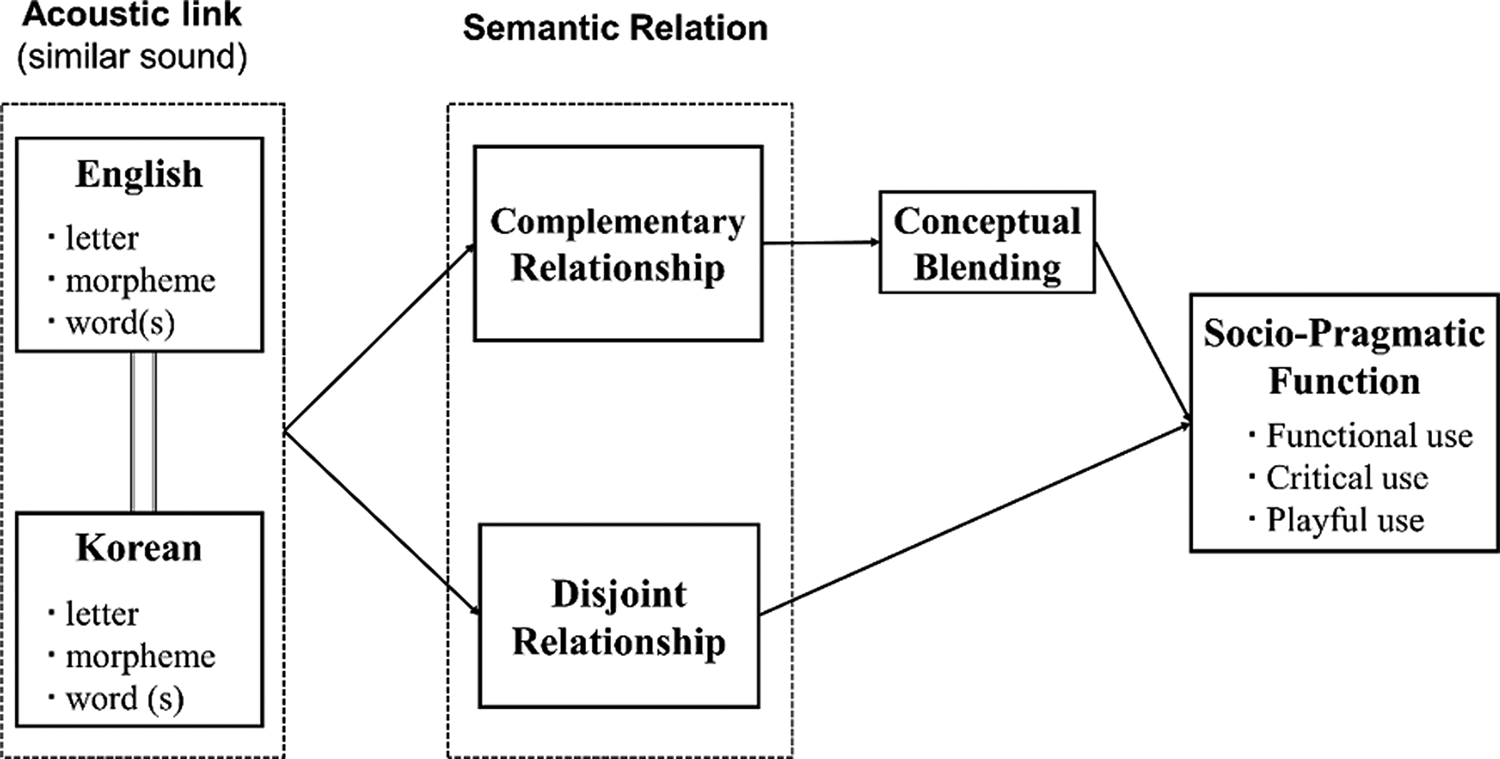
The study explored English–Korean CA at various levels as described in previous studies. First, the results show that the bilingual CA phenomenon between English and other languages is also found in the Korean context. This finding corroborates previous research on CA practices in diverse performance domains, such as pop music, linguistic landscape, advertising, and mass media (Luk, Reference Luk2013; Moody & Matsumoto, Reference Moody and Matsumoto2003; Rivlina, Reference Rivlina2015; Scherling, Reference Scherling2016). In addition, this study reveals that the cognitive linguistics model can enhance our understanding of bilingual CA at the semantic level as it displays bilingual speakers’ process of blending two language codes using analogical mapping (Knospe, Reference Knospe, Virker and Winter–Froemel2019; Oakley & Pascual, Reference Oakley, Pascual and Dancygier2017). Figure 2 suggests the possible phonetic and semantic processes at work in English–Korean CA. At the phonetic level, English and Korean expressions are connected through an acoustic link, which is actualized through either Englishization or Koreanization. At the semantic level, English and Korean lexical items may have a complementary or disjoint semantic relationship depending on which messages the code ambiguated expression intends to deliver. Pairs of words in the complementary relationship may pass through conceptual blending and eventually reach a socio-pragmatic function. In comparison, the other pairs of words without a semantic relationship (i.e., disjoint relationship) directly lead to a socio-pragmatic function without conceptual blending.
The process of English–Korean code ambiguation

The present study provided new English–Korean CA examples for the descriptive typology of CA in English–Korean contact (Moody, Reference Moody and Tam2009; Rivlina, Reference Rivlina2015). This finding particularly confirms that bilingual creativity in manipulating sounds, meanings, and socio-pragmatic uses emerges in the Korean context as previous research reports in other languages (Moody & Matsumoto, Reference Moody and Matsumoto2003; Luk, Reference Luk2013; Rivlina, Reference Rivlina2015; Scherling, Reference Scherling2016). It further indicates that bilingual CA is based on common knowledge of the two languages although it is limited to the intra-sentential level (Rivlina, Reference Rivlina2015). Although the study used three levels of CA, the author acknowledges that it does not address other aspects reported by previous studies, such as a morpho-lexical combination in Russian (Rivlina, Reference Rivlina2015) and social interaction in verbal and non-verbal communication using Chinese–English CA (Tai & Li, Reference Tai and Li2021). Thus, future studies may consider these aspects to promote our understanding of CA in the Korean context.
 SEONGYONG LEE is an assistant professor in English Education at Hannam University, South Korea. He obtained his Ph.D. in foreign and second language education from the State University of New York at Buffalo. His research interests include world Englishes, English as a lingua franca, and computer-assisted language learning. He teaches diverse courses, such as English through media, language assessment, and language teaching method. His articles have appeared in English Today, Asian Englishes, Information Technology & People, and Applied Linguistics Review. Email: seongyong@hnu.kr
Appendix 1. Sources of data
(1) ‘Maria,’ Hwasa, Online at <https://youtu.be/-M5H_0Gx9Qg> (Accessed July 15, 2020).
(2) ‘Red Up,’ AB6IX, Online at <https://youtu.be/IR3_7n0GzzY> (Accessed July 16, 2020).
(3) ‘Whistle,’ Blackpink, Online at <https://youtu.be/dISNgvVpWlo> (Accessed July 20, 2020).
(4) ‘Sweet Talking Baby,’ Girls’ Generation, Online at <https://youtu.be/W_zru5hZZZY> (Accessed June 18, 2020).
(5) ‘Napal Baji,’ Psy, Online at <https://youtu.be/tF27TNC_4pc> (Accessed May 9, 2020).
(6) Pium. 2018. ‘KV roman baeun apeurika, apeunikka geumanhaja.’ Pida, February 10. Online at <http://pida.or.kr/pium/?q=YToyOntzOjEyOiJrZXl3b3JkX3R5cGUiO3M6MzoiYWxsIjtzOjQ6InBhZ2UiO2k6NDt9&bmode=view&idx=501350&t=board&category=62612a0owI> (Accessed July 15, 2020).
(7) JTBC. 2020. ‘Mungchimyeon chanda.’ May 10. Episode 45. Online at <https://tv.jtbc.joins.com/soccer> (Accessed June 11, 2020).
(8) Da-dream Church. Online at <http://dadream.org/> (Accessed June 15, 2020).
(9) ‘Hell로,’ Facebook. Online at <https://www.facebook.com/HiHelllo> (Accessed June 22, 2020).
(10) ‘Deuraibeu-seuru norae SHOW – deuruwa,’ MBN. Online at <https://www.mbn.co.kr/vod/programMain/830> (Accessed July 08, 2020).
(11) ‘Master in the House,’ SBS. Online at <https://programs.sbs.co.kr/enter/2018house/main> (Accessed June 08, 2020).
(12) ‘Solo,’ Jennie. Online at <https://youtu.be/b73BI9eUkjM> (Accessed June 10, 2020).
(13) ‘Arm & Hammer,’ Yuhan. Online at <https://youtu.be/_OJqpvvym0M> (Accessed June 06, 2020).
(14) ‘Feel My Fyre,’ The Quiett. Online at <https://youtu.be/pH0AvBN8-VE> (Accessed May 22, 2020).
(15) SBS. 2018. ‘Master in the House.’ July 8. Episode 27. Online at <https://programs.sbs.co.kr/enter/2018house/main> (Accessed June 22, 2020).