Introduction
In different parts of the English-speaking world various vowel changes have been taking place in recent years, perhaps the most noticeable of which is the vowel lowering in words like DRESS and TRAP. This lowering would seem to have its origins some few decades ago in North America, probably in California and perhaps simultaneously in Canada. The shift, labelled here short front vowel lowering (SFVL), has spread quickly across the anglophone world and is found in locations as far apart as Ireland, South Africa and Australia. In each case where the change has been adopted there has been an adaptation of the change to local circumstances within the borrowing variety. The transmission of the change is also significant as the spread would seem not to be by direct speaker contact.
Supraregional forms of English
By ‘supraregional’ is meant forms of English which are not local dialects but found across whole regions. In the anglophone world, as elsewhere, there is a vertical scale along which varieties are ordered by their degree of vernacularity. The most vernacular forms are the local dialects and the least vernacular are those forms which show fewest local features. This is largely a matter of pronunciation, but it can also involve grammatical idiosyncrasies. For the present paper the pronunciation of English by speakers towards the upper end of the vertical social scale will be analysed. The level of education which such speakers have achieved and whether they have mastered written standard English is not of primary relevance; the main point is that they are partaking in those shifts in vowel values which can be found in non-local speech across the English-speaking world today.
To discuss vowels in varieties linguists normally use lexical sets, a notation devised by John Wells in which a keyword is chosen to represent a class of words which will have the same pronunciation with any one speaker although there will be considerable differences between groups of speakers (Wells, Reference Wells1982).
The vowel lowering dealt with here would seem to be related to a number of movements in the vowel system of English such as GOOSE-fronting (Harrington, Reference Harrington, Solé and Recasens2012). This is a development whereby the vowel of this and similar words is articulated further forward in the mouth. Originally, the GOOSE vowel was a high back rounded long vowel. But given that English does not have any high front rounded vowels there was no systemic obstacle to the fronting of this vowel once it had started. However, one cannot say that the vowel fronted because there are no high front rounded vowels in English. But one can see with languages like French and German that the existence of such front vowels means that the equivalent of the English GOOSE vowel is articulated quite far back, cf. French fou [fu:] ‘mad’ and German Schuh [ʃu:] ‘shoe’. The fronting of the GOOSE vowel is a widespread development in native-speaker varieties of English in Europe, North America and the Southern Hemisphere (Mesthrie, Reference Mesthrie2010) as well of that of emigrant groups (Wong, Reference Wong2014). Other possible vowel shifts include GOAT-centralisation, referring to the tendency to move the onset of the diphthong in words like home, go, row, goat towards the centre of the mouth, i.e. towards the schwa vowel. In some cases, such as recent Dublin English, it may be that this centralisation is a gender-specific development with females leading the way (Hickey, Reference Hickey2017b).
Short front vowel lowering (SFVL)
The lowering discussed in this article can be seen in a typical realisation of this article's title as [jæs ðats ðə bæst] with the vowel in the first and last word lowered from [ε] to [æ] and that of the second word from [æ] to [a]. Such lowering would seem to be a fairly recent phenomenon in the anglophone world. For instance, neither Docherty (Reference Docherty and Kirkpatrick2010) nor Deterding (Reference Deterding and Kirkpatrick2010), in their overviews of phonological variation in Britain and across forms of English outside the British Isles respectively, mention the lowering of the KIT, DRESS and TRAP vowels which has come to prominence across the anglophone world in the past few years. Nonetheless, a certain general awareness of the vowel lowering has arisen, just consider the discussions of [jæs] (often lengthened) as a pronunciation of yes which one can find on the internet.
Descriptions of this lowering exist for (Northern) California by Penelope Eckert (Reference Eckert2012) and it is not generally regarded as typical of elswhere in the United States where other shifts, like the Northern Cities Shift and the Southern Shift have been active (Gordon, Reference Gordon and Hickey2012). For Canada, SFVL has been described by Charles Boberg (Reference Boberg2005, Reference Boberg and Hickey2012) and a little earlier by Sandra Clarke and her colleagues (Clarke, Elms & Youssef, Reference Clarke, Elms and Youssef1995). It would also seem to be spreading to the Southern Hemisphere, to South Africa (Chevalier, Reference Chevalier2016) and to Australia, see Cox and Palethorpe (Reference Cox and Palethorpe2008, Reference Cox, Palethorpe and Hickey2012). In the British Isles, the shift has been found in Ireland (Hickey, Reference Hickey and Hickey2016: 28–31) and in Scotland (Holmes–Elliot & Smith, Reference Holmes-Elliott and Smith2015).
Short front vowels in recent history
Any discussion of change assumes that there is a clear point of departure compared to which the new realisations represent change. Traditionally, the keywords KIT, DRESS and TRAP were transcribed, and presumably realised, as follows: [kɪt], [dres] and [træp] respectively (Upton, Reference Upton, Kortmann and Upton2008: 241). At least that would have held for supraregional British and American English in the mid-20th century, although the TRAP vowel did and does have a tensed realisation before nasals (in words like man, can, and).
It is difficult to pinpoint where and when SFVL began but some forms of English give us clues about how short front vowels developed in the past two centuries. From the history of varieties of English in the Southern Hemisphere (Hickey, Reference Hickey2014: 157–158, 293), chiefly in South Africa, Australia and New Zealand where English settlement began in earnest at the beginning of the 19th century, it is known (see e.g. Branford, Reference Branford and Burchfield1994: 477) that short front vowels were raised somewhat, i.e. words like catch were pronounced with a vowel closer to [e] than [æ]. Examinations of recordings of Received Pronunciation speakers from the early 20th century, e.g. of the writer Virginia Woolf (Hickey, Reference Hickey and Hickey2017a), also show raised front vowels of the type characteristic of traditional Southern Hemisphere varieties of English. However, during the course of the 20th century, especially with moderate RP speakers after WWII, lower pronunciations of the short front vowels began to appear and now at the beginning of the 21st century an [ε] in the TRAP lexical set is distinctly old-fashioned and hardly found at all (see Bauer, Reference Bauer1985, Reference Bauer1994: 120–121). The movement away from higher realisations of short front vowels is clear in present-day standard southern British English (Received Pronunciation, RP) so that one has for DRESS and TRAP pronunciations closer to [drεs] and [træp] ~ [trap] respectively (Upton, Reference Upton, Kortmann and Upton2008: 242; Reference Upton and Hickey2012: 63). So it would seem that the lowering being examined in this article is in tune with a more general, if less extreme, lowering of short front vowels in British English in the later 20th and early 21st century. The essential difference between advanced RP and the Short Front Vowel Lowering dealt with here is the lowering of KIT (in North America) and the very open realisation of the DRESS vowel as [dræs]. In addition, the TRAP vowel is a centralised [a] rather than the more fronted, but low, [a] vowel found in current RP in England.
The California Vowel Shift
Research on the present lowering of short front vowels was first carried out on English in California and in Canada. The lowering in the large, westernmost state of the USA consists of a series of vowel shifts which are typical of young speakers, especially females, initially more in the north of the state (Eckert, Reference Eckert2012) but by now a geographical distinction between the north and south cannot be strictly be maintained.
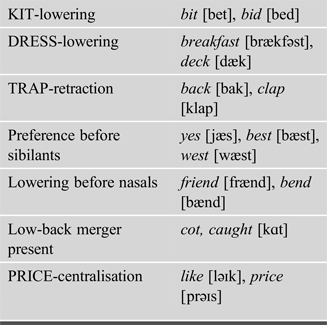
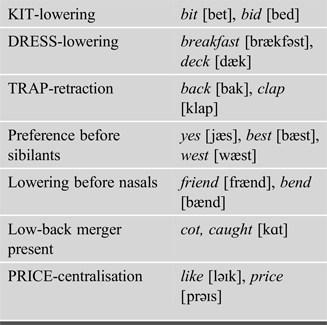
In this change short front vowels are lowered, e.g. DRESS is [dræs], KIT is [ket] (but not before [ŋ]) while TRAP is realised as [trap]. There is one important exception to this, namely the raising of the ASH-vowel [æ] when in pre-nasal position (a supraregional feature of many varieties of American English), e.g. and [eənd]. This means in fact that the realisation of the TRAP vowel before nasals is higher in phonological space than the unconditioned realisation of the DRESS vowel. In addition to these shifts there is a fronting of high back vowels in the GOOSE and GOAT lexical sets as well as the STRUT vowel while the PRICE diphthong shows a centralised onset.
The Canadian Shift
Since the mid-1990s (Clarke, Elms & Youssef, Reference Clarke, Elms and Youssef1995) a lowering of front vowels has been found in supraregional forms of Canadian English. The lowering is accompanied by a degree of centralisation of the short front vowels, most clearly for the DRESS vowel (Boberg, Reference Boberg and Hickey2012: 173) and has come to be termed the ‘Canadian Shift’.
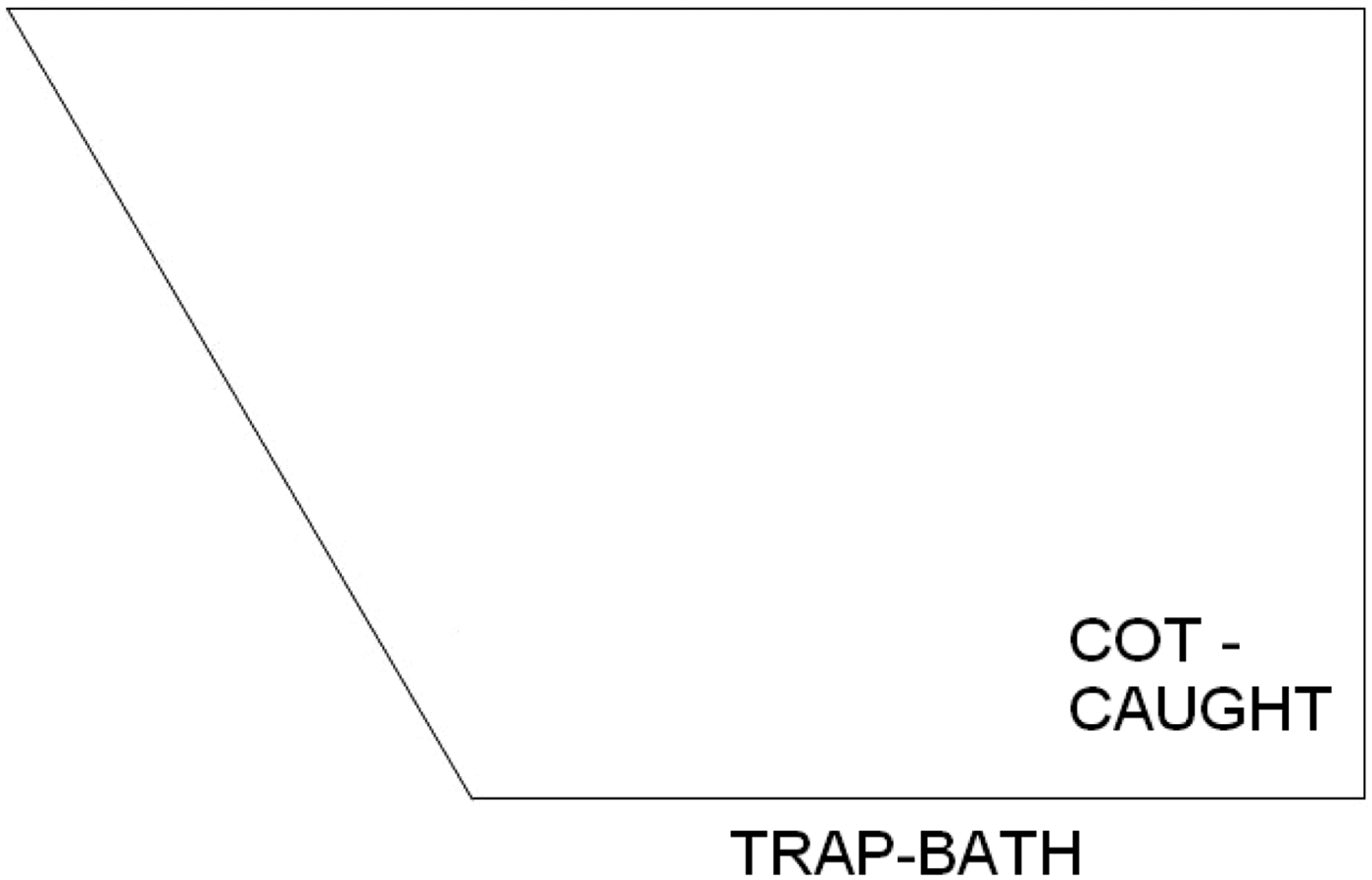
In Boberg's view the lowering of the short front vowels was apparently triggered by the retraction of the vowel in the TRAP lexical set from [æ] to [a]. This led to the lowering of DRESS with the latter ‘dragging KIT down behind it’ (Boberg, loc. cit.). The remaining vowels, in the KIT and DRESS lexical sets, were lowered and centralised to some extent in the process. If this causal sequence is valid then what might have induced the retraction of the TRAP vowel, thus triggering the entire change? In the view of Boberg, the essential trigger is the existence of a COT-CAUGHT merger in Canadian English. The merger is well attested for this variety with pairs of words such as not and naught or Don and dawn not distinguished by their vowel realisations. Given furthermore that Canadian English does not have a split of the vowels in TRAP and BATH (Boberg, Reference Boberg and Hickey2012: 170), which British English generally does, cf. band [bænd] and grant [grɑ:nt], there are fewer vowel distinctions in the low to low-back region of phonological space in Canadian English (Figure 1).
Low and low-back vowels in Canadian English

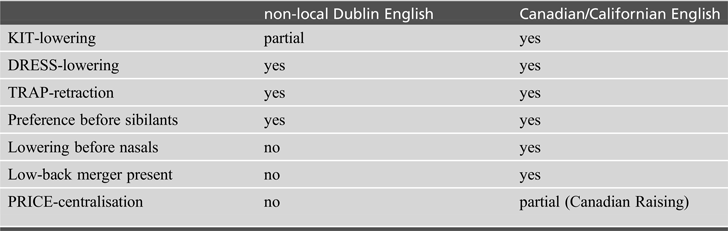
In their analysis of young adults’ speech from various parts of California, Kennedy and Grama confirmed the lowering of short front vowels with a certain gender effect with females leading in the shift. This leads the authors to conclude that the shift is not clearly a pull-chain (with TRAP pulling on the other vowels), as posited by Boberg for Canadian English and may have started as an independent push chain (with KIT and DRESS pushing downwards) (Kennedy & Grama, Reference Kennedy and Grama2012: 52–53). The authors also regard the shift in Canada and that in California as separate phenomena and point to the differing diachrony (Table 1): the Canadian Shift was already described in the mid 1990s but in the Atlas of North American English (Labov, Ash & Boberg, Reference Labov, Ash and Boberg2006) the lowering of short front vowels for California is not noted (the data for this project was collected between 1993 and 2001).
Short front vowel lowering in Californian and Canadian English
Short front vowel lowering in Dublin English
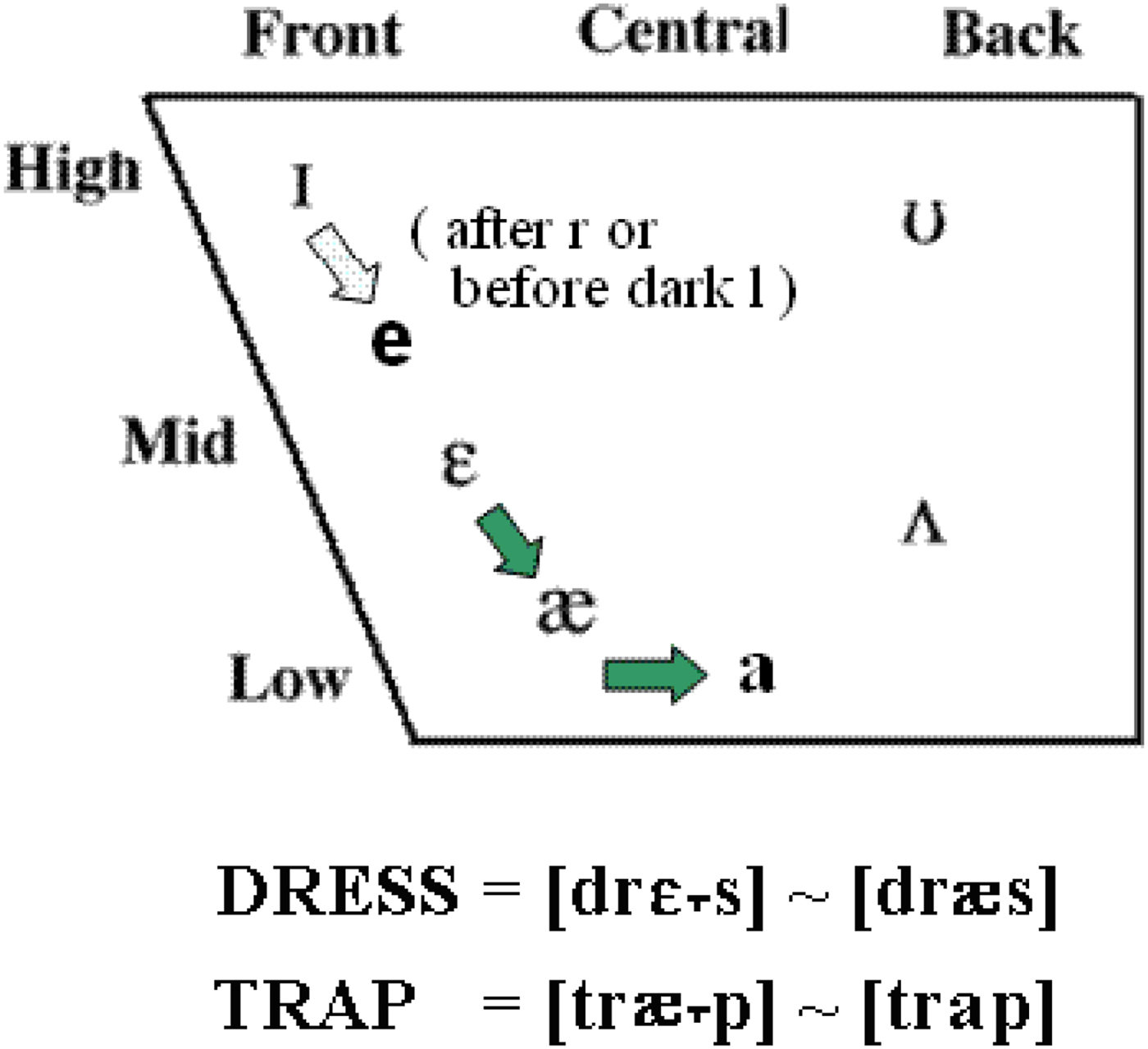
In recent years young female speakers of non-vernacular Dublin English have been showing a lowered vowel realisation, (Hickey, Reference Hickey and Tristram2003) near [æ], in the DRESS lexical set and a centralised [a] in the TRAP set. The KIT vowel is rarely lowered and only in the environment of /r-/, e.g. rid [red]. The LOT and STRUT vowels are, as yet, unaffected by SFVL. Note that there is no low-back vowel merger in Irish English, i.e. word pairs like Don and dawn are pronounced differently, as [dɒn] and [dɒ:n] respectively (Figure 2).
The lowering of short front vowels in recent Dublin English

Speaker groups with short front vowel lowering
The group of speakers who show SFVL in Dublin do not use the local vernacular, a stable form of English which has existed for several centuries in the city (Hickey, Reference Hickey2005). Instead they are non-vernacular speakers who use general supraregional (southern) Irish English, but, importantly, with the changes being described here. The group consists at present entirely of young females but does not appear to encompass all members of this group. That is, not all young females engage in SFVL but certainly enough of them to make this an established feature among this speaker group.
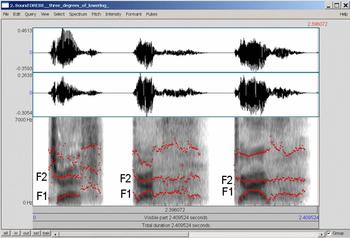
In Figure 3 the values for F1 and F2 are progressively closer to each other from left to right due to the raising of F1. This is a clear indication of increased lowering of the DRESS vowel as the value of F1 correlates inversely with the position of the vowel in phonological space, normally shown as a vowel quadrangle as in Figure 1 above.
Spectrogram showing realisations of DRESS from three speakers with progressively lower vowels from left to right

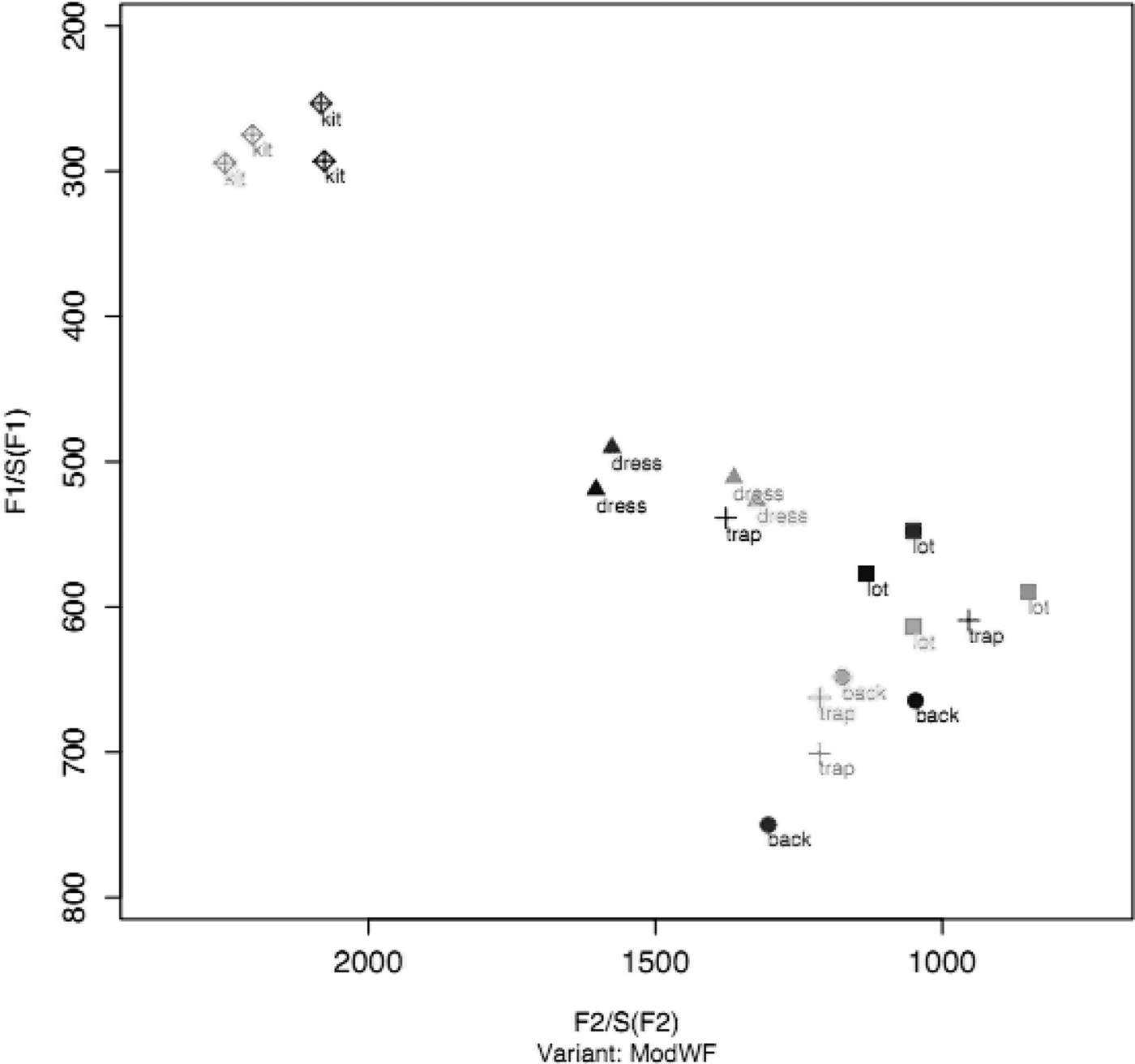
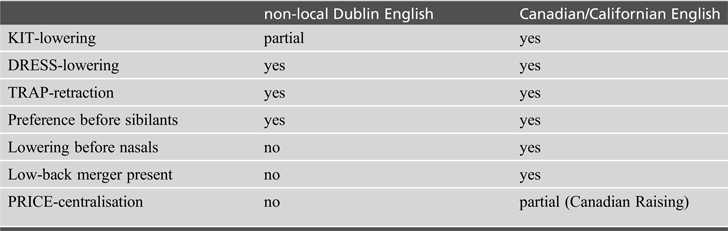
In the plot shown in Figure 4 the distance between the KIT and DRESS realisations is striking as is the low position of the TRAP vowel, showing clearly that all speakers have adopted SFVL. There are certain correlations in the speech of individuals with SFVL. For instance, they show GOAT-centralisation in Dublin and in California (termed /ow/ centralizing in Kennedy & Grama, Reference Kennedy and Grama2012: 42). This is not to say that both are causally linked, but that the individuals with SFVL are a subset of those who speak advanced Dublin English or advanced Californian English with GOAT-centralisation as in home [həʊm]. In Dublin at least there are speakers who do not show SFVL but have GOAT-centralisation confirming that the latter is a necessary but not sufficient condition for SFVL (Table 2). Note that PRICE-centralisation is avoided by non-vernacular speakers in Dublin as this is a salient feature of local speech in the city.
Vowels formant values for KIT, DRESS, TRAP, BACK and LOT from four young Dublin females plotted using the modified Watt-Fabricius method

Short front vowel lowering
Short front vowel lowering across the English-speaking world
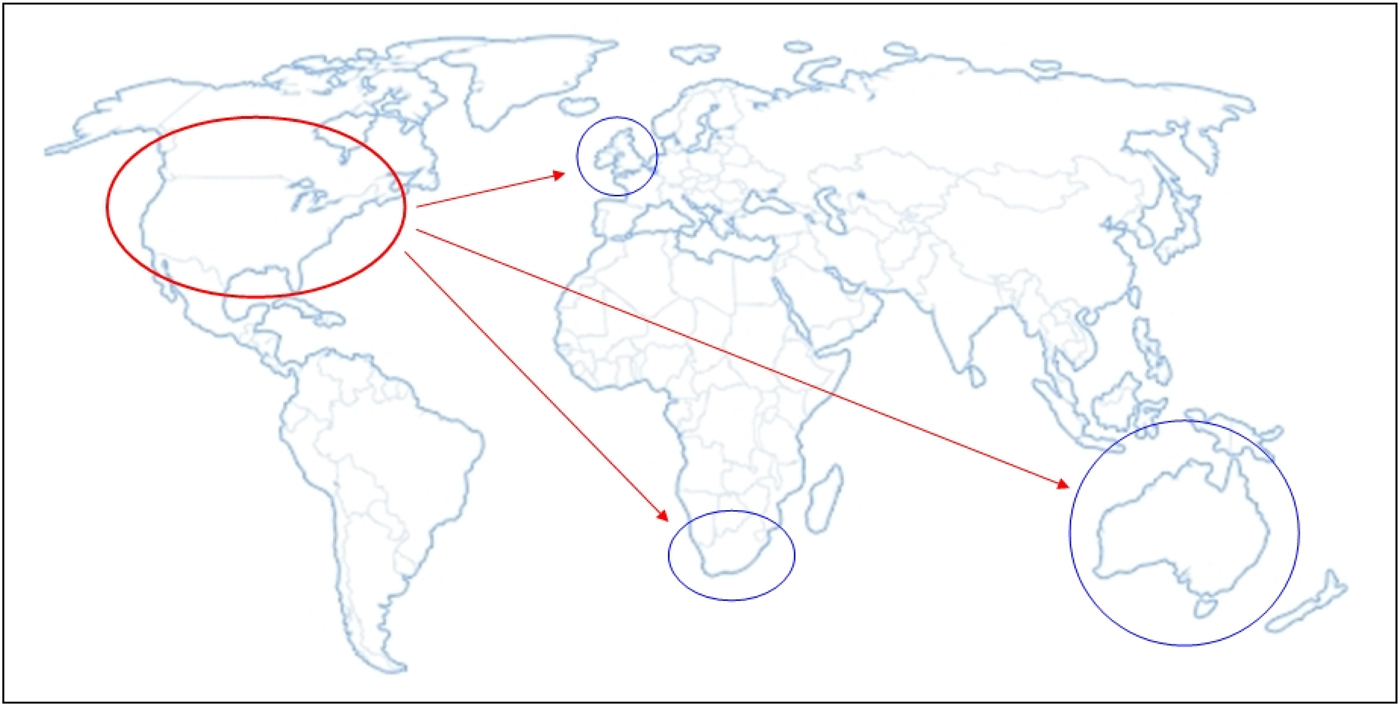
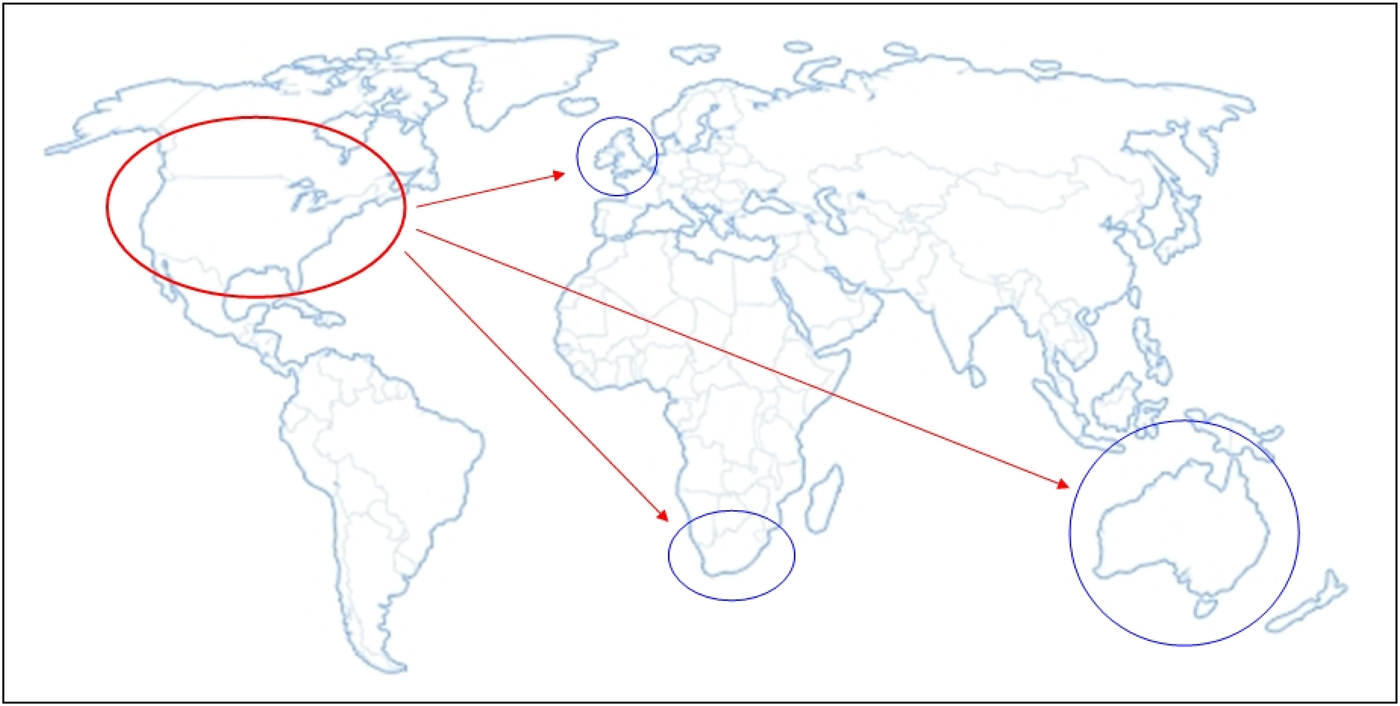
If a change takes place at two different locations at the same time then it is legitimate to ask if the two instances of change are related and possibly have the same cause. However, the chronology of the current change would imply that it began in North America – whether independently in California and Canada is an unresolved question. What remains to be considered is whether the appearance of SFVL at anglophone locations outside North America is due to an adoption of the change from North America (Map 1). The very appearance of the shift in geographically non-contiguous parts of the English-speaking world at the same time would suggest a causal connection.
Spread of short front vowel lowering in the English-speaking world
There are two basic types of explanation for the source of language change, an internal one which sees the change as arising within a speech community and an external one which regards an external trigger as initiating the change (Hickey, Reference Hickey, Hernández-Compoy and Conde-Silvestre2012). Arguments can be put forward pro and con each explanation and indeed a combined account can also be put forward.
1) Internal argument
SFVL is favoured in the environment of liquids, i.e. post-/r/ and pre-/l/. /r/ would depress the third formant and hence favour vowel lowering, cf. breakfast [brækfəst]. In non-vernacular Dublin English syllable-final /l/ is pharyngealised and so would have a lowering effect on the preceding vowel, e.g. hotel [həutεæl]. However, if the internal linguistic constraints always existed in a variety then the external sources must be the trigger for the change, otherwise one cannot account for the fact that it is occurring now and did not do so earlier. Note furthermore that it is common for a change to move from a phonetically favoured environment to other positions, i.e. for the change to undergo generalisation.
2) External argument
SFVL is primarily attested in the speech of young females, who are generally regarded as especially sensitive to change and movements within language. Exposure in the media to other young female speakers with SFVL would trigger the adoption of this change. In Ireland, young female broadcasters, weather forecasters and continuity announcers on Irish national radio and television have SFVL and may contribute to its dissemination. It is also true that on local radio channels throughout the country young female broadcasters, who do not use local dialect, are now showing SFVL.
But this suggestion would still leave the unanswered question: how did people in the media pick up SFVL to begin with? Did some young females speakers go to Canada/California and pick up the rudiments of SFVL there and then plant the seed of this shift back in Dublin with the shift then spreading throughout the city? Attitudes may well play a role here: the Irish are definitely America-friendly and have many connections across the Atlantic and so there is an openness to things American and a readiness to adopt impulses from North America.
Another argument for an external trigger is that SFVL appeared suddenly in the past few years in Ireland. This would suggest that the change was adopted from outside rather than arising in a phonetically gradual manner within a community of Irish English speakers in Dublin.
Combined accounts: Adaptation to local conditions
Assuming an external trigger for change does not exclude a degree of internal justification. A change from outside may be adopted and then adapted to local conditions which can accommodate the change. The manifestation of the change can then look partial vis-à-vis the external source but may well fit in better with the arrangements of sounds in the adopting variety. Consider recent non-local Dublin English where SFVL has appeared but without KIT-lowering. There is furthermore no PRICE-centralisation (not part of SFVL but of the [Northern] Californian Vowel Shift, according to Penelope Eckert) and no fronting of the STRUT vowel. If SFVL is an adopted change in Dublin English then it not unexpected to find the most salient elements of this change DRESS-lowering and TRAP-retraction to appear but not the KIT-lowering. This vowel is very short and hence of lower salience and an altered value may not be easy for (adult) speakers to register and adopt, except perhaps in the environment of /r/ or a dark /l/ as in rid /red/ and kill /keæl/. Thus the differential expression of SFVL in Dublin English would strongly suggest that it is an adopted change from an external source which has been accommodated to local phonology.
How well does SFVL fit in locally?
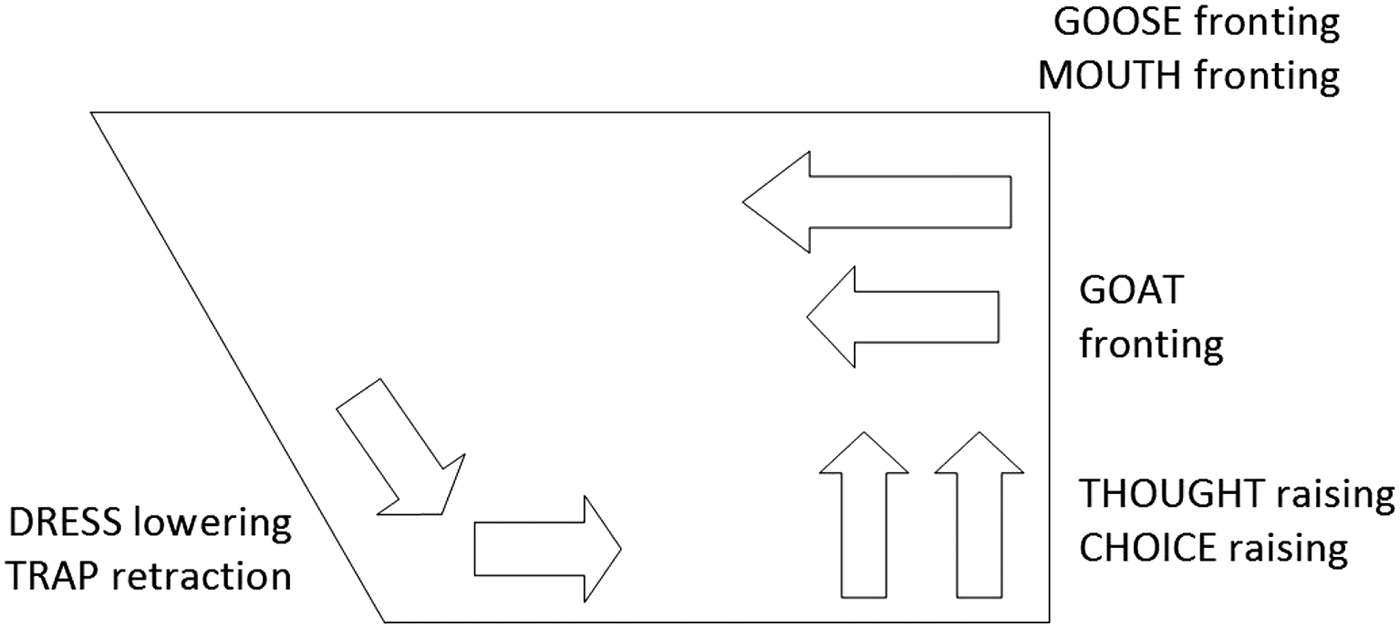
The readiness of speakers to adopt a change from an external source has social reasons but is also determined by the linguistic configuration of their variety. One argument, that can be put forward for the adoption of SFVL in recent Dublin English, is that various vowel shifts of the past two decades in Dublin have resulted in a distribution of vowels in phonological space into which lowered short front vowels fit well. The changes of the past two decades have led to a rotation of vowels from a low back position upwards and to a fronting of those vowels which were already in the higher regions of phonological space. This is illustrated in the following diagram in which MOUTH fronting refers to the use of a fronted onset for this diphthong, i.e. [mεʊt] and GOAT-fronting to the use of schwa as an onset for this diphthong, i.e. [gəʊt]. By THOUGHT-raising is meant the use of a relatively high vowel, i.e. [to:8], and CHOICE-raising refers to the use of a high vowel as onset for this diphthong, i.e. [tʃoɪs]. Various arguments can be made for and against the validity of a rotation principle in vowel space, see below.
Arguments in favour of vowel rotation
All speakers with SFVL also have GOOSE-MOUTH-GOAT-Fronting as well as THOUGHT-CHOICE-Raising. The movement away from the low back area reduced the number of vowels distinctions in this section of phonological space (Irons, Reference Irons2007, Bigham, Reference Bigham2010; Dinkin, Reference Dinkin2011) thus favouring the retraction of TRAP towards a low central position. If this interpretation is correct then SFVL in Dublin English is a pull shift, triggered by an under-utilisation of low back vowel space. However, if the fronting of GOOSE and MOUTH is regarded as motivating the adoption of SFVL then it is a push shift. However, an argument against this is that KIT is not really affected (except in the environment of liquids).
Vowel rotation has one further advantage: it renders the question of an exclusively external or internal motivation for SFVL less relevant for Dublin English and maybe for other varieties as well. Rather it provides a pre-existing internal argument which, given an appropriate external stimulus, can manifest itself as a rotation in vowel space which, while it will not be identical to that found elsewhere in the anglophone world, will nonetheless show sufficient similarity to be classified as the same type of change.
Arguments against the vowel rotation
Vowel rotation, as illustrated in Figure 5, involved long and short monophthongs as well as diphthongs. In the history of English vowel shifts affect one type of vowel, e.g. the Great Vowel Shift concerns long vowels while the raising of front vowels in 18th- and 19th- century southern British English and Southern Hemisphere varieties of English only involved short vowels. In addition, for Dublin English, the FLEECE, FACE and PRICE vowels are not affected by the movements of SFVL.
The rotation of vowels in recent Dublin English

Conclusion
Even a cursory consideration of vowels in varieties of English world-wide shows that there is much movement in such systems and that forms of English in North America can ‘export’ changes initiated there. There are additional factors which can favour the course of vowel movement such as creaky voice, often termed vocal pop or vocal fry (Yuasa, Reference Yuasa2010), which can lead to a lowering of the fundamental frequency for female voices and this may in turn have had a downward drag effect on the short vowels among young women.
Deciding on the cause of a change is difficult because when it appears in speech it has already taken place. However, the spread of a change is something which linguists can scrutinise and, by tracing its precise development and course at a number of locations in the English-speaking world, can help us to better understand the establishment and spread of sound change.
 RAYMOND HICKEY is Professor of English Linguistics at the University of Duisburg and Essen. Orignally from Dublin, he has worked on varieties of English for over 30 years. He has written several books on varieties of English including Dublin English. Evolution and Change (John Benjamins 2005), Irish English, History and Present-day Forms (Cambridge University Press, 2007), A Dictionary of Varieties of English (Wiley-Blackwell 2014) and Listening to the Past, Audio Records of Accents of English. (Cambridge University Press, 2017). Email: raymond.hickey@uni-due.de. Websites: Studying Varieties of English: www.uni-due.de/SVE, Variation and Change in Dublin English: www.uni-due.de/VCDE.