


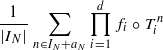
 .


Crossref Citations

This article has been cited by the following publications. This list is generated based on data provided by Crossref.
Austin, Tim
2010.
Deducing the multidimensional Szemerédi theorem from an infinitary removal lemma.
Journal d'Analyse Mathématique,
Vol. 111,
Issue. 1,
p.
131.
Frantzikinakis, Nikos
2010.
Multiple recurrence and convergence for hardy sequences of polynomial growth.
Journal d'Analyse Mathématique,
Vol. 112,
Issue. 1,
p.
79.
Шкредов, Илья Дмитриевич
and
Shkredov, Il'ya Dmitrievich
2010.
Анализ Фурье в комбинаторной теории чисел.
Успехи математических наук,
Vol. 65,
Issue. 3,
p.
127.
Austin, Tim
Eisner, Tanja
and
Tao, Terence
2011.
Nonconventional ergodic averages and multiple recurrence for von Neumann dynamical systems.
Pacific Journal of Mathematics,
Vol. 250,
Issue. 1,
p.
1.
Austin, Tim
2011.
Deducing the Density Hales–Jewett Theorem from an Infinitary Removal Lemma.
Journal of Theoretical Probability,
Vol. 24,
Issue. 3,
p.
615.
AUSTIN, TIM
2012.
Norm convergence of continuous-time polynomial multiple ergodic averages.
Ergodic Theory and Dynamical Systems,
Vol. 32,
Issue. 2,
p.
361.
Tao, Terence
and
Ziegler, Tamar
2012.
The Inverse Conjecture for the Gowers Norm over Finite Fields in Low Characteristic.
Annals of Combinatorics,
Vol. 16,
Issue. 1,
p.
121.
Shao, Song
and
Ye, Xiangdong
2012.
Regionally proximal relation of order d is an equivalence one for minimal systems and a combinatorial consequence.
Advances in Mathematics,
Vol. 231,
Issue. 3-4,
p.
1786.
BERGELSON, V.
LEIBMAN, A.
and
MOREIRA, C. G.
2012.
From discrete- to continuous-time ergodic theorems.
Ergodic Theory and Dynamical Systems,
Vol. 32,
Issue. 2,
p.
383.
Walsh, Miguel
2012.
Norm convergence of nilpotent ergodic averages.
Annals of Mathematics,
Vol. 175,
Issue. 3,
p.
1667.
Kifer, Yuri
2013.
A Nonconventional Invariance Principle for Random Fields.
Journal of Theoretical Probability,
Vol. 26,
Issue. 2,
p.
489.
AUSTIN, TIM
2013.
Equidistribution of joinings under off-diagonal polynomial flows of nilpotent Lie groups.
Ergodic Theory and Dynamical Systems,
Vol. 33,
Issue. 6,
p.
1667.
Luthy, Peter M.
2015.
On a biparameter maximal multilinear operator.
Journal of Functional Analysis,
Vol. 268,
Issue. 5,
p.
1105.
CHU, QING
and
ZORIN-KRANICH, PAVEL
2015.
Lower bound in the Roth theorem for amenable groups.
Ergodic Theory and Dynamical Systems,
Vol. 35,
Issue. 6,
p.
1746.
Austin, Tim
2015.
Pleasant extensions retaining algebraic structure, I.
Journal d'Analyse Mathématique,
Vol. 125,
Issue. 1,
p.
1.
Frantzikinakis, Nikos
2015.
Multiple correlation sequences and nilsequences.
Inventiones mathematicae,
Vol. 202,
Issue. 2,
p.
875.
Bergelson, Vitaly
Tao, Terence
and
Ziegler, Tamar
2015.
Multiple recurrence and convergence results associated to $${\text{F}}_P^\omega $$ -actions.
Journal d'Analyse Mathématique,
Vol. 127,
Issue. 1,
p.
329.
Eisner, Tanja
Farkas, Bálint
Haase, Markus
and
Nagel, Rainer
2015.
Operator Theoretic Aspects of Ergodic Theory.
Vol. 272,
Issue. ,
p.
461.
Austin, Tim
2015.
Pleasant extensions retaining algebraic structure, II.
Journal d'Analyse Mathématique,
Vol. 126,
Issue. 1,
p.
1.
Shkredov, Ilya Dmitrievich
2015.
Структурные теоремы в аддитивной комбинаторике.
Успехи математических наук,
Vol. 70,
Issue. 1(421),
p.
123.