




No CrossRef data available.
Article contents
Pointwise multiple averages for systems with two commuting transformations
Published online by Cambridge University Press: 14 March 2017
Abstract
Core share and HTML view are not available for this content. However, as you have access to this content, a full PDF is available via the 'Save PDF' action button.
We show that for every ergodic measure-preserving system  $(X,{\mathcal{X}},\unicode[STIX]{x1D707},S,T)$ with commuting transformations
 $S$ and
 $T$, the average converges for
 $$\begin{eqnarray}\frac{1}{N^{3}}\mathop{\sum }_{i,j,k=0}^{N-1}f_{0}(S^{j}T^{k}x)f_{1}(S^{i+j}T^{k}x)f_{2}(S^{j}T^{i+k}x)\end{eqnarray}$$
 $\unicode[STIX]{x1D707}$-almost every
 $x\in X$ as
 $N\rightarrow \infty$ for all
 $f_{0},f_{1},f_{2}\in L^{\infty }(\unicode[STIX]{x1D707})$. We also show that if
 $(X,{\mathcal{X}},\unicode[STIX]{x1D707},S,T)$ is an ergodic measurable distal system, then the average converges for
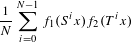 $$\begin{eqnarray}\frac{1}{N}\mathop{\sum }_{i=0}^{N-1}f_{1}(S^{i}x)f_{2}(T^{i}x)\end{eqnarray}$$
 $\unicode[STIX]{x1D707}$-almost every
 $x\in X$ as
 $N\rightarrow \infty$ for all
 $f_{1},f_{2}\in L^{\infty }(\unicode[STIX]{x1D707})$.
Information
- Type
- Original Article
- Information
- Copyright
- © Cambridge University Press, 2017
References
Austin, T.. On the norm convergence of non-conventional ergodic averages. Ergod. Th. & Dynam. Sys.
30(2) (2010), 321–338.Google Scholar
Becker, H. and Kechris, A.. The Descriptive Set Theory of Polish Group Actions
(London Mathematical Society Lecture Note Series, 232)
. Cambridge University Press, Cambridge, 1996.Google Scholar
Bourgain, J.. Double recurrence and almost sure convergence. J. Reine Angew. Math.
404 (1990), 140–161.Google Scholar
Chu, Q.. Multiple recurrence for two commuting transformations. Ergod. Th. & Dynam. Sys.
31(3) (2011), 771–792.Google Scholar
Donoso, S. and Sun, W.. A pointwise cubic average for two commuting transformations. Israel J. Math
216(2) (2016), 657–678.Google Scholar
Furstenberg, H.. Recurrence in Ergodic Theory and Combinatorial Number Theory
(M. B. Porter Lectures)
. Princeton University Press, Princeton, NJ, 1981.Google Scholar
Glasner, E.. Ergodic theory via joinings.
(Mathematical Surveys and Monographs, 101)
. American Mathematical Society, Providence, RI, 2003.Google Scholar
Host, B.. Ergodic seminorms for commuting transformations and applications. Studia Math.
195(1) (2009), 31–49.Google Scholar
Host, B. and Kra, B.. Nonconventional averages and nilmanifolds. Ann. of Math. (2)
161(1) (2005), 398–488.Google Scholar
Huang, W., Shao, S. and Ye, X. D.. Pointwise convergence of multiple ergodic averages and strictly ergodic models. Preprint, 2014, arXiv:1406.5930.Google Scholar
Jewett, R. I.. The prevalence of uniquely ergodic systems. J. Math. Mech.
19 (1969/1970), 717–729.Google Scholar
Krieger, W.. On unique ergodicity. Proc. Sixth Berkeley Symp. on Mathematical Statistics and Probability (University of California, Berkeley, CA, 1970/1971), Vol. II: Probability Theory. University of California Press, Berkeley, CA, 1972, pp. 327–346.Google Scholar
Tao, T.. Norm convergence of multiple ergodic averages for commuting transformations. Ergod. Th. & Dynam. Sys.
28(2) (2008), 657–688.Google Scholar
Walsh, M.. Norm convergence of nilpotent ergodic averages. Ann. of Math. (2)
175(3) (2012), 1667–1688.Google Scholar
Weiss, B.. Strictly ergodic models for dynamical systems. Bull. Amer. Math. Soc. (N. S.)
13 (1985), 143–146.Google Scholar
 You have
Access
- 6
- Cited by