We partner with a secure submission system to handle manuscript submissions.
Please note:
You will need an account for the submission system, which is separate to your Cambridge Core account. For login and submission support, please visit the
submission and support pages.
Please review this journal's author instructions, particularly the
preparing your materials
page, before submitting your manuscript.
Click Proceed to submission system to continue to our partner's website.
To save this undefined to your undefined account, please select one or more formats and confirm that you agree to abide by our usage policies. If this is the first time you used this feature, you will be asked to authorise Cambridge Core to connect with your undefined account.
Find out more about saving content to .
To send this article to your Kindle, first ensure no-reply@cambridge.org is added to your Approved Personal Document E-mail List under your Personal Document Settings on the Manage Your Content and Devices page of your Amazon account. Then enter the ‘name’ part of your Kindle email address below. Find out more about sending to your Kindle.
Find out more about saving to your Kindle.
Note you can select to save to either the @free.kindle.com or @kindle.com variations. ‘@free.kindle.com’ emails are free but can only be saved to your device when it is connected to wi-fi. ‘@kindle.com’ emails can be delivered even when you are not connected to wi-fi, but note that service fees apply.
We consider the fourth-order thin film equation (TFE)with the unstable second-order diffusion term. We show that, for the first critical exponentwhere N ≥ 1 is the space dimension, the free-boundary problem the with zero contact angle and zero-flux conditions admits continuous sets (branches) of self-similar similarity solutions of the formFor the Cauchy problem, we describe families of self-similar patterns, which admit a regular limit as n → 0+ and converge to the similarity solutions of the semilinear unstable limit Cahn-Hilliard equationstudied earlier in [12]. Using both analytic and numerical evidence, we show that such solutions of the TFE are oscillatory and of changing sign near interfaces for all n ∈ (0,nh), where the valuecharacterizes a heteroclinic bifurcation of periodic solutions in a certain rescaled ODE. We also discuss the cases p ⧧ = p0, the interface equation, and regular analytic approximations for such TFEs as an approach to the Cauchy problem.

The quasi-steady power-law Stokes flow of a mixture of incompressible fluids with shear-dependent viscosity is studied. The fluids are immiscible and have constant densities. Existence results are presented for both the no-slip and the no-stick boundary value conditions. Use is made of Schauder's fixed-point theorem, compactness arguments, and DiPerna–Lions renormalized solutions.
We propose a phase field model for stress and diffusion-induced interface motion. This model, in particular, can be used to describe diffusion-induced grain boundary motion and generalizes a model of Cahn, Fife and Penrose as it more accurately incorporates stress effects. In this paper we will demonstrate that the model can also be used to describe other stress-driven interface motion. As an example, interface motion resulting from interactions of interfaces with dislocations is studied.
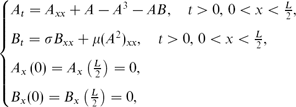
We consider the following system of equations: where the spatial average ⟨ B ⟩ = 0 and μ > σ > 0. This system plays an important role as a Ginzburg-Landau equation with a mean field in several areas of the applied sciences and the steady-states of this system extend to periodic steady-states with period L on the real line which are observed in experiments. Our approach is by combining methods of nonlinear functional analysis such as nonlocal eigenvalue problems and the variational characterization of eigenvalues with Jacobi elliptic integrals. This enables us to give a complete classification of all stable steady-states for any positive L.
We assume that the Stefan problem with underheating has a classical solution until the moment of contact of two distinct free boundaries and the free boundaries have continuous velocities until the moment of contact. Under these assumptions, we construct a smooth approximation of the global solution of the Stefan problem with underheating, which, until the contact, gives the classical solution mentioned above and, after the contact, gives a solution that is the solution of the heat equation.
The competition between inertia and solidification for the high-Reynolds-number flow of molten aluminium across a cool solid aluminium surface is investigated. A two-dimensional molten aluminium droplet is of finite extent and is surrounded by a passive gas. The droplet initially freezes due to rapid thermal conduction into the solid. Depending on the initial velocity of the molten aluminium, one of two situations may develop: (i) If the molten aluminium has a non-decreasing initial velocity profile, solidification continues until the passing of the trailing edge of the liquid/gas interface or the flow is engulfed; (ii) If the molten aluminium has a decreasing initial velocity profile, the droplet narrows and thickens resulting in a reduction in the heat flux and in the rate of solidification; this will eventually lead to fluid clumping and shock formation. The rate of solidification may also be reduced by increasing the ambient temperature. The results are interpreted in terms of the recast observed during the solidification phase of laser percussion drilling.
The stationary flow of a jet of a Newtonian fluid that is drawn by gravity onto a moving surface is analyzed. It is assumed that the jet has a convex shape and hits the moving surface tangentially. The flow is modelled by a third-order ODE on a domain of unknown length and with an additional integral condition. By solving part of the equation explicitly, the problem is reformulated as a first-order ODE with an integral constraint. The corresponding existence region in the three-dimensional parameter space is characterized in terms of an easily calculable quantity. In a qualitative sense, the results from the model are found to correspond with experimental observations.
This paper deals with a problem of nondestructive testing for a composite system formed by the connection of a steel beam and a reinforced concrete beam. The small vibrations of the composite beam are described by a differential system where a coupling takes place between longitudinal and bending motions. The motion is governed in space by two second order and two fourth order differential operators, which are coupled in the lower order terms by the shearing, k, and axial, μ, stiffness coefficients of the connection. The coefficients k and μ define the mechanical model of the connection between the steel beam and the concrete beam and contain direct information on the integrity of the system. In this paper we study the inverse problem of determining k and μ by mixed data. The inverse problem is transformed to a variational problem for a cost function which includes boundary measurements of Neumann data and also some interior measurements. By computing the Gateaux derivatives of the functional, an algorithm based on the projected gradient method is proposed for identifying the unknown coefficients. The results of some numerical simulations on real steel-concrete beams are presented and discussed.
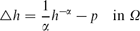
Let , N ≥2 be a bounded smooth domain and α > 1. We are interested in the singular elliptic equationwith Neumann boundary conditions. In this paper, a complete description of all continuous radially symmetric solutions is given. In particular, we construct nontrivial smooth solutions as well as rupture solutions. Here a continuous solution is said to be a rupture solution if its zero set is nonempty. When N = 2 and α = 3, the equation is used to model steady states of van der Waals force driven thin films of viscous fluids. We also consider the physical problem when total volume of the fluid is prescribed.
This article presents a method for the numerical quadrature of highly oscillatory integrals with stationary points. We begin with the derivation of a new asymptotic expansion, which has the property that the accuracy improves as the frequency of oscillations increases. This asymptotic expansion is closely related to the method of stationary phase, but presented in a way that allows the derivation of an alternate approximation method that has similar asymptotic behaviour, but with significantly greater accuracy. This approximation method does not require moments.
Layered nanocrystals consist of a core of one material surrounded by a shell of a second material. We present computation of the atomistic strain energy density in a layered nanocrystal, using an idealised model with a simple cubic lattice and harmonic interatomic potentials. These computations show that there is a critical size r*s for the shell thickness rs at which the energy density has a maximum. This critical size is roughly independent of the geometry and material parameters of the system. Interestingly, this critical size agrees with the shell thickness at which the quantum yield has a maximum, as observed in several systems and thus leads one to support the hypothesis that maximal quantum yield is strongly correlated with maximal elastic energy density.
In this article the linear theory of thermoviscoelastic mixtures is considered. The fundamental solution of the system of linear-coupled partial differential equations of steady oscillations (steady vibrations) of the theory of thermoviscoelastic mixtures is constructed in terms of elementary functions and basic properties are established.
We study travelling-wave solutions for a reaction-diffusion system arising as a model for host-tissue degradation by bacteria. This system consists of a parabolic equation coupled with an ordinary differential equation. For large values of the ‘degradation-rate parameter’ solutions are well approximated by solutions of a Stefan-like free boundary problem, for which travelling-wave solutions can be found explicitly. Our aim is to prove the existence of travelling waves for all sufficiently large wave speeds for the original reaction-diffusion system and to determine the minimal speed. We prove that for all sufficiently large degradation rates, the minimal speed is identical to the minimal speed of the limit problem. In particular, in this parameter range, non-linear selection of the minimal speed occurs.
We analyse the two-dimensional, gravitationally-driven spreading of fluid through a porous medium overlying a horizontal impermeable boundary from which fluid can drain freely at one end. Under the assumption that none of the intruding fluid is retained within the pores in the trail of the current, the motion of the current is described by the dipole self-similar solution of the first kind derived by Barenblatt and Zel'dovich (1957). We show that small perturbations of arbitrary shape imposed on this solution decay in time, indicating that the self-similar solution is linearly stable. We use the connection between the perturbation eigenfunctions and symmetry transformations of the self-similar solution to demonstrate that variables can always be specified in terms of which the rate of decay of the perturbations is maximised. Unsaturated flow can be modelled by assuming that a constant fraction of the fluid is retained within the pores by capillary action in the trail of the current. It has been shown (Barenblatt and Zel'dovich, 1998; Ingerman and Shvets, 1999) that in this case, the motion of the current is described by a self-similar solution of the second kind characterised by an anomalous exponent. We derive leading-order analytic expressions for the anomalous exponent and the self-similar quantities valid for small values of the fraction of fluid retained using direct asymptotic analysis and by using a novel application of the method of multiple scales. The latter offers a number of advantages and permits the evolution of the current to be clearly connected with its initial conditions in a way not possible with conventional approaches. We demonstrate that the theoretical predictions provided by these expressions are in excellent agreement with results from the numerical integration of the governing equations.
The intrusion of a constant density fluid at the interface of a two-layer fluid is considered. Numerical solutions are computed for a model of a steady intrusion resulting from flow down a bank and across a broad lake or reservoir. The incoming fluid is homogeneous and spreads across the lake at its level of neutral buoyancy. Solutions are obtained for a range of different inflow angles, flow rate and density differences. Except in extreme cases, the nature of the solution is predicted quite well by linear theory, with the wavelength at any Froude number given by a dispersion relation and wave steepness determined largely by entry angle. However, some extreme solutions with rounded meandering flows and non-unique solutions in the parameter space are also obtained.
In this work we consider the inverse problem of the identification of a single rigid body immersed in a fluid governed by the stationary Navier-Stokes equations. It is assumed that friction forces are known on a part of the outer boundary. We first prove a uniqueness result. Then, we establish a formula for the observed friction forces, at first order, in terms of the deformation of the rigid body. In some particular situations, this provides a strategy that could be used to compute approximations to the solution of the inverse problem. In the proofs we use unique continuation and regularity results for the Navier-Stokes equations and domain variation techniques.
The flow of a thin layer of fluid down an inclined plane is modified by the presence of insoluble surfactant. For any finite surfactant mass, traveling waves are constructed for a system of lubrication equations describing the evolution of the free-surface fluid height and the surfactant concentration. The one-parameter family of solutions is investigated using perturbation theory with three small parameters: the coefficient of surface tension, the surfactant diffusivity, and the coefficient of the gravity-driven diffusive spreading of the fluid. When all three parameters are zero, the nonlinear PDE system is hyperbolic/degenerate-parabolic, and admits traveling wave solutions in which the free-surface height is piecewise constant, and the surfactant concentration is piecewise linear and continuous. The jumps and corners in the traveling waves are regularized when the small parameters are nonzero; their structure is revealed through a combination of analysis and numerical simulation.
We generalise the notion of fractal interpolation functions (FIFs) to allow data sets of the formwhere I=[0,1]n. We introduce recurrent iterated function systems whose attractors G are graphs of continuous functions f:I→, which interpolate the data. We show that the proposed constructions generalise the previously existed ones on . We also present some relations between FIFs and the Laplace partial differential equation with Dirichlet boundary conditions. Finally, the fractal dimensions of a class of FIFs are derived and some methods for the construction of functions of class Cp using recurrent iterated function systems are presented.
In this paper the problem of finding the impermeable parachute of optimum shape in a subsonic gas flow has been solved. The effects of compressibility have been taken into account out by making use of ideas of Chaplygin's approximate method. A formula for the drag coefficient has been deduced and by comparison with exact solutions it has been demonstrated that for bluff bodies its related error is no more than 0.5% for any Mach number at infinity less than unity. On the basis of the formula a functional for the drag force has been constructed and its global maximum has been found analytically. It has been shown that the optimum shape is slightly affected by compressibility.
The rich dynamics of quantized vortices governed by the Ginzburg-Landau-Schrödinger equation (GLSE) is an interesting problem studied in many application fields. Although recent mathematical analysis and numerical simulations have led to a much better understanding of such dynamics, many important questions remain open. In this article, we consider numerical simulations of the GLSE in two dimensions with non-zero far-field conditions. Using two-dimensional polar coordinates, transversely highly oscillating far-field conditions can be efficiently resolved in the phase space, thus giving rise to an unconditionally stable, efficient and accurate time-splitting method for the problem under consideration. This method is also time reversible for the case of the non-linear Schrödinger equation. By applying this numerical method to the GLSE, we obtain some conclusive experimental findings on issues such as the stability of quantized vortex, interaction of two vortices, dynamics of the quantized vortex lattice and the motion of vortex with an inhomogeneous external potential. Discussions on these simulation results and the recent theoretical studies are made to provide further understanding of the vortex stability and vortex dynamics described by the GLSE.



