





Introduction
Debates on gender, equality, and sexuality have moved to the forefront of political conflict across advanced democracies. Terms such as ‘gender ideology’, ‘genderism’, or ‘gender gaga’ have been strategically employed as polemic labels, particularly by far-right actors, to delegitimize feminist, queer, and equality-oriented agendas (Butler Reference Butler2024). What might sound like rhetorical skirmishes has translated into far-reaching political struggles, producing both restrictive and liberalizing reactions. In Eastern Europe, for example, the previous Hungarian government banned pride parades, impeded access to abortion, and legally recognized only two genders, signaling a clear agenda to roll back gender equality and LGBTIQ+ rights. Similar tendencies are visible in the U.S., where in 2022 the Supreme Court overturned Roe v. Wade, marking a significant setback for reproductive rights. In the UK, the Supreme Court ruled that womanhood is narrowly defined in terms of biological sex. Defining gender categories is even central enough to prompt US President Donald Trump, on his inauguration day in 2025, to decree that only two genders would be officially recognized in the United States. Moreover, Trump ended all programs for diversity, equality, and inclusion and threatened economic actors with exclusion from governmental orders if they still endorse diversity programs. Disputes over gender categories have similarly shaped domestic policy debates: in Germany, several federal states have banned gender-sensitive language in public administration, schools, and universities. At the same time, opposite developments point toward liberalization, such as France’s recent constitutional protection of abortion rights in 2024, Germany’s adoption of a law on gender self-determination in 2022, and the legalization of same-sex marriage in Greece in 2024. These divergent trajectories illustrate not only the ambivalent and deeply contested nature of gender politics today but also how debates on gender equality and LGBTIQ+ have become important battlegrounds of contemporary political conflict and now feature prominently in public discourse (Abou-Chadi, Breyer, and Gessler Reference Abou-Chadi, Breyer and Gessler2021; Dietze and Roth Reference Dietze and Roth2020; Hark and Villa Reference Hark and Villa2015). As their political significance has grown, they may well be creating ‘new electoral cleavages’ (Biroli and Caminotti Reference Biroli and Caminotti2020: 1).
Recognizing this electoral significance, researchers turned their attention to understanding the voting implications of gender-related attitudes. This line of inquiry has produced a now well-established finding: modern sexism – the belief that women no longer face discrimination – and traditional gender role attitudes foster support for far-right parties and candidates (e.g., Anduiza and Rico Reference Anduiza and Rico2022; Cassese and Barnes Reference Cassese and Barnes2019; Christley Reference Christley2022; de Geus, Ralph-Morrow, and Shorrocks Reference de Geus, Ralph-Morrow and Shorrocks2022; Off Reference Off2023; Valentino et al. Reference Valentino, Wayne and Oceno2018). While this finding represents an important advance in our understanding of contemporary voting patterns, it also reveals significant gaps in the literature that limit our comprehension of how gender equality and LGBTIQ+ issues relate to electoral politics more broadly. First, studies have concentrated mostly on attitudes toward women and women’s equality, yet contemporary public debates extend far beyond questions of equality between women and men, encompassing rights and recognition of lesbian, gay, and bisexual individuals, and particularly contentious issues surrounding transgender and queer people. If LGBTIQ+ issues are investigated at all, they tend to focus narrowly on homosexuality and are often examined only in combination with nativist or xenophobic views (e.g., Lancaster Reference Lancaster2020; Spierings Reference Spierings2021). Attitudes toward trans, intersex, and non-binary people, arguably the most contested dimension of contemporary gender politics, remain largely understudied – in large part due to the scarcity of suitable survey data – with only a handful of studies beginning to address this gap (e.g., Wurthmann Reference Wurthmann2024). Second, research has focused predominantly on far-right vote choice, leaving open questions about how attitudes toward women and LGBTIQ+ relate to support for parties across the broader political spectrum. Finally, we lack a comprehensive understanding of how citizens position themselves across different women’s and LGBTIQ+ issues, how they structure these attitudes, and most importantly, how they translate into electoral choices beyond far-right voting. By investigating a broader range of attitudes toward women’s and LGBTIQ+ issues, we can develop a more nuanced understanding of public opinion patterns and their political implications. Simultaneously, extending our focus beyond far-right voting allows us to analyze how these increasingly salient issues relate to voting behavior throughout the democratic political landscape, ultimately providing a more complete picture of their role in contemporary electoral competition.
To address these gaps, this study focuses on Germany as a theoretically informative case. As a welfare state historically shaped by Catholicism and the traditional male breadwinner model, Germany has long been considered a laggard in adopting gender equality measures (Ferree Reference Ferree2012). However, the country has made notable progress in recent years with regard to women’s equality and, more recently, in strengthening LGBTIQ+ rights, while at the same time, facing increasing issue contestation from populist right and anti-gender mobilizations – a development it shares with many European democracies. Against this backdrop, we take an exploratory approach to examine how citizens position themselves across a broader range of gender-related issues and how these attitudinal patterns translate into electoral choices. Therefore, we focus on the demand side of gender-related party competition, that is, on public opinion as a potential electoral resource that parties may strategically respond to. Specifically, we first ask how strongly public opinion is polarized across different gender-related issues (RQ1). Second, we examine how voters structure these attitudes (RQ2). And third, we assess how these attitudinal patterns translate into electoral choices, moving beyond the usual focus on far-right voting (RQ3). We contend that our findings on the specific German case have implications for political conflicts and party competition in many other countries around the globe, where gender-related issues have (again) become contested terrain. Our analysis draws on original data from the second wave of the German Social Cohesion Panel, which – to our knowledge – is the first large-scale survey to capture a broader and more diverse set of gender-related attitudes, including those toward trans, intersex, and non-binary people. As this item battery was introduced for the first time in this wave, our findings remain correlational for the time being.
The paper proceeds as follows: We begin by outlining the politicization of gender issues in the second section, setting the stage for understanding their growing salience. The third section then reviews the current state of research on the electoral relevance of these issues, highlighting how public attitudes can translate into political behavior and how research so far has neglected attitudes, especially on LGBTIQ+ issues. In the fourth section, we describe the data and methodology used in our study, while section five presents the results of our analysis. Finally, the sixth section offers concluding reflections and discusses the implications of our findings.
From value change to cultural backlash: the politicization of gender issues
Gender issues have become a prominent fault line of contemporary politics, shaping both public debate and party competition. To understand how they have evolved into a substantial axis of political conflict, we draw on three theoretical frameworks: the theory of value change, cultural backlash theory, and the GAL-TAN cleavage.
From the perspective of ‘value change’ theory, processes of modernization and post-industrialization have fostered a fundamental shift in advanced democracies from materialist concerns centered on economic and physical security towards post-materialist values emphasizing the quality of life, autonomy, self-expression, and equality (Inglehart Reference Inglehart1977). Since the 1970s, economic development, rising educational attainment, and generational replacement have underpinned a value transition, resulting in, among other things, greater public support for women’s equality and the recognition of LGBTIQ+ rights. This broader liberalization process reshaped social norms and gradually expanded rights and protections for women and sexual minorities, reflecting society’s growing demand for inclusive and egalitarian ideals in the last decades (e.g., Alexander, Inglehart, and Welzel Reference Alexander, Inglehart and Welzel2016; Andersen and Fetner Reference Andersen and Fetner2008; Ayoub and Garretson Reference Ayoub and Garretson2017; Caughey, O’Grady, and Warshaw Reference Caughey, O’Grady and Warshaw2019; Flores Reference Flores2015; Gerhards Reference Gerhards2010).
In recent years, contestation around cultural conflicts has intensified. As debates over immigration, environmentalism, gender equality, and sexual diversity gained more visibility in public and political discourse, feelings of relative deprivation increased among more conservative segments of the population. For these groups, the broader trend towards liberalization and multiculturalism is often experienced as a direct threat to traditional beliefs and social status, eliciting what Norris and Inglehart (Reference Norris and Inglehart2019) describe as a cultural backlash. Alongside anti-immigration positions, far-right actors have capitalized on these sentiments by strategically mobilizing against what they disparagingly call ‘gender ideology’ (e.g., Mayer and Sauer Reference Mayer, Sauer, Kuhar and Paternotte2017). This resonates with groups who perceive their long-held values and norms as increasingly marginalized or under attack, prompting some to channel their discontent into support for far-right parties (Ignazi Reference Ignazi1992, Reference Ignazi2003). Scholars conceptualize this resistance to social liberalization on gender issues as a gender backlash (Flood, Dragiewicz, and Pease Reference Flood, Dragiewicz and Pease2021). In this context, gender and sexual diversity are framed not simply as policy disputes but as existential threats to moral order and cultural identity. The result is a politics that seeks not only to oppose specific gender policies but also to defend or restore traditional gender hierarchies, turning gender-related debates into a symbolic rallying point for broader conservative agendas (e.g., Butler Reference Butler2024; Dietze and Roth Reference Dietze and Roth2020).
Competing dynamics over cultural issues – ranging from nationalism and immigration to environmentalism and gender equality – have intensified, particularly with the rise of far-right parties, and have restructured political competition (e.g., Bornschier Reference Bornschier2010; Dassonneville, Hooghe, and Marks Reference Dassonneville, Hooghe and Marks2024; Kriesi, Grande, Dolezal et al. Reference Kriesi, Grande, Dolezal, Helbling, Höglinger, Hutter and Wüest2012). Building on the traditional economic left-right divide, scholars have identified a new cultural cleavage conceptualized as the GAL-TAN divide, contrasting Green, Alternative, and Libertarian orientations with Traditional, Authoritarian, and Nationalist positions (Hooghe, Marks, and Wilson Reference Hooghe, Marks and Wilson2002; Marks, Hooghe, Nelson et al. Reference Marks, Hooghe, Nelson and Edwards2006). Within this framework, questions of gender and sexual diversity have long been subsumed under the broader theme of socio-cultural liberalization (Inglehart Reference Inglehart, Dalton and Klingemann2007; Wallaschek, Verbalyte, and Eigmüller Reference Wallaschek, Verbalyte and Eigmüller2024), and only more recently have they begun to receive explicit attention in cleavage research (e.g., Schäfer, Khoudja, and Grunow Reference Schäfer, Khoudja and Grunow2024). Some scholars even suggest that the growing strength of far-right parties may itself indicate the emergence of a distinct gender cleavage in contemporary politics (Sass and Kuhnle Reference Sass and Kuhnle2023). It has become increasingly evident, however, that conflicts over women and LGBTIQ+ rights now constitute central lines of cultural contestations (Campbell and Erzeel Reference Campbell and Erzeel2018; Dietze and Roth Reference Dietze and Roth2020; Hark and Villa Reference Hark and Villa2015; Siegel and Wang Reference Siegel and Wang2018), forming ‘a dividing line in the public identities of parties, politicians, and candidates’ (Biroli and Caminotti Reference Biroli and Caminotti2020: 1).
Within the GAL-TAN cleavage, left-libertarian parties are typically located on the GAL side, advocating for expanded women’s as well as LGBTIQ+ rights. Historically, the advancement of gender equality has been spearheaded by actors on the political left (e.g., Beckwith Reference Beckwith2000; Ferree Reference Ferree2012; Mazur Reference Mazur2003). These parties have embraced this agenda, as it ideologically aligns with their core commitment to social justice and inclusion (e.g., Inglehart and Norris Reference Inglehart and Norris2003; Weeks, Caravantes, Espírito-Santo et al. Reference Weeks, Caravantes, Espírito-Santo, Lombardo, Stratigaki and Gul2024). Many of these parties also explicitly endorse LGBTIQ+ rights. In doing so, they acknowledge diversity in sexual orientations, gender identities, and family models and actively promote comprehensive reforms in areas such as legal recognition, healthcare, and education (e.g., Hunklinger and Ferch Reference Hunklinger and Ferch2020; Schotel Reference Schotel2022; Tremblay and Patternotte Reference Tremblay and Patternotte2011).
By contrast, conservative-traditional parties are positioned on the TAN side of the divide. They tend to adopt more traditional or restrictive positions on gender issues – especially those concerning sexual orientation and gender identity – emphasizing the preservation of established gender norms, heteronormative family structures, and a binary understanding of gender. Here, center-right and Christian democratic parties may formally endorse the principle of gender equality, yet they often remain hesitant to initiate substantive reforms, preferring to maintain the status quo (e.g., Giuliani Reference Giuliani2022; Sass and Kuhnle Reference Sass and Kuhnle2023; Valiente Reference Valiente and Roth2008). Importantly, they do not necessarily want to reverse achievements in gender equality but are likely to slow their implementation, as gender issues tend to be assigned lower priority on their political agenda and are pursued with low ambition (e.g., Ferree Reference Ferree2012; Gwiazda Reference Gwiazda2023; Henninger and von Wahlen Reference Henninger and von Wahlen2019). Instead, their positions and political actions are typically reactive in nature, shaped by national legal frameworks and prevailing public opinion (Ahrens, Ayoub, and Lang Reference Ahrens, Ayoub and Lang2022; Hildebrandt Reference Hildebrandt2016).
Far-right and right-wing populist parties occupy the extreme end of the TAN pole, where their agendas are often explicitly antifeminist (Akkerman Reference Akkerman2015; Kitschelt and McGann Reference Kitschelt and McGann1995). In their interpretation, gender equality and LGBTIQ+ rights are portrayed as left-liberal impositions that undermine traditional social and moral orders (e.g., Butler Reference Butler2024; Mayer and Sauer Reference Mayer, Sauer, Kuhar and Paternotte2017). Especially homo- and transphobic narratives have become central to right-wing populist and extremist discourse, with the LGBTIQ+ community often serving as a popular projection surface for resentments (Bosia et al. Reference Bosia, McEvoy and Rahman2020; Sauer, Kuhar, Ajanovic et al. Reference Sauer, Kuhar, Ajanovic, Saarinen, Lazaridis and Campani2017). These positions are often framed in protective terms, such as safeguarding children, defending women’s spaces, or preserving the ‘natural family’ (e.g., Lang Reference Lang and Grigat2017; Reinhardt, Heft, and Pavan Reference Reinhardt, Heft and Pavan2024). Consistent with this framing, far-right actors typically promote traditional gender roles, a heteronormative nuclear family model, and the belief in a biologically determined binary gender system as the natural social order (e.g., Erel Reference Erel2018; Gaweda, Siddi, and Miller Reference Gaweda, Siddi and Miller2023; Reinhardt, Heft, and Pavan Reference Reinhardt, Heft and Pavan2024; Wallaschek, Verbalyte, and Eigmüller Reference Wallaschek, Verbalyte and Eigmüller2024).
However, research on femonationalism (Farris Reference Farris2012) and sexually modern nativism (Spierings, Lubbers, and Zaslove Reference Spierings, Lubbers and Zaslove2017; cf. Puar Reference Puar2007; Turnbull-Dugarte and López Ortega Reference Turnbull-Dugarte and López Ortega2024) demonstrates that far-right parties at times strategically invoke pro-equality and pro-LGBTIQ+ rhetoric – not as an expression of genuine support, but as a tool to mobilize against immigrants, particularly from Muslim-majority countries. By casting themselves as defenders of Western liberal values, they elevate them as markers of ‘civilization’ that set ‘us’ apart from ‘them’. In this way, liberal discourses on gender and sexuality are instrumentalized to advance nationalist and xenophobic agendas, reinforcing the cultural boundaries that far-right parties seek to draw (de Lange and Mügge Reference de Lange and Mügge2015; Fangen and Lichtenberg Reference Fangen and Lichtenberg2021; Foster and Kirke Reference Foster and Kirke2023; Spierings Reference Spierings2021; Spierings, Lubbers, and Zaslove Reference Spierings, Lubbers and Zaslove2017).
Attitudes toward gender issues and voting behavior
As political contestation around gender equality and LGBTIQ+ issues has intensified, research has increasingly turned to examining their implications for voting behavior. The central insight emerging from this body of work reveals that sexist attitudes are consistently and strongly correlated with support for the far-right. A growing number of studies show that men who perceive women’s social and economic advancements as a threat to their status often adopt a zero-sum perspective on gender relations, whereby women’s progress is interpreted as men’s loss (Kehn and Ruthig Reference Kehn and Ruthig2013). Such perceptions can trigger feelings of resentment, discrimination, or diminished power (Breyer Reference Breyer2024; Clayton, O’Brien, and Piscopo Reference Clayton, O’Brien and Piscopo2019; Kimmel Reference Kimmel2017), leading to opposition against policies aimed at promoting gender equality and a heightened preference for parties that defend the traditional social order – a male-dominated status quo (Jost, Pelham, Sheldon et al. Reference Jost, Pelham, Sheldon and Ni Sullivan2003; Mansbridge and Shames Reference Mansbridge and Shames2008; Mutz Reference Mutz2018).
Within this broader dynamic, sexism has become a key analytical concept. Understood as a set of attitudes that evaluate individuals negatively based on their sex and reinforce unequal gender hierarchies (Swim and Hyers Reference Swim, Hyers and Nelson2009), research distinguishes between hostile and benevolent sexism, rooted in antagonistic, restrictive, traditional beliefs about gender stereotypes (Glick and Fiske Reference Glick and Fiske1997; Swim, Aikin, Hall et al. Reference Swim, Aikin, Hall and Hunter1995). Today, however, sexism often operates in less overt ways. Rather than directly questioning, e.g., whether women should work outside the home, modern sexism downplays or denies the existence of ongoing discrimination, delegitimizes complaints about inequality, and portrays policies designed to promote equality as unnecessary or even unfair to men (Swim, Aikin, Hall et al. Reference Swim, Aikin, Hall and Hunter1995; Swim and Cohen Reference Swim and Cohen1997). Empirical evidence shows that these attitudes exert significant influence on electoral choices. Sexist attitudes were strongly associated with voting for Donald Trump in the 2016 U.S. presidential election (Cassese and Barnes Reference Cassese and Barnes2019; Knuckey Reference Knuckey2019; Valentino et al. Reference Valentino, Wayne and Oceno2018), shaped support for Brexit (Green and Shorrocks Reference Green and Shorrocks2023) and the Conservative Party in Britain (de Geus, Ralph-Morrow and Shorrocks Reference de Geus, Ralph-Morrow and Shorrocks2022), and underpinned support for far-right parties across European contexts such as Spain and Sweden (Anduiza and Rico Reference Anduiza and Rico2022; Off Reference Off2023). Furthermore, traditional attitudes regarding gender roles in care work and paid employment increase the likelihood of supporting far-right political parties across the EU (Christley Reference Christley2022).
By contrast, the literature on the electoral relevance of LGBTIQ+ attitudes is less developed. Although opposition to LGBTIQ+ rights has clearly become a defining element of far-right political strategies and gained saliency in public discourse, empirical electoral research has only selectively addressed these attitudes. When they are considered, studies are primarily focused on views toward homosexuality, often treating them in combination with xenophobic or nativist sentiments. The concept of sexually modern nativism illustrates how tolerance toward homosexuality can be co-opted into nationalist views and foster support for far-right political parties (Lancaster Reference Lancaster2020; Spierings Reference Spierings2021; Spierings, Lubbers, and Zaslove Reference Spierings, Lubbers and Zaslove2017). However, by treating attitudes toward homosexuality only in combination with anti-migration attitudes, this approach masks their independent and direct electoral effects. Moreover, far-right parties do not adopt uniform positions on homosexuality across countries, which further complicates generalizations (Spierings, Lubbers, and Zaslove Reference Spierings, Lubbers and Zaslove2017). Even more strikingly, attitudes toward trans, intersex, and queer issues – despite their increasing salience in public debate and far-right rhetoric – remain almost entirely absent from electoral research.
This selective focus on women’s equality while sidelining LGBTIQ+ attitudes reflects what Kantola and Lombardo (Reference Kantola and Lombardo2017) identify as a fundamental imbalance in (feminist) political analysis. Their framework distinguishes between two dimensions of gender-related politics: women-focused equality policies addressing representation, economic equality, and traditional gender roles, and LGBTIQ+-focused policies that acknowledge the social construction of gender through diverse family models, sexuality, and gender-inclusive language (Kantola and Lombardo Reference Kantola and Lombardo2017: 325–327). As they argue, each analytical approach ‘can only make visible one particular angle of political reality’, highlighting the need for plural analytical perspectives rather than the dominance of a single framework to capture the complexity of – in this case, gendered – political phenomena (Kantola and Lombardo Reference Kantola and Lombardo2017: 336). Importantly, the distinction between the women-focused equality and LGBTIQ+-related policies should not be interpreted as essentialist or mutually exclusive. Instead, it serves as an analytical tool for mapping the field of debated gender issues while acknowledging that individuals may be affected by policies across both dimensions (cf. Wallaschek, Verbalyte, and Eigmüller Reference Wallaschek, Verbalyte and Eigmüller2024). Applied to electoral research, this suggests that the current emphasis on sexism and women’s equality – while very important – offers only a partial understanding of how gender-related conflicts relate to voting behavior. The near absence of research on attitudes toward trans, intersex, and queer issues exemplifies this analytical gap. Understanding the full spectrum of gender-related political contestation, therefore, requires systematic attention to the diversity of gender politics in electoral research, examining not only their association with voting behavior but also their potential combined and interactive effects.
Addressing the analytical gaps outlined in the previous two sections – the selective focus on women’s equality, the limited attention to LGBTIQ+ attitudes as independent predictors, and the narrow concentration on far-right voting – we develop a more comprehensive understanding of how attitudes toward gender-related issues are associated with contemporary electoral politics. This study pursues three interrelated research questions. First, given the intensifying cultural conflicts outlined above and the increasing positioning on gender issues by political actors across the spectrum, we examine how polarized public opinion actually is across both women-focused equality issues and LGBTIQ+-related matters. Second, recognizing that it remains an open question whether voters structure their attitudes according to these two analytical dimensions, we investigate how citizens actually organize their attitudes on diverse gender-related issues in practice. Third, moving beyond the predominant focus on far-right voting, we analyze how these attitudes translate into electoral choices across the broader political landscape. Specifically, we ask:
(RQ1) How polarized is public opinion on various gender-related issues?
(RQ2) How do voters structure attitudes toward gender-related issues?
(RQ3) How do these attitudes translate into electoral choices beyond far-right voting?
Thus, as our research taps into (partly) unmapped terrain, we refrain from formulating concrete hypotheses. Also note again that we base our research on original cross-sectional data. Accordingly, our findings are correlational, and we do not make causal claims in a narrower sense. This is particularly the case with regard to RQ3, as we cannot disentangle whether attitudes toward gender issues are causally related to vote choices (the demand-side perspective) or whether preferences for certain parties shape individuals’ attitudes (the supply-side perspective).
Research design
Data
To explore how attitudes toward gender issues relate to voting behavior, we draw on survey data from the German Social Cohesion Panel (SCP) (Gerlitz, Axenfeld, Cornesse et al. Reference Gerlitz, Axenfeld, Cornesse, Groh-Samberg, Kroh, Lengfeld, Liebig, Minkus, Reinecke, Richter, Teichler, Traunmueller and Zinn2024). Germany represents a particularly interesting case for examining the electoral relevance of attitudes toward gender issues. As a welfare state historically shaped by Catholicism and the traditional male breadwinner model, the country was long considered a laggard in advancing gender equality policies (Ferree Reference Ferree2012). Yet, significant legislative progress has been made, particularly during Angela Merkel’s tenure as the chancellor of governments led by Christian Democrats (CDU/CSU), which saw pivotal initiatives securing women’s equal labor market access and equal rights for homosexual couples.Footnote 1 Between 2021 and 2024, the ‘traffic light’ coalition of Social Democrats (SPD), the Greens, and the Liberals (FDP) has further expanded LGBTIQ+ rights, for example by introducing the gender self-determination law. However, like other countries, Germany has experienced an intensifying politicization of cultural conflicts in recent years. What initially centered on immigration (e.g., Bremer and Schulte-Cloos Reference Bremer, Schulte-Cloos, Hutter and Kriesi2019; Stövsand, Dietz, Roßteutscher et al. Reference Stövsand, Dietz, Roßteutscher, Scherer, Schmitt-Beck, Roßteutscher, Schoen, Weßels and Wolf2022) has gradually expanded to encompass gender, sexuality, and family models. This development has been particularly accelerated by the rise and electoral success of the Alternative für Deutschland (AfD), which mobilizes explicitly against liberalizing gender politics (Henninger Reference Henninger2022; Lang Reference Lang, Campbell and Davidson-Schmich2023; Luxton, Jabra and Braun Reference Luxton, Jabra and Braun2025; Reinhardt, Heft, and Pavan Reference Reinhardt, Heft and Pavan2024; Sprengholz Reference Sprengholz2021). In contemporary democracies, such elite-driven opposition is said to produce increasing polarized attitudes on specific policy issues among the mass public, where citizens increasingly align their positions with their partisan and ideological identities (e.g., Abramowitz and Saunders Reference Abramowitz and Saunders2008; Fiorina, Abrams, and Pope Reference Fiorina, Abrams and Pope2011). Against this backdrop, gender equality measures for women and LGBTIQ+ rights have become fiercely contested in contemporary German politics. A detailed description of the development of gender-related policies and the positions of major German political parties is provided in the online Appendix A.
Our analysis draws on 8,643 respondents from the second wave of the SCP, conducted between September 2022 and January 2023. The annual survey, administered through a mixed-mode design, is based on a representative sample of the German adult population. Sampling followed a two-stage random procedure, first selecting municipalities and then drawing individuals from local population registers within these communities. Aimed at capturing a wide range of attitudinal and behavioral dimensions of social cohesion, the survey includes German residents aged 18 and older (Gerlitz, Axenfeld, Cornesse et al. Reference Gerlitz, Axenfeld, Cornesse, Groh-Samberg, Kroh, Lengfeld, Liebig, Minkus, Reinecke, Richter, Teichler, Traunmueller and Zinn2024). Although the SCP is designed as a longitudinal panel study, our analysis is limited to a cross-sectional perspective, as items related to gender issues were included only in the second wave. To the best of our knowledge, the SCP is the only available dataset that combines a wide range of questions on gender-related topics – from equality policies for women to issues such as gender-sensitive language and the recognition of gender identities beyond the male-female binary – with measures of voting intention, offering a rare opportunity to examine the political relevance of attitudes toward gender-related issues in an integrated way. After accounting for missing values, we yield a sample size of 6,413 respondents.Footnote 2
Operationalization
Dependent variable
In the following analyses, our dependent variable is respondents’ vote intention for one of the six political parties represented in the German national parliament at the time of the survey (late 2022/beginning 2023). Participants were asked which party they would vote for if the federal election were held next Sunday: (1) Die Linke (Left Party), (2) Bündnis 90/Die Grünen (Greens), (3) Social Democrats (SPD), (4) The Liberals (FDP), (5) Christian Democrats (CDU/CSU), and (6) Alternative für Deutschland (AfD).
Independent variables
The key variables for the following analyses are attitudes toward gender issues. To capture them, we make use of seven items asking about respondents’ views on political measures promoting gender equality for women and LGBTIQ+. Table 1 provides an overview of the items and their exact wording. The questions cover a broad spectrum of policy-relevant topics, including the introduction of gender quotas for leadership positions (A), equal pay between women and men (B), the use of gender-sensitive language (C)Footnote 5 , adoption rights for same-sex couples (D), the installation of toilets for a ‘third gender’ (E), and the option to register a ‘third gender’ on official identification documents (F). A seventh item (G) asks more generally about support for state measures aimed at promoting gender equality for women. For items (A) through (F), respondents indicated their level of agreement on a five-point Likert scale ranging from ‘do not agree at all’ (1) to ‘fully agree’ (5). Item (G) uses a broader 11-point scale, ranging from 0 (‘state measures already go too far’) to 10 (‘state measures still do not go far enough’). To ensure consistency in interpretation, all items were recoded where necessary so that higher values consistently reflect stronger support for gender equality.Footnote 6
Question wording of attitudes toward gender issuesFootnote 3

Table 1. Long description
A table listing statements about gender equality and related issues. The table has seven rows and two columns. The first column lists statements, and the second column provides corresponding labels. Row 1: There should be a mandatory quota for women in leadership positions in the economy. (A). Row 2: The state should do much more to ensure equal pay for women and men. (B). Row 3: Writing and speaking in gender-sensitive language, for example ‘Bürger*innen’, are effective measures to ensure greater equality. (C). Row 4: The state should allow lesbian and gay couples to adopt children. (D). Row 5: The state should take care of more important things than toilets for the third gender (people who are neither men nor women). (E). Row 6: I think it’s right that people should be able to have a third gender on their identity card. (F). Row 7: Measures for women’s equality already go too far/still do not go far enough. (G).
Source: SCP 2022/23.
Control variables
For later multivariate analysis, we include a set of control variables: gender (men and women)Footnote 7 , age (four age groups), and level of education (low, middle, high, or other). These controls account for the fact that women tend to express greater support for gender issues, particularly those that address women specifically, than men, and that younger age and those with higher education are generally more supportive of diverse gender issues, as predicted by both value change theory and the GAL-TAN literature (e.g., Bolzendahl and Myers Reference Bolzendahl and Myers2004; Bornschier Reference Bornschier2010; Inglehart Reference Inglehart1977; Lewis, Flores, Haider-Markel et al. Reference Lewis, Flores, Haider-Markel, Miller, Tadlock and Taylor2017; Marks, Hooghe, Nelson et al. Reference Marks, Hooghe, Nelson and Edwards2006; Norris and Inglehart Reference Norris and Inglehart2019).Footnote 8 Moreover, we control for region (East and West Germany), given that both parts of the country experienced very different historical trajectories, with differences in voting behavior and the relative strength of political parties, which are still clearly visible even almost four decades after reunification (e.g., Schoen and Weßels Reference Schoen and Weßels2024). We also control for general left-right self-placement in order to make sure that stances on gender issues are not predetermined by the general ideological position of the respondents. Additionally, we control for religious affiliation (various denominations, including no affiliation), as religiosity is related to how individuals perceive women’s and LGBTIQ+ people’s rights and, in particular, shape voting decisions (e.g., Elff and Roßteutscher Reference Elff, Roßteutscher, Schoen and Weßels2024; Lewis, Flores, Haider-Markel et al. Reference Lewis, Flores, Haider-Markel, Miller, Tadlock and Taylor2017). Finally, we include household income (below 75 percent, 75 to 150 percent, and above 150 percent of the median income, and a category for missing values) as a second core indicator of socio-economic status next to education. Table B1 in the online Appendix B details the operationalization and summary statistics of all variables used in the analyses.
Empirical strategy
The study’s analytical approach unfolds in three steps. First, we assess the degree of polarization in attitudes toward gender issues by examining their distribution across respondents (RQ1). To do so, we visualize these distributions and report measures of central tendency and dispersion. Second, we examine the extent of issue alignment, that is, how individuals’ positions on different gender-related topics converge (RQ2). For this purpose, we perform an exploratory factor analysis to identify possible underlying dimensions that structure these attitudes, followed by a look at the distribution of the resulting factors. In the third step, we explore how these attitudinal dimensions relate to vote intention (RQ3). Using multinomial logistic regression, we estimate the individual effects of each dimension on the likelihood of voting for one of the six major parties in the German Bundestag. Finally, we extend the model by adding an interaction term to test whether the dimensions reinforce or moderate each other in shaping vote choice.Footnote 9
Importantly, our evidence is correlational, and we do not make causal claims. We are aware that causality might run in both directions, i.e., voters might choose parties because of their attitudes toward gender equality and LGBTIQ+, or voters might adapt their attitudes on gender issues in response to elite cues (Dassonneville and Kostelka Reference Dassonneville and Kostelka2021; Morgan and Buice Reference Morgan and Buice2013). Our approach is therefore more modest but nonetheless highly original, as we are among the first to systematically document levels of support and polarization around a diverse range of gender-related issues and demonstrate how these attitudes relate to vote choice.
Results
Attitudes toward gender issues
To begin with, RQ1 concerning polarization on gender issues, Figure 1 shows the distribution of attitudes toward the seven gender issues. Upon initial examination, there is little indication of a polarization in the sense of two opposing camps positioned at the extremes of the response scales. Instead, on several issues, public opinion leans clearly in a supportive direction. For instance, the vast majority of respondents endorse efforts to ensure equal pay for women and men, with 81.6 percent selecting the supportive response categories (4 or 5). Similar levels of support are evident for the right of same-sex couples to adopt children (69.1 percent) and for further-reaching state gender equality measures for women (67.9 percent choosing values above 5). By contrast, other issues elicit markedly more skeptical reactions. Attitudes toward gender-sensitive language and the provision of toilets for individuals who do not identify as either male or female are predominantly negative, as reflected in right-skewed distributions. 64.5 percent are critical of gender-inclusive language, and 74.0 percent agree that the state should take care of more important things than installing such facilities. Views on mandatory quotas for women in leadership positions appear more mixed, following a roughly normal distribution, with no clear majority in favor or against. Lastly, while responses to the option of entering a ‘third gender’ on official documents are more evenly spread, a slight majority (50.7 percent) expresses support.
Distribution of attitudes toward gender issues.
Note: See Table B2 for detailed summary statistics.
Source: SCP 2022/23.

In sum, these findings do not point to a deeply divided public locked into opposing camps. Instead, the overall picture is one of broad consensus – either in support of or in opposition to the issues at hand – with only public opinion on quotas for women and third gender identification remaining more mixed, yet still far from truly polarized.Footnote 10
Theoretical structure of attitudes toward gender issues
Next, addressing RQ2, we explore the theoretical structure that might underlie attitudes toward gender issues. For this purpose, we conduct an exploratory factor analysis (EFA). To account for differences in item scale lengths while preserving the continuous nature of the responses, we first standardized all gender issue items to a 0-to-1 range. Before running the EFA, we examine the suitability of the items by calculating pairwise correlations, which range from 0.14 to 0.50 (see Table B3). These moderate correlations suggest a sufficient fit for the factor analysis.Footnote 11
Carrying out the EFA, a two-factor solution proves to be the most adequate for capturing the structure of attitudes across gender issues (Table 2), as both factors have eigenvalues greater than one (see Figure B1). Accordingly, items related to the gender pay gap (B), state equality measures for women (G), and quota for women (A) load the highest on the first factor and are therefore grouped together, whereas the second factor combines attitudes toward toilets for individuals who do not identify as either male or female (E), gender-sensitive language (C), and the entry of a ‘third gender’ on one’s identification card (F). The item on same-sex couple adoption (D) shows some cross-loading on both factors, indicating that it touches on both dimensions. This likely reflects the intermediate status of homosexuality in public opinion, where acceptance of same-sex relationships exceeds that of transgender and non-binary identities, yet falls short of support for women’s equality (Zick, Küpper, Mokros et al. Reference Zick, Küpper, Mokros, Achour, Albert, Delto and Schröter2023: 160; cf. Lewis, Flores, Haider-Markel et al. Reference Lewis, Flores, Haider-Markel, Miller, Tadlock and Taylor2017). Accordingly, the item’s loading on the first factor remains below the conventional threshold of 0.40 (Stevens Reference Stevens2009), while it loads strongly enough on the second to warrant inclusion there.Footnote 12 Finally, reliability analysis shows acceptable internal consistency for both factors, with Cronbach’s alpha values of 0.73 and 0.70.
Exploratory factor analysis of gender issues

Table 2. Long description
A table with three columns and eight rows, including a header row. The columns are labeled Factor 1 loadings, Factor 2 loadings, and Uniqueness. The rows are labeled with different gender issues: Gender pay gap, Gender equality measures for women, Quota for women, Third gender toilets, Gender-sensitive language, Third gender ID, Same-sex couple adoption, and Cronbach’s alpha. Each row contains numerical values corresponding to the factor loadings and uniqueness for each gender issue. The table shows that the gender pay gap has the highest loading on Factor 1, while third gender toilets have the highest loading on Factor 2. Cronbach’s alpha values for the factors are 0.73 and 0.70, indicating acceptable internal consistency.
Note: n = 8,344.
Source: SCP 2022/23.
To make sense of the two factors, three aspects are particularly helpful. First, they reflect different conceptualizations of gender and sexuality. The first factor encompasses items that center on equality between women and men or on the explicit promotion of women and, thus, address a binary understanding of gender grounded in traditional categories of male and female. By contrast, the second factor captures attitudes toward non-heteronormative gender identities and sexual diversity, as items (E), (C), and (F) refer to non-binary genders and item (D) to homosexuality. Notably, item (C) on gender-sensitive language refers to the use of the Gendersternchen in German, a form of inclusive language that explicitly addresses gender identities beyond the male-female binary.Footnote 13 Respondents are therefore likely to associate this item with a broader, non-binary concept of gender.
Second, the two factors differ with regard to the claims they represent. The first primarily addresses economic and labor market-related demands, such as equal pay and women’s representation in leadership through quotas. For item (G) on state measures for women, a cognitive pretest confirms that respondents tend to link respective policies to pay equity and leadership quotas (Infas 2022).Footnote 14 Consistently, this item shows the strongest correlations with attitudes toward women’s quotas and the gender pay gap (see Table B3). In contrast, the second factor reflects broader calls for societal recognition and inclusion of the LGBTIQ+ community, touching on rights, language, public infrastructure, and civil status regulations. In essence, the first factor centers on redistributive claims within a binary gender framework, while the second points to the recognition of identities and family forms that challenge heteronormative norms and institutions.
Third, the two factors reflect a discursive distinction between what might be called ‘older’ (first- and second-wave feminist policy issues) and ‘newer’ issues (third-wave feminist policy issues). Debates about women’s equality are well established in public discourse and have long shaped feminist agendas and equality-focused policymaking. While some aspects of gender equality for women remain contested, women’s equality has achieved a certain societal consensus, and LGBTIQ+ topics have only more recently gained broader visibility in mainstream public and political debates. Demands that challenge heteronormative assumptions about gender, sexuality, and family structures are still evolving in terms of societal and political recognition, making them comparatively less institutionalized and more emergent within both public debate and party competition.
Based on this, we label the first attitudinal factor binary gender issues and the second non-heteronormative gender issues. Crucially, while our data reveal these as two empirically distinct dimensions warranting separate treatment, they remain conceptually and empirically intertwined, as reflected in their moderate but significant correlation (r = 0.48, p < 0.001) (cf. Albaugh, Harell, Loewen et al. Reference Albaugh, Harell, Loewen, Rubenson and Stepheson2025; López-Sáez, García-Dauder, and Montero Reference López-Sáez, García-Dauder and Montero2020). Using this empirical structure, we generate two new variables that contain predicted rotated factor scores for each respondent. To facilitate further analysis of attitudinal patterns, both variables are standardized to range from 0 to 1, maintaining a continuous level of measurement. As before, lower values indicate dismissive views, while higher values indicate support for the respective gender issues.
Figure 2 now shows the distribution of attitudes toward the two gender issue dimensions. When it comes to binary gender issues, public support is more widespread, as indicated by a pronounced left skew in the distribution. Indeed, 84.8 percent of respondents express either favorably or clearly supportive views (scoring above 0.5). The picture looks quite different for non-heteronormative gender issues, however. Here we see a right-skewed distribution indicating that attitudes are far more contested, with only 34.0 percent of respondents showing a markedly smaller share of supporters. This contrast is further underscored when we compare the mean values: average support for binary gender issues is notably higher (M = 0.68) than for non-heteronormative issues (M = 0.42). However, despite these pronounced differences in overall support levels, there is no sign of deep attitudinal polarization. Neither distribution reveals a sharp divide between strongly supportive and strongly dismissive camps (as additionally confirmed by the bimodality coefficients in Table B5). Thus, while non-heteronormative gender issues clearly generate less public support overall, the data does not point toward a polarization in the sense of a deeply fragmented public opinion landscape.
Distribution of gender issues factors.
Source: SCP 2022/23.

When analyzed separately by party supporters, attitudes toward binary gender issues tend to cluster toward the supportive end of the scale (Figure 3), just as in the general sample. This suggests broad societal consensus rather than polarization between political camps on this dimension. The main difference is one of degree rather than direction, with AfD voters showing a somewhat flatter and more dispersed distribution compared to other party constituencies, pointing to greater internal heterogeneity regarding the support of gender equality between men and women. This pattern changes considerably when it comes to non-heteronormative gender issues. Here, distributions are much more dispersed across all parties, reflecting greater overall contestation. CDU/CSU, FDP, and SPD supporters tend to be more disapproving, while AfD voters stand out as a clear outlier, with responses heavily concentrated at the disapproving extreme. Notably, however, no mirror-image pattern is evident on the other end of the spectrum. Even among Green and Left Party supporters – who are the most supportive compared to other parties – distributions remain relatively flat, indicating that support for non-heteronormative gender issues is neither uniform nor consolidated even within the left political camp.
Distribution of gender issues factors by vote choice.

Figure 3. Long description
Panel A: The density plot titled ‘Binary gender issues’ shows the distribution of support and disapproval across different political parties. The x-axis ranges from disapproval (0) to support (1), and the y-axis represents kernel density. The plot includes lines for Left Party, Greens, SPD, FDP, CDU/CSU, and AfD, each showing varying levels of support and disapproval. Panel B: The density plot titled ‘Non-heteronormative gender issues’ similarly shows the distribution of support and disapproval. The x-axis ranges from disapproval (0) to support (1), and the y-axis represents kernel density. The plot includes lines for Left Party, Greens, SPD, FDP, CDU/CSU, and AfD, each showing different patterns of support and disapproval.
The effect of attitudes toward gender issues on voting behavior
To examine how citizens’ views on binary and non-heteronormative gender issues relate to their electoral choices (RQ3), we estimated a multinomial logistic regression model that includes both sets of attitudes as primary predictors alongside relevant control variables. The results, displayed in Figure 4, show the average marginal effects of attitudes toward binary and non-heteronormative gender issues on the predicted probability of voting for each of the six major political parties in Germany.
Marginal effects of attitudes toward binary and non-heteronormative gender issues on vote choice.
Note: Average marginal effects with 95 percent confidence intervals, derived from a multinomial logistic regression model. Estimates reflect the change in predicted probabilities of voting for each party associated with a one-unit increase in attitudes toward binary and non-heteronormative gender issues. Full model estimates are presented in Table B6 Model 1. Results are reported for all six parties, including the reference category (AfD). n = 6,413. Source: SCP 2022/23.

When it comes to attitudes toward binary gender issues, the results suggest some degree of partisan sorting across party families. Respondents who support measures addressing inequality between men and women are significantly more likely to vote for (center-)left parties. Specifically, a one-unit increase on the attitude scale relates to a substantial 20.8 percentage point rise in the likelihood of voting SPD. Voting probability for the Greens follows a similar pattern, though with a more modest 7.6 percentage points increase. This aligns with both parties’ clear commitment to equality policies such as closing gender gaps, implementing quotas, and promoting egalitarian gender roles (Wallaschek, Verbalyte, and Eigmüller Reference Wallaschek, Verbalyte and Eigmüller2024). Interestingly, for the Left Party, no meaningful increase is observed, even though the results point to a slight positive correlation. Thus, although pointing in the same direction, (center-)left parties’ positions on binary gender issues relate very differently to vote choices. Egalitarian stances matter a lot for one party (SPD), matter modestly for the Greens, and seem irrelevant for vote decisions in favor of the most leftist party (Left Party). As all three parties’ electorates position themselves as relatively similarly supportive (see Figure B2), this result hints towards a divergent salience of binary gender issues among (center-)left party voters.Footnote 15
The flip side of this pattern emerges clearly among (center-)right parties. Voters holding more skeptical or dismissive views on binary gender issues gravitate towards economically liberal or conservative options, with supportive attitudes corresponding to a 15.8 percentage point decrease in FDP voting probability and an 11.8 percentage point drop for the CDU/CSU. This negative effect extends to voting for the AfD as well, though it remains surprisingly weak and fails to reach statistical significance. So, despite the party’s prominent messaging around traditional gender roles, attitudes toward binary gender issues appear to have little bearing on the decision to vote AfD. Again, we suppose that this is related to issue salience, i.e., for far-right party supporters, other issues are way more important for their vote choice. Yet, opposition to women-focused equality is nevertheless present. Examining the individual items underlying the binary dimension shows that the belief that gender equality measures for women have already gone too far significantly increases the likelihood of voting for the AfD (see Figure B3), aligning with research linking modern sexism to right-wing populist support, whereas attitudes toward women’s quota and the gender pay gap do not (e.g., Anduiza and Rico Reference Anduiza and Rico2022; Cassese and Barnes Reference Cassese and Barnes2019; Christley Reference Christley2022; de Geus, Ralph-Morrow, and Shorrocks Reference de Geus, Ralph-Morrow and Shorrocks2022; Off Reference Off2023; Valentino et al. Reference Valentino, Wayne and Oceno2018).
When we shift our focus to non-heteronormative gender issues, the left-right sorting observed previously dissolves into a more antagonistic pattern. The Greens present the dominant party choice among voters holding supportive LGBTIQ+ attitudes: a one-unit increase in support is associated with a remarkable increase in voting probability of 42.1 percentage points for the Greens. This stands in contrast to the other (center-)left parties, for which attitudes toward non-heteronormative gender issues are not related to vote choice. Neither support for the Left Party nor for the SPD is significantly associated with these attitudes. The pronounced case of voting for the Greens might again be explained by issue salience: For Green party adherents who strongly advocate supportive stances on non-heteronormative gender issues, these positions are highly relevant for voting, while this is not or much less so the case for the other (center-)left parties.
The (center-)right and liberal parties present a more uniform picture, with all three experiencing significant declines in support among voters who express supportive views on non-heteronormative gender issues. The FDP sees a decrease of 6.5 percentage points in voting probability, the CDU/CSU drops by 14.4 points, and the AfD experiences the steepest decline at 16.7 percentage points. This pattern reveals an important difference between the two gender issue dimensions: while attitudes toward binary gender issues create nuanced sorting effects between voting for (center-)left and all other parties, attitudes toward non-heteronormative gender issues produce a starker divide, setting the Greens apart from almost the entire rest of the party system, but especially from the FDP, CDU/CSU, and AfD. Thus again, issue salience seems to play a crucial role. AfD supporters position themselves clearly on a dismissive stance and stand out also in comparison to supporters of other (center-)right parties (see Figure B2). However, with regard to vote choice, the impact of these positions is neither particularly strong nor different from that observed among supporters of the major center-right party, the CDU/CSU.
After assessing how each attitudinal dimension individually relates to vote choice, we take a closer look at how they work in combination. To do so, we extend our model by including an interaction term to explore whether and how the effects of attitudes toward binary and non-heteronormative gender issues are mutually dependent and how different combinations of these attitudinal dimensions correspond to party support. To facilitate interpretation, we calculate predicted voting probabilities and visualize them. Thus, Figure 5 presents heat plots of these probabilities for each party across the full spectrum of both attitudinal dimensions. The color scales range from yellow (indicating the highest probabilities) to dark blue (indicating the lowest probability). Note that each plot is scaled individually, so color shades are not directly comparable across parties. The plots offer a detailed picture of how different combinations of attitudes translate into varying levels of electoral support, both within and between parties.
Predicted vote choice across combined attitudes toward binary and non-heteronormative gender issues.
Note: Estimates show predicted probabilities. Full model estimates are presented in Table B6 Model 2. n = 6,413.
Source: SCP 2022/23.

Figure 5. Long description
Panel A: The heatmap for the Left Party shows predicted probabilities ranging from 0.012 to 0.125. The x-axis represents support for non-heteronormative gender issues, and the y-axis represents support for binary gender issues. Panel B: The heatmap for the Greens shows predicted probabilities ranging from 0.055 to 0.569. The x-axis represents support for non-heteronormative gender issues, and the y-axis represents support for binary gender issues. Panel C: The heatmap for SPD shows predicted probabilities ranging from 0.113 to 0.419. The x-axis represents support for non-heteronormative gender issues, and the y-axis represents support for binary gender issues. Panel D: The heatmap for FDP shows predicted probabilities ranging from 0.034 to 0.286. The x-axis represents support for non-heteronormative gender issues, and the y-axis represents support for binary gender issues. Panel E: The heatmap for CDU/CSU shows predicted probabilities ranging from 0.063 to 0.307. The x-axis represents support for non-heteronormative gender issues, and the y-axis represents support for binary gender issues. Panel F: The heatmap for AfD shows predicted probabilities ranging from 0.008 to 0.221. The x-axis represents support for non-heteronormative gender issues, and the y-axis represents support for binary gender issues.
Starting with within-party patterns, the Left Party presents a particularly unique case. Peak support appears at both extremes: among voters strongly rejecting both dimensions (12.5 percent) and those strongly supporting both (10.1 percent), suggesting that the party appeals to voters with consistent yet opposing attitudinal profiles. The coexistence of these opposing dominant voter profiles likely reflects the party’s internal ideological heterogeneity prior to the 2024 split that led to the formation of Bündnis Sahra Wagenknecht (BSW), which had not yet occurred at the time of the survey. The BSW and its supporters sharply reject identity politics, such as gender and sexual diversity, aligning much more closely with right-wing positions on sociocultural issues (Wagenknecht Reference Wagenknecht2021).Footnote 16 The lowest support for the Left Party is found among respondents who support binary but reject non-heteronormative gender issues (4.5 percent). Although the reverse combination – rejecting binary but supporting non-heteronormative gender issues – appears visually in the heat plots and shows an even lower probability, this group of respondents is either extremely small or entirely absent from the data (see Figure B2), making meaningful interpretation impossible. As this rare combination shows up sparsely, if at all, across all parties, it is excluded from further discussion.
Among Green voters, consistent support across both dimensions is key. The highest predicted probability of voting for the Greens (56.9 percent) occurs among respondents who strongly endorse both binary and non-heteronormative gender issues, consistent with the party’s vocal championing of gender equality as well as gender and sexual diversity (Hunklinger and Ferch Reference Hunklinger and Ferch2020; Wallaschek, Verbalyte, and Eigmüller Reference Wallaschek, Verbalyte and Eigmüller2024). In contrast, predicted support decreases to just 5.5 and 9.1 percent among those who fiercely reject both dimensions or support binary but not non-heteronormative gender issues. For the SPD, the strongest support (41.9 percent) comes from individuals who either strongly endorse or lean toward supportive views on binary gender issues while at the same time expressing skeptical to dismissive stances on non-heteronormative gender issues. That SPD voters especially endorse binary gender issues reflects the party’s historical emphasis on labor market policies, as captured by the items measuring the binary gender issue dimension. Conversely, the lowest predicted probability (11.3 percent) is found among those who categorically reject both dimensions. The FDP’s highest predicted probability (28.6 percent) appears among respondents who strongly disapprove of binary gender issues but hold neutral to skeptical views on non-heteronormative gender issues. This pattern aligns with the party’s rejection of state-regulated measures – captured primarily by the individual items in the binary gender issues dimension – alongside a comparatively lower reluctance toward non-heteronormative gender issues, which the FDP typically frames as matters of individual liberty and therefore tends to support. In contrast, support drops sharply (3.4 percent) for respondents who strongly support both dimensions. A similar, though more diffuse, pattern is evident for the CDU/CSU, with support among voters peaking at the lower-left corner (30.7 percent), reflecting the party’s tentative support for women-related policies alongside reserved stances toward LGBTIQ+ matters (Hunklinger and Ferch Reference Hunklinger and Ferch2020; Wallaschek, Verbalyte, and Eigmüller Reference Wallaschek, Verbalyte and Eigmüller2024). Voting for the CDU/CSU, therefore, decreases to 6.3 percent among those who endorse both. Notably, the CDU/CSU is the only party for which an enhancing effect appears, where stronger support on one dimension slightly amplifies the effect of the other (see Table B6). In other words, when individuals express consistent and strong support across both attitudinal gender issue dimensions, the CDU/CSU becomes even less unattractive as a vote choice than would be expected from the sum of the separate effects. Lastly, the AfD shows one of the most distinct patterns. Its highest predicted support (22.1 percent) comes from voters who strongly reject both gender issue dimensions, with variance, if any, appearing solely on binary gender issues. This mirrors the party’s extreme positioning, as it has made opposition to gender and sexuality issues a cornerstone of its political messaging through promotion of traditional family models, a strictly binary biological understanding of gender, and framing diverse sexual orientations and gender identities as threats to social order (Beljan Reference Beljan2024; Hajek and Dombrowski Reference Hajek and Dombrowski2022; Sprengholz Reference Sprengholz2021). In contrast, support is lowest (0.8 percent) among those who strongly endorse both dimensions.
To facilitate cross-party comparison, we focus on predicted probabilities for three main attitudinal profiles: 1) strong support for both dimensions, 2) strong disapproval of both, and 3) a mixed profile (support for binary but disapproval of non-heteronormative gender issues). Among respondents with consistently supportive views on both binary and non-heteronormative gender issues, the Green Party dominates with a predicted voting probability of 56.9 percent, followed at a distance by the SPD (22.2 percent) and the Left Party (10.1 percent). On the contrary, the CDU/CSU (6.3 percent), FDP (3.4 percent), and especially the AfD (0.8 percent) attract minimal support from this group. When looking at respondents with a strongly disapproving stance toward both dimensions, (center-)right parties dominate. Surprisingly, the CDU/CSU (25.5 percent) and FDP (25.0 percent) are slightly ahead of the AfD (22.1 percent) in terms of predicted voting probability, whereas the SPD (11.3 percent), the Left Party (12.5 percent), and particularly the Greens (5.5 percent) attract far less support from this segment. Finally, looking at respondents with a mixed profile – supporting binary but rejecting non-heteronormative gender issues – the SPD leads with a predicted probability of 41.9 percent, followed by the CDU/CSU (27.2 percent) and the FDP (10.6 percent). Support for the Greens (9.1 percent) and the AfD (8.4 percent) remains at much lower levels, while the Left Party shows the lowest predicted probability among this group (4.5 percent).
Discussion and conclusion
Women-focused equality and LGBTIQ+ rights have become contested terrain in contemporary debates over entitlement, belonging, and recognition. While confrontational and ideologically charged discussions are particularly visible at media and political party levels (e.g., Abou-Chadi, Breyer, and Gessler Reference Abou-Chadi, Breyer and Gessler2021; Reinhardt, Heft, and Pavan Reference Reinhardt, Heft and Pavan2024; Wallaschek, Verbalyte, and Eigmüller Reference Wallaschek, Verbalyte and Eigmüller2024), our understanding of how these issues relate to electoral behavior remains incomplete. Previous research links forms of sexism and sexually modern nativism to far-right support, yet it has not systematically examined how citizens position themselves across a wider range of gender-related issues – from women-focused equality to gender and sexual diversity – nor how these attitudes associate with party choices across the entire political spectrum rather than merely the far-right margin.
This study has addressed these gaps by investigating how attitudes toward gender-related issues are associated with party preferences in Germany. Drawing on survey data from the German Social Cohesion Panel (2022/23), we demonstrate the analytical value of conceptually distinguishing between two dimensions of gender-related attitudes: binary and non-heteronormative gender issues. While support for the former is broadly consensual, reflecting decades of institutionalization and normative anchoring, support for non-heteronormative gender issues remains notably lower, likely because they challenge more fundamental assumptions about gender and sexuality and have only more recently entered mainstream discussions in politics and society. This divergence may indicate either the early stages of society’s engagement with more expansive understandings of gender and sexuality or a deliberate resistance rooted in traditional views or transformation fatigue amid broader socio-political changes (Mau et al. Reference Mau, Westheuser and Lux2024: 264–265). Whatever the origin, the overall lower support for non-heteronormative gender issues makes political advancement difficult and, at the same time, creates an electorally attractive terrain for parties beyond the far-right to mobilize voters.
Indeed, our findings show how these two attitudinal dimensions map onto electoral behavior. On binary gender issues, we observe partisan sorting: support increases the probability of voting for (center-)left parties and decreases support for (center-)right parties, indicating that opposition to binary gender issues extends to support for the CDU/CSU and FDP. Interestingly, however, attitudes toward binary gender issues do not significantly predict Left Party and AfD voting.
The pattern shifts markedly on non-heteronormative gender issues. Here, attitudes produce a pattern of antagonism rather than sorting. Support for non-heteronormative gender issues only (and strongly) increases the likelihood of voting Green while most sharply decreasing the probability of voting AfD, positioning these parties at opposite ends. Yet this divide is not limited to the extremes: support also decreases the probability of voting for CDU/CSU and FDP. Given the lower overall support for non-heteronormative gender issues, they constitute a potent contemporary battleground that structures party competition well beyond the far-right, with voter segments of several parties aligned against the supportive position most clearly articulated by (segments of) Green voters.
Considering the combined effects of both gender issues dimensions uncovers considerable heterogeneity within the (center-)left bloc. While the Greens stand out as the only party that unites voters around consistent support for both binary and non-heteronormative gender issues, the SPD and the Left Party attract mainly voters with markedly different attitudinal profiles. SPD voters predominantly combine support for binary gender issues with hesitation toward non-heteronormative concerns, while the Left Party draws support mainly from both attitudinal extremes. A post-2024 analysis, after the split that produced Sahra Wagenknecht’s party BSW, would likely show a more coherent pro-equality profile among remaining Left Party voters, with the more critical positions concentrated within BSW. This internal fragmentation may partly reflect the ideological diversity of feminist traditions on the left. Whereas many Green voters tend to align with the social-liberal and queer-feminist orientation of the party – one that challenges the normative status of binary gender categories, foregrounds the intersecting axes of gender, sexuality, and other identity dimensions, and prioritizes the legal recognition and inclusion of non-binary gender identities. In contrast, SPD and the Left Party electorates appear to align with the parties’ materialist and socialist feminist frameworks, which locate gender oppression in structural economic relations and emphasize collective mobilization around shared material conditions over questions of individual identity.
In contrast, the (center-)right parties present a more uniform picture: the CDU/CSU, FDP, and AfD all draw strongest support from voters who oppose or express skepticism toward both dimensions – differing mainly in degree – with AfD supporters showing the most coherent pattern of rejection. This overlap suggests a cultural affinity that transcends conventional boundaries between conservative, liberal, and far-right camps in Germany. Just as immigration represents potential fault lines in the so-called Brandmauer (firewall against the far-right) between the CDU/CSU and AfD, our findings suggest that gender-related issues – particularly non-heteronormative ones – constitute another axis of convergence that even includes the FDP. These shared orientations have increasingly found political expression. At the level of public positioning, the CDU/CSU has consistently articulated skepticism toward reforms in gender and sexual politics by firmly opposing the gender self-determination law, framed as a security concern (von Wahl Reference von Wahl2024), as well as issuing warnings that the decriminalization of abortion could intensify societal polarization (Die Zeit 2024). Beyond these rhetorical positions, the party has also translated its stance into concrete political action. In several CDU/CSU-led state governments, the party has been the main driver of bans on gender-sensitive language in schools, universities, and/or government agencies in several states, including Baden-Württemberg, Bavaria, Hesse, Saxony, Saxony-Anhalt, and Schleswig-Holstein (Henninger and Beck Reference Henninger and Beck2024).
Overall, considering attitudes toward both binary and non-heteronormative gender issues reveals an asymmetry between (center-)left and (center-)right parties that produces a comparatively cohesive conservative bloc, while voters with supportive views disperse across parties with distinct attitudinal compositions. For (center-)right parties, emphasizing opposition to – especially non-heteronormative – gender issues is both safe and potentially rewarding. A CDU/CSU campaign against gender-sensitive language or the self-determination law resonates not only with its core base but also with AfD supporters and possibly even with FDP voters, creating an opportunity to attract voters from neighboring electorates, provided that gender-related issues are salient to them. In contrast, (center-)left parties face a more constrained strategic landscape. While the Greens represent a unique offering for voters who strongly support both binary and non-heteronormative gender issues, their appeal is largely limited to this segment. The SPD, whose electorate largely supports binary gender issues but is more hesitant on non-heteronormative issues, has little incentive to emphasize the latter, as doing so could alienate parts of its base. Consequently, (center-)left parties must carefully calibrate their stances and emphasize gender-related issues.
The coherence of this conservative bloc across both attitudinal dimensions also invites a more theoretically comprehensive interpretation of what the binary gender dimension is actually capturing. Opposition to binary gender issues may not simply reflect disagreement with specific equality policies for women but something deeper, namely, a perceived threat to the gender binary itself as a ‘natural’ and fixed social order. This connects to the concept of modern sexism, which holds that gender equality has already been achieved and that further efforts are therefore unnecessary and unfair. From this perspective, demands for greater gender equality are not just superfluous but actively destabilizing, as they challenge a gender order that is considered settled. If this is the case, then it is hardly surprising that the same voters also oppose non-heteronormative gender issues. While binary gender issues challenge the traditional roles and status quo associated with the male-female divide, non-heteronormative gender issues go a step further by challenging gender binarity and heteronormativity itself. So rather than two separate policy domains, the two dimensions may thus be two expressions of the same underlying concern: the feeling that the traditional gender order is under threat. This interpretation resonates with Wurthmann’s (Reference Wurthmann2024) analysis of trans-hostile attitudes, which similarly identifies the defense of binary gender norms as a key structuring mechanism. While our data do not allow us to fully test this interpretation, it offers a theoretically compelling explanation for why the two dimensions are conceptually intertwined yet empirically distinct and why opposition to both tends to cluster among the same voter segments, particularly on the center-right and far-right.
Several limitations of our analysis warrant acknowledgment. While we could show that issue positions in several cases are not directly associated with vote choices, we could not explore the possible mechanism, as we lack information on issue salience. Thus, future research needs to confirm our interpretation that the partial mismatch between positions and vote choices is moderated by issue salience, also compared to other policy issues. Moreover, while we identify correlations between gender-related attitudes and vote choice, with our cross-sectional design, we cannot establish causality. Voters may support a party despite – or precisely because of – its stances on gender issues. Moreover, the item battery used covers key aspects of current debates on gender and sexuality but would benefit from additional items that reflect more culturally connoted aspects of women-focused equality, such as abortion, and an even broader range of LGBTIQ+ issues. For instance, research shows that support for homosexuality exceeds support for transgender or non-binary people yet remains lower than support for women’s equality (e.g., Cozza, Di Landro, Aldrich et al. Reference Cozza, Di Landro, Aldrich and Somer-Topcu2025; Lewis, Flores, Haider-Markel et al. Reference Lewis, Flores, Haider-Markel, Miller, Tadlock and Taylor2017; Turnbull-Dugarte Reference Turnbull-Dugarte2025). This pattern suggests that attitudes toward gender-related issues may comprise three distinct dimensions rather than two, potentially reflecting separate orientations toward women’s rights, sexual orientation, and gender identity. Those are subtleties that the current measures may only partially capture, as we include only one item on homosexuality, and warrant further research. Finally, this research focused only on Germany. That said, gender backlash or rollback occurs in many countries, and the politicization of LGBTIQ+ issues is observable in almost all advanced democracies. We believe that our findings carry broader comparative relevance, as insights derived here are likely to resonate with and inform our understanding of how gender-related attitudes structure electoral competition in similar political contexts (cf. Dietz and Otteni Reference Dietz and Otteni2026). As far as we are aware, the SCP is the first representative survey that included a broader range of gender issues on both dimensions and permits a linkage to vote preferences. Nevertheless, it would be extremely important to test our claim of generalizability through further case studies and, ideally, even comparative approaches.
Nonetheless, even with these limitations, our findings demonstrate that gender-related attitudes constitute a multidimensional and politically consequential structure of preferences that shape party competition across the political spectrum. By showing how distinct dimensions of gender-related attitudes align differently with party choice, this study highlights the growing importance of gender and sexuality issues as structuring forces in electoral politics, one that extends clearly beyond the far-right and is likely to become increasingly important in future political conflict and coalition-building.
Supplementary material
The supplementary material for this article can be found at https://doi.org/10.1017/S1475676526101935.
Data availability statement
This study uses data from the second wave of the German Social Cohesions Panel (SCP-W2-RAW, released March 21, 2023). While currently available only for Research Institute Social Cohesion-internal use, these data will be made publicly available at a later date. For updates on public data release or to request information about data access, please contact fgzdz@uni-bremen.de.
Acknowledgements
We gratefully acknowledge the feedback from the anonymous reviewers, whose insightful comments significantly improved this work. We also thank Catherine Bolzendahl, Sara Hobolt, Corinna Körber, and Jan-Philip Steinmann for their valuable contributions as discussants at conferences, and our colleagues at the Research Institute Social Cohesion (RISC), as well as everyone for their comments and questions on earlier manuscript versions.
Funding statement
This research is supported by the Federal Ministry of Research, Technology and Space (BMFTR) through the Research Institute Social Cohesion (RISC). The work is conducted as part of research project A_09: “Politicized gender issues between voting behavior and online communication.”
Competing interests
The authors declare no conflicts of interest.
Use of AI
We confirm that we have not used generative AI tools to produce or create text or figures for this manuscript. Claude Haiku 4.5 was only used to check the grammar and spelling of the text while manually deciding which suggestions are acceptable.
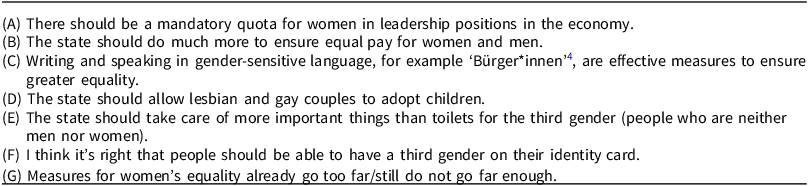

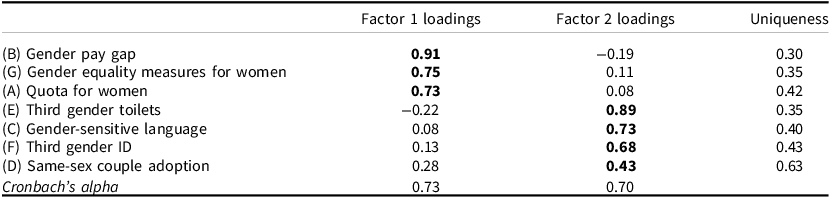
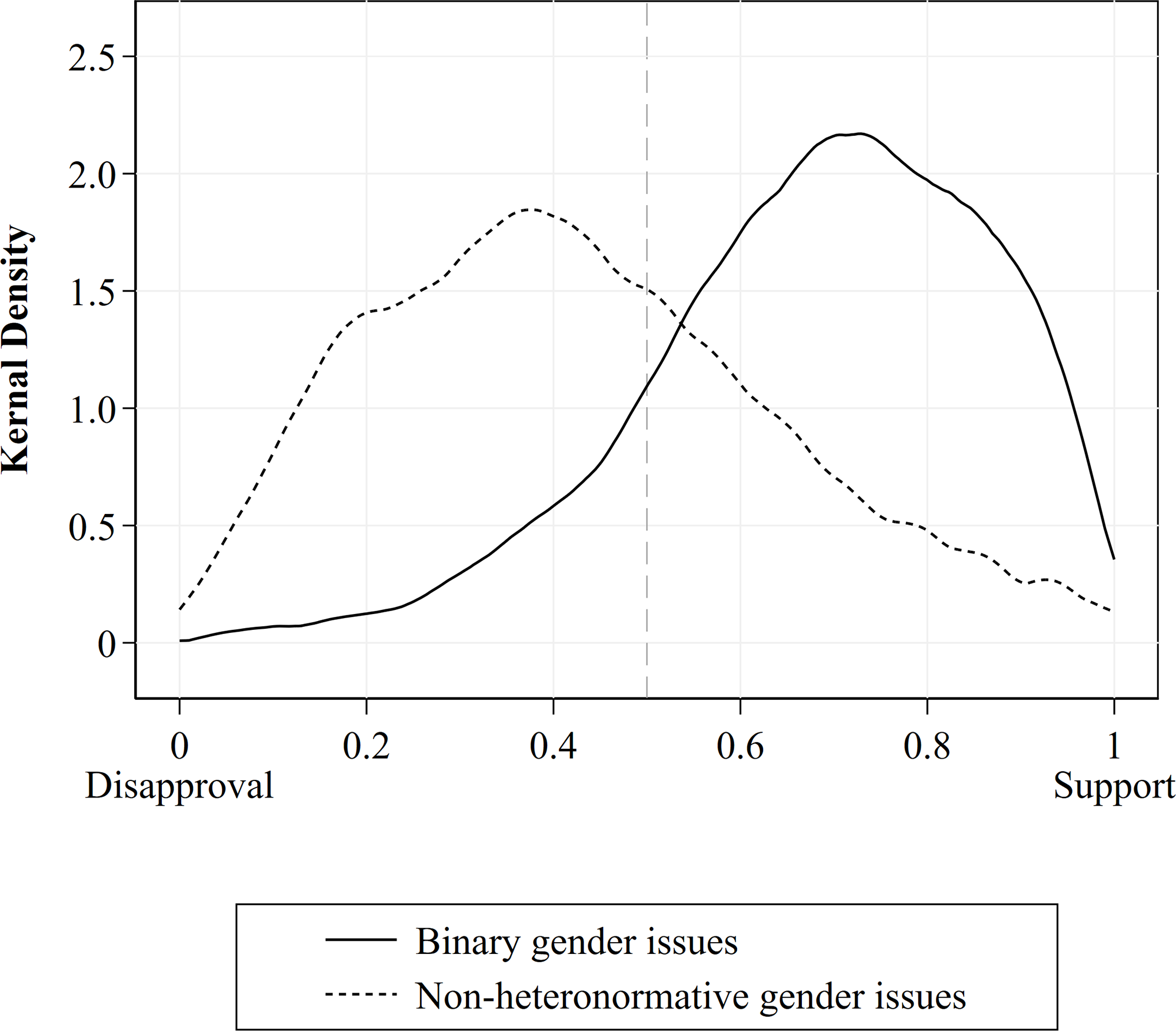

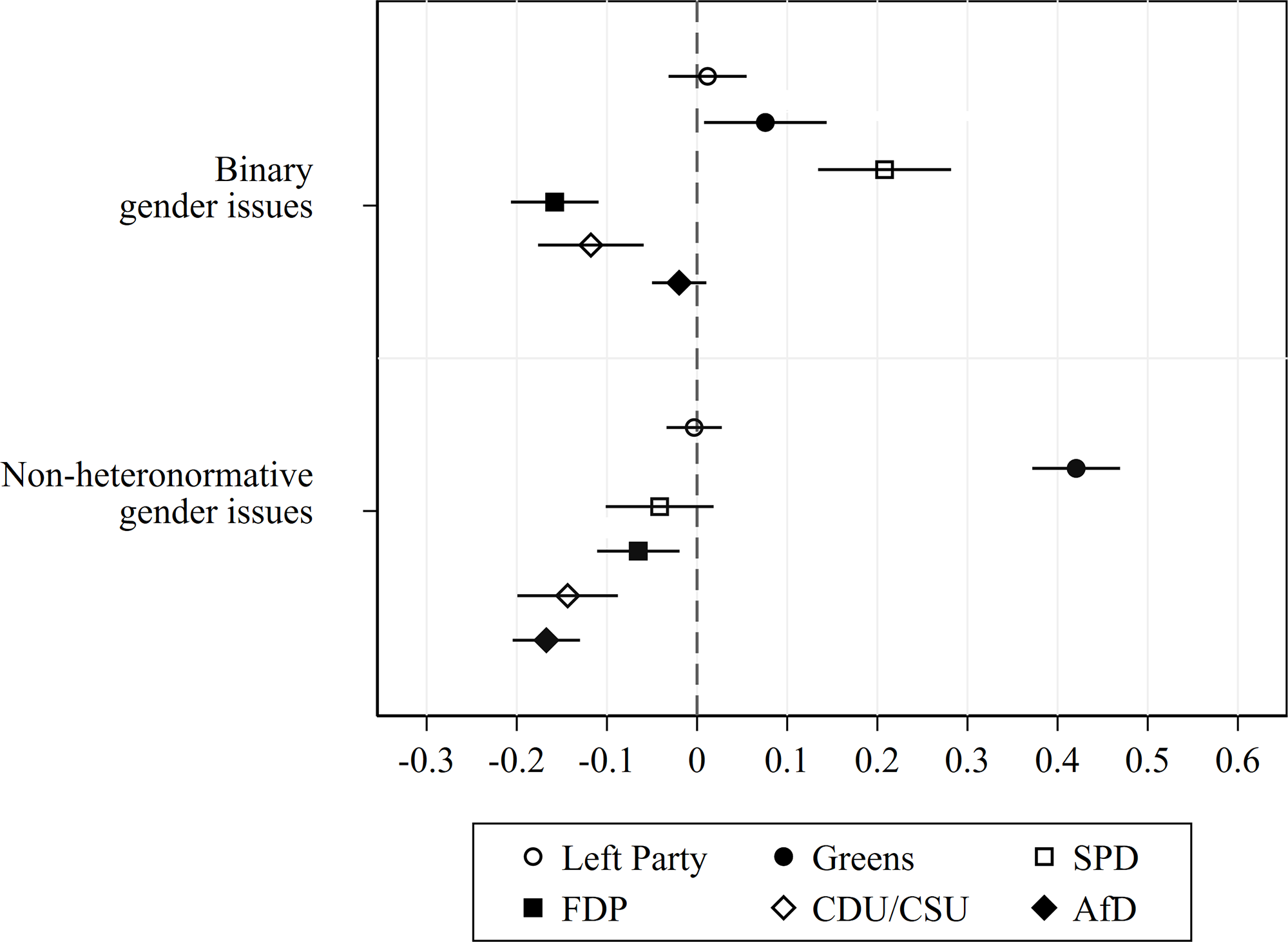


 Open access

