


Introduction
Beginning with the seminal work by Pitkin (Reference Pitkin1967), a large body of literature has asked whether citizens are better represented by politicians who share with them personal or biographical characteristics such as race or gender (Phillips, Reference Phillips1998; Young, Reference Young2000; Clayton et al., Reference Clayton, Josefsson, Mattes and Mozaffar2019; Lowande etal., Reference Lowande, Ritchie and Lauterbach2019). Central to the concept of “descriptive representation” is the view that legislators are more likely to act in the interests of those individuals with whom they share a politically salient trait, leading to better substantive representation in practice (Sobolewska et al., Reference Sobolewska, McKee and Campbell2018). Numerous studies have concluded that shared characteristics between legislators and citizens do in fact improve substantive representation in important ways (e.g., Bratton and Haynie, Reference Bratton and Haynie1999; Burden, Reference Burden2007; and for reviews, see Wängnerud, Reference Wängnerud2009 and Trounstine, Reference Trounstine2010). Some research also highlights the limitations of personal identity traits when other factors like partisanship and constituency conditions are accounted for (Saalfeld et al., Reference Saalfeld, Wüst and Petrarca2011; Childs and Lovenduski, Reference Childs, Lovenduski and Waylen2013; Wallace, Reference Wallace2014).
Most existing work on the consequences of descriptive representation focuses on just one characteristic in isolation, typically ethnicity, race, or gender (Clayton et al., Reference Clayton, Josefsson, Mattes and Mozaffar2019; Lemi, Reference Lemi2022). However, a more recent body of literature has begun to explore the impact of a small number of characteristics in combination (Montoya et al., Reference Montoya, Bejarano, Brown and Gershon2022; De Jong, Reference De Jong2025). Moreover, there are compelling reasons to believe that a wider set of personal characteristics, such as social class, educational background, and language, may also result in shared policy priorities (Mansbridge, Reference Mansbridge1999; Sobolewska et al., Reference Sobolewska, McKee and Campbell2018; Lupu and Warner, Reference Lupu and Warner2022). We also know from a growing body of research on intersectional group identities that multiple identity characteristics can combine to shape the political experiences, preferences, and behaviors of both citizens and politicians (Smooth, Reference Smooth2011; Mügge et al., Reference Mügge, Van der Pas and Van de Wardt2019; Siow, Reference Siow2023; De Jong and Mügge, Reference De Jong and Mügge2024). Thus, we follow the call made by Erzeel and Rashkova (Reference Erzeel and Rashkova2023) and Barnes and Holman (Reference Barnes and Holman2020) to contribute research that considers the representation of multiple group identities simultaneously as the basis for greater citizen-politician alignment.
In this article, we examine descriptive representation as a multi-dimensional phenomenon by assessing the cumulative impact of multiple shared traits between local government councillors and citizens on policy priority alignment (PPA) – the degree to which these actors share beliefs about the most important policy issues to address. We focus on priorities because, under constrained resources, citizens may generally agree on the desirability of many basic services, but disagree on which policies are the most important for politicians to focus on. While opinion alignment is neither necessary nor sufficient for substantive representation in practice, it is reasonable to expect that constituents will be better represented by politicians who share their views and priorities (Clayton et al., Reference Clayton, Josefsson, Mattes and Mozaffar2019). It can also be argued that substantive representation turns on the initial identification of interests and priorities (Lovenduski, Reference Lovenduski2005: 18–19). Moreover, policy priority alignment can allow us to better understand what underlying factors shape the perspectives of local politicians in representing the interests of their constituents.
Our second contribution is to offer one of the first large-scale empirical tests of multi-trait descriptive representation outside of the Global North. To do so, we employ original survey data about elected local councillors in urban and near-urban municipalities in South Africa, combined with multiple national representative citizen surveys to investigate the implications of a wide variety of descriptive factors on PPA. We ask: are elected representatives who descriptively mirror their constituents across an increasing number of identity categories more likely to share their policy priorities? The connection between descriptive and substantive representation is instructive in new democracies such as South Africa, where multiple social cleavages coexist alongside strong party brands, raising questions about the extent to which descriptive similarities between citizens and politicians shape policy priorities. Indeed, many scholars have sought to test the continued salience of race and ethnicity on issue resonance and party identification (Mattes and Piombo, Reference Mattes and Piombo2001; Patel et al., Reference Patel, Sadie, Sello, Megan and de Klerk2001; Garcia-Rivero, Reference Garcia-Rivero2006; Naidu, Reference Naidu, Pillay, Roberts and Rule2006; McLaughlin, Reference McLaughlin2007, Reference McLaughlin2008; Schulz-Herzenberg, 2014; Mattes, 2015; McClendon, 2016; Paret, Reference Paret2018). The institutional design of South Africa’s post-apartheid political system also yields diminishing returns for political parties that rely on narrow identity-based constituents, including weak regional structures and a proportional voting system that incentivizes the aggregation of constituents. Finally, South Africa’s party-political system has experienced increased fragmentation in recent years, especially in local government. As a result, there is a large share of the electorate for whom race is no longer a dominant or reliable conduit for prioritizing interests, and for whom other features such as class and education may be more compelling.
In addressing this question, we operationalize the concept of descriptive representation with a variable we term multi-dimensional descriptive representation (md-DR). We define md-DR as a property of the dyadic relationship between a citizen and an elected leader, which increases in value to the extent that members of the dyad share “sticky” (not easily changed) characteristics that constitute key aspects of their respective personal biographies. Such traits – which include race, ethnicity, gender, language, educational attainment, and experiences with poverty – are associated with distinctive lived experiences, socialization processes, and social networks that potentially influence policy preferences. We explore the hypothesis that increasing levels of md-DR lead to increased PPA between citizens and politicians. We also examine whether this link depends on particular trait combinations, such as those reinforcing intersectional privilege or disadvantage.
Our results broadly confirm both arguments. Across hundreds of thousands of dyadic relationships between local politicians and citizens who reside in the same municipalities in South Africa, we find a robust link between md-DR and PPA. This relationship holds across and within political parties and is especially strong for citizen-councillor pairs that share historically marginalized identity traits. We show that the substantive association of md-DR with PPA is just as strong as the link between party identification and PPA, even in a country with strong party brands. These results confirm the intuition that voters seeking to elect politicians who are most likely to share their policy priorities would do well to consider multiple identity characteristics beyond partisanship.
We also show that the design of South Africa’s local government system moderates the relationship between md-DR and PPA. We find that md-DR is most strongly associated with priority congruence for ward councillors, who are directly elected by voters in single-member districts, whereas it shows relatively weaker effects for PR councillors who are elected to municipal councils from a party’s candidate list based on a party’s proportional share of seats. Given that ward councillors work in smaller, highly localized districts and tend to have more frequent contact with constituents, this pattern suggests that md-DR may increase citizen-councillor policy priority alignment partly by increasing personal communication channels. Our findings here resonate with past research in the U.S. context that has found that under certain conditions, minority interests are better represented in local governments in the context of ward elections relative to “at-large” elections (Abott and Magazinnik, Reference Abott and Magazinnik2020).
In the remainder of this paper, we proceed as follows: First, we develop our propositions concerning the implications of md-DR for policy priority alignment. We then describe the context of our case – political representation in South Africa’s local government system. Third, we describe our research approach and data collection. Fourth, we report and discuss our findings. We conclude by detailing some implications of our research for democratic representation in local government.
Why multi-dimensional descriptive representation might align policy Priorities
Our central proposition, that md-DR will be associated with increased PPA, builds on established theories of descriptive representation. This literature proposes at least four theoretical mechanisms that link descriptive representation to PPA.
First, life experiences such as discrimination, privilege, or hardship are known to affect policy preferences (Peelen et al., Reference Peelen, Guerts and Glas2025). To the extent that descriptive traits correlate with such experiences, individuals and politicians who share descriptive characteristics may develop similar preferences and priorities (Mansbridge, Reference Mansbridge1999; Allen, Reference Allen2022). This is very likely for disadvantaged groups, who often experience intergenerational discrimination that strongly affects the course and quality of their lives (Sobolewska et al., Reference Sobolewska, McKee and Campbell2018).
Second, politicians may have a greater willingness to represent voters with whom they share descriptive characteristics due to feelings of solidarity and a sense of responsibility towards members of their own group (Mansbridge, Reference Mansbridge1999). Occasions where representatives respond to the concerns of group members residing outside of their own electoral district are often cited as evidence of this intrinsic motivation to represent (Swain, Reference Swain1993; Broockman, Reference Broockman2013). Feelings of group solidarity may in turn contribute to a politician’s desire to understand and to express the priorities of their constituents, leading to greater alignment on policy priorities.
Third, there is some evidence that citizens are more likely to contact and engage with representatives with shared individual-level traits, due to personal comfort and ease of communication. Legislators may therefore be more aware of the needs of descriptively aligned citizens due to preferential access to information (Gay, Reference Gay2002; Barnes and Burchard, Reference Barnes and Burchard2013), leading to greater opinion alignment.
Finally, electoral incentives may reinforce the link between descriptive representation and PPA. Representatives seeking re-election will focus their resources and energy on activities and policies that they believe will be most appealing to a critical mass of their constituents (Mansbridge, Reference Mansbridge2003; Norris, Reference Norris2004). Where politicians are elected in districts with high numbers of individuals from a shared group, representatives have incentives to prioritize and publicly express support for policies seen as aligned with those identities in the hope of gaining support for being a champion of those groups (Mansbridge, Reference Mansbridge2003; Sobolewska et al., Reference Sobolewska, McKee and Campbell2018).
To date, these mechanisms have been primarily examined in relation to just one or sometimes two descriptive traits. We argue, however, that their logic should also hold with increasing levels of trait similarity between citizens and politicians. To develop this argument, we begin by discussing the importance of widening the number of descriptive traits that we consider.
Among single-trait descriptive representation studies, gender is by far the most frequently studied characteristic. Numerous studies have concluded that women elected to public office tend to share more of the priorities of women voters, and provide better substantive representation for women in practice, than their male counterparts (Bratton and Haynie, Reference Bratton and Haynie1999; Hogan, Reference Hogan2008; Cowell-Meyers and Langbein, Reference Cowell-Meyers and Langbein2009; Piscopo, Reference Piscopo2011). Mansbridge (Reference Mansbridge2005: 622) goes so far as to say that “descriptive representation by gender improves substantive representation for women in every polity for which we have a measure.”
Ethnicity and race are also well-studied traits. According to Erzeel and Rashkova (Reference Erzeel and Rashkova2023), over 22.7 percent of publications on substantive representation between 1995 and 2021 focused on one of these two characteristics. Bratton and Haynie (Reference Bratton and Haynie1999) find that Black legislators in the United States are significantly more likely to introduce legislation focusing on Black interests; while Saalfeld et al. (Reference Saalfeld, Wüst and Petrarca2011) find that Black, Asian and minority-ethnic (BAME) Members of Parliament in the UK are more likely to articulate issues relevant to BAME constituents.
There are, however, good reasons to believe that characteristics beyond gender, race, and ethnicity will also be associated with PPA (Barnes and Holman, Reference Barnes and Holman2020). First, shared characteristics such as experience with poverty and educational background are also likely to inform shared life experiences, leading to a potential alignment in policy interests between public representatives and citizens (Peelen et al., Reference Peelen, Guerts and Glas2025). Like race and gender, these socioeconomic traits shape the lived environments of individuals over long periods of time and are not easily changed for adults. Economic class and education attainment also plausibly inform policy priorities in ways that cut across racial and gender cleavages.
Second, representatives from groups with some of these other shared characteristics may feel a similarly strong impulse to act in the specific interests of their community, leading to potentially strong alignment between the policy goals of politicians and the interests of citizens from the same groups. For example, politicians who experienced poverty growing up may feel more solidarity with their impoverished constituents and thus be more likely to prioritize issues like unemployment or affordable housing.
Finally, the argument that citizens are more likely to engage with representatives who “look like them” is, again, unlikely to be exclusive to race, ethnicity, and gender. Many other characteristics are also visible (or in the case of native language, audible) and important. While traits such as educational background or social class might be less obviously visible to citizens, many of them are more-or-less knowable to the general public, making it reasonable to expect that they can function along the same lines.
Thus, we propose that policy priority alignment between politicians and citizens should reflect multiple dimensions of descriptive representation. As political elites and voters share more traits in common, we expect their policy priorities to become increasingly aligned, irrespective of their political party identification. Note that this expectation is not initially obvious. After all, the increased importance of any single cleavage (for example, gender) could, in practice, lead to the reduced salience of other identity traits (e.g., race or class) when it comes to public policy preferences and priorities. We seek to test the explanatory value of descriptive representation considered as a multi-dimensional phenomenon with additive as well as interactive features with respect to policy priority alignment.
In advancing this argument, we build on a relatively new, but growing, body of literature on intersectionality in representation, which shows that overlapping identities do indeed seem to matter for representation (Bejarano et al., Reference Bejarano, Brown Nadia, Gershon and Montoya2021; Montoya et al., Reference Montoya, Bejarano, Brown and Gershon2022; Geurts et al., Reference Geurts, Glas, Sipma and Spierings2025; Peelen et al., Reference Peelen, Guerts and Glas2025). This literature highlights some of the important implications that arise when considering the combined traits of citizens and political elites. For example, Siow (Reference Siow2023) shows that intersectional descriptive representatives significantly improve the quality of representation for minoritized women. Similarly, Mügge et al. (Reference Mügge, Van der Pas and Van de Wardt2019, 705) argue that an intersectional analysis can show how the relationship between descriptive and substantive representation “differs within and between gender and ethnic groups”, while Smooth (Reference Smooth2011) finds that female African American state legislators articulate political agendas that reflect complex and multifaceted notions of identity.
We build on this literature in two key ways. First, we consider a broader set of descriptive characteristics than the intersectionality literature to date, which has tended to mirror the larger literature on descriptive representation by focusing almost exclusively on gender, race and ethnicity to the exclusion of other socioeconomic characteristics (though see Peelen et al., Reference Peelen, Guerts and Glas2025; and De Jong, Reference De Jong2025 for examples of more varied approaches). By evaluating the link between policy priority alignment and a multi-dimensional index of mass-elite trait alignment, we seek to provide empirical validation for Dovi’s insight that “how race can work in conjunction with class is relevant to determining who is a preferable descriptive representative” (Dovi, Reference Dovi2002: 741).
Second, whereas existing research on intersectional representation has been primarily focused on the intersection of characteristics in marginalized groups (Hawkesworth, Reference Hawkesworth2003; Htun, Reference Htun2016; Brown and Gershon, Reference Brown and Gershon2017; Montoya et al., Reference Montoya, Bejarano, Brown and Gershon2022; Siow, Reference Siow2023), we broaden the aperture to explore whether identity trait combinations also impact mass-elite policy priority alignment. We seek to characterize the general relationship between increasing levels of descriptive representation and opinion congruence, while also considering whether combinations of traits associated with marginality within society are more strongly predictive of PPA relative to other types of trait combinations. Thus, we provide a novel test of claims by intersectionality theorists that individuals with multiple disadvantaged traits are “multiply burdened” (Crenshaw, Reference Crenshaw1989) in the domain of mass-elite democratic representation, and we respond to Hancock’s (Reference Hancock2007) call to employ intersectionality as an empirical research paradigm.
The discussion above yields our two key hypotheses:
H1: Increased md-DR should be associated with increased PPA
H2: The md-DR-PPA link should be stronger for trait combinations associated with marginalized identities and backgrounds
Finally, it is also worth noting that we consider priority alignment across a wide range of policy issues. This helps us address another limitation in the existing literature, which is that most studies focus on the consequences of descriptive representation only for issues related to the characteristic of interest (Clayton et al., Reference Clayton, Josefsson, Mattes and Mozaffar2019). For example, work on gender tends to focus on the ways in which the presence of women in government affects representation on women’s issues, such as legislation promoting women’s interests (Swers, Reference Swers2002; Taylor-Robinson and Heath, Reference Taylor-Robinson and Heath2003) or beliefs around gender equality (Lovenduski and Norris, Reference Lovenduski and Norris2003; Campbell et al., Reference Campbell, Childs and Lovenduski2010; Childs and Lovenduski, Reference Childs, Lovenduski and Waylen2013). As a result, we know little about whether shared descriptive characteristics impact opinion alignment on a wider range of policy issues.
Studying md-DR in South Africa’s local government system
We study the relationship between md-DR and PPA at the local government level in South Africa, focusing on the relationship between voters and local government councillors in urban and near-urban municipalities across the country. Several factors make local government in South Africa an appealing site for exploring the link between md-DR and PPA.
First, South Africa is a diverse, increasingly competitive, and multi-party polity – especially in more urbanized areas, where citizens and politicians hail from a wide variety of demographic backgrounds and support a diversity of issues and political parties.
Second, South Africa has a unique mixed electoral system at the local level, with approximately half of all councillors in municipalities being directly elected to represent single-member wards, and the other half being appointed to PR seats via party lists and seat allocations. The adoption of a dual system of direct and indirectly elected councillors was intended to balance collective interests amid the highly unequal and racialized urban geography of South Africa, with the unique needs of constituents residing in specific areas. It also serves to moderate and constrain the individual agency that ward councillors can exercise at an area level to advocate for the rights and aspirations of their constituents within an increasingly centralized and bureaucratized municipal system (De Visser, Reference De Visser2009; Smith and De Visser, Reference Smith and de Visser2009; Millstein, Reference Millstein2010; Paradza et al., Reference Paradza, Mokwena and Richards2010; Vivier and Wentzel, Reference Vivier and Wentzel2013; Naidoo, Reference Naidoo2021).
Crucially, this dual system allows us to investigate the potential intervening factors between md-DR and PPA by comparing local politicians who perform different institutional roles and have potentially different relationships with their constituents. For instance, ward councillors have been saddled with a more labor-intensive role of being the primary agent of democracy and development to residents in their areas. They are tasked with building trust and presiding over legislated and non-legislated channels of citizen participation such as ward committees and other community forums. Yet they are also perceived as enjoying less status and career prospects than their PR counterparts, who are more likely to serve on central municipal executive structures and rise more quickly up party ranks to other levels of government (Piper, Reference Piper and Booysen2012; Wegner, Reference Wegner2018). Ward councillors are also more likely to be incentivized to respond to citizen pressures to “get things done” and meet the immediate needs of their constituents compared to PR councillors (Lieberman et al., Reference Lieberman, Martin and McMurry2017).
A third benefit of the South African case is that the scholarly literature to date has focused overwhelmingly on representation in the Global North,Footnote 1 especially Europe and the United States. Our study aims to improve an understanding of the implications of descriptive representation outside of Western Europe and North America. Despite the rich context for studying descriptive representation, only a few scholars have contributed empirical data to related questions in the South African context. As with the wider literature, most of these works have focused narrowly on gender (Albertyn, Reference Albertyn, Dobrowolsky and Hart2003; Nwankwor, Reference Nwankwor2021); race (Ferree, Reference Ferree2006), or the two together (Lieberman, Reference Lieberman2012). Significant gaps remain in our understanding of both md-DR and mass-elite opinion alignment in the South African political arena.
Data and empirical analysis
To assess whether md-DR is associated with increased PPA, we study the traits and attitudes of politicians and citizens from the same local government jurisdictions. We consider the extent to which the number of shared trait dimensions influences agreement on policy prioritization. We also investigate whether certain combinations of traits – particularly those that reinforce intersectional marginalization – impact the md-DR-PPA link.
We collate data from two original surveys of South African councillors, one conducted in 2016 (n = 1019), and the second conducted in 2022 (n = 659), as well as several large-scale surveys of ordinary citizens administered by a variety of organizations. These include the 2016 South African Social Attitudes Survey (SASAS) (n = 3079), the 2016 Round 6 Afrobarometer (n = 2390), the 2021 Round 8 Afrobarometer (n = 1600), and the 2022 Round 9 Afrobarometer (n = 1580). In total, we analyze a sample of 1,678 politicians from 27 different parties, along with 8,649 citizens, which combine to create 296,265 dyadic representative relationships across 39 urban and near-urban municipalities.Footnote 2
To establish the plausible importance of increased levels of md-DR for the quality of democratic representation in South Africa, a necessary first step is to verify whether politicians exhibit variation in policy priorities across different descriptive identity dimensions. We therefore begin by evaluating the extent to which our descriptive traits of focus – race, gender, language, educational attainment, and experience with poverty – are associated with different policy priorities among the politicians in our sample. We treat party affiliation as a point of comparison, given that party labels are generally understood to be key to how citizens make choices about representation in South Africa (Booysen, Reference Booysen2012; Mattes et al., Reference Mattes, Krönke, Lockwood, Poguntke and Hofmeister2024). In fact, South Africa is a hard test for demonstrating the impact of descriptive traits on policy opinions because parties tend to hold distinctive positions on a range of policies, with much stronger party brands than in most other countries in Africa. Because party affiliation is not perfectly captured by descriptive traits, we can consider the additional value of descriptive representation for PPA.
Figure 1 plots the differences in the frequency with which councillors identified different issues as a “top 3 priority” across each trait dimension, providing a visual depiction of the correlation between trait differences and policy prioritization. Perhaps not surprisingly in a country long known for racialized politics and substantial race-based inequalities, we find the most sizeable differences in policy prioritization between councillors of different racial groups, as well as sizeable gaps in the expressed priorities of ANC versus non-ANC councillors. Among the other traits, language appears to be the most consistently important cleavage for issue prioritization, but for each dimension we find some degree of priority divergence. In Appendix Figure A2 online we show that these descriptive traits also correlate with significant gaps in politicians’ policy preferences on issues like immigration, taxation and service delivery, and government accountability.
Policy priority gaps by issue and cleavage (politicians). Differences that are statistically significant at the 0.05 level using a two-sample t test are indicated with solid dots.

Figure 1. Long description
Panel A: A scatter plot showing differences in policy priorities by race. The x-axis represents the difference in percentages, and the y-axis lists various issues. Solid dots indicate statistically significant differences at the 0.05 level. Panel B: A scatter plot showing differences in policy priorities by gender. The x-axis represents the difference in percentages, and the y-axis lists various issues. Solid dots indicate statistically significant differences at the 0.05 level. Panel C: A scatter plot showing differences in policy priorities by poverty status. The x-axis represents the difference in percentages, and the y-axis lists various issues. Solid dots indicate statistically significant differences at the 0.05 level. Panel D: A scatter plot showing differences in policy priorities by education level. The x-axis represents the difference in percentages, and the y-axis lists various issues. Solid dots indicate statistically significant differences at the 0.05 level. Panel E: A scatter plot showing differences in policy priorities by language. The x-axis represents the difference in percentages, and the y-axis lists various issues. Solid dots indicate statistically significant differences at the 0.05 level. Panel F: A scatter plot showing differences in policy priorities by political affiliation. The x-axis represents the difference in percentages, and the y-axis lists various issues. Solid dots indicate statistically significant differences at the 0.05 level.
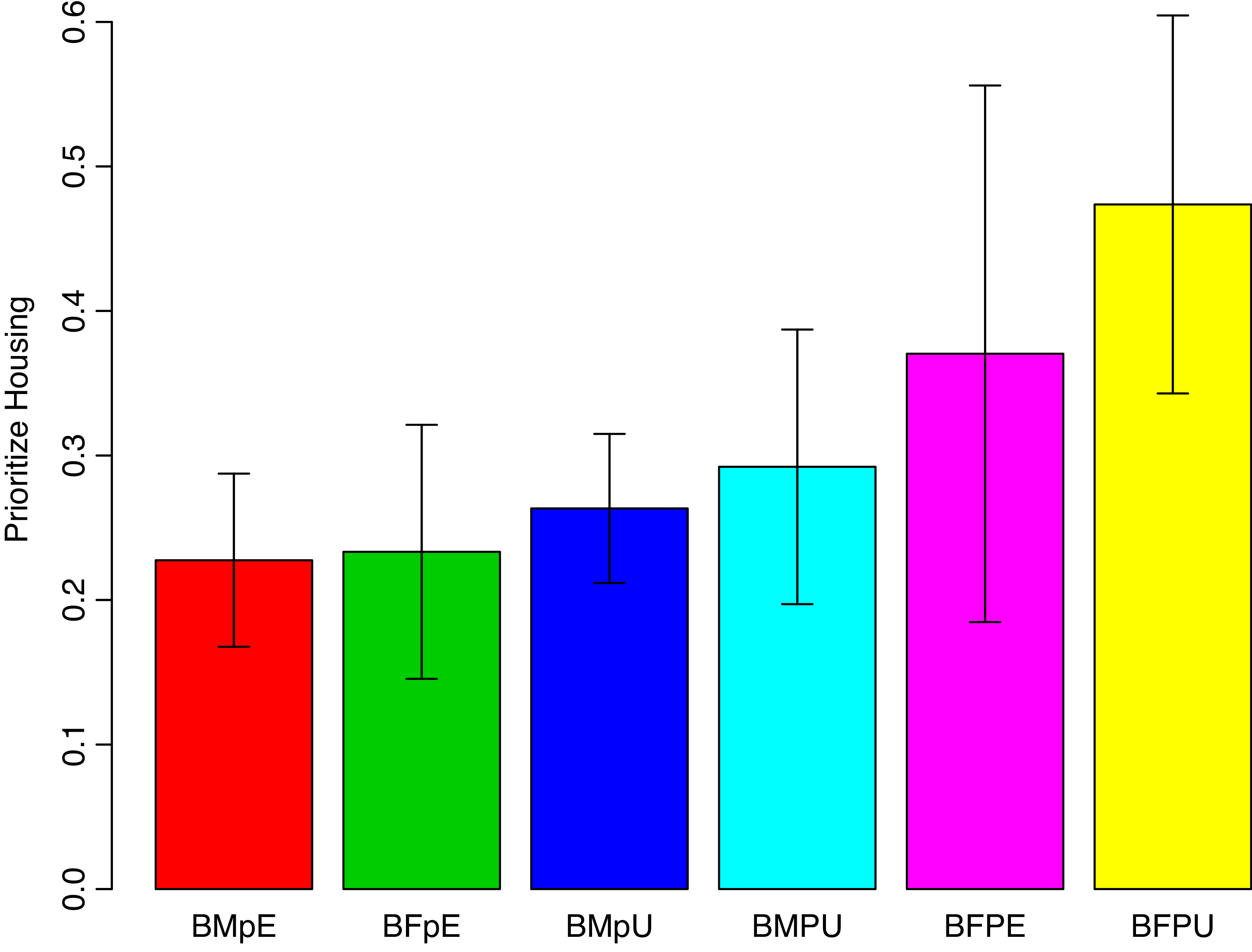
We next consider whether combinations of descriptive traits – particularly those that reinforce historical marginalization – can be predictive of politicians’ policy priorities. Figure 2 compares housing prioritization among select groups of politicians that differ in terms of race, gender, experiences of lived poverty, and education. We use housing prioritization for illustrative purposes because the issue has a significant degree of priority variance across all identity traits, but not across political parties. Moreover, all of the subgroups in Figure 2 represent a plausible set of counterfactuals in South African local democracy, and a non-trivial number of councillors in our sample have these repertoires of traits. The plot shows how the policy priority gaps associated with single traits illustrated in Figure 1 can have powerful interactive properties. While women councillors, those who have experienced lived poverty, and less educated councillors are all somewhat more likely to prioritize housing on average (as shown in Figure 1), Black councillors with all of these traits are much more likely as a group to prioritize housing (48 percent) than are Black councillors who are male, not poor, and highly educated (22 percent).
Housing prioritization among politicians across select identity combinations. B = Black, M = Male, F = Female, p = not Poor, E = Educated, P = Poor, U = Uneducated. 95 percent confidence intervals shown.

Thus, we see that along each of the trait dimensions included in our framework, politicians do, on average, vary in their policy priorities. While some traits have greater individual weight than others – race and language appear to be especially meaningful cleavages – all of the traits we include in our md-DR variable are plausibly relevant for the policy priorities of politicians in at least some domains. Moreover, these descriptive traits can have powerful additive and interactive properties, as illustrated by the example of housing prioritization. Having established these patterns, we now turn to our central question: do increasing levels of md-DR between politicians and citizens lead to higher policy priority alignment?
Md-DR and opinion alignment among politician-citizen dyads
At the heart of our contribution is establishing whether md-DR significantly contributes to attitudinal congruence between politicians and citizens in South Africa with respect to policy prioritization. We adapt the approach of Lupu and Warner (Reference Lupu and Warner2022) and construct citizen-politician dyads as our unit of analysis. That is, for each politician surveyed, we matched that politician with every citizen in the same municipal council jurisdiction that was surveyed within a year of the respective politician survey. For example, each politician surveyed in 2016 was paired with each citizen in the corresponding municipality from the 2016 SASAS and Afrobarometer surveys, and each politician surveyed in 2022 was paired with each municipally matching respondent from the 2021 and 2022 Afrobarometer surveys. This process generated a total of 296,265 relevant citizen-politician dyads for analysis.Footnote 3
Having constructed the dyads, we then characterized each dyad in terms of the degree of congruence of both descriptive traits and policy priorities between the respective individuals. For each dyad, the variable md-DR gains one point when each of the following is true:
-
• Same race. The citizen and politician belong to the same racial population group (Black, White/European, Colored, or Indian/Asian).
-
• Same home language. The citizen and politician speak the same language in the home (English, Afrikaans, Tshivenda, Xitsonga, isiZulu, isiXhosa, isiNdebele, Siswati, Sepedi, Setswana, Sesotho, or other).
-
• Same gender. The citizen and politician identify as the same gender (Male or Female).Footnote 4
-
• Same poverty experience. The citizen and politician both report that they have/have not gone without enough food to eat at least once in the last year.
-
• Same education. The citizen and politician were in the same of three categories of educational attainment: less than grade 12/matric,Footnote 5 finished grade 12/matric, or beyond grade 12.
We measure PPA between councillors and citizens by focusing on the ten most frequently mentioned priorities for government (economy/poverty/unemployment, education, crime/violence, housing, service delivery, corruption, HIV/health, land, racism/xenophobia, and gender/family/culture). Each dyad is coded 1 if both the citizen and politician mentioned that issue as a top three priority and 0 otherwise. To calculate an overall alignment score, we take the sum of priority congruence dummy variables, and then divide by the total number of issues listed by the politicians. This method allows us to account for the fact that some politicians in our survey listed more than three issues.Footnote 6 In those cases, the overall alignment score is down-weighted to adjust for the fact that politicians who list more priorities are more likely to find themselves in agreement with citizens on at least some issues.
Admittedly, this outcome measure does not capture politicians’ actual legislative behavior. Nonetheless, we maintain that priority alignment is a necessary first step for the process of substantive representation to occur. Politicians’ responses indicate what types of issues they think should be prioritized, and this provides an indication of whether politicians have a propensity to represent constituents’ interests by advocating for action on that issue formally or informally. Moreover, most bills in South Africa are introduced to the legislature by the Executive (Calland and Taylor, Reference Calland and Taylor1997), making it hard to deduce representative priorities from legislative behavior.
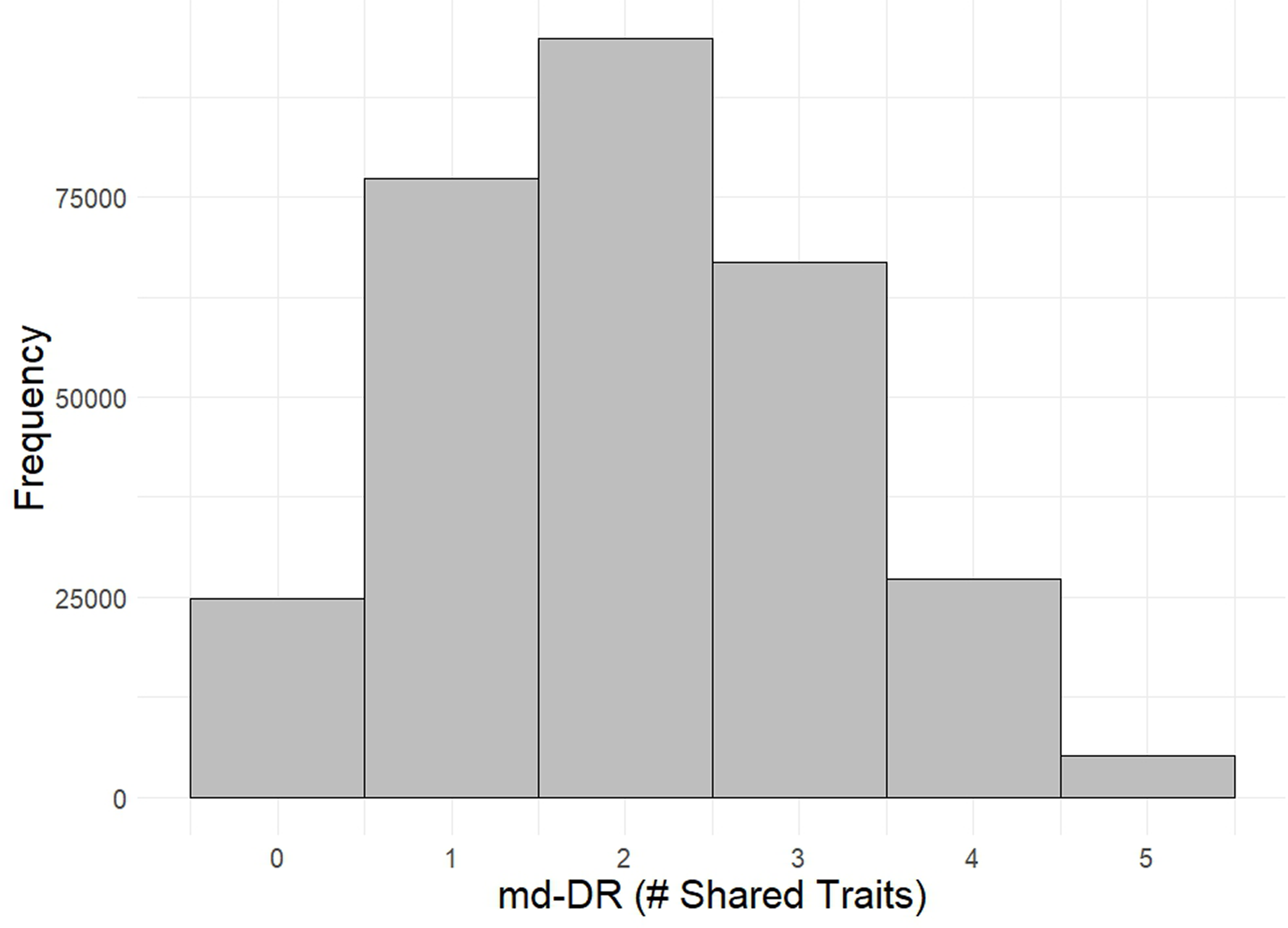
Figures 3 and 4 display the distribution of policy priority alignment and md-DR across all citizen-politician dyads in our dataset. The graphs demonstrate that there is a wide distribution of values on both measures.
Distribution of policy priority alignment in the dyadic data.

Distribution of md-DR in the dyadic data.

The dyadic nature of our dataset allows us to flexibly analyze the relationship between shared identity traits and substantive issue congruence among citizens and politicians in South Africa. We estimate the predictive value of md-DR on policy priority alignment with two main specifications. First, we use a simple ordinary least square (OLS) linear model that regresses policy priority alignment on md-DR, conditioning on shared political party and including fixed effects for municipality and councillor party.Footnote 7 Shared political party is a binary measure of whether there is alignment between the politician’s party and the citizen’s chosen party when asked who they would vote for if an election were held today. Second, we estimate a linear mixed effects model that includes random effects for politicians and citizens in order to account for dyadic dependencies. This second specification allows us to directly model the link between a dyad’s shared identity traits and policy priority alignment while adjusting for variation arising from individual citizens and politicians, parties, and municipalities.
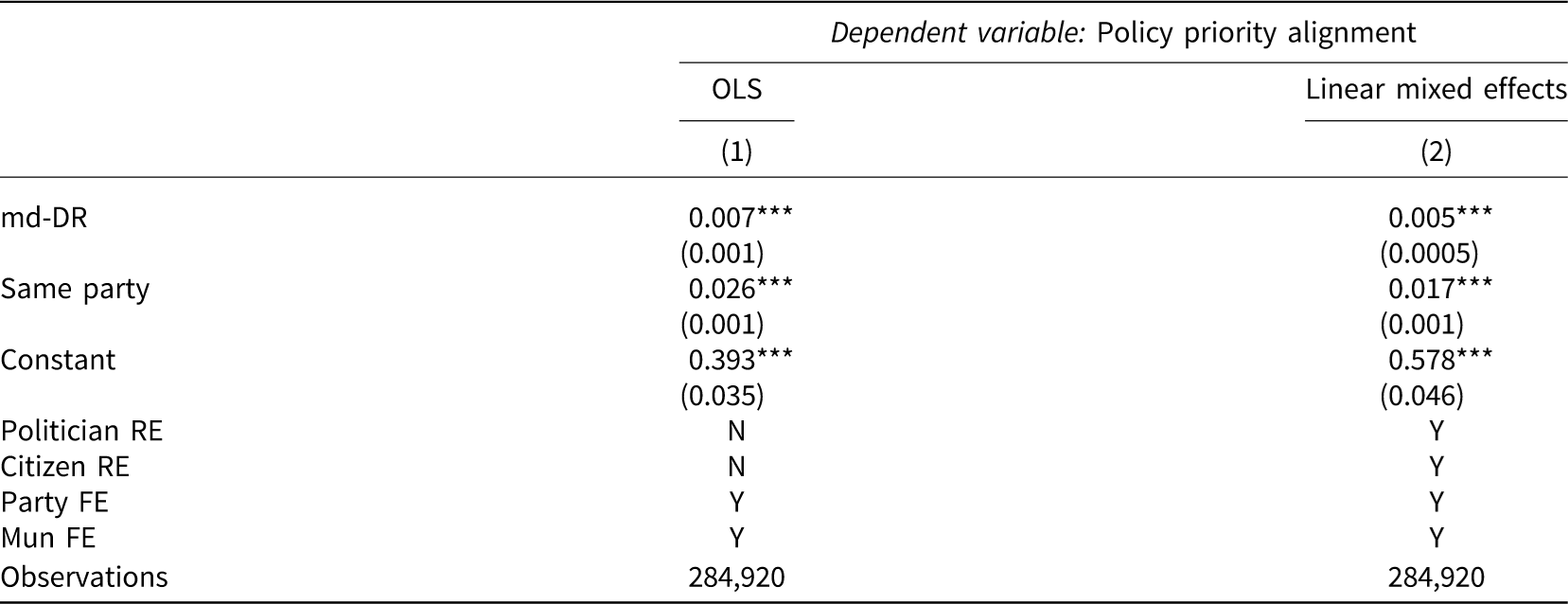
The results support the central proposition that increased levels of md-DR are associated with increased policy priority alignment, even after netting out the effects of party affiliation. We present the findings from our dyadic analyses in Tables 1–3. As shown in column 1 of Table 1, an increase in one dimension of md-DR leads to an average 0.7 percentage point increase in priority alignment even after controlling for political party congruence – which itself is associated with a 2.6 percentage point increase in likelihood of priority congruence. Column 2 shows results from the linear mixed effects model with random effects for citizens and politicians, which produces broadly similar estimates.
md-DR and Policy priority alignment among citizen-politician dyads

Table 1. Long description
A table comparing policy priority alignment using OLS and Linear mixed effects models. The table has 6 rows and 3 columns. Column headers are OLS, Linear mixed effects, and empty. Row labels are md-DR, Same party, Constant, Politician RE, Citizen RE, Party FE, Mun FE, Observations. Row 1: OLS, 0.007***, 0.005***; Linear mixed effects, empty. Row 2: OLS, 0.026***, 0.017***; Linear mixed effects, empty. Row 3: OLS, 0.393***, 0.578***; Linear mixed effects, empty. Row 4: OLS, N, Y; Linear mixed effects, empty. Row 5: OLS, N, Y; Linear mixed effects, empty. Row 6: OLS, Y, Y; Linear mixed effects, empty. Row 7: OLS, Y, Y; Linear mixed effects, empty. Row 8: OLS, 284920, 284920; Linear mixed effects, empty.
Note: *p < 0.1; **p < 0.05; ***p < 0.01.
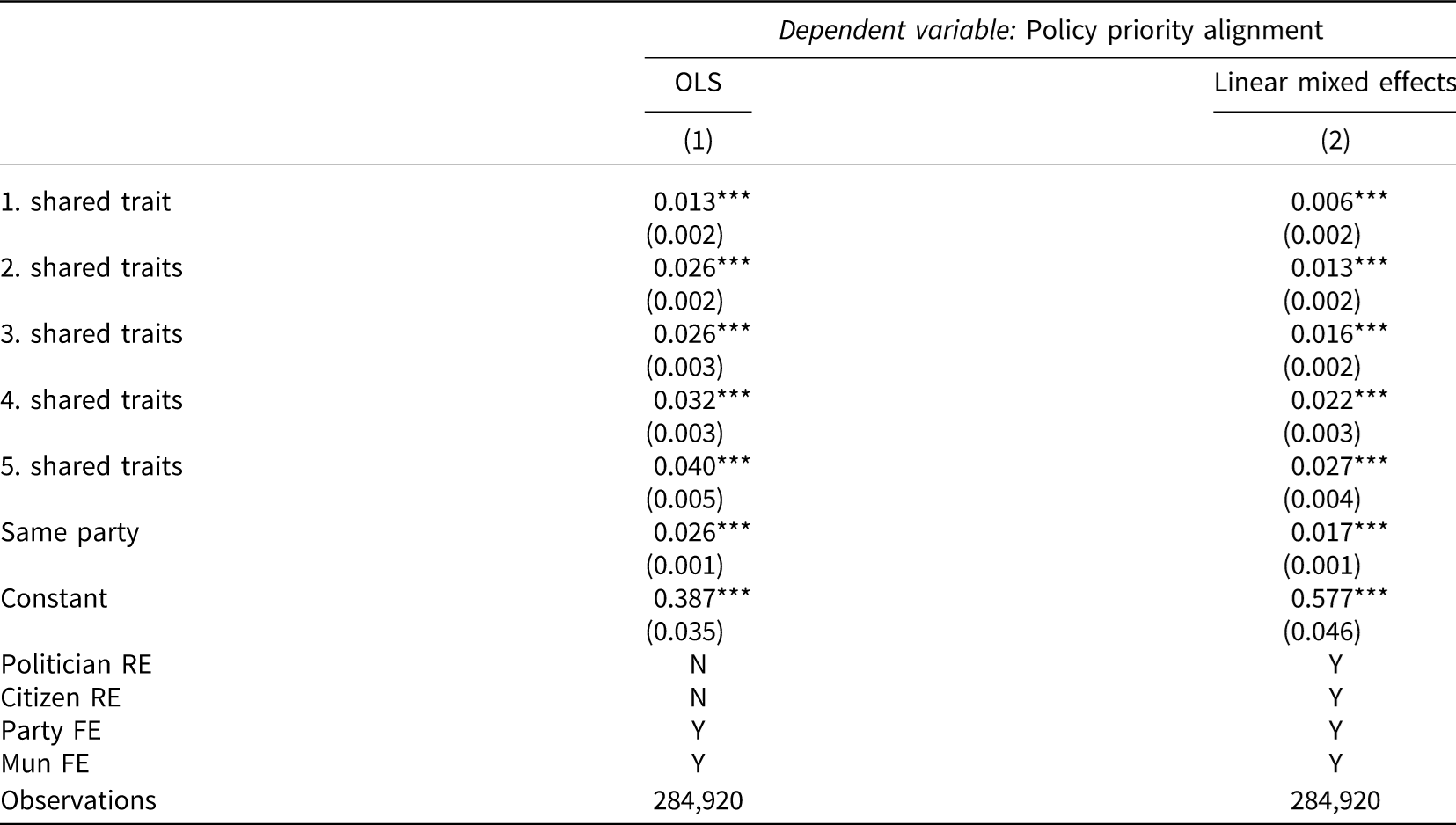
md-DR levels and Policy priority alignment among citizen-politician dyads

Table 2. Long description
The table presents data on policy priority alignment among citizen-politician dyads, comparing OLS and linear mixed effects models. It has 12 rows and 6 columns. The columns are labeled ʼ1 shared traitʼ, ʼ2 shared traitsʼ, ʼ3 shared traitsʼ, ʼ4 shared traitsʼ, ʼ5 shared traitsʼ, ʼSame partyʼ, ʼConstantʼ, ʼPolitician REʼ, ʼCitizen REʼ, ʼParty FEʼ, ʼMun FEʼ, and ʼObservationsʼ. Row 1: 1 shared trait, 0.013, 0.006, (0.002), (0.002). Row 2: 2 shared traits, 0.026, 0.013, (0.002), (0.002). Row 3: 3 shared traits, 0.026, 0.016, (0.003), (0.002). Row 4: 4 shared traits, 0.032, 0.022, (0.003), (0.003). Row 5: 5 shared traits, 0.040, 0.027, (0.005), (0.004). Row 6: Same party, 0.026, 0.017, (0.001), (0.001). Row 7: Constant, 0.387, 0.577, (0.035), (0.046). Row 8: Politician RE, N, Y. Row 9: Citizen RE, N, Y. Row 10: Party FE, Y, Y. Row 11: Mun FE, Y, Y. Row 12: Observations, 284,920, 284,920.
Note: *p < 0.1; **p < 0.05; ***p < 0.01.
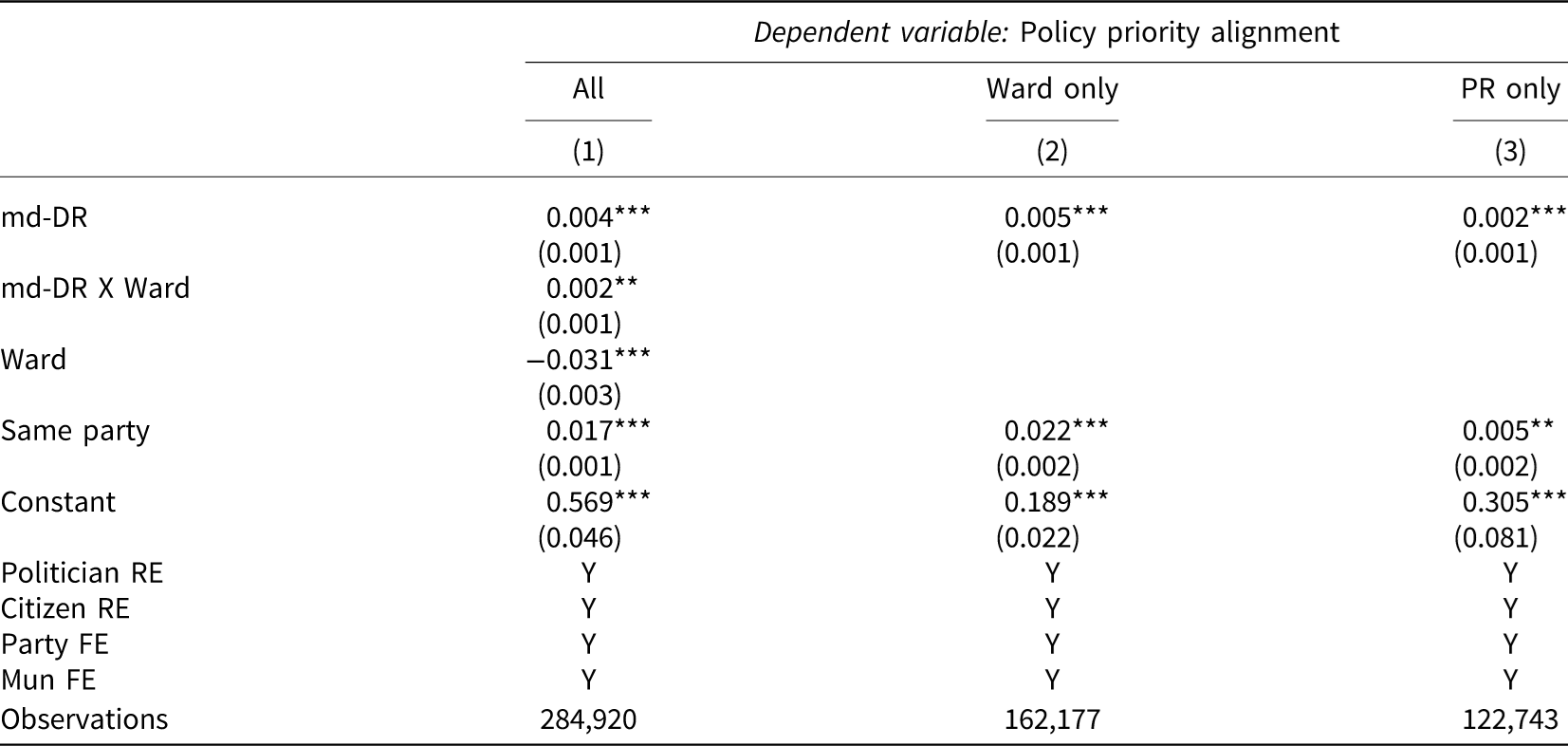
The conditioning effect of politician roles – Ward vs PR

Table 3. Long description
A table with three columns and eight rows, showing the effect of politician roles on policy priority alignment. The columns are labeled ʼAllʼ, ʼWard onlyʼ, and ʼPR onlyʼ. The rows include variables such as md-DR, md-DR X Ward, Ward, Same party, Constant, Politician RE, Citizen RE, Party FE, Mun FE, and Observations. Each cell contains numerical values or indicators. The table presents data on how different factors influence policy priority alignment, with specific values for each variable under different conditions.
Note: *p < 0.1; **p < 0.05; ***p < 0.01.
At the extreme, our dyadic analyses imply that going from zero descriptive representation to full descriptive representation (matching on all traits) would lead to an estimated 3.5 percentage point average increase in policy priority alignment. Normalizing by the standard deviation of the outcome variable, a shift from the minimum to maximum level of md-DR results in an approximately 0.11 standard deviation increase in policy priority alignment for the average dyad. Or, to take a less extreme example, shifting a politician-citizen dyad from only 1 shared trait to 4 shared traits would lead to an estimated 2.1 percentage point increase in policy priority alignment, or a 0.06 standard deviation increase. By comparison, matching citizens and politicians to the same party results in an approximately 0.08 standard deviation increase in policy priority alignment. As another way of interpreting the meaning of these differences, consider that the mean for policy priority alignment is about 0.49 for dyads with the highest value of md-DR (full trait alignment). This means that with an effect size of 0.035, citizens who have no descriptive similarities to a local politician can expect the policy priorities of that politician to be about 7 percent further from them compared to citizens with fully aligned descriptive traits. Citizens misaligned on party, meanwhile, can expect politicians’ priorities to be about 5 percent further away compared to those aligned on party. Thus, while the effect sizes are modest overall, md-DR appears to account for a comparable amount of variance in PPA as party identification.
The results presented so far suggest that, on average, md-DR increases policy priority alignment. But is this relationship linear, as the model assumes? That is, does increased trait overlap between citizens and politicians result in roughly equivalent increases in policy priority alignment at each level of descriptive congruence? In Table 2, we present non-parametric estimates, which consider the effects of each level of md-DR separately (relative to a baseline of zero trait overlap) so as to not impose a linear functional form on the model. The estimates confirm a generally consistent upward trend in policy priority alignment along with increased md-DR. While there is no difference between dyads with two versus three traits in common in the baseline OLS model, all other level jumps in md-DR yield a roughly similar increase in policy priority alignment.
Of course, it is important to recall the distribution of the variance of md-DR within the polity. As shown in Figure 4 above, only a relatively small share of the dyads are characterized by either zero or complete trait overlap. Citizens will thus rarely confront two councillors within their municipality that reflect these opposite poles of descriptive representation, limiting their ability to capitalize on the potential benefits of a 5-dimension gain in md-DR. But 2- or 3-dimension gains are quite plausible, and such shifts in md-DR are still substantively meaningful for increasing policy priority alignment. Moreover, increasing shared traits continues to lead to statistically significant increases in PPA even among citizen-politician dyads who already share traits like race and gender, underlining that no single identity characteristic dominates the link between descriptive representation and priority alignment.
Next, we evaluate whether citizen-politician overlap on disadvantaged versus advantaged identity traits is associated with different levels of PPA. We code two alternate versions of md-DR, one that counts only shared historically disadvantaged traits (non-white, female, less educated, poverty experience, and non-English/non-Afrikaans language) and one that counts only shared historically privileged traits. The results, displayed in Figure 5, indicate that overlapping traits on the disadvantaged dimension are indeed more powerful (about three times the magnitude) than overlapping traits on the privileged dimension. These findings resonate with past work on descriptive representation (which suggest that when it comes to single identity traits, politicians who share marginalized identities with voters provide stronger substantive representation), while also providing empirical support for a key argument made in the intersectionality literature.
Estimated influence of md-DR on policy priority alignment for disadvantaged and privileged traits. Linear mixed effects specification. See Table A3 in the Appendix for full regression results.

To dig deeper into the potential reason that md-DR is linked to PPA, we analyze politicians’ institutional roles as a potential moderator of the md-DR-PPA link. In so doing, we recognize that some politicians may be better positioned to act as delegate representatives rather than as trustee representatives – the former more attuned to ideological congruence, the latter evaluated for competence (Fox and Shotts, Reference Fox and Shotts2009).Footnote 8 Recall that existing theories of descriptive representation posit different explanatory channels for our focus of delegate representation. By distinguishing the impacts of md-DR among ward and PR councillors separately, we provide an exploratory test (admittedly indirect) of a channel based on citizen-politician contact. If md-DR increases PPA because citizens are more likely to engage with and communicate their views to representatives who “look like them” across multiple traits, then we should see a stronger md-DR-PPA link for ward councillors whose roles involve more direct contact with constituents. By contrast, if shared traits matter for opinion alignment primarily for other reasons (such as life experiences or general feelings of group solidarity), then we would expect to see little difference in the md-DR-PPA link between ward and PR politicians.
We find that politicians’ institutional roles moderate the md-DR-PPA link. In Table 3, we estimate separately the predictive value of md-DR for policy priority alignment among dyads where the councillor was directly elected to represent a single ward, or as an “at-large” representative who received their seat via party lists and with seat allocations determined by proportional representation voting. Column 1 includes an interaction term between md-DR and ward, which is positive and statistically significant. Comparing columns 2 and 3, we find that the estimated coefficient for md-DR is more than twice as large for ward councillors as it is for PR councillors. Policy priority alignment is also stronger for citizens and politicians with shared party identity among ward councillors compared to PR councillors.
While there are multiple potential reasons that descriptive representation correlates more strongly with PPA for ward councillors compared to PR councillors, we suspect that these patterns may be attributable to differences in citizen-politician communication. Ward councillors in South Africa are more likely to have face-to-face contact with constituents on a regular basis, and citizens seeking such contact may be more comfortable approaching and communicating their views to councillors who share with them multiple identity traits. This interpretation is consistent with past research linking descriptive representation to constituent-representative contact and communication (Bowen and Clark, Reference Bowen and Clark2014). We acknowledge, however, that other factors may also be relevant such as differences in the types of politicians who select into ward versus PR roles, and that further research is necessary to directly test this communication channel.
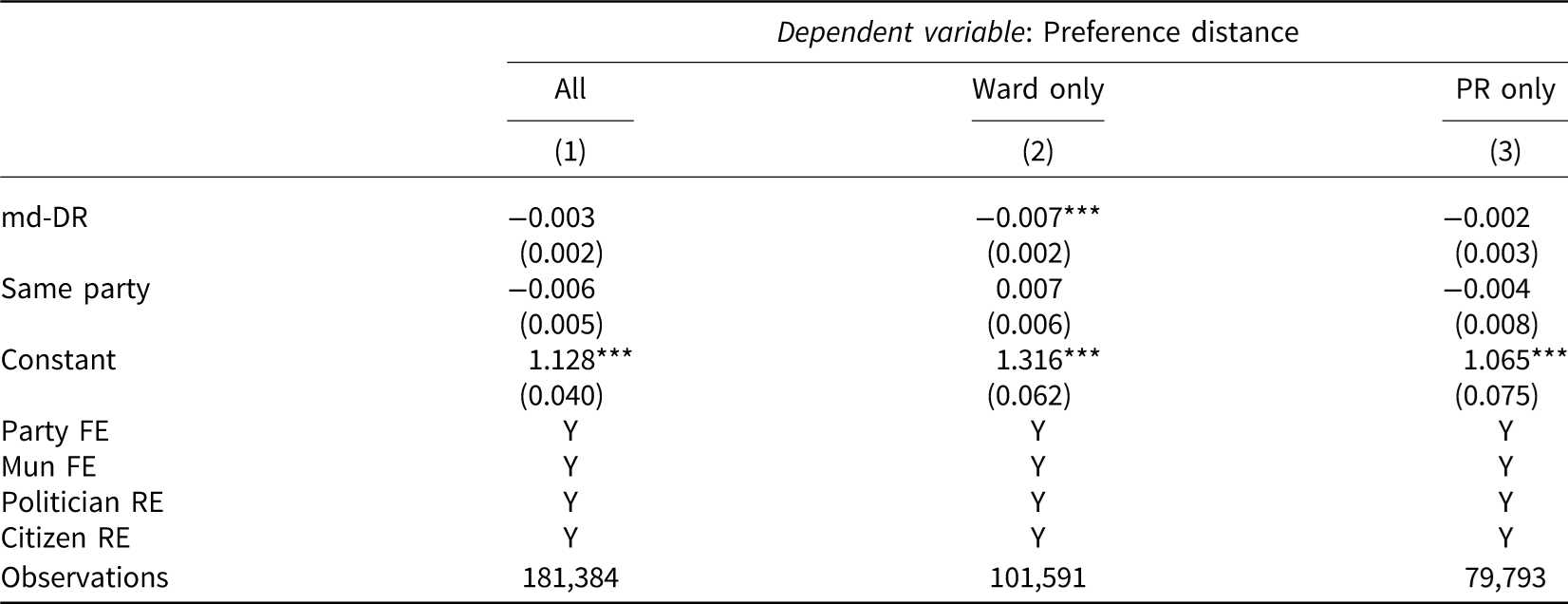
Finally, to evaluate whether md-DR matters for mass-elite alignment on policy preferences as well as issue prioritization, we analyze citizen and politician opinions about whether they think efficient government decision-making or government accountability to citizens is more important. This question was included on both politician surveys as well as the R6, R8, and R9 Afrobarometer citizen surveys. Because this outcome is measured as a scale and not as a binary variable, we consider the estimated distance between citizens and councillors, such that smaller values on the outcome indicate more concordance. As presented in Table 4, we find that higher levels of md-DR are associated with greater alignment on this dimension of policy opinion, though the difference is not statistically distinguishable from zero. However, we again find that politicians’ institutional roles have a strong mediating effect. Among dyads with politicians directly elected to single-member district wards, there is a strong and statistically significant link between md-DR and alignment on views about government accountability. Among dyads with PR councillors, by contrast, we find no significant association between md-DR and opinion congruence. Overall, md-DR may matter for preference as well as priority alignment.
md-DR and preferences about government accountability

Table 4. Long description
A table with three columns and four rows, plus additional rows for fixed effects and observations. The columns are labeled ʼAllʼ, ʼWard onlyʼ, and ʼPR onlyʼ. The rows include variables ʼmd-DRʼ, ʼSame partyʼ, ʼConstantʼ, ʼParty FEʼ, ʼMun FEʼ, ʼPolitician REʼ, ʼCitizen REʼ, and ʼObservationsʼ. Each cell contains numerical values with standard errors in parentheses. The table examines the relationship between md-DR and preferences about government accountability, showing coefficients and their significance levels. Notable trends include the significant negative coefficient for md-DR in the ʼWard onlyʼ column and the constant values across different political roles.
Note: *p < 0.1; **p < 0.05; ***p < 0.01.
Discussion and implications
In this article, we study descriptive representation in terms of five different observable traits, and demonstrate that increasing levels of similarity in the personal background of local government politicians and constituents in South Africa are predictive of policy priority alignment, especially when dyads share traits that reinforce intersectional disadvantage. Even in a political environment with relatively strong party brands and programmatic differences, the diversity of representatives within and across parties is associated with important differentiation of policy preferences and priorities. While the coefficient magnitudes we report are modest, md-DR accounts for a comparable share of variance in policy opinion alignment as shared party identification. Indeed, a citizen could expect about half the representative value of a shared party identity when a given councillor shares just two additional traits with that citizen, on average.
We also show that the md-DR-PPA link is meaningfully affected by the proximity of elected representatives to citizens. We find a stronger link with ward councillors, whose roles involve frequent direct contact with their constituents. This suggests that descriptive similarity may influence opinion alignment at least in part by amplifying the communication of policy views between citizens and their representatives.
South Africa is an informative case because of its extraordinary diversity on multiple dimensions, alongside material inequalities that reinforce the salience of those dimensions. This uniqueness is not sui generis, and other cases, including the United States, India, Brazil, and Malaysia might exhibit similar patterns. But it is an open question whether, in other societies, some cleavages tend to depress the relevance of others, imposing upper bounds on the degree to which increasing md-DR enhances PPA. Our findings in South Africa highlight substantive relevance for each additional cleavage.
Our theoretical and methodological approach may also prove useful in other African contexts where representation is often analyzed through the lens of ethnicity. Kenya and Nigeria, for example, are often characterized as cases in which ethnic cleavages play a central role in political competition, while Ghana presents a useful contrast in which ethnicity remains politically relevant, but is moderated by institutional arrangements that discourage overt ethnic mobilization. Examining multi-dimensional descriptive representation in such settings could reveal whether shared gender, class, regional, or other social characteristics reinforce, substitute for, or condition the effects of ethnicity on citizen-representation alignment.
A key implication of these findings is that when citizens require shortcuts for finding representatives who share their policy orientations, they may do well to consider the full battery of personal characteristics of political candidates for office and/or in who they choose to consult as champions for their needs once in office. Demographic trait matching on multiple dimensions seems to increase the likelihood of shared perspectives. In this sense, our findings resonate with research highlighting the significance of intersectional group identities for the quality of democracy, while also suggesting the importance of considering factors beyond the more standard dimensions of gender and ethnicity/race, and of exploring trait matching in majority as well as minoritized groups.
That said, the value of representatives who share one’s views is itself likely to be strongly moderated by governing institutions and structures of power that go beyond our study. Any politician’s influence on policy and outcomes will be affected by their position within their party and/or their party’s position in government. In the former case, Ichino and Nathan (Reference Ichino and Nathan2013) find that citizens who may be minorities in particular districts frequently vote for non-co-ethnic parties even in environments that value ethnic voting in order to get more goods. In the latter case, South Africa’s recent experience with coalition governments in several large metropolitan areas, which often involves political horse-trading and outsized influence for parties with little electoral support, can disrupt the functioning of representative institutions altogether, with knock-on effects for the md-DR-PPA link.
The normative implications of our findings are mixed. Optimistically, the promise of md-DR in a highly unequal society such as South Africa is that historically disadvantaged citizens may find it easier to advance goals that redress such inequalities through the relatively simple mechanism of seeking out and voting for politicians that look like themselves. The md-DR perspective prompts us to consider more than just a single trait of representation, and highlights the value of trait similarity for predicting PPA – especially for groups where historical disadvantage is marked by intersectional identities. It tempers the notion of a single master cleavage that separates groups of politicians and citizens.
However, it is also easy to imagine some unappealing consequences of the regularity we have identified. To the extent that the md-DR-PPA link is common knowledge, it could tend to reinforce different social cleavages, including the idea that people are better governed by “one of their own,” and perhaps in increasingly narrowly defined configurations. In turn, political leaders may find it frustratingly difficult to gain support from citizens who actually share their views simply because they do not share their demographics.
Finally, we emphasize that increasing levels of md-DR is far from determinative of political beliefs or behaviors, at least in the South African case, where many policy priorities and preferences are widely shared across traits and parties. Shared traits are neither necessary nor sufficient to ensure shared preferences between citizens and representatives. Md-DR is just one tool for citizens to increase their prospects of having their views represented in democratic governments. Future research ought to consider the link between md-DR and PPA in other contexts and whether these patterns are indicative of increased substantive representation in practice.
Supplementary material
The supplementary material for this article can be found at https://doi.org/10.1017/S1755773926100708.
Data availability statement
Replication files and data for this study are available at https://doi.org/10.7910/DVN/JAB5T9.
Acknowledgements
We are grateful for comments from Nicholas Lyons and participants at the 2024 Meeting of the Annual Political Science Association (Philadelphia, PA), as well as three anonymous reviewers.
Funding statement
This research was supported by grants from the Institute for Development Studies (Making All Voices Count) Project Number: PA/12035 Grant Number: 16/109, the Massachusetts Institute of Technology, the American Political Science Association, and the University of Cambridge.
Competing interests
The authors report there are no competing interests to declare.
Use of AI
No AI was used in the writing of the manuscript. Microsoft Copilot was used to assist in generating the R code to create Figure 5.





 Open access

