Introduction
This article seeks to correct two widespread misperceptions concerning devolution in European Union (EU) research. Various aspects of devolution – understood as the transfer of competences from the state to an intermediate form of territorial self-government (Keating, Reference Keating2009: 424) – have been under the academic microscope for some time. Until now, however, research dealing with the combined themes of devolution and EU politics has largely failed to correct for two thick-skinned fallacies. The first is the idea that greater devolution of powers from the state to its regions will increase conflict and bypassing on the European scene. The second is a lacuna, rather than a fallacy stricto sensu, which overlooks the formal status of regions as influential (and even sometimes veto) players in the internal EU policy-shaping process of some member states. These two shortcomings in the EU politics literature have led to biased predictions about the impact of devolution. While much of the multi-level governance (MLG) literature has predicted greater autonomy from, and bypassing of, central governments by highly devolved regions, literature inspired by a liberal intergovernmentalist (LI) reading of EU politics has overlooked the institutional weight of regions in the domestic preference formation phase, and hence underplayed the importance of this very special type of non-state actor.
With a view to addressing these enduring misperceptions, this paper starts by briefly highlighting their origins and consequences. It then introduces a new data set measuring institutionalized regional involvement in the domestic EU policy-shaping process in 304 regions and assesses its relationship with regional authority (as a proxy for devolution levels). It argues that a quadratic function best captures such a relationship and then qualitatively ascertains the robustness of its causal nature. Accepting the hypothesis that greater devolution increases institutionalized regional involvement in the domestic EU policy-shaping process explains why greater devolution leads to less bypassing and more state-region cooperation on the European scene (contrary to some MLG predictions) and why LI analytical frameworks will remain misleading about the role and influence of regions in the EU until they accommodate the formal leverage that they have, throughout the EU policy process, in member states such as Austria, Belgium, Germany, Italy, Spain, or the United Kingdom but also – albeit to a lesser degree – Denmark, Finland, the Netherlands, or Portugal. This research thereby helps to bridge the gap between MLG and LI approaches to the question of the impact of devolution on regional involvement in the EU policy-shaping process.
Overlooked and misunderstood: the impact of devolution on regions and their member states in the EU
Much of both the MLG and the LI literatures have misperceived the impact of devolution on regions and their member states in the EU. Unfortunately, the literature using an LI framework generally overlooks the formal role of regions. This is inconsistent with the LI analytical framework which gives much importance to the ‘pressure from domestic societal actors as represented in political institutions’ in LI’s first phase, that of ‘domestic preference formation’, which conditions the ‘configuration of state preferences’ and hence the interests states will defend during the second phase of ‘interstate bargaining’ (Moravcsik, Reference Moravcsik1993: 482). Taking stock of devolution levels, and hence of the domestic power of regions, is therefore highly compatible with LI. Indeed, Moravcsik has unambiguously and repeatedly underlined the significance of the internal process of negotiation between state and non-state actors, which determines and constrains the nature of the preferences pursued by the member state on the European scene. In a 1993 article and elsewhere before and after that (Moravcsik, Reference Moravcsik1991, Reference Moravcsik1992, Reference Moravcsik1995; Moravcsik and Schimmelfennig, Reference Moravcsik and Schimmelfennig2009), he specified that:
The foreign policy goals of national governments are viewed as varying in response to shifting pressure from domestic social groups, whose preferences are aggregated through political institutions. National interests are, therefore, neither invariant nor unimportant, but emerge through domestic political conflict as societal groups compete for political influence, national and transnational coalitions form, and new policy alternatives are recognised by governments. An understanding of domestic politics is a precondition for, not a supplement to, the analysis of the strategic interaction among states (Moravcsik, Reference Moravcsik1993: 481).
Moreover, in a later passage, Moravcsik underlines that a societal group’s influence on the domestic process will covary with how much it stands to gain or lose from European integration and its associated policies (Moravcsik, Reference Moravcsik1993: 483). Although mainly intended to accommodate for various types of (mostly economic) stakeholders and interest groups, the LI framework clearly allows for regions to be a prominent element of the right-hand side of the ‘domestic preference formation’ equation. Strictly speaking, regions can be conceived as domestic non-state actors that have some leverage in the national institutional and political set-up through a battery of formal and informal means. These range from the more institutionalized and constraining, such as in the case of the German Länder and the so-called Politikverflechtung (Scharpf, Reference Scharpf1988, Reference Scharpf2006; Moore and Eppler, Reference Moore and Eppler2008), to the more diffuse and informal, such as in unitary and centralized states (Le Galès and Lequesne, Reference Le Galès and Lequesne1998; Négrier and Jouve, Reference Négrier and Jouve1998). In twenty-first century Europe, most regions generally ‘stand to gain and lose a great deal per capita’ (Moravcsik, Reference Moravcsik1993: 483) as the functions and competences devolved to them increasingly overlap with those delegated to the EU (Jeffery, Reference Jeffery1997a; Bourne, Reference Bourne2003, Reference Bourne2004; Fleurke and Willemse, Reference Fleurke and Willemse2006; Tatham, Reference Tatham2007b). Logically, an LI framework should predict that, depending on the level of devolution, regions can be among the most influential players during the ‘domestic preference formation’ phase and hence a non-trivial player in EU politics. The argument has indeed already been made some time ago that ‘strong regions have both more to gain by trying to influence EU policy and more to lose if they do not’ (Marks et al., Reference Marks, Haesly and Mbaye2002: 9).
The counter-intuitive omission of regions as relevant players in the original LI framework can partially be explained by the fact that, initially, few member states had high levels of devolution. Of the original six, GermanyFootnote 1 was the only fully federal member state, while devolution levels were still low in Belgium, France, or Italy. However, various waves of devolution throughout Europe (such as in Belgium, France, Italy, the UK, Poland, Hungary, or Romania), as well as the accession of highly devolved member states (e.g. Austria, Spain) have increased the mass, power, and hence relevance of the regional level in domestic and EU politics. In this light, LI has surprisingly overlooked the EU’s regions despite its analytical framework being highly compatible with the factoring of regions into its first stage of national preference formation.
Though it has certainly not overlooked the impact of devolution on regions and their member states in the EU, much of the MLG literature has misperceived its consequences. The topic of the interaction between regionalization and EU integration is not new and these last three decades have been characterized by an abundance of research on several of its aspects (for an overview see, among others, Keating, Reference Keating1998, Reference Keating2008a, Reference Keatingb, Reference Keating2009). Within this literature, a narrower corpus of work has focused on identifying the main determinants of regional involvement in the EU policy process. Even if quite diversified, this research has made significant claims about the impact of devolution on various aspects of regional involvement. Though the level of devolution is often presented as only one important determinant among others, its recurrence as a significant explanatory factor is testimony to the fact that such a variable plays a non-negligible, non-random role. Looking at structural policy, a number of authors emphasize the importance of devolution levels in determining the activeness and autonomy of regions (Pollack, Reference Pollack1995: 377; Bache et al., Reference Bache, George and Rhodes1996: 319; Bache and Bristow, Reference Bache and Bristow2003: 424). Similarly, some studies on regional mobilization at the EU level have argued that the higher the devolution level, the greater and more efficient the mobilization by regional actors in Brussels (Marks et al., Reference Marks, Nielsen, Ray and Salk1996: 183; Hocking, Reference Hocking1997: 105; Nielsen and Salk, Reference Nielsen and Salk1998: 247; Jeffery, Reference Jeffery2000: 12–13; Marks et al., Reference Marks, Haesly and Mbaye2002: 9; Sykes and Shaw, Reference Sykes and Shaw2008: 69; Tatham, Reference Tatham2008: 504, 507).
Although these findings are undeniably robust, they have led to the misleading expectation that greater devolution increases bypassing of, and conflict with, central government abroad – and in Brussels more particularly – as the consequent loss by central government of its gatekeeping role would illustrate (Pollack, Reference Pollack1995: 377; Bache et al., Reference Bache, George and Rhodes1996: 319; Keating and Hooghe, Reference Keating and Hooghe2006: 281). In a nutshell, devolution would increase regional mobilization, which would in turn erode the gatekeeping position of the member state thereby circumvented on the EU scene (Goldsmith, Reference Goldsmith1993: 698; Marks et al., Reference Marks, Nielsen, Ray and Salk1996: 170; Ward and Williams, Reference Ward and Williams1997: 445). In addition, it has often been assumed that, as greater devolution generates greater tensions between the centre and its periphery domestically, these tensions would then translate into greater conflict on the Brussels scene. Recent qualitative and quantitative research, however, has argued that, contrary to expectations, higher devolution levels lead to greater cooperation with, and less bypassing of, the member state. One theoretical explanation for this counter-intuitive relationship is that devolution increases the level of inclusion of regions in the domestic EU policy-shaping process (Jeffery, Reference Jeffery2007a: 14; Tatham, Reference Tatham2007a: 24, Reference Tatham2010: 83).
Unfortunately, the link between devolution and regional involvement in the domestic EU policy-shaping process has never been fully and systematically investigated. There are obvious reasons for this research gap. Measures of devolution have always been highly contested and often unconvincing while no systematic measure of regional involvement in the domestic EU policy-shaping process exists. On the first point, the measure proposed by Hooghe et al. (Reference Hooghe, Schakel and Marks2008) is by far the most convincing of its kind. One can criticize it and point to some limitations. However, the regional authority index (RAI) is, without doubt, the best indicator available.
On the second point, there are no cross-sectional indicators available. Some authors have offered insightful studies of national EU coordination systems but have not particularly focused on regions while their work usually predates the last two enlargement waves (Kassim et al., Reference Kassim, Peters and Wright2000; Kassim et al., Reference Kassim, Menon, Peters and Wright2001). Other authors do mention lists of factors when detailing intra-state channels of regional interest representation (Hooghe, Reference Hooghe1995, Reference Hooghe2002; Hooghe and Marks, Reference Hooghe and Marks1996; Jeffery, Reference Jeffery1997a, Reference Jeffery2000; Keating and Hooghe, Reference Keating and Hooghe2006; Tatham, Reference Tatham2007b). Charlie Jeffery, however, goes furthest and breaks down ‘central-regional coordination on EU policy’ into six distinct dummy variables and classifies five highly devolved member states accordingly (Jeffery, Reference Jeffery2007a: 7).
Building on Jeffery’s and others’ works, the following section discusses the different dimensions and limitations of a parsimonious indicator of institutionalized regional involvement in the domestic EU policy-shaping process. The section after that explores its relationship to devolution (as measured by Hooghe et al.’s RAI indicator) and discovers that a quadratic function best captures the non-linear but overall positive relationship. This finding illustrates how the disregard for regions in LI analyses of EU politics constitutes a non-trivial omission and sheds some light on the otherwise counter-intuitive impact of devolution on state-region relations in Brussels that much of the MLG literature had largely failed to predict or account for.
Measuring institutionalized regional involvement in the domestic EU policy-shaping process
This section details the rationale behind the selection and coding of the dimensions included in the operationalization of the institutionalized regional involvement indicator. It also underlines the inherent limits of the aggregate indicator.
Dimensions and rationale
Like all latent variables, the concept of ‘regional involvement in the domestic EU policy-shaping process’ is a construct which is both multi-dimensional and, ultimately, incommensurable. Indeed, many determinants of such involvement are either difficult to measure or stochastic (personal relationships and chemistries, entrepreneurship, know-how, social and political capital, networking, etc.). However, I argue that these elements only introduce some variation from a ‘baseline’ level of involvement, which can be best captured by focusing on institutionalized involvement.
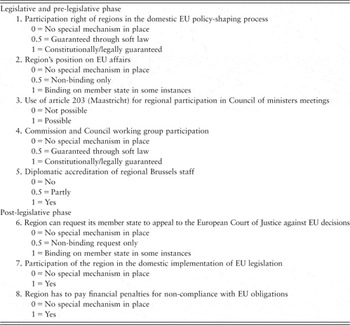
To facilitate analysis, the policy process has been divided into two phases: the legislative and pre-legislative phase, on the one hand, and the post-legislative phase once legislation has been passed and requires implementation, on the other. The first phase has been further unpacked to extract five dimensions. The second has been broken down into three dimensions. The combined indicator hence comprises eight elements.
By its very nature, this indicator captures institutionalized involvement only in policy areas where regions are competent. This implies that the aggregate indicator is applicable only to these policy areas.Footnote 2 These policy areas vary across regions, with some regions having greater competences over a wider array of policy areas and others having very few competences in still fewer policy areas. Such cross-sectoral and cross-sectional variation is – by default – captured by the aggregate score (as an indicator of the institutionalized involvement of regions in policy areas where they are legally competent). I outline the dimensions of each phase, starting with the legislative and pre-legislative phase, below.
The first dimension evaluates whether regions have any participatory rights in the domestic EU policy-shaping process. A distinction is made between three situations. First, when there are no special mechanisms in place; second, when these are only guaranteed through soft, non-binding law; and third, when they are legally or constitutionally guaranteed. The UK devolved governments are the only cases that fall in the second category.Footnote 3 Countries falling into the third category include not only highly devolved systems such as Austria, Germany, Belgium, Spain, or Italy, but also islands benefiting from special arrangements, such as Åland or Madeira and the Azores, and countries which have a strong consultative tradition, such as Denmark, Finland, or the Netherlands (Mannozzi, Reference Mannozzi2005a: 227–228; Ronchetti, Reference Ronchetti2005a: 130, Reference Ronchetti2005b: 140; Ronchetti and Santantonio, Reference Ronchetti and Santantonio2005: 48; Sciumbata, Reference Sciumbata2005b: 215–216). Concerning this third category, the decision was taken to conflate constitutional and legal guarantees as it is expected that whether the participation rights are constitutionally protected or simply legally guaranteed will not drastically alter the level of regional involvement. For example, though the Spanish Autonomous Communities’ participation right is not constitutionally enshrined, it is still protected by a corpus of laws and constitutional court rulings and its constitutional enshrinement would not make a notable difference in the level of involvement (Aldecoa and Cornago, Reference Aldecoa and Cornago2009: 263; Keating, Reference Keating2009: 433).
The second dimension evaluates whether there is a special procedure for regions to express their position on EU issues (where their competences overlap) and when this is the case, whether such a position can be binding or whether it can only ever be non-binding, as is the case for the UK devolved governments, the Dutch Provinces, and the Azores and Madeira islands (Mannozzi, Reference Mannozzi2005a: 219; Sciumbata, Reference Sciumbata2005b: 216). The rationale behind the choice of looking at whether regions have the possibility to express a binding position, as opposed to whether they actually use this option frequently,Footnote 4 lies in the argument that the possibility of expressing a binding position on the member state can be a credible threat by regions to have their interests included – even when they do not have a binding right in the policy area concerned or do not usually use it.
The third dimension is a simple dichotomous measure of whether regional representatives can have access to Council negotiations through the use of Maastricht’s article 203. The literature is still divided on the usefulness of such a provision for regions to represent their EU interests or coerce their member state into supporting them. However, it has been argued that such a tool can allow regions to represent distinctive interests at a crucial stage in the EU policy process (Tatham, Reference Tatham2008: 499–502). The usual suspects comprise the German and Austrian Länder, the Belgian regions, the Italian regions and autonomous provinces of Trento and Bolzano, the Spanish Autonomous Communities, and the UK devolved governments (Mannozzi, Reference Mannozzi2005b: 236; Ferrara, Reference Ferrara2005a: 102, Reference Ferrara2005b: 162, 169; Keating and Hooghe, Reference Keating and Hooghe2006: 274; European University Institute, 2008: 185, 286; Aldecoa and Cornago, Reference Aldecoa and Cornago2009: 255).
The fourth dimension deals with sub-state participation in Commission and Council working groups. More precisely, it assesses whether there are any mechanisms in place to guarantee such participation (or, at the very least, attendance), and when this is the case, whether provisions are made through soft law or legally/constitutionally guaranteed. The merger of the legal and constitutional guarantees follows the same logic as that of the first dimension. The only case where this provision is made through soft law is that of the Spanish Autonomous Communities (Mannozzi, Reference Mannozzi2005b: 240; Aldecoa and Cornago, Reference Aldecoa and Cornago2009: 254–255) while the UK devolved governments are considered as having a legally guaranteed right of access as a consequence of the unified nature of her Majesty’s civil service.Footnote 5 The Province of Åland also stands out because of its legally guaranteed participation in Finland’s permanent representation (PR) and hence access to the working groups (Ronchetti, Reference Ronchetti2005b: 139).
The fifth dimension details whether Brussels office staff benefit from diplomatic accreditation completely, partially, or not at all. As suggested elsewhere (Tatham, Reference Tatham2008: 507), diplomatic accreditation grants member state-like rights (and duties) to officials of regional offices, thus granting them an access to the Commission and the Council equal to that enjoyed by their member state colleagues. Three categories are identified: accreditation, partial accreditation, and no accreditation at all. Only Belgian sub-state entities and the UK devolved governments have full diplomatic accreditation. Partial accreditation means that the staff in the regional Brussels office do not have accreditation but that the region either has some staff specifically representing it in the state’s PR (hence with diplomatic accreditation) or a collective representative for all regions in the PR (hence with diplomatic accreditation). Austrian and German Länder have a representative in their member state PR in the form of a Länderbeobachter for the latter and a joint Länder/VST representative for the former. The Italian regions and autonomous provinces of Trento and Bolzano have four regional officials nominated to the PR by the State-region conference (Mabellini, Reference Mabellini2005b: 201) while the Spanish Autonomous Communities have, since 1996, created the post of Counsellor for Autonomous Affairs as an integral part of the PR while the December agreement of 2004 increased this presence with two extra officials from the Autonomous Communities themselves (Mannozzi, Reference Mannozzi2005b: 239–240; Aldecoa and Cornago, Reference Aldecoa and Cornago2009: 255). Although the coding is the same, the situation is different for the islands of Åland, Madeira, and the Azores, each of which has an official representing its specific interests within the member state PR (Mannozzi, Reference Mannozzi2005a: 220; Ronchetti, Reference Ronchetti2005b: 139).
The sixth, seventh, and eighth dimensions deal with the post-legislative phase, that is, that of implementation. The sixth dimension details whether there are provisions for regions to request their member state to appeal to the European Court of Justice (ECJ) against EU decisions through the annulment procedure spelt out in article 230 of the EC Treaty. More precisely, the variable describes whether such a right for regions to request their member state to bring proceedings before the ECJ when legislation impinges on their competences exists or not, and when such a mechanism exists, whether the regional request can ever be binding or not, following the logic outlined for the second dimension. Only Austrian and German Länder and the Belgian and Italian sub-state entities can formulate binding requests on their state, while they are non-binding in the case of the Spanish Autonomous Communities (Ferrara, Reference Ferrara2005c: 88–89; Mabellini, Reference Mabellini2005b: 206–207, Reference Mabellini2005d: 293–294; Kiefer, Reference Kiefer2009: 72).
The seventh dimension evaluates whether regions participate or not in the domestic process of implementing EU legislation. A simple dichotomous distinction is here made between cases where there is or is not a special mechanism in place to achieve such a task. Only the Austrian and German Länder, the Belgian and Danish regions, the Italian regions and autonomous provinces of Trento and Bolzano, the UK devolved governments and the islands of Åland, Azores, and Madeira fall into the former category (Mabellini, Reference Mabellini2005a: 70–71, Reference Mabellini2005b: 202–204; Mannozzi, Reference Mannozzi2005a: 226, 229; Ronchetti, Reference Ronchetti2005a: 131, Reference Ronchetti2005b: 142–143; Sciumbata, Reference Sciumbata2005a: 119).
The eighth and last dimension distinguishes cases where there is a special mechanism, or not, by which regions would have to pay financial penalties for member state non-compliance with EU obligations where they would be identified as responsible. Such procedures are in place in Belgium, Denmark, Germany, Italy,Footnote 6 and for the UK devolved governments (Ronchetti, Reference Ronchetti2005a: 132; Mabellini, Reference Mabellini2005c: 77; European University Institute, 2008: 319; Raccah, Reference Raccah2008: 271; Hrbek, Reference Hrbek2009: 156). Table 1 details how each individual dimension was numerically coded.
Coding scheme: measurement of institutionalized regional involvement in the domestic EU policy-shaping process

EU = European Union.
The legislative and pre-legislative measure is an additive index of the first five dimensions, while the post-legislative measure is an additive index of the last three dimensions. The overall involvement score is a sum of these two additive indexes. A decision was taken to scale all variables between zero and one so that they should all have an equal weight in the aggregate score as they all represent different dimensions of the same concept. There were no theoretical reasons to weigh these variables in any particular way. Since the literature does not offer systematic evidence of the relative importance of each dimension vis-à-vis each other, the default option of adding them unweighted but standardized was implemented.
Limits
Like any measure of a latent variable, this indicator has its limits. Two types of limits can be identified and need to be acknowledged before proceeding any further. The first type of limit has to do with some involvement mechanisms, which have been overlooked for the sake of parsimony or because of a lack of robust theoretical and empirical evidence justifying their inclusion. First, domestic participation in ministerial meetings might make a substantial difference in terms of regional access and influence. Such participation takes place in countries such as Austria or the UK, but not in others such as Germany. This mechanism, however, correlates highly with the first dimension (participation right) without representing a theoretically distinct dimension. Though not irrelevant, it was sacrificed in the name of parsimony and simplicity. Second, the bilateral or multilateral nature of domestic intergovernmental relations was ignored. Indeed, one could assume that there might be better access and hence higher involvement when there are only three devolved governments as in the United Kingdom, as opposed to 17 Autonomous Communities in Spain or 16 Länder in Germany. However, it is not obvious that a higher number of powerful regions might not lead to more efficient involvement: a coalition of a dozen Länder may be more difficult to ignore, and hence marginalize, than a couple of devolved governments. Since there has been little theoretical and empirical consensus on the effect of bi- and multilateralism on the level of involvement of regions concerning EU affairs, this variable was also excluded.
Similarly, other features were not included in the index because of a lack of strong theoretical grounds or significant added value compared to existing indicators. For example:
• if the member state has to abstain (from taking a position at the EU level) in cases of lack of agreement between itself and its regions or between the regions themselves, as is the case in Austria for the former and Belgium for both the former and the latter;
• if regional ministers can chair or lead the member state delegation in the Council of Ministers, as is the case for the United Kingdom, Belgium, or Germany, but not Austria;
• the modalities under which the central government can implement EU legislation in substitution of regions in case of implementation failure. Sometimes, this is only possible after an ECJ ruling as a necessary precondition as in Austria or Belgium, after a national court breach of Community law notification as in Germany, or through pre-emptive, substitutive action by the central government until the regions have themselves acted as in Portugal, Italy, and Spain (Mabellini, Reference Mabellini2005d: 293);
• whether there are institutionalized organs for conflict arbitration. These can take the form of arbitration through constitutional courts, conciliatory committees (such as the Belgian ‘Concertation Committee’ or the German conciliation procedure when there is disagreement between the Bundesrat and the federal government), or strictly political arbitration, for example, by the office of the head of government.
Ultimately, the objective of the institutionalized involvement measure is to simplify the uniqueness of each domestic system in comparative perspective and hence it does not capture all variation. Inevitably, countries with differing systems and slightly different involvement mechanisms will have similar or identical scores. A constructed indicator seeking to operationalize an abstract concept such as institutionalized regional involvement in the domestic EU policy-shaping process necessarily clusters cases together, which, despite not being strictly identical, are, comparatively to all other cases, most similar.
The second type of limit recognizes the fact that merely focusing on institutionalized involvement mechanisms ignores non-institutionalized factors, which, though sometimes stochastic, might play a relevant role in determining the extent of a region’s involvement in the domestic EU policy-shaping process. Though it is recognized that these non-institutional mechanisms do play a role, it is also argued that they are difficult to measure over 304 regions. Factors which might hinder or increase regional involvement, such as party political (in)congruence between the centre and its regions (Bauer, Reference Bauer2006: 34),Footnote 7 pan-European regional networks and associations (Tatham, Reference Tatham2008: 508–509), the entrepreneurship of regional representatives (Jeffery, Reference Jeffery2000: 14–16), personal chemistries and networks between state and regional élites, the role of issue saliency (Blatter et al., Reference Blatter, Kreutzer, Rentl and Thiele2008: 467; Tatham, Reference Tatham2008: 503), the compatibility of policy preference constellations, the embeddedness of regional executives in networks of private and public actors (Fargion et al., Reference Fargion, Morlino and Profeti2006: 770–771), perceived legitimacy and social capital (Jeffery, Reference Jeffery2000: 17), or socio-historical and cultural factors (Soldatos, Reference Soldatos1990: 44–46), had to be excluded. Though often relevant, their occurrence and effect over 304 regions are either intractable or unsystematic.
Three institutionalized involvement indicators
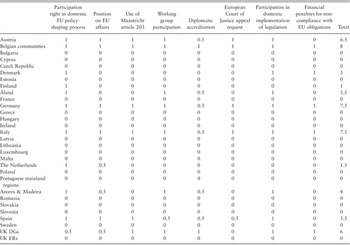
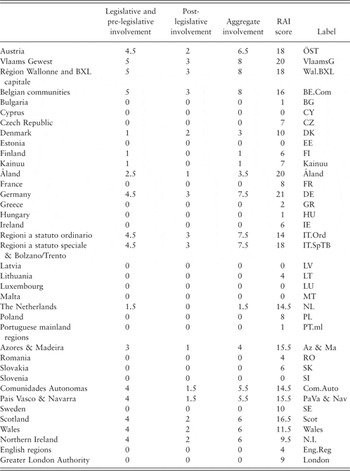
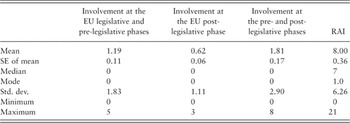
Having cut down institutionalized regional involvement to eight dimensions and clearly outlined the limits of such a measure, 304 individual regions were coded using the data presented in Table 2, which summarizes the values for every system of involvement. Table 3 displays the values of the three involvement indicators as well as the RAI score and label for each system while descriptive statistics are reported in Table 4. As this last table indicates, the average values of the three involvement measures are rather low. The table also indicates that positive involvement values are clearly a minority among EU regions as the median – and hence the mode too – is at zero. Such a zero-inflated distribution of scores highlights that a majority of European regions, in fact, benefit from very little institutionalized involvement.
Eight indicators of institutionalized regional involvement in the domestic EU policy-shaping process

Notes: EU = European Union; UK DGs = UK devolved governments; UK ERs = UK English regions.
Sources: Kassim et al., Reference Kassim, Peters and Wright2000, Reference Kassim, Menon, Peters and Wright2001; Kovziridze, Reference Kovziridze2002; Zeller and Stussi, Reference Zeller and Stussi2002; Alfieri, Reference Alfieri2004; Committee of the Regions, 2005; Instituto di Studi sui Sistemi Regionali Federali e sulle Autonomie, 2005; Gunlicks, Reference Gunlicks2005, Reference Gunlicks2007; Paraskevopoulos et al., Reference Paraskevopoulos, Getimis and Rees2006; Dimitrova and Toshkov, Reference Dimitrova and Toshkov2007; Jeffery, Reference Jeffery2007a, Reference Jefferyb, 1997b; Bache, Reference Bache2008; European University Institute, 2008; Moore, Reference Moore2008; Raccah, Reference Raccah2008; Keating, Reference Keating2009; Michelmann, Reference Michelmann2009.
Summary of three institutionalized regional involvement indicators and RAI scores

RAI = regional authority index.
Regional involvement and RAI descriptive statistics (n = 304)

EU = European Union; RAI = regional authority index.
As is apparent from Table 3, using individual regions as the unit of analysis allows intra-state variation on all variables. In some member states, such as Austria, Germany, Poland, Romania, or Sweden, there is no such variation. However, other states are asymmetrical, be it in terms of their RAI scores or of their institutionalized regional involvement scores. This is obviously the case not only for the various Belgian sub-state entities, the UK devolved governments and Greater London Authority (GLA), some Spanish Autonomous Communities, the Italian regions and autonomous provinces, but also the Azores and Madeira in Portugal and Kainuu and Åland in Finland. However, territories which belong to a member state but do not belong to the EU, such as Greenland, the Faroe Islands, and some British,Footnote 8 Dutch,Footnote 9 Finnish,Footnote 10 and FrenchFootnote 11 territories, have been excluded from the analysis since they are formally not ‘EU’ regions.
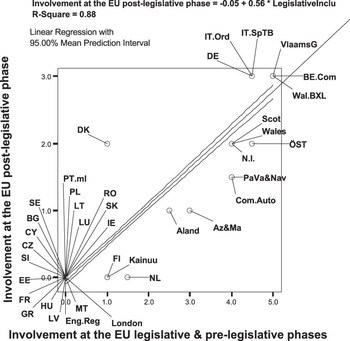
The relationship between the measure of involvement at the legislative and pre-legislative phase and that of involvement at the post-legislative phase is graphically illustrated in Figure 1. The strength of this relationship suggests that involvement at the different phases of the policy cycle tends to be highly related.
Relation between institutionalized regional involvement measures at the different legislative phases.

Regional involvement and devolution
This section explores the relation between devolution and institutionalized regional involvement and then qualitatively assesses the robustness of the purported causal link between the two.
Linear and non-linear patterns
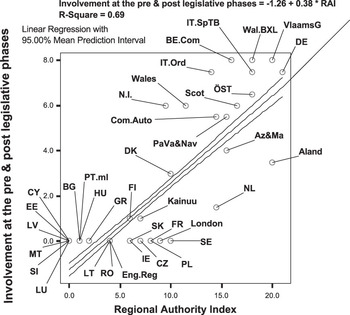
Figure 2 maps out the relationship between the aggregate involvement indicator and Hooghe et al.’s measure of regional authority (RAI) and fits a regression line. The graph indicates two things. First, it outlines that the relationship between regional authority and regional involvement is strong and positive. Second, it specifies that the RAI indicator accounts for 69% of the variance in institutionalized regional involvement.
Linear relation between regional authority and institutionalized regional involvement.

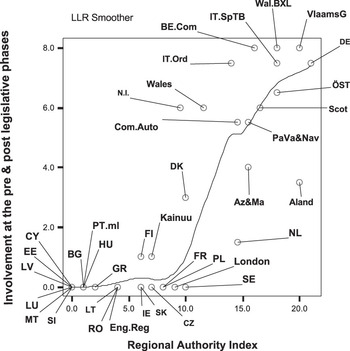
Figure 3 reproduces precisely the same scatterplot but this time fits a local linear regression (LLR) smooth line so as to assess the degree of non-linearity in the relationship between the two variables. The main finding is that a non-linear reading of the relationship is much more instructive than a linear one. Indeed, Figure 3 clearly indicates that there is a strong threshold effect. It appears that the devolution and regional involvement indicators, though highly correlated overall, hardly correlate when the devolution levels remain below a certain threshold. In fact, until the RAI reaches a value of about 9 (i.e. London’s GLA), it has no or very little impact on the degree of institutionalized regional involvement. However, beyond values of 9, the correlation is both very strong and positive, that is, the more devolution, the greater the involvement. Hence, if a region has lower levels of devolution than the GLA, as is the case for the French, Polish, Czech, Slovakian, or Irish regions, its institutionalized involvement remains minimal. However, once it has greater levels than the GLA, as is the case for Northern Ireland, the Danish regions, or Wales, then the relationship between devolution and regional involvement becomes highly positive. The exceptions to this rule are the Swedish regions, which have an RAI score of 10 but do not benefit from specific involvement mechanisms, and the Finnish regions, which (Aland excluded) have an RAI score of 7 for Kainuu and 6 for the rest, but benefit from specific participation rights. Interestingly, the mean value of the RAI variable is 8, hence suggesting that when a region scores above the EU average, it is more likely to benefit from some form of institutionalized involvement in the domestic EU policy-shaping process.
Non-linear relation between regional authority and institutionalized regional involvement.

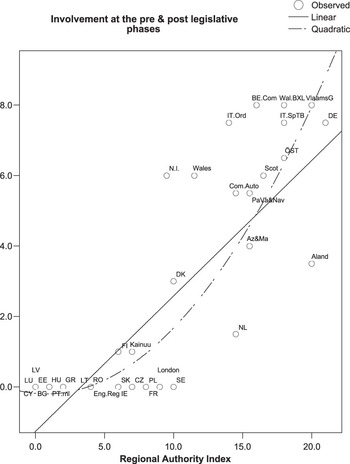
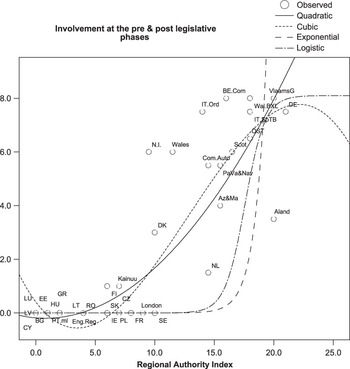
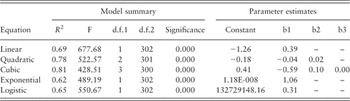
The findings suggested by the LLR smoother line were further confirmed when a quadratic curve function was fitted. Similar to the linear regression model, such an equation returned estimates significant at the 0.001 level but with a higher model fit. As is graphically represented in Figure 4, the fit went from 69% of variance explained through the linear model, to 78% through the quadratic model. The improvement in model fit confirms that the relationship between devolution and institutionalized regional involvement is more fruitfully understood as non-linear and that a quadratic conceptualization of their association better describes the data at hand for the EU’s 304 regions.
Quadratic curve estimation and linear regression line of the relation between regional authority and institutionalized regional involvement.

Contrary to expectations, the exponential and logistic readings of the relationship reaped a lower model fit: about 62% of variance captured for the former and 65% for the latter.Footnote 12 Although a cubic polynomial achieves a superior model fit than its quadratic equivalent, the difference is only of about three percentage points. Crucially, a cubic function makes little theoretical sense as it predicts a drop in institutionalized involvement at high RAI values. Hence, though it fits the data marginally better, the cubic understanding of the relationship between devolution and regional involvement is non-sensical – and therefore rejected. These findings are graphically represented in Figure 5 and summarized in Table 5.
Quadratic, cubic, exponential, and logistic relations between regional authority and institutionalized regional involvement.

Model summaries and parameter estimates of the relationship between institutionalized regional involvement (Y) and regional authority (X)

Assessing causality
I have argued above that the relationship between devolution and institutionalized regional involvement in the domestic EU policy-shaping process is not strictly linear but has a threshold effect below which the relationship is quasi-non-existent and above which it is strongly positive, as the quadratic function suggests. Below, I argue that this relationship is causal.
Establishing causation is no mean task and implies the fulfilment of three conditions at the very least. The first is that there should be temporal precedence (X before Y). The second is that there should be covariation (if X then Y, with a positive or a negative correlation). The third is that alternative causes should be eliminated (if no X then no Y even in the presence of Z), that is, that the relationship should not be spurious, driven by a third variable.
Temporal precedence and covariation
Ascertaining temporal precedence is a matter of process tracing. As the number of cases here is rather limited (as outlined in Table 3, the 304 cases belong to 38 distinct systems), this is no insurmountable task. A simple survey of each system indicates that, each time, greater involvement has followed devolution of powers. Put another way, there are no cases of greater involvement preceding initial devolution. Concerning (quasi) devolution-invariant systems, where devolution levels have remained relatively stable, regional involvement has tended to increase over time as a consequence of deepening European integration or of EU accession. The German case is a fine example of the former trend (Gunlicks, Reference Gunlicks2005, Reference Gunlicks2007; Jeffery, Reference Jeffery2007b; Hrbek, Reference Hrbek2009) while Austria illustrates the latter (Morass, Reference Morass1997; Kovziridze, Reference Kovziridze2002; Kiefer, Reference Kiefer2009). In most devolution-variant systems, however, involvement has increased with devolution levels, albeit with a (differential) time lag. This lag was almost non-existent concerning the UK devolved governments, where adjustment between the devolution and involvement levels was immediate (Bulmer et al., Reference Bulmer, Burch, Carter, Hogwood and Scott2002; Tatham, Reference Tatham2007b). In other cases, such as those of the Italian regions or the Spanish Autonomous Communities, the lag was greater, most probably because the European integration process was still largely underway at the time of devolution, and hence the pressure for matching devolution levels with involvement levels was initially weaker, but strengthened over time as integration deepened (Mabellini, Reference Mabellini2005b; Fargion et al., Reference Fargion, Morlino and Profeti2006: 764; Aldecoa and Cornago, Reference Aldecoa and Cornago2009).
The second condition, covariance, is easier to test. Simple correlation indicates a high level of covariance between devolution and institutionalized regional involvement. Indeed, Pearson’s correlation coefficient is 0.83 and is significant at the 0.001 level (two-tailed).Footnote 13
Rival explanations
The third condition is the elimination of rival causes of variation on the involvement measure. This is usually the most difficult step in substantiating a causal claim as it entails testing for other determinants to check that the initial relationship between X and Y is not spurious and is either accidental or caused, for example, by omitted variable Z. As the traditional example goes, despite being temporally precedent and correlating strongly, Robins and birthday cards cause neither Spring nor birthdays. Indeed, if one were to repel all Robins and dismantle all mailboxes, Spring and birthdays would still come. Establishing causation between devolution, on the one hand, and institutionalized involvement by central government of regions on EU affairs, on the other, requires asking the counterfactual question: if there were no devolution, would there be institutionalized regional involvement?
The best test for such a counterfactual question is to have a look at most similar systems using Mill’s Method of Difference (Lijphart, Reference Lijphart1971: 688–689) so as to further explore whether variation on the devolution variable causes variation on the involvement variable. This can be done in two ways: either by comparing the same case over time or by synchronically comparing an asymmetrical system. Comparison of a case over a long period of time, however, weakens the ceteris paribus assumption as other factors – especially the depth of European integration – do not remain constant. Typically, these cases include Belgium, Italy, Spain, Poland, or France, with the latter two, however, still having too low a level of devolution at the regional level to impact on the involvement variable. These cases do give an idea of the trend, which has been that when devolution levels remain low, institutionalized involvement remains quasi non-existent and that when devolution levels increase over time, institutionalized involvement also increases over time. The second way is probably a more powerful test of non-spuriousness and consists of a comparison of regions in an asymmetrical political system. The UK devolved governments, the islands of Åland (Finland), Madeira and the Azores (Portugal) illustrate that within the same political system, where the devolution and involvement levels are strikingly different between regions, they still correlate highly. Indeed, the Province of Åland has higher levels of devolution than the other Finnish regions and hence higher involvement values. Ditto for Scotland, Wales, Northern Ireland, and the Madeira and Azores islands. Extreme cases such as Greenland or the Faroe Islands (both excluded from the data set) all have high enough levels of devolution that they have even been allowed by their member state to opt out of the EU altogether, and hence partly regain control over what would otherwise equate to EU affairs.Footnote 14
The argument that the relationship might be spurious because driven by an omitted variable such as cultural or historical distinctiveness (which would account for variations on both the devolution and involvement variables) is interesting but can be rejected by having a look at cases with strong and weak historical/cultural heritage and seeing how these values correlate (or not) with the devolution and involvement levels. If one considers territories, such as Savoy, Corsica, Brittany, Normandy, the French Basques, Cornwall, Friesland, Silesia, Bohemia, or the Finlandssvensk (the Swedish-speaking Finns), then it appears that cultural distinctiveness and historical heritage certainly do not cause devolution or institutionalized involvement. Many symmetric unitary states do comprise historically and culturally singular territories, which, in spite of their specificities, do not benefit from special institutional arrangements. Reciprocally, many non-historical and non-cultural regions benefit from high levels of devolution and involvement, as some non-historical Autonomous Communities (cf. café para todos) or linguistically composite Italian regions show (e.g. Lazio or Puglia). Meanwhile, relatively demos-homogeneous countries such as Germany or Austria have adopted highly federal systems (Kramer, Reference Kramer2005: 144; Erk, Reference Erk2008: 17–18, 57, 72; Kiefer, Reference Kiefer2009: 67). Indeed, in some federations, the constituent units represent distinct historical or cultural communities, while in others they are merely functional territories (Karmis and Norman, Reference Karmis and Norman2005; Keating, Reference Keating2009: 430). This does not mean that cultural distinctiveness or historical heritage does not play a role. They do. However, their impact is neither unidirectional nor strong enough to codetermine the devolution and involvement levels and hence make their correlation spurious.
Consequently, the mismatch between the cultural/historical distinctiveness of a territory and its institutional empowerment and hence the lack of a deterministic link between identity/culture on the one hand, and territorial devolution of power on the other (Guibernau, 1999: 33–66; Keating et al., Reference Keating, Loughlin and Deschouwer2003: 20–27; Smith and Wistrich, Reference Smith and Wistrich2007; Keating, Reference Keating2009: 424–431) strongly suggests that such a variable does not play a decisive role in jointly determining the levels of devolution and institutionalized involvement in the domestic EU policy-shaping process. Undeniably, as Marks et al. have previously concluded,
the causes of regionalisation are diverse. (…) Regionalisation has taken place in small countries and large countries (…), ethnically diverse societies and ethnically homogenous societies, countries that were centralised in 1950 and countries that were regionalised in 1950, established democracies and new democracies. (…) It is worth noting (…) that regionalisation has taken place, to some degree, in all but a few countries not shielded by their tiny population size or by the fact that they were already highly regionalised (Marks et al., Reference Marks, Hooghe and Schakel2008: 169).
On the basis of the method of difference, as applied both longitudinally to single cases which vary on the devolution variable over time and synchronically to different regions which vary on the devolution variable within the same member state, one can argue that the causal link suggested by the temporal precedence and high covariance between devolution and institutionalized involvement seems fairly robust.
Conclusion
Devolution has been at the heart of much research focusing on the interaction between the EU and its regions. It has been perceived as both a driver and enabler of territorial mobilization at the EU level and has led some research to presume that it not only increases the level of regional activity and influence in Brussels, but also its independence from central governments. Moreover, as devolution was positively correlated with conflict in domestic intergovernmental relations, it was also assumed that it would lead to greater conflict on the European scene. Though popular in much MLG research, these two assumptions (greater independence in Brussels and greater conflict on the European scene) have been questioned by recent research which has stressed that higher devolution levels are in fact associated with less bypassing and greater cooperation between the state and its regions in their European activities (Jeffery, Reference Jeffery2007a; Tatham, Reference Tatham2007a, Reference Tatham2010). Though somewhat counter-intuitive at first, these findings simply suggest that greater devolution causes greater regional involvement in the domestic EU policy-shaping process.
Such a relationship between devolution, on the one hand, and regional involvement in the domestic EU policy-shaping process, on the other, had never been systematically investigated in the EU-27. To fill this research gap, this paper has proposed a measure of institutionalized regional involvement and analysed its relationship to Hooghe et al.’s RAI. I argue that such a relationship is overall strongly positive but also non-linear. A comparison of linear and non-linear models reveals that a quadratic conceptualization of the relationship between devolution and regional involvement is more accurate. The quadratic model indicates that below a certain level of devolution the relationship is inexistent and beyond such a level it is overwhelming. Qualitative assessment of the causal link shows that there are good grounds to accept the hypothesis that, beyond a certain threshold situated above the population mean, greater devolution leads to greater institutionalized regional involvement in the domestic EU policy-shaping process.
This study therefore sheds some light on the apparently incompatible findings of research on domestic intergovernmental relations and research on state-region interaction in Brussels. Indeed, while greater devolution has tended to increase the amount of conflict in domestic intergovernmental relations, it has not led to the expected increase in conflict in Brussels. To the contrary, greater devolution has caused greater coordination and cooperation at the EU level (Jeffery, Reference Jeffery2007a; Tatham, Reference Tatham2010). The overall positive, though non-linear, relationship between devolution and institutionalized regional involvement in the domestic EU policy-shaping process explains this otherwise counter-intuitive finding. Process and outcome should therefore not be confused: though the process (of domestic intergovernmental relations) might be conflict-ridden, the outcome at the EU level will be more coordinated and cooperative than when devolution levels remain critically low.
Finally, this research highlights the salience and influence of regional players in the EU policy cycle and argues that the recognition of their role and power is not only compatible with the LI analytical framework but, in fact, an intrinsic – though neglected – part of it. Indeed, regions represent important domestic players in a growing number of member states and hence codetermine national preferences along with other non-state players such as a variety of (generally economic) interest groups and stakeholders. The growing number of regions in the EU, as well as their gradual empowerment over the last three decades, all point to the necessity of explicitly factoring regions into the right-hand side of the ‘national preference formation’ equation. Many European regions are deeply and formally involved in their member state’s domestic EU policy-shaping process, from the pre-legislative phase to the post-legislative phase. Ignoring the power of regional governments in Austria, Belgium, Germany, Italy, Spain, or the United Kingdom is clearly non-sensical. Continuing to overlook regions when analysing EU politics not only hampers the predictive capacity of LI but is also contrary to its theoretical foundations. The self-professed openness of LI ‘to dialogue and synthesis with other theories’ (Moravcsik and Schimmelfennig, Reference Moravcsik and Schimmelfennig2009: 67) should encourage its users to carefully rethink the impact of devolution and the subsequent role of regions in the EU policy process. In this sense, a bridge between LI and MLG can be fruitfully built.
Acknowledgements
The author would like to thank Yvette Peters, Adrienne Héritier, Michael Keating, Charlie Jeffrey, Tanja Börzel, Peter Mair, Fabrizio Gilardi, Laura Cram, Chris Hanretty, Catherine Moury, and three anonymous reviewers for feedback and advice on a draft version of this paper. The author would also like to acknowledge financial support from the Lavoisier programme (French Ministry of Foreign Affairs) and the European University Institute (Florence, Italy). All of the usual disclaimers apply.