


Introduction
In the context of growing polarization and culture war conflict (Norris and Inglehart, Reference Norris and Inglehart2019), political contestation increasingly takes place not only in traditional venues such as elections, legislatures, and street demonstrations, but also in the realm of popular culture. This trend is exemplified by the world’s largest musical competition, the Eurovision Song Contest (ESC). Created in the 1950s by pan-Europeanist members of the European Broadcasting Union, the ESC has long been considered a symbolic cultural space through which social and political identities are reinforced and negotiated (Fricker and Gluhovic, Reference Fricker and Gluhovic2013; Kyriakidou et al., Reference Kyriakidou2018; McNamara, Reference McNamara2015; Sieg, Reference Sieg2013; Vuletic, Reference Vuletic2018). Yet the contest has increasingly become a global stage for political messaging, despite its official principle of political neutrality. Five countries boycotted the ESC in 2026 as a protest against Israel’s participation, given the war in Gaza, and Iceland was fined in 2019 after its artists waved Palestinian scarves during the live broadcast in Tel Aviv (Abellan Matamoros, Reference Abellan Matamoros2019; Marshall, Reference Marshall2026).
The ESC is seen as increasingly political not only because of the messages that countries and artists seek to communicate but also because of purported influences on voting behavior in the contest. Ukraine’s victories in 2016 and 2022 are often seen as a demonstration of support for the country amid its ongoing war with Russia (Gilbert, Reference Gilbert2022; Guisinger, Reference Guisinger2024; Seely, Reference Seely2016). Suggestive evidence of political influences on contest results has drawn criticism (Jones and Subotic, Reference Jones and Subotic2011; Öberg, Reference Öberg2025), including from the BBC’s longtime commentator Terry Wogan, who resigned from his role in 2008 after declaring the ESC “no longer a music contest” (BBC, 2008; Bolin, Reference Bolin2006; Dekker, Reference Dekker2007; Gatherer, Reference Gatherer2004, Reference Gatherer2006; Ginsburgh and Noury, Reference Ginsburgh and Noury2008; Jones and Subotic, Reference Jones and Subotic2011). Yet it is hard to know from such examples how much political attitudes toward participant countries—as opposed to cultural preferences or the quality of the musical performance—influenced voters’ decisions. Although a large, multi-disciplinary literature has sought to examine how politics shapes ESC outcomes (Bello Orgaz et al., Reference Bello Orgaz, Cajias and Camacho2011; Blangiardo and Baio, Reference Blangiardo and Baio2014; Charron, Reference Charron2013; Clerides and Stengos, Reference Clerides and Stengos2012; Dekker, Reference Dekker2007; Fenn et al., Reference Fenn2006; Fischer et al., Reference Fischer, Pasquali and Vergioglou2024; Garca and Tanase, Reference Garca and Tanase2013; Gatherer, Reference Gatherer2004, Reference Gatherer2006, Reference Gatherer2007; Gilbert, Reference Gilbert2020; Ginsburgh and Noury, Reference Ginsburgh and Noury2008; Jacques and Biernacki, Reference Jacques and Biernacki2014; Saavedra et al., Reference Saavedra, Efstathiou and Reed-Tsochas2007; Spierdijk and Vellekoop, Reference Spierdijk and Vellekoop2009; Stockemer et al., Reference Stockemer2018; Yair, Reference Yair1995; Yair and Maman, Reference Yair and Maman1996), nearly all existing studies have examined the most readily available Eurovision election data, country-level aggregate results, making it difficult to distinguish political influences on voting behavior from cultural attitudes toward other countries or simple aesthetic preferences.
What are the individual-level drivers of voting behavior in the Eurovision Song Contest, and what role do political attitudes play? The present paper addresses this question by analyzing an original four-country survey on Eurovision voting. We show that the vast majority of Eurovision voting is attributable to idiosyncratic factors rather than those that have been highlighted in previous studies. Political attitudes, cultural attitudes, and song quality all have statistically significant effects on voting behavior in our survey, but effect sizes and explained variance are small. Moreover, the effect of political attitudes is driven by the inclusion of Ukraine and Israel, whose policies generate strong support or condemnation.
The results challenge public perceptions and scholarly discussions highlighting the influence of political attitudes on cultural behavior. They suggest that, even in highly polarized national and global political contexts, cultural preferences may still be primarily about aesthetics and individual taste rather than politics.
Our research has implications for the broader study of political influences on cultural preferences. As Western democracies become more polarized, with people increasingly sorting themselves into communities of the politically like-minded (Bornschier et al., Reference Bornschier2021; Brown and Enos, Reference Brown and Enos2021; Harteveld, Reference Harteveld2021; Levendusky, Reference Levendusky2009; Mason, Reference Mason2018; Sczepanski, Reference Sczepanski2024), popular culture remains one of the few spaces where those of different political persuasions regularly come together. Yet studying political influences on cultural preferences has proven difficult. Most existing research has examined on-field activism by professional athletes in the United States and Europe. Scholars have sought to study attitudes toward sports activism using survey data (Druckman et al., Reference Druckman, Howat and Rothschild2019; Meier et al., Reference Meier2024; Müller et al., Reference Müller2024; Thorson and Serazio, Reference Thorson and Serazio2018; Utych, Reference Utych2022; Wilkinson et al., Reference Wilkinson, Kiang and Seagroves2025), but directly measuring such opinions is prone to social desirability bias (Mueller, Reference Mueller2022). We argue that our findings, from a unique cultural space where ordinary individuals routinely express their preferences in the form of a vote, offer insights for this broader literature.
Background and theory
Eurovision Song Contest: history and rules
The Eurovision Song Contest was created in the 1950s as part of an effort by European broadcasters to promote cultural market integration and generate a continent-wide audience for television programming. In 2025, the ESC’s live broadcast was followed by 166 million people, making it the largest song competition in the world and confirming the success of its creators’ initial goals.
Since its debut in 1956, the ESC’s participant list has grown considerably, most notably with the incorporation of formerly socialist Eastern European countries in the 1990s. The European Broadcasting Union is formally independent of the EU, meaning that non-EU members, and even countries geographically located outside of Europe, can also join and participate in the ESC. Thus, the list of regular participants includes Switzerland, Norway, Iceland, Russia, Ukraine, the Caucasus countries, and even Israel and Australia.
The ESC is not only the world’s largest song competition; it is also “probably the world’s largest election for a non-political office” (Stockemer et al., Reference Stockemer2018, 428). While winners were initially chosen by national juries of music industry experts, members of the public, known as “televoters,” have played a role since 1998. In a 2020 IPSOS survey of 13 ESC participant countries, 10 percent of respondents—and as high as 23 percent in Sweden—reported voting at least once in the ESC (Ipsos, Ipsos). These figures are quite high given that the public has to pay to participate; each vote costs 0.99 euros, up to a maximum of 20 votes per person.
In the contest’s present form, members of the public cast votes for their preferred songs (excluding the entry from their own country) by telephone, SMS, or the Eurovision mobile app. Televotes are tallied nationally, and each country awards points to individual entries using a Borda count system, where the first-place song receives 12 points, the second receives 10 points, and the third through tenth receive 8–1 points. For the finals, national juries vote separately and award a parallel set of points using the same formula. Points awarded by each country’s televoters and jury are then combined to determine the overall winner.
In contrast to standard political elections, individual vote totals are not made public; only the points awarded by each country’s televoters and jury are released. Hence, as discussed below, nearly all studies of voting behavior in the ESC have analyzed these country-level aggregate results—which are themselves one step removed from the country-level vote totals—rather than data on individual votes. For clarity, therefore, this paper uses “votes” to refer to individuals’ song preferences, which are not directly observed, and “points” to refer to the country-level aggregate results.
Voting behavior in the eurovision song contest
An extensive literature has examined country-level aggregate results in the Eurovision Song Contest. Most research has focused on patterns of particular countries voting for other countries—often reciprocally, which creates pairs or blocs that regularly favor one another (Bello Orgaz et al., Reference Bello Orgaz, Cajias and Camacho2011; Blangiardo and Baio, Reference Blangiardo and Baio2014; Charron, Reference Charron2013; Clerides and Stengos, Reference Clerides and Stengos2012; Dekker, Reference Dekker2007; Fenn et al., Reference Fenn2006; García and Tanase, Reference Garca and Tanase2013; Gatherer, Reference Gatherer2004, Reference Gatherer2006, Reference Gatherer2007; Ginsburgh and Noury, Reference Ginsburgh and Noury2008; Jacques and Biernacki, Reference Jacques and Biernacki2014; Saavedra et al., Reference Saavedra, Efstathiou and Reed-Tsochas2007; Spierdijk and Vellekoop, Reference Spierdijk and Vellekoop2009; Yair, Reference Yair1995; Yair and Maman, Reference Yair and Maman1996). Many studies assume that no country should have a consistent edge in terms of song quality, and thus deviations from random point distribution among countries over time represent some form of favoritism or enmity (Clerides and Stengos, Reference Clerides and Stengos2012; Fenn et al., Reference Fenn2006; Gatherer, Reference Gatherer2007).
A number of distinct mechanisms could account for nonrandom patterns of point distribution over time. Countries with similar cultural roots might tend to favor one another because of shared musical tastes (Clerides and Stengos, Reference Clerides and Stengos2012; Gatherer, Reference Gatherer2006; Yair, Reference Yair1995). Other forms of cultural or geographic proximity, such as sharing borders or a common language or religion, might also drive reciprocal patterns of support (Blangiardo and Baio, Reference Blangiardo and Baio2014; Clerides and Stengos, Reference Clerides and Stengos2012; Spierdijk and Vellekoop, Reference Spierdijk and Vellekoop2009). In countries with many immigrants from another ESC competitor, such as Germany with its large Turkish population, diaspora voting may drive patterns of favoritism (Blangiardo and Baio, Reference Blangiardo and Baio2014; Dekker, Reference Dekker2007; Spierdijk and Vellekoop, Reference Spierdijk and Vellekoop2009). Historical allegiances or rivalries may also underlie patterns of support, such as Ireland and Britain or Turkey and Cyprus rarely giving points to one another (Yair, Reference Yair1995). Finally, there is suggestive evidence of punishment or sympathy votes based on how countries’ domestic or foreign policies align with the liberal values that predominate within the ESC (Yair, Reference Yair2019). While all non-aesthetic voting is sometimes labeled “political” (Dekker, Reference Dekker2007), only these last two mechanisms involve truly political as opposed to cultural motivations.
Distinguishing among these individual drivers of voting behavior using country-level point totals is a challenging endeavor. Charron (Reference Charron2013, 486) concludes that whether reciprocal patterns of support are “for reasons of geography, shared culture or language, diaspora, or simply a recognition of shared music tastes is difficult to parse out because we do not have “exit polling” from voters and thus do not know individual motivations as to why people vote the way that they do” (see also Spierdijk and Vellekoop, Reference Spierdijk and Vellekoop2009, 423; Clerides and Stengos, Reference Clerides and Stengos2012, 41).
To our knowledge, only one study has gone beyond analysis of country-level point totals, using survey data to investigate what drives ESC voting behavior at the individual level. Stockemer et al. (Reference Stockemer2018) fielded an online survey to a convenience sample, seeking to distinguish between those who vote based on aesthetic preferences, strategic considerations, and other criteria. The largest share of voters falls into the “other” category, encompassing all of the various mechanisms that underlie bloc voting, including both cultural and political factors. They conclude with a call for further research to “unravel this puzzle of “other” voting in the ESC” (Stockemer et al., Reference Stockemer2018, 438).
In sum, a broad literature has documented consistent patterns of favoritism or non-favoritism among particular pairs or groups of countries in the Eurovision Song Contest, which could be attributable to a variety of cultural or political mechanisms. But nearly all studies have examined points awarded at the country level rather than individual-level voting, making it difficult to distinguish among these various drivers of voting behavior and to quantify how much voting is driven by political attitudes versus cultural affinities. Moreover, the one study that uses individual-level survey data on ESC vote intention was not designed to differentiate these mechanisms.
Our research builds upon the work of Stockemer et al. (Reference Stockemer2018) as well as the many studies of country-level results by gathering individual-level survey data to distinguish between the political and cultural mechanisms that underlie bloc voting in the ESC. Our key innovation is separately measuring respondents’ opinions about the culture and the governments of a variety of different countries that compete in the contest. We then show them videos of real ESC performances from five different countries, randomly chosen from among those on which we gathered attitudinal data, and ask which one they would vote for.
Armed with individual-level data that will allow us to distinguish between cultural and political biases toward other countries, as well as a separate measure of songs’ aesthetic quality, we aim to test the following hypotheses:Footnote 1
-
• H 1: More positive attitudes toward the culture of a performer’s country are associated with a vote for that song.
-
• H 2: More positive attitudes toward the government of a performer’s country are associated with a vote for that song.
-
• H 3: Higher song quality is associated with a vote for that song.
While the ESC voting literature justifies H 2 as a general hypothesis, many of the specific claims about political attitudes influencing voting behavior involve countries whose recent foreign or domestic policies have generated strong support or condemnation (Yair, Reference Yair2019). At the time of our study in 2025, Ukraine and Israel stood out among participant countries for their involvement in ongoing wars. Hence, we would expect that attitudes toward governments matter more for Ukraine and Israel than for other countries that have not recently been involved in major wars, scandals, or other internationally salient events:
-
• H 2a: The positive relationship between attitudes toward the government of a performer’s country and voting for that song will be stronger for Ukraine than for other countries.
-
• H 2b: The positive relationship between attitudes toward the government of a performer’s country and voting for that song will be stronger for Israel than for other countries.
In the online Appendix, we show results for two additional interactive hypotheses: that song quality moderates the effects of attitudes toward governments and culture, and that being a neighboring country moderates the effect of song quality. These hypotheses test substitution effects: we might expect that attitudes matter less for a high-quality song, and quality matters less when there is cultural proximity.
Research design
We test these hypotheses via an online survey in Spain, Sweden, Poland, and the Netherlands. We selected these countries due to their diversity and the popularity of the ESC among their citizens. In the 2020 IPSOS survey, these were the four regular ESC participants with the highest share of respondents who had previously watched the contest (73 to 86 percent), and they were also among the countries where voting was most common (10 to 23 percent) (Ipsos, Ipsos). Each belongs to a different European region and a different bloc of countries that have traditionally favored one another in the contest.
We surveyed 500 respondents from each country, recruited by Cint, with gender and region quotas to ensure diverse national samples. In the Appendix, we compare each sample to census and national probability sample figures. The survey was fielded in May 2025, prior to the final of the ESC on May 17. Our research design and hypotheses were pre-registered with Open Science Framework (OSF).
Our survey separately measures attitudes toward the culture and the governments of different countries via two batteries at the start of the survey. The order of the batteries is randomized, as is the order of the countries appearing in each list.
Think about the culture of the following countries, including their food, language, art, traditions, values, and the people who live there. Do you have a very favorable, somewhat favorable, somewhat unfavorable, or very unfavorable opinion of … [British culture, French culture, etc.]
Think about the government of the following countries, including the role they play in the world and how they treat their people. Do you have a very favorable, somewhat favorable, somewhat unfavorable, or very unfavorable opinion of … [the British government, the French government, etc.]
We ask about attitudes toward countries’ governments, rather than political systems more broadly, because of evidence that political voting in the ESC is tied to current events, such as Britain’s participation in the Iraq War or Russia’s invasion of Ukraine (Yair, Reference Yair2019).
We gather opinions about the culture and governments of ten countries beyond those surveyed: Belgium, Czechia, Finland, France, Germany, Israel, Norway, Portugal, Ukraine, and the United Kingdom. These include some of the largest states that compete regularly in the ESC; Ukraine and Israel, whose involvement in recent wars has generated strong support or condemnation; and several immediate neighbors of each surveyed country. We thus seek to maximize the chance that respondents will have meaningful opinions about the culture and governments of the countries they are asked to evaluate.
Following the measurement of attitudes, we show each respondent a randomly chosen set of five ESC videos. We first sample five countries from among the ten on which we gathered attitudes; we then sample one video from among each country’s last five non-winning Eurovision entries. Randomly choosing from among multiple songs for each country helps ensure variation in the aesthetic qualities of the music and performance so that we can empirically distinguish between song quality and attitudes toward the country it represents. Respondents are required to view each video for at least 30 seconds before advancing.
After showing each video and listing the artist, song title, and country, we measure the outcome of interest:
Imagine that you were voting for one of these songs in this year’s Eurovision Song Contest. Which one would you vote for?
While we randomize which videos are shown to respondents as well as the order in which they are shown and presented as voting options, the inferences we seek to draw are observational. In the Appendix, we discuss what an experimental approach might look like and why we opted for an observational study.
Estimation and analysis
We estimate the predictors of Eurovision voting using a respondent-song-level linear probability model. The Appendix contains more details, including how the estimation approach deviates from the pre-analysis plan and how results are robust to the original specification. Our dependent variable is an indicator for whether the respondent voted for a given song. Our key independent variables are the respondent’s 1–4 Likert scale evaluations of the culture and government of the song’s country (higher is more favorable) and a common measure of a song’s aesthetic quality for the respondent’s country: the average jury points awarded to that song from all other countries participating in the final round (Charron, Reference Charron2013; Ginsburgh and Noury, Reference Ginsburgh and Noury2008; Spierdijk and Vellekoop, Reference Spierdijk and Vellekoop2009). To facilitate comparisons of magnitude, each of these independent variables is standardized.
Our analysis includes controls for several song characteristics that have been shown to influence performance in the ESC: whether the song is wholly or primarily in English and the gender and type of performer (male soloist, female soloist, duet, or group) (Blangiardo and Baio, Reference Blangiardo and Baio2014; Charron, Reference Charron2013; Clerides and Stengos, Reference Clerides and Stengos2012; Spierdijk and Vellekoop, Reference Spierdijk and Vellekoop2009). Song data for 2017–2023 are taken from Eurovision Song Contest Data on Kaggle;Footnote 2 we coded 2024 ourselves, as described in the Appendix. Standard errors are clustered on the respondent, since voting decisions will be correlated within respondents (if one song is chosen, the others are not), as in conjoint analysis (Hainmueller et al., Reference Hainmueller, Hopkins and Yamamoto2014). As a robustness check, we estimate the model for the subset of respondents who report previously voting in the ESC, thus making the analysis more comparable to studies based on contest results.
Existing studies of the ESC based on country-level point totals commonly control for measures of proximity between countries, including linguistic similarities, geographical distance or shared borders, trade relationships, and migration data. We deliberately exclude such variables because we consider them causes of the more proximate attitudinal variables that we do measure. To the extent that such characteristics vary in our study, they should induce variation in attitudes toward the culture and government of a given country, increasing statistical power.
At the same time, country-level characteristics that influence voting decisions may serve as confounders if their effects are not mediated by these more proximate attitudinal variables. To rule out this possibility, we also estimate a specification with country pair fixed effects. This more demanding specification leverages only idiosyncratic variation in how different co-nationals evaluate the culture and government of a given country, rather than exploiting variation across countries that may be driven by any of these factors identified in the existing literature.
Results
Eurovision voting in our survey—and, by inference, in the real contest itself—is primarily a function of subjective, individual taste rather than political attitudes, cultural attitudes, or common measures of song quality. All three variables have statistically significant effects on voting behavior. However, the magnitude of these effects pales in comparison to the influence of idiosyncratic factors not captured by the model. Moreover, the effect of political attitudes is conditional on the inclusion of countries whose foreign or domestic policies generate strong opinions.
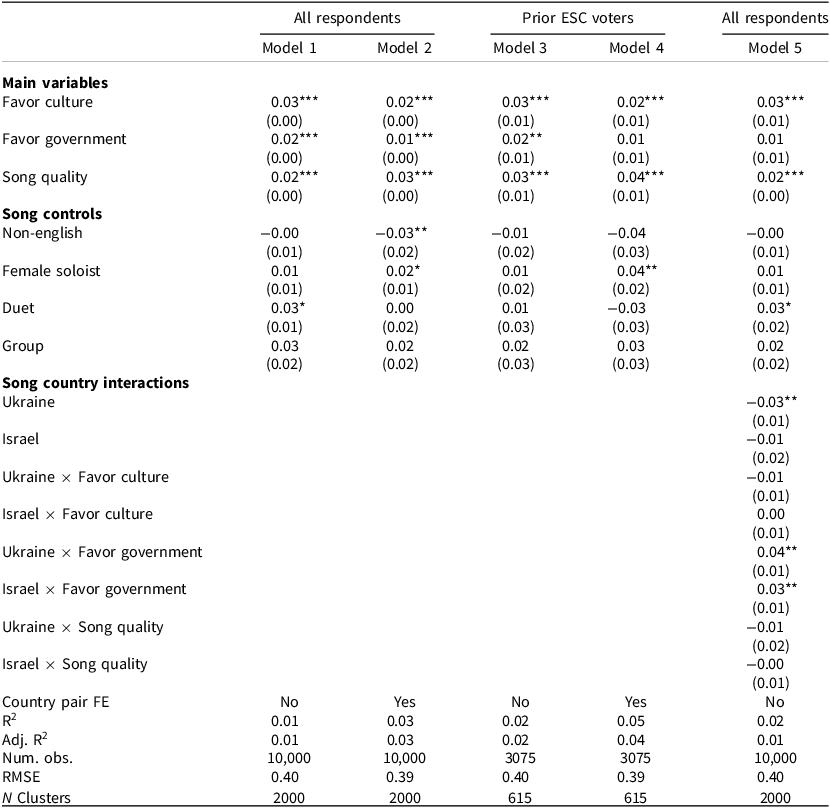
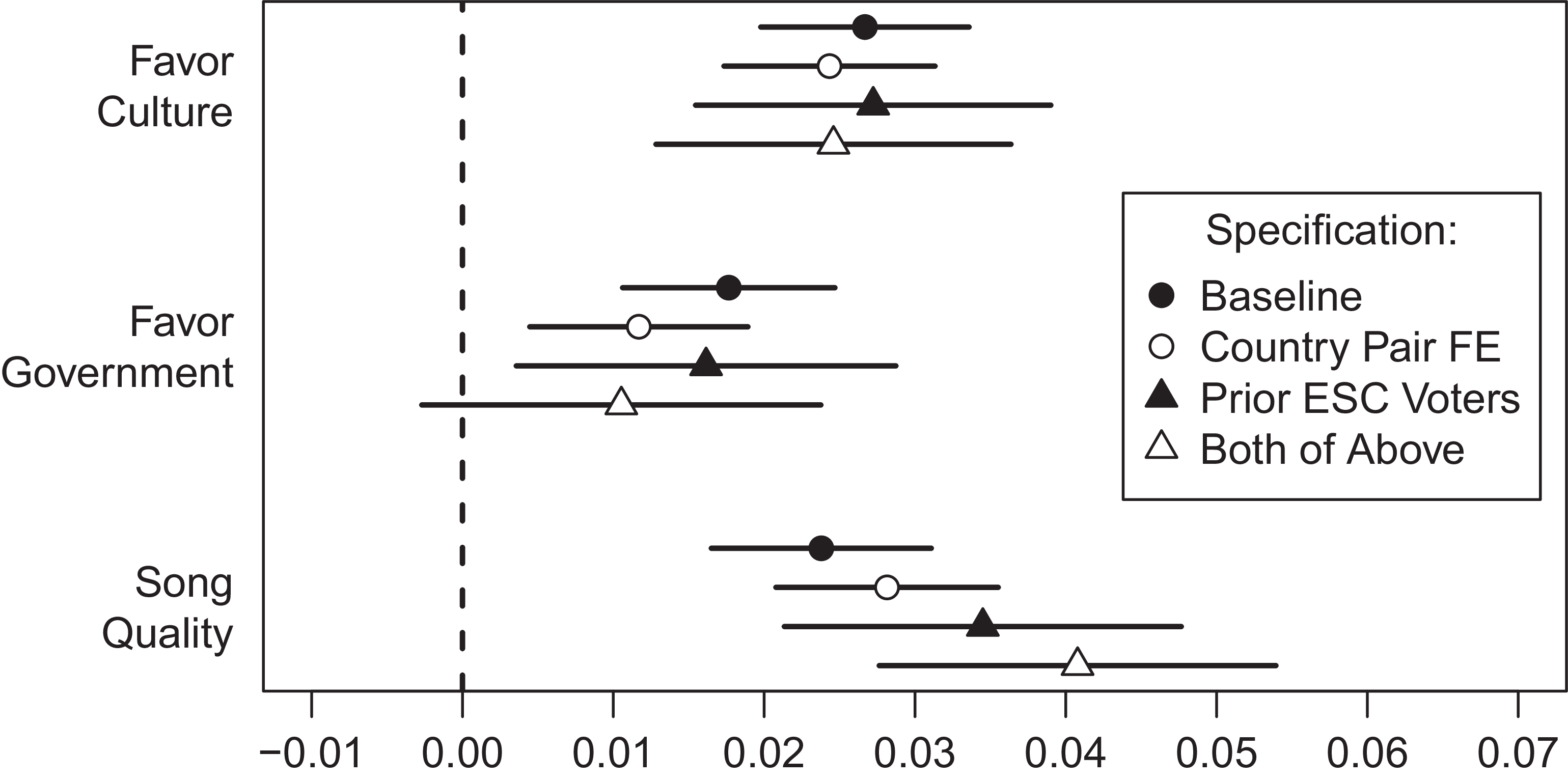
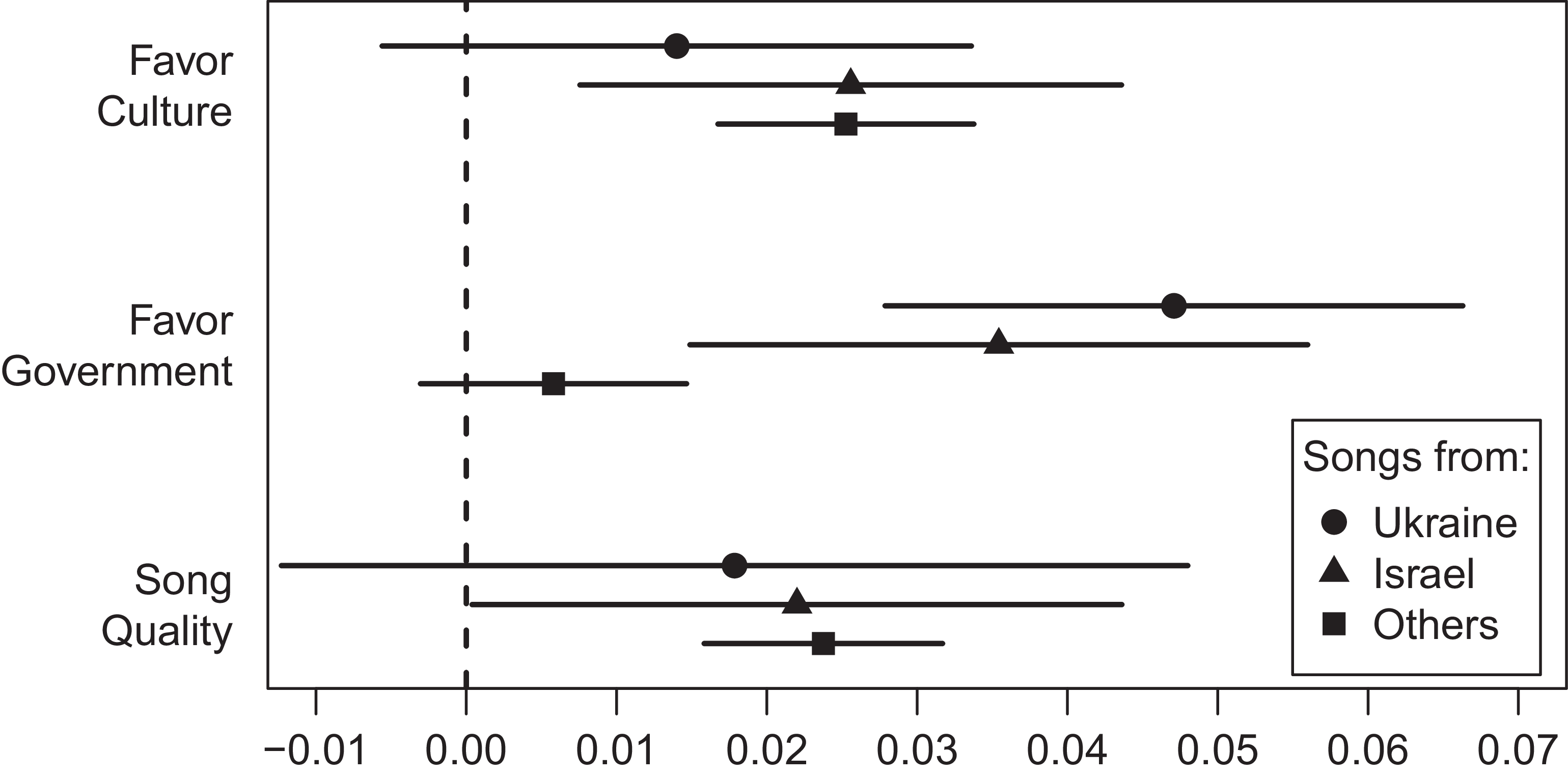
Table 1 presents coefficient estimates for our models, and Figure 1 plots point estimates and 90 percent confidence intervals (equivalent to one-sided hypothesis tests at the 0.05 level, as pre-specified) for favoring a country’s culture, favoring its government, and song quality. All three variables are positively associated with voting for a song. Cultural favoritism has a stronger association with voting in our survey, though the difference in effect sizes is not statistically significant. Our estimates are robust to including country pair fixed effects and subsetting on those respondents who previously voted in the ESC, though Favor Government loses significance when we do both. In the Appendix, we show that the effects of political and cultural attitudes are invariant with respect to two attention check screeners: one based on identifying each song’s genre and another testing recall of the countries whose songs were shown.
Predictors of Eurovision voting

Table 1. Long description
The table presents coefficient estimates for five models predicting Eurovision voting. The models compare the impact of favor culture, favor government, and song quality on voting preferences. The table includes data for all respondents and prior ESC voters. Main variables include favor culture, favor government, and song quality, with their respective coefficients and standard errors. Song controls include non-English, female soloist, duet, and group, with their coefficients and standard errors. Song country interactions include Ukraine and Israel, with their interactions with favor culture, favor government, and song quality. The table also includes country pair fixed effects, adjusted R squared, number of observations, RMSE, and number of clusters.
***p < 0.01; **p <0.05; *p <0.1.
Predictors of Eurovision song contest voting.

Cultural attitudes, political attitudes, and song quality are more reliable predictors of voting behavior than other song-level characteristics that have been emphasized in prior studies. Coefficients for these variables are almost always in the expected direction—male soloists (the omitted category) fare worse than other performer types, and non-English entries suffer—but they are only occasionally significant. In the Appendix, we also show that we can replicate two prespecified patterns of bloc voting: Swedish and Dutch respondents tend to favor songs from Norway and Belgium, respectively.
While political attitudes are a significant predictor of voting behavior, this effect is driven by two countries about which respondents have strong opinions: Ukraine and Israel. As shown in the Appendix, attitudes toward these countries’ governments are more polarized, presumably because of their ongoing or recent wars. Column 5 of Table 1 and Figure 2 show results from a version of our baseline model where indicators for songs from Ukraine and Israel are interacted with our key independent variables. The effect of favoring a country’s government is large and statistically significant for Israel and especially Ukraine but insignificant for all other countries. The same is not true for cultural favoritism and song quality, whose effects are comparable across countries.Footnote 3
Predictors of Eurovision song contest voting: heterogeneous effects.

Most importantly, while cultural attitudes, political attitudes, and song quality all have detectable and robust effects on voting behavior in our survey, the magnitude of these effects is quite small, and their explanatory power pales in comparison to idiosyncratic factors that influence individuals’ song preferences. In our baseline Model 1, only 1 percent of the variation in vote choice can be explained by our main variables plus the song-level controls. In Model 4, where we restrict the analysis to prior ESC voters and include country pair fixed effects, which should account for all of the bloc voting that has been extensively studied in the Eurovision literature, explained variance rises only to 5 percent.
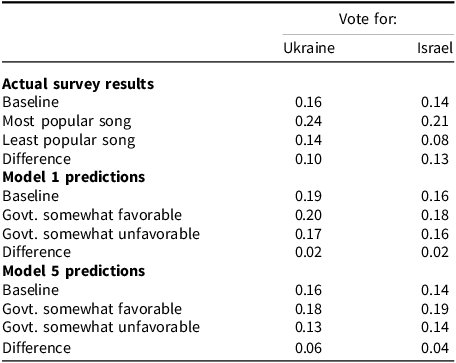
Figures are probabilities of voting for Ukraine/Israel given that song being in the respondent’s choice set. Predicted probabilities leave all covariates (baseline) or all but governmental favorability at their observed values.
Table 2 reports predicted voting probabilities based on our models, which help put the magnitude of effects in comparison. In our baseline Model 1, varying attitudes toward a country’s government across its inter-quartile range, from somewhat unfavorable to somewhat favorable, is associated with a 2 percentage point change in the probability of voting for a song from Ukraine or Israel (or any other country, since this model contains no interaction terms). In Model 5, where we estimated heterogeneous effects for Ukraine and Israel, this difference is associated with a change of 6 and 4 percentage points, respectively. Meanwhile, there is greater variation in the actual voting probabilities across the five Ukrainian and five Israeli songs included in our study: the most popular song was 10–13 percentage points more likely to be chosen than the least popular. These figures underscore that, even for those countries where attitudes toward governments matter most for voting in the ESC, idiosyncratic aesthetic preferences matter even more.
Actual and predicted vote probabilities

Table 2. Long description
The table has 11 rows and 4 columns. The columns are labeled Actual survey results, Model 1 predictions, Model 5 predictions, and Vote for. The Vote for column has two sub-columns: Ukraine and Israel. The rows are labeled Baseline, Most popular song, Least popular song, Difference, Baseline, Govt. somewhat favorable, Govt. somewhat unfavorable, Difference, Baseline, Govt. somewhat favorable, Govt. somewhat unfavorable, Difference. Row 1: Actual survey results, Baseline, Ukraine, 0.16; Israel, 0.14. Row 2: Actual survey results, Most popular song, Ukraine, 0.24; Israel, 0.21. Row 3: Actual survey results, Least popular song, Ukraine, 0.14; Israel, 0.08. Row 4: Actual survey results, Difference, Ukraine, 0.10; Israel, 0.13. Row 5: Model 1 predictions, Baseline, Ukraine, 0.19; Israel, 0.16. Row 6: Model 1 predictions, Govt. somewhat favorable, Ukraine, 0.20; Israel, 0.18. Row 7: Model 1 predictions, Govt. somewhat unfavorable, Ukraine, 0.17; Israel, 0.16. Row 8: Model 1 predictions, Difference, Ukraine, 0.02; Israel, 0.02. Row 9: Model 5 predictions, Baseline, Ukraine, 0.16; Israel, 0.14. Row 10: Model 5 predictions, Govt. somewhat favorable, Ukraine, 0.18; Israel, 0.19. Row 11: Model 5 predictions, Govt. somewhat unfavorable, Ukraine, 0.13; Israel, 0.14. Row 12: Model 5 predictions, Difference, Ukraine, 0.06; Israel, 0.04.
Conclusion
In this article, we draw on an original survey of four European countries to test distinct influences on Eurovision voting behavior: attitudes toward national cultures, attitudes toward national governments, and the aesthetic quality of individual songs. Contrary to public and scholarly perceptions that the Eurovision has become overwhelmingly politicized, our results show that voting in the ESC is mostly driven by idiosyncratic aspects of individual taste. While political attitudes, cultural attitudes, and a common measure of song quality are all significantly associated with voting behavior, estimated effects and explained variance are small in magnitude. The effect of political attitudes is driven by the inclusion of Israel and Ukraine, whose involvement in ongoing wars has generated particularly strong opinions—and even for these countries, aesthetic preferences matter more. In the overarching global context of political polarization and culture war conflict, this particular instance of fandom remains largely driven by aesthetics rather than politics.
Beyond the Eurovision Song Contest, our results suggest that political attitudes influencing cultural preferences may be the exception rather than the rule. High-profile incidents, such as U.S. athletes protesting racism by kneeling during the national anthem or German athletes wearing rainbow armbands to express LGBTQIA+ solidarity (Druckman et al., Reference Druckman, Howat and Rothschild2019; Meier et al., Reference Meier2024; Mueller, Reference Mueller2022; Müller et al., Reference Müller2024; Thorson and Serazio, Reference Thorson and Serazio2018; Utych, Reference Utych2022; Wilkinson et al., Reference Wilkinson, Kiang and Seagroves2025), may mean that, for some fans, politics influences who they root for. But, as we find with the ESC, the majority of fandom is likely to be driven by non-political variables such as aesthetic preferences. For sports, we would expect both the quality of performance (i.e., competitiveness and athleticism) and cultural biases (i.e., rooting for the home or national team) to matter more than political attitudes.
While our conclusions emphasize the small and conditional effects of political attitudes on ESC voting behavior, one should bear in mind that behavior in hypothetical contexts may not always mirror behavior in the real world. Although fictional vignettes like our survey’s contest among previous ESC entries often produce unrealistically large estimates of effects on voting behavior (Boas et al., Reference Boas, Hidalgo and Melo2019; Incerti, Reference Incerti2020), in this instance effects may be smaller than in real life if the low-stakes nature of a hypothetical Eurovision allows idiosyncratic factors to matter more. Those who want to punish a warmonger or show sympathy with a victim in the real ESC may not care much about doing so in the context of a survey. Estimated political effects in our survey may also be smaller than in the real-world contest due to the absence of national commentators, who could play a role in priming political considerations during live broadcasts. Finally, while estimated effects were invariant with respect to our two attention check screeners, we cannot rule out that respondents as a whole were less attentive to our survey than to a real Eurovision song contest, which would tend to attenuate results.
These limitations suggest opportunities for future research. To enhance realism, the ESC would seem to be a prime candidate for lab-in-the-field studies. Subjects could be assembled for watch parties, with their cultural and political attitudes measured prior to the real contest and their real-life votes recorded afterwards. Repeated studies with a similar design would also allow investigating whether the effect of political attitudes on voting for Ukraine and Israel diminishes as these conflicts drag on, or is bolstered as new fronts break out, such as the joint Israeli-American war with Iran. We hope that future research will propose similarly innovative research designs as in the present study, taking advantage of real-world mass cultural events to further shed light on the interactions between popular culture and politics.
Supplementary material
The supplementary material for this article can be found at https://doi.org/10.1017/S1755773926100757.
Acknowledgements
Thanks to Aaron Erlich, seminar participants at Boston University, and three anonymous reviewers for comments on prior versions, and to Olga Bednarek, Alberto López Ortega, Erik Olsson, and Sophie van Alen for assistance with survey translation. This study was declared exempt by the Institutional Review Board of Boston University (Protocol 7904X). A pre-analysis plan was filed with Open Science Framework (OSF). Data and code necessary to reproduce the quantitative results are available at https://doi.org/10.7910/DVN/MUI6JB. The research was funded by internal Boston University sources. Artificial Intelligence was used only as a validation check on human data coding, as described in the online Appendix.
Competing interests
The authors declare no conflict of interest.


 Open access

