


Introduction
The rise of far-right leaders, parties and movements is increasingly influencing and changing domestic politics and international relations. From Trumpism in the United States, Bolsonaro in Brazil, and Modi’s Bharatiya Janata Party (BJP) in India, to the electoral breakthroughs of parties such as Alternative for Germany, Brothers of Italy, or National Rally in Europe, the far right is gaining widespread support and challenges, either from the opposition or in government, established tenets of state foreign policy as well as prevailing international norms and institutions. Having treated the far right predominantly as a domestic phenomenon in the past, far-right scholarship increasingly recognizes its “global” dimension (Miller-Idriss, Reference Miller-Idriss2022; de Jonge et al. Reference de Jonge2025).
Likewise, International Relations (IR) scholarship has recently begun to pay attention to far-right forces, but has primarily analyzed them under the label of “populism” (Chryssogelos et al. Reference Chryssogelos2023; Wajner and Giurlando, Reference Wajner and Giurlando2024). However, an emerging IR literature on the far right examines the nexus between far-right politics and international relations (de Orellana and Michelsen, Reference de Orellana and Michelsen2019; Worth, Reference Worth2019; Abrahamsen et al. Reference Abrahamsen2020, Reference Abrahamsen2024; Anievas and Saull, Reference Anievas and Saull2023; Wojczewski, Reference Wojczewski2024; Drolet and Williams, Reference Drolet and Williams2025). Given the growing awareness for the international, transnational, and global dimensions of the far right, one scholar even speaks of an “International Turn in Far-Right Studies” (Estrada Campos, Reference Campos2023).
This article aims to examine, assess, and further develop the nascent literature on the far right’s inter- and transnational politics (FITP). Its intended contribution is threefold: First, by reviewing the existing literature, it seeks to fully appraise its contributions and the interlinkages between the far right and “the international”: How do inter- and transnational factors shape the rise and patterns of far-right politics? How do far-right actors, through foreign policy and other cross-border activities, influence international politics? Second, it integrates this literature into a general framework that delineates different research themes and lines of inquiry, considers macro, meso, and micro levels of analysis, and connects far-right studies to various IR subdisciplines, such as foreign policy analysis (FPA), (critical) security studies, and research on international norms and institutions. Thereby, it aims to diversify the theoretical, empirical, and methodological scope of the FITP research program and to foster scholarly dialogue both among the various approaches within this research program and between far-right studies and IR. Third, it aims to identify gaps in the existing literature and advance a future research agenda that considers the far right as a diverse and increasingly global phenomenon and equips IR scholarship with the analytical tools to understand and counter its rise.
Although a cross-disciplinary literature has emerged that analyzes the inter- and transnational dimensions of far-right politics, there has been no previous attempt to provide a comprehensive state-of-the-art review of this literature by delineating its different research strands and embedding them within the wider IR discipline. There are good reasons to explore, map, and further develop the FITP research program. To begin with, the far right – understood as an umbrella term for different political forces located on the rightmost end of the left-right political spectrum and united by a strict belief in natural inequalities between people (Mudde, Reference Mudde2019; Pirro, Reference Pirro2023) – is, with its themes such as chauvinistic, ethnocultural nationalism and authoritarianism, increasingly becoming political mainstream. In addition, many of its themes are directly relevant to IR. The simultaneous rise of far-right forces (Anievas and Saull, Reference Anievas and Saull2023; Estrada Campos, Reference Campos2023) and their cross-border networking (Abrahamsen et al. Reference Abrahamsen2024) indicates that the far right is a global phenomenon that can only be fully understood by analyzing inter- and transnational political, social, and economic processes and connections.
Despite the importance of “the international” for understanding the far right and recent scholarly advancements, the FITP research program is, however, still in its infancy. Empirically, it has not systematically analyzed the role of far-right politics in multiple world regions and, so far, has provided only limited evidence for the concrete effects of far-right parties and governments on foreign policy outcomes and global politics more generally. Theoretically, the literature has made some tentative efforts to engage with IR theories, but the embedment of the far right in major IR paradigms and subdisciplines is still in its preliminary stages. While far-right actors have developed their own thinking about world politics (Drolet and Williams, Reference Drolet and Williams2018; de Orellana and Michelsen, Reference de Orellana and Michelsen2019), this thinking has no distinct place in the major theoretical frameworks of IR as well as in the meso- and micro-level approaches used in IR subdisciplines such as FPA. Worse perhaps, “some of disciplinary International Relations’ (IR) own key categories (e.g., “the nation,” “sovereignty,” “order,” etc.) and “race-blind” analyses have been implicated in the Weltanschauung of the far right itself” (Anievas and Saull, Reference Anievas and Saull2023, 720). At the same time, the prevalent analysis of far-right actors under the label of (right-wing) populism means that IR scholarship has diverted attention away from the far right’s ideological positions, goals, and strategies and largely ignored the literature on the far right.
The present article argues that the advancement of the FITP research program requires embedding existing studies within a broader framework that enables the delineation and examination of their distinct theoretical, empirical, and methodological approaches, as well as the further consolidation of FITP as a coherent and independent research field. In keeping with this, the article identifies and discusses five different research strands in FITP scholarship: (1) foreign and security policy, (2) international thought, (3) the global causes of the rise of the far right, (4) inter- and transnational collaboration, and (5) international norms, institutions, and orders.
Through the charting of the FITP research program, the article demonstrates that this research program is empirically and methodologically broader than is commonly recognized. For example, many IR studies tend to focus on the New Right’s (NR) international thought and networking (Abrahamsen et al. Reference Abrahamsen2024), rather than on the concrete impact of far-right governments on foreign policy or more militant far-right actors; or on how macro-level economic structures such as neoliberal capitalism have shaped the far right’s global rise (Saull, Reference Saull2015), whereby non-material and micro- and meso-level factors are discounted. By integrating the existing literature into a broader framework, the article establishes clear, and thus far underdeveloped, connections between far-right studies and the IR literature on the far right as well as the wider IR discipline. Thereby, it identifies promising research agendas and methodological tools to advance the FITP research program.
On this basis, the article proposes a layered meta-theoretical framework for the study of FITP that considers systemic, state/societal, and individual levels of analysis and examines material and ideational factors, causal and constitutive mechanisms, and different variants of far-right politics at these levels. Through this framework, it is possible to connect macro-, meso-, and micro-theoretical approaches used in far-right studies with IR’s major theoretical paradigms and subdisciplines and their different ontological, epistemological, and methodological positions. The levels-of-analysis framework offers an open, pluralistic, and cross-disciplinary approach to the study of FITP. It generates new research questions and strategies by advancing the systematic examination of the material and ideational dimensions of far-right politics as well as the evaluation of the explanatory power of different analytical layers and theories, along with their underlying causal or constitutive effects.
The article proceeds as follows: The first section provides a brief overview of far-right scholarship, discussing some of its major issues and debates, including the achievements and limitations of its more recent “international turn.” The second section delineates the five research strands on FITP by exploring their distinct analytical approaches and key findings, and it relates each strand to relevant IR paradigms and subdisciplines. The third section outlines a future research agenda by discussing some key limitations and challenges facing this research program that relate to the concrete effects and different types of far-right politics, the relationship between far right and populism, and the prevalent Western-centrism in existing scholarship. It then proposes a multi-layered framework as a methodological approach for analyzing FITP.
Unpacking the far right: definitions, themes, and debates
Far-right studies is an interdisciplinary research field (Ashe et al. Reference Ashe2021). Terminological debates about how to define the far right and identify its core features have long preoccupied this literature. This has resulted in a proliferation of concepts, such as far right, right-wing extremism, populist radical right (PRR), or (neo-)fascism, and attempts to capture and unpack their main ideational content (von Beyme, Reference von Beyme1988; Griffin, Reference Griffin2000; Minkenberg, Reference Minkenberg2000; Mudde, Reference Mudde2007; Camus and Lebourg, Reference Camus and Lebourg2017; Carter, Reference Carter2018).
However, in recent years, a growing consensus has emerged in the literature to treat the term “far right” as “an umbrella concept” used to refer to different “variants of right-wing politics,” including radical conservativism, (neo-)fascism, (neo-)Nazism, and racial supremacism (Pirro, Reference Pirro2023, 103). This conceptualization of the far right is informed by Norberto Bobbio’s work which defines the main distinction between left and right based on their opposite attitudes towards the notion of equality: the left is driven by egalitarian principles, aiming to eliminate or at least reduce key inequalities among people; in contrast, the right is non-egalitarian, viewing the inequalities between people as natural and positive (Bobbio, Reference Bobbio1996). Accordingly, the far right is characterized by its strict belief in a natural order of inequality that embraces and defends differences, hierarchies, and practices of exclusion, relating to culture, ethnicity, race, gender, or class (Mudde, Reference Mudde2019, 24–25).
Despite this shared anti-egalitarianism and hostility towards liberal democracy, the far right can, as Mudde (Reference Mudde2019, 7) argues, be further divided into an “extreme right” and a “radical right”: While the extreme right “rejects the essence of democracy, that is, popular sovereignty and majority rule,” the “radical right accepts the essence of democracy, but opposes fundamental elements of liberal democracy, most notably minority rights, rule of law, and separation of powers.” While the extreme right is typically regarded as more militant and violent, the radical right’s principal acceptance of democracy and more reformist approach to politics, enables it to combine its radical-right positions with populism (Mudde, Reference Mudde2007; Rydgren, Reference Rydgren2018).
A central debate within far-right studies concerns the relative importance of demand- versus supply-side explanations for the emergence, appeal, and success of far-right parties, groups, and movements (Mayer, Reference Mayer and Stephen2021). Although this literature considers inter- and transnational factors such as globalization, IR scholars have rightly noted that this literature is characterized by an “under-theorized conceptualization of ‘the international’” (Anievas and Saull, Reference Anievas and Saull2023, 719) and a “methodological nationalism” (Estrada Campos, Reference Campos2023, 898). Accordingly, this literature rests on a problematic separation of national and international/global contexts and tends “to treat the ‘international’ as an ad-hoc theoretical addendum to an overwhelmingly static set of nationally-constituted comparative cases” (Saull et al. Reference Saull and Saull2015, 13). Such a perspective downplays how the far-right is distinctly conditioned by “the international” that it regards as “a permanent source of existential threat to the spatial and racial integrity of ‘the homeland’: the very basis of its politics” (Anievas and Saull, Reference Anievas and Saull2023, 719f.). This shows that “the international” is an important, but neglected, level of analysis in the study of far-right politics.
From an IR perspective, it is indeed notable how far-right scholarship has foregrounded the national or domestic sphere, while relatively few studies have considered the inter- and transnational dimensions. These studies have analyzed the impact of and attitudes towards globalization and the European integration process (Caiani et al. Reference Caiani2012; Mammone, Reference Mammone2015; Vasilopoulou, Reference Vasilopoulou2018; Halikiopoulou and Vlandas, Reference Halikiopoulou and Vlandas2019; Lorimer, Reference Lorimer2024), transnational networking between far-right actors (Durham and Power, Reference Durham and Power2010; Zúquete, Reference Zúquete2015; Fangen and Weisskircher, Reference Fangen and Weisskircher2024), and the transnational diffusion of far-right ideas, themes, and strategies via the internet and social media (Froio and Ganesh, Reference Froio and Ganesh2019).
However, despite its inter- and transnational approach, this literature is largely disconnected from IR and does not engage with its theories, concepts, and debates. As a result, it is hardly surprising that far-right studies have not considered core IR themes such as the impact of the far right on foreign policy, war and peace, or the design, decision-making, and programmatic evolution of international organizations (IO). What has further hampered a more global approach is the focus of large parts of far-right studies on Western states and societies, particularly Europe (Mudde, Reference Mudde2007; Mammone et al. Reference Mammone2013; Camus and Lebourg, Reference Camus and Lebourg2017; Ashe et al. Reference Ashe2021). This Western-centric approach in terms of theory-building and empirical analysis has only recently been challenged by studies focusing on the far right in the Global South (Leidig, Reference Leidig2020; Pinheiro-Machado and Vargas-Maia, Reference Pinheiro-Machado and Vargas-Maia2023).
This section has outlined key concepts and themes of far-right studies and shown that, although the field has tentatively engaged with “the international,” it has remained largely disconnected from the IR discipline and many of its research themes. The article’s following section turns to the emerging IR scholarship on the far right and integrates it into a broader framework that connects IR and far-right studies. It identifies potential synergies between research on the far right and various IR paradigms and literatures, and appraises existing lines of inquiry and outlines new ones. The delineation and exploration of the FITP research program reveals the presence and relevance of different levels of analysis, theoretical and methodological approaches, and variants of far-right politics. To establish itself and grow as an autonomous research program, FITP scholarship should offer a general framework that maintains the coherence of its subject matter and between IR and far-right studies, while remaining pluralistic and open to diverse theoretical, empirical, and methodological perspectives.
Delineating FITP’s research strands
In this section, the article reviews the FITP literature and integrates it into a general framework by delineating and examining five different research strands and their respective analytical approaches. It embeds existing studies in each strand, relates each strand to different IR paradigms, subdisciplines, and literatures, and discusses existing and unexplored lines of inquiry.
(1) Foreign and security policy
The first research strand analyzes the nexus between the far right and foreign and security policy. As the main link between domestic politics and international relations, foreign and security policy is pivotal in IR. In this research strand, scholars analyze the foreign and security policy preferences of far-right parties and governments and how far-right actors influence state foreign and security policy. It also analyzes how their social and discursive constructions of foreign policy and security influence political mobilization and identity formation and rationalize specific forms of political action, be it foreign policy revisionism or political violence.
This research strand has a natural home in the FPA literature on the impact of political parties and ideologies on foreign and security policy (Raunio and Wagner, Reference Raunio and Wagner2020; Hofmann and Martill, Reference Hofmann and Martill2021) as well as liberal IR theory that analyzes how “[s]ocietal ideas, interests, and institutions influence state behavior by shaping state preferences” (Moravcsik, Reference Moravcsik1997, 513). Though still relatively rare, studies following this approach have explored the foreign policy preferences of far-right parties. Wojczewski (Reference Wojczewski2024) developed a theoretical framework that derived five foreign policy characteristics from far-right ideology: (1) ultra-nationalism, (2) group-based enmity, (3) authoritarianism, (4) revisionism and reactionism, and (5) producerism. By applying this framework in a comparative analysis of radical-right and extreme-right parties in Germany, the study identifies a broadly shared foreign policy outlook, while also revealing notable differences in terms of ideological dogmatism and the primary “enemy Other.” In the IR populism literature, scholars have analyzed the positioning of European PRR parties on trade, regional integration, development policies, international alignments, and defense issues (Verbeek and Zaslove, Reference Verbeek and Zaslove2015; Ostermann and Stahl, Reference Ostermann and Stahl2022); however, this literature tends to privilege the analysis of populism’s effects at the expense of a deeper interrogation of radical-right ideology.
By considering the far right’s attitude towards international conflicts and alliances, some of these studies bridge the gap between FPA and Security Studies. Traditionally, Security Studies “explores the conditions that make the use of force more likely, the ways that the use of force affects individuals, states, and societies, and the specific policies that states adopt to prepare for, prevent, or engage in war” (Walt, Reference Walt1991, 212). In this context, IR studies can examine how far-right parties view particular security and defense issues and how far-right government formation affects a state’s propensity to use force, military expenditures, or membership in military alliances. For example, scholars have shown how radical-right parties in opposition can “exploit policy dilemmas surrounding military intervention[s]” and how their positioning is guided by their “nativist commitment to protect the national community from Islamist violence or uncontrolled migration” (Greene, Reference Greene2024, 137f.).
With the emergence of Critical Security Studies (CSS), scholars have increasingly transcended state- and military-centric conceptions of security (Peoples and Vaughan-Williams, Reference Peoples and Vaughan-Williams2014). In keeping with this research agenda, FITP scholarship draws attention to the effects of the far right on other reference objects of security (e.g., racialized minorities and the LGBTQ community) and issues such as environmental and human security (Moore and Roberts, Reference Moore and Roberts2022). It can also analyze the patterns of far-right radicalization processes and violence, including terrorism (Ahmed and Lynch, Reference Ahmed and Lynch2021), and how state agencies counter this security threat across the globe (Búzás and Meier, Reference Búzás and Meier2023).
Much existing research on far-right foreign and security policy focuses on opposition parties. Given the increased far-right government formation over the last decade, studying the concrete influence of far-right parties in power on foreign policy behavior constitutes a promising and highly relevant research agenda. Research on cases such as Italy, Hungary, and India offers a mixed picture, showing that ruling far-right parties do not always fundamentally change the substance of foreign policy but rather procedural aspects (Plagemann and Destradi, Reference Plagemann and Destradi2019; Varga and Buzogány, Reference Varga and Buzogány2021; Fasola and Lucarelli, Reference Fasola and Lucarelli2024; Destradi and Diodato, Reference Destradi and Diodato2026). However, this research predominantly focuses on the effects of populism. The IR literature has, thus far, not systematically analyzed the concrete impact of far-right ideological, strategic or stylistic elements on foreign policy formulation, decision-making, and outcomes.
These research themes lie at the core of FPA (Hudson, Reference Hudson2005; Kaarbo and Thies, Reference Kaarbo and Thies2024) and can best be addressed by considering different levels of analysis. In addition to meso-level approaches that focus on parties and governments, FITP studies can also turn to the micro level and examine the worldview, personality, and style of far-right leaders by drawing on leadership traits analysis (Brummer, Reference Brummer, Mello and Ostermann2022) and role theory (Wehner and Thies, Reference Wehner and Thies2014). In line with this research agenda, scholars have, for example, analyzed the role conceptions of far-right leaders (de Sá Guimaraes and de Oliveira e Silva, Reference De Sá Guimarães and Dutra De Oliveira E Silva2021) and their ability to enact fundamental foreign policy changes (Lopes et al. Reference Lopes2022). Moving beyond state-, leader-, and party-centric approaches to foreign policy, Carvalho (Reference Carvalho2025) demonstrated how the far-right Identitarian Movement has influenced French foreign policy during the 2015 crisis of the European asylum system.
Another promising and largely unexplored research avenue shifts the focus away from the causal analysis of the impact of far-right actors and ideologies on foreign and security policy to the constitutive role of ideational factors such as ideas, norms, and identity. This research agenda aligns primarily with constructivist and poststructuralist IR approaches and shows how FITP studies can build on and contribute to IR theory. Drawing on poststructuralism, Wojczewski (Reference Wojczewski2025) has, for example, analyzed how fascist discourses use foreign policy for constructing the notion of a weak and besieged nation by demarcating it from a “threatening, foreign outside.” Through this antagonistic dichotomy, fascist discourses interpellate their followers by promising that the elimination of the “foreign Other” will restore a mythical national wholeness and purity. This research agenda considers foreign policy as a site for far-right political mobilization, agitation, and identity construction and overlaps with the CSS literature on the construction and politics of security (Peoples and Vaughan-Williams Reference Peoples and Vaughan-Williams2014).
(2) International thought
The second research strand examines how far-right thinkers have theorized international relations and the intellectual history of far-right international thought. This research strand is primarily anchored in the IR subfields of International Political Thought and Historical International Relations (Hall, Reference Hall2016; De Carvalho et al. Reference De Carvalho2021). Although demonstrating the real-world implications of the far right’s tradition of international thought, scholars working in this strand typically focus – in contrast to the previous research strand – less on far-right parties and governments than on the far right’s theoretical, normative, and intellectual foundations. This research focus is justified on the grounds that understanding and countering the far right presupposes a critical engagement with its thinking about world politics and how it informs its political strategies and the transnational networking activities by Steve Bannon and others (Abrahamsen et al. Reference Abrahamsen2020, 95/102f.).
Within this research strand, there is a relatively small literature that tries to bridge the gap between IR and fascism studies by re-constructing and critiquing fascist international thought (Allen, Reference Allen2023). IR scholars have analyzed the “fascist internationalism” of Italian fascist thinkers who sought to project the fascist Italian state to the globe and envisioned an illiberal set of norms and institutions as an alternative to liberal internationalism (Steffek, Reference Steffek2015; Allen, Reference Allen2021). This research agenda aims to broaden the disciplinary history of IR and discuss the theoretical and normative implications of fascist international thought and its inherent limitations and contradictions (Allen, Reference Allen2023, 3). It can also provide important clues for understanding and rebuking the international thought of the NR by illuminating intellectual antecedents and evolutions.
Research on the international thought of the NR has emerged as one of the most vibrant fields in FITP scholarship. This literature already offers very substantial and novel insights into the role of “the international” in the thought of the NR, which constitutes an important intellectual current in the contemporary far right (Drolet and Williams, Reference Drolet and Williams2018; de Orellana and Michelsen, Reference de Orellana and Michelsen2019; Abrahamsen et al. Reference Abrahamsen2024). The NR refers to a loose network of predominantly European far-right thinkers that originated in the French Nouvelle Droite and draws primarily on the political thought of so-called young conservatives such as Oswald Spengler and Carl Schmitt in the interwar era as well as Gramsci’s concept of cultural hegemony (Bar-on, Reference Bar-On2007). Its US counterpart is paleoconservatism, an “anti-establishment strain of radical conservatism” that shares with the European NR a “critique of contemporary liberal democracy and global liberal governance” and its appropriation of Gramscian metapolitics to seize political power (Drolet and Williams, Reference Drolet and Williams2020, 28/34).
IR scholars have shown how NR thinkers such as Alain de Benoist, Aleksandr Dugin, and Paul Gottfried draw on the texts and themes of the so-called conservative revolution of the interwar period and apply this intellectual framework to analyze and critique the global liberal order (de Orellana and Michelsen, Reference de Orellana and Michelsen2019; Abrahamsen et al. Reference Abrahamsen2024). According to the NR, a hegemonic political project characterized by a “postmodern, globalizing logic of liberal managerialism” (Drolet and Williams, Reference Drolet and Williams2022, 35) has emerged that develops through its ideological universalism and cosmopolitanism a totalitarian drive that erodes “‘traditional’ social orders and identities” and results in alienation, moral relativism, and social conflicts (Abrahamsen et al. Reference Abrahamsen2020, 97ff.). As the NR views global politics – be it through neoliberal globalization or the human rights regime – at the forefront of this project, it aims to counter it with a “reactionary internationalism”: This “reactionary challenge to liberal belief in human universality” promotes “a birth-culture identity” and the ethnoculturally exclusive nation as the dominant actor in international relations (de Orellana and Michelsen, Reference de Orellana and Michelsen2019, 752/763).
By mapping the NR’s international thought and connections, this literature has demonstrated the increasing transnationalization and de-territorialization of the far right, which is particularly relevant to IR, and how it combines its nationalism with pan-regional and civilizational concepts that make possible transversal coalitions in world politics (Abrahamsen et al. Reference Abrahamsen2024; Drolet and Williams, Reference Drolet and Williams2025). Although the NR is a Western tradition of thought whose key proponents come from Europe and the United States, IR scholars argue that its radical-conservative project is a global phenomenon that shapes not only the Trump movement and European radical-right parties but also resonates with political forces in the Global South such as Erdoğan in Turkey, Modi and the Hindu Right in India, and Bolsonaro in Brazil (de Orellana and Michelsen, Reference de Orellana and Michelsen2019, 762; Abrahamsen et al. Reference Abrahamsen2020, 95ff.).
However, these studies offer only limited evidence for the relevance of NR thought for the global far right. This research strand has yet to engage with other important intellectual sources beyond the NR, such as the Italian philosopher Julius Evola, who has influenced the political thought of US far-right networker Steve Bannon and far-right movements in Europe and Latin America. Likewise, it has not considered past and contemporary far-right thinkers in the Global South, such as V.D. Savarkar in India or Olavo de Carvalho in Latin America.
(3) Global causes of the rise of the far right
The third research strand analyzes the global causes of the rise of the far right. It elucidates how economic, political, and socio-cultural structures and processes at the regional, international, and transnational levels facilitate the resurgence and success of far-right parties, groups, and movements (Bornschier, Reference Bornschier and Rydgren2018; Worth, Reference Worth2019; Anievas and Saull, Reference Anievas and Saull2023). This strand of research provides a fruitful ground for scholarly dialogue between different theoretical paradigms as well as between IR and far-right studies, which has – in contrast to the themes of the two previous research strands – considered the role of global factors behind the emergence of the far right in its debates about demand-and-supply-side explanations.
In IR, Marxist scholars have pioneered the analysis of the economic drivers behind the rise of the far right and bridged the subdiscipline of International Political Economy and far-right scholarship (Saull et al. Reference Saull2015; Parmar, Reference Parmar2018; Worth, Reference Worth2019). A key insight of these studies is that there is “a connection between the socio-economic instabilities associated with capitalist development and the political fortunes of the far-right” (Saull, Reference Saull2015, 25). This allows for a conceptualization of the far right as a decisively international phenomenon. It highlights how the far right in different countries operates within and responds to the global structures of capitalism and the related shifting geopolitical arrangements and crises, which can provide material and/or ideological opportunities for the far right (Saull et al. Reference Saull2015, 7/14; Worth Reference Worth2019, 50ff.).
The importance of the global economic context for understanding the rise of the far right is widely acknowledged in far-right studies (Kitschelt and McGanns, Reference Kitschelt and McGann1997). However, Marxist IR studies have shifted the analytical focus from the national to the global level by placing emphasis on capitalism’s inter- and transnational organization, from neo-imperialist states to neoliberal global institutions, and by countering the widespread Eurocentrism in far-right studies. By analyzing capitalism’s imperialist dimension and the violent and uneven integration of the Global South into the world economy, Marxist studies shed light on the international structural arrangements and processes that have facilitated the rise of the far right both in the Global North and the Global South. For example, Marxist scholars have highlighted the structural interconnections between the far right and liberal order-building by showing how colonialism, imperialism, and racism made modern international orders (Parmar, Reference Parmar2018; Anievas and Saull, Reference Anievas and Saull2020). This research agenda has a natural affinity with the literature on the colonial and racist foundations of IR (Hobson, Reference Hobson2012; Anievas et al. Reference Anievas2014). The shared but different exposure to global structures and processes can also provide a starting point for analyzing both the global interconnectedness and the variations between the far right in the Global North and the Global South (Estrada Campos, Reference Campos2023; Pinheiro-Machado and Vargas-Maia, Reference Pinheiro-Machado and Vargas-Maia2023).
The political causes of the rise of the far right have primarily been analyzed by liberal scholars who argue that globalization and related phenomena such as the European Union (EU) have produced a new political cleavage in Western democracies, pitting those who benefit from these processes against those who tend to be disadvantaged by them (Kriesi et al. Reference Kriesi2006; Hooghe et al. Reference Hooghe2019). Accordingly, globalization has created a political opportunity for the far right “to mobilize the ‘losers of globalization’ that strongly identify with the national community and feel threatened by the opening up of national borders” (Mayer, Reference Mayer and Stephen2021, 22). This political cleavage is argued to structure political mobilization and party competition in Western democracies increasingly.
In contrast to Marxist approaches, liberal scholars typically explain the rise of the far right with the incomplete realization of liberal ideals such as political representation, market economy, and liberal global governance. For example, IR scholars have analyzed how the growing political authority of regional and global governance and the resulting denationalization of policy-making lead to a legitimacy crisis and domestic and transnational backlash politics (Zürn Reference Zürn2018). These insights are highly relevant for the study of the far right, because far-right politics articulates regional and global governance as an antagonist to the homogenous and sovereign ethnoculturally/racially constituted political community. This backlash politics is particularly evident in Europe (Kriesi, Reference Kriesi2020). However, this body of literature has devoted insufficient attention to other regions, leaving it unclear whether far-right politics follows similar patterns in the Global South.Footnote 1 In an attempt to bridge this gap, Adler-Nissen and Zarakol (Reference Adler-Nissen and Zarakol2021) argue that a merger of two strains of recognition struggles in the West and the semi-periphery drives the global surge of illiberal forces.
Socio-cultural explanations argue that the rise of the far right is primarily a reaction against rapid cultural and social change, especially among groups who feel their traditional values, status, or identity are threatened (Ignazi, Reference Ignazi1992; Bornschier, Reference Bornschier and Rydgren2018). This approach aligns with the IR literature that has interpreted the global rise of the far right as a backlash against international women’s and LGBTQ rights and their domestic protection (Cupać and Ebetürk, Reference Cupać and Ebetürk2020; Sanders and Jenkins, Reference Sanders and Dudley Jenkins2022). The ontological security literature in IR draws attention to the socio-psychological effects of globalization and views these changes as more existential insofar as they challenge prevalent conceptions of time, space, being, and belonging and thereby can trigger feelings of ontological insecurity (Kinnvall, Reference Kinnvall2004, Reference Kinnvall2015). Far-right forces can tap into and amplify these fears and anxieties and appeal to their followers by constructing their socio-political identities (e.g., nation or hypermasculinity) as a source of ontological security.
In far-right studies, debates over the relative importance of economic anxiety and cultural backlash have long occupied a central place. However, FITP scholarship would be well-advised to follow Mudde’s suggestion to regard these themes as complementary (Mudde, Reference Mudde2019, 101). The levels-of-analysis framework developed in the article’s final section takes this insight into account and encourages scholars to examine the interplay of economic, political, and cultural factors behind the rise of the far right from the individual to the global level.
(4) Trans- and international collaboration
The fourth research strand examines the trans- and international collaboration between far-right actors. One of the main puzzles driving this line of inquiry is to understand and explain why and how actors known for their nativist, racist, and ultra-nationalist positions collaborate across borders (Zúquete, Reference Zúquete2015; Caiani, Reference Caiani and Rydgren2018; Abrahamsen et al. Reference Abrahamsen2024; Wojczewski, Reference Wojczewski2026). Accordingly, this research strand seeks to analyze the causes and patterns of “the transnationalization of the far right” (Froio and Ganesh, Reference Froio and Ganesh2019) by illuminating the cross-border activities and ties between far-right governments, parties, groups, movements, and activists (Durham and Power, Reference Durham and Power2010; Macklin, Reference Macklin2013). There are strong synergies between IR and far-right studies in this research strand due to the shared focus on transnational practices and because this topic has been examined more extensively by far-right scholarship.
The causes of trans- and international collaboration are typically attributed to political opportunity structures that provide an incentive for far-right actors to reach beyond national borders and establish inter- and transnational connections. Global economic, political, and social structures, processes, and events such as globalization or regional integration can, as discussed in the previous section, not only facilitate the emergence of the far right across the world, but also its cross-border collaboration. They confront the far right with shared challenges and perceived threats as well as providing it with new means of political communication such as social media (von Mering and McCarty, Reference von Mering and Wyman McCarty2013, 3ff.; Caiani, Reference Caiani and Rydgren2018, 396f./403f.). “Behind the formation of this network of nationalist parties and movements,” Zúquete (Reference Zúquete2015, 70f.) highlights, “is the belief that all the evils that afflict their communities have a global origin and are better fought out, and eventually defeated, in unity.”
Networking fulfills central functions for far-right actors, enabling the cross-border exchange of ideas and information on policy and praxis, showcasing collective strength, and the diffusion of ideology and strategy, that is the precondition for transnational political mobilization, organization, and action (Macklin, Reference Macklin2013, 176f.; Fangen and Weisskircher, Reference Fangen and Weisskircher2024, 683). Networking is not restricted to political parties; militant far-right organizations also engage in cross-border networking activities by sharing and adopting ideas, strategies, and tactics (Dafinger and Florin, Reference Dafinger and Florin2022). For example, the so-called Turner Diaries published by the US Neo-Nazi William Pierce have inspired far-right terrorists in Europe, including Combat-18 and the National Socialist Underground in Germany (Schultz, Reference Schultz2023). Recently, social media has emerged as a central networking tool, driving the increased transnational diffusion of far-right themes, frames, and narratives (Froio and Ganesh, Reference Froio and Ganesh2019; Zhang, Reference Zhang2026). This makes it a very important FITP research topic for mapping the far right’s increased cross-border ties.
This research strand can draw on and contribute to the IR literature on the global diffusion of ideas and policies (True and Mintrom, Reference True and Mintrom2001; Börzel and Risse, Reference Börzel and Risse2012). In particular, it relates to IR research on the international politics of authoritarianism that analyzes how authoritarian regimes engage in inter- and transnational activities to secure their survival and promote autocratic practices abroad (Tansey, Reference Tansey2016). Given their commitment to authoritarianism either as a regime type or as a political practice (Mudde, Reference Mudde2019, 7/29), far-right actors are in a similar situation and might regard the inter- and transnational space as useful in their efforts to attain and maintain political power. In this context, FITP scholarship can draw on insights from the IR literature on transnational legitimation strategies (Wajner, Reference Wajner2022) and examine how far-right actors seek to enhance their legitimacy through inter- and transnational practices and alignments (e.g., electoral support). This can also involve diaspora politics (cf. Kunz, Reference Kunz2012).
However, the far right’s inter- and transnational collaboration is not exclusively motivated by domestic concerns or opportunism. As shown above, the far right’s political thought does not prevent the development of cross-border ties and projects. Today, the pan-European ideas of NR thinkers (Bar-on, Reference Bar-On2007; Drolet and Williams, Reference Drolet and Williams2025) are reflected in the efforts of far-right parties to create a joint political group in the European Parliament. Scholars have analyzed the material and ideational, as well as domestic and international, factors behind this pan-European cooperation and the challenges it presents (Caiani, Reference Caiani and Rydgren2018; McDonnell and Werner, Reference McDonnell and Werner2019; Wojczewski, Reference Wojczewski2026). Given the increasing cross-border ties among far-right actors, more research is needed on the consolidation, limits, and expansion of this cooperation beyond Europe, including the joint conferences and initiatives that bring together representatives of the Trump movement with their far-right counterparts from Europe and other world regions.
Although this research strand provides evidence for the growing inter- and transnational ties of the far right, many studies – in contrast to most studies in the second research strand – also highlight the significant limitations and challenges faced by the far right in its efforts to mobilize and organize across borders (Macklin, Reference Macklin2013; Froio and Ganesh, Reference Froio and Ganesh2019; Fangen and Weisskircher, Reference Fangen and Weisskircher2024). This points to another important line of inquiry for FITP research that analyzes the challenges to constructing and acting upon shared political identities and causes.
(5) International norms, institutions, and orders
The fifth research strand analyzes the effects of far-right politics on international norms, institutions, and orders. Far-right politics is informed by “exclusionary, hierarchical, and dehumanizing ideals that prioritize and seek to preserve the superiority and dominance of some groups over others” (Miller-Idriss, Reference Miller-Idriss2022, 8). This research strand examines how far-right parties, governments, movements, and networks seek to contest and shape international norms, institutions, and orders, based on this ideological core belief. In many ways, this research strand builds on insights from the other research strands, yet it is also the most understudied. Although IR studies have shown how the far right’s thinking and rhetoric contests the “normative architecture” of world politics by envisioning its reconstitution “on the basis of inequality among identities” (de Orellana and Michelsen, Reference de Orellana and Michelsen2019, 748), they have thus far only provided limited empirical evidence for its concrete impact on regional and global orders and governance.
Research on the far right can make an important contribution to IR scholarship on norm contestation that studies how international norms are weakened, changed, or abandoned by challenging their application, interpretation, or legitimacy (Wiener, Reference Wiener2018; Deitelhoff and Zimmermann, Reference Deitelhoff and Zimmermann2020). Far-right politics can affect a wide range of international norms. Its nativism and racism drive the contestation of norms on migration, minority rights, and humanitarian assistance. For example, far-right parties, governments, and groups have actively resisted the UN Global Compact for Migration (Rone and Fielitz, Reference Rone and Fielitz2025). Driven by anti-feminist and anti-gender views, far-right actors have also sought to undermine norms safeguarding women’s and LGBTQ rights (Sanders and Jenkins, Reference Sanders and Dudley Jenkins2025). While existing studies demonstrate that the far right can influence public discourse on international norms and shape the positions of other political parties, there is limited research on its impact on policy formulation and its role as a potential international norm-maker.
The impact of the far right on international institutions is of direct significance to the IR literature on IOs and their contestation (Zürn, Reference Zürn2018; Steffek, Reference Steffek2023). A key research objective is to examine how the far right influences IOs, specifically their design, funding, decision-making processes, policy outcomes, and persistence. Despite the far right’s frequently hostile rhetoric toward IOs, preliminary research presents mixed evidence, indicating that this antagonism does not automatically translate into efforts by far-right governments to obstruct, undermine, or exit these institutions (von Borzyskowski and Vabulas, Reference von Borzyskowski and Vabulas2019; Cottiero et al. Reference Cottiero2025; Tokhi and Zimmermann, Reference Tokhi and Zimmermann2025).
In this context, IR theories such as realism, liberalism, and constructivism could offer valuable insights into how material and ideational factors – including power structures, interdependence, and domestic norms – shape and constrain the behavior of far-right governments. At the same time, research on the far right’s attitudes toward the EU has identified different patterns of opposition to European integration (Vasilopoulou, Reference Vasilopoulou2018) and shown how these varying stances lead far-right parties to adopt different roles in the integration process, functioning as spoilers, agnostics, or even architects (Mastrorocco, Reference Mastrorocco2025). This shows that it would be useful to distinguish between different forms and degrees of contestation such as procedural, operational, and normative.
International orders refer to “the settled rules and arrangements between states that define and guide their interaction” (Ikenberry, Reference Ikenberry2011, 12). Driven by anti-liberalism and anti-egalitarianism, the far right is an actor in the making and breaking of political orders, and as such, is relevant to IR research on the liberal international order (LIO) (Ikenberry, Reference Ikenberry2018; Lake et al. Reference Lake2021). FITP scholarship can analyze how far-right actors conceptualize, contest, and seek to establish their visions of world order. Historical studies have shown how Fascist Italy and Nazi Germany envisioned a fascist and national-socialist international order, respectively, and how these visions informed their international practices (Herren, Reference Herren, Sluga and Clavin2017; Bauer, Reference Bauer2020).
Today, radical-right governments are argued to promote a “reactionary international society” centered on the principle of “birth-cultural sovereignty” and “exclusive spheres of competence and transactionalism” (Michelsen et al. Reference Michelsen2025, 3). While there is considerable scope for analyzing the historical and contemporary far right as an antagonist to liberal order-making, it is equally important for FITP research to consider that some aspects of the LIO may be compatible with far-right politics (Anievas and Saull, Reference Anievas and Saull2023, 721f.); for example, the notion of a hierarchical relationship between a “superior” liberal Western Self and an “inferior” non-Western Other.
FITP’s future direction of research
In this section, the article illuminates three pressing issues facing the FITP research program. Based on the exploration and delineation of the five different research strands, it discusses how future research can advance the FITP’s research program by addressing the concrete effects and different types of far-right politics, the relationship between far right and populism, and the prevalent Western-centrism in existing scholarship. Then, it outlines a layered meta-theoretical framework for the study of FITP that can integrate the different research strands and explore their main themes from different theoretical perspectives.
First, future research should undertake a more systematic analysis of the concrete effects of far-right politics on international relations, while also accounting for the diversity of its ideological variants and political manifestations. For instance, existing studies on the foreign and security policies of the far right have predominantly concentrated on opposition parties and their policy preferences, rather than on decision-making processes and policy outcomes. Here, the FPA literature can offer valuable insights for comparative research on the impact of far-right governments on foreign policy and the domestic and international factors that constrain their foreign policy revisionism.
Likewise, while IR research has demonstrated the connections between the NR’s thought and contemporary far-right politics (Abrahamsen et al. Reference Abrahamsen2024), there is a need for a more systematic analysis of the impact of the NR on far-right parties and governments by tracing personal ties and the policy-making processes. Some scholars conflate NR and PRR parties under the label “New Right populism” (de Orellana and Michelsen, Reference de Orellana and Michelsen2019). Such accounts overlook the “significant ideological and tactical differences” between NR thinkers and PRR parties (Bar-on, Reference Bar-On2007, 169) and risk overstating the impact of NR thinkers. This also shows that there is potential for a more in-depth dialogue between research strands (1), (2) and (4) and the more systematic integration of different levels of analysis, as laid out below.
Moreover, while it is understandable that most IR studies focus on radical-right forces as the currently most significant manifestation of the far right, scholars should not disregard the more extreme variants of far-right politics. On the one hand, the extreme right managed to seize power in Europe’s interwar period, and IR scholarship can make a valuable contribution to understanding the international drivers, patterns, and effects of its rise to power. On the other hand, the extreme right is not dead, but an active political force and responsible for acts of violence that target racialized minorities, the LGBTQ community, and political opponents – incidents that have notably increased in scope recently (Miller-Idriss, Reference Miller-Idriss2022, 19f.). An analysis of the extreme right can also contribute to a better understanding of the heterogeneous nature of the far right and the different patterns of international alignments it facilitates.
Second, there is a pressing need to rethink the relationship between far-right and populism scholarship. In contrast to the vast and rapidly expanding IR populism literature (for an overview, see Wajner and Giurlando, Reference Wajner and Giurlando2024), IR scholarship on the far right is still relatively limited in scope. While the FITP research program can undoubtedly benefit from the empirical and theoretical insights produced by the populism literature, this imbalance has led IR scholars to predominantly interpret far-right actors through the lens of populism – a tendency that carries several important limitations. Specifically, it diverts attention away from the far right’s fundamentally anti-egalitarian worldview and practices, including its nativist, racist, or anti-feminist positions, by privileging the populist framing of a people/elite antagonism; or it risks concept-stretching by subsuming these positions under the concept of populism.Footnote 2 This, in turn, can euphemize or even inadvertently legitimize far-right positions by presenting them as expressions of a frustrated popular will (Mondon, Reference Mondon2025).
FITP research can constitute a valuable corrective to the populism literature by warning against “the temptation to dismiss right-wing ideas as ‘merely’ populist and by implication as lacking in ideological and theoretical foundations” (Abrahamsen et al. Reference Abrahamsen2020, 96). However, given the role that populism plays in certain variants of far-right politics, it is necessary to bridge the gap between the far-right and populism literatures in IR. From the perspective of far-right scholarship, populism – whether understood as a thin ideology, style, or strategy – is, at most, an element of a broader political project and needs to be decentered by conceptualizing it as a tool for advancing the far right’s underlying, non-populist ideological core. Hence, FITP scholarship highlights – both conceptually and empirically – the paramount role of far-right themes, ideological beliefs and goals, and the primarily instrumental nature of populism. This dynamic can be analyzed across the five research strands discussed above.
Third, future research needs to address the widespread Western-centrism in far-right studies in IR and beyond, which is increasingly problematized by scholars (Estrada Campos, Reference Campos2023, 909). With relatively few exceptions, the IR literature focuses on Europe and the US. While most studies draw their empirical evidence from Western contexts, those that consider the far right in the Global South often do so through a predominantly Western-centric framework. For example, IR scholarship on the NR speaks of an interlinked “global right” – encompassing actors such as the Hindu Right in India and the Erdoğan regime in Turkey – yet, it reconstructs its ideological project exclusively through the lens of NR thinkers in Europe and the US (Abrahamsen et al. Reference Abrahamsen2020, Reference Abrahamsen2024). This approach risks portraying far-right actors in the Global South as passive recipients of Western ideas, without offering a substantive analysis of their discourses or demonstrating the actual influence of NR thinkers in non-Western contexts. This is indirectly acknowledged by Abrahamsen et al. (Reference Abrahamsen2024, 94), when they state that the NR’s thinking “finds powerful resonances as anti-Westernism and anti-colonialism in many parts of the Global South,” but is “rarely explicitly allied with radical conservative views in the North.” Hence, instead of a common political project, it makes more sense to speak of certain ideological affinities and discursive equivalences.
However, this underscores the importance of recognizing and exploring the far right’s distinct trajectories and characteristics across the Global North and Global South. It also shows that it is important to critically interrogate how “global” the far right really is.Footnote 3 For example, most far-right parties and movements are still located in the Global North, and the far right in the Global South typically places less emphasis on nativist nationalism and strict anti-immigration policies than their counterparts in the Global North (Borges and Zanotti, Reference Borges and Zanotti2025). The fact that PRR parties are currently divided into three different political groups in the European Parliament demonstrates that we should not exaggerate the “unity of the global Right” (Abrahamsen et al. Reference Abrahamsen2024, 20) and that even the cooperation among far-right parties within the same world region encounters substantial obstacles. These differences and faultlines are likely to multiply once we move beyond Western-centric accounts of the far right.
To counter the Western-centric nature of far-right studies and advance its research program, Estrada Campos (Reference Campos2023) has proposed drawing on global historical sociology (GHS). By making transnational and global social relations and processes the focal point of the analysis, a GHS framework can effectively be used to problematize the national/international dichotomy and analyze the interconnectedness and co-constitution of the “global” far right. However, GHS tends to overemphasize large-scale structures and global connections and entanglements, thereby downplaying the role of agency, micro-level dynamics, and cultural and national factors. Furthermore, it is not (fully) compatible with major theoretical paradigms in IR, such as realism and liberalism, nor with certain subfields such as FPA. Consequently, the reliance on GHS may inadvertently narrow the analytical scope of far-right studies in IR and beyond.
Building on the delineation of the five different research strands in FITP, the present article argues that a layered meta-theoretical framework that analyzes how the far right operates across, and is shaped by factors at multiple levels, is better-suited to advance this research program. Each layer answers different research questions and can be analyzed from different theoretical perspectives. Thus, this article understands the levels of analysis “as methodological tools rather than ontological postulates” insofar as each level can be analyzed by theories with different ontological – holistic and atomistic as well as causal and constitutive – positions (Temby, Reference Temby2015, 721/728f.).
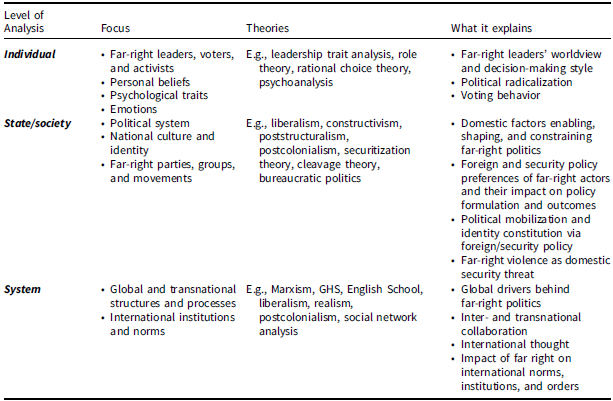
As shown in Table 1, a layered framework for the study of FITP draws on the common distinction between the individual, state/societal, and systemic levels of analysis in IR (Waltz, [1959]Reference Waltz2018)Footnote 4 and considers both structure and agency (Wendt, Reference Wendt1987; Carlsnaes, Reference Carlsnaes1992). At the individual level, it analyzes the role of individuals, their personal beliefs and psychological traits and how they influence political behavior, including decision-making processes, voting, and political radicalization. At the state/societal level, it analyzes how domestic – material and ideational – conditions (e.g., party system and national identity narratives) shape the rise of far-right parties, groups, and movements and their ideological, strategic, and organizational approaches to “the international.” At the systemic level, it analyzes how international or global structures and relations (e.g., neoliberal globalization, racism, and international institutions) shape the emergence and patterns of far-right politics and are shaped by it.
Layered framework for the study of FITP

Table 1. Long description
A table titled Layered framework for the study of FITP. The table has four rows and four columns. The columns are labeled Level of Analysis, Focus, Theories, and What it explains. The rows are labeled Individual, State/society, and System. Row 1: Level of Analysis, Individual; Focus, Far-right leaders, voters, and activists, Personal beliefs, Psychological traits, Emotions; Theories, E.g., leadership trait analysis, role theory, rational choice theory, psychoanalysis; What it explains, Far-right leaders’ worldview and decision-making style, Political radicalization, Voting behavior. Row 2: Level of Analysis, State/society; Focus, Political system, National culture and identity, Far-right parties, groups, and movements; Theories, E.g., liberalism, constructivism, poststructuralism, postcolonialism, securitization theory, cleavage theory, bureaucratic politics; What it explains, Domestic factors enabling, shaping, and constraining far-right politics, Foreign and security policy preferences of far-right actors and their impact on policy formulation and outcomes, Political mobilization and identity constitution via foreign/security policy, Far-right violence as domestic security threat. Row 3: Level of Analysis, System; Focus, Global and transnational structures and processes, International institutions and norms; Theories, E.g., Marxism, GHS, English School, liberalism, realism, postcolonialism, social network analysis; What it explains, Global drivers behind far-right politics, Inter- and transnational collaboration, International thought, Impact of far right on international norms, institutions, and orders.
A layered meta-theoretical framework has three advantages for the study of FITP: First, it facilitates a pluralist and cross-disciplinary approach by aligning with diverse IR theoretical paradigms and subdisciplines, as well as the interdisciplinary literature on the far right and its micro-, meso-, and macro-level theorizing. Second, it can be used to examine the relative importance of various dimensions of far-right politics – including material, normative, discursive, and affective factors – and evaluate the explanatory power of different levels and theoretical perspectives, along with the causal or constitutive mechanisms they emphasize. Third, it enables the systematic and comparative analysis of different countries and regions, time periods, and variants of far-right politics by contextualizing the different historical, geopolitical, and socio-economic conditions in which far-right actors operate and elucidating the distinct patterns of far-right politics that emerge from these contexts.
Conclusion
This article has reviewed the scholarship on the international, transnational, and global dimensions of the far right. Given the rise of the far right in many parts of the world, this literature has effectively bridged the field of IR and far-right studies and, through its important theoretical, conceptual and empirical advancements, established a new and expanding research program that can be called FITP. The principal purpose of this review exercise was to integrate the nascent FITP literature into a general framework that appraises their different analytical perspectives and themes, connects each research strand with various IR paradigms, subdisciplines, and literatures, and identifies potential gaps, limitations, and future research agendas. Thereby, the article aimed to broaden and diversify the theoretical, empirical, and methodological scope of the FITP research program and to further facilitate synergies and dialogue between IR and far-right studies. At the same time, it aimed to promote the scholarly exchange among the different literatures and approaches within the FITP research program by highlighting their distinct lines of inquiry and insights.
To further consolidate and advance the FITP research program, the article developed a framework by identifying and examining five principal research strands: (1) foreign and security policy, (2) international thought, (3) the global causes of the rise of the far right, (4) inter- and transnational collaboration, and (5) international norms, institutions, and orders. While research strands (2) and (3) have been among the most vibrant areas of inquiry in IR, producing substantial insights, and strands (3) and (4) have long attracted significant interest in far-right studies beyond the field of IR, research strands (1) and (5) are still in their preliminary stages and have only recently begun to produce noteworthy works.
Based on delineating and exploring the five research strands, the article discussed a future research agenda for FITP that addresses its major conceptual, theoretical, and empirical challenges and shortcomings. It proposed a layered meta-theoretical framework for the study of FITP and the advancement of its research program. In keeping with the different research strands and methodological approaches, this framework distinguishes between different levels of analysis – individual, state/societal, and systemic – and considers the multiple causal and constitutive, as well as material and ideational, mechanisms at work in far-right politics. This, in turn, allows for a pluralist and cross-disciplinary approach that can integrate various theoretical perspectives and analyze the different dimensions, manifestations, and contextual conditions of far-right politics across the globe. Given the increasing mainstreaming and consolidation of far-right politics in different parts of the world, FITP’s research program is highly relevant for understanding and countering this formidable challenge to pluralist democracy and global cooperation, human rights, peace, and solidarity.
Data availability statement
N/A.
Acknowledgements
I would like to thank the three anonymous reviewers for their very helpful feedback and suggestions on an earlier version of this article.
Funding statement
N/A.
Competing interests
None.
Use of AI
None.

 Open access

