


Introduction
Once experimental, deliberative mini-publics have proliferated across advanced democracies in recent years as policymakers seek new ways to address complex issues such as climate change (OECD, 2023). National and local governments in France, Ireland, Belgium, Denmark, and Poland, among others have convened citizens’ assemblies on climate policy, while the UK has emerged as a particularly active site for experimentation (Farrell and Field, Reference Farrell and Field2022). This mainstreaming of deliberative democracy has been accompanied by the emergence of individuals and organizations specializing in organizing and running mini-public processes such as climate assemblies, juries, or panels. This outsourcing and specialization of the deliberative field to expert practitioners has generated sustained scholarly debate over whether such developments should be a cause for concern. Aspects of professionalization – professionalism, marketization, and capture – are often conflated. On one hand, professionalism is associated with benefits such as standardization, knowledge sharing, and specialized expertise (Dzur, Reference Dzur2008; Goldfrank et al., Reference Goldfrank, Ross and Welp2026, 6). On the other hand, marketization implies a conflict between market pressures and deliberative ideals, placing greater emphasis on value for money, time efficiency, and measurable deliverables at the expense of reflection and considered discussion (Hendriks and Carson, Reference Hendriks and Carson2008). These concerns are often framed in terms of commercialization and commodification. Additionally, professionalization is seen as increasing the risk of co-optation and capture, whether by commissioning bodies seeking to exert control over the process or by an increasingly specialized deliberative elite (Lee, Reference Lee2014a; Beauvais and Warren, Reference Beauvais and Warren2019; Oross and Tap, Reference Oross and Tap2021; Junius, Reference Junius2025).
Given the substantial literature that demonstrates mini-publics can inform legislation and legitimize policy choices (see Wells et al., Reference Wells, Howarth and Brand-Correa2021; Farrell and Field, Reference Farrell and Field2022; Ainscough and Willis, Reference Ainscough and Willis2024), it is crucial to examine this debate. This article addresses questions about professionalization by clarifying the normative assumptions underlying different definitions and examining three dimensions: marketization, capture, and professionalism. Building on these concepts, we develop an account of the network of actors and organizations involved in local climate mini-publics (or CMPs) and the implications of these relationships for deliberative practice and standards. Using a qualitative social network analysis (SNA), these findings provide more precise answers to the concerns of capture and marketization that have surrounded critiques of CMPs, and broader public deliberation processes; for example, who are the key professional actors involved in UK CMPs? How is influence distributed among these actors in the deliberative network? And how do professional relationships and network structures shape practices, design decisions and standards in CMPs?
This article aims to improve extant literature in two main ways. First, we draw on the case of local CMPs in the UK, focusing on the set of actors ‘behind-the-scenes’ to understand both the risks of professionalization and any benefits. While some existing scholarship highlights the influence of facilitators and process designers (Moore, Reference Moore2012; Blue and Dale, Reference Blue and Dale2016; Agger and Egmose, Reference Agger and Egmose2025), this article expands the scope to include advisory board members, expert witnesses, sortition companies, and ‘pracademics’ involved in CMPs. Second, we employ a qualitative SNA approach, supported with document analysis and data from 22 interviews. This method is specifically suitable for analyzing the relational impact of social ties on the flow of ideas that ultimately shape the practices, design, and innovation of CMPs. Previous studies of deliberative practitioners have tended to rely on either single cases or ethnographies (Lee, Reference Lee2014a; Bherer et al., Reference Bherer, Gauthier and Simard2017; Mazeaud and Nonjon, Reference Mazeaud and Nonjon2020), isolated roles within the backstage process (Moore, Reference Moore2012; Salamon et al., Reference Salamon, Lightbody, Roberts, Reher, Reggiani, Escobar and Elstub2025), or interviews that capture individual attitudes but not relationships (Cooper and Smith, Reference Cooper and Smith2012; Parry, Reference Parry2025). These approaches have generated valuable insights into practitioner norms and discourse, but cannot map the structural ties through which influence and knowledge actually circulate. This paper, therefore, contributes a novel understanding of the hidden architecture of the deliberative field, which organizations are most central, which serve as brokers or gatekeepers, and how expertise and resources flow through the system.
So, should deliberative democrats be concerned about the rapid proliferation of a professional deliberative market? This paper finds that, rather than overt elite capture, the professionalization of deliberation has created a network dependency in which a few central facilitators hold significant influence, potentially protecting the process but also risking exclusion and stagnation. Whilst CMP processes are not necessarily robust enough to block overt attempts of co-optation, our analysis indicates that political actors, such as councils, prefer to transfer responsibility, and therefore power, to facilitating companies. These facilitators are hence the reluctant recipients of control and influence. Moreover, this trend towards knowledge sharing through professionalism, appears to reinforce industry-cluster divergence, benefiting those within established ‘in-groups’ while marginalizing newcomers or less-connected participants.
The article reviews existing research on CMP governance and the value of a social network approach before outlining the methodology and findings on three key features of the deliberative industry: centrality, small-world dynamics, and clustering. It concludes by examining the implications of these features for deliberative integrity, arguing that professionalization can both strengthen procedural standards and create risks of fragmentation and vulnerability.
Overview of the debate: integrity, professionalization, and deliberative networks
Constructing high-quality CMPs has been a central concern in deliberative democracy and democratic innovation research. As a result, scholarship has focused mainly on institutional design, examining how discussion formats (Esterling et al., Reference Esterling, Fung and Lee2015; Baccaro et al., Reference Baccaro, Bächtiger and Deville2016), recruitment methods (Owen and Smith, Reference Owen and Smith2018; Flanigan et al., Reference Flanigan, Gölz, Gupta, Hennig and Procaccia2021; Abbas and Sintomer, Reference Abbas and Sintomer2022; Dryzek and Niemeyer, Reference Dryzek and Niemeyer2024) and modes of political embedding (Felicetti et al., Reference Felicetti, Niemeyer and Curato2016; Setälä, Reference Setälä2017; Beauvais and Warren, Reference Beauvais and Warren2019) affect deliberative quality and impact. Underpinning this work is an emphasis on deliberative quality, with design ‘recipes’ intended to enhance discussion, autonomy, and downstream influence (Fung, Reference Fung2003; Steenbergen et al., Reference Steenbergen, Bächtiger, Spörndli and Steiner2003; Himmelroos, Reference Himmelroos2017). More recently, scholars have shifted attention beyond these ‘front-stage’ features to the ‘back-stage’ infrastructure of CMPs. Parry and Curato (Reference Parry and Curato2024) conceptualize this as deliberative integrity: the administrative and governance arrangements that shape key decisions, such as agenda-setting, expert selection, participant recruitment, and process duration. Given the rapid proliferation of deliberative processes (OECD, 2023) and the growing interest in climate assemblies in particular (Smith, Reference Smith2024), the industry has had to assimilate this demand through greater numbers of facilitating organizations and more competitive tendering. Situating the decisions surrounding deliberative integrity within this commercial environment raises concerns about the potential manipulation of CMPs. At the same time, other accounts emphasize how standardization, professional frameworks, and specialization may improve deliberative quality.
These tensions are examined most directly in studies of the deliberative democracy industry (Hendriks and Carson, Reference Hendriks and Carson2008; Cooper and Smith, Reference Cooper and Smith2012; Lee, Reference Lee2014a; Bherer et al., Reference Bherer, Gauthier and Simard2017; Chilvers, Reference Chilvers2017; Christensen and Grant, Reference Christensen and Grant2020; Barry and Legacy, Reference Barry and Legacy2023). Much of this literature frames discussions of the industry in terms of ‘professionalization’ often using overlapping terms such as commercialization, commodification, or marketization. Hendriks and Carson (Reference Hendriks and Carson2008, 299), for example, argue that deliberative consultants ‘actively commodify ideals of public deliberation’, packaging and selling deliberative products to clients across sectors. Others seek to soften this critique by emphasizing communities or networks of practice between ‘public participation professionals’ (Bherer et al., Reference Bherer, Gauthier and Simard2017), ‘consultants’ (Hendriks and Carson, Reference Hendriks and Carson2008) and ‘process designers’ (Escobar and Roberts, Reference Escobar and Roberts2015).
Professionalization can hence be discussed differently depending on whether it is viewed as a risk or as a resource. To clarify this debate, we define ‘professionalization’ as the consolidation of a specialized field of actors, organizations, practices and networks claiming authority over the design and delivery of deliberative processes. Within this general definition, various aspects of marketization, capture and professionalism are often conflated. First, marketization refers to the subordination of democratic principles to commercial imperatives. Cooper and Smith’s (Reference Cooper and Smith2012) comparative study of British and German practitioners shows how the need to remain market-focused constrains democratic ambitions through unrealistic delivery timeframes, value-for-money requirements, and reputational pressures. More broadly, commercial incentives may prioritize standardization over innovation, reputation management over transparency, and self-censorship over critical reflection (Kashefi and Mort, Reference Kashefi and Mort2004; Spada and Ryan, Reference Spada and Ryan2017; Hanson, Reference Hanson2018). These concerns should be distinguished from wider critiques of mini-publics, such as democracy-washing or the selective uptake of recommendations, which can arise regardless of who delivers them. Rather, the concern is that professionalization shapes the incentives, relationships and governance arrangements through which such challenges are mediated. From this perspective, the concern is not that the market necessarily creates these democratic challenges, but that it may alter the incentives, relationships, and governance arrangements through which they are mediated. Further, scholars question how commercial contexts influence control over information and expertise. Research demonstrates that expert selection can delimit the epistemic boundaries of deliberation, influencing participant views and policy outputs (Moore, Reference Moore2017; Roberts et al., Reference Roberts, Salomon, Reggiani, Lightbody, Reher and Pirie2022; Blijleven, Reference Blijleven2023). Since experts themselves are not neutral, limited transparency and standardized recruitment processes heighten the risk of manipulation (Christensen and Grant, Reference Christensen and Grant2020).
Second, professionalization often refers to concerns of elite capture. This is a critique hinted at in normative accounts of deliberation but often not fully substantiated with empirical evidence (O’Flynn and Sood, Reference O’Flynn, Sood, Setälä, Bächtiger and Grönlund2014; Lafont, Reference Lafont2019; Hammond, Reference Hammond2021). The commercial and institutional contexts in which CMPs operate create opportunities for political, economic, or organizational elites to shape deliberative processes in subtle but consequential ways. Control over agenda-setting, framing of policy questions, selection of experts, and interpretation of outcomes provides multiple points at which elite interests can steer deliberation without overt interference. As Christensen and Grant (Reference Christensen and Grant2020) note, market incentives may encourage practitioners to align processes with commissioner expectations, particularly where funding or future contracts are at stake. Elite capture thus operates not through the direct manipulation of participants, but through back-stage governance arrangements that delimit the scope, direction, and political relevance of deliberation. Junius (Reference Junius2025) outlines these risks in relation to a Belgian mini-public and offers a comprehensive framework for understanding how public engagement processes can be captured. Further research is needed to test these claims in other contexts, such as the UK.
Countering these critiques, other scholars use professionalization to refer to professionalism. The expansion of professional networks has supported the global diffusion of mini-publics, increased funding, and strengthened partnerships. Calls for standards and accountability frameworks suggest a move beyond the assumption that markets are inherently corrosive to democracy (Parry, Reference Parry2025; Parry et al., Reference Parry, Curato and Dryzek2025). Moreover, empirical realities complicate simplistic market narratives: many CMP organizations are small, reliant on grants or lottery funding, and sustained by unpaid or underpaid labor (Lee, Reference Lee2014a; Lee, Reference Lee2014b, Parry, Reference Parry2025, 412, 416). For such actors, professional standards may help protect deliberative integrity and buffer against market pressures rather than exacerbate them. There appears to be a delicate balance between the benefits of professionalism and the risks of overt marketization and capture in handling the growth of mini-publics efficiently and with high-quality standards.
Despite growing interest in professionalization and market dynamics, relatively little attention has been paid to the social and relational dimensions through which it operates. While existing research gestures towards ‘networks of practice’ or ‘communities of practice’, and notes the importance of relationships between practitioners, researchers, commissioners, and gatekeepers in shaping deliberative processes (Hendriks, Reference Hendriks2006; Hendriks and Carson, Reference Hendriks and Carson2008; Cooper and Smith, Reference Cooper and Smith2012; Spada and Ryan, Reference Spada and Ryan2017), these dynamics remain largely implicit and under-theorized. This is a significant omission, given that professionalization unfolds not only through formal rules or market incentives, but through patterned relationships of collaboration, trust, reputation, and repeated interaction. As mentioned by Barry and Legacy (Reference Barry and Legacy2023, 86), it is important to note ‘not only who is doing the work but also…whose organisational and professional norms are guiding the process’. We therefore argue that SNA offers a valuable lens for examining the deliberative backstage. By mapping relationships among organizations and individuals involved in CMPs, SNA can reveal patterns of centralization, brokerage, and dependency that are otherwise difficult to observe. In doing so, it offers a means of identifying potential sites of elite capture, such as the concentration of agenda-setting power, recurring expert involvement, or the disproportionate influence of well-connected organizations within the deliberative marketplace. Combined with interviews and document analysis, it enables analysis of how deliberative integrity is shaped through networks of professional and social relations rather than isolated design choices.
Methodology
The case
This article focuses on individuals and organizations involved in UK local-government-commissioned CMPs. The UK is notable for the scale, density and relative maturity of its deliberative industry, making it a particularly instructive case for research. The country has a comparatively long history of public participation organizations, shaped in part by the Blair government’s early 2000s emphasis on localized civic engagement, as evidenced by the founding of companies such as Involve and DemSoc (Elstub and Escobar, Reference Elstub and Escobar2026). Since 2019, the increasing popularity of climate assemblies has both deepened specialization among established providers and drawn new actors into the field, contributing to the expansion and consolidation of a professionalized deliberative marketplace (see Tables A4 and A5 in the online Appendix). This rapid proliferation of locally commissioned climate assemblies, combined with limited government in-house capacity, has led to a firm reliance on a small set of facilitators, recruitment agencies, and advisors. Such concentration makes relational dynamics such as centrality, preferential attachment, and clustering especially visible, allowing a network-based analysis of how influence, standards, and practices circulate behind the scenes. Restricting the network boundary to climate-focused processes limits heterogeneity in issue scope and institutional context, enabling ties between actors to be interpreted as part of a shared professional network rather than as incidental or cross-sectoral connections. In addition to these methodological considerations, there are a number of scholarly discussions that have also focused on the UK deliberative market. Hendriks and Carson (Reference Hendriks and Carson2008, 306) noted, almost two decades ago, a shift toward market competition and non-deliberative outcomes in the UK when examining health reform mini-publics, which at the time were the most common focus. This was also noted by Harrison and Mort (Reference Harrison and Mort1998), Parkinson (Reference Parkinson2004), Rowe and Shepherd (Reference Rowe and Shepherd2002), and Kashefi and Mort (Reference Kashefi and Mort2004). Similar dynamics were identified by Chilvers’ (Reference Chilvers2008, Reference Chilvers2010, Reference Chilvers2017; Pallett and Chilvers, Reference Pallett and Chilvers2013) analysis of the UK Sciencewise programme. While professionalization supported the diffusion of public participation practices, it also narrowed the range of ‘legitimate’ arrangements by privileging citizen juries and a small set of established providers, producing practitioner hierarchies and increasing fragmentation. It seems appropriate to revisit these concerns through an analysis of the UK’s current dominant deliberative focus: local CMPs.
Approach to social network analysis
This article analyses the deliberative marketplace using a qualitative SNA framework, informed by network terminology and a theoretical understanding of social ties and influence. It is important to note that the notion of a network can be used in many different ways in different contexts, for example, as a metaphor to describe specific governance characteristics that take place outside of formal politics, or as an analytical tool to understand policy implementation (Lazer, Reference Lazer2011; Nochta, Reference Nochta2020). Here, the term network is used as a descriptive term or lens to interpret the interconnected set of social relationships that can comprise individuals, collective or cooperative actors. Given that politics inherently involves interactions among multiple actors, network theory is particularly useful: it demonstrates that power is not merely an attribute of an individual actor but also encompasses the capacity to influence others. Such networks are analytically valuable because of the resources and information exchanged among actors (Wasserman and Faust, Reference Wasserman and Faust1999; Scott, Reference Scott2017).
SNA, therefore, examines the consequences of these relational patterns, using terms such as ‘centrality’ to characterize the strength and type of influence and connectedness that actors possess. These actors or entities are labeled ‘nodes’, and the relationships between them are ‘ties’. Following Borgatti and Li (Reference Borgatti and Li2009) and Rawlings et al. (Reference Rawlings, Smith, Moody and McFarland2023), network ties can be conceptualized in four ways: membership ties, which situate actors within a shared social space; relational ties, based on role-defined connections and mutual orientations; interaction ties, capturing direct exchanges between actors; and flow ties, referring to the transfer of material or symbolic resources such as information, ideas, practices, or influence. Crucially, a node can have more than one type of tie with multiple other nodes, for example they could have worked with another facilitator on a CMP but also have a friend who has been an expert witness on another CMP. This is known as a ‘multiplex network’ (Rawlings et al., Reference Rawlings, Smith, Moody and McFarland2023, 49). The analysis enables an understanding of the impacts of these connections on knowledge and information flows, and therefore about how ideas are shaped, contested, and ultimately integrated into CMP designs and processes.
While SNA is typically associated with quantitative methods – using numerical data to assess the ‘strength, intensity, frequency and direction of network relations’ (Heath et al., Reference Heath, Fuller and Johnston2009, 645) – not all network structures are readily measurable. For example, Carpenter (Reference Carpenter2014) explores the discursive landscape of global advocacy issues and applies network analysis to demonstrate how certain issues are foreclosed or enabled by network structures. In such cases, qualitative SNA offers a more suitable approach, allowing for richer insights into how relationships form, evolve, and are perceived over time (Schepis, Reference Schepis2011). This article’s focus on flows of information and standards within the deliberative community, and on the structures through which these occur, led us to adopt a qualitative SNA approach.
Data collection
The data for the analysis was collected in two stages: first, we collected a full dataset of all individuals involved in government-commissioned UK local CMPs between 2019-2025, focusing on facilitators, advisory board members and expert witnesses as recorded in publicly available reports. Freedom of Information requests were used if this was not publicly available. This resulted in a list of 425 advisory board members and 612 expert witnesses across 12 primary facilitation companies for 36 CMP processes. A simple matrix was constructed to highlight any recurring names or companies.
Purposive sampling was used to select the initial participants for an interview from these recurring names in the matrix. We also focused interview invites on advisory board members of local CMPs, as these were primarily perceived to be the relevant stakeholders due to their influence over key aspects of the process as outlined in public reports. Individuals spanned a range of geographical locations with a representative range of professional sectors.
An iterative approach was adopted following this initial round of interviews to extend the boundary to include the facilitation organization, government stakeholders, expert witnesses and facilitators. The reason for this was that we learnt of the limited influence of the advisory board, largely due to infrequent meetings, expertise and available resources. Sortition organizations were also included to cover all aspects of the CMP process. We spoke to a total of 24 individuals, with questions related to areas participants felt their expertise was in. These interviews gave us a 97% (35/36) coverage of the relevant CMPs in the UK, meaning we spoke to at least one person involved in each process. We supplemented any gaps with additional desk research of the public reports, news articles and council minutes where we were not able to speak to anyone involved. Many of these interview participants held multiple roles across multiple CMPs, often simultaneously acting as practitioners, experts and facilitators or moving from one company to another, making this a multiplex network. Some had also worked with other types of deliberative engagements as well as mini-publics on non-climate topics, which were also brought into the discussion. A full list of anonymized interview participants is available in the online Appendix (Table A1). Ethical approval was secured through the University’s research ethics committee.
Interviews took place online, and began by asking participants about their career background and their role in the commissioning, designing and running of CMPs. A second set of questions focused on the network features, including their relationship with other actors and organizations, their understanding of their influence on other actors and the CMP process, and how information is shared and exchanged through the network. We developed our understanding of ties in the network by explicitly asking connection-based questions or name-generator questions, such as asking who they have worked with previously. Finally, participants were asked about the extent to which a community of shared practice has become established and any barriers to this, including their opinions of increasing standardization, elite capture or institutionalization within the community. By asking these questions, we were able to reach an understanding of how the CMP network operates and the areas where certain commercial dynamics are more dominant. A sample interview guide is available in the online Appendix (Table A6). Network questions often need to be asked sensitively due to the focus on personal relationships, so a reactive approach was taken to ensure interviewees understood the way in which this data would be used.
Data analysis
Interviews were transcribed and analyzed in NVivo by both authors. The first 25% of interviews were blind double-coded, after which the coding framework was refined through discussion before the remaining interviews were coded independently. Regular discussions were held to support intercoder reliability. The initial coding structure built on the method proposed by Löblich and Pfaff-Rüdiger (Reference Löblich and Pfaff-Rüdiger2011) for qualitative network analysis, as well as drawing on theoretical understandings of two-mode networks and knowledge innovations (Prell, Reference Prell2012). For our initial understanding, we sorted the codes into actors, their relationships and structure, as well as knowledge diffusion in the network. Additional sub-codes were then added as the analysis progressed. Responses to name-generator questions were used to construct an adjacency matrix of actor relationships, which was then cross-checked against the document analysis.
Findings
The analysis begins by exploring who is in the network to understand how influence and authority emerge, focusing on ‘centrality’. The second section asks how the wider network is structured, analyzing ‘centralization’ and the formation of clusters and communities.
Who is in the network? Importance and influence
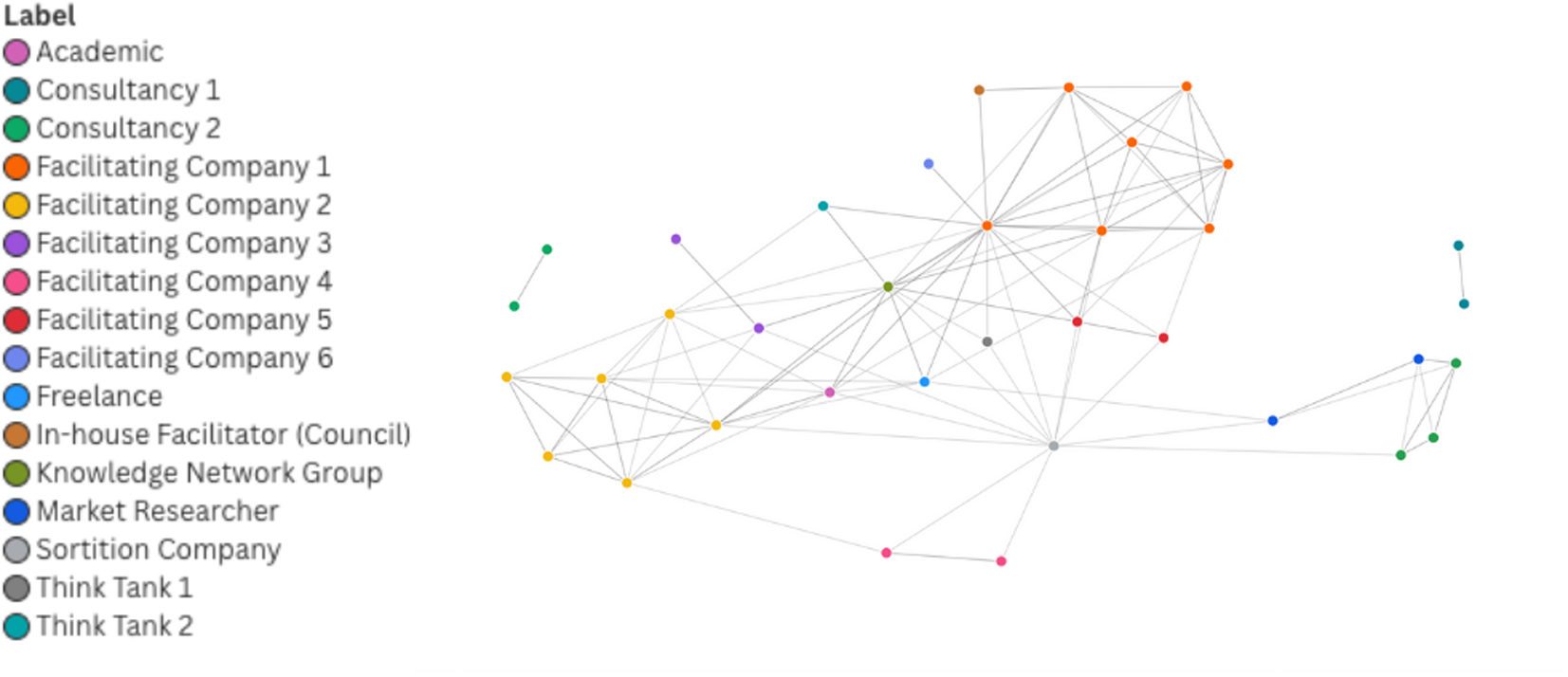
Figure 1 shows the highly connected network CMP professionals, indicated by most nodes having one or more connections to other nodes in the network. Each circle represents an actor, otherwise known as a node. The ties between nodes represent a relationship, as indicated during interviews or document analysis. The colors show the company-level affiliation, so for example, all green circles are employed by the same facilitating company. The nodes with no ties are isolated from the rest of the network, given the lack of reported connections. To understand this graph and the network in more detail, it is helpful to think in terms of centrality to analyze how some nodes are more influential relative to others. An individual’s centrality is thus a useful indicator of power, influence and prestige within a network. There are four main ways to measure centrality: degree centrality, betweenness centrality, closeness centrality and eigenvector centrality.
-
a) Degree centrality
A sociogram of local CMP professionals in the UK.

Figure 1. Long description
A sociogram illustrating the network of local CMP professionals in the UK. The sociogram features a network of interconnected nodes, each representing a different professional category. The nodes are color-coded according to their labels, which include categories such as Academic, Consultancy 1, Consultancy 2, Facilitating Company 1 through 6, Freelance, In-house Facilitator (Council), Knowledge Network Group, Market Researcher, Sortition Company, Think Tank 1, and Think Tank 2. The nodes are connected by lines indicating relationships or interactions between the professionals. The network shows clusters of nodes with varying degrees of connectivity, suggesting different levels of interaction and collaboration among the professionals. The sociogram provides a visual representation of the professional landscape and the interconnectedness of various roles within the deliberative field.
Firstly, degree centrality, or ‘connectedness’ (Carpenter, Reference Carpenter2014, 45) is a simple measure of how many connections a node has. It therefore captures the overall volume of activity. In this case, having a higher degree centrality demonstrates a form of importance of an individual within the CMP industry. This importance comes from being active through the many connections they have built across the network over time. Hafner-Burton et al. (Reference Hafner-Burton, Kahler and Montgomery2009, 570) note that individuals with high degree centrality ‘…may possess social power, easily accessing resources and information from other nodes because of its central position’. For example, Figure 2 highlights a freelance facilitator with a relatively high number of connections across the network who works in different organizations, for example in comparison to a facilitator that has only worked for one company.
A sociogram showing a node with high degree centrality, indicated by the high number of ties to other nodes.

Other nodes with high degree centrality included non-facilitating network groups that brought together various democracy organizations to share and reflect on practice. A small number of names were mentioned time and time again across all interviews. One participant reflected that ‘it’s a small ecosystem’ (Academic 1) – these were not necessarily the CEOs or those with senior positions within the largest organizations, but those that connected across the network. These key actors have multiple ties to other individuals, going beyond just the CMP they were directly involved in, implying a high degree-centrality. Often these specific actors play a significant role not just in the facilitation or designing of CMPs, but take on an ‘activist’ role in advocating for the emergence of deliberative practices (Fung, Reference Fung2005). As noted in wider deliberative circles, ‘it is fair to say that the deliberative movement around the globe is spearheaded by a relatively small cadre of experts’, demonstrating the professionalized and specialized features of the industry (Button and Ryfe, Reference Button, Ryfe, Gastil and Levine2005, 21).
-
b) Betweenness centrality
Secondly, betweenness centrality measures ‘the extent to which an actor acts as a broker in the network’ (Smith and Newman, Reference Smith and Newman2024, 229). Brokers are individuals who connect otherwise unconnected nodes, enabling access to diverse knowledge and opportunities (Granovetter, Reference Granovetter1973). In the deliberative market, high-betweenness actors play a key role in connecting otherwise disconnected organizations and shaping communities of practice. Interviewees reflected that those who were able to sit at the intersection of theory and practice, such as ‘pracademics’, were able to broker successful coalitions of multiple organizations or non-facilitating organizations that aim to create a community of practice, rather than consultancy services (as indicated in Figure 3). One individual mentioned how once practitioners realized that they weren’t ‘going to try and capture something in the market’ it meant they can ‘talk to everyone…because they know that I’m not competing with them for a contract’ (Practitioner 1). Brokers also integrate newer or smaller organizations into the field by circulating information, resources, and norms developed across their wider networks. In doing so, they function as bottlenecks through which standards and practices are filtered, while also amplifying visibility and credibility for less established actors. To illustrate this, imagine a newer node to the network who is wanting to facilitate a CMP. Through a past connection, this newer node is connected to a key facilitator who has high betweenness centrality. This means the newer organization has access through this broker to the kind of information that the broker is getting from their many other contacts. Through this connection, they were able to reinforce shared values and practices, and gain disproportionate visibility. Professionalism in this context therefore operates through these brokers who act as intermediaries between different groups in the network. More established organizations can act as key brokers to increase credibility, introduce new organizations to the field and gatekeep (or safeguard) reputational access.
-
c) Closeness centrality
A sociogram showing a node with high betweenness centrality, indicated by how often this nodes acts as a bridge (or ‘broker’) between other nodes.

Closeness centrality helps us to understand the diffusion of ideas within the network, and influence potential. Unlike degree or betweenness centrality, closeness centrality captures a node’s overall proximity to the entire network rather than their number of direct ties or brokerage position. Nodes with high closeness are not necessarily the most visible brokers or the most densely connected, but they are structurally positioned such that ideas, norms, and practices originating from them can diffuse rapidly across the field. This is seen in Figure 4, whereby a key head of a facilitation company is at close proximity with a large proportion of the network beyond their own company. Disruption to this actor, either through funding loss, reputational damage or career change, would have cascading effects throughout the network. Hence, while high closeness centrality enhances efficiency and coordination, it also introduces systemic fragility. One interviewee even joked that if something happened that meant two or three of the leading facilitating organizations disappeared, ‘you’d pretty much wipe out a sector’ (Practitioner 1). Fragility here refers not to dysfunction, but to the reliance of professional deliberative practice on a narrow set of central actors and informal relationships rather than on institutionalized safeguards. The resulting fragility lies in the fact that deliberative integrity is upheld by the goodwill and judgment of central actors, rather than being secured through durable governance arrangements. This has implications for concerns surrounding elite capture, in that certain actors are more susceptible to being targeted.
A sociogram showing a node with high closeness centrality, indicated by the short distance from this node to all other nodes. This tells us how quickly information can spread from that node.

We discussed with interview participants the various measures that are taken to ensure against concentration of influence within these processes, such as advisory boards, but learnt that these are often weakened on a local level where there are limited resources and capabilities. Further, the timing of the appointment of the advisory board is important, as this often takes place post-tender, meaning their oversight role is restricted to expert choice and procedural standards rather than broader questions of facilitators and contracts. As a result of the lack of a strong advisory board or formal safeguards, facilitators assume an outsized role, holding more influence than intended. Many of these individuals feel uneasy about this, with the legitimacy of the process resting heavily on their personal integrity rather than on robust institutional checks. An interview with one of the central facilitators of mini-publics revealed a potential over-reliance on the good will of certain actors:
We need to make sure that our processes are so robust that, if, for example Nigel Farage was running a citizens assembly, we would feel that he couldn’t have too much influence on what was actually going to happen in the process because there are these steps in place. But if I’m the equivalent of Nigel Farage, I think I have too much influence. (Facilitator 3)
The quote highlights a structural weakness in how CMPs and other deliberative forums are organized, particularly at the local level. The interviewee’s reference to Nigel Farage, leader of the radical right Reform UK party, underscores this concern; ideally, deliberative processes should be designed so that even if a partisan or controversial figure were in charge, their ability to manipulate the outcome would be limited by procedural safeguards. In practice, however, the absence of such protections means that if ‘the equivalent of Nigel Farage’ were facilitating, they could exert excessive influence. This points to a worrying over-reliance on the good faith of central individuals. Interviewees also noted that the additional time and labor required to fulfill these governance responsibilities can undermine facilitators’ ability to act as effective safeguards against undue influence from other elites, such as stakeholders involved in advisory processes or expert selection. The concentration of authority thus generates a paradox: facilitators are granted increased control in the name of protecting independence and integrity, yet this very concentration introduces new risks where formal accountability mechanisms are weak.
-
d) Eigenvector centrality
Unlike degree centrality, which counts the number of connections, eigenvector centrality recognizes that being connected to other well-connected nodes matters for influence: knowing a large number of unimportant people is not the same as having important connections. This can be estimated by taking into account a node’s relative position to other important ‘central’ nodes. Figure 5 shows a small facilitation company with low resources and capacity but is able to leverage its connections with other highly central nodes to wield disproportionate influence within the market. What is distinctive about the CMP field is that small organizations can gain such influence not necessarily through material resources or professional positions but rather through their high eigenvector centrality in the network (Facilitators 6, 7, 10, 12). Here what matters is the organization’s structural position to the network through key connections to well-connected individuals and companies. This has implications for how smaller companies experience the market pressures within the deliberative industry. As one facilitator remarked, ‘the reality is, we’re operating in a marketplace which is shit’ (Facilitator 3), another; ‘there is definitely a market, and that’s not, in my view, the way that these sorts of deliberative processes are supposed to work and run and operate’ (Facilitator 8). Nevertheless, interviewees also described intentional efforts to push back against these negative effects of a developing professional marketplace. Using their networks and connections, key actors sought to maintain spaces for collaboration and shared learning, which can help to mitigate competitive pressures associated with tendering and contract applications; talking about another facilitating organization, one company director said ‘we’re not competitors’ (Facilitator 7) and others mentioned the community aspects of the deliberative space in the UK (Practitioner 1, Recruiter 1, Advisor 1). Such spaces allow practitioners to exchange practices and reduce barriers to more innovative or inclusive approaches, even within the constraints of existing market structures.
A sociogram showing a node with high eigenvector centrality, indicated by connections to influential (well-connected) nodes.

What does the wider industry look like? Unequal concentration and clusters
Moving from individual-level measures of centrality, which focuses on how important particular actors are, the wider network-level highlights how unequal importance is across the network. A highly centralized network signals structural inequality in influence and access, producing efficiency and coherence at the cost of resilience, inclusiveness, and autonomy. Figure 1 demonstrates this well, with a small number of actors occupying structurally dominant positions through which a disproportionate share of ties pass. Removing the most central actors would substantially increase path length (and therefore information flows) and isolate several groups, indicating that the network’s connectivity is highly dependent on a narrow core. This centralization can hence be understood as creating something similar to the popularized idea of ‘six degrees of separation’ where everyone is only six (or fewer) social connections away from each other. This level of connectedness raises questions about the flow of new and critical information available to the network. Further, taking this ‘birds-eye’ view of the network also reveals particular tight-knit clusters or sub-communities within the broader network. This highlights how cohesion (and divergence) has an impact on standards and knowledge diffusion.
-
a) Uniformity and centralization
As a result of a few number of highly central facilitating organizations, certain nodes assume a disproportionate degree of authority over key aspects of CMP governance. One interviewee gave such actors the label ‘super-facilitators’ emphasizing their role in not just discussion facilitation but also with decisions about agenda-setting, expert selection, and process design (Facilitator 12). This is particularly the case when commissioners seek to demonstrate independence by distancing themselves from the process. Another interviewee observed: ‘We often talk about the facilitator role, but actually the design process is the really crucial thing…It’s about more than what happens when they’re just sitting around the table with the facilitator’ (Facilitator 8). Centralization thus structures the flow of practices across the network, particularly in the recruitment of expert witnesses and sortition agencies.
When asked about the recruitment of expert witnesses, interviewees emphasized how interpersonal trust and previous experience played a large role. This contributes to a level of uniformity throughout the network. It is important to note this was not to ensure certain messages were conveyed to participants in terms of content (i.e., we should cut down on meet to reduce our carbon emissions), but rather that the way these messages were delivered was consistent with what the provider intended (i.e., using accessible terminology or not using complex scientific graphs in speaker presentations). As one interviewee from a facilitating organization expressed, ‘once you’ve found people who can do it well, you tend to hang on to them’ (Facilitator 4). Dynamics such as this reflect the ‘rich get richer’ phenomenon where relationships that are perceived to be low-risk and able to solve dilemmas are chosen more repeatedly (Barabási and Albert, Reference Barabási and Albert1999; Berardo and Scholz, Reference Berardo and Scholz2010). Over time, this entrenches certain actors, potentially limiting the diffusion of ideas and innovation. Another interviewee spoke through the process of recommending expert witnesses from ‘people I know in my network’ (Advisor 1), reflecting the density feature of the network as utilizing similar individuals with strong ties. The same effect is visible among freelance facilitators, many of whom rotate between different organizations. Interviewees noted that they work with the same people over the years, developing personal as well as professional relationships (Facilitator 6). Finally, interviewees revealed strong ties to a particular recruitment agency, which ‘pretty much has the monopoly’ in the UK (Facilitators 4 & 8). When noting the position of the key sortition company in the network, it is possible to draw a short communication path between all actors and entities and the company, even when they were not used directly. Despite interviewees expressing a desire to try different methods, none of these ideas has shown much ‘sticking power’ with randomly stratified selection remaining as the ‘largely unexamined consensus’ (Dryzek and Niemeyer, Reference Dryzek and Niemeyer2024; 604). This consensus may reflect the network dynamics of knowledge flows, whereby the CMP network can be characterized as similar to airport links with major hubs directing and organizing key information, rather than like a road system with numerous junctions and crossings that enable information sharing (Barabási, Reference Barabási2003). The small-world topology of a few major information ‘hubs’ facilitates rapid diffusion of practice, but can also reinforce a narrow methodological orthodoxy. The dominance of a small number of sortition providers and expert witnesses suggests the emergence of increasing standardization, where organizations copy each other not because it leads to better outcomes, but because it confers legitimacy.
Network theory highlights both the positives and the negatives that such high centrality and uniformity can result in Prell (Reference Prell2012). Existing relationships are reinforced through reliability and reduced transaction costs, but these same dynamics can entrench path dependence and restrict the emergence of alternative recruitment and design practices, such as discursive recruitment, self-descriptive recruitment, or fully randomized sampling.
-
b) Clusters and divergence
By removing the key connection of the sortition agency between facilitating companies, there are much more noticeable communities, as shown in Figure 6. These communities, or clusters, are based on patterns of known ties, often formed from membership and organization but can also be bridged by highly connected nodes. These clusters often share information and values, influencing both broad network dynamics and knowledge sharing and standardization.
A sociogram showing the clusters within the CMP network. Removing ties to the central sortition company (used by almost all facilitating companies in the UK) highlights these distinct communities.

Figure 6. Long description
Panel A: A sociogram showing clusters within the CMP network. The graph type is a network diagram. The nodes represent different entities, and the edges represent connections between them. The distinct communities are highlighted by different colors. Panel B: A sociogram showing the clusters within the CMP network after removing ties to the central sortition company. The graph type is a network diagram. The nodes represent different entities, and the edges represent connections between them. The distinct communities are highlighted by different colors.
The formation and reproduction of clusters is both a social and procedural phenomenon. Clusters reinforce cohesion by adhering to shared practices, some of which are informally diffused while others are increasingly formally institutionalized. As one facilitator reflected on the in-group dynamics of their particular cluster, ‘we’ve all moved around, we’ve probably all taken it to all of the different organizations and everyone’s pretty just doing exactly the same thing’ (Facilitators 1 & 2). This quote reflects how actors carry norms across similarly aligned organizations, building a layer of standardization through mobility. Much of this happens informally, particularly for those central actors who are seen as ‘entrepreneurs’ or advocates of deliberative democracy; one reflected that ‘you won’t see my name anywhere on the website…but I’m probably in the ether around a lot of it’ (Practitioner 1). At the same time, formal knowledge-sharing initiatives such as training provided by facilitating organizations further standardize practice across subgroups of the network. One organization mentioned, ‘we are often training people in facilitation so that partner organisations can deliver the facilitation’ (Facilitator 4). A councilor reflected that this seemed ‘counterproductive’ for an organization that ‘makes money through running these things’ too, but that their ‘shared agenda’ for democratic engagement acted as a motivator to train and share knowledge (Facilitator 12). We heard of both formal and informal (unpaid) consultancy work done by central actors within the network (Facilitators 6 and 7), demonstrating the significant efforts currently being made to ensure robustness and standards across the industry.
Additionally, networked organizations, such as the Knowledge Network on Climate Assemblies (KNOCA), play a central role in documenting and disseminating practice (Facilitators 1, 2, 5, 7, Advisor 1, Commissioner 1). As one interviewee put it, they ‘have a role in facilitating quite a large community of practice’ (Practitioner 19). Conferences, learning calls, reports, and online workshops all further add to a collaborative deliberative network. While in a market sense these organizations are natural competitors, within these spaces they are able to share and collaborate in a much more ‘deliberative’ way. Interviewees spoke positively about these network organizations as an opportunity to combat some of the negative implications of operating in a commercialized market, such as becoming increasingly isolated from competitors or being pushed to always cut costs. As one facilitator stated, ‘We obviously work competitively when we’re bidding for something, but we also work collaboratively when it comes to learning’ (Facilitator 4). The network organizations can hence serve as knowledge brokers, diffusing innovation across organizational boundaries and allowing actors to share practice without compromising their commercial interests.
While some organizations and actors benefit from strong ties within these knowledge networks, others (particularly smaller or more isolated actors) may remain outside these clusters. Moreover, some larger, commercially-driven organizations may participate minimally or bypass these shared learning opportunities altogether. This isolation can be down to choice, resource constraints or strategic positioning within a competitive marketplace. This lack of mutual accountability in certain sectors of the marketplace, particularly among organizations less embedded in collaborative spaces, risks weakening collective standards: ‘We need to be challenged about our practice all the time, and I don’t know that that happens enough’ (Facilitator 3). This divergence introduces a risk of fragmentation within the CMP field, where pockets of high focus on democratic integrity coexist uneasily alongside more procedural, less value-driven approaches.
This leads to a growing concern: that parts of the network are drifting away from deliberative democratic principles, creating inconsistent participant experiences and undermining the legitimacy of the CMP process as a whole. The challenge, then, is not only about network cohesion, but about maintaining alignment on core values in an environment where market dynamics threaten to overshadow collaborative learning and quality deliberation. One practitioner explained how many deliberative organizations operate on limited budgets, earning just enough to ‘keep the lights on’ in order to deliver work that ‘fits with our social purpose’ (Facilitator 7). Practitioners from smaller organizations described frustrations where they were asked to contribute as an unpaid advisor to a process they were excluded from delivering, revealing a dynamic that shows deeper inequities in how value is extracted from the network.
Discussion
To situate these findings within the broader debate on the professionalization of deliberative democracy, it is helpful to reflect on the debate discussed at the beginning of this paper. In terms of the positive side of professionalism, we find that particular clusters of the network have embraced the advantages of increased efficiency and connectivity through knowledge sharing and standards diffusion. This means that whilst a by-product of broader market dynamics, this would not be of concern to deliberative democrats due to a strong commitment within these clusters to norms and shared practices. Importantly, central actors actively use their network position to uphold deliberative integrity, resist inappropriate commissioner interference, and share practice across organizational boundaries. At the same time, these findings are qualified due to the structural fragility of the network. Standards are upheld not because they are embedded in robust governance arrangements, but because they are carried by particular people and relationships; ‘…it isn’t just necessarily a reflection of the views and values of the organisation – the individuals are really involved in the process, and what they think good deliberation looks like and feels like’ (Facilitator 8). The unevenness of this stems from knowledge diffusion operating through network authority, rather than formal regulation or accreditation, meaning a number of highly central actors function as brokers of practice, norms, and expectations across multiple CMPs.
On the other side of the debate that raises concerns about the problematic effects of market pressures, we found that practitioners were aware of such risks and expressed these regarding the market context (Facilitators 3 & 8, Practitioner 1, Academic 1; see also for similar reflections, Cooper and Smith, Reference Cooper and Smith2012; Parry, Reference Parry2025). Those individuals with high eigenvector centrality felt able to retain deliberative integrity through their professional community. However, interviews noted differing commitments to deliberative ideals across the wider network (Facilitator 7, Academic 1). A consequence of clustering was the growing divergence between facilitating companies, where organizations with weaker ties to deliberative communities of practice may prioritize deliverability, client demands, or procedural minimalism. This produces uneven standards across the field rather than wholesale commodification or marketization. Crucially, organizations and practitioners positioned outside key knowledge-sharing networks may face greater barriers to learning, collaboration, and exposure to emerging standards. The quality and consistency of practice may depend not only on the existence of standards themselves but also on the inclusivity of the networks through which those standards circulate. Future discussions around accreditation, codes of conduct, or the institutionalization of CMPs should therefore pay attention to the relational structures that underpin knowledge diffusion within the sector.
Finally, with regard to risks of elite capture raised in these debates, we found little evidence of overt political manipulation or intentional capture by commissioning bodies. None of the interviewees felt that the processes they had been a part of indicated signs of overt political manipulation or capture by the commissioning bodies, a finding in contrast to the concerns raised in some of the literature. Indeed, much more unease was raised about the lack of attention given by commissioners, such as local councils, to the process whereby responsibility was deferred to facilitating organizations on almost all aspects of the CMP. This presents an interesting dynamic, in that commissioners are aware of capture concerns and so, in order to demonstrate independence from the process, willingly hand over to facilitators who are seen as the deliberative ‘experts’. However, in doing so, this opens the process up to alternative forms of capture such as through pressure from stakeholders involved in the advising process or in design choices by key facilitators. Practitioners could consider whether introducing more formalized standards or codes of conduct would reduce this risk. Again, it is important to reiterate that we found no evidence of co-optation by individuals involved in these processes, however, interviewees did speak honestly about facilitating organizations being given ever increasing control. Interviewees expressed a degree of reluctance and discomfort in taking on this role, particularly when considering when the facilitators in charge may not prioritize deliberative standards or integrity in the same way as some practitioners hope for. Capture, where it becomes a risk, is therefore less a matter of strategic interference than of structural dependency.
Conclusion
It is important to acknowledge that this study focuses on UK CMPs, and deliberative industries vary across national and policy contexts. While caution is warranted in generalizing these findings to larger and more diffuse deliberative industries, the dynamics identified here are likely to extend beyond climate-focused practice. In particular, the findings highlight how information sharing, reputational considerations, and informal networks shape organizational behavior within relatively small and specialized deliberative sectors (such as crime and policing or the arts). These findings suggest the value of applying a social network lens to deliberative practitioners in other domains where organizations interact frequently and rely on dense professional networks. Further SNA research could therefore examine whether actor centrality affects adherence to deliberative standards or participation in knowledge-sharing groups such as KNOCA, as well as how clusters and cliques relate to broader market dynamics and collaboration patterns. This would also help assess the institutionalization of CMP processes as market and professional dynamics interact with deliberative commitments. Related questions about whether CMPs should be facilitated in-house or outsourced to external professionals remain central to debates on their future role in policy systems. The observed clustering and centralization, alongside limited evidence of overt capture, highlight key considerations for this discussion.
By introducing SNA to the study of deliberative practice, this article opens a research agenda centered on the social dynamics of knowledge diffusion. This has clear implications for practice, particularly given emerging discussions around institutionalizing mini-publics (OECD, 2021; Abbas and Smith, Reference Abbas and Smith2024; Abels et al., Reference Abels, Alemanno, Crum, Demidov, Hierlemann, Renkamp and Trechsel2022; KNOCA, 2025), standardization (Involve, 2025a), and professional training (Involve, 2025b; FIDE, 2026). Crucially, these findings encourage practitioners to look beyond mere procedural frameworks and to focus on substantive content. While current standards primarily emphasize impact, procedural quality, and independence, there is an apt need to incorporate metrics for expert witness recruitment, tendering transparency, and the oversight power of advisory boards. This is especially urgent as market pressures enforce competitive tendering and efficiency targets, while lax entry barriers simultaneously allow potentially poor standard-adhering, non-deliberative processes to operate under the guise of ‘citizen assemblies’.
Rather than viewing ‘professionalization’ as inherently antithetical to deliberative democracy, this study has shown that actors within CMPs respond in varied and nuanced ways, such as resisting market logics through their central network positions, or participating in formal network organizations to share and collaborate. By focusing on the social ties and relationships that underpin the CMP marketplace, this research shifts attention from front-stage design choices to the behind-the-scenes actors shaping the deliberative sphere. Ultimately, understanding these structural dynamics is crucial for assessing how the pursuit of deliberative ideals can be sustained, and perhaps expanded, within systems increasingly shaped by market forces.
Supplementary material
The supplementary material for this article can be found at https://doi.org/10.1017/S1755773926100733.
Data availability statement
The dataset of CMPs in the UK that support the findings of this study is openly available: https://doi.org/10.7910/DVN/KDHSEP. The social network dataset is not publicly available due to privacy and ethical restrictions.
Acknowledgements
We are grateful to Alfred Moore, Neil Carter, John Evemy, and Pavlos Vasilopoulos for helpful comments and guidance throughout the writing of this article. Earlier versions of this paper were presented at the Political Studies Association (PSA) Annual Conference, University of Birmingham, April 16, 2025, and the European Consortium for Political Research (ECPR) General Conference, Aristotle University of Thessaloniki, August 28, 2025. We thank participants and discussants for their valuable comments, in particular Oliver Escobar.
Competing interests
The author(s) declared no potential conflicts of interest with respect to the research, authorship, and/or publication of this article.
Ethical standard
This study was approved by the Economics, Law, Management, Politics and Sociology Ethics Committee at the University of York.
Use of AI
No AI tools were used in the generation of text, collection or analysis of data, or generation of visual content in this article.


 Open access

