


Introduction
In recent decades, autocratization has become a major concern in various regions of the world. Scholars (Bermeo, Reference Bermeo2016; Cassani and Tomini, Reference Cassani and Tomini2020; Lührmann and Lindberg, Reference Lührmann and Lindberg2019; Waldner and Lust, Reference Waldner and Lust2018) have increasingly warned about this phenomenon, referring to it as the evolution of a political regime “toward autocracy and away from democracy” (Croissant and Tomini, Reference Croissant and Tomini2024, 3). Witnessing its relevance, the evolution of political regimes toward autocracy has led to a scenario where people living under an autocratic regime account for almost 75% of the global population (Nord et al. Reference Nord, Altman, Angiolillo, Fernandes, Good God and Lindberg2025).
Autocratization typically results from measures aiming at seizing, strengthening, and consolidating political power. However, it does not come without risks for autocratizers, making the establishment of durable power far from certain. During a process of autocratization, autocratizing leaders can face different challenges and forms of resistance (Panzano and Tomini, Reference Panzano and Tomini2026) including adverse popular mobilizations, resistance from their own party, adverse actions by other political or institutional actors or, depending on the political regime, the activation of institutional mechanisms aimed at limiting concentration of power (e.g., impeachment). In addition, elements of regime transformation such as “unpredictability,” “irresolvable ethical dilemmas,” “confusion about motives and interests,” (O’Donnell and Schmitter, Reference O’Donnell and Schmitter1986; see also Somer et al. Reference Somer, McCoy and Tuncel2022) and the participation of a variety of actors with conflicting interests can characterize autocratization processes and make them difficult to navigate. Autocratization, in short, is a risky business: it can backfire and even lead autocratizers to lose power.
What makes incumbent forces more capable of surviving during such a perilous process? Autocratization is by definition a remarkable phenomenon: as noted above, it represents a significant transformation of the political regime in an authoritarian direction. However, it does not necessarily lead to the consolidation of autocratizers in power. Understanding what makes such an outcome more likely is particularly important. Moreover, in a context such as the contemporary one, where autocratization tends to be gradual and usually starts in a democratic setting (Lührmann and Lindberg, Reference Lührmann and Lindberg2019), increased ability to survive during autocratization and hence sustain longer processes of autocratization can enable autocratizers to deepen their authoritarian projects and inflict more damage to democracy.
Many factors can influence the ability of incumbents to survive during autocratization, ranging from contextual and institutional factors to the actions and features of the actors involved in the process. However, we argue that in electoral regimes (i.e., democracies and electoral autocracies), where venues of contestation, including elections, are still (at least imperfectly) effective, ideological legitimation plays a particularly important role. By providing a “justification” (Enyedi, Reference Enyedi2024) for the actions of autocratizers, it can limit legitimacy costs associated with autocratization among the public and help perform the difficult task of combining actions aimed at the concentration of power with the needed levels of popular support to maintain power through electoral means. Ideology can also increase the cohesion of the ruling party/coalition which, together with mass support, can make the incumbent less vulnerable to challenges and pressures from the opposition and other institutional actors (e.g., protests, horizontal accountability mechanisms). While in past autocratization processes ideology was often combined with violence and more blatant forms of coercion, its role in contemporary, less violent forms of autocratization appears even more central. More specifically, we argue that incumbent leaders relying on ideological legitimacy claims during autocratization are better equipped and more capable of surviving during autocratization in democracies and electoral autocracies. We also expect the protective effect of ideology on incumbents to be higher where contestation venues are more open and where they are more likely to face institutional resistance. While the potential contribution of ideological legitimation to sustain authoritarian projects has been often discussed, we test its effect through a novel research design including a survival analysis of global autocratization episodes from 1900 to 2024 and highlight its particularly central role in light of the specific features of autocratization processes.
In the next section we examine the dangers that incumbents face during autocratization and the contextual institutional and socio-political variables that influence their salience. In the third section, we review the literature on legitimation strategies in non-democratic settings, develop our theoretical argument, and formulate our hypotheses. In the fourth and fifth sections, we test our hypotheses by conducting a survival analysis of incumbents during autocratization episodes and present its results. We conclude by discussing the relevance and implications of our findings.
Autocratization: a risky business
Since the end of the Cold War, democratic quality has declined in a significant number of countries and regions, giving rise, in recent years, to a rapidly increasing debate on the nature, modes, causes, and implications of the phenomenon. Reflecting the fact that these processes may unfold through different modes and in different regimes, different concepts have been used, ranging from democratic backsliding or democratic erosion to authoritarian deepening. Recently, scholars have proposed the concept of autocratization as a more general “overarching concept” subsuming different types of processes that affect the democratic quality of a political regime (Cassani and Tomini, Reference Cassani and Tomini2020; Croissant and Tomini, Reference Croissant and Tomini2024; Lührmann and Lindberg, Reference Lührmann and Lindberg2019). Though sometimes questioned for potentially obscuring differences among cases of declining democratic quality, particularly across different regimes (Kneuer, Reference Kneuer2023), this approach has rapidly gained traction, contributing to conceptual clarity and providing the opportunity to compare processes sharing the weakening of democratic institutions. In line with such conceptualization, while limiting our analysis to more comparable regimes with meaningful electoral competition, we refer to autocratization as a political regime’s evolution “toward autocracy and away from democracy” (Croissant and Tomini, Reference Croissant and Tomini2024).
During an autocratization process, autocratizers typically aim to take control of the government and/or concentrate power and ultimately perpetuate themselves in office. Indeed, a variety of agents can contribute to autocratization, including non-state actors (Balderacchi, Reference Balderacchi2022), but the leaders of autocratization typically control the government, before or as a result of autocratization measures. Over the course of the last century, measures underlying autocratization have often proven instrumental to incumbents’ pursuit of indefinite power. However, this has not always been the case: on multiple occasions incumbents have failed to consolidate their power, failing to convert these measures into stable power or even experiencing a relatively early loss of power during the autocratization process. Indeed, autocratization presents significant obstacles and dangers for its perpetrators (see also Laebens and Lührmann, Reference Laebens and Lührmann2021), which may vary depending on the political regime where it takes place. First, incumbents may face resistance from social and political opposition, which may take both institutional and extra-institutional actions (Cleary and Oztürk, Reference Cleary and Oztürk2022; Gamboa, Reference Gamboa2017). Regarding the former, depending on the balance of forces in Congress, the form of government, or the nature of the political regime, the resistance of opposition parties in Congress may for example weaken incumbents and even lead, in presidential systems, to institutional crises pitting the presidency against the Congress, which in turn may extend to other institutions. While dangerous for democracy, such crises may prove fatal also for autocratizers. In 2022, for example, when Peruvian president Pedro Castillo announced the dissolution of Congress, the reorganization of the judiciary, and his intentions to rule by decree before the establishment of a new legislature, the Congress reacted by voting his removal. The military backed the Congress, thus sealing the fate of Castillo. Oppositions’ extra-institutional strategies may prove even more dangerous for autocratizers: early in the process eventually leading to the dismantlement of Venezuelan democracy, in 2002 Chávez barely survived an attempted coup staged by the military with the support of part of the social and political opposition.
Autocratization can also spur intense popular protests which may jeopardize the political survival of the government. Even when not producing the fall of autocratizers, they can significantly weaken sitting governments, making them more vulnerable to other challenges. With different fortunes, large protests have opposed autocratizers in countries such as the Bolivarian Venezuela, Gruevski’s North Macedonia, Hernández’s Honduras, Erdogan’s Turkey, Vucic’s Serbia, Jansa’s Slovenia, and Yanukovych’s Ukraine.
Moreover, maintaining unity within the socio-political autocratization coalition may prove hard for incumbents, especially under unfavorable conditions. In Guatemala, for example, following international pressure, the autocratizing government of Alejandro Giammattei lost the support of key partners in what may have proven a central reason behind autocratizers’ failure to consolidate their power (Schwartz and Isaacs Reference Schwartz and Isaacs2023). As noted above in relation to the Venezuelan case, existential threats to autocratizers may also come from the armed forces, at least when these actors do not coincide. In Honduras, Zelaya was removed by the armed forces in 2009 after the confrontation with high courts and the Congress over his plan of a Constituent Assembly. Even a long autocratization process such as the one that unfolded under Evo Morales in Bolivia came to an end in 2019 after Morales resigned in the midst of protests against alleged electoral fraud, under the decisive pressure of the military.
Related to the opposition’s institutional strategies, if not eliminated or substantially compromised, horizontal accountability mechanisms such as impeachment can activate and block autocratization, possibly leading to the ousting of autocratizers. In South Korea, after he declared martial law in December 2024, President Yoon Suk Yeol was impeached, including by members of his own party, arrested and removed from office.
While incumbents face numerous potential threats during their autocratization bid, where electoral results are not predetermined, an even more central challenge may be represented by electoral defeats. Like any other incumbent, autocratizers need to win elections to stay in power. More problematically, they need to win them while engaging in the dismantlement of democracy, which is likely to produce significant legitimacy costs. Distortions of the playing field and/or manipulations on the election day can provide the incumbent with undue advantages but their ability to compensate insufficient levels of popular support can only go so far where accountability mechanisms are still (partially) functioning.
Importantly, the salience of these dangers is influenced by contextual institutional and socio-political variables that scholars have identified as important factors facilitating or hindering autocratization processes, including civil society activism and political parties institutionalization (Bernhard et al. Reference Bernhard, Hicken, Reenock and Lindberg2020), autocratizers’ control of the legislature (Kneuer, Reference Kneuer2021), levels of political polarization (Svolik Reference Svolik2020), and the presence of different forms of accountability mechanisms (Laebens and Lührmann, Reference Laebens and Lührmann2021). As noted by Bernhard et al. (Reference Bernhard, Hicken, Reenock and Lindberg2020), by bolstering accountability mechanisms, civil society activism and institutionalized parties may hinder and even doom autocratization efforts. In a similar vein, Laebens and Lührmann (Reference Laebens and Lührmann2021) note how horizontal and vertical accountability mechanisms may combine with a mobilized civil society to stop autocratizers. Conversely, the ability of autocratizers to control the legislature is crucial for a favorable outcome of the autocratization process (Merkel and Lührmann, Reference Merkel and Lührmann2021), while polarization can make citizens more willing to accept undemocratic measures and hence facilitate autocratizers’ efforts (Svolik, Reference Svolik2020). Polarization, however, can also plausibly make opponents more willing to tackle autocratizers by any available means.
While contextual factors may influence the salience of these dangers, incumbent forces may also influence their own chances of success through their agency and features. Indeed, scholars have increasingly viewed autocratization and its outcomes as the result of political actors’ characteristics, decisions, and actions (Balderacchi and Tomini, Reference Balderacchi and Tomini2024; Medzihorsky and Lindberg, Reference Medzihorsky and Lindberg2024, 421; Tomini et al. Reference Tomini, Gibril and Bochev2023). From this perspective, we view legitimation strategies, particularly those based on ideology, as central tools in the arsenal of incumbents during autocratization. Through ideology, autocratizing forces may limit the legitimacy costs inevitably associated with autocratization both within the public and the governing coalition and ultimately increase their ability to survive during autocratization. In the next section, after reviewing the resurging literature on legitimation strategies in non-democratic regimes, we lay out the theoretical argument positing a positive relationship between ideological legitimation strategies and the ability of incumbents to survive during autocratization and formulate our hypothesis which we then test in section Research design and data.
Ideology and legitimation strategies during autocratization
In the last few years, the political regimes field has experienced a resurgent interest in the study of autocratic legitimation mechanisms. The idea that even non-democratic ruling systems rely to a certain extent on legitimacy and support, and that accordingly try to foment it, has long been present in the study of political regimes. However, more recently, scholars have considered these processes and addressed conceptual and measurement aspects with renewed vigor.
As recently noted by Gerschewski (Reference Gerschewski2013), legitimation is a key element of autocratic stability, together with repression and cooptation. Responding to an existential need, political regimes of different kind pursue legitimation through different mechanisms, including ideology, performance, nominally democratic procedures, and leaders’ personalism (Dukalskis and Gerschewski, Reference Dukalskis and Gerschewski2018; Tannenberg et al. Reference Tannenberg, Bernhard, Gerschewski, Lührmann and Von Soest2021; Von Soest and Grauvogel, Reference Von Soest and Grauvogel2017). Among these mechanisms, in autocracies ideology may be viewed as a typical form of regime legitimation. Yet, compared to highly ideological totalitarian regimes, over time the evolution of autocratic regimes and, in particular, the growth of electoral autocracies have led to a diversification of legitimation mechanisms in non-democratic regimes (Dukalskis and Gerschewski, Reference Dukalskis and Gerschewski2018). Similarly, over time ideologies adopted in authoritarian projects have assumed a less structured and coherent form than in the past (Enyedi, Reference Enyedi2024, 154). However, newly available data have confirmed that claims based on ideology continue to play a significant role in the legitimation strategies of autocratic governments (Tannenberg et al. Reference Tannenberg, Bernhard, Gerschewski, Lührmann and Von Soest2021), as also suggested by the ideational component of legitimation efforts in important contemporary autocratic regimes (Kneuer, Reference Kneuer2017).
Authoritarian governments’ continued reliance on ideological legitimation strategies highlights the positive appreciation that world autocrats have for these tools to maintain power. Such an evaluation appears with merit. Ideology can make an authoritarian project more appealing (Kneuer, Reference Kneuer2021). It may also contribute to insulate popular support from performance downturns: recent experimental research in electoral authoritarian settings, for example, has shown that normative support, that is “support for the ideals, norms, and principles of non-democratic regimes” can provide stability and buttress the regime during crises (Neundorf et al. Reference Neundorf, Ozturk, Northmore-Ball, Tertytchnaya and Gerschewski2024, 1855). Moreover, in their attacks on democracy, autocratizers can also use ideology to produce polarization with the goal of energizing supporters and divide and weaken the opposition (Corrales and Salas Díaz, Reference Corrales and Jose Salas Díaz2025). Finally, ideology has also been viewed as able to promote cohesion among political allies (Levitsky and Way, Reference Levitsky and Way2010).
Traditionally viewed as an important element of autocratic stability, we argue that ideological legitimation may play an even greater role in the transformation of a political regime toward autocracy, at least where venues of contestation have not been completely eliminated, such as in electoral regimes including liberal democracies, electoral democracies, and electoral autocracies. Legitimacy and support are even more needed in processes of change (i.e., autocratization) upsetting existing distributions of power, which, as a result, are likely to generate significant opposition from both citizens and elite actors, including political allies. By embedding autocratization into a political project aimed at a greater good, ideology can justify the measures underlying autocratization and limit their legitimacy costs among voters. This increases the ability of the autocratizer to maintain/win popular support despite measures targeting democratic institutions. Where contestation venues are (relatively) open, autocratizers need to win elections and these cannot be won exclusively through fraud or the manipulation of the playing field. In addition, ideology contributes to the cohesion of the ruling party/coalition which contributes to maintaining mass support. Popular support, including the resulting ability to win institutional power, and increased party/coalition cohesion, in turn, reduce the vulnerability of the incumbent to challenges and pressures from the opposition and/or other institutional actors. These considerations apply, especially, though not exclusively, to contemporary processes of autocratization given that, in the contemporary era, violence and repression play a less considerable role and that autocratization typically takes place in a democratic setting (Lührmann and Lindberg, Reference Lührmann and Lindberg2019). Ideology is then primarily a structural feature of incumbents that is pre-existing to autocratization and that helps incumbents survive during autocratization. This, however, may not preclude “tactical” use of ideology in specific moments during autocratization when incumbents can make tactical choices about how to frame their actions and which ideological themes to emphasize within a structural ideological framework.
As noted by Enyedi (Reference Enyedi2024, 153), although ideology has been largely overlooked in scholarly analyses of contemporary autocratization processes, a diverse array of ideologies extending well beyond the often-discussed role of populism has sustained autocratization in different regions of the world, ranging from “civilizationist ethnocentrism” and populism to nativism and anti-universalism (Enyedi, Reference Enyedi2024, 162). For example, Enyedi (Reference Enyedi2024, 157) underlines the role of antiglobalist, pro working-class ideology in the desensitization of (part of) American voters to Trump’s illiberal practices in one of the most consolidated democracies in the world. At the same time, some of the most durable cases of autocratization such as Erdogan’s Turkey, Chávez’s Venezuela, and Orbán’s Hungary have been characterized by a distinctively ideological nature, ranging from Chávez’s twenty-first century socialism to Erdogan’s religious conservatism (Balderacchi and Tomini, Reference Balderacchi and Tomini2024).
In Venezuela, for example, measures favoring or responsible for autocratization were embedded in a coherent program of social transformation which included references to a different form of democracy more suited to the Venezuelan context.
The Bolivarian project that Venezuelans largely supported did progressively concentrate power in the hands of the executive but, at the same time, pointed to higher goals that resonated among large segments of the population. For example, more specific measures such as the creation of government-controlled participatory institutions arguably included the goal of undermining more independent representative institutions (Balderacchi, Reference Balderacchi2017) but they were also coherent with the project of societal transformation proposed by Chávez. Accordingly, the idea of a more egalitarian, participatory society contributed to the appeal of the Bolivarian revolution despite a clear process of democratic erosion (Kneuer, Reference Kneuer2021; Weyland, Reference Weyland2013). While other factors were at play, including the abundance of oil revenues, Chávez’s charisma, and the initially disloyal role of part of the opposition, the fact that autocratization measures were embedded in this ideological framework crucially contributed to limiting their legitimacy costs among voters, as reflected by the widespread popular support that the Bolivarian revolution enjoyed for many years. At the same time, the revolutionary mission of Chavismo contributed to unify a relatively diverse support base.
Similarly, in Hungary, despite a radically different ideological orientation and different contextual conditions, a political project designed along clear ideological lines including nationalist and conservative values, provided a justification to the government’s autocratization measures. As noted by Enyedi et al. (Reference Enyedi, Mikola and Vegh2026, 11), also because of their alignment with the values proposed by Fidesz and its ideologically imbued policies (ranging from the cultural to the welfare sphere), many Hungarians continued supporting Orbán even while recognizing the ongoing process of democratic backsliding. As these authors put it (Reference Enyedi, Mikola and Vegh2026, 11): “Public support for illiberalism in Hungary is neither accidental nor purely manipulated.”
This marks a difference with autocratization processes with no or little ideological support. Without an ideological legitimation strategy, combining the erosion of democracy with the needed popular support to remain in power is more difficult: in the recent case of Giammattei’s Guatemala, for example, the autocratizing coalition was voted out and autocratization proved short-lived also because it lacked any appealing justification, clearly appearing as the attempt of entrenched elites to perpetuate themselves in power in defense of their material, often illicit, interests. Moreover, after the first round of the fatal 2023 presidential election, when international and domestic pressure combined to avoid the arbitrary exclusion of the candidate of pro-democratic forces from the run-off (i.e., Bernardo Aŕevalo), a coalition without any ideological commitment rapidly crumbled (Schwartz and Isaacs, Reference Schwartz and Isaacs2023).
We do not easily dismiss other forms of legitimation such as the reference to nominally democratic procedures, performance, or the persona of the chief executive and their potential contribution to incumbents’ ability to survive during autocratization. For example, especially in regimes where democratic institutions are still present (be they fully democratic or not) and when the process is gradual, autocratizers often refer to democratic values and institutions to legitimize their autocratization bid (Balderacchi, Reference Balderacchi2018). However, the ability to dismantle democracy through a mere reference to legal, democratic procedures faces limitations in more democratic regimes. True, when gradual, certain autocratization practices may be nuanced, go relatively unnoticed, and the threat that they pose may be underestimated by elite actors and the public in the early phase of autocratization. Yet, at a certain point, particularly upon credible electoral confrontation, autocratizers will likely need to show their true colors (Kneuer, Reference Kneuer2021, 1456–1457), thus undermining the effectiveness of their claims of adherence to existing democratic procedures. When this happens, ideology can limit the resulting legitimacy costs. In a different vein, positive socio-economic performance may certainly reinforce a government with autocratic goals but expectations are mixed: while autocratizers may justify their actions on the heels of positive performance, crisis is also often viewed as a context providing opportunities to governments willing to attack democracy. In addition, positive performance may take time to reward the incumbent in terms of legitimation. Regarding personalistic legitimation, a charismatic leader may certainly buttress an autocratization project. However, unlike the context of autocratic stabilization, within an autocratization process aimed at changing existing distributions of power a legitimation strategy based on the glorification of incumbents’ persona may spur concerns of concentration of power and hence resistance, especially in democratic or competitive contexts and in the absence of truly charismatic and/or exceptional leaders.
Accordingly, we view ideological legitimation as a particularly important legitimation strategy during autocratization and argue that ideological legitimation claims can increase the ability of autocratizers to maintain power during autocratization. To test this argument, we formulate the following hypothesis:
H1: During an autocratization process, the use of ideological legitimation strategies in electoral regimes is positively associated with the duration of time incumbents remain in power.
At the same time, the strength of this effect is likely to vary depending on the institutional context in which autocratization unfolds. Our argument rests on two premises: that autocratization generates legitimacy costs, and that ideology helps incumbents absorb those costs by providing a justificatory framework for their actions. Both premises, however, are sensitive to the degree to which contestation venues remain effective. This suggests that the protective value of ideology for survival might not be constant across the different settings covered by our sample. If we consider the three regime types that we are analyzing, in liberal democracies, where accountability mechanisms are most effective, opposition actors most competitive, and normative commitments to democracy historically and deeply embedded, the legitimacy costs of autocratization matter more. Incumbents who erode democratic norms in these contexts are expected to face strong resistance and significant risks of electoral punishment. In this setting, the ability of ideological legitimation to provide a justificatory framework is particularly important. In electoral democracies, the logic is similar but the stakes are somewhat lower: accountability mechanisms are already eroded and opposition actors less effective, but real electoral competition still creates meaningful vulnerability for the incumbents. Ideology remains a useful tool, though its marginal value may be lower than in fully consolidated liberal democracies. Finally, in electoral autocracies, competition is already substantially compromised. Incumbents in these settings can rely more heavily on repression, cooptation, and the manipulation of institutions to neutralize opposition, reducing their dependence on legitimation strategies. The marginal value of ideological legitimation for survival is therefore lower.
This reasoning generates a clear conditional expectation: the protective effect of ideological legitimation for the incumbent should be strongest in liberal and electoral democracies, and weaker in electoral autocracies. Still, our dataset includes only seven autocratization episodes beginning in liberal democracies, which precludes reliable estimation in that category alone. We therefore operationalize this conditional expectation by contrasting democratic regimes (liberal and electoral democracies combined) with electoral autocracies.
More broadly, the logic of our argument points to horizontal accountability as the institutional feature most relevant to the mechanism of legitimation we theorize. Where horizontal accountability is strong, incumbents face greater exposure to the monitoring of oversight bodies, impeachment procedures, judicial review, or legislative opposition; in these contexts, the justificatory function of ideology is most effective. Horizontal accountability thus serves as a theoretical proxy for the broader variation in contestation venues across regime types. This leads to our two conditional hypotheses.
H2: The positive effect of ideological legitimation on incumbent survival during autocratization is stronger in democratic regimes (electoral and liberal democracies) than in electoral autocracies.
H3: The positive effect of ideological legitimation on incumbent survival during autocratization is stronger where horizontal accountability mechanisms are more robust.
In summary, we expect ideological legitimation to strengthen the ability of incumbents to remain in power during autocratization and that its effects are stronger where contestation venues are more effective. In the next section, we test these hypotheses through a survival analysis of global incumbents during autocratization from 1900 to 2024.
Research design and data
Survival analysis is particularly suited for analyzing the temporal dynamics of political processes that unfold over time and may end in a specific event, such as regime change or leader removal. In the context of autocratization, this statistical technique allows us to examine not only whether the incumbent loses power during autocratization episodes, but also when and under what conditions. Survival analysis accounts for censored data and time-varying predictors, that allows to model both the probability and timing of an event’s occurrence (Allison, Reference Allison1984; Moore, Reference Moore2016). This method has been increasingly used in comparative politics and, specifically, in regime studies to analyze leadership survival, regime transitions, or democratic erosion (De Mesquita and Siverson, Reference De Mesquita and Siverson1995; Maeda, Reference Maeda2010; Stradiotto and Guo, Reference Stradiotto and Guo2010; Svolik, Reference Svolik2008; Tansey et al. Reference Tansey, Koehler and Schmotz2017; Wright and Escrib‘a-Folch, Reference Wright and Escrib‘a-Folch2012). In this article, we use survival analysis to investigate how specific legitimacy claims influence the ability of incumbent leaders to survive during autocratization processes.
To test our hypotheses regarding the role of ideological legitimation claims in autocratization processes, we conduct a survival analysis of incumbents during autocratization episodes lasting more than one year and beginning in democracies (liberal and electoral) or electoral autocracies, as recorded in the V-Dem Episodes of Regime Transformation (ERT, v15) (Edgell et al. Reference Edgell, Maerz, Maxwell, Morgan, Medzihorsky, Wilson, Boese, Hellmeier, Lachapelle and Lindenfors2025; Maerz et al. Reference Maerz, Edgell, Krusell, Maxwell and Hellmeier2020), from 1900 to 2024. This yields a total of 135 autocratization episodes that start in liberal democracy, electoral democracy, or electoral autocracy across 98 countries. Despite certain limitations (McGuire, Reference McGuire2024), the ERT dataset is well suited for this analysis as it conceptualizes autocratization as a process with a clear beginning and end. According to the ERT codebook (Edgell et al. Reference Edgell, Maerz, Maxwell, Morgan, Medzihorsky, Wilson, Boese, Hellmeier, Lachapelle and Lindenfors2025), an autocratization episode is coded when a minimum initial decline of –0.01 in the V-Dem Electoral Democracy Index (EDI) is observed, along with a cumulative decline of at least –0.10 during the episode. The dependent variable captures how long incumbents remain in power during an autocratization process, operationalized as the number of years incumbents stay in power during an autocratization episode until they lose office. We use data from the 2016 4.1 version of the Archigos dataset (Goemans et al. Reference Goemans, Gleditsch and Chiozza2009), specifically the variables STARTDATE and ENDDATE, which we updated to 2024 and which denote the start and end of a leader’s spell in office. By merging ERT data with Archigos, we can identify whether and when the incumbent leader in each autocratization episode loses power.
This leader-centered approach allows us to focus on the risks faced by incumbents during autocratization. This aligns with our theoretical interest in the capacity of incumbents to survive during autocratization. From this combination, we obtain 178 cases of incumbents during 135 autocratization episodes in 98 countries (autocratization episodes may include more than one incumbent, and single countries may experience more than one episode of autocratizationFootnote 1 ). We therefore have 896 leader-year observations in our dataset. In line with the recognition that autocratization processes are diverse (Balderacchi and Tomini, Reference Balderacchi and Tomini2024), the features and role of these governments in these episodes may vary, including executives systematically pursuing autocratization through comprehensive institutional reforms (e.g., Chávez in Venezuela, Orbán in Hungary), governments more ambiguously abusing their powers (e.g. the Mitsotakis government in Greece), incumbents undermining democracy in the midst of complex geopolitical contexts (e.g., Georgian Dream in Georgia), governments resulting from coups, cases where the responsibilities of the autocratization process tend to be more diffused among different actors (e.g., Peru under Boluarte or Vizcarra), or executives characterized by the sheer violation of human rights (e.g., Duterte in the Philippines). While in some cases incumbents may play a less decisive role in the autocratization process and reap fewer benefits from it, they are typically central actors in these processes.
In 93 cases, the incumbent loses power during the autocratization process and the outcome is coded 1. In the remaining 86 cases, the episode concludes or is ongoing with the same leader still in office, and the outcome is coded 0. We interpret the former as instances in which the incumbent fails to survive the autocratization process. In some of these cases, the loss of power ends the episode; in others, the process continues under a new leader not affiliated with the same political party or coalition in power. Among censored cases, we acknowledge that ongoing episodes of autocratization and episodes that end without the removal of the incumbent are analytically different. However, our analysis concerns the risk of incumbents of losing power during autocratization, not the outcomes of autocratization. Accordingly, when incumbents are no longer exposed to the risks associated with autocratization, either because autocratization is ongoing or because autocratization ends, they are removed from the risk set. To mitigate concerns regarding the dependence between the end of autocratization and the risk of losing power, we control for factors that the literature commonly considers as predictors of both events. When autocratization ends and incumbents are still in power, the end of autocratization may result from incumbents’ achievement of all of his/her intended goals but also from significant resistance from civil society, opposition actors, or institutions (Cleary and Oztürk, Reference Cleary and Oztürk2022; Gamboa, Reference Gamboa2022; Merkel and Lührmann, Reference Merkel and Lührmann2021; Somer et al. Reference Somer, McCoy and Luke2021; Tomini et al. Reference Tomini, Gibril and Bochev2023).
The central explanatory variables in our analysis capture the diverse strategies through which incumbent leaders seek to justify their authority during autocratization episodes. Our hypotheses focus on ideological strategies, but we acknowledge that incumbents’ legitimation efforts typically rely on a combination of different strategies (Brunkert and von Soest, Reference Brunkert and von Soest2023). Drawing on V-Dem’s expert-coded indicators of legitimation strategies (Coppedge et al. Reference Coppedge, Gerring, Knutsen, Lindberg, David Altman, Angiolillo, Bernhard, Cornell, Steven Fish, Fox, Gastaldi, Gjerløw, Glynn, God, Grahn, Hicken, Kinzelbach, Marquardt, McMann, Mechkova, Neundorf, Daniel Pemstein, von Ròmer, Seim, Sigman, Skaaning, Staton, Sundström, Tannenberg, Tzelgov, Wang, Wiebrecht, Wig and Ziblatt2025; Tannenberg et al. Reference Tannenberg, Bernhard, Gerschewski, Lührmann and Von Soest2021), we then consider five key dimensions of legitimacy claims. These reflect core types of authority traditionally theorized in influential regime legitimation literature (Beetham, Reference Beetham2013; Gerschewski, Reference Gerschewski2013; Gilley, Reference Gilley2006; Levi et al. Reference Levi, Sacks and Tyler2009; Weatherford, Reference Weatherford1992; Weber, Reference Weber1978), namely ideological justification, charismatic leadership, performance legitimacy, and legal-rational legitimacy. The variable Ideology (v2ex llegitideol) measures the extent to which the current government promotes a coherent ideological or societal model to justify its rule. Ideological narratives, that can be religious, communist, socialist, nationalist, or reactionary, are vital to the development of citizen loyalty and elite cohesion.
The more the regime depends on ideology to define and legitimize its actions and goals, the higher the score. Ideology Character (v2exl legitideolcr) is a categorical variable that divides the ideological content promoted by the regime into five types: nationalist, socialist/communist, restorative/conservative, separatist/autonomist, or religious. These more differentiated types have frequently been considered individually. For instance, nationalist ideologies have been analyzed in relation to the militarization of society (Slater, Reference Slater2010), and reactionary ideologies have been analyzed as principal drivers of autocratization (Enyedi, Reference Enyedi2024), while religious or traditional appeals often have been studied in relation to regime resilience (Gerschewski, Reference Gerschewski2013; Koesel, Reference Koesel2014). The variable Person of the leader (v2exl legitlead) captures the degree to which the chief executive is portrayed as possessing extraordinary personal qualities or leadership abilities. Charismatic authority, as theorized by Weber (Reference Weber1978), is often invoked in populist or personalist autocratization, where the regime centers on a strongman figure (Kendall-Taylor et al. Reference Kendall-Taylor, Frantz and Wright2017; Weyland, Reference Weyland2013). High scores reflect personalistic leadership narratives. Performance legitimation (v2exl legitperf) captures references to policy effectiveness (economic growth, public service delivery, security, and anti-corruption) as sources of regime justification. Performance legitimacy is generally at the center of developmental authoritarian regimes (e.g., Singapore, Rwanda) and is commonly used to compensate for weak electoral legitimacy (Cheeseman, Reference Cheeseman2015; Svolik, Reference Svolik2012). Finally, Legal-Rational legitimation (v2exl legitratio) assesses the extent to which the government legitimizes its rule by referencing laws, constitutional procedures, and bureaucratic norms. Often invoked in “rule-by-law” regimes, this strategy may coexist with authoritarian practices to maintain a faćade of legality (Levitsky and Way, Reference Levitsky and Way2010; Møller and Skaaning, Reference Møller and Skaaning2014). Higher scores indicate an emphasis on formal institutional frameworks as sources of legitimacy, even amid substantive democratic erosion. These five dimensions collectively capture the major types of legitimation strategies identified in the literature, ranging from charismatic to rational-legal, ideological, performance-based, and identity-based types. In our models, we measure all these legitimacy-related independent variables at the beginning of each leader’s term during autocratization.
To isolate the effect of legitimacy claims on leader survival during autocratization, we include a range of theoretically grounded control variables. These covariates are selected based on prior empirical studies of regime breakdown, elite defection, and resistance to autocratization. To reduced endogeneity, we measure this group of variables in the year immediately preceding the onset of each autocratization episode. We distinguish three sets of control variables according to their theoretical status relative to the autocratization process: First, we include Presidentialism, military influence, and GDP per capita as structural pre-conditions: these are slow-moving institutional or economic confounders that are unlikely to change substantially as a direct result of autocratization in the short term. Presidentialism. (v2exhoshog): this variable measures whether or not the head of state is also the head of government. It serves as a proxy for presidential systems where, by institutional design, the removal of the incumbent is typically more difficult compared to parliamentary systems (Linz Reference Linz1990).
Military Influence. (v2x ex military): it captures whether the military exerts significant influence over the executive. Military-backed regimes may be more stable but also prone to coercive repression (Croissant et al. Reference Croissant, Kuehn, Chambers and O Wolf2010; Geddes et al. Reference Geddes, Wright and Frantz2014). Economic Development. (e gdppc): Logged GDP per capita. Higher levels of economic development are generally associated with regime stability and democratization, although the effect may vary across regime types (Przeworski et al. Reference Przeworski, Alvarez, Cheibub and Limongi2000).
Second, we include three accountability indices (vertical, horizontal, and diagonal), divided party control, and political polarization as confounders that are more susceptible to post-treatment bias, as autocratization by definition erodes institutional constraints and may exacerbate polarization over time. Accountability Mechanisms. Vertical Accountability (v2x veracc): it measures the ability of citizens to hold leaders accountable through elections. Horizontal Accountability (v2x horacc): it assesses the strength of institutions that can constrain executive power, such as courts or parliaments. Diagonal Accountability (v2x diagacc): it captures the role of the media and other informal mechanisms of scrutiny. These accountability measures are negatively associated with the success of autocratization (Bermeo, Reference Bermeo2016; Merkel and Lührmann, Reference Merkel and Lührmann2021). PowerSharing. Divided Party Control Index (v2x divparctrl): it indicates whether executive and legislative powers are controlled by the same or different parties. Divided government may constrain autocratizing leaders (Levitsky and Ziblatt, Reference Levitsky and Ziblatt2018). Political Polarization(v2cacamps): this variable measures the extent of ideological or identity-based polarization among elites, which may exacerbate autocratization risks or provoke resistance (McCoy et al. Reference McCoy, Rahman and Somer2018).
Third, we include an indicator of pro-democracy mobilization and we consider this variable as a potential mediator rather than a confounder: it captures a popular reaction to autocratization that may itself be influenced by incumbents’ legitimation strategies. We retain it in our models as a sensitivity check while acknowledging its potential endogeneity. The Time-Varying Covariate Civil Resistance, measured through the Pro-Democracy Mobilization (v2cademmob) variable, is therefore a time-Varying mediator that captures the presence of pro-democracy protests and civil society activism during the autocratization episode. Popular mobilization has been shown to significantly disrupt authoritarian trajectories (Bayer et al. Reference Bayer, Bethke and Lambach2016; Chenoweth and Stephan, Reference Chenoweth and Stephan2011).
Analysis and discussion
The analysis proceeds in several steps. First, we test each of the five indicators of legitimation strategies separately using the non-parametric Kaplan–Meier survival estimator and log-rank tests. For this purpose, the V-Dem variables on legitimacy claims are transformed into binary indicators based on their original ordinal scales. These variables assume the value 1 for the original values 3 and 4 (corresponding to the responses “To a large extent but not exclusively” and “Almost exclusively”), and the value 0 for original values 0, 1, and 2 (corresponding to the responses “Not at all,” “To a small extent,” and “To some extent but it is not the most important component”). In summary, a value of 1 indicates that the legitimacy claim played an important, if not prevalent, role, whereas a value of 0 reflects its absence or only marginal relevance. The only exception is the variable measuring the type of ideology, which is categorical and includes three distinct categories: nationalist/conservative, socialist/communist, and religious.Footnote 2
Figures 1–5 present the results of the Kaplan–Meier estimations and log-rank tests for these variables. The findings indicate that only the variable measuring the importance of ideology is statistically significant. In practical terms, this suggests that stronger ideological legitimation efforts by the incumbent significantly increases the survival prospects of the incumbent during episodes of autocratization (Figure 1). Figure 2 presents the results by type of ideological legitimation, showing that there are no significant differences in survival time across ideological categories. The last three figures (Figures 3–5) show the results for personalistic, performance-based and legal-rational legitimation strategies, respectively, failing to provide evidence of an impact of these forms of legitimacy claims on the incumbent’s survival chances.
Relevance of ideology.

Figure 1. Long description
A table comparing the results of Cox regression models of leader survival during autocratization. The table has 12 rows and 5 columns. The columns are labeled as (1), (2), (3), (4), and (5). The rows are labeled as Ideology, Personalism, Performance, Legal/rational, Presidentialism, Military role, GDP per capita, Vertical accountability, Horizontal accountability, Diagonal accountability, Divided party control, Political polarization, and Mobilization for democracy. Each row contains values and standard errors for each model. Row 1: Ideology, 0.662, 0.653, 0.600, 0.518, 0.515. Row 2: Personalism, 1.047, 1.027, 1.011, 1.064, 1.031. Row 3: Performance, 1.002, 0.956, 1.007, 1.065, 1.110. Row 4: Legal/rational, 1.149, 1.261, 1.287, 1.254, 1.260. Row 5: Presidentialism, 0.932, 0.931, 0.930, 0.938. Row 6: Military role, 1.967, 1.777, 2.925, 3.271. Row 7: GDP per capita, 1.003, 1.003, 1.009, 1.010. Row 8: Vertical accountability, 1.522, 1.535, 1.458. Row 9: Horizontal accountability, 1.118, 1.356, 1.331. Row 10: Diagonal accountability, 0.424, 0.333, 0.321. Row 11: Divided party control, 1.505, 1.521. Row 12: Political polarization, 1.013, 1.010. Row 13: Mobilization for democracy, 1.184. The table also includes additional statistics such as Num.Obs., AIC, BIC, RMSE, and Events for each model.
Type of ideology.

Person of the leader.

Performance legitimacy.

Rational/legal legitimacy.

Building on these preliminary findings, we conducted a multivariate regression analysis using Cox proportional hazards models, with clustered standard errors per episode/leader to account for within-episode/leader correlation. Among the variables previously tested with Kaplan–Meier, we exclude only the variable that differentiates between the different sub-types of ideology. We use time-constant predictors measured at the beginning of each leader’s term during the episode of autocratization using the V-dem continuous legitimation variables based on expert-coded ordinal data from V-Dem and computed using V-Dem’s Bayesian measurement model.
Table 1 presents the results. Model 1 includes only the predictors of legitimation strategies. Models 2 through 5 progressively incorporate control variables, grouped by categories. We tested the proportional hazards assumption for all predictors in our Cox models using scaled Schoenfeld residuals. Two control variables (Presidentialism and Political polarization) showed evidence of violating the PH assumption. To account for this, we specified these two controls as time-varying effects using the tt() function in our Cox models. Footnote 3 This allows their impact on leader survival to change over time, while other predictors were kept as time-constant effects. Substantively, these variables are included as controls and do not affect our main conclusions regarding ideological legitimation.
Cox regression models of leader survival during autocratization – time-constant predictors with time-varying effects for Presidentialism and political polarization

Table 1. Long description
A table comparing the results of Cox regression models of leader survival during autocratization. The table has 12 rows and 5 columns. The columns are labeled as (1), (2), (3), (4), and (5). The rows are labeled as Ideology, Personalism, Performance, Legal/rational, Presidentialism, Military role, GDP per capita, Vertical accountability, Horizontal accountability, Diagonal accountability, Divided party control, Political polarization, and Mobilization for democracy. Each row contains values and standard errors for each model. Row 1: Ideology, 0.662, 0.653, 0.600, 0.518, 0.515. Row 2: Personalism, 1.047, 1.027, 1.011, 1.064, 1.031. Row 3: Performance, 1.002, 0.956, 1.007, 1.065, 1.110. Row 4: Legal/rational, 1.149, 1.261, 1.287, 1.254, 1.260. Row 5: Presidentialism, 0.932, 0.931, 0.930, 0.938. Row 6: Military role, 1.967, 1.777, 2.925, 3.271. Row 7: GDP per capita, 1.003, 1.003, 1.009, 1.010. Row 8: Vertical accountability, 1.522, 1.535, 1.458. Row 9: Horizontal accountability, 1.118, 1.356, 1.331. Row 10: Diagonal accountability, 0.424, 0.333, 0.321. Row 11: Divided party control, 1.505, 1.521. Row 12: Political polarization, 1.013, 1.010. Row 13: Mobilization for democracy, 1.184. The table also includes additional statistics such as Num.Obs., AIC, BIC, RMSE, and Events for each model.
Notes: + p < 0.1, *p < 0.05, **p < 0.01, ***p < 0.001. Time-varying effects are modeled using interactions with time.
Across all model specifications, ideological legitimation is associated with a significantly lower hazard of leader exit during autocratization episodes. Specifically, one unit-increase in legitimation claims measure reduces the risk by 48.5% to 33.8% of being removed from office during autocratization across the models tested, all else being equal, and this effect is highly robust to the inclusion of controls. By contrast, the other time-constant predictors are not statistically significant. Among control variables, results are consistent with theoretical expectations. Presidentialism is associated with a modest reduction in exit risk, particularly in earlier stages of the episode, reflecting the institutional insulation that presidential systems provide to incumbents against early removal (Linz, Reference Linz1990). Divided party control increases the hazard of losing power, which is consistent with the idea that legislative opposition is one of the most important constraint that autocratizers face (Levitsky and Ziblatt, Reference Levitsky and Ziblatt2018). Finally, diagonal accountability, that measures the role played by civil society actors and media, is negatively associated with the hazard of removal. This finding requires further investigation but that may reflect the ability of ideologically coherent incumbents to effectively deal with public scrutiny in contexts marked by active media and civil society environments. Descriptive statistics, Schoenfeld residual plots, as well as additional robustness tests are reported in the Appendix.
More specifically, as robustness tests we first run a model with time-varying predictors lagged by one year (Table A3). Despite the endogeneity issue related to this specification, the results are robust for ideological legitimation but the effect is reduced (around 20.2% to 30.9% of risk reduction), indicating that while in our main model we show that ideological legitimation operates as a structural feature of government, it can also have a tactical or reactive, albeit reduced, role during autocratization processes. Second, we run the time-constant main battery of models using a truncated dataset that considers only democratic regimes (thus excluding electoral autocracies from our sample), confirming the same findings of our main model (Table A4). Third, as a further test of the within-episode dependence structure we include shared frailty models that explicitly account for unobserved heterogeneity shared by leaders within the same autocratization episode (i.e., the possibility that some episodes may be systematically “harder” to survive regardless of observed covariates). Results in Appendix (Table A5) are virtually identical to the main specification. This indicates that unobserved heterogeneity across episodes is negligible once observed covariates are controlled for, and does not confound the estimated relationship between ideological legitimation and incumbent survival. Fourth, we provide two more robustness checks (Table A6 and A7) based on sample restriction. In the first, we exclude all leaders who entered mid-episode of autocratization without party or coalition continuity. The coefficient on ideological legitimation remains statistically significant and of comparable magnitude across all the five model specifications, confirming that our findings are not driven by the inclusion of mid-episode leadership transitions. In the second, we exclude autocratization episodes lasting less than four years, to provide empirical evidence that our findings are not driven by short episodes most susceptible to selection concerns, considering that from an empirical perspective, short episodes are more likely to reflect failed or even ambiguous autocratization attempts and, from a methodological perspective, their boundaries are most sensitive to the thresholds choices made by ERT. Once again, this test confirms our main findings.
Overall, these findings strongly support H1 – that is, that during an autocratization process the use of ideological legitimation strategies in electoral regimes is positively associated with the duration of time incumbents remain in power. Ideological narratives likely provide autocratizer incumbents with durable frameworks of justification of political actions, organizational support, and also elite cohesion that are not easily undermined by short-term shifts in the political environment. A limitation is that the dependent variable fall from power collapses different exit modes which, in turn, prevents the estimation of the effect of ideology on specific types of exit. What is also interesting is that neither legal-rational nor performance-based or personalistic forms of legitimation show a consistent or significant effect in either model specification. This could indicate that during episodes of autocratization, which are by definition periods typically marked by norm shifting and institutional instability, rational-legal legitimacy loses much of its legitimation power, since the very “rule-of-the-game” of the political regime are changing. Similarly, performance-based legitimation might fail to translate into a higher chance of incumbent survival during autocratization, given the time this mechanism needs to show its outcome-oriented effects. Regarding personalistic legitimation, while charismatic leaders can sustain autocratization, the worship of chief executives is not necessarily matched by a truly charismatic leader and such strategy during autocratization may not favor incumbents due to the concerns of a possible concentration of power and the related resistance that such a legitimation strategy may foster among citizens and elite actors, particularly in democratic contexts.
Regarding our conditional hypotheses, we run two interaction models including, respectively, (1) an interaction between ideological legitimation and a dichotomous indicator of democratic regime (electoral and liberal democracies vs. electoral autocracies) and (2) between ideological legitimation and a dichotomous indicator of high versus low horizontal accountability (split at the sample median). Regarding H2, the interaction term between ideological legitimation and democratic regime does not reach conventional levels of statistical significance. Still, the direction of the coefficient is consistent with our theoretical expectations and the conditional effect is substantively meaningful. In electoral autocracies, ideological legitimation reduces the hazard of losing power by approximately 43% (HR = 0.57). In turn, in democracies (liberal and electoral) the protective effect is larger, reducing the hazard by 56% (HR = 0.44). We interpret the lack of statistical significance as likely reflecting limited power given the sample size (90 democratic episodes vs. 89 electoral autocracy episodes), rather than the absence of a genuine conditional relationship.
On the contrary, regarding H3, the interaction between ideological legitimation and horizontal accountability is significant, providing support for our conditional expectation. Where horizontal accountability is low, ideological legitimation has no statistically significant and low protective effect (HR = 0.67) reducing the hazard by 33%: incumbents in institutionally weak contexts survive regardless of whether they use ideological legitimation, likely because they face fewer effective institutional challenges to begin with. In turn, where horizontal accountability is high, ideological legitimation substantially and significantly reduces the hazard of removal by 59% (HR = 0.41). We report both interactions in Tables A8 and A9 in the Appendix.
To better illustrate these findings, Figure 6 provides visual support for H3, plotting KM survival curves for the four combinations of ideological strength and horizontal accountability. Where horizontal accountability is high, ideological legitimation makes a key difference: incumbents with strong ideological profiles retain a survival probability above 70% after ten years, while those with weak ideological profiles are almost entirely removed from office by the same point in time. On the other hand, where horizontal accountability is low, the gap between ideologically strong and weak incumbents is substantially smaller and closes rapidly, suggesting that in institutionally weak contexts neither ideological strength nor its absence significantly alters incumbents’ prospects.
Ideological legitimation and horizontal accountability.

Taken together, these findings refine our main argument in an important way: the protective effect of ideological legitimation is not universal but is concentrated in precisely the contexts where our theory predicts it should matter most, that is, where checks and balances and institutional actors have still the capacity to restrain power and challenge autocratizers.
Conclusion
Autocratization typically results from measures aiming at seizing, maintaining, and increasing political power. However, it is also a perilous process for its perpetrators, facing them with a variety of challenges. Autocratizers’ consolidation in power is therefore not a necessary outcome and understanding what makes autocratizers more capable of surviving during autocratization represents both a theoretical and practical priority. It is even more important in the contemporary era where autocratization is often gradual and occurring in democratic regimes: in such contexts, autocratizers surviving longer during autocratization can inflict more damage to democracy. We found evidence that incumbents relying on ideological legitimation strategies are better equipped to survive during autocratization in democratic and electoral authoritarian regimes, and that the effect of ideological legitimation is higher where accountability mechanisms are more effective.
The ability of incumbents to lead and control autocratization may vary, but they typically play a central role in such processes. By showing that ideological legitimation strategies increase the ability of incumbents to survive during autocratization, our study then contributes to a better understanding of these processes in multiple ways.
First, it corroborates the importance of ideology in autocratization processes. Ideology has been traditionally viewed as a potential instrument to buttress the power of authoritarian projects. Through a novel research design, we provide evidence of this role, specifically during regime transformations toward autocracy. In particular, by examining the contribution of ideology in light of the specific features of autocratization, we contribute to the understanding of contemporary attacks on democracy. Interestingly, despite a consolidated literature on how ideology may serve authoritarian projects, the scholarly attention to ideology in contemporary cases of autocratization has been limited (Enyedi, Reference Enyedi2024, 153).
Importantly, the significant contribution that ideological legitimation provides to autocratization contributes to explaining why political leaders have been able to substantially damage democracy even in consolidated or relatively consolidated democratic regimes. Legitimation strategies can strengthen autocratization projects and help overcome even strong democratic antibodies such as relatively solid institutions and accountability mechanisms. Ideological legitimation strategies, in particular, are less constrained by underlying real world conditions such as poor performance and undemocratic practices, which instead may undermine the credibility of performance and rational-legal legitimation claims. Ideological claims, in other words, can make autocratization work even where contextual conditions would suggest otherwise. This, in turn, lends further credit to agent-based interpretations of autocratization processes where autocratizers make autocratization possible thanks to their own actions and features.
While the findings of this study provide evidence of the role of ideology during autocratization and are consistent with the theorized causal mechanism, more research is needed to understand more in detail how ideological legitimation operates during an autocratization process and how it interacts with other actors and institutions. In particular, the recognition of the supportive role of ideology during autocratization processes, in turn, raises important questions that may contribute to a better understanding of contemporary autocratization. If ideology is a central tool in the arsenal of autocratizers, how is ideological legitimation sustained over time? What institutions, channels, and policies support it? Answering these questions may help deal with authoritarian projects.
Relatedly, the contribution of ideological legitimation claims to autocratization has also important implications for resistance strategies. Depending on the context, resisters may need to resist also on ideological grounds, countering the ideological discourse of autocratizers with a coherent, convincing societal model that needs to go beyond a mere, vague negation of autocratizers’ model. As noted by Enyedi (Reference Enyedi2024, 162), the liberal democratic model itself may need “ideological adjustments and fine-tuning” to resist competing ideologies.
Data availability statement
The data and replication materials for this study are publicly available on Open Science Framework (OSF) and can be accessed at https://osf.io/mr96d.
Acknowledgements
We would like to thank the editors of EPSR and three anonymous reviewers for their guidance and comments during the review process. We also thank Andrea Cassani for his comments to a previous version of the paper and the colleagues who offered helpful suggestions during the 2025 IPSA panel “Understanding Pathways to Autocratization and their Consequences: Theoretical and Global Insights” in Seoul, South Korea, and the 2025 SISP panel “Going Too Far? Exploring the Limits of Resistance Against Autocratization” in Naples, Italy, and in particular Nic Cheeseman, Licia Cianetti, Marie-Eve Desrosiers, Mamoudou Gazibo, Julia Leininger, and Angelo Vito Panaro.
Funding statement
This research received no specific grant from any funding agency in the public, commercial, or not-for-profit sectors.
Competing interests
The author(s) declare no competing interests.
Ethical standards
This research did not require ethical approval, as it did not involve human subjects, sensitive personal data, or other elements requiring review under standard institutional guidelines.
Appendix
Descriptive statistics

Table A1. Long description
A table with 14 rows and 5 columns presenting descriptive statistics for various political and economic variables. The columns are labeled n, Mean, SD, Min, and Max. Each row corresponds to a different variable, including Ideology, Personalism, Performance, Legal/rational, Presidentialism, Military role, GDP per capita, Vertical accountability, Horizontal accountability, Diagonal accountability, Divided party control, Political polarization, and Mobilization for democracy. Row 1: Ideology, 895.00, 0.24, 1.16, 2.37, 3.37. Row 2: Personalism, 895.00, 0.04, 1.26, 3.23, 3.25. Row 3: Performance, 895.00, 0.50, 1.01, 3.11, 2.41. Row 4: Legal/rational, 895.00, 0.60, 0.94, 1.88, 2.46. Row 5: Presidentialism, 896.00, 0.40, 0.49, 0.00, 1.00. Row 6: Military role, 896.00, 0.16, 0.15, 0.00, 0.50. Row 7: GDP per capita, 882.00, 15.25, 15.23, 1.56, 89.97. Row 8: Vertical accountability, 896.00, 0.83, 0.42, 0.81, 1.62. Row 9: Horizontal accountability, 896.00, 0.45, 0.68, 1.83, 1.87. Row 10: Diagonal accountability, 896.00, 0.81, 0.52, 2.00, 1.65. Row 11: Divided party control, 896.00, 0.21, 1.04, 1.64, 1.62. Row 12: Political polarization, 896.00, 0.23, 0.97, 2.60, 2.26. Row 13: Mobilization for democracy, 895.00, 0.30, 1.20, 2.76, 4.71.
Test of proportional hazards assumption (Schoenfeld residuals): time-constant models

Table A2. Long description
A table titled Test of proportional hazards assumption (Schoenfeld residuals): time-constant models. The table has 14 rows and 3 columns. The columns are labeled Chi-sq, df, and p. The rows are labeled with different factors: Ideology, Personalism, Performance, Legal/rational, Presidentialism, Vertical accountability, Horizontal accountability, Diagonal accountability, Divided party control, Political polarization, GDPpc, Military role, Mobilization for democracy, and GLOBAL. Each row contains values for Chi-sq, df, and p. Row 1: Ideology, Chi-sq 2.6584541, df 1, p 0.10300. Row 2: Personalism, Chi-sq 1.8825421, df 1, p 0.17005. Row 3: Performance, Chi-sq 0.1273151, df 1, p 0.72123. Row 4: Legal/rational, Chi-sq 2.6077725, df 1, p 0.10634. Row 5: Presidentialism, Chi-sq 3.8560340, df 1, p 0.04957. Row 6: Vertical accountability, Chi-sq 2.3367362, df 1, p 0.12635. Row 7: Horizontal accountability, Chi-sq 2.4675092, df 1, p 0.11622. Row 8: Diagonal accountability, Chi-sq 0.1979402, df 1, p 0.65639. Row 9: Divided party control, Chi-sq 0.3779904, df 1, p 0.53868. Row 10: Political polarization, Chi-sq 4.9116465, df 1, p 0.02668. Row 11: GDPpc, Chi-sq 3.2210963, df 1, p 0.07269. Row 12: Military role, Chi-sq 0.0002991, df 1, p 0.98620. Row 13: Mobilization for democracy, Chi-sq 0.2585695, df 1, p 0.61110. Row 14: GLOBAL, Chi-sq 26.2580514, df 13, p 0.01569.
Schoenfeld residual plots for time-constant models.

Figure A1. Long description
Panel A: Ideology. A scatter plot with a line graph overlay shows the trend of ideology over time from 1920 to 2020. The y-axis ranges from -2 to 2, and the x-axis represents time. The data points show a slight downward trend with some fluctuations. Panel B: Personalism. Another scatter plot with a line graph overlay illustrates personalism over time. The y-axis ranges from -2 to 2, and the x-axis represents time. The trend appears relatively stable with minor variations. Panel C: Performance. A scatter plot with a line graph overlay depicts performance over time. The y-axis ranges from -2 to 2, and the x-axis represents time. The trend shows a slight increase over the years. Panel D: Legal/rational. A scatter plot with a line graph overlay shows the trend of legal/rational indicators over time. The y-axis ranges from -4 to 4, and the x-axis represents time. The data points indicate a slight downward trend. Panel E: Presidentialism. A scatter plot with a line graph overlay illustrates presidentialism over time. The y-axis ranges from -5 to 5, and the x-axis represents time. The trend shows a slight decrease over the years. Panel F: Military Role. A scatter plot with a line graph overlay depicts the military role over time. The y-axis ranges from -4 to 2, and the x-axis represents time. The trend appears relatively stable with minor fluctuations. Panel G: GDP per capita. A scatter plot with a line graph overlay shows the trend of GDP per capita over time. The y-axis ranges from -0.1 to 0.4, and the x-axis represents time. The data points indicate a slight upward trend. Panel H: Vertical Accountability. A scatter plot with a line graph overlay illustrates vertical accountability over time. The y-axis ranges from -10 to 10, and the x-axis represents time. The trend shows a slight increase over the years. Panel I: Horizontal Accountability. A scatter plot with a line graph overlay depicts horizontal accountability over time. The y-axis ranges from -10 to 10, and the x-axis represents time. The trend appears relatively stable with minor variations. Panel J: Diagonal Accountability. A scatter plot with a line graph overlay shows the trend of diagonal accountability over time. The y-axis ranges from -20 to 20, and the x-axis represents time. The data points indicate a slight downward trend. Panel K: Divided party control. A scatter plot with a line graph overlay illustrates divided party control over time. The y-axis ranges from -1 to 3, and the x-axis represents time. The trend shows a slight increase over the years. Panel L: Political polarization. A scatter plot with a line graph overlay depicts political polarization over time. The y-axis ranges from -3 to 1, and the x-axis represents time. The trend appears relatively stable with minor fluctuations. Panel M: Mobilization for democracy. A scatter plot with a line graph overlay shows the trend of mobilization for democracy over time. The y-axis ranges from -1 to 3, and the x-axis represents time. The data points indicate a slight upward trend.
Cox regression models of leader survival during autocratization – time-varying lagged legitimation variables

Table A3. Long description
A table with five columns and multiple rows presenting Cox regression models of leader survival during autocratization. The columns are labeled (1), (2), (3), (4), and (5). Each row represents different variables and their corresponding values across the columns. The variables include Ideological legitimation (lagged), Personalistic legitimation (lagged), Performance legitimation (lagged), Legal/rational legitimation (lagged), Presidentialism, Military role, GDP per capita, Vertical accountability, Horizontal accountability, Diagonal accountability, Divided party control, Political polarization, and Mobilization for democracy. Each cell contains a value with a standard error in parentheses. The table also includes summary statistics at the bottom, such as Num.Obs., AIC, BIC, RMSE, and Events. Notable trends include the consistent significance of Ideological legitimation across all models, with varying degrees of risk reduction. The table provides a detailed comparison of how different legitimation variables affect leader survival during autocratization.
Notes: + p < 0.1, *p < 0.05, **p < 0.01, ***p < 0.001. All legitimation variables are lagged by one year.
Cox regression models of leader survival during autocratization – time-constant predictors with time-varying effects for Presidentialism and Political Polarization – democracy only, Subsample analysis

Table A4. Long description
A table comparing various predictors of leader survival during autocratization in democratic regimes. The table has 12 rows and 5 columns. The columns are labeled (1), (2), (3), (4), and (5). The rows are labeled Ideology, Personalism, Performance, Legal/rational, Presidentialism, Military role, GDP per capita, Vertical accountability, Horizontal accountability, Diagonal accountability, Divided party control, Political polarization, and Mobilization for democracy. Each row contains values and standard errors for the predictors across the five columns. The table also includes summary statistics at the bottom, such as the number of observations, AIC, BIC, RMSE, and the number of events. Notable trends include the consistent significance of Ideology and Presidentialism across the columns, with varying effects for other predictors.
Notes: + p < 0.1, *p < 0.05, **p < 0.01, ***p < 0.001. Time-varying effects are modeled using interactions with time.
Cox regression models of leader survival during autocratization – shared frailty models

Table A5. Long description
A table comparing various factors affecting leader survival during autocratization using Cox regression models. The table has 11 rows and 5 columns. The columns are labeled (1), (2), (3), (4), and (5). The rows are labeled Ideology, Personalism, Performance, Legal/rational, Presidentialism, Military role, GDP per capita, Vertical accountability, Horizontal accountability, Diagonal accountability, Divided party control, Political polarization, and Mobilization for democracy. Each cell contains a value and a standard error in parentheses. Row 1: Ideology, 0.662, 0.653, 0.600, 0.518, 0.515. Row 2: Personalism, 1.047, 1.027, 1.011, 1.064, 1.031. Row 3: Performance, 1.002, 0.956, 1.007, 1.065, 1.110. Row 4: Legal/rational, 1.149, 1.261, 1.287, 1.254, 1.260. Row 5: Presidentialism, 0.585, 0.580, 0.574, 0.613. Row 6: Military role, 1.969, 1.778, 2.932, 3.280. Row 7: GDP per capita, 1.003, 1.003, 1.009, 1.010. Row 8: Vertical accountability, 1.521, 1.534, 1.458. Row 9: Horizontal accountability, 1.118, 1.356, 1.331. Row 10: Diagonal accountability, 0.424, 0.333, 0.321. Row 11: Divided party control, 1.506, 1.521. Row 12: Political polarization, 1.107, 1.077. Row 13: Mobilization for democracy, 1.184. The table also includes rows for Num.Obs., AIC, BIC, and RMSE with corresponding values for each column.
Notes: + p < 0.1, *p < 0.05, **p < 0.01, ***p < 0.001.
Cox regression models of leader survival during autocratization – subsample with only the first leader in each autocratization episodes

Table A6. Long description
A table with five columns and twelve rows, including a header row. The columns are labeled (1), (2), (3), (4), and (5). The rows include Ideology, Personalism, Performance, Legal/rational, Presidentialism (time-varying), Military role, GDP per capita, Vertical accountability, Horizontal accountability, Diagonal accountability, Divided party control, Political polarization (time-varying), and Mobilization for democracy. Each row contains values with standard errors in parentheses. The table also includes summary statistics at the bottom, such as Num.Obs., AIC, BIC, RMSE, and Events. Notable trends include significant values for Ideology, Presidentialism (time-varying), and Divided party control across different models.
Notes: + p < 0.1, *p < 0.05, **p < 0.01, ***p < 0.001. Time-varying effects are modeled using interactions with time.
Cox regression models of leader survival during autocratization – subsample with only episodes lasting more than three years

Table A7. Long description
A table with five columns and sixteen rows, including a header row. The columns are labeled (1), (2), (3), (4), and (5). The rows include various factors such as Ideology, Personalism, Performance, Legal/rational, Presidentialism (time-varying), Military role, GDP per capita, Vertical accountability, Horizontal accountability, Diagonal accountability, Divided party control, Political polarization (time-varying), and Mobilization for democracy. Each row contains values with standard errors in parentheses. The table also includes summary statistics at the bottom, such as Num.Obs., AIC, BIC, RMSE, and Events. Notable trends include significant values for Ideology, Personalism, Legal/rational, Presidentialism (time-varying), and Diagonal accountability across different models. The table provides a detailed comparison of how these factors influence leader survival during autocratization.
Notes: + p < 0.1, *p < 0.05, **p < 0.01, ***p < 0.001. Time-varying effects are modeled using interactions with time.
Cox regression models of leader survival during autocratization – interaction between ideology and democracy

Table A8. Long description
A table comparing various political and economic factors with their respective coefficients and standard errors. The table has 5 columns and 16 rows, including a header row. The columns are labeled (1), (2), (3), (4), and (5). The rows include variables such as Ideology, Democracy, Ideology × democracy, Personalism, Performance, Legal/rational, Presidentialism (time-varying), Military role, GDP per capita, Vertical accountability, Horizontal accountability, Diagonal accountability, Divided party control, Political polarization (time-varying), and Mobilization for democracy. Each row lists the coefficients and standard errors for these variables across the 5 columns. The table also includes summary statistics at the bottom, such as the number of observations, AIC, BIC, RMSE, and the number of events. Row 1: Ideology, 0.724 (0.133), 0.739 (0.138), 0.669 (0.132), 0.566 (0.117), 0.576 (0.119). Row 2: Democracy, 0.718 (0.235), 0.761 (0.259), 0.865 (0.387), 1.155 (0.542), 1.431 (0.700). Row 3: Ideology × democracy, 0.831 (0.201), 0.785 (0.193), 0.820 (0.205), 0.834 (0.207), 0.773 (0.196). Row 4: Personalism, 1.015 (0.111), 1.007 (0.115), 1.004 (0.116), 1.074 (0.128), 1.050 (0.128). Row 5: Performance, 1.001 (0.136), 0.937 (0.134), 0.982 (0.144), 1.038 (0.155), 1.079 (0.164). Row 6: Legal/rational, 1.172 (0.182), 1.265 (0.216), 1.280 (0.231), 1.237 (0.232), 1.242 (0.233). Row 7: Presidentialism (time-varying), 0.934 (0.033), 0.930 (0.033), 0.925 (0.034), 0.930 (0.035), 0.930 (0.035). Row 8: Military role, 1.881 (1.911), 1.928 (2.106), 3.271 (3.660), 4.083 (4.639). Row 9: GDP per capita, 1.003 (0.009), 1.003 (0.009), 1.011 (0.010), 1.013 (0.010). Row 10: Vertical accountability, 1.545 (0.813), 1.272 (0.706), 1.011 (0.573). Row 11: Horizontal accountability, 1.115 (0.303), 1.362 (0.387), 1.327 (0.381). Row 12: Diagonal accountability, 0.441 (0.202), 0.325 (0.161), 0.291 (0.144). Row 13: Divided party control, 1.525 (0.199), 1.578 (0.208). Row 14: Political polarization (time-varying), 1.014 (0.019), 1.009 (0.019). Row 15: Mobilization for democracy, 1.243 (0.139). Row 16: Summary statistics, 895, 881, 881, 881, 880 observations; 481.1, 472.1, 474.9, 467.0, 461.6 AIC; 509.9, 515.1, 532.3, 533.9, 533.3 BIC; 0.30, 0.36, 0.36, 0.36, 0.35 RMSE; 93, 92, 92, 92, 91 events.
Notes: + p < 0.1, *p < 0.05, **p < 0.01, ***p < 0.001. Time-varying effects are modeled using interactions with time.
Cox regression models of leader survival during autocratization interaction between ideology and horizontal accountability

Table A9. Long description
A table with five columns and multiple rows, presenting Cox regression models of leader survival during autocratization. The columns are labeled (1), (2), (3), (4), and (5). The rows include various factors such as Ideology, High horizontal accountability, Ideology × High horizontal accountability, Personalism, Performance, Legal/rational, Presidentialism (time-varying), Military role, GDP per capita, Vertical accountability, Diagonal accountability, Divided party control, Political polarization (time-varying), and Mobilization for democracy. Each row contains values with standard errors in parentheses. The table also includes summary statistics at the bottom, such as Num.Obs., AIC, BIC, RMSE, and Events. Row 1: Ideology, 0.766 (0.122), 0.797 (0.128), 0.755 (0.130), 0.662 (0.125), 0.669 (0.128). Row 2: High horizontal accountability, 0.525 (0.168), 0.477 (0.159), 0.472 (0.167), 0.629 (0.237), 0.592 (0.228). Row 3: Ideology × High horizontal accountability, 0.746 (0.181), 0.654 (0.164), 0.660 (0.167), 0.654 (0.166), 0.614 (0.159). Row 4: Personalism, 0.988 (0.111), 0.979 (0.114), 0.973 (0.114), 1.026 (0.124), 0.995 (0.123). Row 5: Performance, 0.987 (0.129), 0.939 (0.126), 0.949 (0.132), 0.981 (0.139), 1.022 (0.146). Row 6: Legal/rational, 1.256 (0.203), 1.345 (0.233), 1.377 (0.243), 1.337 (0.246), 1.348 (0.249). Row 7: Presidentialism (time-varying), 0.929 (0.032), 0.927 (0.032), 0.923 (0.034), 0.931 (0.036). Row 8: Military role, 1.345 (1.355), 1.226 (1.280), 2.099 (2.289), 2.423 (2.656). Row 9: GDP per capita, 1.002 (0.009), 1.001 (0.010), 1.009 (0.010), 1.010 (0.010). Row 10: Vertical accountability, 1.721 (0.765), 1.811 (0.843), 1.723 (0.809). Row 11: Diagonal accountability, 0.549 (0.231), 0.417 (0.190), 0.391 (0.181). Row 12: Divided party control, 1.487 (0.201), 1.521 (0.208). Row 13: Political polarization (time-varying), 1.011 (0.019), 1.007 (0.019). Row 14: Mobilization for democracy, 1.222 (0.131). The table also includes summary statistics at the bottom: Num.Obs. with values 895, 881, 881, 881, 880; AIC with values 478.0, 467.6, 469.3, 463.5, 458.5; BIC with values 506.8, 510.6, 521.9, 525.7, 525.4; RMSE with values 0.30, 0.36, 0.36, 0.36, 0.35; Events with values 93, 92, 92, 92, 91.
Notes: + p < 0.1, *p < 0.05, **p < 0.01, ***p < 0.001. Time-varying effects are modeled using interactions with time.
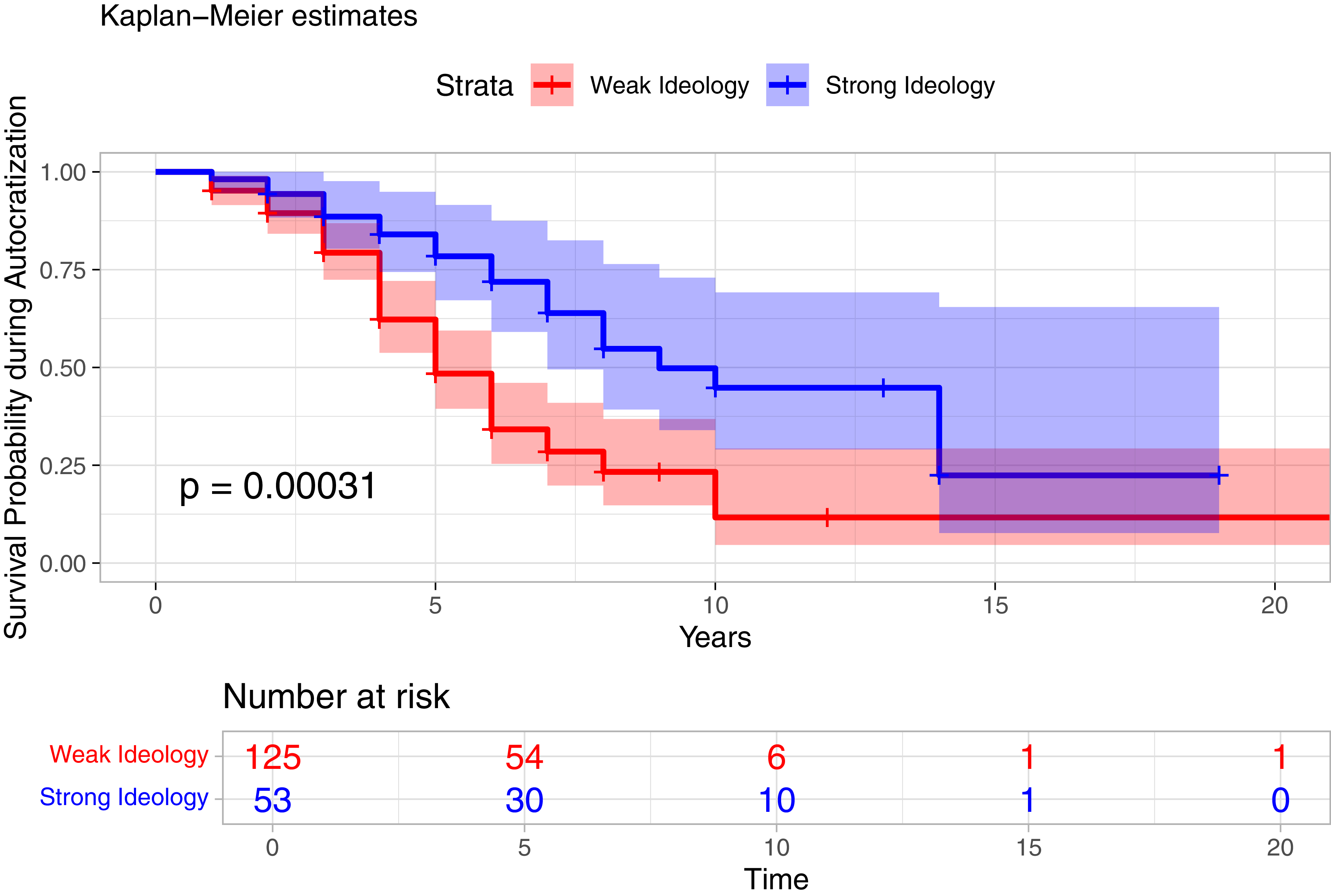
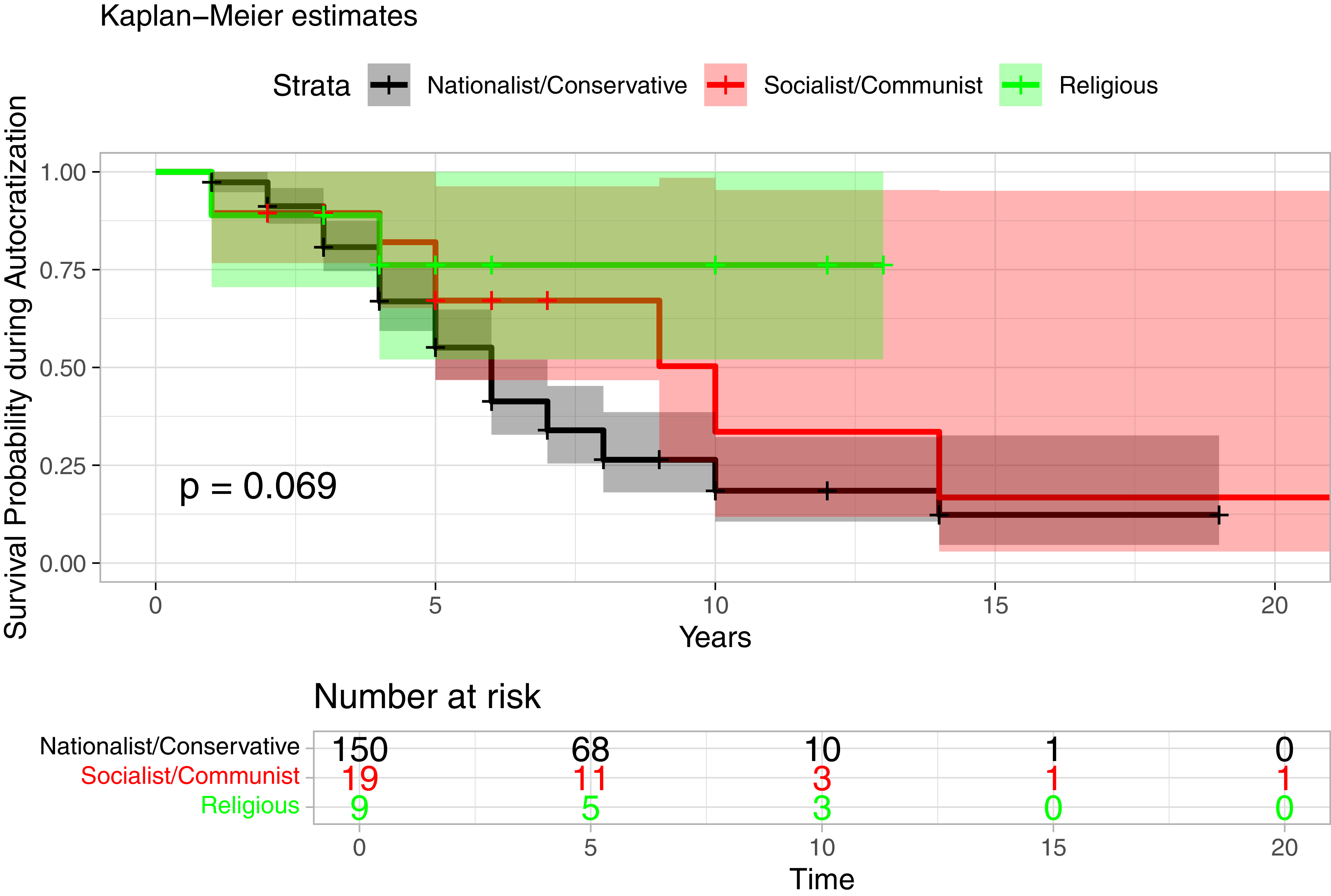
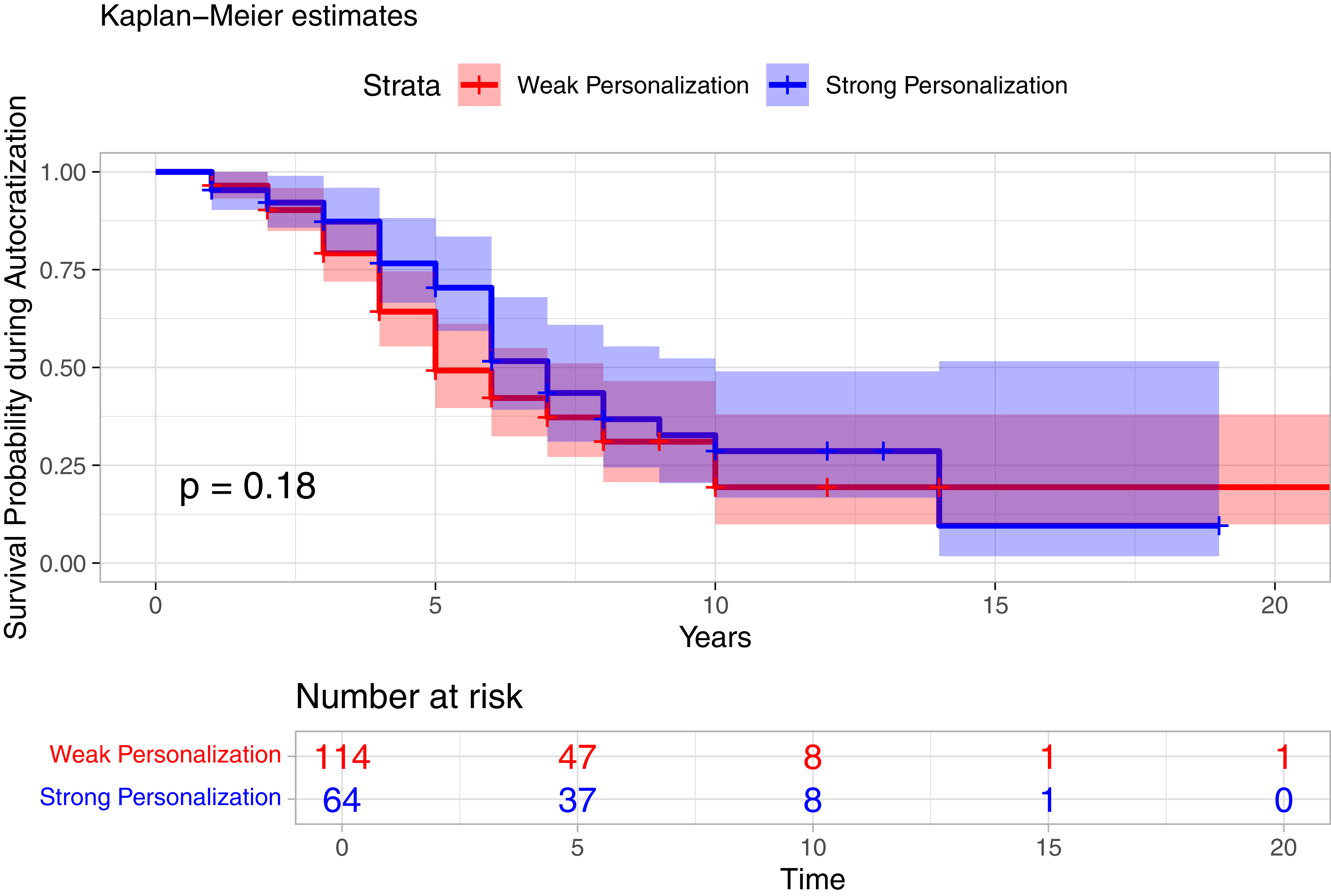
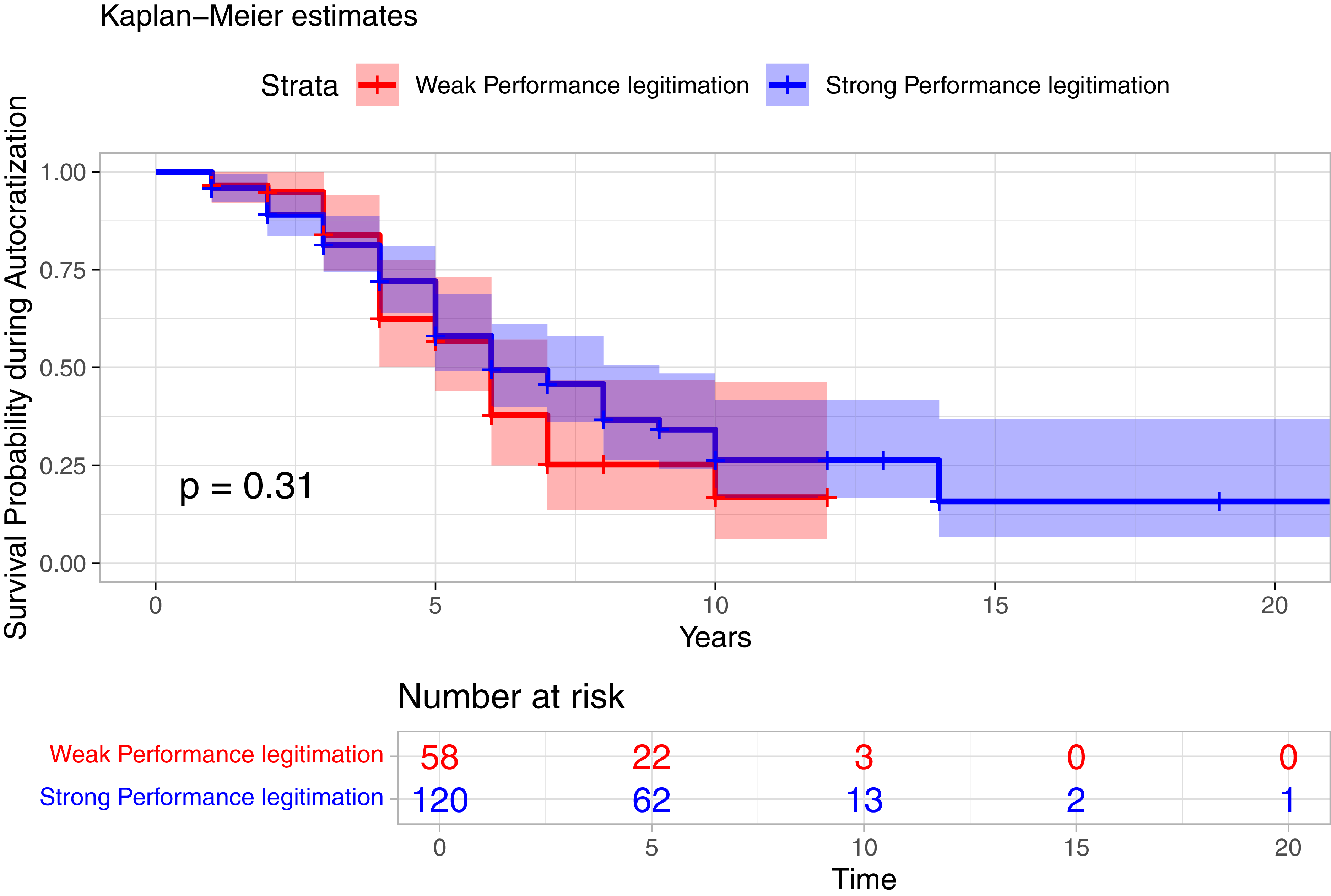
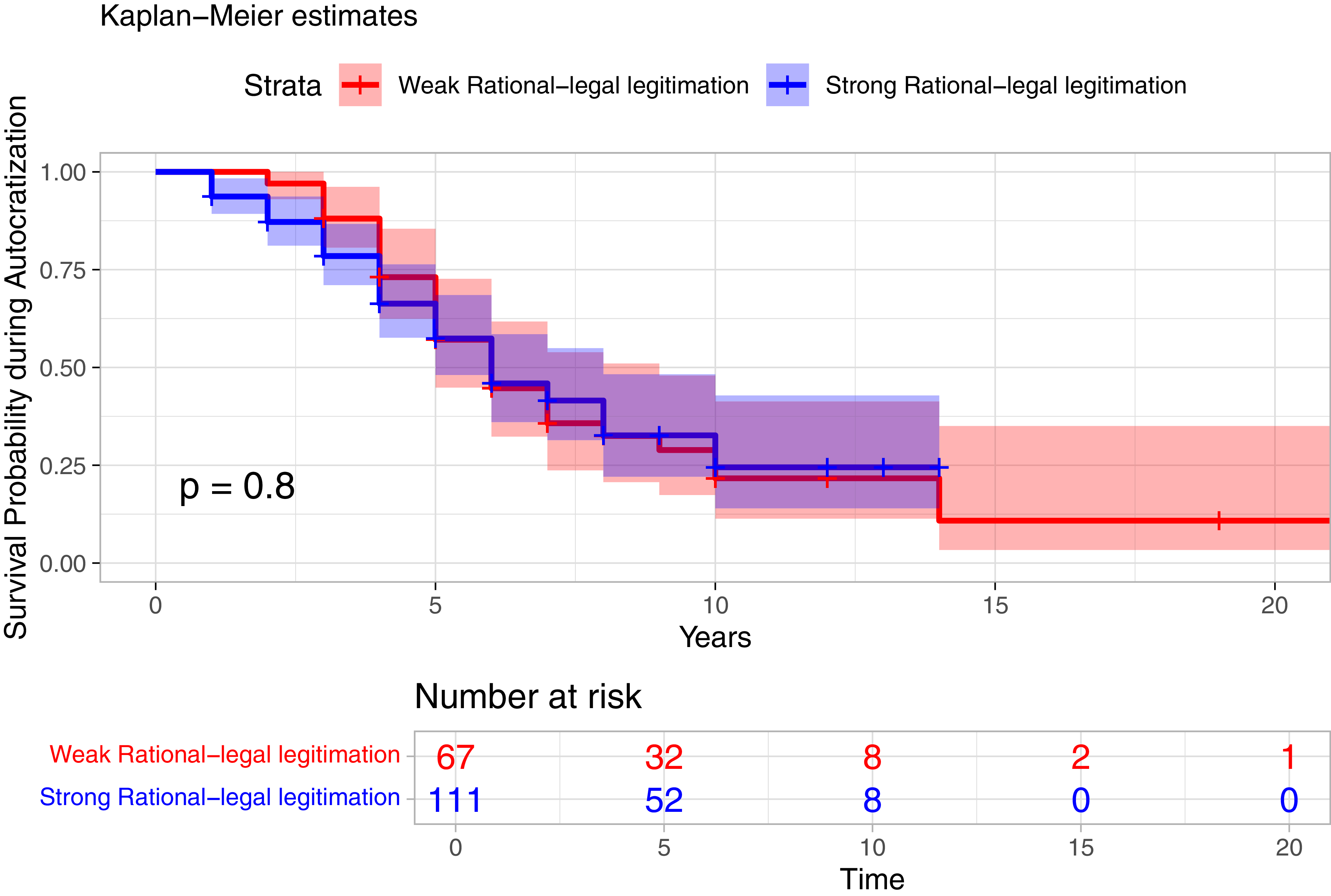
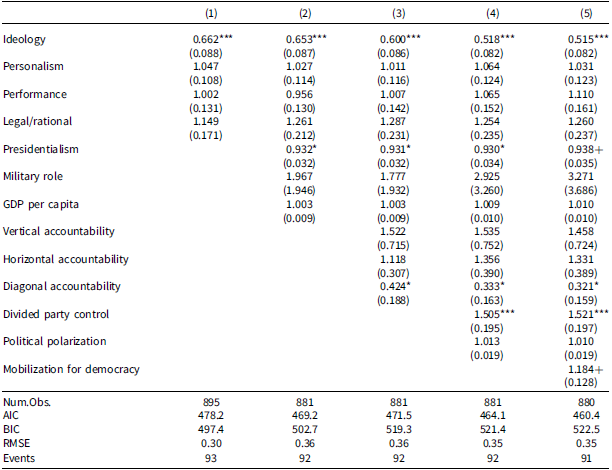

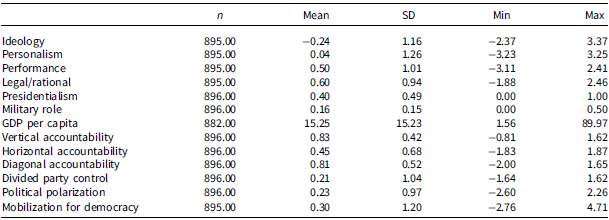
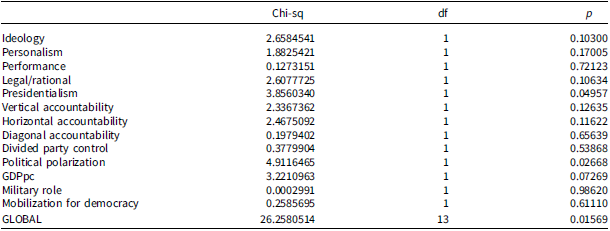

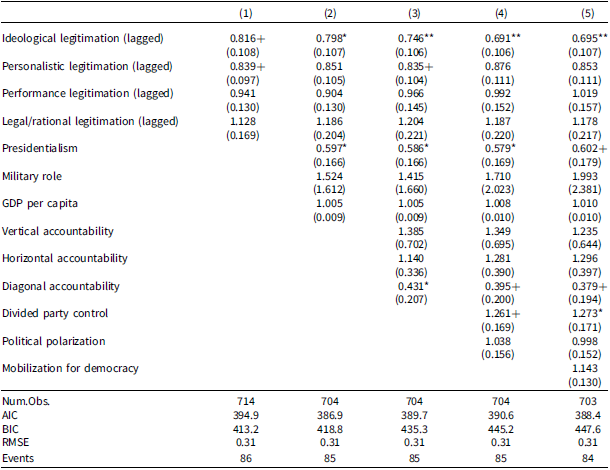
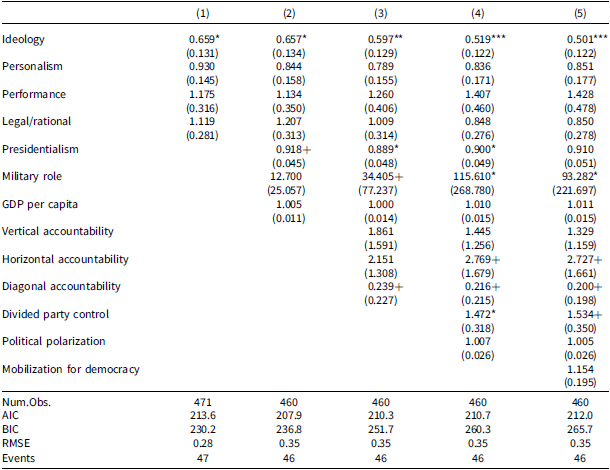
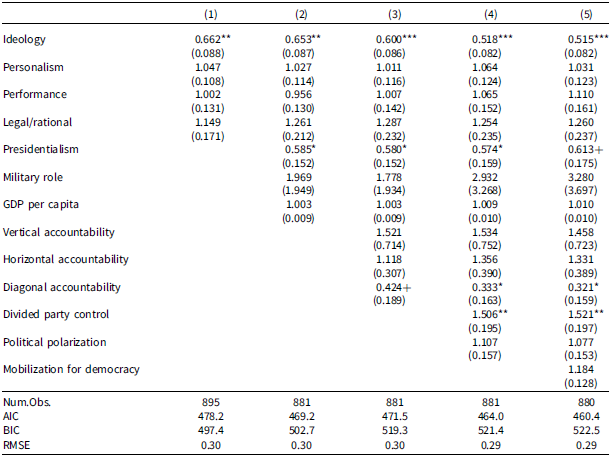
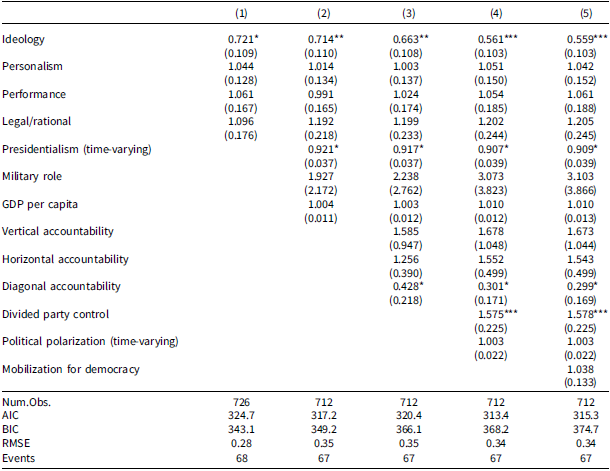
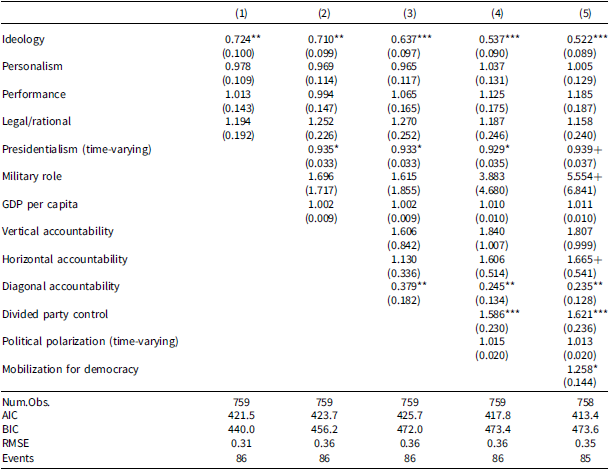
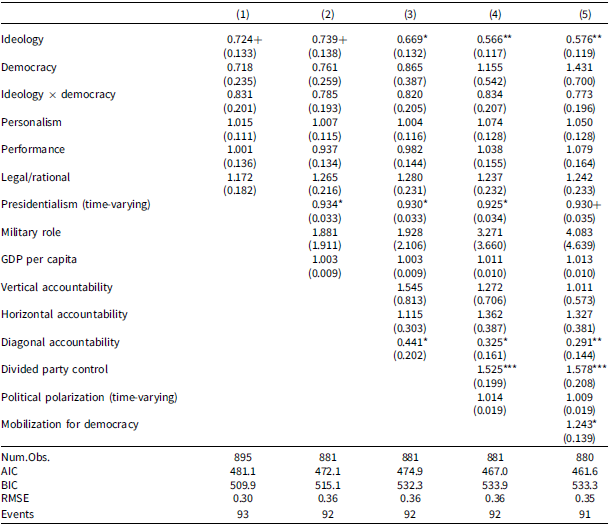
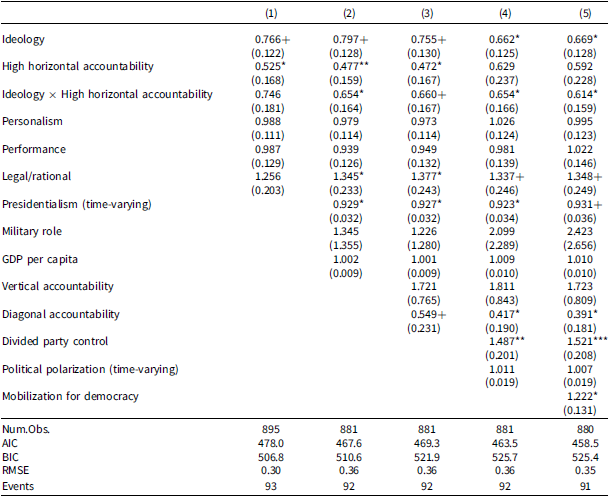

 Open access

