For most of our contemporaries Louis Pasteur is mainly the father of the rabies vaccine. However, this vaccine was only the last of his discoveries in a rich and multifaceted career. Let us recall his main achievements.
• His work on crystallography led to the notion that molecules are three-dimensional objects and he founded the concept of chirality.
• He discovered a new world, the world of microbes. Not that he was the first to see them – Antonie Van Leeuwenhoek did it more than a century before him – but he was the first to demonstrate their ubiquity and their role in many natural processes such as fermentation and putrefaction. He also showed that these microbes did not appear as a result of spontaneous generation.
• In parallel with Robert Koch, in Germany, he proved the role of microbes in infectious diseases, thus opening the way to the rationalization of hygiene and the treatment and prevention of infectious diseases.
• After Jenner, who had discovered the concept of vaccination at the end of the previous century, he showed how one could prepare vaccines from the very microbes that caused the disease.
This article will focus on three aspects of his work that relate most to chemistry: the foundation of stereochemistry, fermentations and the premises of enzymology, from live to chemical vaccines.
The Foundation of Stereochemistry
From Pasteur's early period (1848), the image that comes most readily to mind is that of the young 26-year old chemist, fresh out of ‘École Normale Supérieure’, sorting out crystals of tartaric acid under the incredulous eyes of Jean-Baptiste Biot, the eminent crystallographer (Figure 1). After the experiment was over, according to Pasteur himself, the illustrious old man was deeply moved. ‘My dear boy’, he said, taking Louis by the arm, ‘I have loved science so much all my life that this touches my heart’.
(Colour online) Ancient etching representing Biot examining, under the microscope, the tartrate crystals prepared by Pasteur.

What was so dramatic in this discovery?
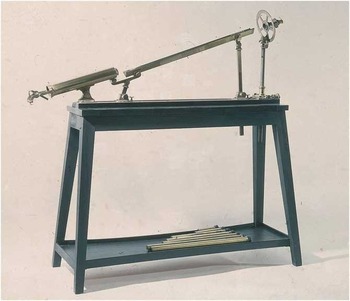
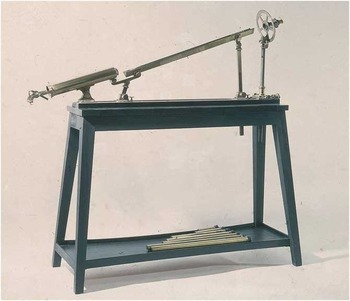
Tartrate, a salt of tartaric acid, is found in fermentation vats as a by-product of alcoholic fermentation. This organic compound, like many others, was said to be ‘optically active’ because its solutions induced a rotation of the plane of polarized light (Figure 2). However, a rare form of tartrate had been encountered, called paratartrate, identical to tartrate in all its properties, except that it was optically inactive, i.e. with no effect on polarized light. How could molecules composed of the same atoms, linked by the same bonds, have different effects on polarized light? This was the mystery that Pasteur attempted to solve.
(Colour online) Picture of a polarimeter kept at the Pasteur museum. A polarimeter is an instrument allowing one to observe and measure the action of a compound on polarized light.
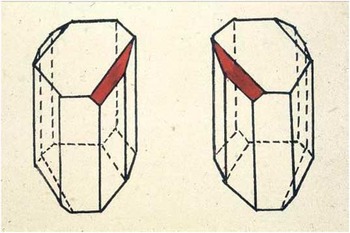
What Pasteur demonstrated to Biot was that paratartrate was composed of equal quantities of two types of molecules the crystals of which, though very similar, could be distinguished by the orientation of one tiny facet (Figure 3). When put into solutions these two types of crystals, unlike paratartrate, were both optically active, but had opposite effects on polarized light: they induced a rotation of the plane of polarized light in opposite directions, one to the right, the other to the left. Paratartrate was optically inactive because it contained equal quantities of the two types of tartrates. Pasteur hypothesized that these two forms of tartrate with opposite effects on polarized light corresponded to two different spatial configurations of the atoms in the molecule, two forms that were asymmetrical in themselves, each being like a mirror image of the other, just as are our two hands (Figure 4). As we would say today, tartrate is a chiral molecule. The very concept of chirality emerged from this finding of Pasteur.
(Colour online) Scheme showing the crystals of the two forms of tartrate.

(Colour online) Modern representation of the molecules of the two tartrate stereoisomers (enantiomers).

This was a most revolutionary hypothesis: two molecules, containing the same atoms, linked to one another by the same bonds, could nevertheless differ in the spatial arrangement of these atoms. This hypothesis, which would not be definitively confirmed until 30 years later with the establishment of the principle of carbon asymmetry, laid the foundation for stereochemistry.
The far-reaching consequences of this concept can be appreciated today, when molecular biology has demonstrated that all interactions between biological molecules, and hence all life processes, precisely result from their three-dimensional structure.
Fermentations and the Premises of Enzymology
Upon observing that all optically active compounds originated from plant or animal sources, Pasteur began to suspect that asymmetry was a characteristic of life. With this idea in mind, he began his studies on fermentation in 1854.
Fermentation had been known from very ancient times since it was used in the preparation of bread, wine and many other types of food and drink. But when Pasteur began to look into it, the question of fermentation was the subject of utmost confusion. The presence of micro-organisms in fermenting matter had been recognized for some time, but their role was not understood. For instance, Justus Liebig, the renowned German chemist, a contemporary of Pasteur, interpreted the role of yeast in fermentation as follows:
The yeast of beer, and in general all animal and plant substances undergoing putrefaction, impart to other substances the state of decomposition in which they find themselves. The movement which is imparted to their own elements, as the result of the disturbance of the equilibrium, is communicated equally to the elements of the substances which come in contact with them.
Needless to say, Pasteur could not accept such a confusing explanation. The observation that optically active and thus, in his mind, asymmetrical products appeared or disappeared during the process of fermentation led him to an entirely different hypothesis. According to him:
Fermentation, far from being a lifeless phenomenon, is a living process … all phenomena of fermentation correlate with the development of mycodermic cells and plants (micro-organisms) which I have prepared and studied in an isolated and pure state.
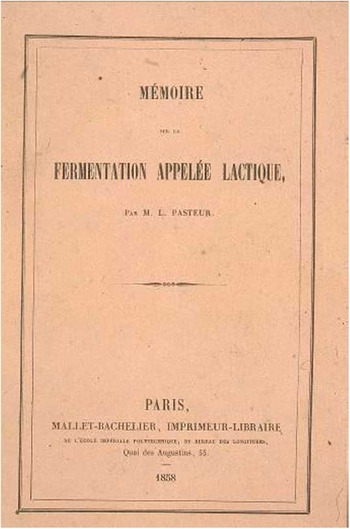
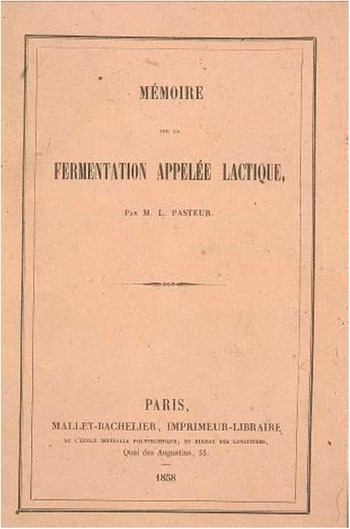
Indeed, he describes this method in his ‘Memoir on the so-called lactic acid fermentation’, published in 1858 and which can be considered as the birth certificate of microbiology (Figure 5). Here is a most significant sentence in this Memoir:
The purity of a ferment, its homogeneity, its free unrestrained development, by the help of food substances well adapted to its individual nature, these are some of the essential conditions which are essential for good fermentation.
(Colour online) Cover of the ‘Mémoire sur la fermentation appelée lactique’, considered to represent the birth certificate of microbiology.
These are the basic rules of microbiology!
When we look back upon the debate on fermentations, Pasteur would seem to have been the apostle of a mysterious ‘vital force’ carried by the micro-organisms, in contrast with Liebig, who considered yeasts to be catalysers. And one could say that the vitalist theories of Pasteur met with a scathing rebuttal in 1897 when Büchner obtained fermentation, the transformation of sugar into alcohol, in the absence of any ‘vital force’, through the effect of a cell-free extract from yeast, his famous ‘zymase’. Therefore, Pasteur might seem to have been a major opponent to the emergence of enzymology.
However, things are not so simple.
At the time, the chemical theories of fermentation, as could be judged from the above citation of Liebig, were formulated in such a confusing way that they did not lend themselves to the understanding of the phenomenon. They were based upon the assumption that the active principle for fermentation was to be found in the fermentable matter itself, eventually awakened by a chemical force, e.g. yeast in decomposition. The vitalist theory of Pasteur, on the contrary, hypothesized that the fermentation process was a sign of the development of a living agent, independent of and foreign to the altered matter, behaving like a parasite toward it. This did not preclude the existence of ‘chemical forces’ within these live independent agents. And, indeed, as we shall see, from his very early work on, Pasteur was led to the notion that living cells contained catalysts that made metabolism possible.
This had been revealed to him in the course of his work on tartrates.
He had observed that, when right- or left-handed tartaric acids combined with optically inactive substances such as sodium, potassium or ammonia, the resulting salts had exactly the same properties of stability and solubility. However, this was no longer the case when tartaric acids combined with an optically active organic substance, such as quinine, strychnine or cinchonine. The resulting salts often had very different properties. For example, the differential solubility of their complex with cinchonine provided a method to separate the two stereoisomers. Even more striking was the observation that some optically active substances, such as asparagine, combined with right-handed but not with left-handed tartaric acid.
Pasteur then came up with the idea that comparable phenomena, i.e. stereo specific interactions, might occur in living tissue, where optically active compounds, or what he called ‘the albumin-like matter of plasma’, were always found. This could explain the frequent observation that only the right- or left-handed variety of diverse substances were used or produced during fermentation phenomena. Thus, very early on, he had observed that, in a solution of paratartrate accidently contaminated with micro-organisms, right-handed tartrate disappeared, with left-handed tartrate being left untouched.
In 1878 he wrote ‘I would not be surprised to see yeast cells producing a soluble alcoholic ferment’. The ‘zymase’ described 19 years later by Büchner was not very far away…
Thus, it is evident that, despite his dispute with Liebig, Pasteur was truly one of the fathers of enzymology. He had the intuition that micro-organisms transformed organic matter by using it as a nutrient, and that the process required the action of stereospecific ferments present within them.
Furthermore, he foresaw that similar rules applied to all living cells.
Thus, in 1886, 30 years after he had stopped working on molecular asymmetry, he had a discussion with a colleague at the French academy of sciences on two stereoisomers of asparagine. He remarked that one of them had a taste whereas the other stereoisomer was tasteless, and he made the suggestion that this difference might result from a different action of the two types of molecules on the asymmetric components of the gustatory nerve. This could be taken as evidence that Pasteur was the founder of molecular neurobiology!
From Live to Chemical Vaccines
Leaving aside a great part of Pasteur's work, let us come to his very last but most renowned achievement, the vaccine against rabies.
In the case of three animal diseases, chicken cholera, swine erysipelas and anthrax, Pasteur had shown that one could immunize animals by injecting them with a live but attenuated form of the microbe. Attenuation was obtained by cultivating the micro-organism under special conditions. As we know now, at least in the case of anthrax, attenuation resulted from the loss of genetic determinants carried by a plasmid and responsible for the virulence of the bacterium.
In 1881, the development of the anthrax vaccine, which was widely publicized, had a considerable impact on opinion. However, doubts remained, especially amongst medical doctors, about Pasteur's theories. In a bid to convince the sceptics, Pasteur turned his attention to rabies, which affected humans as well as animals. Its symptoms in human patients gave rise to a certain fascination, as expressed by one of Pasteur's biographers, Émile Duclaux:
Rabies stirs our imagination. It evokes images of legend and of frenzied patients terrorizing all those around them, tied up and screaming, or suffocated between two mattresses.
For Pasteur, conquering rabies would prove his theories once and for all.
First, however, he had to identify the germ that caused rabies. Since the germ was transmitted by biting, Pasteur first looked for it in the saliva of rabid dogs. Under his microscope, he did find microbes, but he saw the same in the saliva of healthy dogs. In 1879, the French doctor and scientist Paul-Henri Duboué had developed a ‘nervous theory’ of rabies. According to him, the germ for rabies attached itself to the nerves uncovered by the bite and migrated from there to the upper nervous system. Following this idea, Pasteur looked in the nerves and brain of rabid dogs, but he could not detect any microbe under his microscope. Still, injection of the saliva or of ground brain tissue from rabid animals induced rabies in previously healthy animals, which could again serve for further transmission of the disease. This suggested that, although invisible under the microscope, the microbe was there and multiplied whenever it passed into an animal. Thus, even though he could not see it, or multiply it in any growth medium, Pasteur decided to grow it, so to speak, in the nervous system of animals. For this purpose he used rabbits, much less dangerous than dogs, and by passing from animal to animal he obtained what he called a ‘stable’ strain of the microbe.
As we all know now, the reason why Pasteur could neither see nor cultivate the rabies microbe is that, unlike the microbes responsible for chicken cholera, swine erysipelas or anthrax, it is not a bacterium but a virus, observed for the first time much later, in 1962, using the newly invented electron microscope.
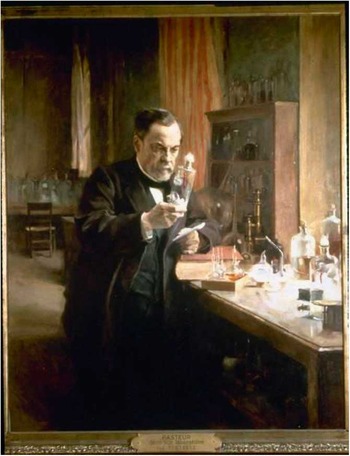
Having grown the microbe, Pasteur still had to attenuate it, as he had done for animal diseases such as anthrax. To do so he used a procedure consisting in desiccating the spinal cord from rabid rabbits under a dry atmosphere (Figure 6). Vaccination consisted of the daily inoculations of suspended ground spinal cords, starting with fully attenuated samples and then of less and less attenuated preparations to finish with fully virulent samples.
(Colour online) Famous painting of Pasteur by Edelfelt. Pasteur is shown handling a vial in which is drying the spinal cord of rabid rabbit, the source of his rabies vaccine.
When he used his vaccine on dogs, and then, in 1885, on human beings, Pasteur thought that he was inoculating an attenuated form of the microbe. However, at the very end of his scientific activities, in a little known publication (a letter to Duclaux written in December 1886), he reported experiments indicating that spinal cords that had been treated at a high temperature, such that the infectious agent had not only been attenuated but destroyed, could still induce immunity against rabies. He thus concluded that the spinal cord that had lost its virulence induced immunity through a ‘vaccinating substance’ accompanying the rabies microbe rather than through an action of the microbe itself. He thus recognized that immunity was obtained thanks to a chemical vaccine.
Therefore, the route was opened for the second large family of vaccines, besides live attenuated microbes – vaccines consisting of killed microbes. The concept of killed vaccines in turn opened the route to the third class of vaccines, the subunit vaccines. These are immunizing substances originating from the pathogenic agents. The first examples were the diphtheria and tetanus vaccines produced by Gaston Ramon at the Institut Pasteur in the 1920s, building on the previous discovery of serotherapy by Emile Roux and colleagues in the same institute in 1894. These vaccines, still in use today, consist of bacterial toxins rendered inactive by treatment with formaldehyde. Today, some vaccines involve sophisticated chemical techniques, for instance those against meningitis, which are semi-synthetic vaccines consisting of polysaccharides from the bacteria causing the disease, attached to protein carrier molecules.
Conclusion
Pasteur had been trained as a chemist or perhaps, as we would say now, as a physico-chemist. His first work, on tartrates, reflected this formation, but he later changed disciplines to become a biologist. Some of our contemporaries even believe that he was an MD. He was not an MD and, as a matter of fact, many MDs of the time, who did not appreciate his theories on the role of microbes in infectious diseases or on vaccination, called him disparagingly ‘chimiâtre’. He was not an MD, but there is no doubt that most of his work, beginning with that on fermentation and finishing with that on vaccines, would now be considered as biology. Still, as we have seen, chemistry was always present in his mind, even at the very end of his scientific career. In that, he was a precursor of modern molecular biologists who attempt to interpret all life phenomena in terms of atomic interactions.
Maxime Schwartz defended in 1967 a PhD thesis prepared in the laboratory of Jacques Monod at Institut Pasteur. Most of his scientific work has dealt with the molecular biology of bacteria. From 1975 to 1987 he directed the Unit of Molecular Genetics at the Institut Pasteur. In 1985 he became the Scientific Director of the Institut Pasteur and in 1988 he became its General Director, a position he occupied for 12 years. He published in 2001 How the Cows turned Mad, and then, in 2008, together with François Rodhain, Des Microbes ou des Hommes, qui va l'emporter? (Microbes or Men, Who will Win?) and, in 2009, together with Jean Castex, a book on the Franco-American controversy regarding the discovery of the AIDS virus. In 1999, he also published, with Annick Perrot Pasteur, des Microbes au Vaccin (Pasteur, from Microbes to Vaccines). In 2013 he published Pasteur et ses Lieutenants, Roux, Yersin et les Autres, again with Annick Perrot.