





Introduction
Since the 1980s, public debt management has increasingly been framed as a technical and expert-driven activity, insulated from political interference and guided by standardized best practices. Particularly after the 1997 Asian financial crisis, multilateral institutions such as the International Monetary Fund (IMF) and the World Bank promoted reforms encouraging governments to adopt financial risk-management techniques and market-oriented borrowing strategies (Silva et al., Reference Silva, Carvalho and Medeiros2009). These reforms contributed to the diffusion of a model of sovereign debt management grounded in financial economics across both core and peripheral economies (Lemoine, Reference Lemoine2013, Reference Lemoine2016; Fastenrath et al., Reference Fastenrath, Schwan and Trampusch2017).
An expanding body of research interprets this transformation as a key expression of state financialization (Lagna, Reference Lagna2016; Fastenrath et al., Reference Fastenrath, Schwan and Trampusch2017; Schwan et al., Reference Schwan, Trampusch and Fastenrath2021). The latter refers to the growing tendency of states to rely on financial and market-oriented instruments rather than traditional instruments of state intervention (Lagna, Reference Lagna2016: 168). Within this perspective, public debt management becomes a central site through which financial logics come to structure the operational practices of the state.
This article examines how the transition from a developmentalist to a neoliberal policy paradigm created the conditions under which specific institutional and infrastructural changes led to the financialization of public debt management (Hall, Reference Hall1993). This shift redefined the role of the state in economic governance and created the institutional and ideological conditions that reorganized debt management around market-based instruments, financial infrastructures, and investor-oriented policy objectives.
Understanding how a financialized form of debt management emerges requires attention not only to policy paradigms and institutional reforms but also to the material infrastructures through which states interact with financial markets (van der Heide, Reference van der Heide2024). Sovereign debt markets rely on complex technical systems for issuing, trading, and managing government securities. Examining how these infrastructures are incorporated into state institutions is critical in uncovering the mechanisms through which financial logics come to structure the day-to-day practices of public debt management.
To unpack this process, the article employs an inductive form of process tracing informed by theoretical insights (Trampusch and Palier, Reference Trampusch and Palier2016). The empirical analysis identifies three mechanisms through which the paradigm shift from developmentalism to neoliberalism was translated into the financialization of public debt management: (1) the internalization of financial market instruments and infrastructures within public debt management, (2) the emergence of selective bureaucratic insulation in debt management institutions, and (3) the influence of international financial institutions.
The debt examined in this article refers specifically to federal government debt issued in the domestic market. Contrary to the broader Latin American trend, Brazil’s federal public debt has been predominantly domestic since the late 1990s. Nevertheless, Brazilian social science scholarship has largely overlooked this phenomenon, focusing primarily on external debt. Likewise, the international literature has paid limited attention to the Brazilian case. In addition to shedding new light on Brazil’s domestic public debt, this article aims to bring a historically-grounded analysis of this case to bear on broader debates on state financialization, offering a new perspective from the periphery of global capitalism.
This article is structured into four sections, in addition to this introduction and the concluding remarks. The first section presents the theoretical and methodological framework. The remaining sections examine three key historical periods in the transformation of Brazil’s public debt management between 1964 and 2001. The first historical section analyzes the emergence of Brazil’s domestic public debt market. The second examines the 1980s as a period of interlude and transition, marked by the combined effects of the external debt crisis, the transition from military rule to democracy, and the crisis of the developmentalist paradigm, which was already eroding but had not yet been replaced by a consolidated neoliberal order. The third section examines the consolidation of a neoliberal policy paradigm, a period in which the mechanisms identified in this article converged to produce a financialized model of public debt management.
Neoliberalism and the financialization of sovereign debt governance
One key insight found across the literature on state financialization is that the rise of neoliberalism did not weaken the state but reconfigured its role in economic governance. Under neoliberalism, the boundary between state and market has become increasingly blurred, particularly in the domain of macroeconomic governance. Rather than governing primarily through hierarchical regulation, states increasingly govern through financial markets, adopting market-based instruments and practices within core areas of economic policy (Braun, Reference Braun2018; Braun and Gabor, Reference Braun, Gabor, Mader, Mertens and van der Zwan2020; Schwan et al., Reference Schwan, Trampusch and Fastenrath2021).
Part of this literature emphasizes the growing authority of financial economics, which operates as a ‘sense-making framework’ that reshapes how public officials understand and perform their roles (Fastenrath et al., Reference Fastenrath, Schwan and Trampusch2017). In this framework, public debt management is reinterpreted through principles derived from modern portfolio theory, privileging cost-risk optimization over broader macroeconomic or developmental objectives. As Pape and Rommerskirchen (Reference Pape and Rommerskirchen2024: 1372) note, debt management institutionalizes the link between sovereign borrowing and market-based finance. As a result, sovereign liabilities increasingly come to be managed as financial portfolios, balancing cost and risk through calculated trade-offs.
These developments imply a shift in how states operationalize macroeconomic governance. Instruments such as accrual accounting, derivatives, and performance-based benchmarks reinforce this orientation by introducing private-sector metrics, software, and practices into the heart of public financial institutions. As a result, public authorities increasingly engage in bond issuance strategies, portfolio management, and investor communication, incorporating financial market expectations into the routine operation of macroeconomic governance. Debt Management Offices (DMOs), often staffed by former bankers or professionals with backgrounds in finance, further institutionalize this shift by replicating private-sector organizational models and technologies. In short, these developments reflect a broader transition from market-enabling to market-embedded governance.
These dynamics can be further understood through the notion of the infrastructural power of finance (Braun, Reference Braun2018; Braun and Gabor, Reference Braun, Gabor, Mader, Mertens and van der Zwan2020; Petry, Reference Petry2021; Pape and Rommerskirchen, Reference Pape and Rommerskirchen2024; van der Heide, Reference van der Heide2024). In contrast to instrumental power (influence through lobbying or campaign financing) and structural power (derived from state dependence on private capital), Braun (Reference Braun2018) conceptualizes infrastructural power as arising from the interdependence between public authorities and financial institutions at the level of policy instruments. Rather than shaping political outcomes through external pressure, this form of power emerges when states govern through financial markets, relying on financial infrastructures to implement core functions of monetary and fiscal policy. In this context, financial actors do not merely respond to state policies; they also participate in shaping the instruments and frameworks through which policy is enacted. As Petry (Reference Petry2021) notes, financial infrastructures are not merely platforms for transactions – they constitute the sociotechnical conditions that make markets possible and shape how power is distributed within them.
While the financialization of debt management is well documented, van der Heide (Reference van der Heide2024) argues that the role of material infrastructures in shaping how state-market relations operate remains underexplored. Building on this perspective, this article argues that debt markets depend on concrete, technical systems for issuing, pricing, and exchanging sovereign bonds. Understanding these material infrastructures is essential for identifying the mechanisms through which financial logics structure state practices.
To investigate this transition, this study employs process tracing with an inductive orientation to reconstruct the causal processes through which public debt management in Brazil became financialized (Trampusch and Palier, Reference Trampusch and Palier2016). Rather than testing predefined hypotheses, the analysis relies on an iterative dialog between empirical data collection and theoretical refinement, allowing the causal mechanisms to emerge from the evidence. The central argument is that the shift toward a neoliberal policy paradigm (Hall, Reference Hall1993) created the macro-level conditions under which three mutually reinforcing mechanisms interacted to produce a financialized form of debt management.
The first mechanism is the internalization of financial instruments and market infrastructures within the state. This involves incorporating financial market technologies, issuance mechanisms, and technical systems into the operational structure of public debt management. Beyond the mere presence of financial instruments, this process reflects a reorientation around financial market logics. From the perspective of financial infrastructural power (Braun, Reference Braun2018), this signifies a growing operational interdependence between public authorities and financial infrastructures, where fiscal functions are increasingly implemented through market-based tools.
The second mechanism is selective bureaucratic insulation (Bin, Reference Bin2020). This refers to the creation of specialized institutional units, such as DMOs, deliberately structured to restrict the influence of democratic deliberation and popular contestation over fiscal policy. By maintaining significant autonomy from representative political oversight while fostering symbiotic interactions with financial market actors, this arrangement limits the space for political dispute. This institutional design enforces a technocratic closure that privileges financial market stability over social demands, rendering sovereign debt governance increasingly immune to the mandates of the voting public and reinforcing the hegemony of financial logics in the state apparatus.
The third mechanism is the influence of international financial institutions, particularly the IMF and the World Bank. These organizations played an important role in disseminating a financialized model of sovereign debt governance by promoting ‘best practice’ frameworks and supporting institutional reforms in borrowing countries.
While analytically distinct, these mechanisms are not individually sufficient; rather, they interact non-sequentially over time to produce financialization. The empirical analysis, therefore, traces how these mechanisms emerged in the historical record to translate the neoliberal paradigm shift into concrete institutional change.
To reconstruct this trajectory, the study draws on discursive textual analysis (Moraes, Reference Moraes2003) of official publications from the National Treasury and other key actors. The documentary corpus includes legal instruments, technical reports, manuals, and policy guidelines covering the period from 1964 to 2001. Given the study’s historical scope and the fact that many key actors are no longer alive, interviews were not used as primary sources to avoid the methodological limitations of long-term retrospective accounts. Instead, the analysis leverages extensive written records, including memoirs and policy reflections produced by key participants. Through the systematic analysis of these materials, the study reconstructs how a developmentalist framework was gradually replaced by a financialized form of debt governance oriented toward risk management and investor credibility.
State-led financial innovation: The genesis of Brazil’s domestic public debt market
On April 15, 1964, General Humberto Castello Branco assumed the presidency of Brazil following a coup that inaugurated the country’s military dictatorship. The new government declared its intention to modernize the economy and implemented extensive reforms in state finances aimed at addressing the ongoing monetary and financial crisis (Gouvêa, Reference Gouvêa1994; Ferreira, Reference Ferreira2006). During the early years of the regime, the developmentalist paradigm that had guided Brazilian economic policy since the 1930s was temporarily displaced, as policymakers prioritized inflation control and fiscal stabilization.
The Government Economic Action Program (Programa de Ação Econômica do Governo (PAEG)) which guided the government’s economic policy, illustrates the scale of the ‘financial revolution’ (Souza, Reference Souza2016) overseen during this period (Ministério do Planejamento e Coordenação Econômica, 1965). The program redefined the role of the state in economic coordination, positioning it as a complementary agent to the market and emphasizing the need to discipline public investment and rationalize government action (Klüger, Reference Klüger2017: 195). Under this framework, macroeconomic stabilization was considered a prerequisite for development.
A central component of this strategy was the decision to finance fiscal deficits through debt rather than monetary issuance. This policy created a structural demand for domestic debt instruments and required the construction of a financial market capable of absorbing government securities. Rather than responding to existing market demand, the reforms sought to actively construct the institutional and material conditions under which such demand could emerge.
At the time, the Brazilian capital market lacked the infrastructure necessary to sustain an internal debt strategy, leaving external borrowing as the key alternative source of financing. Favorable international financial conditions, particularly the predominance of Keynesian ideas and the United States’ strategy of promoting development-oriented programs in Latin America such as the Alliance for Progress, facilitated access to foreign capital. Nevertheless, constructing a domestic debt market remained a strategic objective.
The first military government marked the period in which the institutional foundations of both a domestic government debt market and a broader financial market were established in Brazil. It would be premature to suggest that these developments alone heralded the financialization of public debt management, however. Rather, this period witnessed the construction of the institutional and material preconditions upon which such financialization would later depend.
For policymakers at the time, the absence of a domestic debt market reflected institutional disorganization and inadequate policy coordination. The creation of the Central Bank of Brazil and the National Monetary Council were considered fundamental to the project of building this market. The Central Bank was granted the authority to conduct operations involving the purchase and sale of public securities as a monetary policy instrument and to finance public deficits. The National Monetary Council was tasked with coordinating monetary, credit, budgetary, fiscal, and public debt policies, both internal and external (Ministério do Planejamento e Coordenação Econômica, 1965). These institutional arrangements enabled the state to centralize and coordinate the issuance and management of public debt.
Government documents frequently referred to the need to ‘restore the prestige of public securities’ (Ministério do Planejamento e Coordenação Econômica, 1965). Demand for such securities was virtually nonexistent in the early 1960s, severely constraining the government’s ability to finance deficits through debt. Prior to these reforms, domestic public debt consisted largely of non-standardized nominative securities issued for diffuse purposes (Pedras, Reference Pedras, Silva, Carvalho and Medeiros2009: 59). Persistent inflation, as well as the Usury Law of 1933 which limited interest rates further discouraged investment in government bonds.
To address these constraints, Treasury Adjustable Bonds (Obrigações Reajustáveis do Tesouro Nacional (ORTN)) were created, incorporating a monetary correction clause. Rather than responding to market demand, these instruments were part of a deliberate state strategy to generate it.
Roberto CamposFootnote 1 (1994: 612), who served as Minister of Planning at the time, describes resistance from economists at the IMF, who advocated a ‘radical shock’ to control inflation and opposed the introduction of monetary correction. However, Campos and Finance Minister Octávio Gouvêa de BulhõesFootnote 2 resisted this position, considering indexation essential to the PAEG strategy.
To ensure demand, the government authorized the payment of federal taxes with these securities, granted tax exemptions on investments in them, and required companies to allocate part of labor compensation funds to these bonds (Ministério do Planejamento e Coordenação Econômica, 1965; Simonsen, Reference Simonsen1974: 9). Another strategy aimed at attracting financial institutions involved guaranteeing liquidity through Central Bank operations. Carlos BrandãoFootnote 3 describes this process:
Gedip’s [a department within the Central Bank that has historically held responsibility for the administration of federal public debt] work in 1969 initially consisted of attracting large, medium, and small institutions – that is, large commercial banks, investment banks, brokers, and dealers – to begin purchasing ORTN [government bonds], thereby ensuring their liquidity. Such a mechanism had not existed prior to that period. In January 1969, only four institutions were buying National Treasury bonds with any regularity, and not very frequently. They were four brokerage firms that purchased such bonds to speculate on currency devaluation during periods when they expected it to occur. (Brandão, Reference Brandão1989a: 49–50)
These developments illustrate a pattern in which financial innovation was primarily driven by state actors rather than by private financial markets. Government officials designed new financial instruments, created the institutional infrastructure required for their operation, and generated investor demand:
There were, without a doubt, some strategies used to facilitate the implementation of the ORTNs [government bonds], such as, for example, the requirement to invest workers’ severance funds in ORTNs. During 1965, subscription of these bonds was also mandatory for individuals with annual incomes above Cr$600,000. I recall a curious episode. Castello Branco had recommended to Professor Bulhões and me that we pay attention to two ‘promising young men’: José Sarney, governor of Maranhão, and Antônio Carlos Magalhães, mayor of Salvador. When the latter approached us seeking funds, Professor Bulhões told him there was no money, but that he had good bonds for which ‘a market could be created’. Antônio Carlos agreed to become a seller, through the banking network, of Cr$10 million. The revenue obtained allowed him to finance the construction of an avenue in a valley area, opening new urban development prospects for Salvador. (Campos, Reference Campos1994: 643)
As SimonsenFootnote 4 (1965: 77) and Brandão (Reference Brandão1989a: 48) note, between 1964 and 1969 public debt issuance largely responded to legally mandated demand, including labor indemnification funds, tax obligations, and compulsory deposits of commercial banks at the Central Bank. The relationship between the state and financial actors was asymmetrical, with the government relying on its regulatory authority to shape investor behavior. Because of these initiatives, domestic public debt grew steadily and was sufficient to finance the fiscal deficit by the late 1960s (Pedras, Reference Pedras, Silva, Carvalho and Medeiros2009: 60).
Negotiations with the IMF further highlight this period’s dynamics. As Campos recounts:
A third and serious disagreement with the IMF was that Minister Bulhões and I were reluctant to accept strict quantitative targets, whether concerning the inflation rate or the public deficit. We argued that what mattered was to reach an agreement with the IMF on an anti-inflationary ‘strategy’ and to make a ‘choice of instruments’ that were technically appropriate. The precise pace of implementing the measures, we believed, should be a matter of ‘political judgment’, to be decided by the government.
Despite intense debates, it was not possible to persuade the IMF to abandon its mechanistic postulates. For them, it was not enough to agree on an anti-inflationary strategy and the basic instruments to combat inflation. This was because Brazil had a long tradition of noncompliance and, although there was an acknowledgment of the new government’s seriousness of purpose, the IMF’s governing board insisted on having verifiable control targets. ‘We need verifiable benchmarks!’ was the stock response from the IMF negotiators.
As we could not afford to forgo an agreement with the IMF – since without it, we could not begin to negotiate the rescheduling of overdue foreign exchange debts with bankers and foreign governments – we reluctantly yielded to the institution’s demands, while indicating that, in our judgment, experience would reveal the need for greater flexibility. (Campos, Reference Campos1994: 612–614)
This episode reflects both convergence and disagreement between Brazilian authorities and IMF economists regarding the design and implementation of stabilization policies. While both sides shared an anti-inflationary objective, they diverged over the pace and configuration of policy instruments. IMF officials favored strict quantitative targets, whereas Brazilian policymakers argued that the implementation of stabilization policies should remain subject to political judgment. Although constrained by the need for international resources and debt rescheduling, Brazilian authorities maintained indexation despite IMF opposition.
From 1967 onward, a new cohort of developmentalist policymakers assumed key positions in economic policy. Although inflation control remained a concern, economic growth was once again the central priority. Development strategies increasingly relied on external borrowing to finance imports of capital goods, fuel, and industrial inputs. Favorable international financial conditions and geopolitical considerations, particularly the United States’ interest in supporting Latin American development during the Cold War, continued to facilitate access to foreign capital.
By the early 1970s, attention shifted toward creating an ‘open market’ for monetary policy. According to Brandão (Reference Brandão1989a: 50), the Public Debt Department (Gedip) at the Central Bank developed a self-regulation framework for open market operations between 1970 and 1973, including a telephone-based trading system and a network of selected dealers.
The narratives which emerged among policymakers during this period also indicated a symbiotic relationship between the domestic debt market and the broader financial system, in which the expansion of one reinforced the development of the other. Nevertheless, this process remained largely driven by state initiatives. Policymakers frequently identified the indexation of government bonds as a key factor in the emergence of a modern financial market in Brazil:
The importance of the federal government’s public debt securities must be emphasized as the foundation without which, beginning in 1969 and 1970, the growth of our financial savings would not have occurred. The organized issuance of public debt securities, for fiscal and monetary purposes, was what enabled the birth of our current large financial market, triggering a true modernization revolution. (Brandão, Reference Brandão1989b: 49)
Possibly one of the main results of indexation in Brazil is its positive contribution to the organization of a true financial market. Before indexation, this market operated in a manner very similar to commercial banks and was more or less informal and inefficient. Since indexation mitigates unplanned transfers between lenders and borrowers, some financial instruments that previously did not exist were thus finally introduced. (Pastore et al.,Footnote 5 Reference Pastore, Almonacid and Barros1977: 12)
Government actors also played a significant pedagogical role in introducing financial institutions to the technical practices associated with government securities markets. As Brandão recalls:
In August 1970, National Treasury Bills [government bonds] were introduced for monetary policy purposes. Remarkably, at that time, the market did not know how to calculate interest rates. On August 19, 1970, the Central Bank held the first auction of Treasury Bills (LTN) [government bonds], with a discount rate pre-established in the sale notice. The market did not know how to calculate rates, not even for their clients. They earned a spread usually suggested by the Central Bank: buy at 15.55% and sell at 15%. This system lasted until May 26, 1971, and it was only on June 7, 1972, that the first auction with competitive rates was held. (Brandão, Reference Brandão1989b: 50–51)
Through these initiatives, public authorities actively shaped the practices through which financial institutions evaluated and traded government bonds. Over time, this led to a transition from administratively-determined interest rates to a regime in which these rates were defined according to market dynamics. This transformation gradually altered how financial actors formed expectations regarding returns on public debt instruments and reconfigured the relationship between financial actors and the state.
These ongoing efforts by government actors supported a relatively stable growth in domestic public debt, at least until the mid-1970s, when the first oil shock emerged. Despite these developments, domestic public debt remained relatively modest, reaching approximately 4 percent of GDP in 1970 and remaining below 10 percent until the mid-1980s (Pedras, Reference Pedras, Silva, Carvalho and Medeiros2009). More importantly, these reforms unfolded within a policy paradigm that remained fundamentally developmentalist. Financial instruments were deployed primarily to support macroeconomic stabilization and state-led development rather than to optimize debt portfolios according to market-based criteria.
The international environment changed significantly at the end of the 1970s. The second oil shock, the shift in United States monetary policy under Paul Volcker, and the emergence of international debt crises marked a critical juncture for Brazil’s development strategy (Galvêas, Reference Galvêas1990: 53; Reference BielschowskyBielschowsky, 2004[1988]). The previously abundant supply of external capital declined rapidly, undermining the financing model that had supported the military regime’s development strategy.
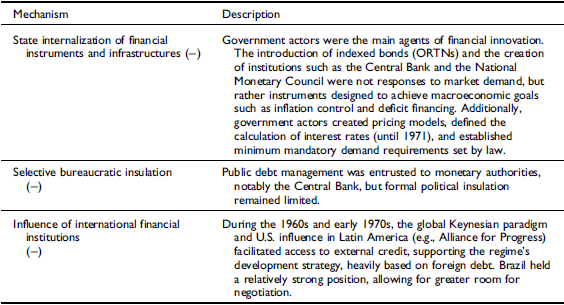
Table 1 summarizes the period from 1964 to 1979, indicating with (−) that the mechanisms associated with the financialization of public debt management were not yet present. The 1964 coup opened a window of opportunity for major financial and monetary reforms. However, neither the domestic financial structure nor the international economic environment favored the emergence of a financialized form of public debt management. Instead, the reforms of this period produced the institutional foundations upon which such a transformation would later unfold. This historical trajectory demonstrates that, during this period, the Brazilian state did not internalize financial market infrastructures; rather, it actively constructed them in order to support developmentalist macroeconomic objectives.
Financialization mechanisms of public debt management, 1964–1979.

Table 1. Long description
A table with two columns and three rows. The first column is labeled Mechanism and the second column is labeled Description. Row 1: Mechanism, State internalization of financial instruments and infrastructures; Description, Government actors were the main agents of financial innovation. The introduction of indexed bonds (ORTNs) and the creation of institutions such as the Central Bank and the National Monetary Council were not responses to market demand, but rather instruments designed to achieve macroeconomic goals such as inflation control and deficit financing. Additionally, government actors created pricing models, defined the calculation of interest rates (until 1971), and established minimum mandatory demand requirements set by law. Row 2: Mechanism, Selective bureaucratic insulation; Description, Public debt management was entrusted to monetary authorities, notably the Central Bank, but formal political insulation remained limited. Row 3: Mechanism, Influence of international financial institutions; Description, During the 1960s and early 1970s, the global Keynesian paradigm and U.S. influence in Latin America (e.g., Alliance for Progress) facilitated access to external credit, supporting the regime’s development strategy, heavily based on foreign debt. Brazil held a relatively strong position, allowing for greater room for negotiation.
The lost decade: A hybrid interlude
Carlos Brandão assumed the presidency of the Central Bank in 1979 but resigned shortly thereafter due to disagreements with the government’s economic strategy amid the critical juncture brought about by the second oil shock. Brandão advocated for monetary tightening and a deceleration of the externally-financed developmentalist program. However, then-President General João Figueiredo opted to sustain the developmentalist strategy, refusing to slow the economy in the hope of achieving a new ‘economic miracle’. This decision prompted not only Brandão’s resignation but also that of the Minister of Planning, Mário Henrique Simonsen. Simonsen was replaced by Delfim Netto, widely regarded as the leading figure of the military regime’s developmentalist project, who would remain in office until 1985.
Although the final military government chose to maintain the developmentalist strategy, the conditions that would eventually undermine this paradigm were already taking shape. Domestically, Brazil entered the ‘lost decade’, characterized by a severe external debt crisis and accelerating inflation that eventually culminated in hyperinflation. Concurrently, the military regime prepared for a negotiated democratic transition toward the 1988 Constitution.
Efforts by debt managers during this period were characterized by experimentation in instrument design, technological innovation, and comprehensive institutional reforms. These initiatives reflected attempts by state actors to sustain the domestic debt market under increasingly unstable conditions. Among these, the establishment of the Special System for Settlement and Custody (Selic) in 1979 was pivotal. Created through a partnership between the Central Bank and the National Association of Financial Market Institutions (Andima), Selic transitioned public securities from physical certificates to electronic book-entries with real-time settlement. Brazil was an early adopter of this form of infrastructure, drawing inspiration from the United States (Bank for International Settlements, 1997).
This partnership signaled a transformation in state-market relations. While earlier market construction had relied on hierarchical state authority, Selic reflected a shift toward institutionalized cooperation between state and financial actors: public authorities and market participants jointly developed the infrastructure, which continues to be used to trade government bonds today. By centralizing custody and settlement, Selic increased the state’s operational dependence on financial market infrastructures, marking the early expansion of the infrastructural power of finance in Brazil.
The domestic debt market had by this time solidified as a central component of Brazil’s economic reality. Selic demonstrated, moreover, that domestic public debt had become both an object of sustained interest and a site of leverage for financial actors. In a retrospective document, the National Association of Financial Market Institutions (Associação Nacional de Instituições do Mercado Financeiro – Andima) notes that financial actors had grown increasingly dissatisfied with the government’s frequent interventions and began calling for a debt market insulated from what they considered ‘harmful’ state interference (Associação Nacional de Instituições do Mercado Financeiro, 1994: 50). These demands reveal the shifting expectations of financial actors, who increasingly sought protection from state intervention. They also highlight the growing importance of investor confidence as a constraint on policy choices.
At the heart of these tensions was the uncertainty surrounding the returns on government bonds, particularly in the context of an external debt crisis and rising inflation. Under these conditions, the role of the state shifted from actively constructing demand for public securities to managing their supply and characteristics in ways designed to promote investor confidence. State actors continued to experiment with the design of securities by adjusting maturities, interest rates, and remuneration methods, as well as through changes to issuance procedures and trading mechanisms. These measures aimed to mitigate risks faced by financial institutions, ensuring their demand in a still-volatile market environment.
State actors therefore remained the primary drivers of innovation in the domestic debt market. However, unlike in the previous period, these innovations were increasingly shaped by the need to respond to investor expectations. Although the influence of financial actors grew, it did so precisely because maintaining their engagement had become an essential element of the government’s broader macroeconomic strategy to stabilize inflation.
This dynamic is illustrated by the progressive indexation of the Brazilian economy to the monetary correction of public securities. From 1964 onward, government strategies sought to establish bonds as a unit of account and a store of value more attractive than the national currency. Because of monetary correction, public bonds – particularly ORTNs – became the benchmark for broader economic indexation, extending to wages, rents, and financial assets (Pastore and Pinotti, Reference Pastore, Pinotti and Simonsen1995: 11; Simonsen, Reference Simonsen and Simonsen1995: 138). By the late 1980s, this widespread indexation was identified as the principal driver of inflation. Between 1986 and 1994, public bonds performed quasi-monetary functions while the official currency failed to stabilize. During this period, debt became highly burdensome, characterized by elevated interest rates and extremely short ‘overnight’ maturities.
By the late 1980s, the developmentalist cycle had exhausted itself, but a neoliberal paradigm was not yet consolidated. This was a period of transition and profound instability. Bureaucratic spaces in federal economic administration were populated by actors with a wide range of ideological orientations, from neo-Marxists to monetarists (Klüger, Reference Klüger2017; Rizzo, Reference Rizzo2019: 417). Within this heterogeneous environment, heterodox proposals began to circulate, advocating for the forced extension of debt maturities, a reduction in interest rates, and even a domestic debt moratorium. More orthodox actors – often labeled neoliberals by their critics – argued in response that creditor fears over such artificial interventions were exactly what made domestic debt so costly. Given the heightened perception of government unpredictability and unreliability, financial actors responded by demanding increasingly higher interest rates and investing only in ultra-short-term instruments. These debates illustrate how market expectations acquired greater weight even before the neoliberal turn.
Ultimately, the outcome of these discussions was that government-led measures to stabilize debt markets were increasingly regarded by many actors as artificial, and at times equated to a form of domestic default. Artificiality in this context was defined in contradistinction to the avowedly ‘natural’ path in which market movements would organically respond to sound economic policies, thereby enabling a gradual reduction in interest rates and an extension of debt maturities. While in the 1960s the state imposed conditions on the market, by the late 1980s, the dynamic had reversed: market reactions now constrained acceptable policy interventions. Any deviation from this was increasingly perceived as an ‘unnatural’, coercive imposition.
Nevertheless, it would be inaccurate to claim that the financialization of public debt management was complete. A clear indication of this was the occurrence of a domestic debt moratorium in 1990. The Collor Plan – the most radical stabilization program of the period, named after then-President Fernando Collor de Mello – implemented a dramatic liquidity freeze, known as the Confisco. The government blocked withdrawals from savings accounts and redemptions of overnight-traded financial assets, including government bonds, intending to convert them into the new currency introduced by the plan – the Cruzeiro.
This intervention marked a watershed moment in the relationship between the Brazilian state and financial markets. By the end of this turbulent period, the narratives of key actors converged around the idea that the Confisco had severely damaged the government’s credibility and, by extension, that of public debt instruments. The measures taken under the Collor Plan signaled to creditors that the enforcement of contracts and the protection of private property were not fully guaranteed in the country, and that with each new administration, the ‘rules of the game’ could change. In this context, the idea that political discretion over debt management should be constrained gained significant traction.
Against the backdrop of this shifting ideational landscape, the 1980s witnessed a set of significant institutional changes. The pressure once described by Roberto Campos in the 1960s – ‘we need verifiable benchmarks!’ – resurfaced, prompting efforts to align national accounts with international standards. By this point, the alliance between monetarism and econometrics was firmly established within Brazil’s economic thinking (Klüger, Reference Klüger2017).
Reformist actors, driven by the need to renegotiate external debt with the IMF, sought to recover the ‘original spirit’ of the 1964 reforms (Nóbrega, Reference Nóbrega2005: 286). Here, the democratic transition acted as a catalyst. Bureaucrats sought to insulate the economic system from the distributive pressures expected under democratic governance. This is made clear by Nóbrega (Reference Nóbrega2005: 296) who observes that ‘The incoming democracy required the adoption of institutional reforms capable of constructing strong budgetary constraints. The Treasury and monetary policy had to prepare themselves to deal with the natural pressures of the democratic process’. Or, as Simonsen (Reference Simonsen2002: 76) puts it, reforms were necessary to ‘prevent lines of beggars from forming outside ministers’ offices’. In other words, the aim was to reduce the space for political influence in this domain.
Under the leadership of Maílson da Nóbrega,Footnote 6 over 150 bureaucrats from multiple public institutions involved in the management of Brazilian public finances developed a proposal for institutional reform. As part of this project, some of these bureaucrats made a trip to Washington to study the functioning of the U.S. Treasury and the Federal Reserve Bank, as well as to observe the relationship between fiscal and monetary authorities (Nóbrega, Reference Nóbrega2005: 299). Additionally, three members of the IMF came to Brazil for several weeks on a ‘technical assistance mission’ to advise Brazilian bureaucrats in the transition process.
The growing involvement of international financial institutions reflected an increase in their influence over domestic policy frameworks, particularly in the context of external debt renegotiation. In this sense, the reformist drive appears to be the product of a growing perception among national actors that the administration of fiscal and monetary policies needed to be modernized and aligned with international models.
As part of these reforms, the National Treasury Secretariat (Secretaria do Tesouro Nacional) was established in 1986. The functions of managing and issuing public debt were gradually transferred to this new body, with the goal of separating fiscal and monetary policies. The creation of this agency represented a milestone in the administration of public debt, signaling the onset of a progressive, selective bureaucracy insulated from broader political pressures.
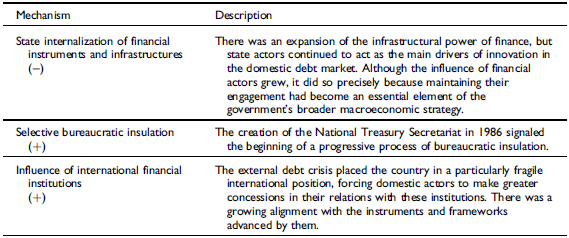
By this point, the developmentalist cycle had come decisively to an end, but the neoliberal paradigm was not yet fully established. The period between 1979 and 1989 is therefore best understood as a hybrid interlude, in which some of the mechanisms associated with the financialization of public debt management began to emerge, while others remained only partially developed. As indicated in Table 2, this resulted in a mixed configuration marked by contradictory mechanisms (indicated by [+] and [−]).
Financialization mechanisms of public debt management, 1979–1989.

Table 2. Long description
A table with two columns and three rows describing mechanisms and their impact on public debt management. The columns are labeled Mechanism and Description. Row 1: Mechanism is State internalization of financial instruments and infrastructures, Description is There was an expansion of the infrastructural power of finance, but state actors continued to act as the main drivers of innovation in the domestic debt market. Although the influence of financial actors grew, it did so precisely because maintaining their engagement had become an essential element of the government’s broader macroeconomic strategy. Row 2: Mechanism is Selective bureaucratic insulation, Description is The creation of the National Treasury Secretariat in 1986 signaled the beginning of a progressive process of bureaucratic insulation. Row 3: Mechanism is Influence of international financial institutions, Description is The external debt crisis placed the country in a particularly fragile international position, forcing domestic actors to make greater concessions in their relations with these institutions. There was a growing alignment with the instruments and frameworks advanced by them.
The neoliberal turn: Financialization at the core of debt management
In the 1990s, Brazil experienced a decisive shift toward a neoliberal policy paradigm, marking the consolidation of the financialization of public debt management. Unlike the previous period, this transformation did not merely involve the expansion of financial instruments or infrastructures. Rather, it entailed a fundamental reorientation of the logic guiding state action. Public debt management became increasingly organized according to market-based criteria, such as credibility, risk, and investor expectations. During this stage, the mechanisms identified earlier began to operate in a more cohesive and fully-articulated configuration which collectively structured the financialization of sovereign debt management.
These developments were anchored in a new conception of economic development inherent to the neoliberal paradigm. Key actors during this period categorically opposed the developmentalist agenda that had guided Brazil throughout much of the 20th century, criticizing ‘statism’ and advocating for a market-led reorientation of economic governance. From this perspective, economic growth could only be sustained through a deepened financial market which would provide the necessary resources for the long-term financing of Brazilian economic progress.
By the late 1990s, public debt began to be cast in policy narratives as a central obstacle to development, accused of causing the ‘crowding out’ of private financial assets (Franco, Reference Franco1998: 69–71; Rocca, Reference Rocca2001). Because public bonds offered high returns due to elevated interest rates, they absorbed resources that would otherwise flow toward the private sector. Increasingly, policymakers viewed the state as competing with and displacing private financial instruments, limiting market diversification.
The reduction of interest rates thus became a priority, but only if this could be achieved through ‘non-artificial’ means – namely, by establishing government credibility. Credibility emerged as the central organizing principle of debt management, redefining the boundaries of legitimate state intervention and anchoring policy decisions in the anticipated reactions of financial markets. As Carlos RoccaFootnote 7 stated, ‘the development of the financial system should have priority equal to that assigned to growth itself’:
The capital market was defined as a priority by the President of the Republic in November 1999. The government’s agenda for the 2001–2002 biennium expressly includes the reform of the capital market and the reduction of the cost of capital as essential actions. It is considered that the democratization and strengthening of the capital market are fundamental to stimulate domestic savings, efficient allocation, and reduction of the cost of capital.
Macroeconomic conditions [for the development of the capital market]. This involves the consolidation of fiscal adjustment and the creation of institutional conditions that ensure credibility for its preservation in the long term. The reduction of interest rates and their maintenance at levels close to international standards is, in fact, the result of building credibility in the conditions for the permanence of stabilization. (…) The private financial system – banks and the capital market – should gradually assume the central role in mobilizing and allocating resources in the Brazilian economy, a role that has been occupied by the public sector in the past few decades. Thus, the development of the financial system in general, and the capital market in particular, is essential and should have priority equal to that given to growth itself. (Rocca, Reference Rocca2001: 74–75, 120–121, 142)
The solution to Brazil’s ‘development problem’ consisted of modernizing the government’s fiscal and financial operations according to the ‘prevailing rules of the international capitalist economic system’ (Ministério da Fazenda and Ministério do Planejamento, Orçamento e Gestão, 2001). This implicated aligning domestic institutions with a model wherein efficiency, liquidity, and risk management were the primary metrics.
Following the creation of the National Treasury Secretariat in 1986, the centralization of debt management reached its apex. By 1993, the Treasury managed all public debt, and the 2000 Fiscal Responsibility Law made the issuance of securities its exclusive prerogative. This consolidation reinforced selective bureaucratic insulation. The 1997 Asian financial crisis is cited in institutional publications as an additional catalyst, positioning stable government bond markets at the center of the agenda for both national actors and multilateral institutions.
Government actors sought to incorporate ‘international best practices’, largely encapsulated in the Guidelines for Public Debt Management published in 2001 by the World Bank and the IMF. This document marked a turning point in the financialization of debt management in Brazil, recommending the adoption of specific instruments and infrastructures (Silva et al., Reference Silva, Cabral, Baghdassarian, Silva, Carvalho and Medeiros2009). The incorporation of these guidelines was part of the Fiscal and Financial Management Strengthening Project (PROGER), which reflected the decisive influence of international financial institutions in promoting a financialized model of sovereign debt governance.
The following passage highlights the influence of OECD countries and financial market consultants in these reconfigurations:
International consultants were hired, both from academia and the financial market, as well as a firm specializing in the development of systems for the financial market. The final results were presented at the Workshop on Public Debt Management in Brazil, an event held at the Fundação Getúlio Vargas in Rio de Janeiro in March 2003, bringing together debt managers from Denmark, Spain, the United States, France, Italy, Portugal, the United Kingdom and the Czech Republic, as well as representatives from the OECD and the World Bank. (Silva et al., Reference Silva, Cabral, Baghdassarian, Silva, Carvalho and Medeiros2009: 173)
Among the major outcomes of the reforms of this period was the centralization of functions into a DMO, known in Brazil as the Subsecretariat of Public Debt (SUDIP). This solidified the mechanism of selective bureaucratic insulation by concentrating decision-making within a specialized technocratic unit, thereby reducing the scope for political interference.
The period also witnessed a proliferation of financial instruments and a growing entanglement between governmental and financial actors. Described in detail in official Treasury publications, methodologies for pricing, risk calculation (CFaR, CaR), and benchmarks were derived extensively from financial economics (Ferreira, Reference Ferreira2006; Alves and Silva, Reference Alves, Silva, Silva, Carvalho and Medeiros2009; Costa, Reference Costa, Silva, Carvalho and Medeiros2009; Silva and Medeiros, Reference Silva, Medeiros, Silva, Carvalho and Medeiros2009; Silva et al., Reference Silva, Cabral, Baghdassarian, Silva, Carvalho and Medeiros2009). For instance, the adoption of the Asset and Liability Management (ALM) model, originally a private banking technique, reflected a profound shift in the epistemic foundations of debt management.
Furthermore, institutional documents describe dealers as strategic partners. Debt managers are expected to maintain regular contact with these institutions to gather data on market expectations (Raimundo, Reference Raimundo2021; Tesouro Nacional, Reference Nacional2020; Venceslau and Pedras, Reference Venceslau, Pedras, Silva, Carvalho and Medeiros2009). As is reflected in the excerpt below, taken from an official Treasury publication, dealers play a fundamental role in monitoring the government securities market, identifying investors’ preferences regarding the products offered and, based on this information, supporting public managers’ strategic planning for securities issuance.
The National Treasury regularly consults these institutions to define the lots of securities to be offered at auction. Based on this sample, it is possible to capture a proxy of the demand for government bonds every week. The two groups of dealers pass on, at least twice a day, information about secondary market bond rates, which is very important for market monitoring, as well as for defining the price of securities offered in the Treasury Direct Program. (…)
Intermediaries play a key role in the proper distribution and pricing of assets in the financial market. They are able to identify investors needs, such as: types of instruments, profitability, desired term, and meet them through the secondary market. The intermediaries also pass on to the Treasury the perception of the acceptability of a certain security, as well as the existence of demand for some type of security or term that is not yet being served by the National Treasury. Such information is quite relevant for planning bond issues. In this sense, both banks and brokers/dealers are also seen as partners to the Treasury in promoting the proper functioning of the federal public debt securities market. (Venceslau and Pedras, Reference Venceslau, Pedras, Silva, Carvalho and Medeiros2009: 343)
In this configuration, financial actors do not merely participate in the market; they actively shape state decision-making, as issuance strategies become increasingly responsive to their expectations and analytical frameworks. The entanglements between state actors and dealers are evidenced in institutional publications at both governance and operational levels. At the operational level, the Treasury becomes dependent on the technological infrastructure developed in partnership with financial market players to commercialize the securities issued by the government (Carvalho and Morais, Reference Carvalho, Morais, Silva, Carvalho and Medeiros2009). Government bond auctions are conducted on the Selic electronic system, mentioned earlier. Financial institutions access the Selic system through the Market Telecommunications Network (RTM), which is the main electronic hub integrating the Brazilian financial market, owned by the Brazilian Financial and Capital Market Entities Association (Anbima)Footnote 8 and B3, the Brazilian stock exchange (Banco Central do Brasil, 2024).
Anbima is also considered a central partner of the Treasury, providing reference rates and specialized tools (Compare, Confere, and the IMA family indexes)Footnote 9 that evaluate public debt products. Although managed by Anbima, these tools were developed with Treasury support to ‘increase attractiveness for investors’ (Pereira et al., Reference Pereira, Pedras, Gragnani, Silva, Carvalho and Medeiros2009: 439). Daily information exchange agreements between the Treasury and Anbima reflect a high degree of institutional and operational interdependence (Pereira et al., Reference Pereira, Pedras, Gragnani, Silva, Carvalho and Medeiros2009: 347; Venceslau and Pedras, Reference Venceslau, Pedras, Silva, Carvalho and Medeiros2009: 300).
In line with Braun’s (Reference Braun2018) concept of financial infrastructural power, this configuration reflects how the state can become operationally dependent on financial market infrastructures to implement core fiscal functions. Rather than exerting influence solely from the outside, financial actors and infrastructures shape the practical conditions of debt management. Sovereign debt governance thus becomes embedded in a sociotechnical infrastructure jointly operated by public authorities and financial market institutions.
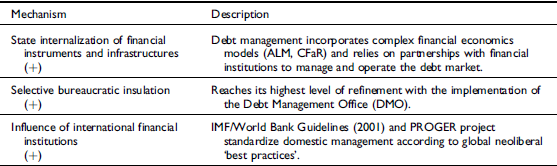
The period from 1989 to 2001 thus marks the consolidation of all the mechanisms associated with the financialization of public debt management, as summarized in Table 3.
Financialization mechanisms of public debt management, 1989–2001.

Table 3. Long description
A table with two columns and three rows describing mechanisms of public debt management. The columns are labeled Mechanism and Description. Row 1: Mechanism is State internalization of financial instruments and infrastructures, Description is Debt management incorporates complex financial economics models (ALM, CFaR) and relies on partnerships with financial institutions to manage and operate the debt market. Row 2: Mechanism is Selective bureaucratic insulation, Description is Reaches its highest level of refinement with the implementation of the Debt Management Office (DMO). Row 3: Mechanism is Influence of international financial institutions, Description is IMF/World Bank Guidelines (2001) and PROGER project standardize domestic debt management according to global neoliberal ‘best practices’.
Here, all the mechanisms which underpin the financialization of public debt management are present (+). These reforms established a durable institutional and analytical framework that continues to structure debt management today. What characterizes this period is not only the presence of financial instruments, but the consolidation of a mode of governance in which state action is systematically oriented toward market-based criteria. In this sense, the financialization of public debt management became not a contingent feature, but a stable and enduring configuration.
Conclusion
This article has examined the historical emergence of the financialization of public debt management in Brazil, demonstrating that this transformation was not a linear or automatic process. While the institutional foundations of the domestic debt market were established in the 1960s, they initially operated within a developmentalist paradigm where financial instruments were subordinated to state-led objectives. Financialization emerged only when these debt infrastructures became articulated with a neoliberal policy paradigm that redefined the principles guiding sovereign debt governance.
The analysis shows that the financialization of debt management resulted from the interaction of three mechanisms: the internalization of financial instruments and infrastructures within the state; the selective bureaucratic insulation of debt institutions; and the influence of international financial institutions in diffusing market-oriented governance models. These mechanisms did not operate in isolation. Rather, their effects became mutually reinforcing only once the neoliberal policy paradigm reoriented the objectives and evaluation criteria of public debt management.
A central insight that emerges from this analysis concerns the relationship between financial instruments, state capacity, and the infrastructural power of finance. During the developmentalist period, financial innovations were designed and implemented by state actors themselves, who constructed the domestic public debt market and defined the parameters within which financial actors operated. In this context, the state functioned as the primary architect of the market and organized the infrastructures through which government securities circulated.
Over time, however, this configuration shifted. As the public debt market expanded and a stable community of creditors consolidated around government securities, market functioning increasingly relied on shared infrastructures, practices, and analytical frameworks. As a consequence, the governance and day-to-day operation of the public debt market became increasingly shared between the Treasury and financial market actors.
Another important implication relates to the path dependence generated by financial infrastructures and their consequences for democratic governance. By establishing the infrastructural power of finance over fiscal policy, consolidated systems such as those observed in Brazil stabilize specific modes of governance that make alternative approaches increasingly difficult to implement. Despite changes in government, the principles and instruments guiding Brazilian public debt have remained largely stable since the early 2000s. This continuity highlights how financial infrastructures generate durable, sociotechnical constraints that shape the range of policy options available to elected governments.
Finally, the article helps to illuminate how state financialization unfolds in peripheral economies. While existing scholarship has largely focused on OECD countries, the Brazilian case highlights how financialization emerges through the interplay between domestic and international drivers. By mapping these dynamics, this study contributes to a broader understanding of how the ‘quiet side’ of debt management (Rommerskirchen and van der Heide, Reference Rommerskirchen and van der Heide2023) fundamentally reshapes the boundaries of state and financial power in peripheral economies.
Acknowledgments
I used the DeepL translation tool to support the preparation of the English version of this manuscript. The final text and all interpretations remain my sole responsibility. Special thanks to Professor Leon Wansleben and to colleagues at the Max Planck Institute for the Study of Societies (MPIfG) for their generous intellectual exchange and insightful comments during my visiting research period, when this research took shape. I also thank the Universidade Federal de Sergipe and my colleagues from the doctoral program for their support throughout my PhD. I am also very grateful to the reviewers for their careful reading and constructive suggestions, which greatly improved this article. Finally, I gratefully acknowledge Coordenação de Aperfeiçoamento de Pessoal de Nível Superior (CAPES) for funding my visiting research period at the MPIfG.

 Open access

