
Hostname: page-component-7b7567c8c-2n9c9 Total loading time: 0 Render date: 2026-11-17T12:37:31.495Z Has data issue: false hasContentIssue false

Addendum to a paper of M. Saks

Published online by Cambridge University Press:  18 May 2009

Hazel Perfect
Affiliation:
University of Sheffield
Rights & Permissions [Opens in a new window]

Extract

Core share and HTML view are not available for this content. However, as you have access to this content, a full PDF is available via the 'Save PDF' action button.

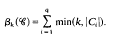
Throughout, (X, ≤ ) denotes a partially ordered set (p. o. set), where X is assumed to be finite. A subset Y of X is called a k-union if Y contains no chain of length K + 1. In particular, therefore, a 1-union is just an antichain; and it is readily seen that Y is a k-union if and only if it is a union of K antichains. (Dually, a subset Z of X is a k-counion if Z contains no antichain of length k + 1.) We denote by dk (X) the maximum cardinality of a k-union in X, with a similar notation for other p. o. sets. Now let be any partition of X into chains, and write
.

Information

Type
Research Article
Copyright
Copyright © Glasgow Mathematical Journal Trust 1984
