


 be an arbitrary strictly increasing infinite sequence of positive integers. For an integer n≥1, let
 . Let r>0 be a real number and q≥ 1 a given integer. Let
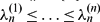 be the eigenvalues of the reciprocal power LCM matrix
 having the reciprocal power
 of the least common multiple of x
 converges and
 . We show that the sequence
 converges if
 and
 . We show also that if r> 1, then the sequence
 converges and
 , where t and l are given positive integers such that t≤l−1.


Crossref Citations

This article has been cited by the following publications. This list is generated based on data provided by Crossref.
Hong, Shaofang
2008.
ASYMPTOTIC BEHAVIOR OF LARGEST EIGENVALUE OF MATRICES ASSOCIATED WITH COMPLETELY EVEN FUNCTIONS (MOD r).
Asian-European Journal of Mathematics,
Vol. 01,
Issue. 02,
p.
225.
Hong, Shaofang
and
Wang, Shaofang
2008.
THERE DOES NOT EXIST AN ODD SINGULAR NUMBER OF THE FORM plqr.
Asian-European Journal of Mathematics,
Vol. 01,
Issue. 01,
p.
77.
Hong, Shaofang
2008.
Divisibility properties of power GCD matrices and power LCM matrices.
Linear Algebra and its Applications,
Vol. 428,
Issue. 4,
p.
1001.
Altınışık, Ercan
2009.
On inverses of GCD matrices associated with multiplicative functions and a proof of the Hong–Loewy conjecture.
Linear Algebra and its Applications,
Vol. 430,
Issue. 4,
p.
1313.
Feng, Weiduan
Hong, Shaofang
and
Zhao, Jianrong
2009.
Divisibility properties of power LCM matrices by power GCD matrices on gcd-closed sets.
Discrete Mathematics,
Vol. 309,
Issue. 9,
p.
2627.
Hong, Shaofang
Zhou, Xingwang
and
Zhao, Jianrong
2009.
Power GCD Matrices for a UFD.
Algebra Colloquium,
Vol. 16,
Issue. 01,
p.
71.
Tan, Qianrong
2010.
Divisibility among power GCD matrices and among power LCM matrices on two coprime divisor chains.
Linear and Multilinear Algebra,
Vol. 58,
Issue. 5,
p.
659.
Qian, Guoyou
and
Lu, Jingya
2010.
LU-FACTORIZATIONS OF SYMMETRIC MATRICES WITH APPLICATIONS.
Asian-European Journal of Mathematics,
Vol. 03,
Issue. 01,
p.
133.
Tan, Qianrong
and
Lin, Zongbing
2010.
Divisibility of determinants of power GCD matrices and power LCM matrices on finitely many quasi-coprime divisor chains.
Applied Mathematics and Computation,
Vol. 217,
Issue. 8,
p.
3910.
Li, Mao
and
Tan, Qianrong
2011.
Divisibility of matrices associated with multiplicative functions.
Discrete Mathematics,
Vol. 311,
Issue. 20,
p.
2276.
Tan, Qianrong
Lin, Zongbing
and
Liu, Liu
2011.
Divisibility among power GCD matrices and among power LCM matrices on two coprime divisor chains II.
Linear and Multilinear Algebra,
Vol. 59,
Issue. 9,
p.
969.
Xu, Jiehong
and
Li, Mao
2011.
Divisibility among power GCD matrices and among power LCM matrices on three coprime divisor chains.
Linear and Multilinear Algebra,
Vol. 59,
Issue. 7,
p.
773.
Hong, Shaofang
and
Qian, Guoyou
2011.
The least common multiple of consecutive arithmetic progression terms.
Proceedings of the Edinburgh Mathematical Society,
Vol. 54,
Issue. 2,
p.
431.
HONG, SHAOFANG
and
LOEWY, RAPHAEL
2011.
ASYMPTOTIC BEHAVIOR OF THE SMALLEST EIGENVALUE OF MATRICES ASSOCIATED WITH COMPLETELY EVEN FUNCTIONS (mod r).
International Journal of Number Theory,
Vol. 07,
Issue. 06,
p.
1681.
Lin, Zongbing
and
Tan, Qianrong
2012.
Determinants of Smith matrices on three coprime divisor chains and divisibility.
Linear and Multilinear Algebra,
Vol. 60,
Issue. 4,
p.
475.
İpek, Ahmet
2012.
Upper bounds for the condition numbers of the GCD and the reciprocal GCD matrices in spectral norm.
Computers & Mathematics with Applications,
Vol. 63,
Issue. 3,
p.
645.
Tan, Qianrong
Luo, Miao
and
Lin, Zongbing
2013.
Determinants and divisibility of power GCD and power LCM matrices on finitely many coprime divisor chains.
Applied Mathematics and Computation,
Vol. 219,
Issue. 15,
p.
8112.
Mattila, Mika
and
Haukkanen, Pentti
2013.
Determinant and inverse of join matrices on two sets.
Linear Algebra and its Applications,
Vol. 438,
Issue. 10,
p.
3891.
Tan, Qianrong
and
Li, Mao
2013.
Divisibility among power GCD matrices and among power LCM matrices on finitely many coprime divisor chains.
Linear Algebra and its Applications,
Vol. 438,
Issue. 3,
p.
1454.
Zhao, Jianrong
2014.
Divisibility of power LCM matrices by power GCD matrices on gcd-closed sets.
Linear and Multilinear Algebra,
Vol. 62,
Issue. 6,
p.
735.