




No CrossRef data available.
Article contents
CELLULAR AUTOMATA OVER ALGEBRAIC STRUCTURES
Published online by Cambridge University Press: 26 April 2021
Abstract
Core share and HTML view are not available for this content. However, as you have access to this content, a full PDF is available via the 'Save PDF' action button.
Let G be a group and A a set equipped with a collection of finitary operations. We study cellular automata 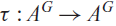 $$\tau :{A^G} \to {A^G}$$ that preserve the operations AG of induced componentwise from the operations of A. We show τ that is an endomorphism of AG if and only if its local function is a homomorphism. When A is entropic (i.e. all finitary operations are homomorphisms), we establish that the set EndCA(G;A), consisting of all such endomorphic cellular automata, is isomorphic to the direct limit of Hom(AS, A), where S runs among all finite subsets of G. In particular, when A is an R-module, we show that EndCA(G;A) is isomorphic to the group algebra
 $${\rm{End}}(A)[G]$$. Moreover, when A is a finite Boolean algebra, we establish that the number of endomorphic cellular automata over AG admitting a memory set S is precisely
 $${(k|S|)^k}$$, where k is the number of atoms of A.
MSC classification
Information
- Type
- Research Article
- Information
- Copyright
- © The Author(s), 2021. Published by Cambridge University Press on behalf of Glasgow Mathematical Journal Trust
References
Burris, S. and Sankappanavar, H. P., A course in universal algebra (The Millennium Edition, New York, 2012).Google Scholar
Ceccherini-Silberstein, T. and Coornaert, M., The Garden of Eden theorem for linear cellular automata, Ergod. Theory Dyn. Syst. 26 (2006), 53–68.CrossRefGoogle Scholar
Ceccherini-Silberstein, T. and Coornaert, M., Injective linear cellular automata and sofic groups, Israel J. Math. 161 (2007), 1–15.CrossRefGoogle Scholar
Ceccherini-Silberstein, T. and Coornaert, M., Cellular automata and groups, Springer Monographs in Mathematics (Springer-Verlag, Berlin, Heidelberg, 2010).CrossRefGoogle Scholar
Cook, M., Universality in elementary cellular automata, Complex Syst. 15 (2004), 1–40.Google Scholar
Evans, T., Endomorphisms of abstract algebras, Proc. R. Soc. Edinb. Sect. A 66 (1962), 53–64.Google Scholar
Grätzer, G., Universal algebra, Second Edition (Springer-Verlag, New York, 2008).CrossRefGoogle Scholar
Givant, S. and Halmos, P., Introduction to boolean algebras, Undergraduate Texts in Mathematics (Springer-Verlag, New York, 2009).Google Scholar
Lehtonen, E. and Pilitowska, A., Entropicity and generalized entropic property in idempotent n -semigroups, Semigroup Forum 91 (2015), 260–281.CrossRefGoogle Scholar
McLane, S., Categories for the working mathematician, Graduate Texts in Mathematics, vol. 5 (Springer-Verlag, New York, 1998).Google Scholar
Milies, C. P. and Sehgal, S. K., An introduction to group rings (Kluwer Academic Publishers, Dordrecht, 2002).CrossRefGoogle Scholar
Rotman, J. J., An introduction to homological algebra, Second Edition (Springer, New York, 2009).CrossRefGoogle Scholar
Salo, V. and Törmä, I., On shift spaces with algebraic structure, In How the world computes. CiE 2012 (Cooper, S. B., Dawar, A., Lwe, B. Editors), LNCS, vol. 7318 (Springer, Berlin, Heidelberg, 2012).Google Scholar
 You have Access