



Hostname: page-component-7b7567c8c-2rsb6 Total loading time: 0 Render date: 2026-11-12T12:06:39.932Z Has data issue: false hasContentIssue false

Dirichlet and Poincaré series

Published online by Cambridge University Press:  18 May 2009

A. Good
Affiliation:
School of Mathematics, The Institute for Advanced Study, Princeton NJ 08540
Rights & Permissions [Opens in a new window]

Extract

Core share and HTML view are not available for this content. However, as you have access to this content, a full PDF is available via the 'Save PDF' action button.

The study of modular forms has been deeply influenced by famous conjectures and hypotheses concerning

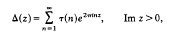
where T(n) denotes Ramanujan's function. The fundamental discriminant Δ is a cusp form of weight 12 with respect to the modular group. Its associated Dirichlet series

defines an entire function of s and satisfies the functional equation

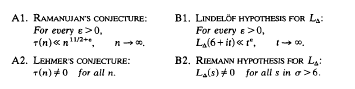
The most penetrating statements that have been made on T(n) and LΔ(s)are:

Of these four problems only A1 has been established so far. This was done by Deligne [1] using methods from algebraic geometry and number theory. While B1 trivially holds with ε > 1/2, it was established in [2] for every ε>1/3. Serre [12] proved A2 for a positive proportion of the integers and Hafner [5] showed that LΔ has a positive proportion of its non-trivial zeros on the line σ=6. The proofs of the last three results are largely analytic in nature.

Information

Type
Research Article
Copyright
Copyright © Glasgow Mathematical Journal Trust 1985