




No CrossRef data available.
Article contents
Models for joint isometries
Published online by Cambridge University Press: 18 May 2009
Extract
Core share and HTML view are not available for this content. However, as you have access to this content, a full PDF is available via the 'Save PDF' action button.
An N-tuple ℐ= (T1…, TN) of commuting contractions on a Hilbert space H is said to be a joint isometry if 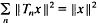 for all x in H, or, equivalently, if
 Athavale in [1] characterized the joint isometries as subnormal N-tuples whose minimal normal extensions have joint spectra in the unit sphere S2N−X a geometric perspective of this is given in [4]. Subsequently, V. Müller and F.-H. Vasilescu proved that commuting N-tuples which are joint contractions, i.e.
 , can be represented as restrictions of certain weighted shifts direct sum a joint isometry. In this paper we adapt the canonical models of [3], and also construct a new canonical model, which completes the previous descriptions by showing joint isometries are indeed restrictions of specific multivariable weighted shifts [2].
Information
- Type
- Research Article
- Information
- Copyright
- Copyright © Glasgow Mathematical Journal Trust 1996
References
REFERENCES
1.Athavale, A., On the intertwining of joint isometries, J. Operator Theory 23 (1990), 339–350.Google Scholar
2.Jewell, N. P. and Lubin, A. R., Commuting weighted shifts and analytic function theory of several variables, J. Operator Theory 1 (1979), 207–223.Google Scholar
3.Lubin, A. R., Models for commuting contractions, Michigan Math. J. 23 (1976), 161–165.CrossRefGoogle Scholar
4.Lubin, A. R. and Attele, K. R. M., Dilations and commutant lifting for jointly-isometric operators—a geometric approach, to appear in J. Func. Anal.Google Scholar
5.Müller, V. and Vasilescu, F.-H., Standard models for some commuting multioperators, Proc. Amer. Math. Soc. 117 (1993), 979–989.CrossRefGoogle Scholar
6.Vasilescu, F.-H., An operator valued Poisson kernel, J. Func. Anal. 110 (1992), 47–72.CrossRefGoogle Scholar
 You have
Access
- 1
- Cited by