

Hostname: page-component-7b7567c8c-fvjsw Total loading time: 0 Render date: 2026-11-17T12:43:30.371Z Has data issue: false hasContentIssue false

On the derivatives at the origin of entire harmonic functions

Published online by Cambridge University Press:  18 May 2009

D. H. Armitage
Affiliation:
The Queen's University, Belfast BT7 1NN.
Rights & Permissions [Opens in a new window]

Extract

Core share and HTML view are not available for this content. However, as you have access to this content, a full PDF is available via the 'Save PDF' action button.

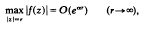
If f is an entire function in the complex plane such that

where 0 ≤ α < 1, and all the derivatives of f at 0 are integers, then it is easy to show that f is a polynomial (see e.g. Straus [10]). The best possible result of this type was proved by Pólya [9]. The main aim of this paper is to prove two analogous results for harmonic functions defined in the whole of the Euclidean space Rn, where n ≥ 2 (i.e. entire harmonic functions).

Information

Type
Research Article
Copyright
Copyright © Glasgow Mathematical Journal Trust 1979