

Hostname: page-component-7b7567c8c-2n9c9 Total loading time: 0 Render date: 2026-11-14T08:51:53.616Z Has data issue: false hasContentIssue false

On the endomorphism semigroup of an ordered set

Published online by Cambridge University Press:  18 May 2009

T. S. Blyth
Affiliation:
Mathematical Institute, University of St Andrews, St Andrews Ky16 9SS, Scotland.
Rights & Permissions [Opens in a new window]

Extract

Core share and HTML view are not available for this content. However, as you have access to this content, a full PDF is available via the 'Save PDF' action button.

M. E. Adams and Matthew Gould [1] have obtained a remarkable classification of ordered sets P for which the monoid End P of endomorphisms (i.e. isotone maps) is regular, in the sense that for every f є End P there exists g є End P such that fgf = f. They show that the class of such ordered sets consists precisely of

(a) all antichains;

(b) all quasi-complete chains;

(c) all complete bipartite ordered sets (i.e. given non-zero cardinals α β an ordered set Kα,β of height 1 having α minimal elements and β maximal elements, every minimal element being less than every maximal element);

(d) for a non-zero cardinal α the lattice Mα consisting of a smallest element 0, a biggest element 1, and α atoms;

(e) for non-zero cardinals α, β the ordered set Nα,β of height 1 having α minimal elements and β maximal elements in which there is a unique minimal element α0 below all maximal elements and a unique maximal element β0 above all minimal elements (and no further ordering);

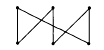
(f) the six-element crown C6 with Hasse diagram

A similar characterisation, which coincides with the above for sets of height at most 2 but differs for chains, was obtained by A. Ya. Aizenshtat [2].

Information

Type
Research Article
Copyright
Copyright © Glasgow Mathematical Journal Trust 1995