




No CrossRef data available.
Article contents
The Reissner-Sagoci problem †
Published online by Cambridge University Press: 18 May 2009
Extract
Core share and HTML view are not available for this content. However, as you have access to this content, a full PDF is available via the 'Save PDF' action button.
The statical Reissner-Sagoci problem [1, 2, 3] is that of determining the components of stress and displacement in the interior of the semi-infinite homogeneous isotropic elastic solid z ≧ 0 when a circular area (0 ≦ p ≦ a, z = 0) of the boundary surface is forced to rotate through an angle a about an axis which is normal to the undeformed plane surface of the medium. It is easily shown that, if we use cylindrical coordinates (p, φ, z), the displacement vector has only one non-vanishing component uφ (p, z), and the stress tensor has only two non-vanishing components, σρπ(p, z) and σπz(p, z). The stress-strain relations reduce to the two simple equations

where μ is the shear modulus of the material. From these equations, it follows immediately that the equilibrium equation
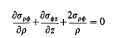
is satisfied provided that the function uπ(ρ, z) is a solution of the partial differential equation

The boundary conditions can be written in the form

where, in the case in which we are most interested, f(p) = αρ. We also assume that, as r → ∞, uπ, σρπ and σπz all tend to zero.
Information
- Type
- Research Article
- Information
- Copyright
- Copyright © Glasgow Mathematical Journal Trust 1966
References
REFERENCES
1.Reissner, E., Freie und erzwungene Torsionschwingungen des elastischen Halbraumes, Ing.-Arch, 8 (1937), 229–245.Google Scholar
2.Reissner, E. and Sagoci, H. F., Forced torsional oscillations of an elastic half-space, I, J. Appl. Phys. 15 (1944), 652–654.CrossRefGoogle Scholar
3.Sagoci, H. F., Forced torsional oscillations of an elastic half-space, II, J. Appl. Phys. 15 (1944), 655–662.CrossRefGoogle Scholar
4.Sneddon, I. N., Note on a boundary value problem of Reissner and Sagoci, J. Appl. Phys. 18 (1947), 130–132.CrossRefGoogle Scholar
5.Titchmarsh, E. C., Introduction to the theory of Fourier integrals (Clarendon Press, Oxford, 1937), 334–339.Google Scholar
6.Sneddon, I. N., The elementary solution of dual integral equations, Proc. Glasgow Math. Assoc. 4 (1960), 108–110.CrossRefGoogle Scholar
8.George, D. L., Numerical values of some integrals involving Bessel functions, Proc. Edinburgh Math. Soc. (2) 13 (1962), 87–113.CrossRefGoogle Scholar
9.Sneddon, I. N. and Tait, R. J., The effect of a penny-shaped crack on the distribution of stress in a long circular cylinder, Internat. J. Eng. Sci. 1 (1963), 391–409.CrossRefGoogle Scholar
10.Cooke, J. C. and Tranter, C. J., Dual Fourier-Bessel series, Quart. J. Mech. and Appl. Math. 12 (1959), 379–385.CrossRefGoogle Scholar
11.Sneddon, I. N. and Srivastav, R. P., Dual series relations, I, Proc. Roy. Soc. Edinburgh A 66 (1963), 150–160.Google Scholar
12.Srivastav, R. P., Dual series relations, II, Proc. Roy. Soc. Edinburgh A 66 (1963), 161–172.Google Scholar
13.Sneddon, I. N., Srivastav, R. P. and Mathur, S. C., The Reissner-Sagoci problem for a long cylinder of finite radius. (To appear in Quart. J. Mech. and Appl. Math.)Google Scholar
 You have
Access
- 39
- Cited by