


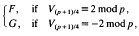
 and the quartic character of units of
 for m ≡ 1 mod 8


Crossref Citations

This article has been cited by the following publications. This list is generated based on data provided by Crossref.
Siligardos, Giorgos
2000.
The Embedding Problem and Representation of Prime Powers by Ambiguous Classes of Quadratic Forms of Discriminant −22sqr.
Journal of Number Theory,
Vol. 85,
Issue. 2,
p.
305.
Halter-Koch, Franz
2003.
Representation of prime powers in arithmetical progressions by binary quadratic forms.
Journal de théorie des nombres de Bordeaux,
Vol. 15,
Issue. 1,
p.
141.
Moree, Pieter
and
Noubissie, Armand
2025.
Higher reciprocity laws and ternary linear recurrence sequences.
International Journal of Number Theory,
Vol. 21,
Issue. 05,
p.
993.