




No CrossRef data available.
Article contents
SIGN CHANGES OF FOURIER COEFFICIENTS OF ENTIRE MODULAR INTEGRALS
Published online by Cambridge University Press: 29 March 2012
Abstract
Core share and HTML view are not available for this content. However, as you have access to this content, a full PDF is available via the 'Save PDF' action button.
Let f be a non-zero cusp form with real Fourier coefficients a(n) (n ≥ 1) of positive real weight k and a unitary multiplier system v on a subgroup Γ ⊂ SL2(ℝ) that is finitely generated and of Fuchsian type of the first kind. Then, it is known that the sequence (a(n))(n ≥ 1) has infinitely many sign changes. In this short note, we generalise the above result to the case of entire modular integrals of non-positive integral weight k on the group Γ0*(N) (N ∈ ℕ) generated by the Hecke congruence subgroup Γ0(N) and the Fricke involution 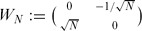 provided that the associated period functions are polynomials.
Keywords
Information
- Type
- Research Article
- Information
- Copyright
- Copyright © Glasgow Mathematical Journal Trust 2012
References
REFERENCES
1.Bol, G., Invarianten linearer differential gleichungen, Abh. Math. Sem. Univ. Hamburg. 16 (3–4) (1949), 1–28.Google Scholar
2.Knopp, M., Modular integrals on Γ0(N) and Dirichlet series with functional equations, in Number theory (Chudnovsky, D. V. et al. Editors) (Springer, Berlin, Germany, 1985), 211–224. Lect. No. 1135.CrossRefGoogle Scholar
3.Knopp, M., Kohnen, W. and Pribitkin, W., On the signs of Fourier coefficients of cusp forms, Ramanujan J. 7 (2003), 269–277.CrossRefGoogle Scholar
4.Kohnen, W., On the growth of the Petersson norms of Fourier-Jacobi coefficients of Siegel cusp forms, Bull. Lond. Math. Soc. 43 (4) (2011), 717–720.CrossRefGoogle Scholar
5.Landau, E., Uber einen Satz von Tschebyschef, Math. Ann. 61 (1906), 527–550.CrossRefGoogle Scholar
 You have Access