Hostname: page-component-7b7567c8c-wxvwp Total loading time: 0 Render date: 2026-11-17T08:28:29.489Z Has data issue: false hasContentIssue false

Some remarks on pramarts and mils

Published online by Cambridge University Press:  18 May 2009

Zhen-Peng Wang
Affiliation:
Department of StatisticsEast China Normal UniversityShanghai 200062, China
Xing-Hong Xue
Affiliation:
Department of StatisticsColumbia UniversityNew YorkNy 10027U.S.A.
Rights & Permissions [Opens in a new window]

Extract

Core share and HTML view are not available for this content. However, as you have access to this content, a full PDF is available via the 'Save PDF' action button.

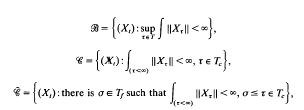
Let F be a Banach space, (ω, ℱ, P) a fixed probability space, D a directed set filtering to the right with the order ≤, and (ℱt, D) a stochastic basis of ℱ, i.e. (ℱt, D) is an increasing family of sub-σ-algebras of ℱ:ℱs ⊂ for any s,t ε D and s≤t. Throughout this paper, (Xt) is an F-valued, (ℱt)-adapted sequence, i.e. Xt, is ℱt-measurable, t ε D. We also assume that Xt, ∈ L1, i.e. ∫ ∥Xt∥ <∞. We use I(H) to denote the indicator function of an event H. Let ∞ be a such element: t <∞, t ∈ D, = D ∪ ∞, and ℱ∞ = σ. A stopping time is a map τ:Ω→ such that (τ<t) ∈ ℱt, t ∈ D. A stopping time τ is called simple (countable) if it takes finitely (countably) many values in D(). Let T and Tc be the sets of simple and countable stopping times respectively and Tf = {τ ∈ Tc: τ<∞ a.s.}. Clearly, (T, <) and (Tf, <) are directed sets filtering to the right. For τ ∈ Tc, let

and

= {(Xt): there is σ∈ Tf such that ∫(ι<∞) ∥Xι∥ < ∞, σ ≤ τ ∈ Tc},

= {(Xt):(Xι, ι ∈ T) converges stochastically (i.e. in probability) in the norm topology},

ℰ = {(Xt):(Xι, ι ∈ T) converges essentially in the norm topology}.

Information

Type
Research Article
Copyright
Copyright © Glasgow Mathematical Journal Trust 1993