





Impact statement
Globally, young individuals are currently navigating through two rapidly growing challenges simultaneously: increasing mental health difficulties and the rising dependence on digital technology. In low-and-middle-income regions like India, this issue is compounded by limited access to quality mental health services. This leads to a critical but hidden risk where young individuals are experiencing worsening mental conditions, but they go unrecognized and unsupported. To better understand the interplay of these challenges, we conducted a study among Indian university students. Our study demonstrates that problematic internet use is closely linked to psychological disorders – depression and anxiety, and that these emotional difficulties play a central role in reducing life satisfaction (LS). Depression and anxiety appear to build on one another rather than independently forming a chain of psychological distress that further reduces well-being. This highlights that addressing one condition in isolation may not be sufficient. The broader implication of this result is that: interventions should move beyond focusing on reducing internet use and instead should focus on addressing psychological distress that contributes to excessive internet use. There is an urgent need for integrated mental health services that include prevention, promotion, early identification and immediate support for young individuals in colleges. In resource-limited settings, strengthening psychosocial support within educational institutions may offer a practical and scalable way to improve mental health outcomes and mitigate the negative impact of problematic internet use.
Introduction
Youth mental health is an area of burgeoning concern in India with over 25% of the total population under 25 years of age (Youth in India, 2022). This paper examines general mental well-being and life satisfaction (LS) among students aged 17 to 20 years, primarily those enrolled in university undergraduate education. This demographic was severely impacted during the COVID-19 pandemic, which saw widespread school and college closures, substantial mortality and significant difficulties experienced by families (Mahapatra and Sharma, Reference Mahapatra and Sharma2021; Arora et al., Reference Arora, Devi, Sardar and Sharma2023). During the pandemic, the sudden and often unplanned transition to online learning worldwide has led to significant gaps in foundational knowledge acquisition (Mumtahena et al., Reference Mumtahena, Sen, Sayyed, Wijayawardhana, Zafari and Kafle2023). These academic setbacks contribute to poorer performance in the current curriculum and heighten the stress arising from the unmet expectations of students and their parents (Mahapatra and Sharma, Reference Mahapatra and Sharma2021). Compounding these issues, many families are still recovering from pandemic-induced financial setbacks due to business or job losses, which further impacts students’ education and psychological well-being (Yang et al., Reference Yang, Sun, Zimmermann and Mukherjee2024). One in seven 10–19 year olds worldwide is experiencing mental health problems (World Health Organization, 2019). The pandemic may have exacerbated the mental health crisis in the youth, and Indian undergraduate students have been disproportionately impacted (Arora et al., Reference Arora, Devi, Sardar and Sharma2023; Suresh and Dar, Reference Suresh and Dar2025). The developmental trajectory implies a confluence of stressors occurring at a sensitive transitional period from adolescence to early adulthood, which is characterized by increased vulnerability to psychological distress and can significantly impair LS through pathways including problematic internet use, depression and anxiety (Kumar et al., Reference Kumar, Goel and Mehra2024; Ma et al., Reference Ma, Li and Lee2025). Furthermore, limited mental health awareness among students, families and educators, combined with stigma surrounding help-seeking and insufficient institutional support frameworks, exacerbates challenges in maintaining satisfactory levels of subjective well-being (Gaiha et al., Reference Gaiha, Taylor Salisbury, Koschorke, Raman and Petticrew2020).
A growing body of evidence demonstrates associations among problematic internet use, depression, anxiety and reduced LS among university students (Longstreet and Brooks, Reference Longstreet and Brooks2017; Ye et al., Reference Ye, Zhang and Zhao2023; Kumar et al., Reference Kumar, Goel and Mehra2024). Problematic internet use has been associated with sleep disruption, reduced motivation, diminished offline social interaction and poorer psychological well-being (Longstreet and Brooks, Reference Longstreet and Brooks2017; Alimoradi et al. Reference Alimoradi, Lin, Broström, Bülow, Bajalan, Griffiths, Ohayon and Pakpour2019). Individuals experiencing depressive or anxiety symptoms may also engage in problematic internet use as a coping or avoidance strategy, while problematic internet use may itself be associated with poorer well-being (Brand et al., Reference Brand, Young, Laier, Wölfling and Potenza2016; Ye et al., Reference Ye, Zhang and Zhao2023). In the present study, problematic internet use refers to the construct assessed using the 12-item Short Version of Young’s Internet Addiction Test (s-IAT-12). The s-IAT-12 is a validated short version of Young’s Internet Addiction Test and assesses problematic internet-use symptoms (Young, Reference Young1998; Pawlikowski et al., Reference Pawlikowski, Altstötter-Gleich and Brand2013). In keeping with terminology used in the instrument and the existing literature, the term “internet addiction” is retained in other parts of the manuscript where appropriate. Direct associations between problematic internet use and LS are well documented. Emerging evidence suggests that this relationship may operate through underlying psychological and social mechanisms (Ma et al., Reference Ma, Li and Lee2025). However, the specific mediating roles of depression and anxiety, particularly when examined simultaneously and sequentially, remain insufficiently understood among Indian students. The present study moves beyond documenting these associations by examining these relationships in the Indian context through simple, parallel and serial mediation models.
Recent longitudinal and joint trajectory research, such as Zhang et al. (Reference Zhang, Wang, Zhang and Chi2024), revealed the heterogeneous patterns of co-developing IA and depressive symptoms among adolescents, ranging from worsening to remission, and highlights how variables such as gender, academic achievement, family functioning and psychosocial assets influence these paths (Zhang et al., Reference Zhang, Wang, Zhang and Chi2024). The Interaction of Person-Affect-Cognition-Execution (I-PACE) model provides a theoretical framework for understanding the development and maintenance of problematic internet use and related addictive behaviours (Brand et al., Reference Brand, Young, Laier, Wölfling and Potenza2016). The framework proposes that individual vulnerabilities and contextual factors interact with affective, cognitive, coping and executive-control processes in shaping problematic internet-use behaviors. Within this framework, depression and anxiety may be conceptualized as affective and psychopathologic factors that are relevant to problematic internet use and may also contribute to its association with broader indicators of well-being. Recent work has also highlighted the relevance of cultural and contextual factors when applying the I-PACE model in Asian settings, including academic stress, family expectations, collectivistic values and culturally shaped affective and cognitive processes (Lee et al., Reference Lee, Potenza and Bhang2025; Yadav et al., Reference Yadav, Devi, Saraswathy and Chaudhary2025). Empirical evidence also suggests that depression and anxiety may be interconnected within pathways linking problematic internet use and psychological well-being. Recent work applying the I-PACE framework in Asian contexts has identified affective factors such as depression, anxiety and stress as important components of addictive internet-use pathways, including evidence that anxiety may mediate the association between IA and depression (Lee et al., Reference Lee, Potenza and Bhang2025). Such findings provide a rationale for examining depression and anxiety not only as independent mediators but also as potentially sequential pathways. Given the absence of established temporal ordering between these symptoms in the present cross-sectional study, we examined both possible sequences – problematic internet use → depression → anxiety → LS and problematic internet use → anxiety → depression → LS – as alternative statistical pathways rather than prespecified causal sequences. Drawing on this framework (Figure 1), the present study examined whether depression and anxiety statistically mediated the association between problematic internet use and LS.
Theory-driven conceptual model based on the I-PACE framework. Internet addiction is hypothesized to negatively influence life satisfaction both directly and indirectly through depression and anxiety. Depression and anxiety are modeled as parallel affective mediators and as sequential mediators reflecting interconnected pathways of psychological distress. The model is informed by the I-PACE framework, which identifies affective processes as central mechanisms linking problematic internet use with adverse psychosocial outcomes. I-PACE = The Interaction of Person-Affect-Cognition-Execution (model).

Figure 1. Long description
The flowchart is divided into two main sections.
At the top is a large box titled I-P A C E Framework. It contains three sub-boxes from left to right.
1. Individual factors including personality traits, psychological vulnerabilities, and prior mental health problems.
2. Social and contextual factors including family, peers, academic environment, cultural influences, and digital access.
3. Affective, cognitive and coping processes including emotional regulation, cognitive responses, coping styles, and executive control.
A bracket beneath these boxes points downward to the conceptual model below, labeled Influence risk for and maintenance of.
The conceptual model at the bottom is anchored on the left by a box for Internet Addiction (Problematic Internet Use) [Independent variable].
Four solid arrows originate from Internet Addiction.
- One points to Depression [Mediator 1] at the top center.
- One points to Anxiety [Mediator 2] at the bottom center.
- One points directly to Life satisfaction [Dependent variable] on the far right.
- One points to a label at the bottom center titled Hypothesis 3 (Independent mediations M 1 and M 2), which then points to Life satisfaction.
In the center, Depression and Anxiety are connected by two dashed vertical arrows.
- Hypothesis 4 a (M 1 to M 2) points from Depression down to Anxiety.
- Hypothesis 4 b (M 2 to M 1) points from Anxiety up to Depression.
On the right, arrows from the mediators converge on Life satisfaction.
- The arrow from Depression is labeled Hypothesis 1 (Indirect effect 1).
- The arrow from Anxiety is labeled Hypothesis 2 (Indirect effect 2).
Accordingly, the study examined whether depression and anxiety independently, jointly and sequentially mediate the relationship between internet addiction and LS among Indian university students.
Specifically, this study tested the following hypotheses:
Hypothesis 1: Depression independently mediates the relationship between internet addiction and LS.
Hypothesis 2: Anxiety independently mediates the relationship between internet addiction and LS.
Hypothesis 3: Depression and anxiety simultaneously act as parallel mediators in the relationship between internet addiction and LS.
Hypothesis 4: Depression and anxiety function as serial mediators in the association between internet addiction and LS, with two possible sequential pathways: (a) internet addiction increases depression, which heightens anxiety, ultimately reducing LS; and (b) internet addiction elevates anxiety, which in turn increases depression, leading to diminished LS.
By testing these hypotheses, the study aims to examine whether the association between internet addiction and LS is best characterized by individual mediation effects of depression or anxiety, their concurrent operation, or a sequential process involving both constructs. However, given the cross-sectional design of the present study, these serial models are interpreted as alternative statistical pathways rather than evidence of causal or temporal ordering. This study is among several inquiries undertaken by Parivartan Trust to better understand the youth mental health profile in Maharashtra and inform the provision of integrated mental health services on college campuses. The broader work further aims to develop multilevel interventions leveraging digital technologies, community-based networks and outreach activities carried out in higher learning institutions to connect youth to services and bring mental health promotion and prevention messages and brief interventions using technology-assisted platforms.
Methods
Study design
This cross-sectional study collected data in batches from selected colleges in Pune, India, between 1st April and 30th November 2022. Written ethical approval was granted by the Ethics Committee of the Parivartan Trust, Pune (Reference: PIEC/INST/2024/0003).
Participants
Participants were students enrolled in engineering disciplines. Recruitment followed ethical protocols, including a pre-assessment group briefing outlining the study objectives, voluntary participation, confidentiality and assurance of no impact on academic outcomes. Informed written consent was obtained from all participants before the assessment. Participants were given a participant information sheet digitally, outlining the study purpose, confidentiality and voluntary participation. Consent was obtained digitally by asking respondents to type their name in designated fields after reading the information sheet. Socioeconomic status was not systematically collected using a standardized measure, although participants were recruited from urban and rural educational settings across Maharashtra.
In this paper, we study the interrelationship between domains assessed through the online youth mental health survey followed up by an evaluation report with psychoeducational materials and social support messages. For the current paper, we are reporting the findings of the survey and the mediational analysis.
Sampling and sample size
Purposive (convenience) sampling was employed by selecting three colleges that were accessible and assessing the students who were present on the scheduled assessment days. Approximately 1,400 students attended single assessment sessions in batches of approximately 200 students at a time. Approximately 5% of the students did not complete participation or submitted incomplete responses. Only complete cases were included in the analyses, resulting in a final analytic sample of 1,320 students. No statistical imputation procedures were required. Ultimately, valid responses were obtained from 1,320 students (958 male students and 362 female students) who voluntarily participated and provided informed consent. Participants were recruited using purposive/convenience sampling from three colleges in Pune. Due to this, the sample may not represent students from other colleges, disciplines, regions, socioeconomic groups, or educational settings in Maharashtra or India. The findings therefore have limited external validity and should not be interpreted as population prevalence estimates. No formal a priori power analysis was conducted before data collection. The final analytic sample comprised 1,320 participants, providing a large sample for estimation of the specified mediation models.
Tools
The questionnaire consisted of three sections: informed consent, demographic questionnaire and psychometric assessments: PHQ-9, GAD-7, Internet Addiction Test (IAT) and Satisfaction with life scale (SWLS).
The 9-item Patient Health Questionnaire-9 (PHQ-9) was selected because it is a brief and widely used measure of depressive symptom severity and has been extensively used in student populations (Kroenke et al., Reference Kroenke, Spitzer and Williams2001). In the present study, the PHQ-9 demonstrated good internal consistency, with a Cronbach’s alpha of 0.780. The Generalized Anxiety Disorder-7 (GAD-7) scale is a 7-item screening tool for generalized anxiety disorder and has been widely used in student and general populations (Spitzer et al., Reference Spitzer, Kroenke, Williams and Löwe2006). In the current sample, the GAD-7 exhibited strong internal consistency (Cronbach’s alpha = 0.822). The 12-item Short Version of Young’s Internet Addiction Test (s-IAT-12) is a brief, psychometrically validated version of Young’s original Internet Addiction Test designed to assess problematic internet-use symptoms, particularly among adolescents (Pawlikowski et al., Reference Pawlikowski, Altstötter-Gleich and Brand2013). The scale comprises two dimensions: loss of control/time management and craving/social problems. In the present study, the total s-IAT-12 score was used as the measure of problematic internet use. The s-IAT-12 demonstrated good internal consistency in the present sample (Cronbach’s α = 0.886). Satisfaction With Life Scale (SWLS) is a 5-item measure assessing global LS, widely used in both clinical and non-clinical populations (Diener et al., Reference Diener, Emmons, Larsen and Griffin1985). In the present study, the SWLS demonstrated satisfactory internal consistency, with a Cronbach’s alpha of 0.778.
Data collection procedure
The survey was administered through a secure Google forms link accessible only to invited participants. Assessments were administered by the first author who provided links to the survey, following a 45-min pre-assessment briefing. To promote honest self-disclosure, participants were informed in the consent form that their responses would be anonymous, confidential and solely used for research purposes. Upon completion, participant responses were deidentified from personal data and securely stored in a protected Google spreadsheet and automatically scored using integrated software. This software computed total and subscale scores, which were subsequently meant to be helpful for statistical analyses. Additionally, individualized feedback reports were automatically generated and sent to participants via email. These reports included information on the presence and severity of symptoms, along with links to psychoeducational videos offering guidance on appropriate coping strategies. Participants also attended a post-assessment session immediately after completing the assessment, during which the interpretation of their results was explained and recommended interventions were discussed for those exhibiting significant symptoms. The session further aimed to enhance mental health literacy, reduce stigma and provide contact information for free counselling services.
Statistical analysis
Statistical analysis was conducted using IBM SPSS Statistics version 27.0.1, while mediation analysis was performed using the PROCESS macro version 4.1 developed by Hayes (Reference Hayes2017). Prior to conducting the mediation analyses, the underlying assumptions of the regression models were assessed. These included linearity, independence of observations, homoscedasticity, normality of residuals and absence of problematic multicollinearity (VIF and Tolerance) among the predictor and mediator variables. All demographic variables were included as covariates to control for their potential confounding effects on internet addiction and mental health outcomes, thereby reducing bias and improving the internal validity of the model. Independent sample t-tests and one-way ANOVA were conducted to examine the associations between demographic variables and LS. A multiple-step mediation approach was adopted to explore the mediating roles of depression and anxiety in the relationship between internet addiction and LS. Three analytical strategies were employed: (1) simple mediation analysis using Model 4 to assess depression and anxiety individually; (2) a parallel mediation analysis using Model 4 to evaluate the simultaneous influence of both mediators; and (3) a serial mediation analysis using Model 6 to test the sequential pathway in which internet addiction is associated with depression or anxiety, which subsequently influences the other mediator and ultimately affects LS.
All mediation models were estimated using 5,000 bootstrap resamples (Preacher and Hayes, Reference Preacher and Hayes2008). Indirect effects were considered statistically significant if the confidence intervals did not include zero (Preacher and Hayes, Reference Preacher and Hayes2008). All demographic variables were included as covariates factors to control potential confounding effects. The results are reported in terms of total, direct and specific indirect effects across each mediation model.
Results
Sociodemographic characteristics
The study included 1,320 Indian students from diverse demographic backgrounds ( Table 1 ). The sample predominantly included male students (72.6%, n = 958), while female students were 27.4% (n = 362) of the sample. Most participants were either in 12th grade or had earned a diploma (83.2%, n = 1,098), while undergraduates accounted for 16.8% (n = 222). In terms of living arrangements, 65.9% (n = 870) resided independently (hostels or paid guest accommodations), whereas 32.8% (n = 433) lived with family. The majority (76.4%) attended schools in urban areas, with the remainder (23.6%) in rural settings. Notably, 94.2% (n = 1,244) reported no history of psychological disorders or severe physical illnesses. There were no significant differences in LS scores across various demographic factors (all p > 0.05).
Sociodemographic characteristics of the respondent (N = 1,320)

Table 1. Long description
The table consists of six columns: Variables, Category, N (%), Mean plus or minus S D, t or F, and p value.
* Gender of the participant: Male students account for 958 (72.6%) with a mean of 23.63 plus or minus 6.153. Female students account for 362 (27.4%) with a mean of 23.87 plus or minus 5.776. The t/F is -0.663 and p value is 0.507.
* Education level: 12th Standard or Diploma Pass includes 1,098 (83.2%) with a mean of 23.72 plus or minus 5.988. Undergraduate level includes 222 (16.8%) with a mean of 23.57 plus or minus 6.365. The t/F is 0.339 and p value is 0.735.
* Current living arrangement: Local residents staying with parents/guardians are 433 (32.8%) with a mean of 23.86 plus or minus 6.023. Those staying away (Hostel/P G) are 870 (65.9%) with a mean of 23.58 plus or minus 6.057. Others are 17 (1.3%) with a mean of 25.18 plus or minus 6.502. The t/F is 0.829 and p value is 0.437.
* Place of school education: Rural areas account for 312 (23.6%) with a mean of 23.85 plus or minus 6.100. Urban areas account for 1,008 (76.4%) with a mean of 23.64 plus or minus 6.038. The t/F is 0.511 and p value is 0.610.
* History of psychological disorders or major physical illnesses: ‘No’ accounts for 1,244 (94.2%) with a mean of 23.74 plus or minus 6.054. ‘Yes’ accounts for 41 (3.1%) with a mean of 23.71 plus or minus 5.377. ‘Prefer not to say’ accounts for 35 (2.7%) with a mean of 22.06 plus or minus 6.593. The t/F is 1.315 and p value is 0.269.
Descriptive statistics and prevalence rates
Descriptive statistics for all study variables are presented in Table 2. Depression scores (PHQ-9) ranged from 0 to 27 (M = 5.77, SD = 4.56), with 252 participants (19.1%, 95% CI: 16.97–21.21%) meeting the PHQ-9 screening threshold for depressive symptoms (PHQ-9 ≥ 10). Anxiety scores (GAD-7) ranged from 0 to 21 (M = 5.62, SD = 4.42), with 251 participants (19.0%, 95% CI: 16.90–21.12%) meeting the GAD-7 screening threshold for anxiety symptoms (GAD-7 ≥ 10). Internet addiction scores (IAT) ranged from 12 to 60 (M = 26.94, SD = 8.93), with 233 participants (17.1%, 95% CI: 15.59–19.71%) meeting the IAT-12 screening threshold for problematic internet use (IAT ≥ 36). Life satisfaction scores (SWLS) ranged from 5 to 35 (M = 23.69, SD = 6.05), with 299 participants (22.7%, 95% CI: 20.39–24.91%) reporting low life satisfaction (SWLS <20). Comorbidity between depression and anxiety was observed in 152 participants (11.51%, 95% CI: 10.08–12.98%).
Descriptive statistics and prevalence rates (N = 1,320)

Table 2. Long description
The table contains nine columns: Variable, N, Mean, S D, Range, Screening threshold, Cases, Prevalence percentage, and 95 percent C I.
* P H Q dash 9 Depression: Mean 5.77, S D 4.56, Range 0 to 24, Screening threshold greater than or equal to 10, 252 cases, 19.1 percent prevalence, C I 16.97 to 21.21.
* G A D dash 7 Anxiety: Mean 5.62, S D 4.42, Range 0 to 21, Screening threshold greater than or equal to 10, 251 cases, 19.0 percent prevalence, C I 16.90 to 21.12.
* I A T Internet addiction: Mean 26.94, S D 8.93, Range 12 to 60, Screening threshold greater than or equal to 36, 233 cases, 17.1 percent prevalence, C I 15.59 to 19.71.
* S W L S Life satisfaction: Mean 23.69, S D 6.05, Range 5 to 35, Screening threshold less than 20, 299 cases, 22.7 percent prevalence, C I 20.39 to 24.9.
A footer note indicates that 152 cases 11.51 percent had comorbidity of depression and anxiety.
Note: No. of cases having comorbidity of depression and anxiety = 152 [11.51% (95% CI: 10.08–12.98)].
PHQ-9: Patient Health Questionnaire-9; GAD-7: Generalized Anxiety Disorder-7; IAT: Internet Addiction Test; SWLS: Satisfaction with Life Scale.
*Screening thresholds represent thresholds for clinically significant symptoms.
Correlation model
The partial correlation analysis, while controlling demographic factors including gender, education level, current living situation, the location of school education and history of psychological disorders, found statistically significant correlations between all study variables (Supplementary Table 1).Internet addiction showed a strong positive association with both depression (r = 0.524, p < 0.001) and anxiety (r = 0.477, p < 0.001) and a moderate negative association with LS (r = −0.372, p < 0.001). Notably, a particularly strong positive correlation emerged between depression and anxiety (r = 0.727, p < 0.001). Furthermore, both mental health measures were negatively associated with LS, with depression showing a slightly stronger negative correlation (r = −0.407, p < 0.001) than anxiety (r = −0.356, p < 0.001).
Simple mediation model
First, we hypothesized that the relationship between internet addiction and LS would be independently mediated by depression and anxiety. For the depression mediation model (Figure 2 & Supplementary Table 2), results showed that higher internet addiction significantly predicted higher depression levels (path a1: = 0.266, p < 0.001, 95% CI [0.242, 0.289]), which in turn was significantly associated with decreased LS (path b1: b = −0.392, p < 0.001, 95% CI [−0.469, −0.316]). The total effect revealed a significant negative influence of internet addiction on LS (Path c: b = −0.253, p < 0.001, 95% CI [−0.287, −0.218]). Importantly, the b direct effect of internet addiction remained significant after considering the mediating role of depression (path c′: b = −0.148, p < 0.001, 95% CI [−0.187, −0.110]), indicating partial mediation. Furthermore, the indirect effect of internet addiction on LS through depression also shows a significant negative relationship (a1 × b1: b = −0.104, 95% CI [−0.129, −0.080]), supporting Hypothesis 1.
Simple mediation model – depression and anxiety. A simple mediation model included indirect effects of internet addiction on life satisfaction through depression and anxiety, respectively. Numbers associated with a, b and c are unstandardized regression coefficients.

For the anxiety mediation model (Figure 2 & Supplementary Table 3), internet addiction was positively associated with anxiety (path a1: b = 0.234, p < 0.001, 95% CI [0.211, 0.257]), which was associated with reduced LS (path b1: b = −0.321, p < 0.001, 95% CI [−0.399, −0.244]). The direct effect of internet addiction on LS remained significant (path c’: b = −0.177, p < 0.001, 95% CI [−0.215, −0.139]), confirming partial mediation. Furthermore, bootstrapping analysis demonstrated a significant indirect effect of anxiety (a1 × b1: b = −0.075, 95% CI [−0.097, −0.055]), validating anxiety’s mediating role and supporting Hypothesis 2.
Parallel mediation model
Figure 3 and Supplementary Table 4 present the parallel mediation model effects, which include both mediators (depression and anxiety) simultaneously but distinctly mediating the association between internet addiction and LS. The total effect of internet addiction on LS was statistically significant (path c: b = −0.253, p < 0.001, 95% CI [−0.287, −0.218]). When both mediators were included, both the direct effect (path c’1: -b = −0.141, p < 0.001, 95% CI [−0.180, −0.101]) and the total indirect effect (path c’2: b = −0.112, 95% CI [−0.137, −0.087]) remained statistically significant. Importantly, depression demonstrated significantly stronger indirect effects (path a1b1: b = −0.084, 95% CI [−0.114, −0.055]) than the effect through anxiety (path a2b2: b = −0.028, 95% CI [−0.054, −0.003]). These results support mediation Hypothesis 3 and indicate that depressive symptoms accounted for a greater proportion of the observed association between problematic internet use and LS in this sample.
Parallel mediation model – effect of internet addiction on life satisfaction via anxiety and depression. The parallel mediation model included (Model 1) the total effect of internet addiction on life satisfaction and (Model 2) the direct and indirect effects of internet addiction on life satisfaction.

Figure 3. Long description
The diagram consists of two panels labeled Model 1 and Model 2.
Model 1 at the top shows a direct horizontal path from a box labeled Internet addiction to a box labeled Life satisfaction. The arrow is labeled with c equals minus 0.253, p is less than 0.001.
Model 2 below shows a parallel mediation structure.
* On the left is the box Internet addiction.
* On the right is the box Life satisfaction.
* In the center top is the mediator box Depression.
* In the center bottom is the mediator box Anxiety.
Pathways in Model 2 include:
* From Internet addiction to Depression: a sub 1 equals 0.266, p is less than 0.001.
* From Depression to Life satisfaction: b sub 1 equals minus 316, p is less than 0.001.
* From Internet addiction to Anxiety: a sub 2 equals 0.234, p is less than 0.001.
* From Anxiety to Life satisfaction: b sub 2 equals minus 0.199, p equals 0.018.
* A direct horizontal path from Internet addiction to Life satisfaction contains two labels: c prime sub 1 equals minus 0.141, p is less than 0.001 and c prime sub 2 equals minus 0.112, p is less than 0.05.
Serial mediation model
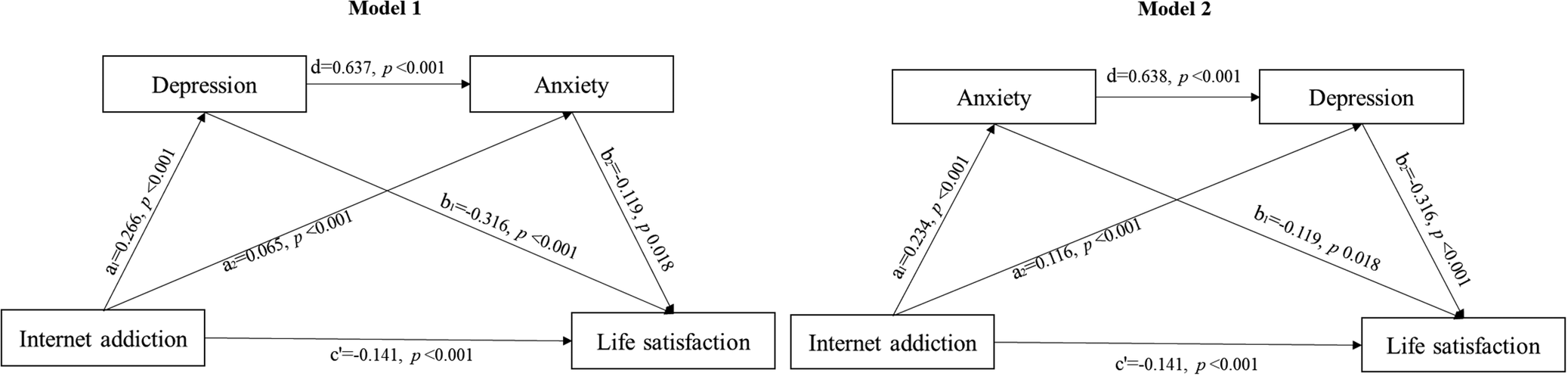
The bootstrap analysis results for the indirect effects are displayed in Supplementary Table 5, while Figure 4 presents the coefficients and their significance levels for each mediation pathway. In Model 1 (where depression preceded anxiety), the indirect effects of depression alone (b = −0.084, 95% CI [−0.114, −0.054]), anxiety alone (b = −0.008, 95% CI [−0.016, −0.001]) and the sequential path through depression and then anxiety (b = −0.020, 95% CI [−0.038, −0.002]) were all significant. In model 2 (where anxiety precedes depression), the indirect effects through anxiety alone (b = −0.028, 95% CI [−0.053, −0.003]), depression alone (b = −0.037, 95% CI [0.052, −0.023]) and the sequential path through anxiety and then depression (b = −0.047, 95% CI [−0.065, −0.029]) were all significant. Both serial mediation models support the mediational Hypothesis 4. Depression and anxiety both play a serial mediating role in the relationship between internet addiction and LS, indicating that excessive internet use may first contribute to increased depression or anxiety symptoms, ultimately leading to a decline in the overall LS.
Serial mediation model – the effect of internet addiction on life satisfaction via depression and anxiety. The serial mediation model included the Model 1 pathway internet addiction → depression → anxiety → life satisfaction and the Model 2 pathway addiction → anxiety → depression →life satisfaction. Numbers associated with a, b, c and d are unstandardized regression coefficients.

Figure 4. Long description
The image contains two panels labeled Model 1 and Model 2. Both models use Internet addiction as the starting point on the bottom-left and Life satisfaction as the endpoint on the bottom-right.
Model 1:
- A direct arrow from Internet addiction to Life satisfaction has a coefficient c prime = -0.141, p < 0.001.
- An arrow points up to Depression (a sub 1 = 0.266, p < 0.001).
- From Depression, an arrow points right to Anxiety (d = 0.637, p < 0.001) and another points down to Life satisfaction (b sub 1 = -0.316, p < 0.001).
- From Internet addiction, an arrow points diagonally to Anxiety (a sub 2 = 0.065, p < 0.001).
- From Anxiety, an arrow points down to Life satisfaction (b sub 2 = -0.119, p 0.018).
Model 2:
- The direct path from Internet addiction to Life satisfaction remains c prime = -0.141, p < 0.001.
- The top boxes are swapped. An arrow points up to Anxiety (a sub 1 = 0.234, p < 0.001).
- From Anxiety, an arrow points right to Depression (d = 0.638, p < 0.001) and another points down to Life satisfaction (b sub 1 = -0.119, p 0.018).
- From Internet addiction, an arrow points diagonally to Depression (a sub 2 = 0.116, p < 0.001).
- From Depression, an arrow points down to Life satisfaction (b sub 2 = -0.316, p < 0.001).
Discussion
This study aimed to elucidate the complex interplay between internet addiction, mental health and LS among Indian university students in the post-pandemic context, through simple, parallel and serial mediation analyses. The descriptive results showed a prevalence of 19.1% for depression, 19% for anxiety and 17.1% for problematic internet use. The parallel mediation analysis showed that both depression and anxiety partly explain the link between internet addiction and lower LS, with depression having a stronger influence. The serial mediation results further suggested a linked pattern of psychological distress through which problematic internet use is associated with lower LS.
In the present study, the prevalence of depression (19.1%) and anxiety (19%) fell within the lower range of estimates reported among the Indian college going populations. Several primary studies from India have reported comparatively higher rates. For example, Deb et al. (Reference Deb, Banu, Thomas, Vardhan, Rao and Khawaja2016) found that 37.7% of students exhibited moderate depression, while Kumar et al. (Reference Kumar, Jain and Hegde2012) reported an overall depression prevalence of 71.25% (Kumar et al., Reference Kumar, Jain and Hegde2012; Deb et al., Reference Deb, Banu, Thomas, Vardhan, Rao and Khawaja2016). Similarly, Shah and Pol (Reference Shah and Pol2020) identified depression and anxiety in approximately 48% and 50% of students, respectively, and Suresh and Dar (Reference Suresh and Dar2025) reported moderate to high levels of anxiety and depression in nearly two-thirds of their sample (Shah and Pol, Reference Shah and Pol2020; Suresh and Dar, Reference Suresh and Dar2025). Although these figures appear notably higher than those observed in our sample, such differences must be interpreted considering the substantial methodological heterogeneity documented in the literature. Systematic and umbrella reviews consistently demonstrate that prevalence estimates for depression and anxiety among university students vary widely, often ranging from 10 to 85% for depression and 7 to 55% for anxiety (Ibrahim et al., Reference Ibrahim, Kelly, Adams and Glazebrook2013; Li et al., Reference Li, Zhao, Chen, Peng and Lu2022; Ahmed et al., Reference Ahmed, Hazell, Edwards, Glazebrook and Davies2023; Tan et al., Reference Tan, Soh, Hartanto, Goh and Majeed2023). This variability is attributed to differences in study design, sampling strategies, population characteristics and the mental health instruments and cut-off thresholds used across studies. Many Indian studies rely on scales such as BDI, DASS-21, or PHQ-9 with varying operational definitions, which can substantially influence prevalence estimates. Thus, the comparatively lower prevalence rates in our study likely reflect methodological distinctions rather than true differences in underlying mental health burden.
Our observed problematic internet use prevalence is consistent with several broader Indian estimates. For instance, a systematic review and meta-analysis covering 19 states of India reported 21.5% prevalence of internet addiction using the Young’s Internet Addiction Test (Y-IAT) (Joseph et al., Reference Joseph, Varghese, Vr, Dhandapani, Grover, Sharma, Khakha, Mann and Varkey2021). In another systematic review and meta-analysis of internet addiction in India, Tadpatrikar et al. (Reference Tadpatrikar, Sharma, Amudhan and Desai2024) found that the pooled prevalence for mild, moderate, severe internet addiction assessed on (Y-IAT) was 36.33%, 18.04%, 0.88%, respectively (Young, Reference Young1998; Tadpatrikar et al., Reference Tadpatrikar, Sharma, Amudhan and Desai2024). The global estimates reinforce these findings. A systematic review by Cheng and Li (Reference Cheng and Li2014), based on 31 nations, estimated global internet addiction prevalence at 6%, with higher rates in East & South-east Asia, while Pan et al. (Reference Pan, Y- and Lin2020) found global pooled prevalence rates ranging from 7–27%, depending on study quality and assessment tool (Cheng and Li, Reference Cheng and Li2014; Pan et al., Reference Pan, Y- and Lin2020).
Consistent with prior literature, our study finds that internet addiction is positively associated with depression and anxiety (see Tables 2 and 3 in the Supplementary Material). These associations mirror the patterns documented in Indian and international samples (Elhai et al., Reference Elhai, Dvorak, Levine and Hall2017; Saikia et al., Reference Saikia, Das, Barman and Bharali2019; Keles et al., Reference Keles, McCrae and Grealish2020; Ye et al., Reference Ye, Zhang and Zhao2023; Kumar et al., Reference Kumar, Goel and Mehra2024; Zhang et al., Reference Zhang, Wang, Zhang and Chi2024). It is well known that anxiety and depressive symptoms frequently co-occur. Together, these findings provide consistent evidence that mood disturbances are closely associated with excessive internet use across diverse cultural and age contexts. The inverse relationship between internet addiction and LS observed in these data aligns with findings from Longstreet and Brooks (Reference Longstreet and Brooks2017) who observed that high internet engagement was associated with poorer well-being (Longstreet and Brooks, Reference Longstreet and Brooks2017). These correlations establish a pattern in which problematic internet use and negative effects reinforce one another, producing lower LS outcomes.
While prior research has documented the coexistence of problematic internet use with depressive and anxious symptoms, much of this work focuses on associations rather than the mechanisms that link internet use to broader well-being outcomes (Elhai et al., Reference Elhai, Dvorak, Levine and Hall2017; Keles et al., Reference Keles, McCrae and Grealish2020; Ye et al., Reference Ye, Zhang and Zhao2023; Zhang et al., Reference Zhang, Wang, Zhang and Chi2024). In the Indian context especially, the psychological pathways connecting internet addiction to LS remain underexplored. By examining depression and anxiety as mediators in both parallel and serial models, our study contributes novel evidence on how these emotional symptoms help explain the detrimental impact of internet addiction on LS. Our simple mediation analysis indicated that depression and anxiety partially mediate the relationship between internet addiction and lower LS. This means that a part, but not all, of the detrimental effect of internet use operates through these mental-health pathways. In parallel mediation models, each mental health variable served as a distinct explanatory pathway with depression exerting a stronger influence than anxiety. This is particularly important because it suggests that depression may serve as a more central mechanism linking problematic internet use to reduced LS. The stronger mediating role of depression could be attributed to its pervasive impact on an individual’s cognitive, emotional and behavioural functioning. Depression often leads to anhedonia (loss of pleasure), reduced motivation, feelings of hopelessness and withdrawal from social activities. These symptoms directly interfere with various life domains that contribute to overall LS, such as academic performance, social relationships and personal goals. While internet addiction can exacerbate anxiety, leading to reduced LS, depression’s more profound and holistic influence on an individual’s perception of their life circumstances appears to exert a more substantial mediating effect in this context. It is plausible that stress and negative life events contribute to drawing individuals to internet behaviours, which then maintain anxiety. However, anxiety can function as both a cause and a consequence.
Our serial mediation models further revealed complex chain effects, indicating a dynamic interplay among mental health problems. We explored two sequential pathways:
Model 1: Higher internet addiction scores were associated with higher depression scores, which were in turn associated with higher anxiety scores and lower LS. In this model, the sequential path through depression and then anxiety [b = − 0.020, 95% CI (− 0.038, −0.002)] was significant. Model 2: Higher internet addiction scores were associated with higher anxiety scores, which were in turn associated with higher depression scores and lower LS. Here, the sequential path through anxiety and then depression [b = − 0.047, 95% CI (− 0.065, −0.029)] was also significant. Consistent with the I-PACE model presented in the introduction (Figure 1), our findings suggest that the relationship between internet addiction and lower LS is partially explained by affective processes. In the parallel mediation analyses, both depression and anxiety independently mediated the association, supporting the proposition that emotional distress represents an important mechanism linking problematic internet use with diminished well-being. Depression emerged as the stronger mediator, suggesting that depressive symptoms may be particularly salient in explaining reductions in LS among individuals with greater internet addiction. The serial mediation analyses further extend the I-PACE framework by demonstrating that depression and anxiety function as interconnected rather than isolated affective processes. Significant indirect effects were observed for both sequential pathways, indicating that internet addiction may contribute to a broader cascade of psychological distress that ultimately undermines LS.
These results suggest that problematic internet use is statistically associated with interconnected depressive or anxious symptoms, which may collectively contribute to a decline in LS. This highlights that mental health problems are not merely independent effects but rather engage in dynamic interplay, forming complex pathways through which internet addiction can undermine well-being. The cross-sectional design limits our understanding of the direction of this interconnectedness in the present study, but the findings highlight the need for integrated intervention approaches in youth mental health service delivery in university settings. In educational institutions, this could involve incorporating routine screening for problematic internet use, depression and anxiety into existing student mental health services, with stepped or coordinated support according to students’ identified needs. Interventions targeting problematic internet use may therefore benefit from incorporating components that identify and address co-occurring depression and anxiety, rather than focusing on internet use in isolation. Conversely, students presenting with depressive or anxiety symptoms could also be assessed for problematic internet use as part of a broader, integrated mental health assessment. LS may additionally provide a relevant outcome for evaluating whether such integrated approaches are associated with improvements in students’ broader well-being.
The findings of this study have several practical implications for university-based mental health services. Universities could integrate early screening & identification, counselling programmes, digital well-being and psychoeducation on healthy internet use into existing student wellness programmes. Confidential screening for problematic internet use, depressive symptoms and anxiety symptoms could support early identification and referral to campus counselling or other appropriate mental health services. University programmes could also strengthen coping skills and peer and social support, alongside accessible psychosocial support for students experiencing psychological distress. Such integrated approaches may help universities address problematic internet use alongside associated mental health concerns rather than treating these concerns in isolation. LS may also be considered as a broader indicator of student well-being when evaluating such programmes. This study is subject to several limitations that warrant consideration: the cross-sectional design prevents the inference of causality and the determination of temporal order, meaning we cannot confirm if internet addiction leads to psychological distress or vice versa; it is plausible that pre-existing depressive or anxious symptoms increase internet use among individuals as they use it as a coping mechanism. The findings should be interpreted within the post COVID-19 educational and psychosocial contexts in which the survey was conducted. Students assessed were likely navigating the after-effects of prolonged educational disruption, increased reliance on digital platforms for learning and social connection, academic uncertainty and altered peer and family interactions. The observed correlations between internet addiction, anxiety and lower LS may be due to the convergence of these post pandemic effects. All primary constructs were assessed using self-report questionnaires administered within the same survey, creating potential for common method variance and social desirability bias. A formal statistical assessment of common method variance was not conducted; therefore, the possibility that shared measurement method contributed to the observed associations cannot be excluded. The use of anonymous and confidential responses may have reduced social desirability pressures but does not eliminate this limitation. The sample was also skewed towards male students, which may have influenced prevalence estimates and the interpretation of psychosocial patterns. The assessment scales were not culturally or linguistically adjusted for the Indian context, potentially introducing bias and the reliance on self-reported assessments may lead to social desirability effects. Additionally, exact participant ages were not recorded and the use of purposive (convenience) sampling from only three colleges limits the generalizability and external validity of our findings beyond the participating colleges. The use of anonymous and confidential responses may have reduced social desirability pressures, but does not eliminate this limitation. Future longitudinal and prospective research is needed to establish temporal ordering and verify the proposed mediation pathways are sustained over time. Such studies should account for additional variables such as personality traits, academic stress, sleep quality, family functioning and social support.
Conclusion
This study significantly contributes to understanding the complex relationship between internet addiction, mental health and LS among Indian university students in the post-pandemic era. Depression and anxiety were found to independently and jointly mediate the negative impact of problematic internet use on LS, with depression emerging as the stronger mediator. The serial mediation models further suggest dynamic chain effects through which problematic internet use may initiate or exacerbate emotional difficulties that collectively diminish well-being. These findings highlight the importance of integrated mental health interventions within higher education settings that combine digital well-being promotion, early identification of psychological distress and accessible psychosocial support. The study provides localized evidence to inform culturally sensitive interventions and highlights the importance of longitudinal research to establish causality and further clarify these mechanisms.
Open peer review
To view the open peer review materials for this article, please visit http://doi.org/10.1017/gmh.2026.10336.
Supplementary material
The supplementary material for this article can be found at http://doi.org/10.1017/gmh.2026.10336.
Acknowledgements
The authors would like to thank all the participants for their time and willingness to contribute to this study. We are also grateful to the academic institutions and administrative staff who facilitated data collection.
AI statement
The authors declare they have used AI tools (ChatGPT, GPT-5.5) for creating Figure 1, language edits, sentence brevity and spelling/grammar checks.
Author contributions
Na.R., A.A. and H.D. conceptualized, designed and implemented the study with students from Indian universities. Na.R. was responsible for data collection and Ni.R., and A.L. conducted detailed data analysis. M.K. provided advisory support throughout the data analysis. All authors contributed to drafting the manuscript. S.P. contributed to editing and proofreading of the manuscript. All authors reviewed and approved the final version of the manuscript.
Competing interests
The authors declare they have no conflict of interest.
Data availability statement
The data that support the findings of this study will be shared upon reasonable request by the corresponding author due to privacy restriction.
Ethics and approvals
This study was conducted in accordance with India’s National Ethical Guidelines for Biomedical and Health Research involving Human Participants. Ethical approval was obtained from the Ethics Committee of Parivartan Trust (Reference: PIEC/INST/2024/0003). Recruitment followed ethical protocols, including a pre-assessment group briefing outlining the study objectives, voluntary participation, confidentiality and assurance of no impact on academic outcomes. Informed written consent was obtained from all participants before the assessment.
Funding statement
The study received no funding support.






 Open access

