This article will address why some German Land constitutions have been changed more frequently than others, despite the fact that all Länder are part of the same multilayered system, act in the same legal framework and share similar historical, economic and cultural conditions. I will try to answer this question by examining necessary and sufficient conditions that are alleged to influence the frequency and scope of amendments to German Land constitutions. At the same time, I will explore new methodological territory by applying fuzzy-set qualitative comparative analysis (fsQCA) to the study of constitutional policy in the German Länder. Even though qualitative comparative analysis has become increasingly popular in political science over the past two decades (Berg-Schlosser et al. Reference Berg-Schlosser, DeMeur, Rihoux and Ragin2009; Legewie Reference Legewie2013; Ragin Reference Ragin1987; Rihoux et al. Reference Rihoux, Álamos-Concha, Bol, Marx and Rezsöhazy2013; Schneider and Wagemann Reference Schneider and Wagemann2007), there has not yet been a study that has used this tool to explain the changeableness of constitutions. This method is not only ‘new to law’ in general (Arvind and Stirton Reference Arvind and Stirton2010: 3) but new to the study of constitutional policy in particular. Following on from Arvind and Stirton’s (Reference Arvind and Stirton2010) study on the reception of the Code Napoleon in Germany, I will use my research question to ‘showcase this method [fsQCA] and demonstrate its power as a tool to assist research into questions of this type’ (Arvind and Stirton Reference Arvind and Stirton2010: 3). I include all 271 amendments and all 1,183 articles that have been added, deleted or changed between 1946 and 2014.
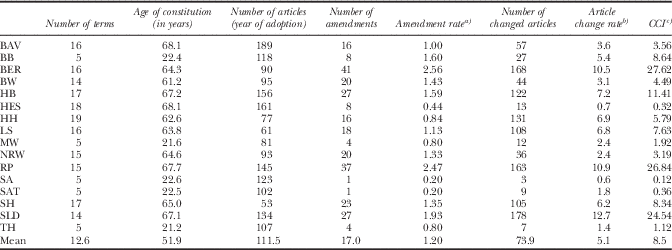
The article will be structured as follows: first, I will review existing approaches that try to explain the frequency and scope of constitutional amendments. Second, using fuzzy-set qualitative comparative analysis, I will analyse the causes of constitutional changeableness by creating a Constitutional Changeableness Index (CCI). I compute this measure by multiplying the number of amendments per term by the number of changed articles per term (Table 1). The findings show that many factors highlighted in seminal studies on constitutional change fail to explain satisfactorily the number and scope of constitutional amendments in the German Länder. Finally, based on theoretical reflections and empirical findings, I will draw some tentative conclusions.
Features of German Land Constitutions (as of December 2014)

Source: My compilation based on Pestalozza (Reference Pestalozza2014b); www.verfassungen.de; websites of Land parliaments.
Notes: a Number of amendments per term. bNumber of changed articles per term. cCCI=Constitutional Changeableness Index=amendment rate multiplied by article change rate.
Abbreviations: BAV=Bavaria; BB=Brandenburg; BER=Berlin; BW=Baden-Württemberg; HB=Bremen; HES=Hesse; HH=Hamburg; LS=Lower Saxony; MW=Mecklenburg West-Pomerania; NRW=North Rhine-Westphalia; RP=Rhineland-Palatinate; SA=Saxony; SAT=Saxony-Anhalt; SH=Schleswig-Holstein; SLD=Saarland, TH=Thuringia.
EXPLAINING SUBNATIONAL CONSTITUTIONAL CHANGE: A REVIEW OF THE LITERATURE
Political scientists have only recently ‘discovered’ subnational constitutional politics as an empirical topic, whether in Germany or in other countries (Burgess and Tarr Reference Burgess and Tarr2012; Dinan Reference Dinan2012; Flick Reference Flick2008; Lorenz and Reutter Reference Lorenz and Reutter2012; Reutter Reference Reutter2015a, Reference Reutter2015b; Reutter and Lorenz Reference Reutter and Lorenz2016: 103; Williams and Tarr Reference Williams and Tarr2004). This limited consideration might be due to the widespread view that German Land constitutions are under the ‘shadow of the Basic Law’ (Möstl Reference Möstl2005: 354; Pestalozza Reference Pestalozza2014a). However, according to Reutter and Lorenz (Reference Reutter and Lorenz2016: 112), amendments to German Land constitutions were not ‘just effects or corollaries of the national “superconstitution” but reflected regional needs and wishes’. In fact, on average German Land constitutions have been altered at least once per legislative term. Furthermore, many amendments addressed important issues. For example, some amendments were adopted in order ‘to “constitutionalize” crucial policy matters’ (e.g. environmental policies), other amendments were supposed ‘to rebalance the power between the executive and the legislative branches of government’ (by strengthening the role of Land parliaments), and again others dealt with subnational effects of European integration (Reutter and Lorenz Reference Reutter and Lorenz2016: 109–12). Overall, the changes underscore the increasing relevance of subnational constitutions and point to the aforementioned question of why some Land constitutions have been changed more frequently than others. From research on both national and subnational constitutional change, I distinguish between structural, institutionalist and actor-centred approaches that tackle issues related to this question (Contiades and Fotiadou Reference Contiades and Fotiadou2013; Lorenz Reference Lorenz2008: 28–35).
Structural approaches explain the frequency, scope and content of amendments to constitutions with exogenous factors.Footnote 1 In this category there is a wide range of theories, including historical, sociological and cultural explanations (Busch Reference Busch2006; Loewenstein Reference Loewenstein1961; Tarr Reference Tarr2000: 55–6; Tarr Reference Tarr2014). An alternative structural approach used in this article links the type of democracy to constitutional policy. For example, Manfred G. Schmidt’s (Reference Schmidt2011: 319–33) analysis of amendments to the Basic Law proved consensus-oriented politics to be crucial for constitutional change. Schmidt (Reference Schmidt2008) even sees decisions requiring a two-thirds majority as a defining element for the German Grand Coalition state or German consensus democracy.
Institutionalist concepts refer to inherent factors. In this perspective, the changeableness of constitutions is due to features of these constitutions (Ferejohn Reference Ferejohn1997; Flick Reference Flick2008; Lorenz Reference Lorenz2008: 28–36; Lutz Reference Lutz1994; Reutter Reference Reutter2008; Reutter and Lorenz Reference Reutter and Lorenz2016: 105–6; Roberts Reference Roberts2009). In essence, such studies hypothesize that the length, age and/or rigidity of constitutions should have an impact on the number and scope of amendments. For example, longer constitutions have more provisions and these provisions are more detailed. Such constitutional stipulations are prone to trigger more adjustments. A similar mechanism seems to work with regard to the age of constitutions. Older constitutions need more adjustment to function in an environment that was not envisaged when the constitution was adopted. Finally, rigidity refers to the formal hurdles an amendment has to overcome. These hurdles are laid down in the constitution. In consequence, the higher these hurdles, the fewer amendments there should be, all else being equal. There are several studies that have produced inconclusive results when attempting to confirm such hypotheses (Ferejohn Reference Ferejohn1997; Flick Reference Flick2008; Lorenz Reference Lorenz2008: 354–9; Lutz Reference Lutz1994; Roberts Reference Roberts2009; Tarr Reference Tarr2000).
A third school of thought tries to shed light on some blind spots of institutionalist and structural theories that grant actors only limited influence. In other words, this approach questions whether parties matter in constitutional policy. Evidently, parties are crucial actors in parliamentary democracies, and some argue that they are also important in constitutional policy (Lorenz Reference Lorenz2008; Reutter Reference Reutter2014, Reference Reutter2015a, Reference Reutter2015b; Reutter and Lorenz Reference Reutter and Lorenz2016; Tarr Reference Tarr2014). Two assumptions are relevant in this respect. First, Contiades and Fotiadou (Reference Contiades and Fotiadou2013: 426) hypothesize that party-system models ‘have great impact on constitutional change’. In this perspective, the fragmentation of the party system predetermines which and how many parties have to agree. The same rationale can be applied to the changeableness of constitutions. It seems evident that the higher the number of parties in parliament, the more difficult it should be to muster the required supermajority. Second, the political denomination of parties might play a role. It might be important whether right or left of centre parties have a majority in parliament. As a rule, left-wing parties tend to endorse more encompassing constitutions than right-wing ones (Beutler Reference Beutler1977; Reutter and Lorenz Reference Reutter and Lorenz2016).
The review of existing literature has highlighted a variety of theories and factors. In addition, the studies differ in their research designs, in their methodology and the data they use (Hirschl Reference Hirschl2005; Lorenz Reference Lorenz2008). Yet, one can still summarize that there seems no clear-cut answer to the research question at hand. Each approach can claim to explain at least partly the frequency and scope of constitutional changes. Hence, I have still to arrive at an understanding of which factors were actually operating in the decisions to adopt or reject amendments to German Land constitutions. Fuzzy-set qualitative comparative analysis provides a methodological tool to assess this situation.
FUZZY-SET QUALITATIVE COMPARATIVE ANALYSIS AND SUBNATIONAL CONSTITUTIONAL POLICY: CALIBRATION, CONDITIONS AND FINDINGS
QCA is to be understood as a proper research design (Geddes Reference Geddes2003; Ragin Reference Ragin2000; Rihoux et al. Reference Rihoux, Rezsöhaz and Bol2011: 11–13; Schneider and Wagemann Reference Schneider and Wagemann2007: 19−30). It offers tools that help to decide which cases to select, what evidence is needed and which theoretical approach I wish to corroborate (Berg-Schlosser and De Meur Reference Berg-Schlosser and DeMeur2009; Berg-Schlosser et al. Reference Berg-Schlosser, DeMeur, Rihoux and Ragin2009). Like any other comparative method, QCA tries to bring similarities and differences between cases to the fore in order to identify causal conditions for an outcome (Berg-Schlosser et al. Reference Berg-Schlosser, DeMeur, Rihoux and Ragin2009; Ragin Reference Ragin2009). Furthermore, QCA has two features that make it the ideal method for my study. Firstly, it takes account of the fact that an outcome might have more than a single cause (causal complexity). ‘Causal complexity’ means that a combination of factors can trigger the outcome that we are trying to explain, that different combinations of factors can lead to the same outcome (equifinality), and that the same combination of factors can have different effects (Legewie Reference Legewie2013: 2–3). These features of QCA prevent the use of variables in the same way as in statistics (Berg-Schlosser and De Meur Reference Berg-Schlosser and DeMeur2009; Berg-Schlosser et al. Reference Berg-Schlosser, DeMeur, Rihoux and Ragin2009: 8–9). In QCA, cases are described as configurative conditions that give reasons for the outcome. Secondly, QCA ‘combines detailed within-case analysis and formalized, systematic cross-case comparisons’ (Legewie Reference Legewie2013: 2). This research process is necessarily ‘iterative’ (Arvind and Stirton Reference Arvind and Stirton2010: 19; Legewie Reference Legewie2013: 2) because the researcher has to go back to the data and ‘recalibrate’ configurations of conditions when needed (Berg-Schlosser et al. Reference Berg-Schlosser, DeMeur, Rihoux and Ragin2009: 6–7; Ragin Reference Ragin1987, Reference Ragin2000: 309–34).
In order to comply with the rules and good practices (Schneider and Wagemann Reference Schneider and Wagemann2010; Wagemann and Schneider Reference Wagemann and Schneider2007) that make fsQCA transparent and replicable, I will first describe the outcome and configurations of cases. Second, I will identify the configurations and reduce causal complexity by identifying necessary and sufficient conditions for the outcome. Finally, I will discuss and interpret the results.
Constitutional Changeableness: Calibrating the Outcome
Any analysis using fsQCA begins with the calibration of the outcome (Koole and Vis Reference Koole and Vis2012: 10; Ragin Reference Ragin2000: 149–80; Ragin Reference Ragin2009: 90–3; Schneider and Wagemann Reference Schneider and Wagemann2007: 180–3). Thus, I turn qualitative conditions into quantitative values (Ragin Reference Ragin2000: 181, 200; Ragin Reference Ragin2009: 89–90). In order to determine the degree of membership in a set, I have to define thresholds or ‘qualitative anchors’ (Ragin Reference Ragin2000: 163 and passim). A fuzzy-set score of 1 means full membership in a set, a score of 0 full non-membership, and the cross-over point 0.5 indicates when an outcome is ‘more in’ rather than ‘more out’. The challenge then is to calibrate the outcome in such a way that constitutions can be qualified as ‘changeable’ or ‘non-changeable’.
However, as far as constitutional changeableness is concerned, I lack established criteria to tell me how often and how far a constitution has to be amended (Lutz Reference Lutz1994: 357). In empirical studies, many scholars have created an amendment rate, sometimes combined with an article change rate (Lorenz Reference Lorenz2005, Reference Lorenz2008: 19−27; Lutz Reference Lutz1994; Roberts Reference Roberts2009). These indices are calculated by dividing the number of amendments and/or changed articles by the age of the constitution. Such an empirically created index has two advantages: it makes constitutional changes comparable and takes account of the varying age of constitutions. I make use of this established index, but adapt it to my research design and my research question. My calculation is not based on the age of a constitution, but on the number of terms a Land parliament was able to alter a constitution.Footnote 2 With this index I try to make a better connection between the changeableness of constitutions and political dimensions, whilst continuing to keep the varying age of constitutions in the equation.
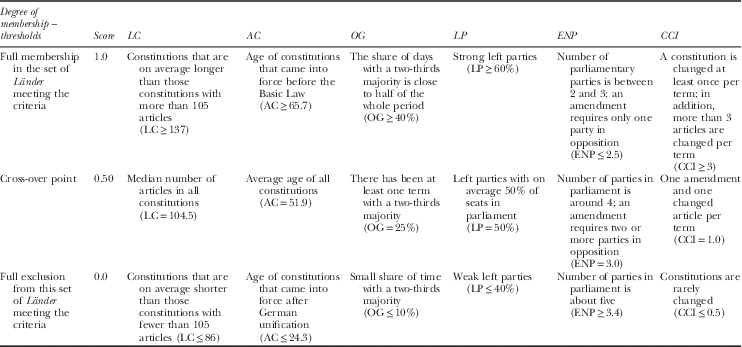
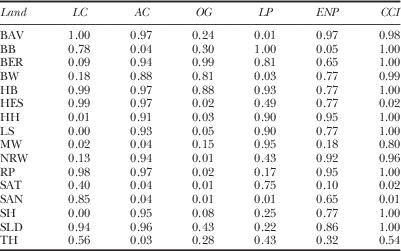
Thus, the defined CCI provides criteria for defining when a constitution is part of the set of changeable constitutions. I assume a constitution to be changeable when each elected parliament has amended at least one article per term. In this case the CCI is 1, which I take as the cross-over point in this set (fsQCA calibrated score=0.5). Länder with a CCI higher than 3 would be regarded as ‘full’ member in the set of changeable constitutions. In this case each elected parliament of a Land has changed at least three articles per term on average. ‘Fully out’ are Länder where the CCI is less than 0.5 because then at least every second elected Land parliament has not amended the constitution. Based on these thresholds I created a continuous fuzzy-set using the fsQCA software 2.5 (Table 4).Footnote 3
Constitutional Changeableness: Configurations of Conditions
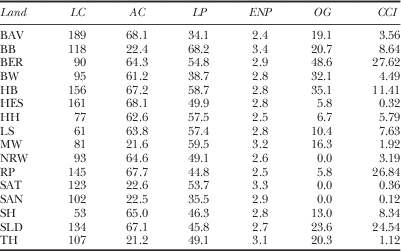
As mentioned previously, QCA describes cases as configurations of conditions that are supposed to be either sufficient and/or necessary for the outcome (Ragin Reference Ragin2000: 64–87, 203–60). In order to determine the degree of membership a case has in each set, I proceeded in the same manner as before. The conditions capture institutionalist aspects (LC and AC), and the impact parties had on the changeableness of constitutions (LP, ENP and OG). Table 2 shows the original data, Table 3 gives a summary of the way I defined the ‘thresholds’ and Table 4 shows the fuzzy-set scores for the conditions. As there is no research referring to fsQCA to study constitutional changeableness, I had to create these conditions as well as the resulting fuzzy-scores from scratch.
Configurational Conditions for the Changeableness of German Land Constitutions

Sources: My calculations; www.elections.de; www.verfassungen.de; Freitag and Vatter (Reference Freitag and Vatter2008: 327).
Notes: LC=Length of constitutions (number of articles in a constitution; year of adoption); AC=age of constitution (in years); LP=strength of left parties; share of seats in parliament (mean of all terms); ENP=number of effective parties (mean of all terms); OG=‘oversized’ governments (governments with a two-thirds majority in parliament (share of days in power) (mean of all terms); CCI=Constitutional Changeableness Index.
Constitutional Changeableness: Thresholds for the Degree of Membership in the Conditions and the Outcome

Fuzzy-set Scores for Configurations of Conditions

Source: My calculation; Ragin and Davey (Reference Ragin and Davey2014).
Length of constitutions (LC)
For Donald S. Lutz (Reference Lutz1994: 358) the length of constitutions is a ‘surrogate measure for all of these other pressures to amend and is a key variable’. This causal link is thought to be due to the fact that longer constitutions tend to contain more provisions and more detailed provisions (Roberts Reference Roberts2009: 100f.). For fsQCA I have to assess when and to what degree a constitution belongs to this set of conditions. However, there are no objective criteria that allow me to determine the ‘optimal’ length of a constitution. When originally put into effect, the length of Land constitutions varied between 189 (Bavaria) and 53 (Schleswig-Holstein). Due to a lack of other criteria, I took the median value (104.5) for all Land constitutions as the cross-over point (score 0.5). Constitutions with fewer than 86 articles will be regarded as ‘fully out’, and constitutions with more than 137 as ‘fully in’.
Age of constitutions (AC)
According to Reutter and Lorenz (Reference Reutter and Lorenz2016: 118), the age of a constitution seems to affect the frequency of amendments. Following up on this finding, I also attempt to find out whether the age of a constitution affects the number and scope of amendments. Once again, there are no established criteria that would allow us to determine a cross-over point. In consequence, I referred to two criteria to define the degree to which constitutions are parts of this set. In order to determine the cross-over point I took the arithmetic means of the ages of all constitutions (score 0.5) and I also used two historical events in German post-war history to determine whether a constitution is ‘fully in’ or ‘fully out’. ‘Fully in’ constitutions are those that are older than the Basic Law, i.e. older than 65.7 years. A Land constitution is ‘fully out’ if it was put into effect after German unification, i.e. if it is younger than 24.3 years.
‘Oversized’ governments (OG)
Reutter and Lorenz (Reference Reutter and Lorenz2016: 117) argue that ruling parties might ‘play a crucial role in constitutional politics’. However, as almost all Land parliaments have to muster a two-thirds majority in order to pass an amendment, I only consider governments as relevant if they can dispose the necessary number of MPs. In most cases this means that grand or oversized coalitions have to be in power (Schniewind Reference Schniewind2008). Yet, there are a few cases when a single party in power could rely on a supermajority of its own and can thus alter a constitution without taking other political veto players into account.Footnote 4 This marks a difference from the national level. In the Länder, divided government is impossible because there is no second chamber. Apart from Saxony, Saxony-Anhalt and North Rhine-Westphalia, all Länder have produced governments that could rely on a supermajority in parliament. I set the cross-over point (0.5) when such governments stayed in power for at least 25 per cent of the time (measured by the share of days), because in this case such a supermajority could have been present for at least one term in each Land. ‘Fully out’ are cases in this set when the share of oversized cabinets is less than 10 per cent, and ‘fully in’ when the share is higher than 40 per cent.
Effective number of parties (ENP)
As indicated, the fragmentation of the party system is supposed to affect the number and scope of constitutional change because the higher the number of effective parties, i.e. the more fragmented a party system is, the more difficult it should be to muster the necessary supermajority (Lorenz Reference Lorenz2008: 70, 77f.; Roberts Reference Roberts2009: 101). Laakso and Taagepera (Reference Laakso and Taagepera1979) developed the most common index for measuring the effective number of parties, taking the relative strength of parties into account. I computed the effective number of parties based on the share of seats in parliament and then calculated the mean value for all terms in each Land. Assuming that constitutional changeableness is higher when there is a low degree of fragmentation, I consider party systems as ‘full’ members in this set if their effective number of parties is less than 2.5. I set the cross-over point (0.5) at 3.0 because then two big and two small parties are needed to muster a two-thirds majority. Party systems are ‘fully out’ when the effective number of parties is on average 3.4 or higher.
Strength of left parties (LP)
In Germany, left-wing parties tend to have a more encompassing constitutional philosophy than conservative and right-of-centre parties (Beutler Reference Beutler1977; Reutter and Lorenz Reference Reutter and Lorenz2016). Leftist parties are more in favour of state interventionist policies, while conservative parties see the role of constitutions in a narrower sense. Hence, I expect that leftist parties will change constitutions more often when they have the chance to do so. In consequence, I have calibrated the varying leverage that left-wing parties have in the Länder. I measured the leverage of leftist parties in this field with the means of share of seats in parliament. Table 2 shows that the mean share of seats for leftist parties in the 16 Land parliaments varies greatly between 34 and 68 per cent. The cross-over point is reached if left-wing parties (the Social Democratic Party (SPD), Greens, Communist Party (KPD), Left Party, Pirates) have on average more than 50 per cent of all seats in parliament. Full membership means that leftist parties have on average more than 60 per cent of all seats in parliament. Non-membership is ascribed to Länder if, on average, left-wing parties could marshal less than 40 per cent of all seats in parliament.
Analysis and Findings
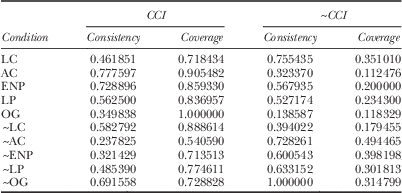
I use QCA to identify necessary and sufficient conditions (or combinations of conditions) for the changeableness of constitutions and conduct the analysis of the data in three steps.Footnote 5 Firstly, as recommended by Schneider and Wagemann (Reference Schneider and Wagemann2007: 197–202) and Ragin (Reference Ragin2000: 203–29), I examined which condition can be qualified as necessary for the outcome (CCI) or the non-outcome (~CCI). Necessary conditions are hard to find. Schneider and Wagemann (Reference Schneider and Wagemann2007: 213) argue that I should have consistency values of at least 0.9 and higher (Koole and Vis Reference Koole and Vis2012: 14). In Table 5, only one condition qualifies as necessary for an outcome: if governments only rarely hold a two-thirds majority, constitutions are also changed rarely or not at all. I find this configuration in Hesse, Saxony and Saxony-Anhalt. In these cases I find perfect consistency but such a low degree of coverage that I cannot infer anything from this finding.
Necessary Conditions for Constitutional Changeability

Note: ~ indicates that the condition or the outcome is absent.
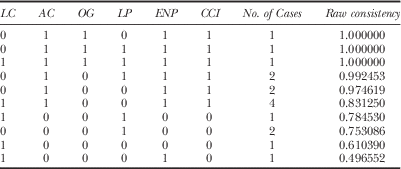
Secondly, I identified the sufficient conditions for the outcome to happen or not to happen. A condition (or a combination thereof) is sufficient if it is in place when the outcome occurs (Ragin Reference Ragin2009: 99). In order to identify these configurations, I have to find out to what extent logically possible combinations of conditions match with empirical cases. In this step the truth table is a vital tool (Koole and Vis Reference Koole and Vis2012: 15). Table 6 reveals that out of 32 logically possible configurations of conditions, 22 failed to match with real cases. These logical cases without empirical correspondence are called ‘logical remainders’. With the software package developed by Charles Ragin and others, I can further reduce the number of configurations of conditions to less complex ones (Ragin Reference Ragin2000: 107−15) by defining the level of consistency. In my analysis I set the cut-off at 0.8, which is the default value provided by the software package. According to Table 6, this produces six configurations with a consistency that is sufficiently high. Four configurations trigger consistencies well below 0.8. Hence, these configurations of conditions cannot be qualified as sufficient for the outcome.
Constitutional Changeableness: Truth Table

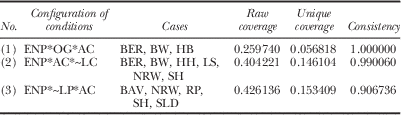
For the analysis it is crucial to consider how the ‘logical remainders’ are dealt with. The software package offers three types of solution: logical remainders can either be ignored (‘complex solution’), all included (‘parsimonious solution’) or used selectively (‘intermediate solution’) (Maggetti and Levi-Faur Reference Maggetti and Levi-Faur2013: 200; Ragin Reference Ragin2009: 111). Though there is some argument that all three solutions should be presented (Maggetti and Levi-Faur Reference Maggetti and Levi-Faur2013: 200; Schneider and Wagemann Reference Schneider and Wagemann2013), I followed Ragin (Reference Ragin2009: 111), who believes the intermediate solution to be ‘superior’ (Grassi and Luppi Reference Grassi and Luppi2014: 9–10; Ragin Reference Ragin2009: 111).Footnote 6 Hence, Table 7 only presents the findings of the intermediate solution. In the intermediate solutions some assumptions have to be made. Only ‘those simplifying assumptions are included that are in line with theory-driven directional expectations’ (Schneider and Wagemann Reference Schneider and Wagemann2013: 211). Due to the relevance of consensual policymaking, I decided that solutions are only relevant when OG was present as cause, while all other variables can be either present or absent.
Intermediate Solution: Sufficiency Conditions for Constitutional Changeableness

Note: Solution coverage: 0.669643; solution consistency: 0.938567.
Table 7 has three configurations:
∙ The first configuration applies to Baden-Württemberg, Bremen and Berlin. All three Länder have a low number of effective parties (ENP), a large share of oversized governments with a two-thirds majority (OG) and old constitutions (AC). The solution shows perfect consistency but could explain just 25 per cent of the cases (raw coverage), while even less of the outcome was explained by this solution alone (unique coverage of 0.6). In addition, all three Länder have changed their constitutions frequently and to large but still varying degrees.
∙ The second configuration leads to a consistency of 0.99; it covers 40 per cent of the cases and alone explains 14 per cent of the outcome. It explains the constitutional changeableness of six Länder: Baden-Württemberg, Berlin, Hamburg, North Rhine-Westphalia, Lower Saxony and Schleswig-Holstein. With the first solution these cases have two conditions in common: a similar number of effective parties (ENP) and the age (AC). However, constitutional changeableness is triggered in these cases when long constitutions were absent (~LC). Similarly, oversized governments and thus a striking feature of the Grand Coalition state did not impact on constitutional changeableness in these cases.
∙ The third configuration has the lowest degree of consistency (0.91). It explains 42 per cent of the outcome, but only 15 per cent is explained by this solution alone. The cases that fit with these conditions are: Bavaria, Rhineland-Palatinate, Saarland, Schleswig-Holstein and North Rhine-Westphalia. These Länder only have few effective parties (ENP), weak leftist parties (~LP) and old constitutions (AC). However, it should be pointed out that in North Rhine-Westphalia and Schleswig-Holstein, leftist parties only just fail to be ‘in’ rather than ‘out’ in this set of conditions. In addition, Hesse is a contradictory case. It shows the same configuration of conditions as the Länder just mentioned but its CCI is ‘fully out’. This might be due to the fact that every amendment to the constitution in Hesse requires a popular referendum. In addition, only those amendments are legal which change the wording of the constitution or add another article. These are very high and restrictive requirements that might have contributed to the low number of adopted amendments even though there have been the same conditions as in the aforementioned five Länder.
Wagemann and Schneider (Reference Wagemann and Schneider2007: 26) recommend that one should also analyse the negation of the outcome, even though the theories above do not include hypotheses on the non-occurrence of the outcome. Yet, an analysis of negative cases can still ‘generate substantively interesting insights in their own right’ (Wagemann and Schneider Reference Wagemann and Schneider2007: 26; cf. also Koole and Vis Reference Koole and Vis2012: 18). However, this option does not apply to my case. As mentioned previously, there is no condition whose absence is necessary in order to trigger the non-occurrence of the outcome. Theoretically, this challenges the theory of German consensus democracy. In addition, just one configuration of conditions looks sufficient for low changeableness. However, the solution (ENP*~LP*~OG*~AC*LC) shows a consistency rate of 0.82, but such a low coverage (0.32) that I cannot draw any further conclusions from this finding.
Interpretation of the Results
My third step is to interpret the findings because thus far I have only tried to compare the cases in a logical and systematic fashion in order to identify sufficient and necessary conditions. It should be noted that QCA does not claim that the relationships between sets and subsets are causal links. Such arguments can only be sustained if the findings can be linked to theoretically developed assumptions (Arvind and Stirton Reference Arvind and Stirton2010: 29). This makes the third step a crucial one for the analysis.
My analysis provided several insights into the question of why the changeableness of constitutions in the German Länder might vary. Firstly, none of the paths or solutions described in Tables 5 and 6 is necessary and sufficient at the same time. Three solutions could explain the outcome (causal complexity). Each solution is theoretically relevant regardless of the number of cases explained by a single solution (Berg-Schlosser et al. Reference Berg-Schlosser, DeMeur, Rihoux and Ragin2009: 9). Secondly, some cases figured in two solutions (BW, BER, SH and NRW). In conclusion, this means that different paths can lead to the same goal (equifinality). Thirdly, the analysis highlighted that none of the factors stressed in studies on constitutional change can alone explain the changeableness of constitutions in the German Länder. It was always a combination of conditions that were sufficient for the outcome, which corroborates the findings of Reutter and Lorenz (Reference Reutter and Lorenz2016). Importantly, neither long constitutions nor a strong history of two-thirds majorities seems to be sufficient to explain the outcome. Fourthly, the overall coverage value of 0.63 is not very impressive. It is, hence, up to future research to either include more conditions into the analysis or refine the calibration of the conditions.
Fifthly, two conditions turned out to be crucial: the age of a constitution and a low number of effective parties, which is a defining element of majoritarian democracy. In consequence, I regard these conditions as core conditions. This corroborates only partly the findings of Reutter and Lorenz (Reference Reutter and Lorenz2016). While Reutter and Lorenz (Reference Reutter and Lorenz2016: 119) found a higher number of effective parties to ‘be causally linked to frequent changes’, my analysis stressed the fact that party systems with on average less than 2.5 parties seem to be linked to the changeableness of constitutions. However, similar to Reutter and Lorenz (Reference Reutter and Lorenz2016: 120), the present analysis proves age, too, to be a core condition to explain the changeableness of constitutions.
CONCLUSIONS: CONSTITUTIONAL CHANGEABLENESS, fsQCA AND FUTURE RESEARCH
In this article I have tried both to solve an empirical question and to introduce a new methodological tool to the study of subnational constitutional policy. The empirical dimension refers to the fact that the German Länder enjoy the same degree of autonomy with regard to constitutional policy but change their constitutions in more or less far-reaching ways. This finding triggers the ‘really interesting inquiry’, which is ‘explaining the reasons for the differences among subnational constitutions – that is, why subnational units have made more or less use of the constitutional space available to them’ (Williams and Tarr Reference Williams and Tarr2004: 12). Thus, one goal of the article has been to provide an answer to the question of why some Land constitutions have been altered more often than others in spite of the fact that they are all part of the same multilayered system and the same legal framework (Gunlicks Reference Gunlicks2003: 141–62; Pestalozza Reference Pestalozza2014a). At the same time, by applying QCA to the study of constitutional policy, I explored new methodological territory. QCA is not limited to analysing and comparing cases, but its ultimate goal is to come to ‘modest generalizations’ (Berg-Schlosser et al. Reference Berg-Schlosser, DeMeur, Rihoux and Ragin2009: 11−12).
It bears noting, though, that Reutter and Lorenz (Reference Reutter and Lorenz2016) come to partly different conclusions. Their analysis corroborated the hypothesis that the more fragmented a party system has been in a Land the more often the constitution has been altered. In addition, they found strong evidence for the hypothesis that a high number of parties and a low degree of rigidity affected the number of changes. At the same time they also failed to corroborate that strong left parties trigger more amendments. However, in their study, Reutter and Lorenz use a different method (linear regression analysis instead of QCA), explain a different outcome (the number of amendments instead of number and scope of amendments) and refer to different empirical data (term values instead of mean values). Nonetheless, in spite of these differences, I can draw similar theoretical conclusions based on my analysis.
Firstly, as Reutter and Lorenz (Reference Reutter and Lorenz2016: 120–2) highlight, I must also conclude that it does not seem enough to refer to Germany as a Grand Coalition state if I want to explain the frequency and scope of constitutional amendments. On the contrary, limiting the analysis to the institutional set-up of the political system and the need to find a consensus in intertwined structures seems to be methodologically and empirically flawed. Such an understanding ignores the Länder level and limits the analysis to just one crucial variable. However, my findings indicate that grand decisions in the Länder can occur without the institutional structure found at the federal level. In addition, the German multilayered system seems to be more complex than many take for granted. In any case, the analysis of subnational constitutional policy demonstrated that Länder enjoy a large degree of autonomy in this area. This confirms the notion that German federalism is dynamic and flexible (Benz Reference Benz1985) and that the ‘conventional paradigm of German federalism as a highly integrated system geared to broadly common outcomes appears inappropriate or at least insufficient’ (Jeffery et al. Reference Jeffery, Pamphilis, Rowe and Turner2014: 1361). In other words, in Germany I can explain variations at the Länder level only if I take subnational factors into account.
Secondly, due to the required supermajority, many see constitutional policy as a prime example of Germany as a consensus democracy or as a ‘state which embodies high “dispersal of power”’ and thus privileges bargaining and compromise as modes of conflict resolution (Schmidt Reference Schmidt2008: 79; cf. also Katzenstein Reference Katzenstein1987; Schmidt Reference Schmidt1987). In this perspective, decisions requiring a two-thirds majority necessarily strengthen ‘the consensus democracy component and the Grand Coalition component in Germany’s polity’ (Schmidt Reference Schmidt2008: 72; cf. also: Lijphart Reference Lijphart1999; Reutter Reference Reutter2010). It goes without saying that this captures many important aspects. However, it would be misleading to assume that party politics is of no relevance in this area. On the contrary, the fact that a low number of effective parties seems to be a core condition for constitutional changeableness moves constitutional policy closer to majoritarian policymaking and to ‘normal politics’ (Busch Reference Busch2006; Tarr Reference Tarr2014). The ‘unique combination of majoritarian and consensus democracy’ (Schmidt Reference Schmidt2008: 87) which is assumed to be typical of the German Grand Coalition state seems to be a striking feature in this policy area in particular. Furthermore, the analysis suggests that the German Grand Coalition state and German consensus democracy seem to capture different aspects of German policymaking. In other words, consensual policymaking seems to work differently in the Länder. At least based on the analysis, ‘oversized governments’ including Grand Coalitions were neither sufficient nor necessary for frequent constitutional changes.
Finally, this is the first time that fsQCA has been used as a tool to analyse constitutional policy in the German Länder. Of course, this creates new challenges and leaves some loose ends to tie up. Notably, the question of which conditions I should include in an analysis and the calibration of these conditions have to be improved and refined. However, fsQCA has helped to ‘uncover complex patterns of factors that might otherwise have eluded’ the researcher’s eye (Arvind and Stirton Reference Arvind and Stirton2010: 19). More importantly, with this study I hope to redirect research on comparative legislative studies in general and on comparative constitutional politics in particular.
Acknowledgements
I am grateful to two anonymous reviewers and Astrid Lorenz who commented on an earlier version of this article. The usual disclaimer applies, of course. The research is funded by the Deutsche Forschungsgemeinschaft (grant no. GZ: LO 1424/3-1; AOBJ: 604048).