


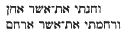
 in Exodus 3:14” in
 is not meant to be a proper name in the idem per idem, it is a proper name here; cf. Arnold, “The Divine Name in Exodus iii. 14,” 124.
 (Yahweh) was forgotton (
 in vv 12, 14 and 4; 12,15.
 “I will be present” and recognizes that it has the same meaning in 3:12, 14; 4; 12,15. The idem per idem for him is “only a more emphatic affirmation of this assurance” meaning “I will indeed be present.” Brevard Childs also notes the four occurrences of
 in chaps. 3 and 4 and says they provide for “thematic unity”; cf. Childs, Exodus, 70. Earlier Smith (The Prophets of Israel, 387–88) was influenced in his views—which are different, however, from those expressed here—by a suggestion of R. Jehuda Hallevy that 3:14 should be interpreted in light of 3:12. Driver too (Exodus, 41, n. 1) cited with approval Ewald who connected these two verses, though he rejected Ewald's translation of the idem per idem. More recently the connection between 3:12 and 3:14 has been noted and emphasized by Bernhardt in “hāyāh,” TDOT, 3. 381.

Crossref Citations

This article has been cited by the following publications. This list is generated based on data provided by Crossref.
Ben-Sasson, Hillel
2019.
Understanding YHWH.
p.
1.
2019.
Ben-Sasson, Hillel
2019.
Understanding YHWH.
p.
25.
Piela, Marek
2024.
Skąd rozbieżności znaczeniowe pomiędzy przekładami Biblii hebrajskiej?.
Między Oryginałem a Przekładem,
Vol. 30,
Issue. 4/66,
p.
53.
KAHALO, Alina
2025.
SOME REMARKS ON PHENOMENOLOGY OF MUSIC.
Filosofska dumka (Philosophical Thought),
p.
223.