

 and
 .
 , see Bacher, Terminologie, 1. 106–8.
M. ʾAbot 3:13
 (Parma A, Lowe) poses a special problem. In the Kaufmann MS this phrase appears as
 . The same reading is found in the Geniza frg. published by
 see Bacher, Terminologie, 1. 108. Cf. Str-B 1. 693. On the root mśr in Qumran see Ben Hayyim, “Massorah,” 288–90.
 , especially in the phrase
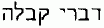 has a specific restricted meaning in rabbinic sources and always refers to the non-Pentateuchal portions of the Bible. See, e.g., m. Taʿan. 2:1, and the discussion in Bacher, Terminologie, 1. 165–66. This restricted use of the noun is unusual. Torczyner proposed revocalizing the noun and understanding it
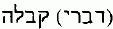 , “(words of) rebuke” (Thesaurus totius hebraitatis [15 vols.; Jerusalem: Ben Yehuda, 1948–59] 11. 5702–3, n. 2). This brilliant hypothesis is supported by appeal to ʾAbot R. Nat. B chap. 42 (ed. Schechter 117) where Lev 26:6 is apparently called
 . Note, however, that the reference may be to Ezek 34:25, as proposed by

 is omitted from MS Vatican 303 by homoioteleuton, but included in MS Parma 327. (See Saldarini, Fathers, 141 n. 1.) Perhaps ʾAbot R. Nat. B chap. 23 is to be explained similarly. Another possibility is to explain the omission of qbl as being due to the influence of m. Hag. 2:2. Either of these solutions seems preferable to Finkelstein's hypothesis which necessitates our conceiving the old Pharisaic document in m. ʾAbot 1 as a verbless list of names.
 . The existence of this form poses a difficulty to the proposal of Ben Hayyim (“Massorah,” 283–84) according to which
 was first invented in the post-Talmudic period and had a restricted meaning—the Massorah (surrounding the written text of the Bible). The preservation of this rare form in MSS
 of ʾAbot R. Nat. A would be further evidence for the conclusion that these MSS are all of the same family (see below n. 19; on variant readings for this passage see the same note). Note that in the version of this passage quoted by Nathan of Rome (Aruch 2.88)
 has been replaced by the more familiar
 .
 is followed by the name of an individual in the singular. As such, these analogies are not that close to
 . Several better analogies exist, such as

 in Mek. R. Sim. Exod 18:27 (ed. Epstein-Melammed 135); and
 in Gen. Rab. 98.8 (ed. Theodor-Albeck 1259, according to the reading of MS Vatican 30). On the meaning of this phrase see
 in m. ʿArak 2:4 (according to the better MSS: Kaufmann, Parma A, Lowe, Vatican 119, Munich 95) is to be explained as a family name, as proposed by Klein, “Geneaological Scroll,” 35 n. 24. See further idem, “Investigation of Names,” Leš 1 (5688) 348 (in Hebrew). Klein admits ignorance concerning the meaning of
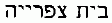 in that same mishnah. Finally, there is
 , t. Yebam. 1.10 concerning which see
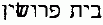 . The latter was definitely not a family name, while all the examples cited in the preceding paragraph may have been (and probably were) family names. For that reason another possibility for understanding
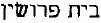 must be considered. Perhaps
 is to be understood as equivalent to
 , a meaning it can sometimes have. See further
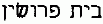 the phrase as a whole should be translated: “It is a tradition among the Pharisees.” Cf. also the version of Nathan of Rome (Aruch 2.88):
 .
 note that for this and other
 and
 (the latter now lost and only known from Schechter's citations). Compare the reading adopted by Schechter.
 , in Finkelstein's sigla).

 and
 I would first note that
 in
 is definitely more difficult than
 of
 Next, the phrase
 might have fallen out of the tradition of
 because of the influence of
 . That is, by a kind of homoioteleuton the following process may have taken place:
 . Alternately, the reading in
 may not be the result of error but may represent the French tradition of ʾAbot deRabbi Nathan A. On this aspect of MS
 see Finkelstein, Introduction, 139–53.
 is adopted (above n. 19) the conclusion that this attack comes from Sadducaean quarters is obvious. Finkelstein's suggestion (Introduction, 35–36) that this passage is an actual quotation from a Sadducaean text goes further than the evidence permits. I wonder whether the Sadducees would have used terms such as “this world” and “the world to come.” Perhaps these are Pharisaic or even rabbinic terms.
 see
 in the writings of the sect see 1QS 1 7; 5 4; 7 19; 9 10; CD 3 5; 3 10; 8 7–8. See further

 . On Pharisaic pride cf. Matt 23:5 and par. On Pharisaic love of money cf. Matt 23:25 and Luke 16:14.
 on the members of the Qumran sect are well attested in Qumran literature. See 1QH 2 32, 35; 4 9 and the discussion in Licht, Thanksgiving Scroll, 73. Are the Pharisees and their attacks responsible for the defections lamented in 1QH 5 20–39 and CD 20 11–13, 25?
 referring to the written text of the Bible (as opposed to the oral-reading tradition). Note also that paradosis can refer to the written text of the Bible, as in the passages cited above n. 4.
 . In some Greek
 . The authenticity of this heading is questionable. It is missing in the Syriac versions, and may be missing in the Ben Sira scroll from Masada. See
 see above n. 29.

Crossref Citations

This article has been cited by the following publications. This list is generated based on data provided by Crossref.
Betz, Hans Dieter
1991.
Wellhausen's Dictum ‘Jesus was not a Christian, but a Jew’ in Light of Present Scholarship∗.
Studia Theologica - Nordic Journal of Theology,
Vol. 45,
Issue. 2,
p.
83.
Schaper, Joachim
1999.
The Cambridge History of Judaism.
p.
402.
Horbury, William
Davies, W. D.
and
Sturdy, John
1999.
The Cambridge History of Judaism.
Hearon, Holly E.
2011.
Uses of The “Technical” Language of Tradition for Constructing Memory and Identity in Early Christian Communities.
Journal of Early Christian History,
Vol. 1,
Issue. 2,
p.
55.
2012.
Defining Jewish Difference.
p.
77.
2014.
The Portrayals of the Pharisees in the Gospels and Acts.
p.
248.
Viljoen, Francois P.
2016.
The Torah in Matthew: Still valid, yet to be interpreted alternatively.
In die Skriflig/In Luce Verbi,
Vol. 50,
Issue. 3,
Viljoen, Francois
2016.
The Matthean community within a Jewish religious society.
HTS Teologiese Studies / Theological Studies,
Vol. 72,
Issue. 4,
Cole, Juan
2019.
Paradosis and monotheism: a late antique approach to the meaning ofislāmin the Quran.
Bulletin of the School of Oriental and African Studies,
Vol. 82,
Issue. 3,
p.
405.
Schwartz, Seth
2020.
Reconsidering Roman power.
Wassén, Cecilia
2026.
In Praise of Wisdom.
p.
51.