1 Introduction
Increasing competition among suppliers is a widely used reform initiative aimed at improving both quality and efficiency in the health care sector and generally in the public sector (Domberger and Jensen, Reference Domberger and Jensen1997). Competition was of little historical relevance to the Norwegian health care sector, but recent reforms may have changed this somewhat. The partially activity-based financing system works as a benchmarking system and implicitly creates competition among hospitals (Shleifer, Reference Shleifer1985). The patient choice reform introduced in 2001 (Ringard et al., Reference Ringard, Rico and Hagen2006) points in the same general direction by increasing a patient’s rights to choose among different providers of specialist health care.
Furthermore, changes at the primary care level may also have increased competitive aspects on the supply side of the system. The 2001 list patient reform meant that more general practitioners (GPs) entered a contractual relationship with the municipalities. About 30% of the GPs’ income is now dependent upon the number of patients on the list (a per capita component) and 70% is based on fee-for-service (an activity-based component). According to Iversen and Lurås (Reference Iversen and Lurås1998a, Reference Iversen and Lurås1998b) and Lurås and Iversen (Reference Lurås and Iversen2002), one effect of the change in financial incentives for GPs after the list patient reform was that patient shortages, defined as fewer patients on the list than desired, led to increased use of medical tests and other income-generating activities to compensate. Another effect is indicated by a qualitative study performed by Carlsen and Norheim (Reference Carlsen and Norheim2003, Reference Carlsen and Norheim2005), who found that GPs in urban areas became more prone to referring patients to specialists for fear of losing patients to other GPs because of the increased competition. The last reference generates the research question of this article: does high spare list capacity in GP services and consequently, competition among the GPs of patients, increase the consumption of specialist health care?
The answer based on findings in the literature is mixed. Several studies show that GPs respond to financial incentives (Hickson et al., Reference Hickson, Altemeier and Perrin1987; Kouides et al., Reference Kouides, Bennet, Lewis, Cappuccio, Barker and Marc LaForce1998; Chaix-Couturier et al., Reference Chaix-Couturier, Durand-Zalesky, Jolly and Durieux2000; Scott, Reference Scott2000), and that this can have effects at the specialist level (Ricketts et al., Reference Ricketts2001; Gravelle et al., Reference Gravelle, Sutton, Morris, Windmeijer, Leyland, Dibben and Muirhead2003; Laditka et al., Reference Laditka2005). Analyses of data from the British system show varying effects of physician density on consumption of specialist health care. One study found a positive effect of physician density on admissions (Gravelle et al., Reference Gravelle, Sutton, Morris, Windmeijer, Leyland, Dibben and Muirhead2003), while others found no significance in their results (Morris et al., Reference Morris2003). An American study carried out by Ricketts et al. (Reference Ricketts2001) found no relationship between physician density at the primary care level and hospital admission rates for a specific diagnosis. However, Laditka et al. (Reference Laditka2005) found a negative relationship between physician density and hospitalization for ambulatory care sensitive conditions in urban areas. Other American studies revealed insignificant results (Krakauer et al., Reference Krakauer1996; Ricketts et al., Reference Ricketts2001). In an Italian study, Rizza et al. (Reference Rizza, Bianco, Pavia and Angellillo2007) found that the number of patients who had what they called a preventable hospitalization increased when the number of patients per primary care physician increased.
Results from Norwegian studies in this area are also mixed. Godager et al. (Reference Godager, Iversen and Lurås2007) found that list capacity, defined as available list places, had a positive effect on the number of contacts with the specialist health care system. They also found that the number of contacts with a GP is higher in municipalities with a high GP list capacity. Nerland and Hagen (Reference Nerland and Hagen2008), using some of the same data used in this article, found that an increased physician-to-population ratio at the municipality level increases spending on specialist health care. Analyses performed by Carlsen et al. (Reference Carlsen, Grytten, Kjelvik and Skau2006) indicated that increased quality in GP services decreases the use of specialist health care services. Based on survey results, they found that municipalities with a high mean score on a survey measuring satisfaction with GP services tend to have a lower consumption of specialist health care resources per capita.
Iversen and Kopperud (Reference Iversen and Kopperud2003) found a negative relationship between physician density and the probability of consultations with private specialists, but no significant effect on hospital contacts. Results point in both directions; an increased GP ratio can increase the consumption of specialist health care, but the opposite can also apply.
This conundrum also reflects the methodological challenges in attempting to capture the relationships between these variables. First, it is not surprising that analyses of data from different countries yield varying results. For instance, differences between the American and Norwegian systems are so pronounced, such as concerning the gatekeeping role of the GPs, that comparisons of results are problematic. Second, the effects may vary depending on whether one focuses on ambulatory or inpatient care. Studies from other countries [see, for instance, Rizza et al. (Reference Rizza, Bianco, Pavia and Angellillo2007) and Laditka et al. (Reference Laditka2005)] have shown that variables at the GP level can affect spending and/or referrals for ambulatory care sensitive conditions. In a study of Norwegian private specialists, Jørgenvåg and Kjekshus (Reference Jørgenvåg and Kjekshus2004) and Kjekshus and Jørgenvåg (Reference Kjekshus and Jørgenvåg2005) found that private specialists perform services that in some cases are direct substitutes for services provided in hospitals’ outpatient clinics, while other activities are more similar to services provided by GPs. This illustrates how the relationship between supply-side variables at the GP level and spending on specialist health care differs depending on the type of specialist health care one focuses on. Consequently, we will expect that effect of high spare list capacity and therefore competition for patients at GP level will manifest itself primarily in spending on ambulatory care while the effects on spending for inpatients are less obvious. Third, it is not clear how capacity and/or scarcity at the GP level should be measured, and the results may consequently vary according to the choice of operationalization that is made. In particular, it may be difficult to separate effects stemming from increasing availability and supplier inducement, when using GP density as an explanatory variable (Stano, Reference Stano1985; Lurås, Reference Lurås2004). If we see an increase in spending at the municipal level that is correlated to, for instance, the GP ratio to the population, this can indicate a demand induced by the physicians but it might also indicate the effect of improved availability. The various publications that show an effect of GP level variables on the consumption of specialist health care services seem to focus either on the ratio of GPs to the population [see, for instance, Laditka et al. (Reference Laditka2005) or Ricketts et al. (Reference Ricketts2001)] or on the number of patients per GP [see, for instance, Morris et al. (Reference Morris2003) or Rizza et al. (Reference Rizza, Bianco, Pavia and Angellillo2007)].
In conclusion, some of the diverging results in the literature are probably because of differences in the institutional setting in different countries, and controlling for this is not possible by the data available for this analysis. It is however possible to address two questions: first, the more operationalizational issues that are mentioned above. I will therefore use different operationalizations of competition based on supply-side factors at the GP level. Second, I will test the effects of these variables on consumption of ambulatory care services (sum of outpatient services and private specialists), inpatient services and the total amount of services (sum of spending on ambulatory care and inpatient services).
2 The institutional setting
In Norway, about 90% of GPs are independent contractors, while the rest, usually located in rural areas, are municipal employees. The municipalities receive a fixed sum [about 300 NOK (Norwegian Krone) or 37 Euro] from the central state for each inhabitant. This makes up the per capita component of the GPs income and means that municipal expenses for providing GP services depend on the number of citizens, while the expenses before the introduction of the list patient system in 2001 depended more on the number of physicians employed by the municipality. Small municipalities (<5000) receive a special grant to compensate for low population density. This is because smaller municipalities require a high ratio of GPs to the population to maintain a sufficient emergency capacity (Norwegian Royal Commission no. 18, 2005). The municipalities are not formally free to contract as many GPs as they prefer. Instead, they must obtain permission from a special council set up by the central state. However, this seems mostly a formality, and these requests are usually approved.
The financing system of the GPs is mixed and the GPs’ revenue stems from three sources. First, each GP receives a capitation amount based on the number of patients on their list. Second, a fee-for-service component that is based on the services he/she provides to the patients, such as consultations and medical tests. Third, the GP receives copayment from the patients. For the patient there is an annual ceiling (approximately 220 Euros or 250 USD) on the expenses for outpatient services, GP services and medication. Expense that exceeds the ceiling is covered by the National Insurance Scheme (NIS). The GP’s income is not affected by the ceiling as payments shifts from the patient to the NIS.
The responsibility for providing specialist health care in Norway is placed on four Regional Health Authorities (RHA). The RHAs are organized as enterprises and provide specialist health care to the citizens in their area through the hospital trusts under their ownership and control or by purchasing services from private contract specialists and some private hospitals. Since the central state took over ownership of the hospitals from the counties in 2002, the private supply of specialist health care has increased (Midttun, Reference Midttun2006), but all in all private suppliers of specialist health care still play a minor role in the Norwegian health care system.
Several decision makers are involved in determining treatment for a patient. First, the patient decides whether or not to see a GP. Because out-of-pocket payments play a minor role, the costs of doing this for the patient are low. The GP will then decide what, if any, treatment the patient should receive and whether he/she needs a referral to the specialist level. If the patient is referred to the specialist level, the physician at this level will have to decide what, if any, treatment the patient is to receive.Footnote 1 The patient may then be discharged, or returned to the community care system. Figure 1 [adopted from Iversen and Kopperud (Reference Iversen and Kopperud2003)] shows the patient flow in the system. The arrows pointing out of the model indicate that a patient is discharged.
Patient flow in the Norwegian health care system

Rationing is the process in which scarce resources are allocated between patients with competing needs (Mechanic, Reference Mechanic2001). According to Klein (Reference Klein1993: 309) rationing is a “complex interaction of multiple decisions, taken at various levels”, and all decision makers in the medical systems are involved in decisions about how medical resources should be allocated. GPs do however play an especially important role in the process of allocating scarce medical resources. GPs generally play a fundamental role in the health care system because they themselves provide care and are key actors in decisions on care provision at the primary or secondary level. Therefore, revealing potential (side) effects of various financial and/or institutional variables at this level is of vital importance when considering a wide array of health political goals, including the utilization of specialist health care resources. As pointed out by Reinhardt (Reference Reinhardt1989), the question of whether resource control is best achieved through regulatory means on the supply side or through the demand side is a key controversy in health politics. While attempts to improve the control over resources can focus on both the primary and the secondary level of the health care system, the fundamental multilevel nature of the system makes focusing on the mechanisms that regulate patient flow between the levels important.
3 GPs: patient advocates or society’s gatekeepers?
In universal tax-based health care systems, rationing most often takes place on the supply side. This reflects the essence of the GPs’ gatekeeping role. Rationing means that the GP may need to deny a patient potentially beneficial care that he or she desires (Carlsen, Reference Carlsen2006). That is, the GP is expected to take not only the patient’s interest into account but also society’s interest in the sense that referrals that are unnecessary in the majority of cases should be avoided to reduce total costs. The marginal benefit of a medical intervention may be unclear or contested, and the GP faces a choice of whether or not it should be carried out. These situations manifest the core conflict in the GP’s role. The typical principal–agent perspective in health care is between a doctor and a patient, but the relationship between health funds and GPs can also be described as a principal–agent relationship.Footnote 2 In the case that is analyzed here, the main point is that the GP has two principals and the actions that he/she undertakes may conflict with one of the principals. If the central state is the principal, then referring ‘gray zone’ cases may be what Iversen and Lurås (Reference Iversen and Lurås2000) described as “unnecessary referrals”. However, if the patient is the principal, then the referral may be seen as useful from his point of view. This duality in the GP’s role is fundamental in gatekeeping systems. The GP is both an ‘advocate’ for the patient and a gatekeeper for society. In medically ambiguous situations, balancing these roles may be difficult, and the balance between two roles may shift depending on other variables in the GP’s surroundings.
However, the empirical expectations that can be derived from these theoretical reflections are not unambiguous. Based on the findings of Carlsen and Norheim (Reference Carlsen and Norheim2003, Reference Carlsen and Norheim2005), we may expect that increased competition for patients because of high spare list capacity increases spending on specialist health care. Because competition leads to a fear of losing patients, GPs may become more ‘advocates’ for the patient than a gatekeeper for society. As a consequence, an increase in ‘unnecessary referrals’ can occur. The argument rests on the premise that patients prefer being referred, and that GPs are sensitive to the patient’s preferences.
Other arguments may lead to other predictions. Having high spare list capacity can lead to more and longer consultations. Longer consultations may imply consultations of a higher quality, and higher quality consultations can decrease referrals to the specialist level. Thus, having high spare list capacity in the municipality may lead to fewer referrals simply because GPs are able to deliver more services themselves. This rests on the premise that specialist care can substitute GP services. This is not the case for all services, but it is probably the case for some outpatient care and care given by private specialists. For example, a survey carried out by the Norwegian Medical Association showed that 70% of physicians outside the hospitals agreed with the suggestion that patients who are hospitalized ‘often’ or ‘sometimes’ could have received care at another level of the health care system (The Norwegian Medical Association, 2000). This indicates that not all referrals are unambiguous. In some cases, GPs may refer patients that could have been treated at the primary level. Several studies also indicate that this is the case. For instance, Fertig et al. (Reference Fertig, Roland, King and Moore1993) found that about 10% of the referrals from GPs in Cambridge could be viewed as inappropriate when compared with the referral guidelines. In a retrospective evaluation of 170 referrals to secondary care, Elwyn and Stott (Reference Elwyn and Stott1994) found that 58 out of these 170 referrals could be regarded as inappropriate or avoidable. Thus, a ‘gray zone’ may exist where patients can receive care at both primary and secondary levels.
Consequently, increased competition through high spare list capacity may have an effect in either direction. It may lead to a decrease in the GP’s emphasis on their gatekeeping role (Carlsen and Norheim, Reference Carlsen and Norheim2003, Reference Carlsen and Norheim2005; Carlsen, Reference Carlsen2006) and consequently increase spending on specialist health care, or it may decrease referrals to the secondary level because it gives the GP the capacity to provide more care and thereby reduce spending on specialist health care.
4 Empirical model and data description
The effect of spare list capacity and competition within the general framework of demand for specialist health care proposed by Gravelle et al. (Reference Gravelle, Sutton, Morris, Windmeijer, Leyland, Dibben and Muirhead2003) was tested:

where use of specialist care is defined as (1) ambulatory care (use of private specialistsFootnote 3 and outpatient clinics at public hospitals), (2) inpatient care and (3) total specialist care (ambulatory care and inpatient care); need variables are a set of demand factors defined below; and supply-side variables are variables describing characteristics both of hospitals and primary care supply, including the list capacity/competition between GPs. All data used are from 2004, aggregated to the municipality level and standardized by the number of inhabitants if not otherwise described since it is not yet possible to connect socioeconomic data to consumption at the individual level in Norway. The data used here is therefore the sum of expenses triggered by the inhabitants in a municipality through admissions (inpatients), services delivered by private specialists and outpatient services in hospitals. The units of analysis are 430 municipalities. These municipalities differ in size; consequently, the data were weighed by the number of inhabitants in the municipality when the different models were tested. I have also tested the models with logged variables. This does not alter the general conclusions drawn in the article.
4.1 Use of specialist care
The variable describing ambulatory care is based on reimbursement to outpatient clinics and private specialists from the NIS and the RHA. Inpatients as well as day surgical and day medical treatments are registered in the DRG (Diagnosis related groups) system. By using the DRG weights and the DRG unit price we can sum different types of treatments and receive a standardized expression of use of in-hospital specialist health care, including day surgery and other day care, in both private and public hospitals.Footnote 4
4.2 Explanatory variables
Out of a pool of approximately 25 different need variables, Nerland and Hagen (Reference Nerland and Hagen2008) concluded that the following eight variables, which also are used here, describe need variation among municipalities in a satisfactory way:Footnote 5
• PROP 67–79: Number of elderly 67–79 years of age per 100 citizens
• PROP 80+: Number of elderly over 80 years of age per 100 citizens
• WELFARE: Number of citizens receiving social welfare per 100 citizens
• DISABLED: Number of disabled per 100 citizens
• DEAD: Number of deaths per 100 citizens
• VIOLENCE: Number of reported violent episodes per 1000 citizens
• LOWEDU: Number of citizens without higher education per 1000 citizens
• TEMP: The mean summer temperature in the municipality
The supply of GP services is described by four alternative variables. First, the effect of variables, measuring the number of available list spaces divided by the number of GPs (GP1) and the number of available list spaces divided by the total number of inhabitants in the municipality (GP2), was tested. The third alternative variable (GP3) is coded 1 if more than half of the GPs in a municipality report free capacity on their list. The argument for using traits of the GP lists as indicators of competition is that they are better measures of the actual free capacity as experienced by GPs. This available capacity is then a stronger indicator of competition than available places as measured by GP1 and GP2. The fourth variable (GP4) adds a second restriction to the operationalization of competition as measured by GP3 and is coded as follows: If more than half of the GPs report free capacity on their list (GP3) and the total number of free places available divided by the total number of GPs with openings on their lists is above 100, then the variable is coded 1, otherwise 0. The first restriction measures the ratio of GPs with free capacity on their lists relative to the total number of GPs in the municipality, while the second reveals information about the scope of the free list capacity on GP lists. GP4 therefore places a tighter restriction on measuring capacity than GP3, and we can expect the effect to be stronger for GP4 than for GP3 if increasing GP list capacity has an effect on the consumption of specialist health care resources.
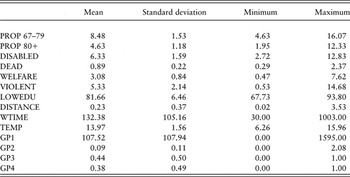
As shown by Iversen and Kopperud (Reference Iversen and Kopperud2003), availability of specialist health care is an important predictor for the utilization of these services. To control for the effect of availability, two variables are included: a variable measuring the distance from the municipality center to the nearest hospital in units of 100 kilometers (DISTANCE), and a variable measuring the waiting time to elective treatment (WTIME). In a recent report from Royal Commission established to revise the financing system between the central state and the RHA, summer temperature was proposed as a variable to be used in the allocation formula (Norwegian Royal Commission no. 2, 2008). The variation in mean summer temperature in Norway reflects the relatively large variations between the southern and the northern areas of the country, and although the causal mechanisms are unknown, the variation affects the consumption of specialist health care resources per capita. Therefore, a variable (TEMP) is included to control for this. Table 1 presents descriptive statistics for the explanatory variables.
Descriptive statistics for the explanatory variables

The utilization approach to measuring need for health care rests on the assumption that utilization of health care is a result of demand and supply, and that demand is influenced by the need for health care (Gravelle et al., Reference Gravelle, Sutton, Morris, Windmeijer, Leyland, Dibben and Muirhead2003). However, a potential problem is that the supply-side variables at time t are correlated with the need at time t − 1. Because the allocation formula takes need into account, this also affects future values of supply-side variables. For example, waiting time may be correlated with unobserved need. Therefore, an estimate of supply-side factors, such as waiting time, may be biased or exaggerated. This may also affect the standard error of the need variables, which can lead to misinterpretation of which demand variables are important in explaining the variation in utilization. The solution proposed by Gravelle et al. (Reference Gravelle, Sutton, Morris, Windmeijer, Leyland, Dibben and Muirhead2003) is to include dummy variables for hospitals trust in the analysis. These dummies pick up unobserved variation in need and supply and make the coefficient for the remaining variables more reliable. This means that the estimates are based on the ‘within’ variation in each hospital trust’s catchment area.
5 Empirical results
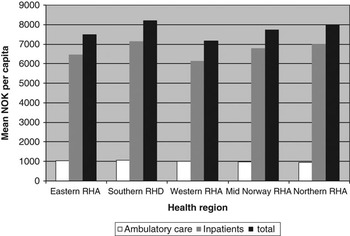
The average amount spent per capita on specialist health care in 2004 was 7647 NOK (952 Euro or 1380 USD) (Figure 2). The variation in total spending on specialist health care from the mean is 1–7% at the RHA level and is largely explained by need variation (Nerland and Hagen, Reference Nerland and Hagen2008). Ambulatory care makes up about 12% of the total spending. The mix between the use of private specialists and outpatient services varies more (figures calculated but not shown), and seems to be complementary.
Mean amount spent per capita on specialist health care in the five health regions (2004)

In the analysis, 12 different models were run. For each of the four variables describing GP capacity or competition (GP1–GP4), we analyzed variation in spending for ambulatory care, inpatient care as well as total spending (inpatient care + ambulatory care). Since the results from the analyses of spending for inpatient care and total spending produce similarFootnote 6 results, only the analyses of spending for inpatient care are reported.
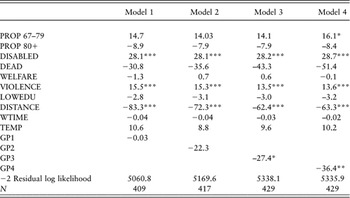
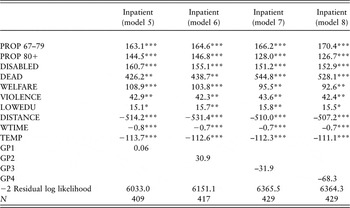
Table 2 shows the results of four different models when the dependent variable is spending on ambulatory care per capita and Table 3 shows the results when inpatient spending is the dependent variable. The multivariate regressions are based on a maximum likelihood procedure (REML) and were run in SAS 9.1.
Use of resources per capita on ambulatory care

***Significant at the 1% level, **significant at the 5% level, *significant at the 10% level. Effects of hospital trust dummies are not reported.
Use of resources per capita on inpatient care

***Significant at the 1% level, **significant at the 5% level, *significant at the 10% level. Effects of hospital trust dummies are not reported.
Table 2 shows that competition amongst GPs for patients, as interpreted here, has a significant effect when consumption of ambulatory specialist health care per capita is the dependent variable. However, the effect is negative and therefore in the opposite direction of what we could expect from the findings of Carlsen and Norheim (Reference Carlsen and Norheim2005). Both GP3 and GP4 are significant and negative and, as expected, GP4 has a stronger and more robust effect than GP3. Thus, adding the second restriction to the operationalization of competition yields a stronger effect. High spare list capacity and, therefore, implicit competition for patients, leads to less spending on ambulatory care per capita. Replacing these variables with a variable measuring the number of free spaces on the GP’s list per capita (GP2) does not give significant results. The same goes for the variable measuring the number of free spaces per GP (GP1). Although a precise interpretation of this is difficult, one interpretation of this is that these variables measure availability, and measuring competition for patients requires stricter restrictions on the operationalization. The variables GP3 and GP4 measure something more than availability, and this can be interpreted as a situation in which the availability is so high that de facto competition among GPs for patients is present.
Table 3 shows that the variables GP3 and GP4 do not have a significant effect on spending on inpatient care. Based on the arguments presented earlier, however, this is in accordance with the general expectation. Because of the potential for substitution between the services provided by a GP and the care provided by private specialists and in outpatient services, we can expect that the effect will only be present for ambulatory care. The effects shown in Table 3 support this.
The variables on the demand side of the model have effects in the expected direction. A higher proportion of older citizens in the municipality increases spending on specialist health care, but less so for spending on ambulatory care, although PROP 67–79 has an effect in model 4. This probably reflects that persons in this age group have less need for ambulatory care and perhaps higher need for inpatient care and care provided at the community level. Not surprisingly, DISABLED has a positive and significant effect in all models. DEAD also has effects in the expected direction, but is negative and insignificant in models 1 to 4. The number of reported violent (VIOLENT) crimes has a positive significant effect in all models. Overall, the variables that measure demand for health care have effects in the expected direction.
Availability in the form of the distance to the nearest hospital in kilometers has a strong and negative significant effect. This supports the results of Iversen and Kopperud (Reference Iversen and Kopperud2003) and shows that longer distances to the nearest hospital decrease the use of specialist care. Availability and the degree of decentralization of hospital services have been, and continue to be, key issues in the Norwegian health care debate. Real or perceived reductions in specialist health care delivery in an area have caused large-scale protests and political turmoil. The result of availability in the form of distance shown here indicates that there is an effect on the use of specialist health care resources. Whether this can be interpreted as having implications on a more general level as far as equity is concerned is unclear from these results.
6 Discussion
Based on the theoretical discussion, as well as findings in both the international and Norwegian literature, two competing hypotheses about the effect of increased competition at the GP level were formed. This could increase or decrease the spending on specialist health care. Furthermore, it was argued that regardless of the direction of the effect, it was most likely present for ambulatory care because these services could be substituted with care provided at the GP level.
As shown in the analysis performed here, the hypothesis that increased competition among GPs for patients increases spending on specialist health care, is rejected. Higher spare list capacity among GPs decreases the spending on ambulatory care, but has no significant effect on inpatient care. Part of the explanation probably lies in a ‘gray zone’ between the services that can be provided by GPs and ambulatory care. In some cases, whether a patient can receive proper care at the GP level or needs a referral to a specialist may be medically ambiguous. The negative effect shown here may reflect the reality that services provided by private specialists and in outpatient care are more easily substituted by GP services.
One possible interpretation of the result is that a decrease in the use of ambulatory care can result from an increase in use of GP services. Iversen and Lurås (Iversen and Lurås, Reference Iversen and Lurås1998a, Reference Iversen and Lurås1998b; Lurås and Iversen, Reference Lurås and Iversen2002) found that the list patient system caused an increase in the use of GP services. The result observed here can be interpreted as consistent with such an effect. However, this is not necessarily a result of ‘unnecessary’ inducements for GP services; it can also reflect higher capacity of GPs, which facilitates providing services at this level. Assuming that a medical ‘gray zone’ exists in which a patient can be referred to a specialist or be treated further by the GP without this having obvious negative effects on the patient’s well-being, increasing services on the GP side can cause a decrease in use of ambulatory health care services. Such an effect is, in this respect, consistent with the intentions of the LEON principle, which states that services should be provided at the ‘lowest efficient level’. An increase in the list capacity at the GP level leads to a decrease in spending on ambulatory specialist care.
The fact that the observed effect was only present for ambulatory care provides important clues on the relationship between the care provided by GPs and the care provided at the specialist level. The relationship between the services provided at the different levels is often complementary in the sense that they cannot be substituted for one another. Rather, they provide different types of services that constitute parts of a whole. This is not necessarily the case for GP services and some specialist services provided by private specialists and outpatient clinics. Here, care can in some cases be provided at either level without any evident negative effects. It is not evident what correct level occurs in all situations. Thus, a patient can be provided care at either level without this having clear negative effects on the quality of the delivered care. However, regardless of the quality aspects, this question has important consequences on the cost side. Providing care at the specialist level is more costly than providing care at the GP level. Thus, it is preferable that care in situations such as this is given at the GP level and not the specialist level. The results presented here indicate effects in this direction, increasing competition for patients because high spare list capacity does not lead to a decline in the gatekeeping aspects of the GP role. If anything, the opposite is the case. However, we do not know precisely why.
Because the data do not reveal information about referral rates, it is not possible to give a clear theoretical interpretation of the results at the micro level. We cannot know, based on the analysis in this article, whether the effects on consumption of specialist health care is caused by variations in referral rates. Furthermore, even though referral rates and consumption of specialist health care are closely related, they are not the same. Some caution should therefore be taken when interpreting these results. The observed result can also be interpreted as being in accordance with different theoretical perspectives on GP preferences, but the implication of the results is nevertheless clear. Based on these results, the gatekeeping role of the GP does not decline if the GP experiences a patient shortage. This is not likely to increase spending on specialist health care. What we do not know based on the data used here, however, is whether the decrease in consumption of ambulatory specialist health care coincides with an increase in spending on primary health care. Do the GPs provide more care themselves because of the ‘shortage’ of patients, and thereby reduce the referrals and spending on specialist health care? According to Carlsen and Norheim (Reference Carlsen and Norheim2003, Reference Carlsen and Norheim2005) a decline in the gatekeeping aspect of the GP’s role can also manifest itself as an increase in the use of services provided by the GP.
It is also worth noting that this is a cross-sectional study. Expanding the data on consumption and the different variables at the GP level that were used here with measurements at several points in time will strengthen the basis for drawing conclusions about the relationship between the variables. Using panel data will strengthen the basis for making causal inferences (Finkel, Reference Finkel1995).
However, regardless of what underlies the effects described here, they illustrate that coordinating policies at the different levels is one of the most pronounced health political necessities. There are several potential benefits from being able to increase coordination between the two levels of the health care system. Given that the need for health care is likely to increase rapidly over the course of the next generation because of the increasing number of older persons, the need for rationing from the GPs’ side will not decrease. Acquiring information about how decisions are made at the primary care level, and the effect these decisions have on patient flow between the different levels of the health care system, is therefore of significant health political importance.
7 Conclusion
The health care system stands out amongst other policy sectors because the outcomes of policies and services are fundamentally multileveled. New reforms or policies on one level can have external effects on the services produced at other levels. The research question that has been answered here illustrates this, although the direction of the effect was consistent with more general health political assumptions. High GP spare list capacity at the municipal level leads to less, and not more, spending on specialist health care. Nevertheless, regardless of the direction of the effect, this result also indicates the complexity of the policy area. Adding to this complexity is that variables at the GP level are influenced by policies made at both the municipal level and the central state level. Thus, the more general implication of the results is the acknowledgment of the complex and multileveled nature of the health care system, and how variables at either level can have significant external effects.
Acknowledgements
The Norwegian Research Council financed this paper through grant no. 153074/530 [Health Organization Research Program, Norway (HORN)]. The author has also received funding from the Innlandet Hospital Trust. The author would like to thank Terje P. Hagen for several comments and suggestions on the analysis conducted and the article in general. The author would also like to thank the anonymous referees of Health Economics, Policy and Law who made several valuable and interesting comments. Needless to say, none of the above-mentioned shares any responsibility for the analysis or the interpretations in this article.