1 Introduction
In competitive health insurance markets health insurers have the major task of purchasing (or delivering) efficient and high-quality care on behalf of their consumers. They must also have the tools to do so, for example some freedom to define enrolees’ entitlements. In such multiple choice settings, consumers must have the freedom to choose on a regular basis the insurer that best satisfies their (health care) needs and preferences. The possibility of consumers switching to a competitor must continuously stimulate insurers to succeed in their roles of purchasers of care, that is enhancing cost containment, efficiency, and quality in health care.
In markets with homogeneous consumer preferences, all consumers will benefit from the critical choice of a minority, because a few critical consumers can be sufficient to spur insurers to be responsive to consumer preferences. However, in health care, consumer preferences are highly heterogeneous. For example, young and healthy consumers have other preferences than old and unhealthy consumers. Consequently, if specific groups of consumers do not feel free to easily switch insurer, insurers have low incentives to accommodate the specific preferences of these groups of individuals. This would be in particular problematic if these consumers are those with most health care needs (i.e. the elderly and unhealthy consumers), because insurers are then no longer spurred to act as quality-conscious purchasers of care for them.Footnote 1
In this paper we focus on the question to what extent switching rates differ between low-risks (i.e. young or healthy consumers) and high-risks (i.e. elderly or unhealthy consumers) in the Netherlands in the period 2009–2012. Although we focus on switching rates in the Dutch context, the policy implications of our findings can also be relevant for other countries in which insurers are purchasers or suppliers of care and have some freedom to define enrolees’ entitlements (e.g. Israel, the HMO market in Switzerland, and the United States).
Previous studies in different Western countries have shown that young consumers are more inclined to switch insurer than elderly consumers (Atherly et al., Reference Atherly, Florence and Thorpe2005; Shmueli et al., Reference Shmueli, Bendelac and Achdut2007; De Jong et al., Reference De Jong, van den Brink-Muinen and Groenewegen2008; Mosca and Schut-Welkzijn; Reference Mosca and Schut-Welkzijn2008; Dormont et al., Reference Dormont, Geoffard and Lamiraud2009; Reitsma-van Rooijen et al., Reference Reitsma-van Rooijen, de Jong and Rijken2011; Boonen et al., Reference Boonen, Laske-Aldershof and Schut2015). Moreover, most of these previous studies concluded that healthy consumers do not switch more frequently than unhealthy consumers, after adjusting for the age differences between the two groups (Shmueli et al., Reference Shmueli, Bendelac and Achdut2007; De Jong et al., Reference De Jong, van den Brink-Muinen and Groenewegen2008; Dormont et al., Reference Dormont, Geoffard and Lamiraud2009; Hoffmann and Icks, Reference Hoffmann and Icks2011; Reitsma-van Rooijen et al., Reference Reitsma-van Rooijen, de Jong and Rijken2011).
Our study is in different ways a valuable contribution to the current evidence regarding consumers’ switching behaviour in the health insurance context. Previous studies mainly used consumers’ self-reported health, (chronic) diseases, and prior health care utilization as health indicators (Mosca and Schut-Welkzijn, Reference Mosca and Schut-Welkzijn2008; Dormont et al., Reference Dormont, Geoffard and Lamiraud2009; Hoffmann and Icks, Reference Hoffmann and Icks2011; Lako et al., Reference Lako, Rosenau and Daw2011; Boonen et al., Reference Boonen, Laske-Aldershof and Schut2015). However, Hoffmann and Icks (Reference Hoffmann and Icks2011) and Dormont et al. (Reference Dormont, Geoffard and Lamiraud2009) considered the use of these subjective health measures and the lack of information regarding switchers’ and non-switchers’ health care expenses as serious limitations. In addition, most previous studies on consumers’ switching behaviour used sample data instead of population data. Two major strengths of our study are therefore the use of: (1) information on objective health indicators (i.e. medically diagnosed diseases and pharmaceutical use) and health care expenses and (2) population data of about 15.3 million individuals to compare low-risks’ and high-risks’ switching behaviour in 2009.Footnote 2 Atherly et al. (Reference Atherly, Florence and Thorpe2005) and Shmueli et al. (Reference Shmueli, Bendelac and Achdut2007) used also population data instead of sample data in their studies on consumers’ switching behaviour, but these studies lacked detailed information on consumers’ health status. Therefore, our use of data with objective health information and information on health care expenses for nearly the entire population is a new approach for comparing high-risks’ and low-risks’ switching behaviour.
Another major strength of our study is the comparison of low-risks’ and high-risks’ three-year switching rate. Only a small number of consumers is willing to decide on their health insurance each switching period (Tamm et al., Reference Tamm, Tauchmann, Wasem and Greβ2007). Therefore, we also focus on low-risks’ and high-risks’ switching rates over multiple years by using sample data. Dormont et al. (Reference Dormont, Geoffard and Lamiraud2009) and Hoffmann and Icks (Reference Hoffmann and Icks2011) have also focused on consumers’ switching behaviour over multiple years. They asked consumers whether they switched insurer in the previous years. Because consumers may not remember whether they switched insurer several years ago, the use of a single question to evaluate consumers’ switching behaviour over multiple years may result in response bias. We asked the same individuals (n=1152) recently after the switching period in 2010, 2011, and 2012 whether they switched insurer in that period, and evaluated whether they have switched insurer (yes/no) in the period 2010–2012. This research method reduces the potential response bias.
The article is organized as follows. First, we describe the Dutch health insurance market. Second, we pay attention to the data and methods. Third, we present our main results. Fourth, we discuss potential interpretations of our results. Finally, we pay attention to some policy considerations and conclude.
2 The Dutch health insurance market
We focus on the switching behaviour of Dutch consumers. These consumers are allowed to switch insurer on 1 January each year.Footnote 3 In the Netherlands, the introduction of the Health Insurance Act (Zorgverzekeringswet, 2006) was an important step towards a nationwide competitive health insurance market. All inhabitants are legally obliged to take out basic health insurance (BI) from a private health insurer.Footnote 4 Insurers are free to offer several BI products, which may differ, for example, in the panel of contracted providers and the deductible level. Insurers must accept each applicant for BI and must charge the same price for the same BI product to each consumer, regardless of the consumer’s risk (i.e. community-rated premiums). Each insurer is free to set its own community-rated premiumFootnote 5 and to specify consumers’ precise entitlements (e.g. the contracted health care providers and pharmaceuticals) in the BI product.
Consumers can voluntarily take out supplementary insurance (SI) for benefits not covered by BI. Insurers are allowed to refuse applicants or charge risk-rated premiums for SI. About 90% of all consumers take out SI. More than 99% of them take out BI and SI from the same insurer (Vektis, 2012), because almost all insurers make it unattractive or impossible for consumers to take out separate SI (Roos and Schut, Reference Roos and Schut2012).Footnote 6 Due to this joint purchase of BI and SI, the decision to switch insurer for BI is also influenced by consumers’ expectations regarding SI.
3 Data and methods
We used both administrative data and questionnaires among an internet panel to determine to what extent low-risks’ and high-risks’ switching behaviour differed in the Netherlands in the period 2009–2012.
3.1 Switching behaviour in 2009
We used individual-level information on risk characteristics, health care expenses, and subscriptions of 95% of the Dutch population (n=15.3 million individuals) to determine which groups of consumers switched insurer on 1 January 2009.
Our analyses involved three steps. First, we determined the switching behaviour of different age groups. Second, we evaluated the switching behaviour of healthy and unhealthy consumers by using objective health status indicators. In this respect, pharmacy-based cost groups (PCGs), diagnoses-based cost groups (DCGs), and multiple-year high costs (MHC) are used as indicators (see Van Kleef et al., Reference Van Kleef, van Vliet and van de Ven2013 for more details about these indicators). Consumers are classified into one or more PCGs if they received in 2008 at least 180 daily dosages of a specific pharmaceutical. If consumers had a specific (hospital) diagnosis in 2008, they are classified into a DCG. Consumers are classified into a MHC if their health care expenses were in 2006, 2007, and 2008 at least in the top 15% of total health care expenses.Footnote 7 Because the health indicators PCG, DCG, and MHC overlap with each other, we distinguished ‘healthy consumers’ (i.e. not classified into a PCG, DCG, and MHC) and ‘non-healthy consumers’ (i.e. classified into a PCG, DCG, and/or MHC). Third, we determined consumers’ switching behaviour by their predicted health care expenses for 2009. These predicted expenses are based upon the risk equalization formula of 2012, which uses the following risk adjusters: age/gender, region, source of income, PCGs, DCGs, socioeconomic status, and MHC (see Van Kleef et al., Reference Van Kleef, van Vliet and van de Ven2013).
3.2 Switching behaviour in the period 2010–2012
Because only a small number of consumers is willing to decide on their health insurance each switching period (Tamm et al., Reference Tamm, Tauchmann, Wasem and Greβ2007), we also investigated consumers’ switching behaviour over a three-year period (2010–2012). An online questionnaire was distributed in February 2010, February 2011, and February 2012 among members of the CentERpanel aged 18 or older. Members of this panel complete questionnaires at home every week. An invitation to fill in the questionnaire was sent to 2227 members in 2010, 2665 members in 2011, and 2419 members in 2012. In 2010, 2011, and 2012, respectively, 1963 respondents, 1852 respondents, and 1939 respondents fulfilled the complete questionnaire. We merged the samples of 2010, 2011, and 2012, and evaluated which respondents completed the questionnaire in all three years. We performed our analyses solely on the 1152 respondents, who completed the questionnaire in 2010, 2011, and 2012. This sample of respondents was older than the general Dutch population. For example, the percentage of respondents aged 20–39 was in our research 15 compared to 33 in the population. Because we focus on switching rates within different consumer groups, the non-representative character of the sample may not seriously threaten the external validity of our results. Respondents have revealed whether they switched insurer in 2010, 2011, and 2012. The switching rates in these three years were, respectively, 3.6, 4.5, and 3.8%. Although switchers may be more eager to respond to a consumer questionnaire about health insurance than non-switchers (Kerssens and Groenewegen, Reference Kerssens and Groenewegen2005), these switching rates are lower than the switching rates in the Dutch population (3.9% in 2010 (Vektis, 2010), 5.5% in 2011 (Vektis, 2011), and 6.0% in 2012 (Vektis, 2012). Because the switching rates in the separate years were low, we were not able to perform reliable analyses by using the panel data approach. Therefore, we focused only on the switching rate over these thee years; that is did consumers switch at least once in the three-year period 2010–2012 (yes/no)?
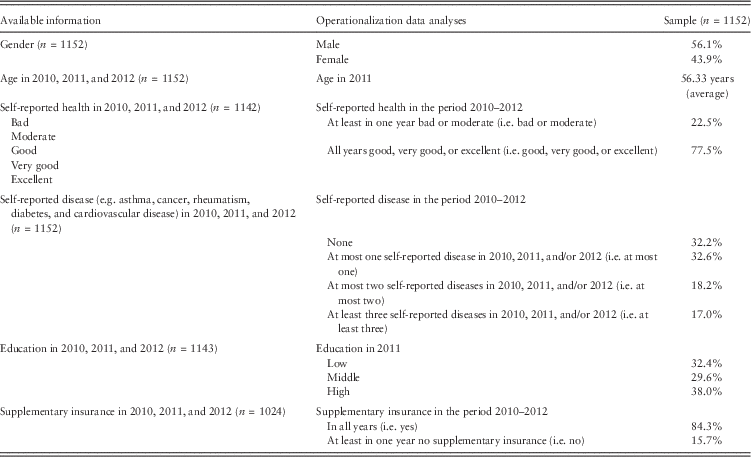
We obtained demographic information, health information, and insurance-related information about each respondent (Table 1). In contrast to the objective health measures used concerning consumers’ switching behaviour in 2009 (see Section 3.1), we used self-reported health and self-reported disease(s) as health indicators for comparing the switching behaviour of healthy and unhealthy consumers in the period 2010–2012.
Background characteristics consumer questionnaires 2010–2012

Different previous studies concluded that high-educated consumers were more inclined to switch than low-educated consumers (De Jong et al., Reference De Jong, van den Brink-Muinen and Groenewegen2008; Mosca and Schut-Welkzijn, Reference Mosca and Schut-Welkzijn2008; Lako et al., Reference Lako, Rosenau and Daw2011; Reitsma-van Rooijen et al., Reference Reitsma-van Rooijen, de Jong and Rijken2011; Boonen et al., Reference Boonen, Laske-Aldershof and Schut2015). In addition, Dormont et al. (Reference Dormont, Geoffard and Lamiraud2009) and Boonen et al. (Reference Boonen, Laske-Aldershof and Schut2015) showed that having a SI is associated with a low switching propensity. Therefore, in the data analyses, we also focused on the switching behaviour of low-, middle-, and high-educated consumers, and on the switching rates of consumers with SI and of consumers without SI.
Our analyses involved two steps. First, we performed Pearson’s χ2 tests to determine whether the variables gender, age, self-reported health, self-reported disease(s), education, and holding a SI are correlated with switching insurer (yes/no) in the period 2010–2012. Second, we performed a binary logistic regression model with y i=1 if a consumer switched insurer at least once in the three-year period 2010–2012 and y i=0 if a consumer stayed with his or her current insurer in that period. The switching model is derived from an underlying latent variable: y* i=X’ iβ+ε i, where y i =1 if y* i>0 and y i=0 otherwise. X’ iβ is a vector of the explanatory variables (i.e. gender, age, self-reported health, self-reported disease(s), education, and holding a SI). In this respect, the latent variable represents the net benefit of switching health insurer. We present the odds ratios to illustrate differences in the switching behaviour of different consumer groups. Odds ratios range between 0 and positive infinity. An odds ratio greater (smaller) than one indicates that a characteristic increases (decreases) the odds of switching compared to the reference group, ceteris paribus.
4 Results
4.1 Switching rates in 2009
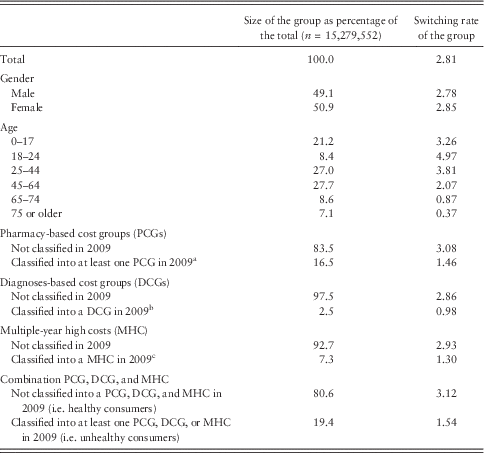
Our results indicate that 2.81% of all consumers switched insurer on 1 January 2009.Footnote 8 Bivariate analyses (Table 2) show that females switched slightly more frequently than males. Switching rates differ by a factor of 10 between young and elderly consumers: the annual switching rate was 3.81% at age 25–44 and decreased to 0.37% at age 75 or older. About 5% of the consumers aged 18–24 switched insurer. The switching rates of children under the age of 18 follow the same pattern as the switching rates of their parents who are most likely aged 25–40 (Figure 1). The percentage of males switching to another insurer is highest at age 18 and 19, while the percentage of females switching to another insurer is highest at age 24 and 25 (not presented in Tables and Figures). Females aged 18–30 were about 20% more inclined to switch insurer than males aged 18–30.
Switching rates on 1 January 2009 of healthy consumers (i.e. in 2009 not classified into a PCG, DCG, and MHC) and unhealthy consumers (i.e. in 2009 classified into at least one PCG, DCG, or MHC) by age.
Percentage of consumers that switched insurer on 1 January 2009
a These consumers received in 2008 at least 180 daily dosages of a specific pharmaceutical.
b These consumers had a specific (hospital) diagnosis in 2008.
c These consumers’ health care expenses were in 2006, 2007, and 2008 at least in the top 15% of total health care expenses.
Although healthy consumers switch twice as much as unhealthy consumers (Table 2), this difference becomes much smaller after adjusting for age (Figure 1). This finding is consistent with previous studies (see Section 1). At each age, healthy consumers are 10–20% more likely to switch than unhealthy consumers. Figure 2 shows that switching rates strongly decrease as the predicted health care expenses increase. For example, 5% of the consumers with very low predicted health care expenses switched insurer in 2009, while this percentage decreases to about 0.5 for consumers with high predicted health care expenses.
Switching rates on 1 January 2009 by predicted health care expenses (in euros) for 2009. NB. Predicted expenses are based upon the risk equalization formula of 2012. About 80% of individuals had predicted health care expenses lower than 2000 euro.
4.2 Switching rates in the period 2010–2012
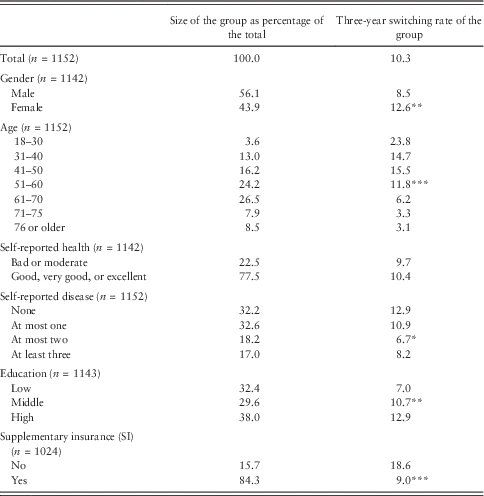
In the period 2010–2012, 10.3% of all consumers switched insurer at least once: 8.85% switched once, 1.39% switched two times, and 0.09% switched three times. Bivariate analyses show that switching rates differ significantly among age groups (Table 3). For example, about 3% of the consumers aged 76 or older switched insurer at least once in the period 2010–2012 compared to about 15% of the consumers aged 31–50. Consumers without a self-reported disease were about 40% more likely to switch insurer than consumers with a self-reported disease. In contrast, based on consumers’ three-year switching rate and subjective health indicators, we can conclude that consumers with a good, very good, or excellent self-reported health are not more inclined to switch insurer than consumers with a bad or moderate self-reported health. This may partly be affected by the fact that respondents revealing their perceived health status take their age into account. High-educated people switched insurer about 85% more than low-educated people. Furthermore, consumers without a SI switched twice as much as consumers with a SI.
Percentage of consumers that switched insurer (yes/no)Footnote a, Footnote b in the period 2010–2012
a We asked consumers whether they switched insurer. Dutch insurers are allowed to offer the BI under different names. Consequently, consumers who switched to a BI that is offered under another name by their current insurer may have stated that they switched insurer while they did actually not.
b ‘Yes’ indicates a switch on 1 January 2010, and/or 1 January 2011, and/or 1 January 2012 (i.e. ‘three-year switching rate’).
*p<0.10; **p<0.05; ***p<0.01.
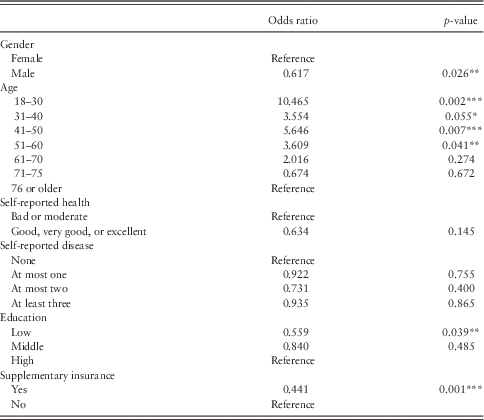
Multivariate analyses do also show that elderly consumers are, ceteris paribus, less inclined to switch insurer than young consumers (Table 4). For example, the odds of having switched in the period 2010–2012 for those aged 41–50 are 565% of those aged 76 or older, ceteris paribus. The difference in switching behaviour of consumers with and consumer without a self-reported disease disappears after adjusting for age. The results regarding education and SI are consistent with previous studies: low-educated consumers and consumers with SI were less likely to switch insurer than, respectively, high-educated consumers and consumers without SI, ceteris paribus. For example, keeping all other explanatory variables constant, having a SI decreases the odds by 56% compared to having no SI.
Logit model of consumer’s decision to switch insurer (yes/no)Footnote a in the period 2010–2012 (n=1009)
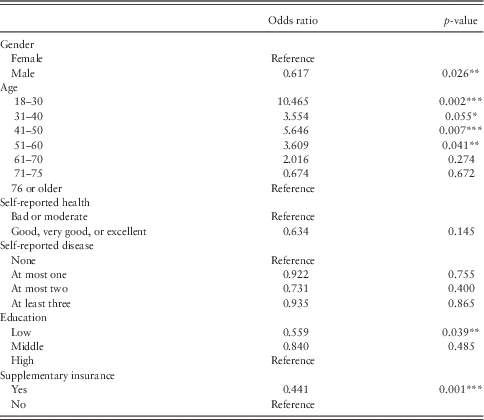
a ‘Yes’ indicates a switch on 1 January 2010, and/or 1 January 2011, and/or 1 January 2012 (i.e. ‘three-year switching rate’).
McFadden R 2=0.086
*p<0.10; **p<0.05; ***p<0.01.
5 Interpretation of our results
Consumers will switch insurer if their perceived switching benefits outweigh their perceived switching costs (Scanlon et al., Reference Scanlon, Chernew and Lave1997; Laske-Aldershof et al., Reference Laske-Aldershof, Schut, Beck, Greß, Shmueli and van de Voorde2004). Therefore, switching rates indicate for which proportion of consumers the switching benefits did outweigh the switching costs.Footnote 9 Our main finding is that switching rates decrease sharply with age. This raises the question: did elderly consumers switch less frequently than young consumers because they (1) face higher switching costs; (2) face lower switching benefits; or (3) face higher switching costs and lower switching benefits?
5.1 Switching costs
Previous studies mentioned that the differences in the switching behaviour of young and elderly consumers can be attributed to differences in their switching costs (Atherly et al., Reference Atherly, Florence and Thorpe2005; Shmueli et al., Reference Shmueli, Bendelac and Achdut2007; Hendriks et al., Reference Hendriks, de Jong, van den Brink-Muinen and Groenewegen2010; Lako et al., Reference Lako, Rosenau and Daw2011; Reitsma-van Rooijen et al., Reference Reitsma-van Rooijen, de Jong and Rijken2011Footnote 10).Footnote 11 The finding is supported by Nosal (Reference Nosal2012) and Handel (Reference Handel2013) who found higher switching costs in the US Medicare market with relatively old consumers (65+) than in the US employer-sponsored insurance market with relatively young consumers (below 65). Nosal (Reference Nosal2012) found a switching cost of $4163 for the median Medicare consumer and Handel (Reference Handel2013) showed that, due to switching costs, an average employee forgoes $2032 each year in expected savings from an alternative option. In addition, Buchmueller (Reference Buchmueller2000) and Strombom et al. (Reference Strombom, Buchmueller and Feldstein2002) found that young consumers were more price sensitive than elderly consumers and attributed this finding to lower switching costs for young consumers than for elderly consumers.
Given this background, it seems likely that differences in the perceived switching costs by young and elderly consumers are also an explanation for our results. Elderly consumers may face higher transaction costs than young consumers, because they may consider price and quality information, while young consumers may be interested in price information only (Hendriks et al., Reference Hendriks, de Jong, van den Brink-Muinen and Groenewegen2010). Different studies did further conclude that elderly consumers have more difficulties with processing health insurance information than young consumers (Hibbard et al., Reference Hibbard, Slovic, Peters, Finucane and Tusler2001; Hanoch and Rice, Reference Hanoch and Rice2006). Moreover, the psychological switching costs of elderly consumers – which may result from habit, tradition, and sunk costs (Samuelson and Zeckhauser, Reference Samuelson and Zeckhauser1988; Frank and Lamiraud, Reference Frank and Lamiraud2009) – may be greater than the psychological switching costs of young consumers. For example, elderly consumers may face higher sunk costs – that is the non-recoverable investments in terms of time, money, and effort in establishing and maintaining a relationship with the current insurer (Duijmelinck et al., Reference Duijmelinck, Mosca and van de Ven2015) – than young consumers, because elderly consumers may be quite familiar with the rules and procedures of their current insurer (Samuelson and Zeckhauser, Reference Samuelson and Zeckhauser1988; Zhang et al., Reference Zhang, Cheung and Lee2012). This is consistent with the results of Beaulieu (Reference Beaulieu2002) and Frank and Lamiraud (Reference Frank and Lamiraud2009) who found that longer tenures of enrolment continuously reduce the likelihood of switching. In addition, previous studies showed that elderly consumers mentioned the loss of the favourable conditions of their current SI – in terms of premium and acceptance – more frequently as a switching barrier than young consumers (Duijmelinck and van de Ven, Reference Duijmelinck and van de Ven2014).
Consumers choosing an insurer for the first time – which are most likely the consumers aged 18–24 – may be the consumer group with the lowest switching costs (Pomp et al., Reference Pomp, Shestalova and Rangel2005). For example, sunk costs and the loss of the favourable conditions of SI may be irrelevant switching costs for these consumers entering the health insurance market. Therefore, low switching costs may explain their high switching propensity.
5.2 Switching benefits
Potential switching benefits for consumers are: price, (financial) welcome gifts, the benefits of SI, the insurer’s service level, and the insurer’s contracted provider network (i.e. the quality of the provider network and the freedom to choose a provider or drug) (Duijmelinck et al., Reference Duijmelinck, Mosca and van de Ven2015). During the research period, these switching benefits were quite comparable for low-risks and high-risks in the Netherlands. First, insurers did mainly compete on price (Brabers et al., Reference Brabers, Reitsma-van Rooijen and de Jong2012), which is a relevant switching benefit for both elderly and young consumers. Second, welcome gifts were a relevant switching benefit for both consumer groups, because there were no indications that insurers provided welcome gifts to attract specific consumer groups. Third, given the considerable amount of differentiated SI products in the Dutch health insurance market (e.g. in 2009, consumers had the choice among about 370 SI products (NZa, 2009)), SI was a switching benefit for both young and elderly consumers. Because the SI coverage regarding maternity care is a relevant switching benefit for young females, young females were probably more inclined to switch insurer than young males. Fourth, the insurer’s service level and the insurer’s contracted provider network are in particular important switching benefits for high-risks because of their high health care use. However, these were quite irrelevant switching benefits during the research period (Brabers et al., Reference Brabers, Reitsma-van Rooijen and de Jong2012). For example, in the period 2009–2012, insurers contracted all hospitals (NZa, 2009, 2010, 2011, 2012).
So far, the above mentioned arguments indicate that during our research period switching benefits were roughly similar for young consumers and elderly consumers. However, consumers’ switching benefits are also influenced by consumers’ switching behaviour in previous years. The switching benefits for consumers who did not switch in previous years will be relatively higher than the switching benefits for consumers who did so. For example, the latter group may have switched to lower-priced insurance products, while the former group may still have to pay a high price. In the period 2006–2008, elderly consumers were – such as in later years – less likely to switch insurer than young consumers (Vektis, 2006, 2007, 2008). This implies that elderly consumers faced on average higher switching benefits in the period 2009–2012 than young consumers.Footnote 12
The above arguments lead to the conclusion that during the research period the switching benefits for the elderly consumers were not lower than those of the young consumers. This implies that the substantial lower switching rate of the elderly consumers compared to the young consumers cannot be explained by a difference in their switching benefits. Therefore, we conclude that elderly consumers face higher switching costs than young consumers.
6 Discussion
In general, low switching rates in the health insurance market may have some positive side-effects, such as low administrative expenditures and increased insurers’ incentives to invest in preventive care (Pomp et al., Reference Pomp, Shestalova and Rangel2005; Brandon et al., Reference Brandon, Sundaram and Dunham2009; Lako et al., Reference Lako, Rosenau and Daw2011). However, in the Netherlands the low switching rates are concentrated among the elderly consumers who perceive high switching costs compared to their switching benefits. In this respect, the positive effects do most likely not outweigh the potential negative effects.
First, large differences in switching rates among groups of consumers reduce effective price competition (Pomp et al., Reference Pomp, Shestalova and Rangel2005; Nosal, Reference Nosal2012). Insurers may initially charge premiums below costs to attract consumers and subsequently increase their premiums to exploit consumers with high switching costs (Pomp et al., Reference Pomp, Shestalova and Rangel2005; Farrell and Klemperer, Reference Farrell and Klemperer2007; Han et al., Reference Han, Ko and Urmie2014). Simultaneously, they could introduce cheaper products to attract the consumers with low switching costs. Marzilli Ericson (Reference Marzilli Ericson2012) provided evidence for such insurers’ behaviour in the US Medicare Part D insurance market. Insurers who charge very low premiums to attract the consumers with low switching costs may enter the market. However, incumbent insurers can keep their premiums above the premiums of entrants, because the profits made on those consumers who do not switch may outweigh the losses associated with the consumers who switch to new entrants (Pomp et al., Reference Pomp, Shestalova and Rangel2005).
Second, lower switching rates for elderly consumers than for young consumers may reduce insurers’ incentives to act as quality-conscious purchasers of care for the elderly consumers (Pomp et al., Reference Pomp, Shestalova and Rangel2005; Shmueli et al., Reference Shmueli, Bendelac and Achdut2007). The developments in the Dutch long-term care sector may exacerbate this problem. In 2015, insurers became responsible for the purchase of long-term outpatient care (i.e. nursing and personal care). In particular elderly consumers need this type of care (Sietsma and Groot Koerkamp, Reference Sietsma and Groot Koerkamp2014). Due to the high perceived switching costs by elderly consumers compared to their switching benefits, it is questionable whether insurers are sufficiently motivated to become prudent buyers of long-term outpatient care.
Third, in case of an imperfect risk equalization model, cross-subsidies among risk groups may be threatened, because young consumers with low switching costs can switch to lower-priced alternatives (Atherly et al., Reference Atherly, Florence and Thorpe2005). For example, Nuscheler and Knaus (Reference Nuscheler and Knaus2005) found that heterogeneous switching costs resulted in the separation of low-risks from high-risks in the German public health insurance system.
To avoid the above effects, the Dutch government should develop strategies to improve elderly consumers’ choice of insurer. For example, the integration of BI and SI into one basic-plus-insurance (BPI) would be an effective solution to decrease the switching costs of the elderly consumers and the chronically ill (Duijmelinck and van de Ven, Reference Duijmelinck and van de Ven2014). This solution takes into account that almost all insurers currently offer BI and SI as a joint product and that one-stop shopping has several advantages for consumers (e.g. a good coordination of basic benefits and supplemental benefits). After the introduction of a BPI, open enrolment also holds for the supplemental benefits. Insurers are still allowed to apply risk rating for the supplemental benefits within the BPI. However, they must charge groups of enrolees with equal risk characteristics and the same supplemental benefits, the same premium. Consequently, consumers opting for a BPI would no longer face the risk that a new insurer imposes less favourable conditions for SI in the next contract period than their current insurer does (Duijmelinck and van de Ven, Reference Duijmelinck and van de Ven2014). A BPI will not threaten the affordability of the basic benefits, because insurers are still bound to community-rated premiums for the basic benefits.
In addition, special attention should be paid to potential strategies to decrease the transaction costs of elderly consumers, for example by focusing on the development of standardized health insurance information that is easily to understand (Hibbard et al., Reference Hibbard, Slovic, Peters, Finucane and Tusler2001; Hanoch and Rice, Reference Hanoch and Rice2006). Moreover, the regulator could launch an information campaign – for example via television and newspapers – that emphasizes the potential switching benefits for elderly consumers in the health insurance market. This campaign could encourage elderly consumers to compare the insurance products of different insurers with each other.
Furthermore, next to the exit option, consumers could express dissatisfaction with their current insurer by using the ‘voice option’ (Hirschman, Reference Hirschman1970). As long as elderly consumers do not have equal opportunities as young consumers to act as well informed and empowered buyers in the health insurance market, the voice option should be effectively facilitated for the elderly consumers; for example by establishing consumer councils and consumer questionnaires.
Due to the lack of selective contracting in the Netherlands, the costs of (not) switching to another health care provider were irrelevant during the research period. These switching costs may be more relevant in later years, because since 2013 Dutch insurers started to selectively contract with health care providers more frequently. Consumers’ switching benefits may have also increase, because an insurer’s contracted provider network may have become a relevant switching benefit in the health insurance market. For consumer’s choice of insurer it is crucial that the switching costs do not increase more rapidly than the switching benefits. Future research can pay attention to this subject. Moreover, future research could attempt to quantify the size of the switching benefits and the switching costs for different consumer groups.
7 Conclusion
In competitive health insurance markets, consumer’s choice of insurer disciplines the insurers to be responsive to consumer preferences. Because these preferences differ among consumer groups, all groups of consumers with specific preferences must be free (and must feel free) to easily switch insurer. We analysed administrative data with objective health status information (i.e. medically diagnosed diseases and pharmaceutical use) and information on health care expenses of nearly the entire Dutch population to evaluate switching rates in the Netherlands in 2009. Our findings indicate that switching rates decrease strongly with age. For example, consumers aged 25–44 switched 10 times more than consumers aged 75 or older. The same conclusion holds when evaluating whether consumers switched in the period 2010–2012 (i.e. a three-year switching rate). In addition, we found that switching rates strongly decrease as the predicted health care expenses increase. For example, 5% of the consumers with very low predicted health care expenses switched insurer in 2009, while this percentage decreases to about 0.5 for consumers with high predicted health care expenses. Another finding is that although healthy consumers switch twice as much as unhealthy consumers, this difference becomes much smaller after adjusting for age.
We conclude that our findings can be explained by higher perceived switching costs by elderly consumers than by young consumers. Because an essential precondition of a competitive health insurance market – the disciplining effect of ‘voting with one’s feet’ – is not fulfilled for elderly consumers, insurers have low incentives to act as quality-conscious purchasers of care for them. Policymakers should develop strategies to increase the choice of insurer of elderly consumers, because a competitive health insurance market can only succeed if all groups of consumers with specific preferences feel free to easily switch insurer.
Acknowledgements
The authors would like to thank René van Vliet for his valuable help with the data analyses.
Funding source
This study was partly supported by the Dutch Healthcare Authority (NZa). The views expressed in this paper are those of the authors and not of the Dutch Healthcare Authority.