





A pupil of the Irish Baptist minister Alexander Carson (1776–1849) once tried to test his teacher’s patience by reading out loud to him for five consecutive hours from ‘an obscure and prosy’ book that the student believed was ‘monotonous enough to set a world asleep’. To Carson’s credit, and his student’s consternation, the minister not only remained attentive throughout the reading but, after the five hours had passed, was unsatisfied and eager for more.Footnote 1 The book in question was William Warburton’s The divine legation of Moses demonstrated, a colossal piece of scholarly theology that appeared in three volumes first published in 1738, 1741, and, posthumously, in 1788.Footnote 2 A work of immense erudition, the book has long had a reputation for being vast, sleepy, and abstruse. Based on Warburton’s deep explorations into half a dozen specialist fields, it is famous for making, but then cunningly twisting, what by 1738 had become known as a provocative freethinking argument: that the writings of Moses contained no promises of future rewards and punishments, or indeed any indication of eternal life.Footnote 3 For freethinkers, this challenged the divine inspiration of those scriptures, for how God-inspired can a text really be that has no mention of immortality? But in Warburton’s hands, apparently damning evidence became an apologetic goldmine. Warburton argued that a doctrine of a future state was absolutely necessary to the functioning of any civil society, and thus the ostensibly embarrassing fact that Moses taught no such doctrine – and yet managed a civil society! – proved his dispensation simply had to have been supported by divine providence.Footnote 4 Prosecuting this argument led Warburton to discuss, in maddening detail, such recondite topics as scientific chronology, pagan mysteries, and the history of writing and especially of hieroglyphics, dedicating hundreds of pages to this last topic alone.
It is difficult for those who have read the three volumes of the Divine legation (hereafter DL) to imagine it had any appeal in the eighteenth century beyond the academics and clerics who worked on these complex issues. Not only was its driving argument something of a paradox, but its multiple volumes together ran to over 2,000 pages of dense prose, flaunting many hundreds of citations and lengthy, highly technical tangents whose connection to the main argument was not always immediately apparent. As one eighteenth-century reader quipped, the DL’s ‘chain of reasoning is so fine that it cannot be seen but by the best microscopes’.Footnote 5 A reviewer for The London Mercury branded Warburton’s style as ‘copious without selection’,Footnote 6 while the salonnière Elizabeth Montagu (1718–1800) described the book as ‘a library which contains many volumes, but has a librarian without judgment, and without taste’.Footnote 7 Given these withering reviews, it is not particularly surprising that while the playwright, poet, and politician Richard Brinsley Sheridan (1751–1816) boasted of having read every volume in his library ‘twice over’, he admitted that he had not managed to make it through the DL a second time.Footnote 8
It is the motivating contention of this article that despite the DL’s technical complexities and manifest ‘sleepiness’, in the middle decades of the eighteenth century the book nevertheless generated a sensation. This is to use a term that amongst intellectual historians has most often been applied to the reception of radical nineteenth-century books, from Robert Chambers’s Vestiges of the natural history of creation (1844) to J. R. Seeley’s Ecce homo (1865).Footnote 9 On first glance it seems perverse to compare the DL to these blockbusters, whose radical takes on evolution and the life of Christ sold in astonishing numbers. The above assessments certainly seem to imply Warburton’s tome was hugely off-putting for the non-specialist reader. However, the very fact that the DL was profiled in popular newspapers and read by the likes of Montagu and Sheridan is already suggestive of its visibility in the public sphere. Libraries, auction catalogues, and other evidence of reading practices show that while academics and clergymen unsurprisingly made up a large proportion of the book’s audience, readers of the DL in fact hailed from a great variety of professions, from physicians, surgeons, and apothecaries,Footnote 10 to natural philosophers, antiquarians, and landscape gardeners,Footnote 11 and army officers, jurists, politicians, and tradesmen.Footnote 12 It should not surprise us that women, too, read the DL; in the 1770s, Elizabeth Rose, the lady laird of Kilravock, finally located ‘a book I have been in search of since … last year’, Warburton’s ‘controversial’ DL.Footnote 13 Interest in the book was such that, in 1741, a debate on ‘The Tendency of the Principles of the Rev. Mr. W––b––n’s Divine Legation of Moses’ was held in the Oratory, near Lincoln’s-Inn Fields in London, a site for public disputation organized by the preacher John Henley that was known to attract diverse crowds.Footnote 14 The DL was in such demand in circulating libraries even across the Atlantic that in 1746 the governor of Virginia told Warburton that when it was added to the public library in Pennsylvania, it ‘soon became the subject of all conversation. Never were such struggles about any book, who should first read it’.Footnote 15 A few years later, a Charleston bookseller whose shop functioned as a lending library placed advertisements in the local Gazette asking ‘all Persons that have borrowed any of his Books, (particularly the 3 Vols. of Warburton’s divine Legation of Moses…) to be so kind as to return them immediately’.Footnote 16
Despite the fact that author and book appear regularly in primary records of eighteenth-century reading, the DL’s reputation for sleepiness continues to colour how historians treat it. A recent suggestion that the DL was a ‘populist’ work, for instance, has been met with cynicism.Footnote 17 Reflecting on the DL’s reception in the nineteenth century, a reviewer remarked that, in its day, the book ‘excited universal attention’, but such comments, despite their frequency, have generally not been taken seriously.Footnote 18 A central empirical contribution of the present article is to show that the DL, and the many pamphlets in which Warburton fortified his case, were printed in numerous editions and in upwards of 10,000 copies in the eighteenth century. The book remained in the public eye for decades, its arguments stirring up controversy in pamphlets and the periodical press that were also widely read. Later in the article I show how this incessant attention ultimately catapulted Warburton himself into the spotlight. In just a few short years, a cleric became ‘famous beyond example’,Footnote 19 a celebrity whose private life – including, most remarkably, his sex life – was profiled and caricatured in gossipy magazines. The more famous the book, the more famous the author, but this also went the other way round. As Warburton’s renown as a scholar grew, so did his notoriety as an uncommonly angry disputant, and a feverish desire to witness his ‘theological rage’ in action only further fed the sensation.Footnote 20 Impoliteness was supremely marketable.
As a self-taught scholar who, despite never attending university, worked his way up to the bishopric of Gloucester, Warburton was a remarkably versatile author. He is known to literary historians as an editor of Shakespeare and executor of Alexander Pope. Enlightenment historians, meanwhile, know him as a proponent of the so-called ‘conservative’ or ‘clerical Enlightenment’ who sparred with luminaries like David Hume.Footnote 21 As the erudite product of a skilled autodidact, the DL has been studied almost exclusively in the context of the period’s scholarly-theological battles.Footnote 22 In this article, I consider Warburton and his book through two different but complementary lenses: the history of print and the history of celebrity. On the one hand, Warburton’s success was the product of a period in which religious works, despite stereotypes about the Enlightenment, were marketed at and read by a far wider readership than ever before.Footnote 23 In a context in which theologians were doubling down on religious radicalism, Warburton’s scholarship, which claimed to combat heterodoxy but appeared to be heterodox itself, turned heads beyond the ivory tower. Simultaneously, Warburton was himself an outsider in academic circles, his lack of university training upsetting dons who already felt their home turf was being appropriated by amateurs.Footnote 24 Yet as much as theology never ceased to matter, erudition was hardly the catchword of the eighteenth century. In many ways the DL was old-fashioned, its learned apparatus making it an unlikely candidate for a literary sensation.
So how did a ‘sleepy’ work of erudite scholarship become a bestseller, indeed a sensation, and its clerical author something of a celebrity? My argument in this article is that the sensation surrounding the DL was significantly ignited, and sustained, by the media ecology of the eighteenth century – that is, by the interplay of different genres, from the book and the pamphlet to journals, newspapers, magazines, and the printed image, and ultimately by marketing strategies behind the scenes. Here Warburton’s partnerships with printers and booksellers, with whom he worked closely, played a pivotal role. Drawing on a rich cache of primary evidence, and building on scholarship that has stressed the expertise of booksellers in securing market success, I show how Warburton and his printers and publishers worked together to manufacture the controversy the DL incited, creating a buzz and inflating the polemic for the market. By creating collectable product suites, designing ‘brands’ for scholars, and harnessing the reach and unique offer of the periodical press, an eighteenth-century ‘team’ could enflame a scholarly controversy in the public sphere and create a scholarly celebrity.
The eighteenth century is now seen as a critical turning point in the emergence of modern celebrity, when it became the norm for the public to be curious not just about dead figures who had achieved glory or notoriety, but also about living people they did not know personally.Footnote 25 Moreover, the curiosity of the public was not limited to the famous individual’s public life, but extended to their private life – in other words, to what happened ‘behind closed doors’.Footnote 26 In recent years we have learned much about how eighteenth-century actors, singers, novelists, poets, and scandalous philosophers like Voltaire and Rousseau were recognized on the street, received fan mail, and were represented in countless collectible portraits, while anecdotes about their private lives were printed ad nauseam.Footnote 27 On the face of it, it should not be surprising that the eighteenth century could also produce celebrities on the basis of a religious work. It was on the back of an incendiary Gunpowder Day sermon in November 1709 that the Oxford don Henry Sacheverell shot to stardom, such that he was featured in celebrity merchandise that ranged from playing cards and ladies’ fans to ceramic figurines and earthenware dishes.Footnote 28 A few decades later, John Wesley, the charismatic Methodist evangelist, likewise became a cultural icon whose face was at the centre of a personality cult.Footnote 29 Yet Warburton’s case is different to these clerical celebrities. Sacheverell’s fame was premised on a dramatic spectacle at St Paul’s, a public display of sedition that inflamed entrenched religious and political tensions and sparked violent riots. Merchandise featuring his image became shorthand for communicating political allegiances.Footnote 30 Wesley’s celebrity likewise had its origins in public performance, albeit of a different kind: though not explicitly political, his impassioned, open-air preaching nevertheless let loose a revival movement that was just as socially disruptive. By contrast, the DL’s sensation and Warburton’s celebrity did not have its beginnings in public spectacle, nor did the DL threaten to disrupt or undermine the status quo. Achieved against the odds, the notoriety of Warburton and his book over many decades illustrates perhaps more clearly than any other case the effectiveness of eighteenth-century ‘technologies of celebrity’, and the ability of the period’s media ecology to make the sleepy exciting.
I
The son of a Nottinghamshire attorney, William Warburton (1698–1779) began his working life in the law.Footnote 31 Although a schoolteacher remembered him as ‘the dullest of all dull scholars’,Footnote 32 a series of mentors gradually developed in him an appetite for voracious reading, which soon made him the butt of jokes about his extreme absentmindedness when absorbed in his books.Footnote 33 In 1723, Warburton’s extensive reading of theology and, according to one eighteenth-century biographer, his preference for ‘retirement to noise’, prompted him to leave the attorney’s office and take orders.Footnote 34 Four years later, his first substantial piece of scholarship was published; soon after, our autodidact was granted an honorary MA from Cambridge. On Warburton’s account, the publication of A critical and philosophical enquiry into the causes of prodigies and miracles (1727) was an accident. While at a London coffee house, he met the poet Matthew Concanon, then poor and seeking patronage, who upon receiving the manuscript from Warburton as a gift almost immediately sold it to a bookseller – without Warburton’s permission, and allegedly for ‘much more than [it was] worth’. This Warburton came to regret, later buying back the copyright to halt a second edition.Footnote 35 With this experience under his belt, Warburton was more strategic with his next major work. That was The alliance between church and state (1736), a contribution to debates about the Test Acts.Footnote 36 This time Warburton shared his manuscript with more eminent readers, not least Francis Hare, bishop of Chichester (1671–1740). Hare was so taken with the text that he promised to help ‘draw so ingenious and learned a man into the light of the world’.Footnote 37 It is probably no coincidence that the printer Hare had been working with for some years was the same one Warburton presently engaged for the Alliance and, soon after, the DL.
That printer was William Bowyer (1663–1737), who ran one of the major presses of eighteenth-century London. Located in Whitefriars, near the buzzing Fleet Street, this was a successful firm with a large array of clients, a wide range of printing types, and a business-savvy leader.Footnote 38 In 1716, Bowyer had sent his son of the same name (1699–1777) to university for the explicit purpose of having a learned corrector on hand.Footnote 39 After six years at Cambridge, Bowyer the younger joined the press with a firm grasp of Latin, Greek, and Hebrew; friendships with up-and-coming scholars who would later become clients; and a knack not just for correcting but also for offering substantive suggestions.Footnote 40 The Bowyer press quickly rose to prominence, being made printer to the Society of Antiquaries in 1736 and the Society for the Advancement of Learning in 1738–48. When Bowyer the younger took over after his father’s death in 1737, the press now had at its helm the country’s most erudite printer.Footnote 41
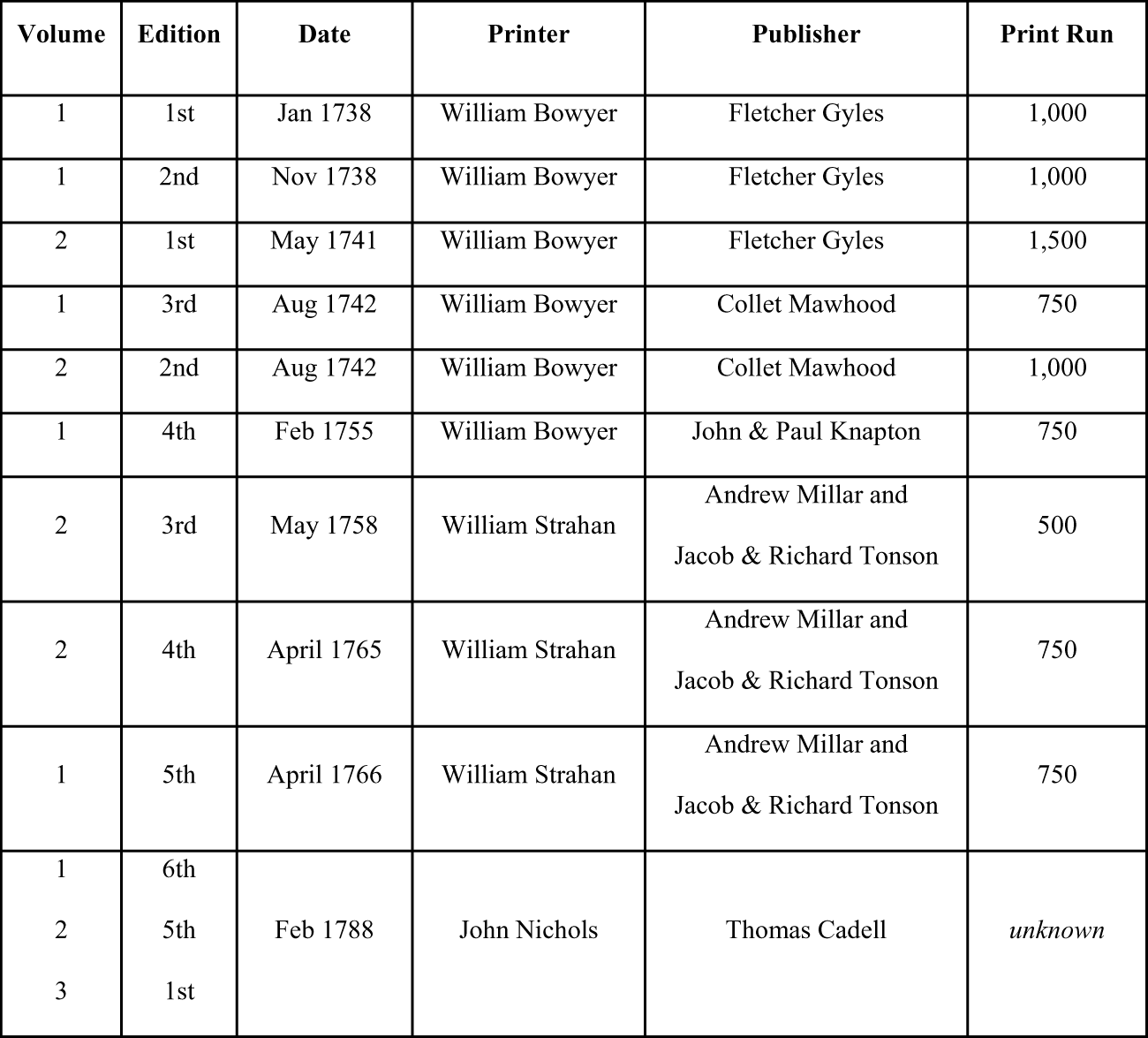
By the time Warburton and Bowyer joined forces, the Bowyers had good working relationships with several prominent booksellers, including Fletcher Gyles (1686–1741), who would become the first publisher of the Alliance and the DL.Footnote 42 Gyles was a logical choice for Warburton. He operated near Gray’s Inn, where Warburton frequently lodged, and had a large business in legal and religious books – Warburton’s dual interests. Like that of any successful bookseller, Gyles’s shop functioned as a meeting point, an informal postal service, a reading room, and a source for gossip.Footnote 43 Gyles was well-connected with the literary and scholarly worlds, and was also Bowyer the younger’s ‘intimate friend’.Footnote 44 Warburton quickly developed close relationships with both Gyles and Bowyer; in early 1739, he wrote of his happiness in having secured not just ‘a learned printer’, but ‘so candid a friend’.Footnote 45 Together, publisher, printer, and author made a robust team to shepherd Warburton’s major scholarly debut, and we can follow their strategies because much of their correspondence as well as Bowyer’s ledgers have survived.Footnote 46 These resources provide valuable information about the printing history of the DL (see Figure 1) and its controversies.
Printing history of the Divine legation, 1738–88Footnote 47

In 1736, Bowyer and Gyles had settled on a run of 750 copies for Warburton’s Alliance.Footnote 48 Written by a relative nobody, this was a test case for Warburton’s marketability. Its great success – alongside the fact that its substantial appendix had deliberately whetted readers’ appetites for the DL – evidently made Bowyer and Gyles comfortable opting for 1,000 copies for the first volume of Warburton’s magnum opus.Footnote 49 In general terms, this was not unusual. An average run at the Bowyer press was 500–1,000 copies, and this tallies well with the similar Strahan Ledgers (1738–85).Footnote 50 It was, however, unusual for a thick work of scholarship, which even Warburton knew was less sought-after than ‘Sermons & plays & novels’.Footnote 51 It is therefore remarkable that the DL continued to be printed in such high numbers in the following decades; moreover, a second edition of volume one was printed less than one year after the first. Between 1738 and 1788, volumes one and two went into six and five editions respectively, in runs ranging from 500 to 1,500. Moreover, less than two months after the first edition appeared, Warburton began to defend himself in pamphlets that across this period were also printed in many hundreds of copies.
Together, this was in essence a DL product suite, one that library catalogues suggest was eminently collectable.Footnote 52 Indeed, in less than a year after the book’s first appearance, ‘the Author of the Divine Legation of Moses’ was already becoming a recognizable brand. This was no accident, but the result of a deliberate publicity strategy. From the beginning, Warburton and his publication team acted tactically, jumping on opportunities to print defences, marketing Warburton’s writings as a package, and stirring up controversy by planting letters in journals. When the first volume was ready in early 1738, Gyles took out advertisements in no less than five papers, brazenly headed ‘DEDICATED to the FREE-THINKERS’, clearly what he believed was the book’s most controversial and thus sellable quality.Footnote 53 Gyles continued to advertise Warburton’s further writings widely, connecting each new addition to the collection by emphasizing that they were ‘all written by the same author’.Footnote 54 Soon even Warburton’s writings on Pope were advertised as ‘by the Author of the Divine Legation of Moses’.Footnote 55 As Richard Sher has found for Scottish authors later in the century, such techniques made the author a sellable product.Footnote 56 In the 1730s, advertisements in London papers usually cost two shillings for two-inches of column space.Footnote 57 When repeated over several weeks, in several papers, this quickly became a costly undertaking. Yet given the wide circulation of these texts, publishers like Gyles evidently calculated that their investment would pay off.
As a result, when the DL appeared in January 1738, readers were primed, and the response was immediate. An informative case study is provided by the Weekly Miscellany (1732–41). Widely known as the ‘clergyman’s’ or ‘parson’s paper’, the Miscellany was composed by a network of London and Cambridge clergymen and was largely read by their urban colleagues.Footnote 58 On 24 February 1738, the paper featured a front-page critique by the main editor, William Webster.Footnote 59 When Warburton heard the news, he wrote a Vindication, which Bowyer printed in 500 copies in March.Footnote 60 This prompted a second letter in the Miscellany, and by July the paper had attacked the DL in eleven separate issues.Footnote 61 This investment of attention was economically motivated: the paper’s editors, worried about their finances, incited a debate to boost subscriptions.Footnote 62 They managed this deftly, publishing a letter against the DL only every few issues and, in between, teasing readers that the next had been ‘receiv’d’ and would appear imminently.Footnote 63 Further interest was stirred up by the strategic planting of supplementary letters in papers like Old Common Sense.Footnote 64 Tellingly, Warburton and his team also jumped at the opportunity. Despite feeling so demoralized by the paper’s critiques that in June that he was ‘fully resolved … not only not to answer but even not to read any thing that wretch [Webster] writes ag[ains]t me’,Footnote 65 the support of friends soon raised Warburton’s spirits, and he began collecting the various papers in which Webster and his allies continued to hound him.Footnote 66 With his friend Robert Taylor, he then co-wrote short, anonymous responses that he arranged to be published in Old Common Sense.Footnote 67 Faith Working by Charity, a sermon he had preached two years earlier, but which was now reframed as a defence of the DL – complete with a postscript providing a delicious, behind-the-scenes glimpse of Warburton’s emotional response to the Miscellany – was printed by Bowyer in June in 750 copies.Footnote 68 Gyles advertised its publication in several papers, making sure to note that at his Holborn shop readers could also buy the DL, the Vindication, and even the Alliance.Footnote 69 After such a busy year, it is less surprising to see Warburton’s team already issuing a second edition of the DL’s first volume in November.
Most tellingly of all, when all the Miscellany letters were published together as Remarks on the divine legation in late 1739, Gyles wrote to his client to suggest that those written in Warburton’s defence ‘should be collected in the same manner’.Footnote 70 After all, the publisher had at his disposal not only Warburton’s own responses, but a number of letters defending the DL that had been published in the periodical press at the urging of Warburton and his team. Indeed, Warburton had deliberately cultivated friendships with a number of Cambridge men, including Lynford Caryl of Jesus College, who he encouraged to pen an anonymous response to Webster which was printed in the General Evening Post (GEP).Footnote 71 Printed in up to 6,000 copies in this period,Footnote 72 the GEP was sold by James Roberts (d. 1754), a collaborator of Bowyer’s.Footnote 73 Warburton himself also wrote two anonymous letters for the same paper, in which he accused the Miscellany of ‘draw[ing] [Warburton] into a Controversy’ in order to ‘sell your Ware’.Footnote 74 He then went on to maintain rumours that these letters were written by Taylor.Footnote 75 By late 1739, therefore, there was much material for Gyles to draw together into ‘a collection’.Footnote 76 When he informed his client of his plans, Warburton told Gyles that if it was ‘worth his while’, he would be happy to act ‘for his interest’, all the while proudly feigning ‘indifference’ about Gyles’s schemes to his friends.Footnote 77 In reality, this was a printing strategy which Warburton had begun to pursue for his own letters in defence of Pope,Footnote 78 and one that his mentor Hare had told him to expect from his publishers.Footnote 79 Warburton had also recently learned of the money such publications could make, for while he initially thought that the Pope collection might sell for a sixpence, he soon learned it could be sold for a shilling.Footnote 80 So, Warburton sent his publisher ‘a Catalogue’,Footnote 81 engaged Taylor to help prepare a preface, and believed Gyles was best placed to choose a title.Footnote 82
To my knowledge Gyles’s collection never appeared, but this is likely because this was not the only DL controversy occupying Warburton and his team in 1739. In March that year a prominent sermon had been preached against the book at the University Church in Oxford by William Romaine. It was published a little over a month later.Footnote 83 When Warburton heard the news, he was reminded of a letter he had received the previous October from one ‘W. Romaine’. He now forwarded the letter to Gyles, suggesting he might want to publish it in a small pamphlet alongside a reply from Warburton. Not content to stop here, Warburton also wrote to his friend Thomas Birch – who at the time was playing the middle man between Warburton and Jacob Robinson, a potential editor of Warburton’s letters on Pope – to instruct him to obtain a copy of Romaine’s letter from Gyles and then to arrange for their correspondence to be printed in April in Robinson’s History of the Works of the Learned, which had printed a review of the DL a year earlier.Footnote 84 When the timing did not work out, Warburton ensured the letters were printed instead in the GEP, along with a promise to readers that they could see the originals in Gyles’s bookshop.Footnote 85
Within a few weeks, an incensed reply from Romaine was printed in the same paper, in which he accused Warburton ‘and his Bookseller’ of distracting the public from ‘the points in dispute’ with ‘a personal quarrel’.Footnote 86 Enraged, Warburton asked Birch to arrange for the whole correspondence to be printed in the Gentleman’s Magazine,Footnote 87 a hugely popular periodical to which Birch was editorial adviser.Footnote 88 Birch failed once again to satisfy his friend’s request, but Warburton was mollified when the letters finally appeared in Works of the Learned with additional commentary.Footnote 89 This silenced Romaine for a time, but when the second volume of the DL was published a few years later in May 1741, he fought back in December with yet another Oxford sermon.Footnote 90 However, by now Warburton was so fed up with this ‘Theologaster’ that he was happy to leave this particular controversy behind.Footnote 91
At that point Warburton was in any case preoccupied with building a new publishing team. In November 1741, Gyles had passed away a year after his own son, leaving his business without a master and Warburton without a publisher. That Warburton’s business was already considered likely to turn a fine profit is suggested by the events that followed. The third edition of volume one was at the time in press, and the second edition of volume two was to be printed imminently. Regrettably, Warburton had not yet made a firm agreement with his publisher regarding the allocation of profits.Footnote 92 After Gyles’s death, Warburton found himself negotiating with his late publisher’s two daughters and executor. Talks were difficult and left a bad taste.Footnote 93 Deeply unsatisfied, Warburton set about considering his options.Footnote 94 Fortunately, he was in a good position. Within a fortnight of Gyles’s death, two booksellers had eagerly approached Pope to offer their services to Warburton: John Knapton (bap. 1696–1770), who had mostly worked with theologians and whose main printer was the Bowyer Press, and Charles Bathurst (fl. 1737–86), whose trade was much smaller. Knapton’s letter arrived first, and Pope foregrounded his application to Warburton, writing to recommend ‘a Bookseller in the room of the honest one you have lost’.Footnote 95 A few days later Pope informed Bathurst that Warburton had chosen Knapton.Footnote 96 Pope was delighted, telling Warburton that no one ‘knows the trade’ like Knapton.Footnote 97 Indeed, Knapton lost no time publishing a slew of Warburtonia. The DL was still being attacked in dozens of books, pamphlets, and periodicals, and Knapton took advantage of the controversy by printing works both for and against it.Footnote 98
Knapton was not the only bookseller who foresaw the value of a financial stake in Warburton’s scholarship. In 1742, Andrew Millar (1705–68), who was by this time running one of the largest publishing firms in Britain,Footnote 99 sought out and purchased a share of the copyright of the DL.Footnote 100 Later, in 1755, when Knapton was forced to sell most of his copyrights to keep his business afloat, Millar jumped at the opportunity to control the whole, even clandestinely negotiating with Warburton outside of the auction.Footnote 101 Soon, Millar and his colleague Somerset Draper were able to print Warburton’s books as they liked, reaping half the profits.Footnote 102 Warburton claimed to trust them ‘on account of my knowledge of them, & affairs I have had with them’.Footnote 103 There was, however, one prickly issue. Millar was publisher to several of Warburton’s bitter rivals, including Viscount Bolingbroke.Footnote 104 When berated by Warburton for this, Millar agreed ‘no[t] to have anything to do with [Bolingbroke’s works]’ henceforth.Footnote 105 Although Millar did not stand by this promise, when he later published David Hume, another of Warburton’s enemies, he successfully appeased his jealous client by allowing him to look over the pre-publication manuscripts.Footnote 106
After he had secured the DL copyrights, which he now shared with the Tonson family press, Millar published three new editions of the DL, now with the leading printer William Strahan. Yet like Knapton, he also took on the publication of books written against it by, for example, Francis Blackburne. Millar hid this double-dipping by ensuring that the name of his warehouseman, Samuel Bladon (1733–99), was printed on the title page instead of his own.Footnote 107 As Adam Budd has noted, Millar’s strategies ultimately worked for both publisher and author, for he was able to ‘maximize’ the impact of the controversy by in this case delaying the publication of rival works so that they might cause more of a stir.Footnote 108 Much the same might be said for Millar’s takeover of the publication of the incendiary Letter to the Right Reverend Dr. Warburton (1760) by Robert Lowth. While working on the fourth edition of Warburton’s second volume in 1765 – which included an appendix responding to Lowth – Millar acquired the copyright to the Letter and engaged Bowyer to print 1,500 copies of a second edition that would appear six months after the new DL edition.Footnote 109 The gambit proved successful, for Millar went on to publish several further editions of Lowth’s pamphlet, in many hundreds of copies, which apparently ‘sold off so fast, that many gentlemen were obliged to wait for a new impression’.Footnote 110 This in turn encouraged further demand for new editions of the DL, printed ‘speedily’ in the years that followed.Footnote 111
II
Taken together, these episodes point to the proficiency of Warburton’s team in navigating the eighteenth-century book trade. By aligning himself with a learned printer and savvy and well-connected publishers, Warburton made it possible for a complex, erudite-theological work to gain broad attention. Just how famous the book and its author would become from the middle decades of the century onwards, however, was something none of these actors predicted. What began as efforts in production and promotion soon turned the DL into a sensation. Here the media ecology of the period was crucial, as the interplay between different genres of print, and the proliferation of the arguments of the book and of its detractors in periodicals, kept the DL in the public eye for decades. Endlessly profiled in newspapers, magazines, and the ever-expanding review machine, the DL became more than a book: it became a controversy. Here again Warburton and his team played critical roles, even if they gradually lost control of the narrative.
In the middle decades of the eighteenth century, reviews of the DL’s various volumes and editions appeared in many periodicals, both learned and ‘popular’. Of the more scholarly outlets, the History of the Works of the Learned was the first to offer a discussion of volume one in April 1738.Footnote 112 By the publication of volume two, the journal had dedicated over 150 pages to Warburton’s work, including the letters with Romaine mentioned above. As well as providing commentary, the journal’s editors saw it as their role to offer readers who did not have ‘Recourse to the Original’ with overviews of new books.Footnote 113 Warburton and his friends agreed: journals should provide abridgements of books so that ‘those, who have never read them, [might have] some idea of their contents’.Footnote 114 Yet Warburton was ultimately displeased with the journal’s account of his first volume, calling the review ‘nonsensical’ and the periodical ‘a most miserable one’. In an attempt to patch up his friend’s bruised ego, the Congregationalist minister Philip Doddridge offered to write a sympathetic overview of the forthcoming volume two. Warburton agreed, and in early 1741 arranged for Gyles to send him sheets from the volume, which was then in press.Footnote 115 A few months later, Warburton confirmed that although the volume’s publication had been delayed, the editor of the journal, Robinson, was on board with their plans.Footnote 116 Warburton received Doddridge’s review a month after the book’s eventual appearance in May, but he ultimately concluded it ‘too good for the journal’, deciding instead to incorporate his friend’s text into his own third volume! Warburton’s actions here were partly conditioned by his belief that a secondary function of learned reviews was to increase sales. And, as it turned out, sales of volume two were already high even one month after its publication, so Warburton concluded that ‘an account of it in the journal is the less necessary’.Footnote 117
Interest in DL was fast gaining momentum. By the 1750s, it had incited pamphlet controversies with numerous scholars, including Julius Bate, Conyers Middleton, Henry Stebbing, Arthur Ashley Sykes, John Tillard, and many others. Here periodicals continued to play an important role, dedicating hundreds of pages to reviews of and letters about the books and pamphlets published both for and against the DL. They also, crucially, brought ‘hype’. For instance, one pamphlet that promised to overthrow ‘all that Mr. Warburton has said about … Moses, &c’ was in such ‘extraordinary demand’ in 1745, according to the Daily Advertiser, that a new edition was on its way.Footnote 118 Warburton’s disagreements with Edmund Law were similarly discussed in The London Magazine,Footnote 119 and his scuffle with Middleton extracted and profiled in the Newcastle General Magazine.Footnote 120 Far larger outlets also played a role. Having passed by the opportunity to print the Warburton-Romaine controversy, in the 1750s The Gentleman’s Magazine – which had print-runs of around 3,000 and reached readers far beyond this number as it circulated between households and within coffeehouses – now published extensive commentary on the DL as well as its supporters and detractors.Footnote 121
These publications enabled a virtual public conversation about the DL. The periodical press was, after all, dialogic. Newspapers printed passionate letters in defence of Warburton, with several admirers even submitting deferential poetry.Footnote 122 In the late 1760s, The London Magazine printed an exchange of letters about the consequences of the DL. It began with a note from one ‘Y.Z.’ that begged the reader’s pardon for ‘adding a little to the chit-chat … that book has occasioned’. He had first learned about the DL twelve years earlier, when a lady read out to him an argument against it from a ‘deistical book’ to the effect that ‘the divine legation of the lawgiver of the Hottentots’, might be as effectively proved as that of Moses ‘by the medium of the omission of a future state’. Y.Z. could not get this critique out of his head. ‘Common chit-chat’ had taught him that Warburton’s scheme was a poorly constructed paradox; however, when he finally read it for himself, he realized his assumptions were misplaced. He therefore wrote to the magazine to inform others: ‘Don’t censure before you read. Judge for yourself’.Footnote 123 Soon ‘A.B.’ vehemently disagreed, arguing that by writing about the book in The London Magazine, Y.Z. would only raise its profile and thus make it more available to freethinkers.Footnote 124 Letters published in The Gentleman’s Magazine also referred to many in-person conversations about Warburton’s arguments.Footnote 125 In September 1765, for instance, ‘B.N.’ wrote to the London Chronicle in the hope the editor would ‘communicate … to the Publick through your paper’ a detailed record of a recent conversation about the book.Footnote 126 Examples like these point to how periodicals might function as a repository of oral culture; at the very least – given that some of these kinds of letters may have been fabricated by editors or even authors like Warburton – they offer an indication of what contemporary oral discussions were expected to look like.
Although the genre dates to the later seventeenth century,Footnote 127 the middle decades of the eighteenth saw the emergence of several new and highly successful review journals aimed at a general audience, not least the Monthly Review from 1749 and the Critical Review from 1756. Ostensibly grounded in an attempt to save the public’s time and money by cataloguing the books worth investing in and those to avoid, as time went on these journals shifted from providing more or less objective reports to offering critical judgements. Although these two journals in particular were founded several years after the early editions of the DL, they published reviews about numerous pamphlets written in response to it before seizing upon the very next edition to come on the market. For the Monthly Review that was the fourth edition of volume one in 1755, followed soon after by the third edition of volume two in 1758. Given that ‘the generality of our readers are sufficiently acquainted with the Divine Legation, and the force of the several objections that have been brought against it’,Footnote 128 these reviews were mainly intended to outline Warburton’s edits so that readers of earlier versions did not need to purchase new copies.Footnote 129 In so doing they detailed the DL’s scholarly apparatus, as well as the ways in which its arguments and analysis might update or overturn other scholarly work, suggesting an expectation that their audience would be interested in these finer particulars.
Articles in The Critical Review, which were also reprinted in The Great Magazine of Magazines, served much the same function. As the reviewer of the 1758 edition explained, those who had purchased the first edition would be likely to ‘raise some complaints’ at the appearance of yet another text. A full account of the revisions, however, would bypass the need to ‘be at the fresh expence of buying [it] again … pay[ing] pretty dear for the additions’.Footnote 130 Many found such summaries useful.Footnote 131 In November 1768, the lawyer Isaac Fletcher spent several days ‘extracting Dr. Warburton’s “Divine Legation” from the Critical Review’.Footnote 132 Newspapers also kept readers on top of new instalments. Some offered complete excerpts of additional paratexts, such as a dedication to Lord Mansfield in the 1765 edition.Footnote 133 The London Chronicle even printed an English translation of the Latin preface to the Dutch translation.Footnote 134 Such papers also printed extracts of pamphlets written against the book.Footnote 135 The St James’s Chronicle featured an excerpt from Lowth’s Letter because it had ‘sold off almost before the world knew it to be in print, by which means it is now difficult to be procured’.Footnote 136 The aim was to keep readers up-to-date with a controversy that was becoming difficult to stay on top of. Keen followers would often write to editors to point them towards new publications they had not yet reviewed, sometimes offering their own reviews.Footnote 137
Many of these reviews were far from positive or impartial. The Monthly Review was particularly critical. One commentator, noting Warburton’s seemingly random assault on the classical scholarship of John Taylor in the 1758 edition, feigned astonishment: ‘Has [Taylor] attacked the Divine Legation? … [No,] it does not even appear that he ever read [it]. What offence then has he given … [but] to differ in opinion from Dr. Warburton?’ Dripping with sarcasm, the review determined this was evidently ‘an offence of a very heinous nature’. Such reviews did more than merely inform the public about the DL’s contents; they dramatized the figure of Warburton himself, turning him into an object of fascination and ridicule. ‘What arrogance’; ‘what a haughty air this Colossus puts on!’Footnote 138
At first, The Critical Review was more sympathetic.Footnote 139 When it came to Warburton v. Taylor, its articles sided with the former,Footnote 140 and throughout the 1750s continued to defend a book that ‘hath stood for many years as a kind of literary butt, or universal mark, to be shot at by every candidate’.Footnote 141 In the 1760s, however, the tone changed. The author of a lengthy three-part review of the 1765 edition did not accept Warburton’s underlying argument, and concluded that while the now bishop had certainly produced a beautiful landscape, it was ultimately a fantasy realm of dragons and fairies.Footnote 142 When the journal stepped into the Warburton-Lowth controversy in another article, it now sided with Lowth, pointing out that Warburton had ‘insulted the most respected personages in the republic of letters in the most illiberal manner’.Footnote 143 Later reviews become more openly satirical of Warburton’s fragile ego.Footnote 144 While it is usually difficult to track down individual reviewers, the fact The Critical Review’s tone had now shifted across all reviews of works related to the DL suggests such remarks are less the product of an idiosyncratic reviewer and more likely an editorial decision to capitalize on a zeitgeist that was increasingly interested in the more scandalous aspects of the controversy, namely Warburton’s self-conceit and poor behaviour. Wading into these lucrative waters was clearly an opportunity too tempting to pass by. Editors often explained that they published detailed commentary about seemingly obscure parts of the DL because they ‘may occasion a controversy’.Footnote 145 As one contemporary wrote, ‘There is no entertainment so pleasing as the battle of two high-bred and well-fed Ecclesiastics’.Footnote 146
III
Warburton’s steadily growing reputation for arrogance and ill-humour had fed the DL controversy since at least the 1740s and in short time became a marketable commodity in itself. Early on, Warburton’s forays into literary criticism showcased a talent that would define his career, namely an unrivalled knack for making enemies. Following a separate scuffle over Samuel Butler’s Hudibras (1744), Warburton so upset the clergyman Zachary Grey (1688–1766) that the latter issued A Word or Two of Advice to William Warburton (1746) in which he claimed that although he had once admired Warburton, he now saw him as ‘one of the vain Babblers, and Disputers of this World’, who ‘tippest down thy adversaries like so many nine-pins’. ‘If the world was emptied of all but himself’, he added, ‘William would quarrel with Warburton, and Warburton with William’. Grey even closed his pamphlet with a catalogue of examples of Warburton’s bad language and disrespectful dealings with other scholars.Footnote 147 In another literary tussle, Warburton distressed John Gilbert Cooper (1722–69) such that the poet publicly decried Warburton’s ‘bitter heart’. Locked in perpetual ‘contest betwixt him and mankind in general’, Warburton was always ready to attack anyone ‘he ever suspected to have the rashness to contradict any of his opinions’.Footnote 148 As Francis Blackburne put it, ‘must no man make use of his eyes or his intellects for fear of squinting at, or differing from Dr. W?’Footnote 149
This titillating image of Warburton quickly entered the popular press. An anonymous letter published in the London Daily Advertiser in July 1752 described him as one who ‘wilfully make[s] himself obnoxious’.Footnote 150 In 1766, the St. James’s Chronicle described him as being of ‘the highest rank in the literary world’, yet as possessing ‘such uncommon fury’.Footnote 151 Newspapers and review journals especially delighted in publishing chastisements for what was becoming known as Warburton’s characteristic ‘theological rage and passion’.Footnote 152 In 1759, Lloyd’s Evening Post published a comment on his scuffle with Stebbing that made play on his ‘theological rage’.Footnote 153 Notably, this newspaper had been founded two years earlier by James Emonson, who had been Bowyer’s partner until a fight over new types that Warburton had demanded for the 1758 DL led to a falling out between the two that also finally cut Warburton off from his old printer and earned him two new enemies.Footnote 154 Luckily for Warburton, he had no problem finding a new printer, and his publishers stood by him. After all, his newfound reputation was marketable. Though driven by personal antagonism, over the coming years Emonson’s paper only helped solidify Warburton’s notoriety. In late 1765, it dedicated a rare full-page article to the Warburton-Lowth dispute, providing an excerpt of Lowth’s pamphlet with a view to ‘the entertainment of the public’. It was accompanied by an editorial note concluding that Lowth had not only got ‘the better of his antagonist’, but that it was also obvious ‘who was the aggressor in the present dispute’. To stir things up further, a letter signed ‘J.L.’ followed this excerpt that invited submissions to a set of queries relating to the ‘behaviour’ of the two men, which heavily implied Warburton’s impropriety.Footnote 155
A few days later, the St James’s Chronicle reprinted these queries, adding an editorial note to the effect that while Lowth had acted in ‘a spirit of decency’, the same could not be said of ‘the ‘R[ight] R[everend] Aggressor’.Footnote 156 The paper had been publishing consistently about their dispute for several years, and given Lowth’s institutional affiliation, this Oxford-based publication unsurprisingly sided openly with the professor rather than a man on whom ‘we refused to confer certain Honours … and by that means obliged you to apply for those honours to another shop [i.e., Cambridge]’.Footnote 157 In response to the original queries, the Chronicle published a letter apparently written by a Warburton defender, styled ‘Cantabrigiensis’, who questioned whether Lowth, who worked on Hebrew poetry at Oxford, was in fact ‘sufficiently acquainted’ with the language of his research.Footnote 158 He was quickly silenced, however, by ‘Oxoniensis’ and ‘Ignoramus’, who both separately dismissed Cantabrigiensis as a ‘mettlesome Freshman’ who knew nothing but wanted to take a stab at the rival university.Footnote 159 Moreover, they claimed, if anyone’s language skills should be questioned, it was Warburton’s. This was an untrained amateur who had the presumption to write about the Old Testament even though he had no knowledge of the Hebrew tongue!Footnote 160 As the London Daily Advertiser noted, controversy was king: without ‘the Tartness of this fashionable Seasoning’, ‘a Theological Pamphlet … is but little set by’.Footnote 161
IV
Over the years, the incessant attention paid to Warburton and the DL turned the book into a sensation and its author into a celebrity. Crucially, these shifts were interconnected. In the early modern period, achieving renown within the republic of letters required networking, the exchange of knowledge commodities, and the publishing of books.Footnote 162 Even for the greatest scholars, erudition was rarely enough on its own; as Lisa Jardine has shown, Erasmus’s reputation was the product of a self-conscious publicity programme that involved the careful curation of a particular vision of himself as a scholar.Footnote 163 By the eighteenth century, the situation was much the same, however technologies of celebrity were now far more numerous and much more accessible.
Alongside the media ecology we have just observed in action, another crucial technology of celebrity in this period was printed portraiture, which in the eighteenth century was subject to a series of technical innovations.Footnote 164 Painted portraits had always been expensive to commission, and although ‘every portrait painter in England has a room to show his pictures’, and ‘people who have nothing to do, make it one of their morning amusements, to go and see these collections’, it is likely that relatively few set eyes on the originals.Footnote 165 Yet paintings served as the blueprint for stipple and mezzotint reproductions, new technologies with far larger print runs than the wood engravings that were more popular in the previous century. These cheap reproductions became collectible items hung in homes and pasted in bound volumes. Customers could also visit print shops to see such portraits on display and rifle through piles of prints.Footnote 166 In this way especially famous figures were represented repeatedly. Here Pope was an extreme case: the poet was careful in crafting his public image, and the wide circulation of pictures of himself created a sense of intimacy between him and his audience.Footnote 167 At least sixty-six primary types of portraits of him survive, which were then reproduced and circulated in various media.Footnote 168
In the 1760s, the decade when his public reputation was spinning out of control, Warburton took the opportunity to use these tools to his advantage. As Pope’s friend then literary executor, Warburton witnessed his strategies up close. In his own attempts at visual communication, Warburton not only emulated Pope, but also deliberately connected himself to the recognizable image of the famous poet. I am aware of five primary images of him. First, an oil portrait by Charles Philips from the late 1730s depicts a seated Warburton, stately and austere, wearing a dressing gown and wig, with bands to show his status as a clergyman-scholar as he writes the DL.Footnote 169 A later mezzotint reproduction features a medallion of Pope’s profile in the top left corner, seemingly an attempt to raise Warburton’s own profile by connection with his late friend.Footnote 170 Then, in 1765, Warburton commissioned an artist who had painted Pope many times, William Hoare (c. 1707–92),Footnote 171 to produce a crayon sketch and at least two oils.Footnote 172 One of these became the basis for a number of prints in which Warburton was depicted alongside scholarly paraphernalia. Warburton gifted one to his friend Hurd; others circulated as medallions.Footnote 173 Conscious of the power of portraiture, when organising the frontispiece for his edition of Pope’s Works, Warburton told the draughtsman that his own figure should be the central one, rather than the poet’s.Footnote 174
Ultimately, the circulation of portraits of Warburton was such that when he appeared in satirical prints without his name, viewers were expected to recognize him. A relatively new genre in England, caricature was already in the mid-eighteenth century a sign of celebrity, one that then as now exaggerated physical appearances but also the sitter’s personality. In 1761, an engraving by William Hogarth, ‘Five Orders of Periwigs’, mocked the fashion for outlandish wigs by playing on the ‘five orders of classical architecture’.Footnote 175 Although Warburton was not named, the wigs depicted as ‘episcopal’, portrayed from several angles of view, were intended to resemble him; in the last image, Warburton’s head is turned to reveal his grumpy face. An etching by John Lodge similarly caricatured Warburton’s cantankerousness.Footnote 176 Depicting him as only a grotesque head and clerical collar, his face is emblematic of his temper and vanity. The simplicity of this sketch, which mirrored the verbal portraits in the press, hints at how recognizable Warburton had become, for here too he is not named. It is easy to imagine viewers identifying and laughing at the famous ‘Colossus’ of church controversy. As a reader of the London Magazine put it, ‘roasting a parson may be thought a good afternoon’s frolick’.Footnote 177
These depictions of Warburton also played out in another eighteenth-century technology of celebrity – magazines dedicated to cultural news. Already in 1745, one such publication printed a sardonic advertisement announcing a new ‘Wonder of the World’ that they could see in London at ‘the Sign of Moses, near Pall-Mall’ – and this giant was none other than Warburton himself, ‘fifty Cubits taller in his own Conceit and Imagination than is his Carcass’.Footnote 178 As Melvyn New put it in a study of Warburton’s literary work, the cleric was ‘eminently susceptible to parody’. The pre-eminent eighteenth-century literary genre, the novel, was a further conduit of such lampooning. Although Warburton apparently paid off Laurence Sterne to stop him modelling the tutor in Tristram Shandy on him, the novel still placed the DL alongside Swift’s Tale of a Tub as a book that would ‘swim down the Gutter of Time’. It also alluded to Warburton’s debate with Lowth, as did The Vicar of Wakefield.Footnote 179 The supposedly sleep-inducing nature of the DL was also parodied in Alicia Lefanu’s Leolin Abbey, when one character reads the DL only to find themselves ‘listless and timid’. A parody of Pope’s The Dunciad similarly made the DL the ‘pillow’ of the goddess Dunless: a ‘grand soporific, to compose her head’.Footnote 180
After Warburton’s aforementioned fallout with Bowyer, the printer penned an unsent letter to his former client in which he observed that after the DL appeared, ‘fame followed … as fast as you could wish’.Footnote 181 From the 1740s onwards, the press paid attention even to Warburton’s private life. As was common with prominent figures, his marriage – to Gertrude Tucker, ‘a fine young Lady’ – was reported in 1745, as was the arrival of their son in 1756.Footnote 182 Several magazines followed his career progression, reporting his appointment as prebendary of Durham, Dean of Bristol, and, finally, Bishop of Gloucester.Footnote 183 Some insinuated that he had only been granted the See because of the DL’s success.Footnote 184 Magazines even commented on his appearance. Towards the end of his life, one pointed out that Warburton was ‘not a regular beauty’, and that ‘his full face has many defects’.Footnote 185
In the latter half of the eighteenth century, the attention paid to Warburton in popular magazines began to resemble something like tabloid gossip. In 1773, The Westminster Magazine published a profile entitled ‘Picture of the Times. A Modern Bishop’. According to the gossipy journalist, Warburton was ‘the proudest mortal under heaven’, who ‘quarrels with his neighbours’. Most outrageously, the author declared that Warburton’s wife Gertrude had ‘given him a right to the much admired fashionable title of Cuckhold long ago’, which was unsurprising considering that she was ‘almost 40 years younger than himself’.Footnote 186 There were, after all, compelling rumours that Gertrude had embarked on an affair with Thomas Potter, the son of the archbishop of Canterbury, and that Warburton’s son was, in fact, the bastard grandson of the archbishop.Footnote 187 It was also rumoured that Warburton himself always kept ‘two or three very fine condescending Females’ around him in Gloucester – even if he had lately ‘dismissed them’ due to the fact that his advanced age meant he was now ‘incapable of enjoying the agreeable company of his Ladies as usual’.Footnote 188
Interest in Warburton’s personal life continued even after his death. Here the last publisher of the DL, John Nichols (1745–1826), played a key role. Formerly apprenticed to Bowyer, Nichols spent much of his formative years eavesdropping on the conversations of Bowyer’s clients,Footnote 189 and later in life compiled a vast collection of stories and correspondence in his nine-volume Literary anecdotes of the eighteenth century (from 1782) and eight-volume Illustrations of the literary history of the eighteenth century (from 1817). Anecdotes about Warburton litter these pages. On one, Warburton complains about the ‘excessive vanity’ of a peer;Footnote 190 on another, he whines about ‘obstinate’ young authors.Footnote 191 Nichols also has Warburton learning of Webster’s attack, then telling a friend ‘what a happy thing it would be if we could send over on a mission some of our hot zealots, to cool themselves in an Indian Savannah!’ Warburton resolved to ‘hang him and his fellows as they do vermin in a warren, and leave them to posterity to stink and blacken in the wind’.Footnote 192 In printing these outrageous comments, Nichols was making public sentiments that Warburton explicitly wished to be kept ‘between friends’.Footnote 193 In doing so, the printer contributed to the maintenance of the image of Warburton that solidified his fame: the arrogant and angry cleric. On one page, Nichols reported an anecdote about Warburton being glimpsed in a bookshop. Before he was recognized, the observer concluded that the man they had seen was ‘some such conceited fellow’. When they eventually realized who it was, they were not at all surprised.Footnote 194
V
John Disney once remarked that ‘few learned theological books have been more universally read in their day, than Mr. Warburton’s Divine Legation’. Yet ‘still fewer of those which have been so much noticed, have been so soon neglected, disregarded and forgotten’.Footnote 195 Although the DL elicited a remarkably broad interest in the half century after its publication, its success has now been largely forgotten. This article is the first study of the print history and public notoriety of this important and often misunderstood book. Warburton’s prominence in the middle decades of the eighteenth century has long been attributed to his literary criticism, most notably his edition of Shakespeare and work in service of Pope’s legacy.Footnote 196 Yet the DL played an unappreciated role in turning a lawyer-cum-country minister into something of a superstar. Warburton’s story is thus significant for the burgeoning historiography of celebrity, for his rise to fame took place against the odds, on the back of an exhaustive and exhaustingly erudite work of theological scholarship.
This article has shown that in the eighteenth century, a dense scholarly book could become a sensation, and a stuffy scholar a celebrity. Although there was an audience for theological scholarship in the eighteenth century, in Warburton’s case the print publicity machine was essential to the particular success his book achieved. In The Enlightenment and the Book (2008), Richard Sher showed how Scottish booksellers in the later eighteenth century were instrumental in securing market success and shaping the public image of their authors.Footnote 197 Here I have shown that the author-publisher relationships Sher saw as bound up with the ‘intimate familial nature of eighteenth-century Edinburgh society’Footnote 198 existed outside these circles, and that many of the marketing techniques Sher identified later in the century were already part of the printer-bookseller’s repertoire decades earlier. Methodologically, I hope to have shown the benefits of studying scholarly-theological books in conjunction not just with evidence of publication strategies, but also with the periodical press.Footnote 199 Triangulating this primary material, especially abundant in the eighteenth century, has the potential to alert us to other overlooked sensational and sensationalized scholarly books, as well as to help us more fully understand the mechanisms of the creation of eighteenth-century celebrity.
For his part, Warburton had conflicting views about his fame. Frustrated by the way his private life had started to be discussed in the press, in 1751 he told Knapton that
if one had one’s choice one would wish such execrable papers as the Magazines would meddle only with their own trash … The Public is a strange machine, which by fits is as easily wound up by the verist dunce or idiot as by the best Artist … It is the condition of human things that the most insignificant of all animals shall do most unaccountable mischief.Footnote 200
While Warburton might have been a wily operator, his efforts to promote the DL went beyond any simple desire for cash and social credit. He saw himself as writing ultimately for the ‘Protection of Religion’ and therefore for ‘the Public Good’.Footnote 201 He offered his ideas ‘to the Public’ in anticipation that his arguments would be tested by ‘[its] Judgement’.Footnote 202 While at the turn of the eighteenth century Richard Bentley – a similarly abrasive character – brought technical philological scholarship to an expanded polite society only with much struggle,Footnote 203 Warburton knew early on how to inhabit the literary market as a scholar. Yet in 1760, he complained to Sterne that ‘whoever is … well received by the public is sure to be annoyed by that Pest of the Public, profligate Scribblers’.Footnote 204 To Warburton, it became obvious that celebrity came with influence and material benefits – high book sales, public renown, preferment – but it also came with consequences.
Acknowledgements
This article emerges from a larger research project during the course of which I’ve benefited from the expertise of many. First, I’m grateful to the incredible editorial efforts of Keith Maslen and John Lancaster on the Bowyer ledgers, which alongside the stimulating work of Ian Hesketh and Jim Secord inspired this piece. I’m also indebted to the archivists at the British Library, Gloucester Cathedral, and Gloucestershire County Council, and especially to Chris Penney at Hartlebury Castle, who always went above and beyond to assist my research on Warburton. Robert Ingram generously shared photographs of archival resources from the Harry Ransom Centre early on in the project. Draft versions of this article were presented in Edinburgh, Oxford, and online through the Lichtenberg-Kolleg Enlightenment seminar. I’m grateful to these audiences for their questions, comments, and encouragement, and for discussions I’ve had about Warburton with Marcello Cattaneo, Moti Feingold, Kristine Haugen, Joseph Hone, Dmitri Levitin, Avi Lifshitz, Jeff Ravel, and Brian Young, among others. Marcello Cattaneo, John Christie, and Kirsten Macfarlane read the essay closely and gave invaluable advice and encouragement. Finally, the anonymous reviewers for the Historical Journal, alongside Sara Caputo, offered incisive feedback that improved this piece immeasurably and saved me from a number of errors.
Competing interests
The author declares none.

 Open access

