Treatment of positive urine cultures in hospitalized patients is a major driver of antimicrobial use.Reference Cope, Cevallos, Cadle, Darouiche, Musher and Trautner 1 – Reference Kelley, Aaronson, Poon, McCarter, Bato and Jankowski 3 However, in the absence of clinical manifestations of a urinary tract infection (UTI), a positive urine culture should be considered asymptomatic bacteriuria (ASB) and should not be treated unless the patient is pregnant or undergoing an invasive urological procedure.Reference Nicolle, Bradley, Colgan, Rice, Schaeffer and Hooton 4 Overuse of antimicrobials leads to increasing rates of bacterial resistance and antibiotic-associated infections such as Clostridium difficile. Several factors contribute to unnecessary treatment of ASB, including lack of familiarity with guidelines, increased testing in patients with multiple comorbidities, and treatment practices within groups of clinicians.Reference Trautner, Petersen, Hysong, Horwitz, Kelly and Naik 5 Prior improvement efforts have included educational presentations, pocket cards, and audit and feedback, which have demonstrated variable success at decreasing antimicrobial use.Reference Pavese, Saurel and Labarere 2 , Reference Kelley, Aaronson, Poon, McCarter, Bato and Jankowski 3 , Reference Chowdhury, Sarkar and Branche 6 – Reference Trautner, Grigoryan and Petersen 10 Evaluations of these interventions have either been performed in a single setting or among practitioners from different specialties.Reference Pavese, Saurel and Labarere 2 , Reference Kelley, Aaronson, Poon, McCarter, Bato and Jankowski 3 , Reference Chowdhury, Sarkar and Branche 6 – Reference Trautner, Grigoryan and Petersen 10 Hospitalists are increasingly providing a broad range of care to hospitalized patients, performing roles as both the primary provider and in consultative service. Given the breadth of care they provide and the potential impact of standardizing care of patients with ASB, hospitalists are an important target for improvement interventions. We evaluated the treatment rates of ASB and assessed the impact of improvement interventions among hospitalists at 3 diverse hospitals in southeastern Michigan.
METHODS
We included 3 hospitals in this study: a large 1,059-bed academic medical center, a large 537-bed community-based teaching hospital, and a small 136-bed community hospital. At the large academic medical center 10 hospitalists provide care for ~105 patients daily; at the large community hospital, ~17 hospitalists provide care for ~275 patients daily; and at the small community hospital, 3 hospitalists provide care for ~30 patients daily.
Baseline treatment rates of ASB were determined through review of medical records. Adult patients with positive urine cultures while admitted to the hospitalist service at each of the 3 hospitals were eligible for this study. Patients were excluded if they were pregnant, were admitted to the intensive care unit, had a history of a major urinary procedure (eg, renal transplant), or were actively being treated for a UTI at the time of admission or >48 hours prior to urine collection. Medical records of the first 50 eligible patients at each site were reviewed for signs and symptoms of infection, microbiological results, antimicrobials used, and duration of treatment for positive urine cultures. Diagnosis of UTI or ASB and treatment rates of ASB were determined through adjudication by 2 hospitalists and 2 infectious diseases physicians using the clinical histories obtained from chart review and the urine culture results. The diagnostic criteria for UTI (adapted from guidelines and requiring group consensus) included patients with any of the following symptoms and signs with no other alternative cause: urination urgency, urination frequency, dysuria, suprapubic pain or tenderness, flank pain or tenderness, new onset of altered mental status, fever >38°C, rigors, acute hematuria, or increased spasticity or autonomic dysreflexia in a spinal cord injury patient.Reference Nicolle, Bradley, Colgan, Rice, Schaeffer and Hooton 4 , 11 – Reference Loeb, Bentley and Bradley 16 All other patients were determined to have ASB.
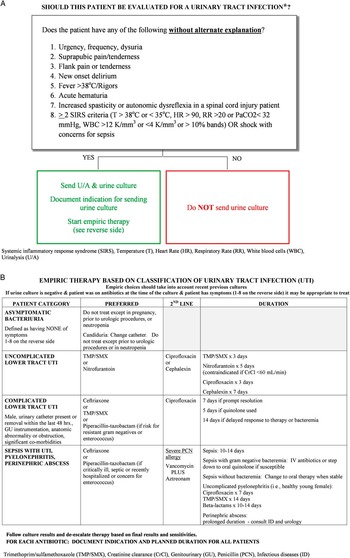
An educational intervention was presented to the hospitalists at each of the 3 hospitals. It included a 60-minute lecture highlighting the unnecessary treatment of ASB at their institution using representative cases from the baseline measurement. A pocket card was introduced with appropriateness criteria for diagnostic testing and antimicrobial treatment recommendations based on institutional antibiograms (Figure 1). In total, 3 sessions were conducted at the academic medical center: 2 sessions at scheduled noon conferences and 1 evening session. In addition, 2 afternoon sessions were conducted at the large community hospital and included hospitalists from the smaller community hospital. Hospitalists unable to attend these sessions were emailed a link to a webcast of the presentation and were asked to watch it and to respond upon completion. Hospitalists were encouraged to document the following items in the medical record: the indication for ordering the urine culture, the category of UTI being treated (eg, uncomplicated, complicated UTI, sepsis with UTI, pyelonephritis, perinephric abscess), and the planned duration of treatment. After the intervention, the medical records of 50 patients with positive urine cultures while admitted to the hospitalist service at each hospital were reviewed. Data collection and adjudication procedures were identical to those used for the baseline measurement.
Pocket card. (A) Front. (B) Back.

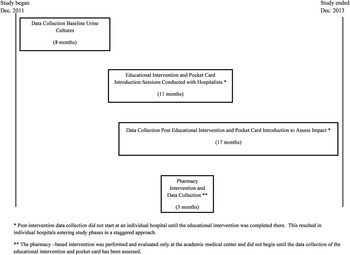
After completion of data collection from the educational intervention, a pharmacy-based intervention was performed at the academic medical center. This intervention included a 30-minute session conducted by an antimicrobial stewardship pharmacist to train team-based pharmacists on the content of the educational pocket card. Pharmacists were then sent a daily electronic alert of positive urine cultures from the microbiology lab for all patients admitted to the hospitalist service. These results were reviewed with hospitalists at daily afternoon rounds Monday through Friday. In the absence of guideline-based clinical manifestations of a UTI, the team-based pharmacist strongly encouraged the hospitalist to refrain from initiation of, or to discontinue antimicrobial treatment (Figure 2). Patients who met guideline-based criteria for UTIs were reviewed for appropriate antimicrobials and planned duration of treatment.
Timeline of project phases.

Descriptive statistics were used to characterize the population. Unnecessary antimicrobial days of therapy per patient with ASB were calculated using the number of antimicrobial days of therapy per patient determined to have ASB based on adjudication. Continuous variables were compared using standard t tests, and categorical variables were compared using the χ2 statistic or Fisher’s exact tests, as appropriate. The 2-tailed α was set at 0.05. Analyses were conducted using Stata/SE 13.1 (StataCorp, College Station, TX). Institutional review boards at each site provided ethical and regulatory approval for this study. To the extent possible, SQUIRE guidelines for describing quality improvement interventions were used in preparation of the manuscript.Reference Ogrinc, Davies, Goodman, Batalden, Davidoff and Stevens 17
RESULTS
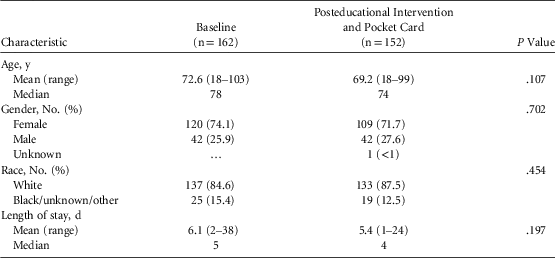
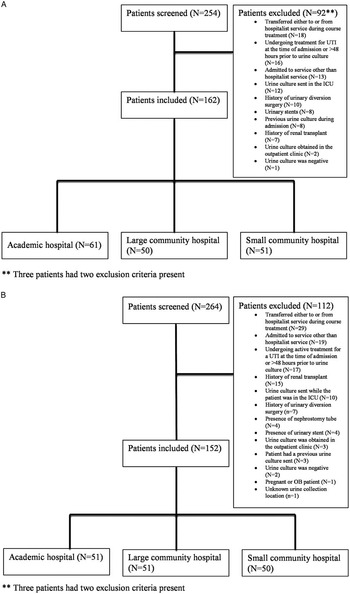
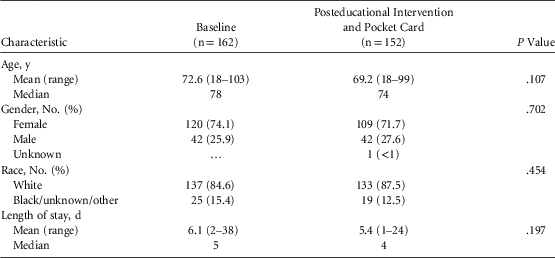
At baseline, 254 patients were screened across all 3 hospitals and 92 were excluded, leaving 162 for detailed chart review. The webcast or educational sessions were successfully completed by 95.3% of hospitalists (N=128) at the 3 sites. After the educational intervention, a subsequent sample of 264 patients was screened, and 112 patients were excluded, leaving 152 patients for evaluation (Figure 3). Patient demographics are presented in Table 1. A total of 104 patients were screened after the pharmacy-based intervention; 52 patients were excluded, leaving 52 patients for evaluation.
Patient Demographics (All Sites Combined)
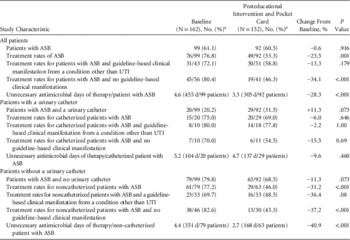
Of the 162 patients at baseline, 99 patients (61.1%) were determined to have ASB. Among these, 76 patients (76.8%) were treated with antimicrobials, with a total of 455 unnecessary antimicrobial days of therapy (Table 2). After the educational session, 92 patients (60.5%) had ASB; among these, 49 patients (53.3%) were treated with antimicrobials (ie, 305 unnecessary antimicrobial days of therapy), demonstrating a decrease of 23.5% (P=.001) in patients with ASB exposed to antimicrobials.
Treatment of Asymptomatic Bacteriuria (ASB) Impact of Educational Intervention and Pocket Card

NOTE. UTI, urinary tract infection.
a Unless otherwise noted.
Treatment rates of ASB at baseline varied among the 3 institutions. The highest rates of treatment were observed at the small community-based hospital (83.9%) and at the academic medical center (80.5%), followed by the large community-based hospital (63.0%).
The impact of the educational intervention and introduction of the pocket card differed among the sites. We observed a decrease in the initiation of antimicrobials in patients with ASB at the academic hospital (27.2%; P=.015) and at the small community hospital (25.8%; P=.001), but we observed a trend toward reduction of initiation of antimicrobials post intervention (14.6%; P=.266) at the large community hospital.
The success of the intervention also varied based on patient characteristics. Some patients determined to have ASB after adjudication had guideline-based clinical manifestations potentially suggestive of UTI; however, the clinical presentation suggested an alternative explanation for the sign or symptom (eg, fever was present, but was due to pneumonia). The impact of the educational intervention and pocket card varied based on whether patients lacked all signs or symptoms (34.1%; P=.001) compared with patients who had guideline-based signs or symptoms (eg, fever or altered mental status) from a condition other than UTI (13.3%; P=.179) (Table 2). The presence of a urinary catheter at the time of urine culture also modified the impact of the intervention. The absolute rate of treatment of ASB decreased in patients without a urinary catheter (31.2%; P<.001) but did not change significantly in patients with urinary catheters (6.0%; P=.646) (Table 2).
During the pharmacy-based intervention at the academic hospital, antimicrobial treatment was initiated for 44.8% of all patients with ASB. Treatment of ASB in catheterized patients improved from 78.6% after the educational intervention to 50.0% during the pharmacy-based intervention (28.6%; P=.218). However, treatment of noncatheterized patients with ASB remained unchanged: 31.3% after the educational intervention versus 41.2% after the pharmacy-based intervention (P=.554).
DISCUSSION
Unnecessary treatment of ASB is common, yet we were able to demonstrate that a hospitalist-focused educational intervention reduced ASB treatment rates by 23.5%, resulting in 150 fewer antimicrobial days of therapy in patients with ASB and a 28.3% decrease in unnecessary antimicrobial days of therapy per patient with ASB. Despite this improvement, site- and patient-specific differences suggest that a universal model does not work as well as a customized approach. The intervention brought treatment rates down across the 3 sites to a range of 48.4%–58.1%, but the reductions were limited to the academic hospital and the small community hospital. The large community hospital demonstrated only a 14.6% downward trend in initiation of antimicrobials for treating ASB. Both sites with the largest benefit from the intervention had baseline ASB treatment rates >80%, almost 20% higher than the large community hospital. This statistic suggests that, at institutions with very high rates of overtreatment, the educational intervention and pocket card assisted in identifying antimicrobial treatment practices and impacted rates of antimicrobial use.
The effect of the intervention also varied based on patient factors, including the presence of a urinary catheter and whether guideline-based signs or symptoms were present. The greatest combined improvement in unnecessary treatment was among patients without any guideline-based clinical manifestations of UTI (34.1%, P<.001) and patients without urinary catheters (31.2%; P<.001). Complex clinical situations make it more difficult for providers to feel confident that a UTI is not present, even when the initial guideline-based signs or symptoms evaluated are explained by an alternative condition or source of infection.Reference Cope, Cevallos, Cadle, Darouiche, Musher and Trautner 1 Clinicians are also more likely to treat ASB in patients with an increased number of comorbidities and in the presence of particular organisms, specifically those with antimicrobial resistant organisms.Reference Cope, Cevallos, Cadle, Darouiche, Musher and Trautner 1 This perceived risk by clinicians also requires an augmented approach to decreasing treatment rates.Reference Trautner, Petersen, Hysong, Horwitz, Kelly and Naik 5
In addition to hospitalist education, we implemented a pharmacy-based intervention using audit and feedback at the academic hospital. Pharmacists were chosen to participate because of their important role in antimicrobial stewardship in the hospital.Reference Kelley, Aaronson, Poon, McCarter, Bato and Jankowski 3 The aim of this intervention was to assure that, as positive urine cultures returned, the hospitalist reviewed the clinical manifestations that prompted testing and reconsidered antimicrobial decisions. This intervention resulted in an additional 8.5% (nonsignificant) reduction in treatment rates of ASB compared with the educational intervention at the academic hospital (P=.606). The small sample size in this phase of the intervention limited our ability to draw firm conclusions. However, we identified a trend indicating that catheterized patients benefited most from this approach. These findings further suggest that the addition of a pharmacist may have the greatest impact when focused on more complex patients. Pharmacy-based interventions targeting unnecessary treatment of ASB in the past have been assessed while bundled with an educational intervention.Reference Kelley, Aaronson, Poon, McCarter, Bato and Jankowski 3 Future endeavors should be targeted at local patterns of unnecessary treatment of ASB, and further understanding these patient-specific differences will enable infection control teams and healthcare systems to tailor selected aspects of such interventions to their institutions.
Our study has important limitations. The retrospective design relied on documentation at the time of care to determine the presence of guideline-based clinical manifestations. While our adjudication process focused on information that was available to clinicians at the time of decision making, a potential for bias exists in the interpretation, given that the clinical outcome was apparent at the time of review. Additionally, unnecessary treatment rates in the baseline group may have been elevated due to lack of documentation of clinical manifestations. The introduction of this study to hospitalists may have improved awareness, leading to increased documentation of clinical manifestations and false elevation of the benefit of the educational intervention. However, the number of patients with ASB did not change significantly between interventions and correlated with previous reports, making changes in documentation less likely.Reference Kelley, Aaronson, Poon, McCarter, Bato and Jankowski 3 Additionally, the pocket cards emphasized the evaluation of the patient for clinical manifestations and, if signs or symptoms were present without an alternative explanation, both urinalysis and urine culture were recommended. Guidelines have emphasized that, even in the presence of symptoms, a urinalysis without pyuria is unlikely to be consistent with a UTI.Reference Hooton, Bradley and Cardenas 14 Use of the urinalysis as a screening test prior to performing urine culture may further decrease the number of urine cultures performed as well as ASB treatment. However, none of the sites in this study used this approach at the time of the study; therefore, we cannot comment on the potential additional benefit of this approach. Finally, small samples of patients with urinary catheters and patients evaluated in the pharmacy-based intervention may have limited our ability to identify meaningful changes. These limitations should be interpreted in the setting of the strengths of our evaluation: (1) a rigorous method of medical record abstraction, (2) consolidation of multiple national guidelines and consensus statements to a single list of treatment criteria that can be customized with antimicrobial recommendations at each hospital, (3) adjudication of all charts by 2 infectious diseases physicians and 2 hospitalists, (4) targeting of hospitalists as a single provider group with a high rate of engagement in the interventions, and (5) a multicenter approach to assessing the generalizability of the intervention.
The next steps in advancing this work should include a similarly targeted intervention for physicians working in the emergency department. Urine cultures are often performed on patients in this setting, and the clinical decision making around testing may not be communicated at the time of transfer to the inpatient provider. Consideration for a durable reminder of testing criteria includes embedding the collated signs and symptoms into a decision-making tool within the electronic medical record. Both of these interventions contribute to decreasing the rates of unnecessary testing, which has been shown to decrease unnecessary treatment of ASB.Reference Chowdhury, Sarkar and Branche 6 , Reference Trautner, Grigoryan and Petersen 10
As antimicrobial stewardship programs search for the most cost-effective approach to reducing unnecessary treatment of ASB, it is important to consider patients with ASB who were treated despite discord between the clinical scenario and the guidelines (eg, a young woman with dysmenorrhea continued on therapy for possible cystitis or a catheterized patients with nephrolithiasis and flank pain who is treated for possible pyelonephritis). Interventions that target these clinical biases are needed, and they may vary between institutions. Hospitalists will likely continue to be key contributors to efforts targeting the reduction of unnecessary treatment of ASB in the future.Reference Charani, Castro-Sanchez and Sevdalis 18 Our study highlights 3 key areas that should be targeted when formulating solutions in future projects: (1) provider education regarding indications for urinary testing, (2) targeted evaluation of patients with increased complexity, including the use of urinary catheters or nonspecific symptoms, and (3) the need to study interventions across multiple sites to understand limitations that may not be apparent in a single-site study.
Patients screened. (A) Baseline. (B) Posteducational intervention and pocket card introduction.

Acknowledgments
We would like to thank Jerod Nagel, PharmD, and Matthew Tupps, PharmD, for their assistance in training and coordinating the pharmacy-based intervention and Mary A.M. Rogers, PhD, MS, for her assistance with statistical analysis. The views expressed in this article are solely the responsibility of the authors and do not necessarily represent the official views of the Department of Veterans Affairs.
Financial support: Centers for Disease Control and Prevention (CDC) Foundation provided funding for this research. The funding source play no role in the study design; data acquisition, analysis or decision to report these data.
Potential conflicts of interest: L.K., L.W., T.G., M.R., S.S., A.M., and S.F. report a grant to their institution from the CDC. S.H. reported money has been paid for her consultancy from Society of Hospital Medicine. S.V. reports nothing to disclose.
L.W. reports grants to her institution from the National Institutes of Health and the American Hospitalists Association and payment for development of education presentations from the American College of Physicians Smart Medicine Ebola. She has received payment for speakers’ bureau lectures for the Michigan Society for Infection Prevention and Control and the American Physicians Institute Board Review Course. She also received payment for travel and/or accommodations and/or meeting expenses from the Global Pandemic Policy Summit and the Bush School of Government and Public Service.
J.M. reports grants to her institution from the Agency for Healthcare Research and Quality (AHRQ) and the National Institutes of Health Clinical Loan Repayment Program (NIH-LRP) related to this work. Her research is supported by an ARHQ Mentored Career Development Award (grant no. K08-HS1976701) and the NIH-LRP (grant no. 2009-2015). She is an employed physician and researcher at the University of Michigan Medical School and Health System and at the Ann Arbor VA Hospital. She receives payment from an AHRQ contract related to several CAUTI prevention projects. She is an extended faculty member under contract by the Society of Hospital Epidemiology of America for a the 50-state On-The-Cusp project to reduce CAUTI. She is under contract with the CDC and is negotiating a contract with the AHA for CAUTI prevention research.
C.C. discloses fees for her SHEA board membership as well as payment for travel expenses and her employment as ICHE Associate Editor.
S.S. has received payment for serving on the medical advisory board of Doximity, a new social networking site for physicians and has received honoraria as a member of the medical advisory and the scientific advisory boards of Jvion, a healthcare technology company.
S.F. reports consultant fees paid by the Institute for Healthcare Improvement and the Society of Hospital Medicine; fees for various expert testimonies; lecture fees from speakers’ bureaus for various talks at hospitals as a visiting professor; and royalties from Wiley Publishing. His institution has received grants and has grants pending from Blue Cross Blue Shield of Michigan and the AHRQ.