Prosthetic joint infection (PJI) is a challenging complication after joint arthroplasty. Our institution performed preoperative screening and treatment of asymptomatic bacteriuria (ASB) prior to joint replacements. This is a common practice despite a lack of evidence showing benefit or a decrease in postoperative PJI.Reference Sousa, Munoz-Mahamud and Quayle 1 , Reference Duncan 2 This practice can lead to increased rates of Clostridioides (Clostridium) difficile infection, multidrug-resistant organisms, higher costs, and adverse reactions. Furthermore, in patients who have both ASB and PJI, studies show that the causative organisms are usually discordant.Reference Codero-Ampuero, González-Fernández and Martínez-Vélez 3 In April 2016, the antimicrobial stewardship team (AST) met with the orthopedic surgery department to provide education and recommended removing routine urine culture from preoperative order sets for joint arthroplasty. The purpose of this project was to evaluate the impact of education alone followed by the removal of urine culture from the preoperative order set on screening and treatment of ASB prior to elective hip and knee joint arthroplasty.
Methods
We conducted a retrospective chart review of all adult patients undergoing elective total knee or hip replacement over 3 years, divided into 3 phases: baseline (April 1, 2015 to March 31, 2016), the education phase (April 1, 2016 to March 31, 2017), and the electronic health record (EHR) intervention (April 1, 2017 to March 31, 2018). The AST provided education for the orthopedic department with a follow-up discussion 3 months later at a quality meeting. The EHR intervention was removal of urine culture from the preoperative order set. Although our initial goal was to immediately remove urine culture from preoperative order set, it was not implemented until a year later, resulting in a 3-phase project. The primary outcome was the number of urine cultures processed in phases 2 and 3, compared to the baseline. Secondary outcomes included the number of positive cultures, rates of PJI, ASB/PJI organism concordance, antibiotics prescribed for ASB, 90-day readmission, and laboratory cost savings.
The data were identified through an infection control report of elective joint replacement procedures and included patient demographics, type and date of procedure, diabetic status, and PJI according to the National Healthcare Safety Network (NHSN) definition. 4 Additional data collected via chart review included smoking status; whether or not a urine culture was processed with corresponding results; antibiotics prescribed; and preoperative signs and symptoms of a urinary tract infection (UTI) including frequency, urgency, dysuria, and/or suprapubic pain. Patients ≥18 years old undergoing elective total hip or knee replacements were included. Patients were excluded if they had documented symptoms of a UTI during the preoperative visit or underwent a hemiarthroplasty. Asymptomatic bacteriuria was defined as growth of ≥105 colony-forming units per milliliter (CFU/mL) of bacteria in an appropriately collected urine specimen obtained from a person without signs or symptoms.Reference Nicolle, Bradley and Colgan 5 , Reference Hooton and Stamm 6 Contaminated specimens were defined as >2 species of bacteria. A process control chart (P-chart) with control limits set at 3 standard deviations (SD) was used to analyze the primary outcome. Consecutive points below the lower control limits represents a significant decrease equivalent to P<.01. We used the χ2 and the Fisher exact tests to assess secondary outcomes. Statistical significance was predefined as P value<.05.
Results
During the study period, 339 patients underwent hip or knee arthroplasty. We excluded 59 patients for hemiarthroplasty and 5 patients for UTI. Among the 275 patients included, the median age was 64 years (range, 23–88 years), and 67.6% were women. Knee replacements accounted for 195 cases (71.0%). In addition, 57 patients (20.7%) had diabetes and 6 patients (2.2%) were smokers.
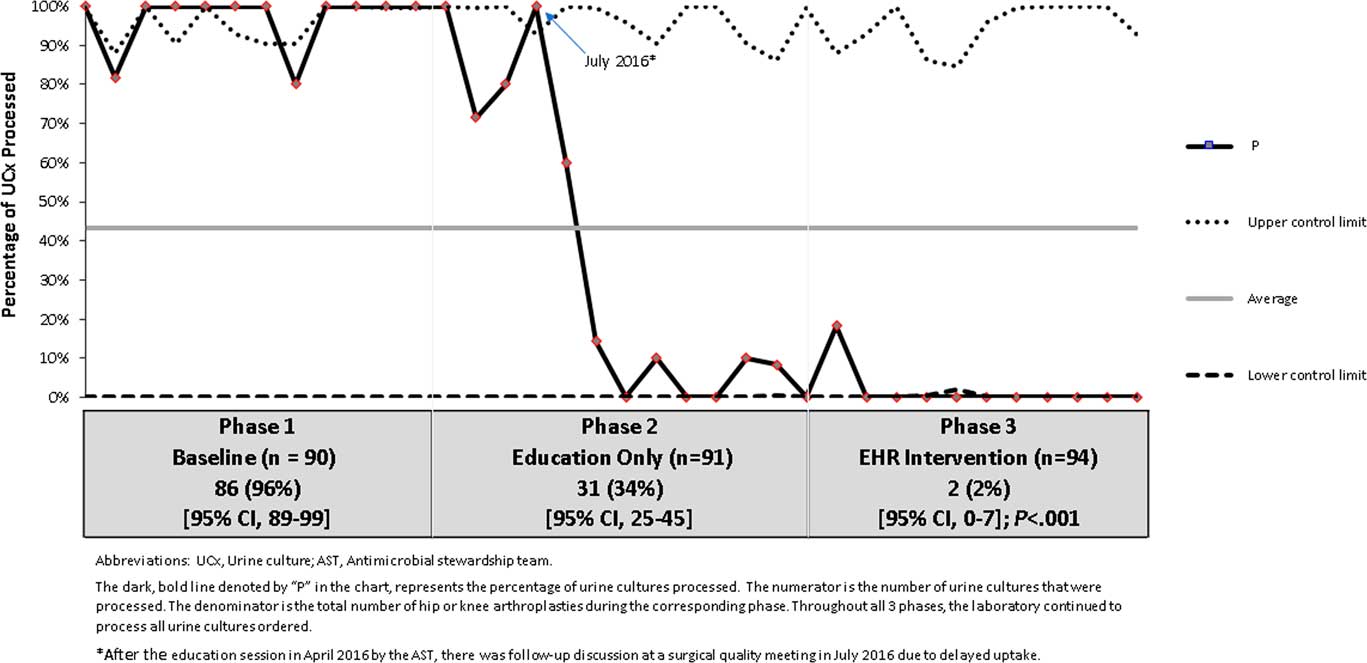
At baseline, 86 of 90 patients had urine cultures processed (96%; 95% CI, 89%–99%). The number of urine cultures decreased to 31 of 91 patients (34%; 95% CI, 25%–45%) in phase 2, and decreased significantly in phase 3, in which 2 of 94 patients had urine cultures processed (2%; 95% CI, 0%–7%; P<.001) (Fig. 1). The corresponding relative risk reductions were 34% (phase 1 vs phase 2) and 98% (phase 1 vs 3). Treatment of ASB also decreased, with 5 patients treated (5.6%) in phase 1 versus no patients treated (0.0%) in phase 3 (P=.03). We observed no difference in the rates of PJIs among phases 1, 2, and 3: 1 (1.1%), 0 (0.0%), and 1 (1.1%), respectively (P=.44 and 1.0). No concordance was observed among organisms causing ASB and PJI (see Supplemental Table 1).
Process-control chart: Monthly average of urine cultures processed.

Discussion
Education coupled with an EHR intervention significantly decreased the number of urine cultures processed and moderately decreased antibiotic prescriptions without impacting rates of PJI in asymptomatic patients undergoing elective joint arthroplasty. Lamb et alReference Lamb, Baillie and Pajak 7 demonstrated a relative risk ratio of 99% in the number of urine cultures processed after removal from order sets and a laboratory intervention. Although we showed improvement with education, other studies have demonstrated that education alone does not sustain the benefit.Reference Hamishehkar, Vahidinezhad and Mashayekhi 8 Education coupled with changes in the EHR is likely to have a more lasting impact. Our interventions resulted in $2,128 of cost savings in laboratory materials due to averted urine testing costs. We did not evaluate additional savings related to a reduction in personnel time, antibiotic prescriptions, and adverse event avoidance. The limitations of this study include lack of randomization, potential effect of unknown confounders, and lack of power to draw conclusions related to clinical outcomes, including no difference in PJI.
In summary, we have demonstrated that education coupled with EHR order set revision can have a significant impact on reducing inappropriate urine cultures in preoperative orthopedic patients. With an international focus on antibiotic stewardship, this is a quick, effective intervention that could be easily implemented in other institutions.
Acknowledgments
We would like to thank Anne Burgess, MT (ASCP) for her contributions to this project.
Financial support
No financial support was provided relevant to this article.
Conflicts of interest
All authors report no conflicts of interest relevant to this article.
Supplementary materials
To view supplementary material for this article, please visit https://doi.org/10.1017/ice.2018.278