





For decades, US higher education institutions have relied on various internationalization strategies to facilitate high-impact collaborations, to boost institutional reputation, and to generate revenue (de Wit and Altbach Reference de Wit and Altbach2021). International students are central to these efforts, bringing abundant intellectual, cultural, and financial resources to the US (Hegarty Reference Hegarty2014; Luo and Jamieson-Drake Reference Luo and Jamieson-Drake2013). Despite COVID-19 disruptions and anti-immigration directives under the Trump administration (Castiello-Gutiérrez and Li Reference Castiello-Gutiérrez and Li2020; Knox 2025), the US continues to host over one million international students, maintaining its status as a top study abroad destination (Buchholz Reference Buchholz2025).
Vietnam ranks ninth globally in outbound tertiary student mobility, with approximately 137,000 students abroad (Education Fair Reference Fair2024). In the US, Vietnamese students constitute the fifth largest international student population, with over 25,000 enrolled, 63% of whom are undergraduates (Minh Nga 2025). These numbers are the result of intersecting developments in Vietnam over the past four decades, including the Đổi Mới (Restoration) reforms, the enduring appeal of a “Western education,” and the increase in government-funded study abroad scholarships (Nguyen Reference Nguyen, Tran and Marginson2018). Notably, Vietnam’s GDP growth throughout the 2000s, driven by its manufacturing and service industries, has expanded the financial capability among Vietnamese households and broadened access to overseas education beyond elite circles and government-funded routes. Today, Vietnam spends 1.4 billion US dollars annually to send students overseas (Cy Reference Cy2023). An estimated 90% of Vietnamese students abroad are self-funded, a tenfold increase from the turn of the century (Bell Reference Bell2017; Clark Reference Clark2013).
International education has long been vital to US-Vietnam relations. Vietnamese students in the US are often celebrated as evidence of Vietnam’s growing national talent on the global stage and of the two countries’ remarkable achievement in bilateral reconciliation. For the US, enrolling Vietnamese students not only serves the national higher education agenda of boosting profit and prestige but also promotes the foreign policy goal of disseminating democratic ideologies around the world (see Ashwill Reference Ashwill2019; Atkinson Reference Atkinson2010; Spilimbergo Reference Spilimbergo2009). This soft power logic, rooted in Cold War politics (Nye Reference Nye1990), persists in prominent US exchange programs such as Fulbright, Boren Awards, and Gilman Scholarships.
For Vietnam, sending students overseas is considered a strategic investment in human capital. Overseas-trained graduates are expected to return and contribute to national development (Nguyen Reference Nguyen2013). Although many students express patriotic aspirations to return and “give back” (Nghia Reference Nghia2019), the popularization of overseas education has also given rise to visions of transnational mobility that do not align with state-propagated ones. Many students pursue long-term settlement overseas, sparking “brain drain” concerns and public debates that moralize the decision to return or not return (e.g., Ha Chi 2024). At a recent conference releasing Vietnam’s migration profile, diplomats reported that 80% of self-funded students remain abroad after graduation (Hong Chieu 2024).
This divergence between government expectations and individual realities compels deeper inquiry into the unique ways in which the students themselves make sense of transnational mobility. This paper argues that a multitude of intersecting variables, including students’ upbringings, educational motivations, relationships, socio-political climates, labor market demands, and future goals, actively shapes whether they decide to return, stay in the US, or move elsewhere. Understanding these processes of meaning-making can help policymakers in both Vietnam and the US move toward more human-centered, context-responsive approaches to cross-border talent development, talent retention, and diaspora engagement.
The study is guided by the following questions:
-
1. What transnational mobility narratives do Vietnamese international undergraduate students in the US construct as they reflect on their moorings across borders and post-graduation plans?
-
2. How do these narratives converge with – and/or diverge from – the dominant discourses of US-Vietnam relations on international education?
Drawing on interviews with eleven Vietnamese international undergraduate seniors in the US, the study identifies six “transnational mobility narratives” through which students ponder on who they are and where they hope to go next. These narratives complicate the nation-state discourses that reduce students’ lives to a single story of “brain drain versus brain gain,” foregrounding instead the complex, classed, relational, and personal dimensions of mobility.
Literature review
This section draws on select scholarly and media sources on Vietnamese international students to contextualize the transnational conditions and forces under which their mobility aspirations and decisions are formed. Existing literature is examined in three strands: (1) overview of Vietnamese student outbound mobility, (2) Vietnamese international students in the US, and (3) Vietnamese international students and return.
Overview of Vietnamese student outbound mobility
Vietnamese student outbound mobility has changed drastically over the past century. During the colonial and Cold War periods, mobility was tied to political agendas and geopolitical alliances, with students carefully selected and sent abroad according to state priorities (Nguyen Reference Nguyen, Tran and Marginson2018). The 1986 Đổi Mới campaign marked a pivotal transition of Vietnam from a centrally planned economy to a socialist-oriented market economy. During this period, the government expanded scholarships and eased visa access to promote overseas education as a component of industrialization and modernization (Nguyen Reference Nguyen2013). Internationalization efforts began to grow across Vietnam’s education sector, chiefly through the incorporation of international curriculum content (Le and Tran Reference Le and Tran2023; Nguyen Reference Nguyen2020; Ryu and Nguyen Reference Ryu and Nguyen2021).
As public exposure to global perspectives increased, so did interest in overseas education. Furthermore, the limited capacity of domestic higher education remains a major driver of outbound mobility (Hoang et al. Reference Hoang, Moslehpour and Seitz2019; INTO 2022; Miller Reference Miller2012). Vietnamese students often cite intense competition for university admission, rote-learning pedagogies, uneven educational quality, and shortage of globally recognized credentials as factors that push them abroad (Nghia Reference Nghia2019; Phan Reference Phan2023a). Vietnamese parents – many of whom benefited financially from Đổi Mới (Clark Reference Clark2013) – invest heavily in overseas education preparation, seeing such investments as liberating for their children’s post-secondary futures (Miller Reference Miller2012; Pham Reference Pham2021). Ma (Reference Ma2020) examines a similar phenomenon among middle-and upper-class households in China, where studying abroad is deemed a pathway to elite circles that bypass the harrowing Gaokao exams. Aside from parental influence, overseas relatives, consulting agencies, and popular culture further fuel students’ motivations (Nghia Reference Nghia2019). In this sense, overseas education in post-1986 Vietnam emerged not merely from state-led reforms but from a transnational social field shaped by expanding global opportunities and classed aspirations across families, communities, schools, and private actors.
As non-state entities became increasingly involved in facilitating overseas education, brain drain grew into a politicized issue (Nguyen Reference Nguyen2013; Nguyen Reference Nguyen, Tran and Marginson2018). Higher earning potential, better quality of life, and more opportunities for personal and professional growth are commonly cited as reasons for remaining abroad (Nghia Reference Nghia2019). In this regard, Nguyen (Reference Nguyen, Tran and Marginson2018) critiques the Vietnamese government’s overreliance on overseas education as a workforce development strategy, arguing that it has reinforced the problematic perception of Western countries as models of civilization for Vietnam to emulate.
To mitigate brain drain, the Vietnamese government has employed legally binding contracts that mandate return for government-funded graduates and media campaigns that frame contributing domestically as a patriotic duty. Diaspora engagement initiatives offering visa exemptions, dual citizenship, and tax benefits were also implemented to attract the return of self-funded graduates (Nguyen Reference Nguyen, Tran and Marginson2018). However, mobility decisions are neither determined by these policies nor shaped in a linear manner. Rather, they involve ongoing negotiations among factors such as employment demands, support networks, and perceptions of long-term belonging and fulfillment (see Ngoc Ngan 2025; Tran Reference Tran2016).
Accordingly, some scholars call for a more relational approach to building return incentives. Recommendations include strengthening government involvement throughout students’ journeys – from pre-departure planning to graduation, improving domestic working conditions, and fostering “brain circulation” through sustained connections with overseas talents (Gribble and Tran Reference Gribble, Tran and Gomes2016; Larsen Reference Larsen2020; Vo and Shi Reference Vo and Shi2017). Nevertheless, Phan (Reference Phan2023b) cautions that such strategies privilege overseas talents over homegrown and home-based talents, which can reproduce global inequalities and worsen brain drain.
Vietnamese international students in the US
During the Vietnam War, approximately 3,000 South Vietnamese students studied in the US. After the Fall of Saigon, student exchange between Vietnam and the US ceased for two decades. Reforms initiated in the Đổi Mới era led to the re-establishment of US-Vietnam relations in 1995 and subsequent revival of Vietnamese student mobility to the US (Do Reference Do2007). Since normalization, education has become a pillar of bilateral peacebuilding, reflected in collaborations such as Fulbright University Vietnam, IMPACT MED Alliance, and BUILD-IT Alliance.
While normalization has ushered in record-high numbers of Vietnamese students to the US, students’ experiences continue to be affected by the legacies of the Vietnam War. Since 1975, a significant segment of the Vietnamese diaspora has consisted of anti-communist refugees and their descendants. In the eyes of many Vietnamese Americans, students from Vietnam are likely “brainwashed” by the Communist Party (Do Reference Do2007). This perception oversimplifies the identities of contemporary Vietnamese students. While they might have been educated under a national curriculum that portrayed the war as a patriotic struggle against the US to “liberate” South Vietnam (Nguyen Reference Nguyen2022), their formative years were also shaped by post-1986 Vietnam, leading most of them to hold apolitical, market-oriented views (Rosen Reference Rosen2015). However, because many arrive in the US with limited awareness of the historical trauma associated with South Vietnam, they often find themselves positioned unfavorably in interactions with Vietnamese Americans. Some even conceal their national origin to avoid anti-communist hostility (Do Reference Do2007). This reality points to an invisible yet powerful layer of marginalization facing Vietnamese students in the US.
Echoing Do’s (Reference Do2007) paper, Tran (Reference Tran, Deutsch, Boehnke, Kuhnen and Boehnke2011) argues that research on Vietnamese international students should move beyond examining how they adapt to Western norms (e.g., Le et al. Reference Le, Koo, Arambewela and Zutshi2017; Wearring et al. Reference Wearring, Le, Wilson and Arambewela2015). According to Tran, students’ journeys should be situated within transnational systemic influences, such as Vietnam’s domestic education policies, societal attitudes toward overseas education, the host country’s political environment, and interactions between students and overseas Vietnamese communities. All these intersect with individual-level variables, including socioeconomic background, major, networks, coping strategies, and post-graduation goals.
Vietnamese international students and return
Vietnamese international graduates have returned to Vietnam for reasons ranging from compulsory – such as caregiving duties and failure to secure immigration sponsorship – to voluntary, such as a patriotic calling to contribute (Nghia Reference Nghia2019), emotional attachment to Vietnam, and favorable career prospects (Nguyen Reference Nguyen2023). Existing literature reveals that the transition back to Vietnam is often more difficult than anticipated for these graduates. Le and LaCost (Reference Le and LaCost2017) found that many returnees experienced tensions with family and colleagues, as their Western-acquired values clashed with Vietnamese cultural expectations. Some reported a severe loss of social networks after years abroad.
Employment dissatisfaction is another theme. While most Vietnamese students venture abroad for a career advantage, many come home to a job market that prioritizes local experience (Nguyen Reference Nguyen2023). They commonly face lower-than-expected salaries, job instability, and difficulty integrating into Vietnamese workplaces (see Binh Minh 2024; Kim Ngan et al. 2023). Pham (Reference Pham, Tran and Gomes2017) notes that Western-educated returnees often lack familiarity with terminology and communicative styles valued by Vietnamese employers. Career opportunities are also uneven across sectors: while multinational companies value foreign credentials, public institutions favor strong domestic knowledge and conformity to traditional professional norms (Pham Reference Pham, Tran and Marginson2018).
Nonetheless, Vietnamese returnees are known for their adaptive foresight. Many graduates choose to remain abroad temporarily to accumulate significant work experience before returning (Phan Reference Phan2020). Tran and Bui (Reference Tran and Bui2021) identify three major Vietnamese returnee archetypes: (1) the “explorer,” who accepts various entry-level roles and work upward; (2) the “advancer,” who returns with prior in-country professional experience and leverages both their existing local networks and newly earned foreign degree to pursue higher-paid positions; and (3) the “adventurer,” who comes from a privileged background and returns to take over their family enterprise or launch a new venture. Overall, while returnees face considerable readjustment challenges, they are resilient navigators of dynamic systems of opportunity and limitation.
Conceptual lens
This study is epistemologically bounded by social constructivism, which posits that reality is produced through social interaction and context (Vygotsky Reference Vygotsky1978). Central to this study is the concept of transnational mobility, which refers to the global movement of people and the circulation of goods, technologies, and ideas that move alongside them. These flows generate connections beyond boundaries of a single nation, contributing to new identities, practices, aspirations, and imaginaries (Appadurai Reference Appadurai1996; Levitt and Schiller Reference Levitt and Schiller2004; Vertovec Reference Vertovec2009).
Crucially, transnational mobility is not a linear process. Shifting power structures – cultural, social, political, and economic – constantly shape why people move (or do not move), what privileges are afforded by movement, and what vulnerabilities it produces. In this sense, transnational mobility compels individuals to (re)map their worldviews, assets, networks, and life paths across changing contexts (see Huang Reference Huang2021; Tran and Vu Reference Tran and Vu2018; Tran and Hoang Reference Tran, Hoang, Peterson, Stahl and Soong2020; Wang Reference Wang2022). Additionally, Gomes (Reference Gomes2021) theorizes that many international students experience mobility as transient, a condition of spatial unsettledness that challenges the binary of temporary versus permanent migration. Bringing these insights into conversation with social constructivism, this study treats transnational mobility as an open-ended interpretive process through which US-based Vietnamese students draw from evolving sources of knowledge to grapple with questions of belonging, opportunity, contribution, and success across borders.
Narrative theory (McAdams Reference McAdams1993) further informs the study by emphasizing that people make sense of their lives by sharing stories that connect their past, present, and future. “Narratives” are meaning-making constructions embedded in stories, through which individuals come to understand their social location, explain choices, and justify aspirations (Bruner Reference Bruner1987). In this study, “transnational mobility narratives” refer to patterned ways in which participants, the storytellers, interpret what moving abroad means to them, particularly how it impacts their identity formation and future-making (see Birindelli Reference Birindelli2023; Roberts Reference Roberts2019).
Method
This study utilizes narrative inquiry, a methodological design that examines narratives through stories situated within broader personal, institutional, and societal contexts (Clandinin and Connelly Reference Clandinin and Connelly2000). A notable feature of narrative inquiry is relationality, which allows the researcher and the participant to engage in reflexive meaning-making. This feature was valuable given the author’s positionality as a US-based first-generation immigrant and former international student, which helped to facilitate trust and rapport-building with participants.
Participants and data
For this study, Vietnamese international undergraduate seniors on F-1 statusFootnote 1 were recruited because self-funded undergraduates constitute a majority of US-based Vietnamese students and, as they approach graduation, are uniquely positioned to reflect across the full arc of their journeys while actively anticipating their futures. Eligibility criteria included having Vietnamese citizenship, a valid F-1 status, a permanent address in Vietnam, full-time undergraduate enrollment in the US, and no more than two semesters remaining until graduation. Recruitment occurred through institutional offices, social media groups, and direct email.
Data collection commenced with eight participants. Recruitment concluded when similar narrative patterns began to recur, and additional interviews yielded limited new insights. Consistent with narrative inquiry, saturation was decided based on interpretive sufficiency rather than statistical representativeness (Clandinin Reference Clandinin2013).
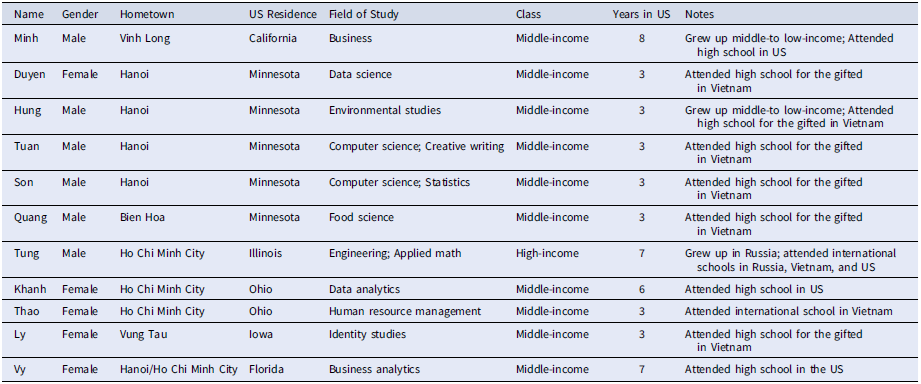
The final sample consisted of eleven participants, aged twenty to twenty-four, from five different cities in Vietnam and residing in six different US states. Six (55%) identified as male and five (45%) as female. Ten (91%) identified as middle-income and reported funding their education through a combination of family support, institutional scholarships, loans, and part-time employment. Six (55%) attended selective high schools for the giftedFootnote 2 in Vietnam, four (36%) completed high school in the US, and two (18%) attended international schools. Table 1 presents participants’ pseudonyms and demographic information.
Participants’ demographic characteristics

Table 1. Long description
A table with eleven rows and eight columns presenting participants’ pseudonyms and demographic information. The columns are Name, Gender, Hometown, US Residence, Field of Study, Class, Years in US, and Notes. The table includes the following data: Row 1: Minh, Male, Vinh Long, California, Business, Middle-income, 8, Grew up middle-to low-income; Attended high school in US. Row 2: Duyen, Female, Hanoi, Minnesota, Data science, Middle-income, 3, Attended high school for the gifted in Vietnam. Row 3: Hung, Male, Hanoi, Minnesota, Environmental studies, Middle-income, 3, Grew up middle-to low-income; Attended high school for the gifted in Vietnam. Row 4: Tuan, Male, Hanoi, Minnesota, Computer science; Creative writing, Middle-income, 3, Attended high school for the gifted in Vietnam. Row 5: Son, Male, Hanoi, Minnesota, Computer science; Statistics, Middle-income, 3, Attended high school for the gifted in Vietnam. Row 6: Quang, Male, Bien Hoa, Minnesota, Food science, Middle-income, 3, Attended high school for the gifted in Vietnam. Row 7: Tung, Male, Ho Chi Minh City, Illinois, Engineering; Applied math, High-income, 7, Grew up in Russia; attended international schools in Russia, Vietnam, and US. Row 8: Khanh, Female, Ho Chi Minh City, Ohio, Data analytics, Middle-income, 6, Attended high school in US. Row 9: Thao, Female, Ho Chi Minh City, Ohio, Human resource management, Middle-income, 3, Attended international school in Vietnam. Row 10: Ly, Female, Vung Tau, Iowa, Identity studies, Middle-income, 3, Attended high school for the gifted in Vietnam. Row 11: Vy, Female, Hanoi / Ho Chi Minh City, Florida, Business analytics, Middle-income, 7, Attended high school in the US.
Life history interviews, characterized by open-ended discussion prompts and probes, were used to collect data (Cole and Knowles Reference Cole and Knowles2001). Using self-narrated biographical accounts as the main data source, this method allows participants to decide which aspects of their lives are most important to share. Interview questions were written to elicit temporally ordered recollections of transnational experiences, encouraging participants to reflect on how personal values, societal conditions, and geographical locations influenced their trajectories at different life stages. This design aligned with narrative inquiry’s three-dimensional emphasis on temporality, sociality, and place (Clandinin and Connelly Reference Clandinin and Connelly2000).
Each participant completed two sixty- to ninety-minute audio-recorded Zoom interviews. The first explored childhood in Vietnam, study abroad motivations, transitions to the US, and experiences of connectedness – or lack thereof – to people and communities at home and abroad. The second one focused on preparation for post-graduation life, including perceived constraints and opportunities, lessons learned abroad, and long-term career and settlement plans. Together, the interviews drew out stories spanning borders that illuminated how participants position themselves, navigate worlds, and imagine futures beyond the nation-state mold.
First interviews were conducted in Fall 2024 and second interviews in Spring 2025. Each participant had a gap of two to three months between interviews. This interval alleviated the emotional and cognitive load of storytelling while encouraging participants to thoughtfully attend to the unfolding realities of their senior year.
Interview recordings were transcribed by Zoom’s AI software and manually reviewed for accuracy. Field notes were taken during and after interviews to document analytically significant observations beyond self-narrated accounts. Reflexive attention was paid to researcher–participant power dynamics, including differences in age, socioeconomic status, education, migration history, and institutional authority, and how such asymmetries shaped discourse and emotional responses. Demographic information, collected through a pre-interview survey, further contextualized participants’ stories.
Trustworthiness was also enhanced through two separate interviews over one academic year, which supported prolonged relationship-building and iterative meaning-making. Interpretive validation occurred through follow-up questions during interviews and post-interview email exchanges. Salient insights, tensions, and ambiguities were revisited with participants when appropriate. Participants were permitted to withdraw and/or modify their responses at any time.
Analysis
Data analysis was guided by analysis of narratives (Polkinghorne Reference Polkinghorne, Hatch and Wisniewski1995), which weaves together individual stories to construct categories of shared ways of knowing and being. First-order analysis was guided by six conceptually informed deductive codes: (1) study abroad motivations, (2) cross-border networks, (3) experiences of belonging and rootedness, (4) experiences of otherness and unrootedness, (5) growth and transformation, and (6) evolving aspirations. These codes encapsulate ideas derived from transnational mobility, transience, and narrative theory.
Each interview transcript was examined in detail to extract events, relationships, thoughts, feelings, choices, and goals associated with the six deductive codes. This process generated a compilation of fragmented stories across borders that each participant lived by. A biographical memorandum was created for each participant to chronologically reorganize coded data into a synthesized “retelling” of their journey from Vietnam to the US, supplemented by select quotations. In attending to the three-dimensional narrative inquiry space, all memoranda annotated temporal, personal, interactional, systemic, and ecological factors that influenced how participants saw themselves, related to others, navigated unfamiliar terrains, and looked toward the future.
Second-order analysis entailed a cross-case examination of eleven memoranda for recurring sensemaking logics, cultural scripts, and tropes. Through this stage, participants’ accounts began to cluster around patterns related to familial responsibility, upward mobility, global flexibility, ethical commitments, repatriation, negotiation, and elitism. In the end, six “transnational mobility narratives” were developed to name these identified patterns.
Limitations
This study carries several limitations. First, as a narrative inquiry study, findings build on participants’ individualized interpretations of mobility to provide in-depth, people-to-people understandings of US-Vietnam educational exchanges, rather than causal or macro-level explanations of transnational experiences (Clandinin Reference Clandinin2013). Second, the study relies on a small sample of eleven US-based Vietnamese international undergraduate seniors. Accordingly, findings are not intended to transfer directly to international student experiences across national contexts, developmental stages, and educational levels. Finally, participants’ narratives were captured at a specific historical moment – graduation amid heightened political polarization in the US and worldwide – and should therefore be understood as contextually situated acts of meaning-making, not universally generalizable truths.
Findings
Before turning to the six narratives, it is important to note several experiences that most participants discussed during interviews. Although they came from different backgrounds and ascribed varied meanings to mobility, many of their stories took place within shared familial, educational, economic, and sociopolitical contexts.
Shared contexts shaping transnational mobility narratives
All participants recognized the importance of family in shaping their study abroad motivations. Six (55%) mentioned receiving intensive English education at a young age. Participants’ parents gathered information from collegial networks, online forums, and private consultants, while keeping affordability a key consideration. All but one participant chose their current institution due to generous financial aid. Additionally, five (45%) noted that older siblings or relatives in the US often served as strong reference points for determining destinations, majors, and career paths.
Aside from familial influence, eight participants (72%) stated that frustration with Vietnam’s schooling environment pushed them to study abroad. They described burnout from excessive academic pressure and limited meaningful engagement with their learning. In contrast, the US education system was perceived as supportive of individual freedom. For five participants (45%), all gifted students in Vietnam, immediate peer networks also served as a source of motivation. They recalled meeting American university recruiters, taking SAT classes, and forming close-knit “US college application support groups” with friends.
Another commonality was participants’ disenchanted outlook on the US job market and society. The Trump administration’s anti-immigration stance discouraged many from envisioning a long-term future in the US. While seeking full-time employment in the US remained an attractive option for all but one participant, six (55%) expressed detachment from the idea of permanent settlement.
Lastly, contrary to existing literature, Vietnamese Americans appeared only peripherally in participants’ stories. Most reported positive or neutral interactions. Only one reported experiencing discriminatory attitudes from a few anti-communist community members. Yet he acknowledged that not all Vietnamese Americans carried such prejudice and that many empathized with his “immigrant struggles.” Collectively, these accounts suggest that Vietnamese diaspora networks were neither overly antagonistic nor integrative. The “old diaspora” – shaped by post-1975 refugees – and the “new diaspora” – led by contemporary students and professionals – existed as two parallel worlds despite shared cultural ties.
The following subsections dive into the six transnational mobility narratives: (1) family trailblazing narrative, (2) mobility optimizing narrative, (3) narrative of idealism, (4) negotiating narrative, (5) homeward strategizing narrative, and (6) narrative of transnational elitism. Each begins with a brief description of the featured narrative, followed by examples and a critical commentary. Participants often embodied multiple narratives and moved across them over time. However, for analytical clarity, this paper situates each participant within the narrative that most prominently characterizes their sensemaking at the time of interviews, while acknowledging concurrent or secondary engagements with other narratives when relevant. As such, the six narratives are not fixed typologies. They are heuristic lenses for understanding the stories that students internalize, contest, and rewrite as they move through lives across borders.
Family Trailblazing Narrative
The family trailblazing narrative speaks to participants’ stories in which transnational mobility is framed as an extension of their families’ upward socioeconomic mobility and intergenerational aspirations. In these stories, moving to the US is not only a path to individual betterment, but also an act of giving back to loved ones. Achievements abroad carry the weight of collective familial pride and hope.
This narrative was most evident in Minh’s journey. Growing up a first-born son in a middle-low-income household of Vinh Long, Minh was taught to value hard work, kinship care, and persistence. His parents, seeing his interest in and strong grades in English, connected with distant relatives in Texas, who offered to sponsor and host him through high school. Due to his family’s limited budget, Minh’s initial study abroad decision was based solely on affordability.
In El Paso, Texas, Minh experienced discrimination at school due to his foreign status and limited English proficiency. His relatives, coming from non-academic backgrounds and preoccupied with their business, could not provide much support. Despite these challenges, Minh remained committed to fulfilling the promise to his parents:
I felt very lonely. But then I remembered my family in Vietnam. They spent their life savings sending me here. I cannot let them down. I must succeed and become a good role model for my brother too.
A turning point came when Minh moved to San Jose, California, where he attended community college to reduce costs before transferring to a four-year university. He found a sense of belonging in the city’s culturally and linguistically diverse demographic landscape, which gave him the confidence to excel academically and professionally. He joined a business honors program and landed multiple internships in Silicon Valley. Outside the classroom, he mentored international students on campus and volunteered to plan events for a local organization serving young overseas Vietnamese professionals.
Looking ahead, Minh hoped to secure employment in San Jose that could lead to permanent residency and start his own company. Interestingly, his plan to stay in the US was shaped not by national or emotional attachment, but by the prospect of high earnings and immigration benefits. In many ways, he felt responsible for repaying his family’s investment:
My family needs me. I don’t see myself as American at all. I just want to make good money and get citizenship so my folks can benefit. I’m willing to work hard and struggle for it. In Vietnam, people work so hard, but they don’t always move up. If they’re from a poor family then they stay poor forever. In America, no matter where you start, you can always turn things around.
The above quote clearly reflects a family-trailblazing orientation in Minh’s meaning-making process, spotlighting his strong sense of familial duty and awareness of systemic barriers in Vietnam that lend purpose to his US education. Minh’s accounts also intersected with the mobility optimizing narrative. His pursuit of a Silicon Valley-based entrepreneurial career and US permanent residency involved calculations about where he believed he could maximize his upward mobility. Additionally, elements of idealism emerged through Minh’s dedication to supporting international students and overseas Vietnamese professionals, who shared his hardships of navigating foreign systems.
The family trailblazing narrative challenges nation-state assumptions about outbound mobility. Minh’s accounts illustrate that Vietnam’s “study abroad boom” is not solely a result of state investment, but also of the resource-pooling efforts of everyday Vietnamese families, including those with limited means. While someone like Minh could get framed as a symbol of national progress (Vietnam) and transformative global engagement (US), in reality both governments contributed little to making his education abroad possible. The burden of investment fell largely on his parents, whose labor, frugality, and kinship networks kick-started his mobility.
This narrative also highlights the pressure that students like Minh carry more heavily than peers from wealthier urban households (see Pham Reference Pham2021) and, in some cases, peers who do not shoulder familial expectations associated with eldest-child roles in collectivist contexts (see Wu et al. Reference Wu, Kim, Nagata and Kim2018). For Minh, striving for US permanent residency became a compelling response to both the need to “make good” on his family’s sacrifices and the structurally constrained opportunities facing poorer provinces in Vietnam (see Pham et al. Reference Pham, Vu, Doan and Nguyen2023). In this way, the narrative not only speaks to Minh’s family-oriented leadership but also exposes the classed hierarchy of international education that determines how much emotional and economic debt one must be willing to bear in venturing abroad.
Mobility optimizing narrative
The mobility optimizing narrative connects with stories that center strategic investments in financial independence, professional prosperity, and optionality. Students who engage with this narrative describe mobility as a milestone to be diligently prepared for and built upon. It is a means for pursuing greater freedom and opportunity, regardless of where they end up.
This narrative was found throughout the journey of Duyen, a gifted student from Hanoi who came to Saint Paul, Minnesota to study data science. Her parents, white-collar professionals skeptical of Vietnam’s political system, started preparing her to study abroad when she was in second grade. Duyen recalled the pressure throughout her childhood to study hard, improve her English, earn a high SAT score, and pick a “sponsorship-friendly major.” Yet this imposing environment also sparked her desire for more choice and flexibility. Moving to the US for college, to her, was a steppingstone toward a more self-directed future.
As a graduating senior, Duyen was committed to utilizing her professional network to secure full-time employment in the US. In addition to having a multi-year airline internship, she regularly conducted informational interviews with and sought referrals from industry professionals. Duyen planned to move to New York City after graduation, saying that it was “the best place for career acceleration.” At the same time, she was unsure about permanent settlement in the US and kept an open mind:
My future here is uncertain. I don’t see myself being tied to one place. I prefer to use my US degree and work experience to get a well-paid, flexible job that allows me to travel and live in a different country every few months or so. I might even do an MBA in Europe and open a startup.
Overall, Duyen consistently centered personal advancement while narrating her journey, a tendency characteristic of the mobility optimizing narrative. A similar mindset was echoed in the journey of Khanh, another gifted student who grew up well-prepared to study abroad, struggled with the high-pressure schooling environment in Vietnam, and embraced the US as a place to grow more into herself. Raised in an academic family with prior overseas education successes, Khanh left Vietnam to continue high school in Lexington, Kentucky on a scholarship, and later headed to college in Oxford, Ohio. In Kentucky, she experienced ostracization by peers from wealthier families, which taught her to prioritize healthy relationships in future endeavors. In college, she changed her major from chemical engineering, which she described as “toxic and socially isolating,” to data analytics, which allowed her time to spend with friends, volunteer, and meet new people, all “without sacrificing immigration sponsorship chances.” Khanh also relied on her mother, a multinational corporate manager in Vietnam, for job-search guidance. She was indeed the only participant who had a full-time job offer pre-graduation.
Khanh believed that the abundant opportunities to reinvent herself and broaden her social networks had deepened her belonging to the US. She planned to move to Chicago to work for a tax company, hoping to secure an H-1B visa while remaining open to other possibilities:
I don’t know about forever, but so far, I love my freedom, career prospects, and the diverse people I’ve met here. My next goal is to do an MBA, get a promotion, and maybe run my own company. I believe everyone is destined to end up somewhere, even when it’s unexpected, and my journey is nowhere near the end.
Like Duyen, Khanh made sense of transnational mobility primarily through strategic positioning and openness to change. For both, living abroad was organized around cultivating leverage and agility in an interconnected world. Simultaneously, Khanh’s accounts mildly overlapped with the narrative of idealism, particularly in how she came to understand success abroad as intertwined with having genuine, uplifting relationships and avenues to give back through community service.
The mobility optimizing narrative further reveals the social stratification underpinning students’ sensemakings of mobility. The accounts of Duyen and Khanh suggested that access to gifted education, early English training, career guidance, and well-positioned mentorship networks could strengthen students’ confidence in imagining multiple upward trajectories for themselves, no matter where in the world they might go. However, as Minh’s reflections implied, such resources are not equally available to all families; for many, overseas education stays unattainable or carries the added pressure to “blaze a trail” for loved ones. This narrative thus critiques how both governments’ discourses on international education obscure the structural realities that decide whose mobility becomes a story of greater global possibility and whose remains constrained by circumstance.
Narrative of idealism
The narrative of idealism emerges from stories which frame authenticity and meaningful social contribution as central to transnational mobility. In accounts characterized by this orientation, mobility is valued for its potential to generate spiritual growth and social impact. While stories centering family trailblazing and mobility optimizing narratives tended to gravitate toward pragmatic choices, idealistic orientations often surfaced through resistance to externally imposed expectations.
This narrative was exemplified in the journey of Hung, a gifted student who grew up middle-low-income in Hanoi, and came to Saint Paul, Minnesota, to pursue environmental studies. His academic interest was ignited by observations of environmental deterioration and limited sustainability education in his hometown. Hung stated that the higher education curriculum in Vietnam followed a stringent structure that inhibited innovation in environmental fields, which prompted him to look for options abroad. His mother insisted that he study computer science and become a software engineer in the US, like his cousin did. Despite this expectation, he believed that the US was the right place to study environmental issues and “make the most out of [his] curiosity.”
Moving forward, Hung planned to gain a few years of US-based work experience in corporate sustainability or urban planning. However, he was not optimistic about the longevity of his environmental career in the US and hoped to eventually relocate to Vietnam or another country in Southeast Asia:
The current US administration worries me. Over the years, I have seen how foreign investments can help developing countries better mitigate the environmental impact of industrialization, so I’m excited to see how I can contribute. I want to build something that can empower the youth back home to care about the environment. Residing in Vietnam or another Southeast Asian country would serve that well.
The above quote shows that aspirations to foster social change guided much of Hung’s sensemaking. His journey also lightly intersected with the homeward strategizing narrative, as concerns about the US political climate led him to envision a future close to home, where he believed his environmental knowledge and values would align more with local economic and educational needs.
Ly, a queer woman from Vung Tau, followed a similar trajectory. She came to Decorah, Iowa to study nursing at the urging of her parents, who saw it as a viable path to US permanent residency. However, after experiencing persistent social isolation in “small town America,” Ly realized that she could not pick a career solely for income-or visa-related reasons. Although her initial choice of major was informed by the mobility optimizing narrative, her lived realities empowered her to switch to identity studies. Despite her parents’ dismay, Ly saw identity studies as a powerful tool to analyze global inequalities in ways that enabled her to “think critically and live authentically.”
Ly planned to start a doctorate in comparative literature after graduation. While her parents wanted her to stabilize her immigration status through marriage, she no longer considered the US politically safe for immigrants and queer people. She instead envisioned a future centered on peacebuilding:
I want to build bridges across differences and improve diplomatic relations. I want to live alongside my fellow global citizens, who are daring and compassionate. There are places out there that can offer that, like Singapore or big cities in Vietnam like Hanoi or Saigon.
Like Hung, Ly demonstrated a deep sense of social responsibility in how she narrated her journey. Simultaneously, she wished to “stay competitive for industry jobs” and planned to obtain a graduate certificate in localization management alongside her doctorate. This consideration signaled an overlap with the negotiating narrative, as Ly continued to balance commitments to social causes with practical concerns surrounding employability and financial sustainability.
The narrative of idealism points to a fascinating dimension of meaning-making, in which deeply held ideals take precedence over following state expectations of “return and contribution” (Vietnam) and ideological assimilation (US). In choosing values-driven majors over “safe” ones, Hung and Ly also defied familial and community pressures to treat overseas education as an investment to be maximized for utilitarian gain, thus departing from the language of family trailblazing and mobility optimizing stories. At the same time, their idealism remained bounded by practical considerations: for Hung, this meant settling closer to home where his environmental work would face fewer political constraints; for Ly, it meant aligning her peacebuilding aspirations with certain market demands. Ultimately, the narrative of idealism shows how mobility can become a site of ethical and socially engaged imagination, complicating both nation-state prescriptions and instrumental framings of education.
Negotiating narrative
The negotiating narrative is embedded in stories marked by tensions among competing priorities. In these stories, transnational mobility is experienced as a process of coming to terms with constraints, uncertainties, and conflicting expectations of international student life. Participants recounted making what they believed to be necessary trade-offs in exchange for long-term stability abroad.
This narrative was present to varying degrees in all participants’ journeys. However, it comes through most clearly in the journey of Tuan, a gifted student from Hanoi. Growing up immersed in American novels and popular culture, he viewed his move to Saint Paul, Minnesota as a long-awaited arrival to his “home on the other side of the ocean.” However, this sense of belonging was soon complicated by the precarity of his immigration status. Although passionate about creative writing and its “power to change hearts and minds,” he declared an additional major in computer science to improve his chances of landing a sponsorship-eligible job, preferably in AI language processing. At the same time, he felt uneasy about the field’s ethical risks:
AI can be vile. But I need a qualifying job to stay here and stick it out. I feel like my big writer dreams and social activism stuff will have to take a backseat for now.
Tuan’s comment illustrates how many international students often put creative and socially engaged endeavors on hold in favor of more practical paths. Still, Tuan hoped to one day get an MFA and become a novelist or writing professor, if and when his immigration status became more secure. In this sense, Tuan demonstrated concurrent engagement with the narrative of idealism: creative expression and social impact were central to how he imagined his distant future, even when they were temporarily subordinated to present immigration needs.
Another example can be found in Quang’s journey. Originally from Bien Hoa, Quang moved alone to Ho Chi Minh City at sixteen to attend a prestigious high school for the gifted. This experience exposed him to diverse urban lifestyles and fueled his desire to continue living beyond traditional norms, which subsequently drew him to the US. In Minneapolis, Minnesota, he appreciated the self-directed learning culture of US higher education but soon recognized the burden of having to independently circumvent the barriers of his immigration status. Although confident in his ability to succeed as a food scientist, he learned that a bachelor’s degree in his field would not suffice for H-1B sponsorship. Pursuing a master’s degree right after graduation, while not financially ideal, became a trade-off that helped him buy time and boost his chances.
Quang also understood the relational sacrifices involved in building a future in the US. While he enjoyed the abundant professional options for his food career in the US, he remained tethered to Vietnam’s communal spirit:
I can grow my career more freely here. It’s also what my family wants. But the US can be overly individualistic and cold-hearted. Vietnamese culture is rigid, but people are community-oriented. I want somewhere that offers the best of both worlds. But if I have to pick one, I’d say the US.
In summary, Tuan and Quang’s accounts show how the negotiating narrative is rooted in compromises. Rather than centering a singular logic of familial obligation, personal advancement, or idealism, it centers students’ arduous efforts to reconcile their multiple “selves,” anchors, and aspirations when no pathway feels entirely without cost.
The negotiating narrative lays bare the systemic vulnerabilities that constrain students’ agency across borders. While the Vietnamese government frames outbound students as future leaders of national development, and the US government projects the idea of the US as the “land of freedom,” Tuan, Quang, and many other participants described experiences shaped by precarity and the constant need to recalibrate against uneven, shifting conditions of opportunity across host and home contexts. In this way, the negotiating narrative uncovers a problematic truth: Vietnamese students’ journeys abroad are sustained – not by grand promises of governments – but by their relentless management of risks within fragmented systems fundamentally misaligned with their transnational lives.
Homeward strategizing narrative
The homeward strategizing narrative captures stories that portray transnational mobility as part of a broader trajectory that ultimately leads back to Vietnam. In these stories, return was not discussed as a failure, but as a validating path of reconnecting with familial and cultural roots. Unlike stories that center permanent settlement abroad as the preferred outcome of mobility, homeward strategizing accounts expressed optimism about Vietnam’s ability to support returnees’ long-term career and lifestyle goals.
Vy, a business analytics student, exemplified this narrative through a growing realization that a fulfilling life awaited in Vietnam, where she could “surround herself with family” while contributing to local entrepreneurship. Raised in a business-minded family from Hanoi that relocated to Ho Chi Minh City for work, Vy recounted having to leave her childhood friends and relatives behind and “start over.” This early experience strengthened her attachment to traditional Hanoian values. Moving to Saco, Maine for high school and later to Tampa, Florida for college helped her become more adaptable to change, but also intensified her longing for a more anchored life:
Being far from family and growing apart from them, it wears on you. Not to mention the job market has been terrible for international students and everyone here is just expected to take care of everything themselves. I’m more about family, collectivity, and stability, so Vietnam is more compatible.
While open to short-term employment in the US, Vy aimed to return and support cross-border ventures in Vietnam. To her, returning was about committing to a place where she felt most grounded.
Thao, who resided in Oxford, Ohio, and grew up attending international schools in Ho Chi Minh City, similarly planned to live close to family and use her bilingual skills to improve human resource operations at Vietnam’s multinational firms. Her decision to return was also reinforced by disillusionment with the “American Dream.” Thao saw returning as rejuvenating for her mental health:
Hard work does not mean much if you are a person of color or immigrant. Also, the cost of living here is too high. In Vietnam, I can afford what I need, eat better, travel, and live without constant anxiety.
The same sentiment was reflected by Son, a computer science student from Hanoi studying in Saint Paul, Minnesota. Following his older brother’s footsteps, he came to the US for the high-paying tech jobs and possibility of permanent residency. However, after witnessing his brother’s failed H-1B process, he decided to change course. While he planned to work in the US temporarily after graduation, he envisioned a comfortable future in Vietnam, centered on material security and supportive networks:
In a few years, I want to have a house, a car, and flexibility at my job so I can travel and make memories with my family. Achieving this in Vietnam is easier. Things are cheaper. Family and friends can help. The US is just a place to make money while I still can.
Collectively, the three participants emphasized proximity to family, cultural familiarity, and the possibility of a professionally, financially, and emotionally gratifying life as key return incentives, especially amid mounting political instability in the US. The homeward strategizing narrative thus challenges both the Vietnamese government’s conceptualization of return as a patriotic duty and the widespread assumption that success abroad depends on permanent status. Instead, it reframes return as an intentional and agentic embrace of community-oriented values and home-based opportunities.
Beyond explaining why students choose to return, the homeward strategizing narrative sheds light on why return feels more favorable for some graduates than others. Vy, Thao, and Son came from urban middle-class backgrounds with access to considerable financial and relational safety nets in Vietnam, making return less fraught than it would be for those from lower-income or non-urban backgrounds (e.g., Minh). Their confidence in Vietnam’s capacity to support their career goals was also shaped by their majors. Business analytics, human resource management, and technology are private-sector fields where US-educated returnees can more readily leverage their multilingual skills and international experience. By contrast, participants hoping to work in policy, creative arts, or scientific research (e.g., Tuan and Quang) anticipated bureaucratic and political constraints that could hinder their advancement. In this sense, the homeward strategizing narrative surfaces that return may be attractive for graduates with stable socioeconomic positions and careers aligned with Vietnam’s globally connected private sector. For others, especially those whose careers require navigating state-run systems, return may not be as appealing (see Pham Reference Pham, Tran and Marginson2018).
In this light, the Vietnamese government’s message urging overseas talents to “come home and contribute” appears hollow, as it overlooks the inequities that enable only a subset of returnees to meaningfully reintegrate while maintaining the same institutional structures that make return alienating to many. Likewise, the US government’s assumption that a US degree holds universal transformative value neglects barriers that many international graduates encounter upon re-entry (see Campbell Reference Campbell, Dassin, Marsh and Mawer2018). Together, these top-down discourses enable governments to claim symbolic credit for certain returnees’ successes, while marginalizing experiences that complicate the polished story that they seek to tell.
Narrative of transnational elitism
The narrative of transnational elitism captures stories in which transnational mobility is experienced with an exceptional sense of ease, confidence, and possibility. Accounts characterized by this narrative signaled affluent, globally connected upbringings. As a result, moving abroad was framed as a relatively low-stakes, ordinary continuation of life, one rooted less in sacrifice, familial obligation, socioeconomic mobility, or idealistic commitment, and more in a long-held assumption that the world would remain an open playing field.
This narrative emerged most clearly in the journey of Tung, an engineering and applied math student who had lived in multiple countries. Born in Moscow to expatriate Vietnamese parents, he attended international schools in Russia and Vietnam before enrolling at a boarding school in New Hampshire and later an elite university in Chicago. Tung was the only participant whose US education was funded entirely by family. He was also well-traveled, having visited more than forty countries.
Unlike other participants, Tung did not recount the acculturative stress and survival anxieties commonly associated with international student life. He felt little attachment to Vietnamese culture and was more comfortable speaking English. Although he visited Vietnam annually, he described it as a place to see family and enjoy recreational offerings, not somewhere he would settle down. With family support, Tung planned to obtain an EB-5 investor visa and secure US permanent residency. Simultaneously, he did not feel permanently tied to the US:
For now, I am happy in the US. It’s where I fit in the most, linguistically and culturally. But I don’t know about the distant future. My family might explore moving to Portugal. Or I might retire in Vietnam when I’m more successful.
Overall, Tung’s journey underscores a dimension of sensemaking made possible by substantial class privilege and largely freed from the existential pressures that many international students face. In stories like his, flexibility, optionality, and sense of control are more available from the outset, rather than earned through strategy and struggle.
The narrative of transnational elitism stands entirely detached from state discourses and the lived realities facing most Vietnamese students abroad. Unlike peers who must craft futures amid immigration precarity, financial strain, familial expectation, career demands, and competing life values, Tung moved through his senior year with comparatively few concerns about what came next. In surfacing a case insulated from the structural conditions that animated the other five narratives, this narrative unveils the deep socioeconomic divide that governs international education and the broader global migration landscape. Such divides render the Vietnamese government’s patriotic calls to “return and contribute” irrelevant, and the US government’s democratic rhetoric of “freedom and opportunity for all” strikingly out of touch.
Discussion
This study sheds light on how transnational mobility narratives, constructed by Vietnamese international undergraduate seniors in the US, converge with or diverge from discourses in US-Vietnam relations on international education. Both governments frame international education in instrumental terms. For the US, international students support the global dissemination of American democratic ideologies. For Vietnam, students abroad are expected to return and contribute to national development. Yet, as the six narratives demonstrate, participants’ meaning-making does not align neatly with these projections.
Among the eleven participants, only three – Vy, Thao, and Son – expressed a clear intent to return. Even then, their return rationales were not driven by patriotic duty. All three had grown weary of their uncertain futures in the US and sought a life that felt more balanced, emotionally fulfilling, and economically sustainable. While their plan to return appeared to align with state expectations, their rationales stemmed mostly from quality-of-life concerns. This finding largely resonates with recent literature and public discourses, which show that overseas Vietnamese return for relational and opportunity cost-related reasons more so than a straightforward patriotic desire to contribute (see Ngoc Ngan 2025; Nguyen Reference Nguyen2023). Simultaneously, it signals the need for future researchers to interrogate who can “afford” to aspire to return and who cannot, as repatriation decisions were also built around the extent to which students felt they could access economic security, safety nets, and career options in chosen fields.
The negotiating narrative fractures the bilateral discourses on international education even further. Tuan and Quang, despite wanting to build productive lives in the US that align with their skills and aspirations, were forced to make significant trade-offs for a chance at securing permanent status. For them, return would be experienced as a “worst-case scenario.” While the Vietnamese government might celebrate their return as a “brain gain,” the students would see it as a difficult reentry into environments that might not be compatible with whom they had become (e.g., Le Vuong and Trang Ha 2026; SVK 2024). This tension exposes the shallow optimism in both governments’ discourses, which overlook the vulnerabilities that many students abroad, as cultural in-betweeners, must confront alone. Furthermore, while existing literature has explored returnees’ readjustment issues (e.g., Le and LaCost Reference Le and LaCost2017; Nguyen Reference Nguyen2023; Tran and Bui Reference Tran and Bui2021), less attention has been paid to how reentry can be experienced differently by those who willingly return and those who return under involuntary circumstances. The negotiating narrative thus points to the need to examine how return can carry distinct emotional consequences for students who view it as a last resort, especially amid social prejudices in Vietnam that cast reluctance toward permanent repatriation as selfishness or “excessive Westernization” (e.g., Do Reference Do2026; Ha Chi 2024).
The family trailblazing and mobility optimizing narratives add another layer of critique by illustrating how heavily contemporary outbound Vietnamese student mobility depends on bottom-up family efforts. This finding aligns with prior research documenting the roles of Vietnamese parents in shaping study abroad motivations and preparatory infrastructures (e.g., Nghia Reference Nghia2019; Pham Reference Pham2021; Pham et al. Reference Pham, Vu, Doan and Nguyen2023). Minh’s accounts exemplified a rural middle-class pathway into transnational mobility, made possible by parents’ life savings, kinship networks, and extraordinary financial risks. Such sacrifices informed his determination to secure US permanent residency and open doors for his family. By contrast, Duyen and Khanh’s accounts showed how access to exclusive educational channels in Vietnam’s major cities, including gifted schools, quality English training, study abroad consultants, and standardized test preparation, expanded the capacity of students to envision futures where their leverage and global optionality take center stage. For students like Minh, Duyen, and Khanh, transnational mobility is not about becoming patriotic returnees of Vietnam or ideological ambassadors of the US. It is about utilizing all resources at their disposal to pursue continual upward mobility for themselves and/or their families. This finding builds on current literature to illuminate a contradiction at the heart of both governments’ discourses: the surge of Vietnamese students abroad – most of whom self-funded – appears less a triumph of state policies than a testament to ordinary Vietnamese citizens’ quiet labor, outward-looking ambitions, and deeply classed capacities.
The narrative of idealism, through Hung and Ly’s accounts, offers yet another departure. The participants’ decision to pursue “risky” majors for international students challenged the “practicality-first” logic commonly reflected in Vietnamese parental advice and study abroad counseling. Although open to returning to Vietnam, Hung and Ly’s outlooks were not guided by patriotic beliefs. They did not see themselves as straightforward agents of Vietnam’s national development nor as carriers of American democratic ideologies. Instead, they imagined themselves as part of a broader community of social changemakers whose work could be pursued in Vietnam or other places compatible with their ethical values and aspirations. This finding enriches existing international student mobility scholarship, which frequently focuses on push-pull dynamics, migration networks, and human-capital considerations (e.g., Brooks and Waters Reference Brooks and Waters2011; Mazzarol and Soutar Reference Mazzarol and Soutar2002; Tran and Bui Reference Tran and Bui2021), suggesting that students may also make mobility decisions around idealistic commitments.
Finally, the narrative of transnational elitism renders visible the extreme class disparities that state discourses erase. While most Vietnamese students experience going overseas as a gamble that involves taxing decisions, a small subset see it as a routine milestone with freedom and opportunity already built in. Tung did not wonder whether he would be able to stay in the US, whether he should return to Vietnam, or how he could build toward a globally fluid future, but where in the world might suit his preferences and prioritize his family’s capital. His accounts thus illuminated a segment of upper-class Vietnamese youth whose lives unfold within global elite ecosystems (see Waters Reference Waters2008) and largely outside the nation-state’s imagination, even as their successes may still be framed as evidence of Vietnam’s global integration or the transformative power of US education.
Conclusion
This study underscores the limits of US-Vietnam bilateral discourses, which portray overseas Vietnamese students as diplomatic or nation-building tools. As demonstrated by the six narratives, Vietnamese students are not encumbered by political visions of either Vietnam or the US. Rather, they construct meanings through multiple personal, relational, ethical, and strategic lenses. In some cases, transnational mobility signifies familial uplift. In others, it offers a space to optimize hard-earned advantages, pursue passions, advocate for social change, cement belonging to the motherland, or sustain a cosmopolitan lifestyle. Students’ stories are molded by the structural conditions and forces in both countries and globally, including childhood upbringings, class, educational backgrounds, immigration regimes, economic opportunities, and socio-political climates. Simultaneously, they manifest worldviews, aspirations, and concerns that are personal, idiosyncratic, and far beyond the grasp of nation-state rhetoric.
In future research on international students and diplomatic relations, the six narratives may serve as an interpretive framework for unpacking self-narrated accounts of trajectory-mapping across borders. Applied in other bilateral and historical contexts, this framework may help surface additional narratives not identified in this study. More broadly, it offers researchers a vocabulary to: (1) avoid one-dimensional representations of internationally mobile subjects and (2) attend to the complexities of individuals’ lives, especially those unfolding within transnational systems where agency coexists with constraint, opportunity with precarity, and ambition with uncertainty (see Stein Reference Stein2021). At its core, this study conveys that if students are to grow into empowered bridge builders across countries, bilateral discourses must leave behind presumptive expectations of what students should become and instead reckon with the deeply human realities through which identities and futures are crafted across borders.
On that note, this study also offers broader implications for contemporary US-Vietnam relations. Collectively, the six narratives point toward reimagining international education, shifting attention away from top-down, state-centric framings rooted in simplified notions of soft power, brain drain, and brain gain. Instead, they foreground understandings grounded in students’ voices, co-creation, and more inclusive, liberating forms of bilateral cooperation.
For Vietnam, the findings point to unresolved tensions surrounding return and contribution. Many Vietnamese students abroad aspire for a more flexible vision of return, one that does not equate contribution with permanent in-country residence and acknowledges how class and sectoral opportunity privilege certain returnees over others. The findings also draw attention to classed pathways into transnational mobility itself. Without equitable access to quality English language education and study abroad counseling outside urban centers, the capacity to pursue overseas education and to freely envision cross-border futures will remain available mainly to students with significant private capital and/or proximity to the right opportunity structures.
Furthermore, the findings invite consideration of structured systems for Vietnam to foster transnational collaborations between overseas Vietnamese graduates and individuals and organizations that remain in Vietnam, thereby supporting forms of contribution other than immediate, permanent return. Cross-border entrepreneurship, civil society engagement, and peer mentorship are examples of such collaborations, through which overseas graduates may stay connected to affairs in Vietnam, align their careers abroad with Vietnam’s developmental priorities, exchange knowledge with domestically educated colleagues, and participate in making a positive impact from wherever they are. Over time, these activities may strengthen the relationship between Vietnam and its globally minded youth, encouraging more Vietnamese students and graduates in the US and other countries to either offer their skills to benefit Vietnam or to see return as a personally meaningful and well-supported life choice rather than a purely patriotic obligation.
Lastly, without transforming the employment conditions of public-sector and public sector-adjacent fields, Vietnam risks disproportionately benefiting returnees whose training transfers more readily to the private sector. Returnees who wish to contribute but struggle to navigate the politics of state-run institutions may continue to be sidelined. Vietnam’s outbound mobility numbers, as impressive as they are, do not alone guarantee broad-based in-country developmental impact. Such impact depends equally on whether domestic institutions undergo substantive reforms that enable them to welcome diverse perspectives and forms of expertise.
For the US, the findings critique the grave disconnect between the soft power rhetoric and the systemic injustice facing international students. Restrictive immigration policies, limited post-graduation employment opportunities, and racialized systems of belonging can erode students’ trust and weaken the US’ claim to cultivating democratic goodwill through higher education. When the most ambitious students spend years investing in a degree and mooring themselves in the country only to encounter persistent systemic instability, the fallout extends far beyond individual disappointment. It may negatively affect how future generations in Vietnam and across the world view the US as a partner. This gap can be addressed by making belonging and economic participation genuinely attainable to international graduates who wish to build long-term futures in the US, alongside institutional support structures that treat international students not as commodities or political pawns (see Castiello-Gutiérrez and Li Reference Castiello-Gutiérrez and Li2020; Yao and Mwangi Reference Yao and Mwangi2021) but as future colleagues, neighbors, and civic contributors to a multicultural American society.
Ultimately, the next chapter of US-Vietnam relations will depend not only on formal agreements, but also on how responsively and thoughtfully both governments engage with students from all walks of life. The eleven participants showed nuanced interpretations of transnational mobility, disrupting the transactional logic that too often defines bilateral discourses on international education. Their stories lend urgency to more human-centered approaches to bilateral exchanges – ones that prioritize flexibility over rigidity, relationship-building over control, and long-term mutual flourishing over short-term political gain. By listening closely to youth educated between the two countries and recognizing the diverse trajectories that they forge, Vietnam and the US can begin to lay the groundwork for a just and sustainable partnership that transcends performative diplomacy to wholeheartedly embrace the lives, dreams, and shared humanity of the people it seeks to serve.
Acknowledgements
The study was approved by the University of Minnesota Institutional Review Board. OpenAI’s ChatGPT was used in the final stages of writing to improve flow, grammar, and language precision. The author provided all original text, reviewed and evaluated suggested revisions, and improved upon them with her own stylistic and scholarly judgment. ChatGPT did not generate data, form argumentative content, or conduct analysis for this study. All ideas and intellectual contributions belong solely to the author.
Competing interests
None.

 Open access

