Over the last decade an approach to 19th-century visual culture that focuses on cross-cultural contact and exchange has begun to supplement an earlier model of Orientalist critique focused primarily on the iconographic analysis of European Orientalist tropes and stereotypes.Footnote 1 In this essay I engage with these discussions by analyzing what I will call networked objects. Tracking the mobility of art works and artifacts across cultural boundaries and their differing signification in varying sites of reception impels a nuanced understanding of how visual culture has been implicated in these networks of power. Influenced by anthropological debates, my approach focuses on the circulation of images and objects across cultures and within the region, exploring their function at divergent sites.Footnote 2 Social networks of artists and patrons facilitated the transplantation of ideas and images, but the meanings of networked objects morphed independently of authorship according to their displacement to new geographic locations. Networked objects were also entangled within patterns of misinterpretation, blockage, and rupture as visual forms were created, reshaped, or productively misinterpreted in the environments into which they were transplanted, thus provoking challenges from the peripheries and divergent forms of indigenous agency.
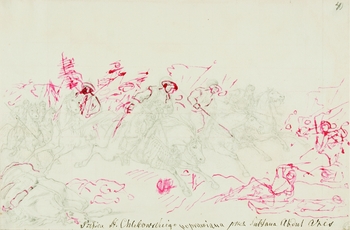
The sketch collaboratively produced by Ottoman Sultan Abdülaziz and Polish Orientalist Stanisław Chlebowski (see Figure 1) is a networked object. Currently housed in the National Museum of Krakow, it is an intriguing fragment of a visual dialogue that transpired in the Dolmabahçe palace studio between the sultan and his Polish court painter. Between 1865 and 1872 they collaborated to produce an Ottoman historical battle cycle to be installed in Abdülaziz's new palaces on the Bosporus where he hosted visiting foreign royalty and heads of state. This sketch was for one of the paintings in that series, The Mora Rebellion. The sultan's red-ink revisions over the artist's pencil sketch instate an energized scene of combat. Uniting the central cavalrymen under an Ottoman standard, Abdülaziz urges his painter to depict them straining further forward, rising out of their saddles in order to more fiercely engage in the rush of the charge. This is matched by a greater massing of figures in the foreground, injecting energy through spatial compression. The sultan inserted a mêlée of Greek rebels slain on the ground and fleeing on foot to create a heightened sense of turmoil and strident reprisal. Here triumphant Ottoman history is inscribed through the force of combat on the field of battle. Abdülaziz redirects his court painter's skills in figurative painting to ensure that the energy of combat prevails. The conventional role of a powerful patron to oversee and arbitrate is augmented here by the sultan's artistic interventions.
Stanisław Chlebowski (Polish, 1835–84) and Sultan Abdülaziz (Ottoman, 1830–76). Charge of the Turkish Cavalry, ca. 1865–72, pencil, ink, and paper (23 × 34.3 cm, 9.125 × 13.5 in.). From the Czaykowska album, 14. From the National Museum in Krakow, inventory no. MNK III-r.a-6688.

The sultan not only asserted his compositional preferences in this battle series, but he also specified the inclusion of Ottoman inscriptions on the top right of six of the paintings. This experimental approach incorporating Ottoman calligraphic text within the pictorial space of easel painting exemplifies his flexible approach to the form. The inclusion created a hybrid visual language referencing the conjunction of word and image in the Ottoman miniature tradition while relocating it into the Western mode of easel painting. These military history paintings were intended to impress upon the foreign visitors to Abdülaziz's palaces the cultural sophistication of the reigning sultan as well as the proud historical legacy of the empire on the world stage. The inclusion of Ottoman inscriptions unequivocally signals that their message was also directed toward an educated elite Ottoman audience.
The series created an historical narrative of the empire's growth and consolidation that emphasized the defense and expansion of its borders in central and southeastern Europe. In the second half of the 19th century, when those borders were again under dispute as the Ottoman state strove to prevent territorial losses, this narrative was particularly resonant. This was an Ottoman vision of the past at a time when new histories were being produced as the ideological buttress to nation and empire building across the globe.
The afterlife of this and sixty-six other sketches formed through this unique artistic conversation is as intriguing as their networked mode of production: they circulated within both Ottoman and Orientalist circles. The sketches remained among Chlebowski's personal effects when he returned to Europe and selections of them were published in art journals in Poland and England.Footnote 3 Their appearance in the prestigious British journal The Studio in 1913 drew the attention of those in the Istanbul art scene. Through this conduit they returned to the Ottoman capital, this time printed on the pages of the Osmanlı Ressamlar Cemiyeti Gazetesi (Journal of the Society of Ottoman Artists).Footnote 4 In Europe they were adduced as evidence of a talented but thwarted sultan within a corrupt political context, whereas in Istanbul they generated a more positive Ottoman narrative. In the 1860s and 1870s the sultan's ink drawings and their related battle paintings had served the politics of Abdülaziz's modernizing state; in the early 20th century, the sketches sustained a developing narrative of Ottoman and then Turkish modernism. In a local context Abdülaziz's drawings were revered as evidence of the personal talent and passion that motivated the sultan's important early efforts at renewal of the arts within the empire.
To construe this Ottoman engagement with European academic art as an undigested imitation of conservative Western aesthetic conventions and tastes would not only be historically inaccurate but also a conceptually naïve reading of processes of cultural transfer and translation. The assimilation of academic art into the Ottoman royal palaces in the 19th century came to serve local agendas and preferences as much as it modified such tastes. In other words, cultural transfers such as these were not passively received but were transposed into their new environments and had transformative effects within that context. And, given the mobility of these networked objects, the sketches did not simply reflect the sultan's imperial ideology or the values of the Polish artist in whose possession they remained. Instead they represented a range of interests and addressed different audiences as they traveled across time and space. This case study is exemplary of the way many works of art by Ottoman and Orientalist artists produced in this period were created, apprehended, and interpreted within a cross-cultural web of connected meanings that were part of modern global culture. Sometimes this web was a battlefield of competing representations; at other times it was a negotiated matrix of divergent positions. Writing the history of networked objects requires us to attend to their interpretation within varied historically contingent nodes of cultural contact as well as to account for their shifting vectors of meaning.