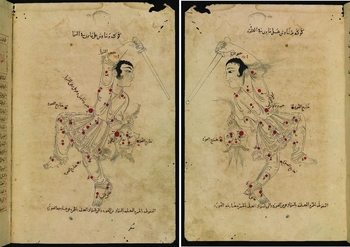
Kitab Suwar al-Kawakib (The Book of the Forms of the Stars) of ʿAbd al-Rahman b. ʿUmar al-Sufi (d. 986), though based largely on Ptolemy's Almagest, included much original material. In the 20th century, its importance for scholars lay mainly in its attestation of the ways Islamicate scholarship built on classical learning. Now we are finding that it also offers fascinating insights into the complex relationship between seeing and knowing in premodern Islamic book culture. Here, I consider that relationship through analysis of the paired images of the constellation Barshawush (Perseus) from the oldest surviving manuscript, copied and likely also illustrated in 1009–1010 by al-Sufi's son.Footnote 1
The manuscript's images were first addressed seriously in a 1959 article by Emmy Wellesz, who was interested mainly in how they show “the ‘orientalization’ of the classical constellation pictures.” For example, whereas in classical iconography Perseus would have carried the head of Medusa, in Islamic iconography he carries instead the head of a demon. Wellesz also briefly notes al-Sufi's stipulation that each constellation be shown twice: first, as it would appear if one were to look down onto a globe and then as it would appear if one were to look up into the sky. She even quotes al-Sufi's comment that “the beholder might be confused if he saw the figure on the globe differing from what he sees in the sky.”Footnote 2 But the point has no bearing on Wellesz's analysis of the images.
By contrast, it is precisely the pairing of images in al-Sufi manuscripts that has been of interest to recent scholars such as Moya Carey. For Carey, the images’ importance lies principally in their function as mnemonic star maps. Responding to al-Sufi's comment, she considers the scenario in which a beginning student, first learning the constellations by looking down at a globe, might have difficulty mentally reversing the images learned. Without being able to conceptualize them in reverse, the student would not be able to find them in the sky. Carey emphasizes that the paired images cleverly address this basic pedagogical problem: together, they do the work of reversing the globe's image for the student.Footnote 3
Other aspects of the relationship between the paired images and al-Sufi's pedagogical goals are more complex. Al-Sufi says that differences between the globe and sky views of constellations can cause confusion; yet, what we actually find in the manuscripts, consistently, is that the images of any given pair differ in apparently purposeful details. In the 1009–1010 Perseus images, for example, the head of the “globe” demon has a moustache but no ears (see right side of Figure 1), whereas the head of the “sky” demon has ears but no moustache (left side of Figure 1). While Carey has not commented on this particular pair, she has analyzed the not-quite symmetries in a late 13th-century manuscriptFootnote 4 whose paired images are distinctively placed so that they are simultaneously visible. Describing Perseus, she astutely draws attention to how, “by subtle differentiation, the two versions of the same constellation have come to enact an encounter, exchanging glances or hostilities without distracting from their functional role. This, she comments, “has no operational advantage, but the net effect is to inject the careful symmetrical images with a drop of panache.”Footnote 5
The constellation Perseus as seen on the globe and in the sky, on two sides of the same folio from the 1009–1010 manuscript of Kitab Suwar al-Kawakib (The Book of the Forms of the Stars) of ʿAbd al-Rahman b. ʿUmar al-Sufi. Oxford, The Bodleian Libraries, University of Oxford, Marsh 144, p. 110 (right), and p. 111 (left) (26.5 × 18.0 cm, full folio).

But perhaps it did have an operational advantage. Not only could aesthetic agendas comfortably coexist with intellectual ones in premodern Islamic book culture, but sometimes the two were inextricably linked.Footnote 6 Consider the 1009–1010 images of Perseus, appearing on opposite sides of the same folio. Upon turning the page for the first time, the attentive reader/viewer notices a few differences, perhaps in the heads of the demons, or in the faces of the warriors. Initial awareness of a few such differences prompts a rewarding, and therefore pleasurable, search for more. As we delve into that search, it becomes clear that the comparative process requires the reader/viewer to generate his or her own abstracted mental images—mental images that accommodate not only both paper images but also the overall visual idea of the constellation. This would be the case even if the paired images were simultaneously visible. But it is particularly the case when the images are separated by a page turn, because this requires the reader/viewer to hold in memory the similarities against which differences may be noted. The remembered similarities provide a frame for generating an abstracted mental image of the visual idea: Perseus. It is this abstracted visual idea of the constellation, rather than either of the paper images, that the al-Sufi manuscripts are meant to teach.
The al-Sufi manuscripts show how comparisons invited by closely related images on paper could be critical to the acquisition of some kinds of knowledge. This brings a new dimension to the rich scholarly discussion about the repetition of pictorial and calligraphic compositions in premodern Islamic manuscripts.Footnote 7 Further, the critical role of near symmetries in drawing the viewer into pleasurable processes of comparison and mental abstraction offers a new angle from which to consider near symmetries in other media.