During the past few years, there has been a growing popular backlash against international institutions. Voters have become more critical of individual international institutions such as the EU,Footnote 1 the World Trade Organization,Footnote 2 and international courts.Footnote 3 More generally, multilateralism has become increasingly contested,Footnote 4 and the stability and legitimacy of the existing liberal world order are being challenged.Footnote 5 Much has been written about why voters in countries as diverse as Greece,Footnote 6 Switzerland,Footnote 7 the United Kingdom,Footnote 8 and the United StatesFootnote 9 have turned against international institutions and international cooperation more generally. There has also been growing interest in which states withdraw from international institutions,Footnote 10 how states challenge international organizations through renegotiations,Footnote 11 and what such withdrawals may mean for the respective international institutions.Footnote 12
However, much less is known about those on the receiving end of such disintegration processes: the citizens of the remaining member states. This is surprising because the effects of a withdrawal by one country from an international institution on the other member states can be large, in both economic and political terms. The US withdrawal from the Iran nuclear deal, for example, made it difficult (or impossible) for the other parties to the agreement to uphold the arrangement. The prospect that Greece could leave the euro after its 2015 bailout referendum caused significant concern in the other Economic and Monetary Union (EMU) member states because it was expected to have far-reaching ripple effects. And most recently, the withdrawal of the United Kingdom from the European Union (“Brexit”) is having significant political and economic repercussions for the remaining EU-27 member states.
Although any state is of course free to leave an international institution, the remaining member states often have a significant say in how the future relationship between the withdrawing state and the international institution will be shaped. Research into how such negotiations play out in specific cases has begun to emerge,Footnote 13 but more rigorous analysis of how governments deal with the dilemmas and intertemporal trade-offs in these negotiations is scarce. We know even less about the goals that the citizens in the remaining member states want their governments to pursue in such withdrawal negotiations and how public beliefs influence the negotiation dynamics at an international level. Yet understanding public opinion matters, both directly and indirectly. First, policymakers take public opinion into account when making foreign policy decisions,Footnote 14 especially when international cooperation is a salient issue in the public sphere.Footnote 15 Second, voters’ preferences can enhance the bargaining power of governments in international negotiations,Footnote 16 and can thus provide a useful tool for policymakers engaged in withdrawal negotiations. For both reasons, it is important to better understand public opinion about the terms of another country's withdrawal from an international organization, and the organization's future engagement with that state.
Our paper fills this gap by providing insights into how citizens in the remaining states want their governments to respond to unilateral withdrawal requests and the dilemmas they face in the process. We begin by conceptualizing two ideal-type negotiation outcomes in withdrawal negotiations based on the extent of (non-)accommodation.Footnote 17 “Accommodation” refers to the degree to which the withdrawing state will be allowed to continue enjoying the benefits of cooperation (and the obligation to bear cooperation costs) after withdrawal. We then explore which types of outcomes and corresponding negotiation approaches voters in remaining states prefer. In particular, we argue that voters’ choice between more or less accommodation is shaped by two main issues: their exposure to the net costs of accommodating the withdrawing state, and concern about the ripple effects of accommodation. Exposure varies across individuals, but also across specific negotiation issues. On some issues, accommodating the withdrawing state leaves the remaining member states worse off, and vice versa. Citizens’ willingness to accommodate the withdrawing country on such zero-sum issues is therefore likely to be small. Other issues require cooperation from both sides to generate benefits, which means that the remaining member states face losses if they refuse to accommodate the withdrawing state. We therefore hypothesize that citizens will support a more uncompromising stance on zero-sum issues, but a more accommodating negotiation position on cooperation issues. At the same time, however, accommodating the withdrawing state with generous terms of withdrawal may encourage further exits. This risks destabilizing the institution in the long run.Footnote 18 Thus voters concerned about the institution's stability should be less willing to make accommodations.
The choice between accommodation and non-accommodation can confront citizens with difficult trade-offs. Citizens with an interest in safeguarding the international institution prefer a non-accommodating stance, but this is a costly path when it puts cooperation gains at risk.Footnote 19 With regard to cooperation issues, these citizens thus face a dilemma which moderates their support for non-accommodation. At the same time, the possible encouragement effects of an accommodative negotiation approach are likely to be perceived as a boon, rather than as a problem, by citizens who themselves wish to leave the institution. However, these citizens face a dilemma with regard to zero-sum issues, where accommodation is costly for the remaining member states. Critics of the international institution will therefore moderate their support for accommodation on zero-sum issues.
We examine these arguments in the context of the largest negotiations on withdrawal from an international organization to date: the Brexit negotiations between the United Kingdom (UK) and the European Union (EU). These negotiations presented an enormous challenge to the remaining member states of the EU, who were losing one of their biggest, geopolitically powerful, net-contributing member states, with whom they were enjoying close ties. Using original data from two surveys conducted in Germany and Spain in December 2017 and March 2019, we analyze individual Brexit negotiation preferences. We first use a conjoint experiment to analyze how citizens evaluate different hypothetical Brexit deals that include a variety of cooperation and zero-sum issues. We find that citizens overall are more willing to accommodate the UK on cooperation issues than on zero-sum issues, but also find evidence for the issue-specific (non-)accommodation dilemmas. Europhiles prefer non-accommodation, but have more moderate preferences with regard to cooperation issues. By contrast, Euroskeptic respondents show a clear preference for more accommodating proposals regarding cooperation issues, but are much less accommodating with regard to zero-sum issues. Of course, the Brexit negotiations covered a multitude of issues. In a second step, we therefore explore respondents’ preferences regarding the general EU-27 Brexit negotiation approach and find that exposure to the costs of non-accommodation and EU attitudes condition overall negotiation preferences as well. Moreover, we run simulations that suggest that the final outcome of the Brexit negotiations was supported by most Spanish and German citizens.
By providing important insights into European citizens’ preferences regarding the Brexit negotiations, our analysis more generally improves the understanding of the dilemmas and intertemporal trade-offs that unilateral withdrawal creates for an organization's other member states. The conclusion demonstrates that these insights can also help us better understand how governments respond to these challenges. More generally, the article contributes to a better understanding of the dynamics surrounding the unilateral challenges to multilateralism that have proliferated in recent years.
Bargaining over the Terms of Withdrawal: (Non-)Accommodation Dilemmas
Membership of an international institution has both costs and benefits for its member states. These costs range from financial obligations, such as yearly dues, to compliance with the mutually agreed compromises and rules of the institution (such as international regulations and standards). Importantly, international cooperation also imposes limitations on national sovereignty.Footnote 20 The benefits include the aggregate gains from international cooperation, reputational benefits, and access to joint programs and initiatives, but sometimes also more tangible benefits such as funding from international programs. For most countries, the costs are outweighed by the benefits—otherwise sovereign states would not join.Footnote 21
A country's request to withdraw from an international institution can be interpreted as a bid to recalibrate this cost–benefit ratio. This suggests that we can conceptualize possible withdrawal outcomes in a 2×2 table that distinguishes outcomes based on whether or not the withdrawing state continues to pay the costs and enjoy the benefits of membership (Table 1). A first possible negotiation outcome is that the leaving state continues to enjoy the benefits, but does not have to bear the costs. This is of course a very good outcome for the withdrawing state, allowing it to free-ride on the efforts of the other states to generate cooperation gains. We refer to such an outcome as an accommodating withdrawal outcome. This contrasts with an outcome in which the withdrawing state loses the benefits that international cooperation provides, but continues to bear at least some of the costs. One can conceive of this outcome as one in which the withdrawing member state is punished for leaving. Such a non-accommodating outcome clearly is the worst outcome for the withdrawing state.Footnote 22
Typology of withdrawal outcomes

These two outcomes are extremes and serve more as an analytical tool than a realistic depiction of negotiation outcomes. In most cases, the outcome will be between these extremes. In somewhat accommodating withdrawal outcomes, the withdrawing state retains many benefits of international cooperation but also continues to bear some of the costs. An example of such an outcome is the US threat to withdraw from the NAFTA treaty in 2017–2018. The new, renegotiated United States–Mexico–Canada Agreement (USMCA) maintained the core of the original agreement, but also modernized it and incorporated new rules and provisions that mostly reflected changes desired by the US.Footnote 23 The US was thus able to keep and even slightly expand its share of the cooperation gains generated by the free trade agreement, while at the same time agreeing to follow the new agreement's rules, with all the sovereignty costs such an agreement entails.
In other cases, the withdrawing state loses access to most of the benefits of cooperation, but in return bears no or only a small share of the costs. This is analytically similar to not entering into the agreement. The important difference is that this implies a reduction of existing cooperation gains for everyone involved relative to the status quo (membership). We classify such instances as somewhat non-accommodating. For example, Burundi's 2017 withdrawal from the International Criminal Court (ICC) means that it no longer benefits from the transnational legal structure and the reputational benefits that ICC membership provides, but in turn also no longer has to allow the ICC to investigate and prosecute international crimes committed in Burundi after the withdrawal.
Which of these scenarios a country ends up in after withdrawing from an international institution can vary considerably. Sometimes, the terms of withdrawal are predetermined by an international agreement,Footnote 24 and sometimes withdrawal simply means a return to the status quo ante.Footnote 25 Even when the international environment has evolved to such an extent that the status quo ante is no longer available, the consequences of withdrawal from individual treaties are sometimes small for the withdrawing state, either because the country is embedded in a wider regime of legal rights and obligations,Footnote 26 or because other countries continue to cooperate to provide a global public good from which the withdrawing state cannot easily be excluded. This also holds in cases where unilateral withdrawal reduces the overall effectiveness of the treaty.Footnote 27
In other cases, however, countries unilaterally (threaten to) withdraw from international institutions and in the process try to renegotiate better terms for their future relations with their former partner states. Examples range from lesser-known cases such as transboundary freshwater agreementsFootnote 28 or bilateral investment treaties,Footnote 29 to better-known cases such as the US bid to terminate NAFTA and renegotiate the USMCA successor agreement,Footnote 30 or Brexit, where the EU and the UK had to negotiate both the terms of withdrawal and the contours of their future relationship.Footnote 31 In essence, such withdrawal negotiations are aimed at establishing a new institutional arrangement that rebalances the costs and benefits of cooperation. By taking a more- or less-accommodating approach to negotiations, the institution's other member state(s) can thus influence the withdrawal outcome and the extent to which the withdrawing state will continue to enjoy the benefits and bear the costs of cooperation after withdrawal.Footnote 32
How do the citizens of remaining member states evaluate these negotiation approaches? We argue that the choice between more or less accommodation confronts voters (and elites) in the remaining member states with a number of difficult trade-offs.Footnote 33 These trade-offs, the dilemmas they create, and ultimately voters’ support for more or less accommodation are shaped by two main issues: first, the extent to which accommodation creates net costs or benefits for the remaining member states in terms of cooperation gains; and second, the extent to which the voter is concerned about the potential ripple effects of accommodation.
Net Costs or Benefits of Accommodation: Zero-Sum and Cooperation Issues
The first issue influencing voters’ preferred negotiation approach concerns the potential costs or benefits for their own countries of accommodation. The extent to which accommodation and non-accommodation affect these costs and benefits varies across different types of negotiation issues. We classify these into two broad categories: zero-sum issues and cooperation issues.Footnote 34
Zero-sum issues are issues for which a more favorable outcome for the leaving state invariably makes the remaining member states worse off, and vice versa. Accommodating the withdrawing state on zero-sum issues thus means that they will be worse off than under the status quo, whereas non-accommodation means that the withdrawing state will be worse off. Zero-sum issues are therefore negotiation issues for which each negotiating party will try to push through the most favorable outcome for itself, which is also why these issues are likely to be particularly divisive. An example of such a zero-sum issue is the conflict between Bangladesh and India about how to share the water of the Ganges, which was one reason for the expiry of the Bangladesh–India agreement on Ganges water-sharing in 1982. More generally, zero-sum issues imply that the worse the outcome is for the withdrawing state, the better it will be for the remaining member states.
By contrast, cooperation issues are issues where cooperation from both sides is required to generate benefits. In this case, denying the withdrawing state continued access to the benefits of international cooperation means that the remaining member states lose these gains as well. For example, if a withdrawal leads to the reintroduction of trade barriers, exporters and consumers in both the remaining and the leaving country will be hurt. Likewise, the expiry of other forms of cooperation and policy coordination, from terrorism prevention to environmental protection, creates transaction costs, economic distortions, and financial risks for economic actors and individuals in both the remaining and the withdrawing state alike. Cooperation issues thus imply that non-accommodation, which generates a worse outcome for the withdrawing state than the status quo, also hurts the remaining member states. Hence, non-accommodation on cooperation issues is costly for both sides.
This discussion suggests that voters in the remaining member states should assess the desirability of an accommodating or non-accommodating withdrawal outcome differently depending on whether the issue(s) under negotiation are zero-sum or cooperation issues. We expect that voters will generally prefer non-accommodation on zero-sum issues but will be more accommodating with regard to cooperation issues. The more exposed an individual is to the consequences of the withdrawal, the more pronounced these effects should be. Taking into account that withdrawal negotiations usually cover multiple issues, we argue that the preferred negotiation outcome will depend on the mix of zero-sum and cooperation issues. This leads to the following hypotheses: The higher the share of zero-sum issues, the less accommodating voters will be (H1). When cooperation issues dominate, voters will be more willing to accommodate the withdrawing state's demands, especially when they are heavily exposed to the economic or social fallout from noncooperation (H2).
Concern about the Ripple Effects of Withdrawal: Precedent and Political Contagion
Withdrawal negotiations and treaty renegotiations often set a precedent for future withdrawals and renegotiations and give voters and elites abroad valuable information about the economic, social, and political consequences of such actions.Footnote 35 It is therefore important to consider the ripple effects of the outcome of any withdrawal negotiations. An accommodating outcome that allows countries to change the cost–benefit ratio in their favor becomes a precedent that makes withdrawal attractive, for example.Footnote 36 This in turn can incentivize critics of the international institution in the remaining member states to push for a withdrawal of their own country.Footnote 37 Accommodation also reduces reciprocity, a key enforcement mechanism of international regimes.Footnote 38 Taken together, this means that accommodation carries the risk of destabilizing the international institution in the long run. By contrast, non-accommodation avoids such problems and instead is likely to deter further exits.Footnote 39
The ripple effects of accommodating and non-accommodating withdrawal outcomes also influence how voters evaluate different negotiation approaches in the first place, in ways that vary according to a citizen's own assessment of the international institution. Citizens who are supportive of the institution will be particularly concerned about potential negative domino effects of accommodation and risks to the long-term stability of the institution.Footnote 40 We therefore expect them to be more likely to endorse a non-accommodating negotiation approach. By contrast, for citizens who would like their own country to withdraw from the international institution as well, an accommodative withdrawal precedent is attractive because it facilitates future withdrawals on favorable terms. As a result, we hypothesize that citizens who are supportive of the international institution will be more likely to prefer a non-accommodating negotiation outcome, while citizens who oppose the international institution will be more likely to prefer an accommodative negotiation outcome (H3).
Negotiation Preferences and Dilemmas
While it is straightforward to derive hypotheses about how the type of negotiation issue and concern about the ripple effects of accommodation influence voters’ negotiation preferences, the problem confronting voters is that these dimensions do not stand in isolation. Combining the two dimensions yields four different settings, two of which create considerable dilemmas for supporters and opponents of the international institution, respectively (Table 2).
Preferred negotiation strategies among supporters and opponents of the international institution (II)

As discussed before, voters who value the international organization and are concerned that a positive withdrawal experience for the leaving state may undermine the long-term stability of the international organization are going to be less willing to accommodate the leaving state. This is easy when non-accommodation carries little cost, that is, when the negotiations revolve around zero-sum issues, for which accommodation is costlier for the remaining member states than non-accommodation. In this scenario, we expect that supporters of the international institution will unambiguously support non-accommodation (upper left-hand corner). However, where cooperation issues are concerned, non-accommodation is costly. For voters who value the international institution and who therefore want to avoid any further destabilization, this creates a dilemma which moderates their preference for a non-accommodating negotiation stance (lower left-hand corner).Footnote 41 The extent of this accommodation dilemma will be shaped by a variety of factors, such as voters’ discount rate, the time profile of the costs and benefits of non-accommodation, or their closeness to elites who emphasize certain issues more than others.Footnote 42 Overall, however, based on the accommodation dilemma, we hypothesize that supporters of the international institution will support a more compromising line with regard to cooperation issues than with regard to zero-sum issues (H4).
Meanwhile, citizens who are opposed to the international institution and would like to withdraw from it themselves face a different kind of dilemma. They are not conflicted with regard to cooperation issues; after all, they want a negotiation outcome that creates an attractive precedent for future withdrawals. They are therefore likely to support accommodating the withdrawing state on cooperation issues (lower right-hand corner). However, they face a non-accommodation dilemma with regard to zero-sum issues (upper right-hand corner). This is because accommodating the withdrawing state on zero-sum issues means tangible costs to the remaining member states. Since opponents of international institutions are often nationalists, allowing another country to enjoy absolute gains at their own country's expense is a particularly bitter pill to swallow. For opponents of the international institution, zero-sum issues therefore create a dilemma between the wish to limit the costs of another country's withdrawal for their own country and the wish to establish a favorable precedent for future withdrawals from the international institution.Footnote 43 We therefore hypothesize that citizens who oppose the international institution will strongly prefer an accommodative negotiation stance with regard to cooperation issues. However, the non-accommodation dilemma will moderate their preferences for accommodation with regard to zero-sum issues (H5).
Empirical Analysis: Brexit Dilemmas in the EU-27
To empirically test our argument, we use original survey data collected in the context of the Brexit negotiations between the UK and the EU, the largest withdrawal negotiations from an international organization to date. These negotiations presented an enormous challenge to the remaining EU-27 member states because a sharp break of the dense ties between the UK and the EU-27, a so-called No Deal Brexit, would have had far-reaching and devastating consequences across Europe.Footnote 44 Even a Brexit outcome that would significantly reduce the level of cooperation with the UK relative to the status quo, commonly referred to as “hard Brexit,” had been projected to reduce national GDP in the EU-27 by between 0.6 percent and 2.6 percent.Footnote 45 By contrast, an accommodative negotiation approach that would have allowed the UK to retain most of the benefits while shedding most of the costs of EU membership would have limited the economic fallout from Brexit, especially in the short run. Thus accommodation had upsides not just for the UK but for the EU as well.
At the same time, accommodation created a number of risks for the EU. It would weaken the EU's acquis communautaire, which would damage the appeal and the unity of the Single Market in the long run.Footnote 46 And allowing the UK to share the EU's benefits without contributing the costs carried an even larger political risk: the risk of political contagion. An accommodating Brexit outcome that left the UK better off than it was previously as an EU member state risked demonstrating to voters across the EU-27 that European integration can be reversed and that countries can unilaterally improve their position by leaving the EU. Allowing single states to opt out from the costs of EU membership while retaining the benefits thus risked setting a precedent with significant long-term ripple effects.Footnote 47 The question of how many benefits the UK should be allowed to continue to enjoy after the transition period and how much of the costs it should be required to shoulder thus confronted the remaining EU member states and their citizens with difficult trade-offs.
Although the Brexit negotiations were conducted by the European Commission, public opinion mattered. Both the Withdrawal Agreement that was concluded in 2019 and the UK–EU agreement about the future relationship negotiated in 2020 had to be ratified by the national parliaments of the EU-27 member states and the European Parliament. Occurring against a backdrop of increasing contestation over the EU,Footnote 48 Brexit was a highly politicized issue not just in the UK but also in the remaining member states, not least because of its impact on defining a blueprint for exiting the EU. National political parties in the remaining member states have used the Brexit negotiations to justify and explain their EU-related policies.Footnote 49 There was also significant media coverage of the Brexit negotiations, and about two-thirds of EU-27 Europeans have stated in surveys that they were paying at least some attention to Brexit,Footnote 50 all of which suggests that politicians’ responsiveness to Brexit-related public opinion should be high.
Case Selection and Data
Our empirical analysis examines German and Spanish citizens’ preferences regarding the Brexit negotiations. Germany and Spain are two of the largest EU member states, and Brexit was a prominently discussed issue in both countries throughout the negotiations. Many citizens in both countries have personal ties with the UK, with approximately 144,000 Spanish citizens (0.4% of all Spanish citizens) and 165,000 German citizens (0.2% of all German citizens) living in the UK in 2016.Footnote 51 The two countries also vary in some important respects that are relevant to our argument, which increases the generalizability of our empirical findings to other EU-27 countries.
With its strongly export-oriented economy, Germany is much more exposed than Spain to the costs associated with not accommodating the UK on cooperation issues such as trade. For example, Chen and colleagues estimate that 5.5 percent of German GDP, but only 0.77 percent of Spanish GDP, is at risk in a non-accommodative “hard Brexit” scenario.Footnote 52 This suggests the hypothesis that Germans should be more willing than Spaniards to accommodate the UK on the cooperative dimensions of the Brexit deal (H6). At the same time, Spain (as a net-recipient country and a country with a territorial debate with the UK about the status of Gibraltar) is more exposed than Germany, a net-contributor country, to the costs associated with accommodating the UK on zero-sum issues such as continued British payments into the EU budget or the status of Gibraltar. This leads to the hypothesis that Spaniards should take a less accommodating line on zero-sum issues than Germans (H7) Finally, the two countries differ significantly with regard to public support and elite-level support for the EU. Euroskepticism has traditionally been absent from the Spanish political debate, and this is still the case despite the emergence of populist right-wing and left-wing political parties in the national arena. In contrast, the rise of a radical right-wing Euroskeptic party, Alternative for Germany, has made the issue of European integration more contested in Germany, not just among voters but also among elites. This suggests that on average, Spaniards should be more concerned about the stability of the EU and thus support a less accommodating negotiation stance overall (H8).
We use original data from two surveys that we designed and conducted, which were administered to a total quota sample of 4,796 respondents in Germany and Spain in December 2017 and March 2019.Footnote 53 In each country 1,550 respondents were surveyed between 9 and 19 December, 2017, a few months after the Brexit negotiations had begun. We repeated the survey with 1,696 respondents (838 in Germany and 858 in Spain) between 4 and 10 March 2019. At the time of the second survey, the withdrawal negotiations had been concluded and the withdrawal agreement was going through the British Parliament for ratification—an endeavor that ultimately failed and put the UK on the brink of a No Deal Brexit just a few days after our survey was completed. We thus cover two distinct periods of the Brexit withdrawal negotiations. Because exposure and contagion risks are unlikely to vary a lot with such specific circumstances, this allows us to test the stability of negotiation preferences across different settings. The focus on ongoing negotiations allows us to explore respondents’ perceptions of Brexit-related trade-offs without the hindsight bias that might arise from observing the actual Brexit deal.
Research Design
Our argument suggests that Europeans’ preference for a more- or less-accommodating negotiation outcome in the Brexit negotiations with the UK depends on the type of issue under consideration and their general level of support for the EU. To test this argument, we proceed in two steps.
Because the Brexit negotiations over the UK's terms of withdrawal and future UK–EU relations were a complex affair that covered multiple dimensions and issues, we first use a conjoint experiment for our main empirical analysis. Conjoint experiments are a statistical technique to analyze how people value different attributes in a given proposalFootnote 54 and measure preferences that drive choices.Footnote 55 In the experiment, respondents have to choose between two alternative proposals, in our case hypothetical Brexit deals, that contain multiple randomly varied issues (“attributes”) over which both parties negotiated. In line with our argument, those attributes take different values, namely more- or less-accommodating outcomes for each specific issue. The literature documents the advantages of conjoint experiments: they are an ideal experimental design to study multidimensional preferences because they allow respondents to analyze several pieces of information jointly, and use the information they consider most relevant, all while reducing social desirability bias.Footnote 56 Conjoint experiments also allow mitigation of partisan biases in the choices of respondentsFootnote 57 and have been shown to have more external validity than vignette experiments, which are the typical alternative.Footnote 58 Conjoint experiments also have disadvantages, such as relying on stated preferences as an outcome variable and inducing cognitive processes that are not always naturalistic. These downsides, however, also apply to any other survey experiment, so we can argue that overall, the advantages of conjoint analyses tend to outweigh their limitations.Footnote 59
Ultimately, what the remaining EU member states had to accept at the end of the negotiations were final Brexit deals: huge documents that regulated all the different issues. Rather than pick and choose on individual issues, the final decision thus collapsed the multidimensionality of the Brexit negotiations into a single dimension, namely support of the overall deal. To examine how German and Spanish voters responded to the question of accepting a more- or less-accommodating overall Brexit deal, a second set of analyses evaluates the public's preferences for the overall EU-27 Brexit negotiation approach.
Negotiating Brexit: A Conjoint Experiment
Experimental Design
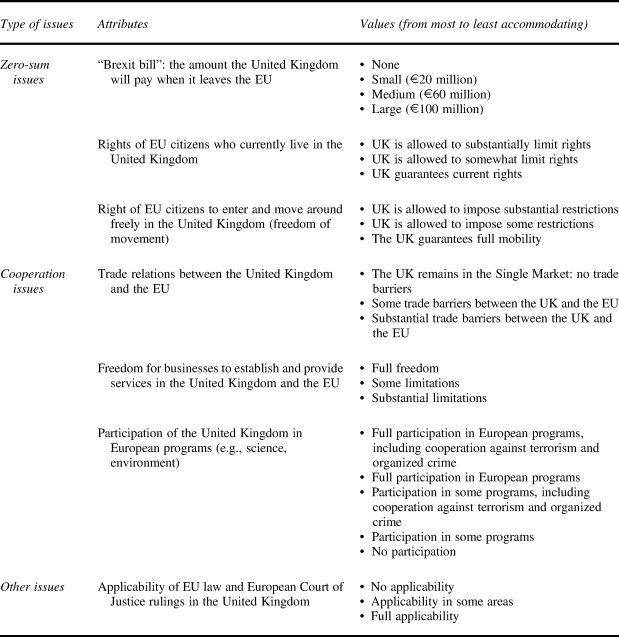
To what extent did German and Spanish voters want to accommodate the UK on different issues in the Brexit negotiations? We have argued that issue type and support for the EU jointly shape these preferences. To empirically test this argument we designed a conjoint experiment that contained a list of seven attributes that were key issues in the negotiations between the UK and the EU about the terms of withdrawal from the EU and the future relationship between the two parties. We chose seven issues that were among the most contested in the negotiations and grouped them into broad categories (Table 3). This number provides a good balance between including too few attributes, which leads to masking problems, and including too many, which generates satisficing problems.Footnote 60 Attributes were presented in a randomized order.
Brexit attributes and values in the conjoint experiment

We include both zero-sum issues and cooperation issues. Zero-sum issues, in which negotiation outcomes become worse for the remaining member states the closer they are to the British position, are issues that each negotiating party has few incentives to compromise on. This is why we expect respondents to generally prefer a non-accommodating stance on these issues. The clearest zero-sum issue is the issue of UK payments to the EU, the so-called “Brexit bill.” The UK had been a net payer into the EU's budget, and its contributions had been an important source of revenue for the EU budget. The Brexit-related loss of revenue was thus going to hurt all the remaining member states: net payers would have to contribute more, and net recipients would see their inflows cut. Larger UK payments to the EU were thus unambiguously positive for the EU-27 states, whereas any compromises on this issue would hurt the EU's interests. A second zero-sum issue concerns the rights of EU citizens who already live in the UK. Because the EU member states, other than the UK, do not regard these rights as a burden, granting equal rights to UK nationals already living in the EU was not regarded as a costly concession. The more the rights of citizens already living abroad were to be limited, the worse the outcome was going to be for the EU side.Footnote 61 Finally, a third zero-sum issue concerns the rights of EU citizens to move to the UK in the future (“freedom of movement”). Many in the UK regarded this as one of the key costs of EU membership, and ending it was seen as one of the key purposes of Brexit.Footnote 62 However, it enjoys a lot of support in the remaining EU member states, so accommodating the UK on freedom of movement was going to be costly for the EU-27 member states and their citizens, who would lose their right to easily find future work opportunities in the UK.
The second group of attributes are cooperation issues. Here, a non-accommodating negotiation outcome which is worse for the UK than the status quo also hurts the remaining member states. Our conjoint experiment includes three cooperation issues: future UK–EU trade relations; freedom for British and EU businesses to establish and provide services in the EU and the UK; and UK participation in EU programs. For all of these issues, an accommodating outcome would be the most favorable outcome not just for the UK, but also for individuals, firms, and other actors on the EU side. Because cooperation from both sides is required to generate benefits on these issues, denying the UK these benefits (for instance by reintroducing trade-barriers or limiting the provision of services) means that the remaining member states lose cooperation gains in these areas as well. We therefore expect EU-27 voters to be more accommodating on these issues.
Finally, a highly contested issue in the Brexit negotiations was the applicability of EU law in the UK and the role of the European Court of Justice. We included it because of its prominence in the negotiations, even though it cannot easily be classified as either a zero-sum or a cooperation issue. Allowing the UK to diverge from EU rules would make trade with the UK more costly for EU-27 firms, and also creates a risk that British deregulation might undercut EU standards, giving a cost advantage to UK firms vis-à-vis their European competitors. This looks, on paper, to be a zero-sum issue. However, to the extent that the supremacy of EU law is also a key element of the Single Market, one could also argue that it is perhaps more of a cooperation issue. This middle position raises conflicting expectations for citizens’ accommodating preferences over this dimension.
In the experiment, respondents had to choose between two hypothetical Brexit deals that presented a different combination of outcomes, randomly assigned to each issue to prevent choices being driven by their specific order.Footnote 63 The different outcomes (values) ranged from accommodating ways to resolving the respective negotiation issue that was closest to the UK's interests, to less accommodating negotiation outcomes which were far from the preferred position of the British.Footnote 64 Because these values varied randomly across the hypothetical Brexit deal packages presented to respondents, the conjoint analysis allows us to explore which specific Brexit negotiation issues and outcomes in each area had the strongest effect on an individual's choices.
The unit of observation is the Brexit deal, and the outcome variable is whether the Brexit deal is chosen over its paired alternative (1 if chosen, 0 if not). Individuals had to choose six times between two different Brexit deals, so the conjoint analysis generated a total of 57,552 observations over the two waves. We estimate the average marginal component effects (AMCE). As Abramson, Koçak, and Magazinnik argue, the AMCE averages over two aspects of individual preferences: their direction and their intensity. This means that “the sign and magnitude of the AMCE depend upon the features included in the experimental design even though individual preferences over these features remain constant across experiments.”Footnote 65 Hence, in an experiment like ours, with several features and profiles, we must use caution in interpreting the results as majority-preferred features.
Effect of Issue Type on Citizens’ Preferences
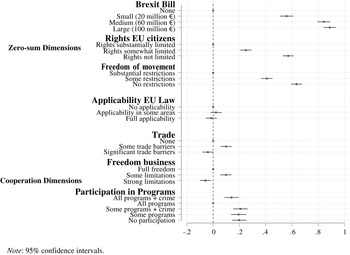
We begin with the overall results of the conjoint experiment. Figure 1 shows the AMCE from logit regressions, displaying the effect each negotiation outcome has in accounting for respondent's choices across different Brexit deals.Footnote 66 Overall, German and Spanish citizens adopt a rather non-accommodating line. For almost all dimensions, the Brexit deal is more likely to be accepted when the outcomes are less accommodating. Considering that in both countries EU supporters outnumber Euroskeptics, this finding is not surprising and also echoes earlier research from all EU-27 countries.Footnote 67
Conjoint experiment on hypothetical Brexit deals: overall analysis

More importantly, this analysis allows us to test our argument that citizens are more likely to prefer a non-accommodating negotiation approach with regard to zero-sum issues, but a more compromising approach with regard to cooperation issues. As expected, we find variation across issues in terms of how accommodating respondents are. Respondents are highly unwilling to accommodate the UK on zero-sum issues, and a non-accommodating negotiation outcome on these issues strongly increases the likelihood that respondents will accept a Brexit deal. This effect is most pronounced for the “Brexit bill,” with significantly higher support for Brexit deals in which the UK pays large sums of money, but it is also large with regard to the rights of current EU citizens in the UK and freedom of movement. In both cases, citizens are much more likely to support Brexit agreements in which the UK is not allowed to impose any restrictions. As predicted by our argument, respondents prefer non-accommodative positions on zero-sum issues for which any gains for the UK represent a cost for the EU-27. Our results suggest that citizens understand this and therefore support less compromising positions on those issues.Footnote 68
By contrast, we find more moderate effects for cooperation issues, where cooperation from both sides is required to generate cooperation gains. The less straightforward nature of the choice is reflected in our conjoint experiment. Compared to zero-sum issues, respondents soften considerably on these issues: the most preferred outcome is generally one where some restrictions are imposed. This means that the European public is willing to give up some, but not all, of the gains of cooperation with the UK in the Brexit deal. Respondents are more likely to accept some barriers and limitations, but there is a negative and significant effect with regard to strong barriers and limitations, for both trade and freedom of businesses to establish in the UK or the EU. With regard to the UK's participation in EU cooperation programs, respondents take a harder position, except when cooperation on security issues is explicitly mentioned. Not allowing the UK to participate in EU cooperation programs or only allowing it to participate in some of them increases the likelihood that the Brexit package is the preferred option by respondents. Overall, the magnitude of effects is considerably smaller for cooperation issues than for the zero-sum issues.
Finally, the applicability of EU law and European Court of Justice rulings is not an issue that has a significant effect on respondents’ choices among Brexit packages. As discussed, this is neither a zero-sum nor a cooperation issue, and we therefore had no clear expectations with regard to this topic. Nonetheless, given the contentiousness of the issue in the Brexit negotiations in the UK, it is interesting that on the EU side, preferences were not so clear-cut.
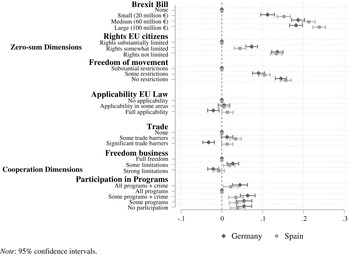
We next examine whether issue-specific Brexit negotiation preferences vary between Germany and Spain. As explained earlier, Germany and Spain differ in their exposure to different aspects of Brexit.Footnote 69 Whereas the export-oriented German economy is particularly exposed to the trade-related fallout from Brexit, Spain is more exposed to the financial consequences of the discontinuation of British contributions to the EU budget. At the same time, the two countries have similar exposure with regard to freedom of movement because significant numbers of citizens from both countries live in the UK. This suggests that Germans should be more accommodating than Spaniards with regard to both trade and the Brexit bill, whereas we expect little difference with regard to freedom of movement.
As expected, Spanish and German respondents differ most strongly with regard to the “Brexit bill” issue and the trade issue, where Spaniards are less willing than Germans to accommodate the UK (Figure 2). With regard to trade, respondents even exhibit opposite preferences, with Germans significantly less likely to accept a Brexit deal with significant trade barriers than one with no trade barriers whatsoever.Footnote 70 Germans are also much more willing to accommodate the UK's wish to avoid full applicability of EU law. In contrast, there are almost no statistically significant differences between Spanish and German respondents for most other issues, including freedom of movement.
Conjoint experiment results by country

More generally, these results underscore the argument that exposure to the costs and benefits of accommodation influences respondents’ withdrawal negotiation preferences. In the online supplement (Appendix 4) we provide empirical evidence that economic exposure affects an individual's negotiation preferences for the cooperative issues of the Brexit deal. We show that in regions that are highly exposed to economic fallout from Brexit, respondents are more likely to reject deals that impose substantial restrictions on both trade and the freedom of businesses and firms to provide services in the UK and the EU.
Yet it is not all about economic exposure. An individual's personal links also matter in understanding their preferences over specific dimensions of the Brexit deal. Citizens with friends and/or relatives living in the UK are more likely to reject deals that involve some restrictions on the rights of EU workers (Appendix 5). Overall, these empirical findings suggest that not only are citizens generally aware of the costs and benefits associated with accommodation on different negotiation issues, but also their issue-specific choices are affected by their particular circumstances.
Concern About Political Contagion: Euroskeptics Versus Europhiles
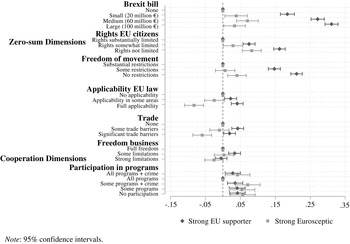
So far, our analysis has shown that an individual's Brexit negotiation preferences are informed by negotiation issue type and, more generally, an individual's exposure to the net costs of accommodation. However, we have argued that concern about the ripple effects of accommodating and non-accommodating withdrawal outcomes also influences how voters evaluate different negotiation approaches. We therefore next explore how attitudes to the EU condition a respondent's negotiation preferences. For this purpose, we include an interaction effect between all values in the conjoint experiment and a variable that captures the respondent's general opinion of the EU, coded from 1 (very negative) to 5 (very positive).Footnote 71
Figure 3 compares the AMCE of each negotiation outcome between citizens with very positive (black) and very negative (gray) opinions of the EU. As expected, Europhiles are much more supportive of non-accommodating Brexit negotiation outcomes than Euroskeptics, who are more likely to reject deals that do not accommodate the UK. This difference between the negotiation preferences of Europhiles and Euroskeptics holds for all issues except for participation in EU programs. This evidence is in line with our argument that supporters of an international institution are worried about the potential ripple effects of accommodation, whereas opponents view accommodation positively because it creates an attractive blueprint for future withdrawals from the institution.
Conjoint analysis by EU attitudes: the (non-)accommodation dilemma

(Non-)Accommodation Dilemmas
As discussed in the theory section, Europhiles’ general support for non-accommodation and Euroskeptics’ general support for accommodation confronts both groups of respondents with a dilemma (Table 2). Non-accommodation is costly where cooperation issues are concerned, which is why we expect Europhiles to face an accommodation dilemma with regard to these issues. By contrast, Euroskeptics face a non-accommodation dilemma on zero-sum issues because accommodation is costly for the remaining member states. These dilemmas should moderate a respondent's support for non-accommodation or accommodation.
The evidence supports this hypothesis (Figure 3). Europhiles are extremely supportive of non-accommodation with regard to zero-sum issues, but much less so with regard to cooperation issues. This preference moderation for cooperation issues is particularly pronounced for the freedom of business: here Brexit deals that impose some restrictions are preferred to both deals that impose no restrictions and deals with substantial restrictions. But compared to zero-sum issues, the substantive effects are also much smaller for trade and EU program participation (and for the applicability of EU law). Euroskeptics, by contrast, tend to be opposed to Brexit deals with non-accommodating outcomes on most cooperation issues, especially those that impose significant barriers to trade and businesses, as well as the applicability of EU law. This support for more accommodating outcomes is not surprising because they create an attractive precedent for future EU withdrawals. However, Euroskeptics’ support for accommodation does not extend to zero-sum issues because these issues confront them with the non-accommodation dilemma: although accommodating the UK on these issues would set favorable conditions for countries that want to leave the EU in the future, it also creates tangible costs for the citizens of the remaining member states.Footnote 72
In sum, the conjoint experiment corroborates our argument that support for a more- or less-accommodating negotiating approach in withdrawal negotiations is shaped by an individual's concern about both the costs and benefits and about the longer-term ripple effects of accommodation.
Preferences for More or Less Accommodation
The Brexit withdrawal agreement and the Brexit deal on the future EU–UK relationship were, of course, package deals that covered myriad issues. We therefore next examine what kind of overall negotiation approach German and Spanish respondents preferred in the Brexit negotiations.
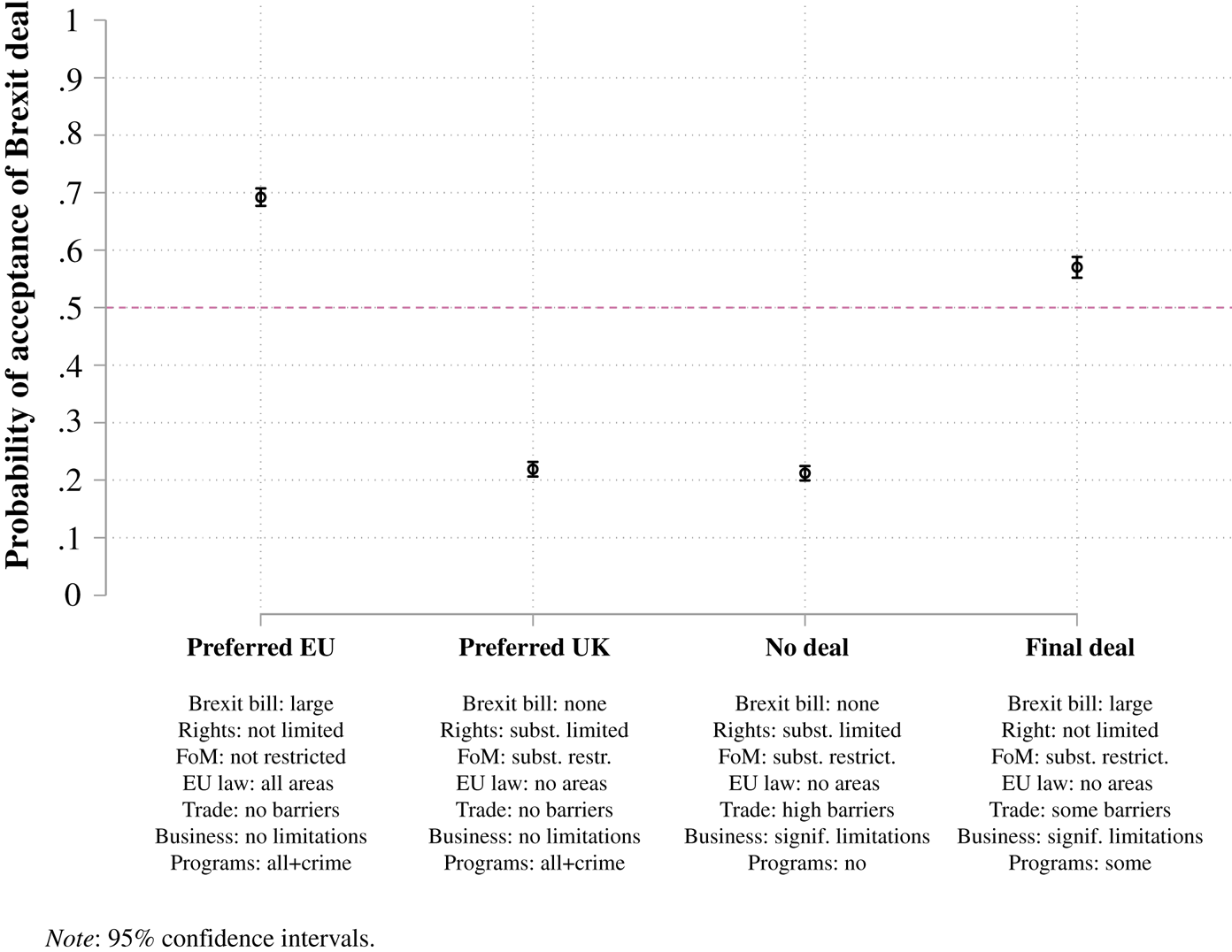
We first use the results of the conjoint analysis to calculate the predicted probability that an individual supports a specific Brexit deal. This exercise allows us to be more precise about the average support of German and Spanish respondents for a deal with a particular set of features.Footnote 73 Figure 4 shows the simulated overall probabilities of supporting four hypothetical Brexit deals and their respective attributes. We start out with the preferred EU deal, which is non-accommodative regarding all zero-sum issues and the question of EU law, but accommodates the UK on cooperation issues in order to keep the existing cooperation gains. This deal is viewed very positively by our respondents, with a 69 percent probability of being accepted. In contrast, the UK's preferred deal (accommodation across all dimensions) is the least preferred deal (22 percent). Next, we examine support for a No Deal Brexit, the scenario which often loomed over the negotiations and which constituted the reversion point in these negotiations. In this scenario, the UK would have avoided the costs of non-accommodation on all zero-sum issues and the EU law issue, but would have lost all benefits of cooperating with the EU. With a predicted acceptance probability of only 21 percent, this scenario is even more unpopular as the UK's preferred deal, which perhaps explains why the UK's No Deal threat did not give it more leverage in the Brexit negotiations.Footnote 74 Finally, we simulate the deal that approximates the eventual outcome of the Brexit negotiations as closely as possible. With a predicted 57 percent probability of being accepted by German and Spanish respondents, this suggests that the EU was able to conclude a widely supported Brexit deal.
Probability of acceptance of different hypothetical Brexit deals

We next focus on which type of overall Brexit negotiation approach respondents support. In other words, how do they make their judgments when the multidimensionality of the Brexit deal collapses into a single dimension? For this purpose, we ask respondents about their overall preference for a more accommodating (“soft”) or less accommodating (“hard”) negotiation approach on a five-point scale, from the EU should take a “very soft line” (1) to a “very hard line” (5). Overall, most respondents (almost 60 percent) supported a hard or somewhat hard line, a non-accommodating negotiation stance vis-à-vis the UK, and not even 10 percent opted for a soft approach. Moreover, these preferences were remarkably stable over the year and a half that lay between our two survey waves, echoing our findings from the conjoint experiment. Although the impending risk of a No Deal Brexit had grown substantially at the time the second survey wave was conducted in March 2019, this did not lead to a softening in negotiation preferences among the Spanish and German publics. Both of these findings echo earlier Brexit-related survey research for the EU-27.Footnote 75
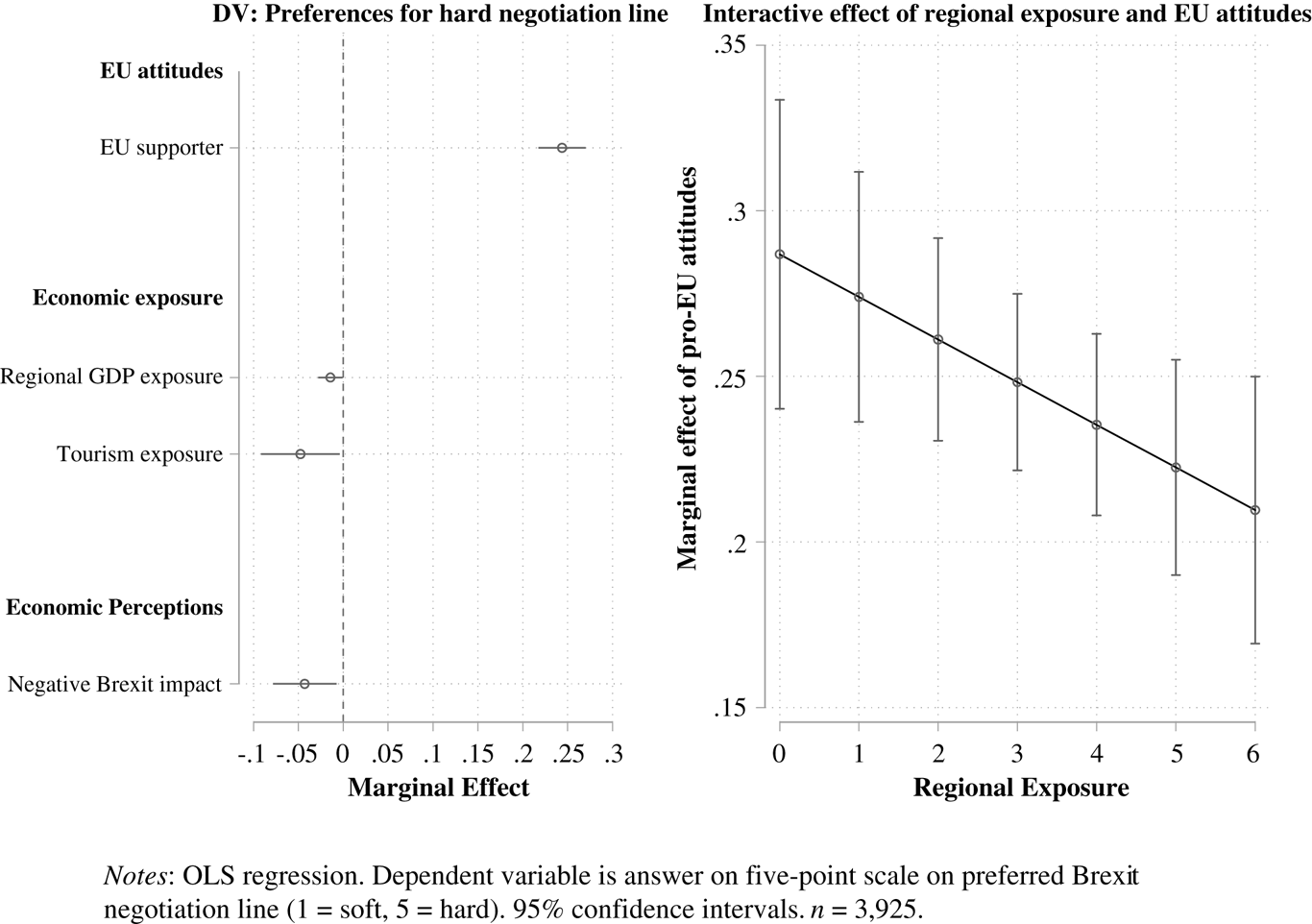
Our argument suggests that overall Brexit negotiation preferences should also be moderated by exposure to the consequences of non-accommodation and individuals’ attitude toward the EU. We operationalize exposure in three ways, two objective and one subjective. First, we measure individuals’ regional economic exposure to a hard Brexit, using estimates of regional (German Länder and Spanish comunidades autónomas) GDP at risk from a hard, non-accommodating Brexit.Footnote 76 They range from 0.5 percent of regional GDP in the Canary Islands (Spain) to 6 percent of regional GDP in Baden-Württemberg (Germany). Second, we include a variable that measures the exposure to tourism of the respondent's region because these regions are likely to be vulnerable to travel restrictions that may arise from Brexit. This variable is measured as the natural logarithm of the number of nights spent at tourist accommodation establishments per inhabitant in the region in 2015.Footnote 77 Third, we include respondents’ subjective assessment of how Brexit will affect their own country in the medium term, on a scale from 1 (it will be much better off in five years as a result of Brexit) to 5 (it will be much worse off in five years as a result of Brexit).Footnote 78 As before, we measure attitudes to the EU as respondents’ overall opinion of the EU (from very negative to very positive), but results are robust to using vote intention in an EU membership referendum (Figure A.10) and controlling for a set of attitudinal, economic, and sociodemographic covariates.Footnote 79
In line with our expectations, greater exposure to the costs of non-accommodation makes respondents more supportive of a softer, accommodating Brexit negotiation approach (Figure 5). Respondents living in regions where large shares of regional GDP are at risk because of close trade relations with the UK or a high reliance on tourism, and those who expect Brexit to have negative consequences for their own country, are more likely to favor a softer negotiation approach. Likewise, attitudes to the EU emerge as a strong dividing line: Euroskeptic respondents tend to prefer a more accommodating approach, whereas Europhiles support a much more uncompromising approach, largely to avoid encouraging other countries to leave the EU.Footnote 80 Because our argument suggests that Europhiles should experience an accommodation dilemma on cooperation issues, which dominate in the Brexit negotiations overall, the right-hand panel shows results for a second model that interacts regional GDP exposure with EU attitudes.Footnote 81 In line with our argument, the preference of Europhile respondents for non-accommodation softens as their regional economic exposure increases.
Correlates of supporting a non-accommodating Brexit negotiation approach

Conclusion
Unilateral challenges to international institutions have proliferated in recent years. In this paper we have examined the receiving end of such challenges: the institutions’ other member states. Focusing on one specific type of challenge, unilateral withdrawal, we have analyzed voters’ preferences about the extent to which the withdrawing member state should be accommodated in the negotiations over the terms of withdrawal and future cooperation. Such negotiations occur when countries unilaterally withdraw, or threaten to withdraw, from international institutions and in the process try to renegotiate better terms for their future relations with their former partner states. While we have focused on Brexit, the most prominent withdrawal negotiation of this kind so far, our argument also extends to such negotiations in other contexts, such as transboundary freshwater agreements,Footnote 82 bilateral investment treaties,Footnote 83 and both successful (e.g., NAFTA, which resulted in a revised treaty) and failed (e.g., the Iran deal, which resulted in the US's withdrawal from the treaty) renegotiation efforts by US President Trump.
We have argued that governments’ and voters’ support for more or less accommodation is shaped by their exposure to the costs of accommodation and concern about its ripple effects. Because non-accommodation is costly with regard to only cooperation issues, and not with regard to zero-sum issues, voters can face two types of dilemmas. Those concerned about the institution's stability are generally less willing to accommodate, but face an accommodation dilemma with regard to cooperation issues. In contrast, critics of the international institution are more willing to accommodate, but face a non-accommodation dilemma with regard to zero-sum issues.
Using survey evidence collected against the backdrop of the Brexit negotiations between the UK and the EU, we found support for this argument. Greater exposure to the costs of a hard Brexit made respondents more willing to accommodate the UK, whereas Europhiles supported a less accommodating approach. Respondents were also much less accommodating on zero-sum issues than on cooperation issues. Moreover, we found evidence that the dilemmas created by Brexit moderated respondents’ negotiation preferences, as predicted by our argument. Whereas EU supporters preferred the least accommodative options in zero-sum issues, they preferred more accommodative outcomes with regard to cooperation issues. Euroskeptic respondents, however, were very accommodative regarding cooperation issues, but less enthusiastic about accommodation with regard to zero-sum issues. Overall, we found that most respondents favored a less accommodating negotiation outcome and supported the final, relatively unaccommodating, outcome of the Brexit negotiations.
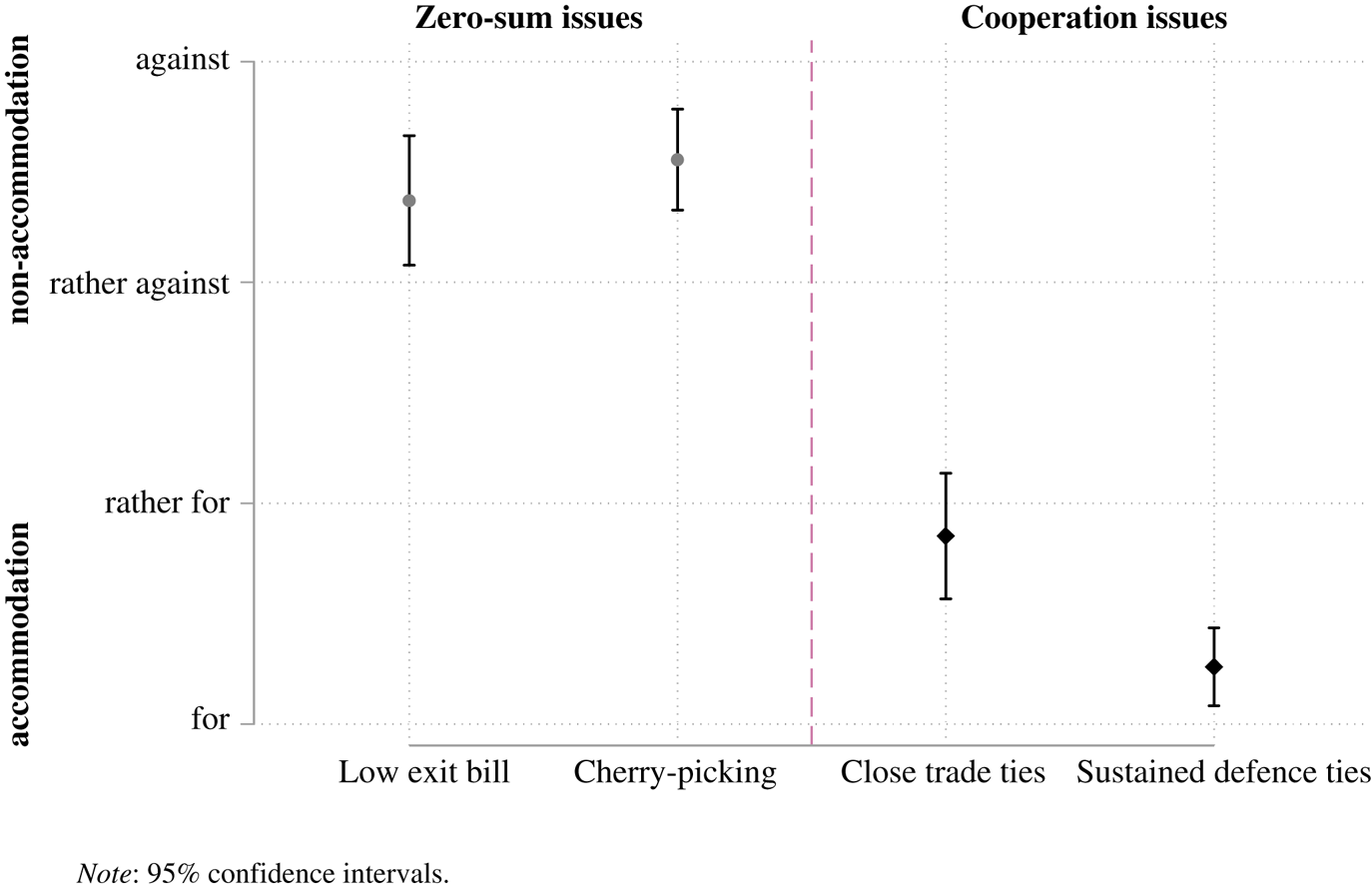
This paper contributes to three major research strands. First, it speaks to a growing body of research on challenges to international organizations such as withdrawals from, renegotiations of, noncompliance with, or even the decay or demise of these organizations.Footnote 84 By conceptualizing the different outcomes of withdrawal processes and showing that the costs and benefits associated with these outcomes depend on the type of issue and the level of contagion risk, it improves our understanding of how governments deal with the dilemmas and intertemporal trade-offs these challenges create. Although we have focused on how individuals view these negotiations, the insights obtained can also help us better understand how governments respond to these challenges. For example, the distinction between zero-sum and cooperation issues allows a deeper understanding of governments’ negotiation preferences as well (Figure 6). Using data on EU-27 governments’ preferences on four Brexit-related negotiation issues from just before the start of the Brexit negotiations,Footnote 85 we see that remaining member state governments were much more supportive of sustained close ties with the UK on cooperation issues (security and trade) than on zero-sum issues (the “Brexit bill” or the UK's cherry-picking from the four freedoms of the EU Single Market). More generally, our analysis suggests that governments and voters in member states of challenged international institutions face difficult trade-offs in withdrawal negotiations or treaty renegotiations in which cooperation issues dominate. When contagion risks are relatively low, as is often the case in bilateral trade treaty renegotiations,Footnote 86 such withdrawal negotiations are likely to be resolved in a cooperative, accommodating manner. However, when zero-sum issues dominate, as, for example, in Trump's bid to renegotiate the Iran deal, room for compromise is limited, and therefore failure of the negotiations is a serious possibility.
Average negotiation preferences of EU-27 governments, April 2017

Second, the paper contributes to research on the popular backlash against international cooperation.Footnote 87 By clarifying the trade-offs confronting the supporters of international cooperation in the face of unilateral challenges to international institutions, it shows that this group does not indiscriminately support cooperation for cooperation's sake. Rather, it is well attuned to issues such as reciprocity and reputation and willing to forgo short-term cooperation gains to secure broader long-term cooperation gains. Moreover, by showing that unilateral challenges to existing international institutions also confront nationalists in other countries with considerable dilemmas, we contribute to newly emerging research on how nationalist and populist movements influence international cooperation.Footnote 88
Finally, the paper contributes to the debate about the extent to which the public can understand foreign policy issues.Footnote 89 Our analyses suggest that the public can understand the costs and benefits of accommodation and non-accommodation in a complex setting such as the Brexit negotiations. Although our results come from a conjoint experiment, which might heighten respondents’ attention, they interestingly contrast with findings for the British public, which has had more trouble grasping the trade-offs associated with Brexit.Footnote 90 One possible explanation is that European elites have emphasized the trade-offs, whereas this has been much less prominently discussed in the UK. A promising avenue for future research is thus to explore the extent to which individual negotiation preferences are a rationalization of elite preferences, or whether citizens genuinely understand the trade-offs involved.
Data Availability Statement
Replication files for this article may be found at <https://doi.org/10.7910/DVN/3DNBNQ>.
Supplementary Material
Supplementary material for this article is available at <https://doi.org/10.1017/S0020818321000412>.
Acknowledgments
Previous versions of this paper were presented at the 2018 APSA and EPSA Annual Meetings, the 2019 Council of European Studies, and the Universities of Barcelona, Pennsylvania, Münster, York, Zurich, Carlos III, IE University, the London School of Economics, and the European University Institute. We thank all participants for their comments, in particular Pablo Beramendi, Elias Dinas, Tim Hellwig, Sara Hobolt, Spyros Kosmidis, Rosa Navarrete, Ignacio Sánchez-Cuenca, Constantin Schäfer, Bernd Schlipphak, and Sofia Vasilopoulou.
Funding
This project has received funding from the Economic and Social Research Council through grant no. ES/N01734X/1 and the Ramón y Cajal Fellowship (PI Ignacio Jurado), the Talento Fellowship of Comunidad de Madrid (PI Sandra León), and the European Research Council under the EU's Horizon 2020 research and innovation programme through grant agreement no. 817582 (ERC consolidator grant DISINTEGRATION, PI Stefanie Walter).