



No CrossRef data available.
Article contents
Elections Within the United Nations: An Experimental Study Utilizing Statistical Analysis
Published online by Cambridge University Press: 22 May 2009
Extract
If, to misquote Harold Lasswell, one considers the study of politics to be the study of who gets what, when, and why, then this paper is a study of the politics of elections in the United Nations. Who gets what and when are easily discovered, since the results of elections and dates of elections are available in any United Nations Yearbook. The “why” is more difficult to determine. This paper is an attempt to analyze—by the use of empirical, numerical indices exclusively—why nations are elected to UN offices.
Information
- Type
- Articles
- Information
- Copyright
- Copyright © The IO Foundation 1963
References
1 See, for instance, Lazarsfeld, P. F., Berelson, B., and Gaudet, H., The People's Choice (New York: Columbia University Press, 1944)Google Scholar, and Berelson, B. R., Lazarsfeld, P. F., and McPhee, W. N., Voting (Chicago: Chicago University Press, 1954).Google Scholar
2 Organski, A. F. K., World Politics(New York: Alfred A. Knopf, 1958), p. 202.Google Scholar
3 The difference between national income and gross national product is merely that estimates of depreciation and indirect business taxes are subtracted from the latter. As measures of power, they are essentially the same.
4 The list of resolutions was compiled by Norman J. Padelford, Thomas Hovet, Jr., and the authors.
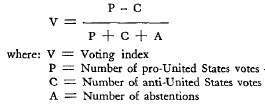
5 The formula for the voting index is:
6 All economic aid figures are from Agency for International Development, Statistics and Reports Division, U.S. Foreign Assistance and Assistance from International Organizations, July 1, 1945–June 30, 1961 (Revised) plus July 1, 1945–June 30, 1962 (Preliminary). Excluded from our calculations were figures for United Nations technical assistance and the United Nations Special Fund.
7 See Sidney, Siegel, Nonparametric Statistics for the Behavioral Sciences (New York: McGraw-Hill, 1956), pp. 213 ff.Google Scholar
8 Obviously, there is a relationship between the size of a nation's gross national product and the absolute amount of economic aid it can absorb. In our calculations, it was found that the use of absolute rather than relative figures revealed trends that otherwise remained obscure, and use of the former was therefore decided upon.
9 Under the heading of important offices the following were included: membership on the Security Council; presidency of the General Assembly; chairmanship of the First Committee (Political and Security Affairs); and chairmanship of the Special Political Committee (formerly called Ad Hoc Committee). All other elective offices were grouped into our category of “other offices.” These include: the posts of chairman, vice-chairman, and rapporteur of the remaining main committees of the General Assembly; those of vice-chairman and rapporteur of the First and Special Political Committee; those of vice-president of the General Assembly; membership on the Trusteeship Council; and membership on the Economic and Social Council. Excluded from all consideration and calculation were the office of Secretary-General and membership on the International Court of Justice.
10 While recognizing that the gross national product of many nations has experienced relative change over the period in question, it was not possible to obtain comparable GNP data for each of our four periods. We have therefore used figures compiled by Usui and Hagen in 1957 for each of the four periods, recognizing that some inaccuracies may result. See Mikoto Usui and Hagen, E. E. E., World Income, 1957 (Cambridge, Mass.: Center for International Studies, Massachusetts Institute of Technology, 1959).Google Scholar
11 The correlation coefficient of gross national product with “important” offices for period I is .477, a statistically significant figure.
12 At least, no distinction is made in the Charter with respect to the political sensitivity of offices.
13 Nations in the “anti-United States” category voted against the United States at least three times for every time they voted with the United States. In fact, since 1946 the only nations to fall into this category have been the communist nations (and, since 1959, Cuba), and almost without exception their voting indices have been exactly –i. The “neutral” nations, on the other hand, often abstained, but when they did vote, they voted with the United States almost as many times as they voted against.
14 For every time the “pro-United States” nations voted against the United States, they voted with the United States at least three times. The nations in the “very pro-United States” group voted with the United States at least seven times for each time they voted against.
15 The two seats were on the Security Council (normally two-year positions).
16 The highest correlation coefficient for any period between voting index and important offices was obtained in period II. Even then it was only .241. This would appear to indicate that pro-United States alignment in the Cold War has been a necessary condition but not of itself a sufficient condition for election to United Nations offices. That is, while all the nations that vote generally above +.50 do not necessarily get elected to important offices, most of the nations elected to these offices vote above + .50.
17 Despite an increase in the total absolute amount of United States economic and military aid over the course of the years in question, we have found it more revealing to keep the categories in constant rather than relative terms. Thus, the categories used were:
1. Those receiving less than $1 million in economic and military aid.
2. Those receiving between $1 million and $25 million in economic and military aid.
3. Those receiving between $25 million and $150 million in economic and military aid.
4. Those receiving more than $150 million in economic and military aid.
18 The correlation coefficient for important offices with economic aid alone in period II was .472, a highly significant figure. The correlation was not nearly as high for any other period or for other offices.
19 Africa and Asia are considered together here (1) because of the limited number of African states in the United Nations until 1956, and (2) because they caucus together.
20 Because the overwhelming majority of nations admitted to the United Nations since 1950 have been Afro-Asian, one often tends to overlook the eleven European nations that have also been admitted since that year.
21 The only exception to this is important offices in period III. It should be recalled at this point that these figures do not include the vast number of offices held by the three European members of the Big Five.
22 While it is true that a great many European nations not elected to important offices have received as much aid, in no period did the percentage of European nations in the highest aid category exceed 64 percent (period I), and that figure has steadily and drastically declined as the focus of United States aid has shifted to Asia, Africa, and Latin America. In period II, the nations receiving more than $150 million in aid accounted for only 57 percent of the European nations in the United Nations, but captured 91 percent of all United Nations offices held by European nations.
23 For a study of the record of representation on the Security Council and the problems of its future composition, see Padelford, Norman J., “Politics and Change in the Security Council,” International Organization, Summer 1960 (Vol. 14, No. 3), pp. 381–401.CrossRefGoogle Scholar
24 The five are Belgium (5 offices), Turkey (5 offices), the Netherlands (3 offices), Norway (3 offices), and Greece (2 offices).
25 The eight are Albania, Byelorussian Soviet Socialist Republic, Czechoslovakia, Hungary, Cyprus, Finland, Portugal, and Spain. While most of these countries joined the world Organization late, it should be noted that five other nations which joined the UN at approximately the same time have already been elected to seven important offices.
26 Jamaica and Trinidad-Tobago are not considered Latin American for purposes of this study.
27 While Latin America has no permanent seat on the Security Council, it has been “compensated” by consistently being elected to two non-permanent seats on that body.
28 Again, the numbers with which we are dealing are very small, and therefore percentage figures must be viewed with extreme caution.
29 The ratio index of these nations has ranged from a high of +34.44 in period 1 to a low of +20.00 in period III.
30 The five are Brazil (7), Colombia (5), Peru (4), Argentina (4), and Chile (3).
31 The eight are Bolivia, Costa Rica, Dominican Republic, Honduras, Nicaragua, Paraguay, Uruguay, and Venezuela.
32 Turkey has been included here because it caucuses with this group and because it has been elected to some offices as an “Asian” nation.
33 This is true despite the inclusion of the five important and nine other seats credited to the area by including Turkey. Also, the only permanent Security Council seat allotted to the area is China's, and the Nationalists do not even caucus with the Afro-Asian group.
34 It should be noted that three of the four remaining offices were filled prior to 1950.
35 The six are Turkey (5), the Philippines (4), Iran (4), Pakistan (2), Thailand (2), and India (2).
36 This figure is exclusive of military aid to Pakistan, the figures for which are classified.
- 10
- Cited by