Although the term “civil war” would seem to imply some sort of domestic process, internal conflicts often have a significant external dimension to them. Current conflicts in Darfur, Colombia, Kurdistan, and Afghanistan, among others, exhibit significant cross-border dynamics as well as outside interference. A large and growing body of research has been dedicated to understanding both the causes and the effects of external involvement in civil war.Footnote 1 Scholars have shown that foreign support for rebel groups changes the dynamics of the civil war itself. Civil wars with outside involvement typically last longer,Footnote 2 cause more fatalities,Footnote 3 and are more difficult to resolve through negotiations.Footnote 4 They introduce new actors into the conflict with agendas of their own, changing the bargaining dynamic to include both state and nonstate actors. Understanding why some groups receive foreign support is therefore critical for understanding how such conflicts unfold, and ultimately, how they are resolved.
Existing research has made significant progress in understanding external involvement in civil conflict. However, it has in our view been hindered by an overly narrow focus on features of the civil war as a whole that make intervention more likely, rather than attributes of the actors involved. External states deciding whether to intervene in a civil war or empower opposition groups do not only gauge their motivation for intervening, but also evaluate their potential options for doing so. States decide whether or not to support particular rebel groups or governments, and the characteristics of those actors should matter in their decision to do so and the specific forms of support that are chosen. The literature has generally ignored this decision process by focusing on the type of conflicts, not the type of actors, which attract external support.Footnote 5
Understanding external support for rebel organizations is important for the study of international relations since it constitutes a form of interstate conflict, albeit indirect.Footnote 6 A focus on foreign support for insurgent groups, then, helps to bridge a long-standing divide between scholars of civil and interstate war.Footnote 7 Rather than treating them as separate areas of inquiry, these forms of conflict are often complementary and interrelated.Footnote 8 One cannot fully understand civil conflicts without noting the pervasiveness of external support for rebels, and one cannot fully understand international conflict without an appreciation of the incentives to undermine rivals through indirect means.
In this article, we seek to advance our knowledge of the relationship between civil and international conflict by examining the factors that influence why certain rebel groups receive external support while others do not. Empirical analyses of external intervention in civil war often examine what type of conflicts are likely to involve external intervention or, at most, which side in the conflict is supported externally, using a rebel/government dichotomy.Footnote 9 However, many civil wars contain more than one rebel group, and in many cases external states support some, but not all, rebel organizations. For instance, in Indonesia, insurgents representing Aceh and East Timor received external support while those fighting for independence for West Papua did not. In the Colombian conflict, while the Fuerzas Armadas Revolucionarias de Colombia (FARC) received external support from Cuba and other regional actors, the Ejército de Liberación Nacional (ELN) did not receive significant external assistance. In Chad, some rebel organizations received support from Libya, while others fought against Libya after that country annexed the Aouzou Strip. Therefore, we seek to understand why specific rebel actors are assisted by external state patrons. We use new disaggregated data on external involvement in civil conflict to examine hypotheses on factors that make some rebels more likely than others to receive external assistance.
Our theoretical argument looks at both the demand and the supply side of this phenomenon. In order for a rebel group—or potentially violent dissidents—to receive external support at least two things must happen: (1) an external state must be willing to support the group (supply); and (2) the group must be willing to accept that support (demand). We use a principal-agent framework to help shed light on these decisions.Footnote 10 States (principals) will sometimes wish to retain foreign policy autonomy and will decide against backing insurgent groups; their willingness to back such groups will depend on the costs of direct military action and the states' ability to select and monitor appropriate agents. Rebel groups (agents) face a parallel dilemma. Although they can significantly augment their resources by accepting outside help, by doing so they can become subject to the whims of their external backers and may therefore choose to remain autonomous.Footnote 11 We focus on this decision-making process and consider the conditions under which external states are likely to offer to support specific rebel groups and the conditions under which these groups are likely to accept that support.
The following section of this article will articulate a theory of rebel support, focusing on interactions between the state sponsor and the rebel organization. Then, we present observable hypotheses derived from our theory. Next we discuss our data and methodology. In particular, we have compiled a new data set on attributes of individual rebel organizations since 1945; in contrast to previous studies, we use the rebel organization as our primary unit of analysis. We then present our empirical analysis that demonstrates that rebels who are moderately strong, have a transnational constituency, and who are fighting governments that are engaged in an international rivalry with other states are most likely to receive external support. Moreover, we find that countervailing intervention, in which external states support rebels who are facing governments that receive external support, are common. We demonstrate the utility of our approach in predicting actual cases of support, particularly in the ability to predict which specific rebel groups within multiparty conflicts will receive support. The final section offers concluding remarks.
Explaining Rebel Patronage
External support to rebel groups requires the consent of both parties—a state must offer support to a rebel organization, and that organization must accept it. Ascertaining which rebel groups receive foreign sponsorship, then, requires an examination of both supply-side and demand-side determinants of rebel support. Here, we examine the conditions under which states choose to assist rebels and those under which rebels will seek or accept such assistance.
The Supply Side
Why do external states offer to provide support to rebels? Sponsoring a rebel organization is a tactic that states use to destabilize target governments. External support, then, will be driven to a large extent by foreign policy decisions and relations with the regime experiencing rebellion. While states may certainly sympathize with opposition groups that share similar goals,Footnote 12 they are unlikely to provide direct aid unless they have some incompatibility or dispute with the state in question, since assisting rebels is clearly a hostile act. During the 1970s and 1980s, for example, South Africa pursued a policy of external involvement in many civil wars—notably, Angola and Mozambique—to destabilize and weaken hostile, anti-apartheid states.Footnote 13 In East Africa, Sudan and Uganda—longtime enemies—have a history of supporting each others' rebels in an effort to weaken the other government.Footnote 14 Finally, Iran and Iraq supported one another's rebel organizations during the 1980s and 1990s while they had an ongoing territorial dispute surrounding the Shatt Al-Arab (Khalij-e Fars, in Farsi) waterway. The specific goals that states hope to achieve by supporting rebels may vary. These may include gaining leverage over territorial issues, disputes over policies, and attempts to unseat unfriendly regimes. Regardless of the nature of the international conflict, empowering rebel organizations is a tactic that states may employ in weakening their enemies.
Foreign support for an insurgent group is one tactic in the toolkit that states use to undermine their opponents, but it is certainly not the only one.Footnote 15 Coercive bargaining entails a spectrum of activities that impose varying costs.Footnote 16 States may impose sanctions and embargoes or seek to obtain international resolutions condemning specific actions. Additionally, even if states choose to target their enemies through military action they can do so in at least two ways—by launching an interstate war or by delegating conflict to rebel groups. In some cases, these strategies may be used as substitutes for one another. For instance, the United States did not try to invade Nicaragua directly during its dispute with the Sandinista government, but rather, funded and supplied the Nicaraguan Contras. Other times, states use these strategies as complements rather than substitutes. The fighting in the Democratic Republic of the Congo (DRC) had elements of both an interstate and a civil war, as Rwanda and Uganda used their own forces to invade the eastern DRC while simultaneously supporting insurgent outfits to first overthrow Mobutu Sese Seko and later attempt to unseat Laurent Kabila.Footnote 17 In such cases, the state retains agency over certain tasks while delegating to rebel organizations to fulfill other objectives.
States, then, have a variety of options to weaken their rivals. Since World War II, however, interstate war has become relatively rareFootnote 18 while external support for rebels has been quite common.Footnote 19 The choice of sponsoring militants versus direct interstate conflict entails important trade-offs. For the state, supporting a rebel group in one's enemy country is less costly than going directly to war in terms of casualties and resource expenditures. Principal-agent theory tells us that delegation is a useful tool that principals use when they wish to avoid the costs—including time, resources, developing knowledge, etc.—associated with particular tasks.Footnote 20 Empowering the domestic adversaries of a rival regime is typically less costly than international war and can offer certain strategic advantages.
First, international conflict requires a commitment of material resources such as troops and armaments, and it risks the lives of government soldiers. These costs may also produce domestic war weariness and discontent.Footnote 21 Providing finances, military equipment, advisors, and so on, to a rebel group requires much less of a resource commitment than a full-scale invasion. Second, the international costs of interstate war can be quite high. The international community is likely to condemn—and perhaps impose sanctions on—countries that engage in an outright invasion of another state's territory, whereas support for an insurgency is far more difficult to prove conclusively and has been historically less likely to be challenged, at least by strong measures.Footnote 22 In addition, alliance partners of the targeted state may be drawn into the conflict if countries resort to direct attacks. Third, support for rebels is often difficult to gauge since it may be conducted in relative secrecy and governments may have an incentive to hide acts of foreign aggression from international as well as domestic audiences.Footnote 23 Avoiding blame may be especially attractive if insurgent forces are known for brutality or war crimes; states can plausibly deny complicity with, or knowledge of, bad behavior by their agents. Finally, enlisting the help of domestic rebel groups may offer several local advantages for the external state. Domestic groups often have more legitimacy given their local ties; foreign invaders are frequently less likely to be welcomed by locals. From a tactical perspective, such groups often have better information about domestic populations, government informants, terrain, critical infrastructure, and so on.
Delegation to rebels, then, can help states avoid some of the costs of interstate war. However, principal-agent theory also tells us that by delegating, principals give up some control over the achievement of their key objectives. While states can avoid the costs and risks of direct military operations, they face potential agency slack, or lost autonomy over their foreign policies and the conduct of the conflict. In interstate war, states have—at least in principle—direct control over their forces through established military hierarchies. However, when states delegate action to rebel groups, they risk losing agency and autonomy over the objectives and means of the war effort.Footnote 24 If the rebel group's preferences are not closely aligned with that of the foreign patron, the potential for agency loss is high. External states may find themselves providing resources to rebels who are pursuing different goals than those desired by the sponsor. This agency slack can take many forms: rebels can devote suboptimal effort to the conflict with the resources provided; engage in unwelcome or egregious behavior such as war crimes; they may divert resources toward other, undesired, objectives; or in some cases, the agent may use the resources supplied against the patron itself. For instance, Rwanda's backing of Kabila's forces in Zaire successfully removed the Mobutu regime but later backfired disastrously as Kabila turned against his former ally.Footnote 25
For external states, then, supporting rebel groups will be more attractive when the costs of foreign aggression are high and the potential for agency slack is low. States will be more likely to delegate when international condemnation and sanctions are likely, when there are benefits to hiding foreign aggression, and when the costs of gathering local intelligence, conducting an invasion, and holding captured territory are prohibitive. Additionally, external states will be more likely to delegate to rebel groups when the stakes in the international dispute are not absolutely critical to the vital interests of the state. The most critical national security interests incline states to retain control over their foreign policy, while less critical concerns may be “contracted” to militant organizations.Footnote 26
At the same time, the incentives for delegating conflict must be weighed against the potential agency loss and the ability to select and monitor appropriate agents. External states will be more likely to delegate to rebels when they are reasonably confident that the rebel force shares similar preferences; when they can select good, competent agents; and when they can effectively monitor agent activities and sanction bad behavior. As a general proposition, we expect states to select rebel agents based on two basic criteria: their ability to pose a viable threat to the target regime, and the degree of preference congruence.
A number of characteristics of rebel organizations can affect the extent to which external states will see them as reliable agents. Groups that are militarily weak, fractured, and disorganized are unlikely to pose a significant challenge to their host state to an extent that justifies supporting them. States will want to select agents that can demonstrate a certain level of competence in fighting the government; otherwise, they risk expending resources for little benefit. More capable groups will be better able to carry out the wishes of the external state. Moreover, rebel organizations that have a strong central leadership to coordinate action will be more attractive partners. Fragmented groups that are prone to splintering, and leaders that cannot direct battlefield operations effectively, are less desirable agents since it is not clear that the wishes of the patron will be carried out by the organization as a whole. Stronger rebel organizations with clear, centralized organizational structures are more likely to pursue the principal's goals efficiently. We expect that states will attempt to screen out unviable rebel groups and those that do not have leadership structures that can ensure compliance with given directives.
In addition to selecting groups on the basis of their competence as a fighting force, states will want to ensure that the rebel organization shares similar preferences. Groups that do not share the goals of the patron are unlikely to be reliable agents. In this regard, shared ethnicity or religion can serve as a screening device when choosing between agents. Ethnic or religious ties to the rebel organization are likely to reduce concern with preference divergence since a common worldview and shared cultural understandings often indicate similar preferences (or are at least perceived to).Footnote 27 Additionally, commonalities of language and culture make monitoring the actions of the agent easier and so should also reduce agency slack. In subsequent sections, we will turn these expectations into more formally stated hypotheses. But first, it is important to consider the costs and benefits of accepting foreign patronage from the rebel's standpoint.
The Demand Side
Just as states consider the costs and benefits of offering support to rebels, the rebel organization must also evaluate the costs and benefits of accepting external support. For the purposes of our argument, we assume that rebels want to maximize two things: (1) the resources they have at their disposal to challenge the state or privately consume, and (2) the autonomy they have over their own actions. All rebels have some specific goals that they are trying to achieve in the conflict. Some have policy goals such as a greater role in the national government or more territorial autonomy, but other groups simply desire personal enrichment and material rewards.Footnote 28 Regardless of the overall objectives of the rebel organization, we believe that it is reasonable to assume that rebel groups will prefer more resources over fewer as well as more autonomy over less. However, these may be competing objectives, as we discuss below.
Rebel organizations are often at a resource disadvantage, particularly at the beginning of a conflict, when small opposition groups are still mobilizing the support they need to challenge better-equipped and organized states. Many nascent rebel groups have little access to the money, equipment, training, and personnel needed to mount an effective challenge to the state. In order for rebels to either topple the regime or extract greater concessions, they need to mobilize a significant military capacity, and quickly, since such groups are often quite vulnerable at initial stages.Footnote 29
External patrons can provide an obvious source of funding for rebel entrepreneurs. Moreover, foreign state patrons—as opposed to private contributions—have the greatest prospect of offering substantial resources, particularly in military terms. During the Cold War, the Soviet Union and United States supported many rebel organizations that espoused a Marxist or anti-Marxist ideology, respectively. Since the end of the Cold War, many rebel organizations have looked beyond these patrons and have found willing sponsors in neighboring countries. Sierra Leone's Revolutionary United Front, for instance, won the backing of Liberia. Similarly, rebels from the Darfur region of Sudan have been aided by the Chadian government. External states can provide money, military equipment, training, sanctuary, and other resources to rebel groups, significantly augmenting their resource base.Footnote 30
Even though there are clear benefits to obtaining external support, the rebel organization may experience substantial costs as well. Accepting funding from foreign patrons will often come with strings attached as the principal assumes some degree of control over the rebel's agenda; rebels give up some control over their aims and tactics in exchange for outside help as sponsors are not likely to offer resources for free. Therefore, being beholden to external patrons may accomplish the goal of expanding resources, but comes at the cost of losing some degree of autonomy. As an example of foreign patrons imposing their agendas, the U.S. Central Intelligence Agency would often provide the Nicaraguan Contras, “precise information on dams, bridges, electrical substations, port facilities and other targets that the rebels will destroy in guerilla raids.”Footnote 31 Leaders of the organization did not act independently, but often took orders from Washington. Thus, while the Contras received substantial assistance from the United States, they were not masters of their own destiny.
Because of concerns with lost autonomy, we argue, rebels will prefer to rely on a domestic support base to obtain resources when they are able to do so. All else being equal, they would prefer their own, reliable, resource streams over external alternatives that impose constraints on their behavior. Operating without the constraints imposed by external parties, insurgent groups have greater freedom to pursue their own objectives and determine their own tactics. Moreover, becoming too dependent on foreign patrons can cause rebel organizations to lose legitimacy at home if they are seen as pawns of a foreign power. For instance, the Iranian rebel group, the Mojahedin-e-Khalq, lost legitimacy in the eye of many Iranians by allying with Iraq, a long-time unpopular enemy.Footnote 32
Groups, then, face a trade-off between the additional resources gained from accepting external support and the potential for lost autonomy and domestic legitimacy by doing so. This means that rebels with the option to do so should seek to mobilize domestic support and gain domestic legitimacy rather than rely on potentially unpredictable external sponsors. We expect the strength and domestic viability of the rebel organization, as well as the degree of preference similarity between the group and potential sponsors, to be critical determinants in the decision to accept foreign sponsorship. In particular, rebels that are quite strong relative to the government and can rely on domestic constituencies and local resources have less of a need for foreign funding and will be unwilling to give up their autonomy. Rebels that are able to control territory and exclude government forces will be able to use tax revenue and natural resources from that territory to support their operations,Footnote 33 and so will have less of a need for external funding. This will only apply to the strongest rebels. By contrast, weak rebels that are unable to mobilize sufficient resources domestically will find foreign support more attractive.
This resources-versus-autonomy dilemma also implies that groups will be more likely to accept support when the external state shares similar preferences. As preferences converge, there is less concern that foreign sponsorship will entail unwelcome constraints. Patrons with significantly different objectives are more likely to ask for things that the rebels are reluctant to provide. To reiterate the point made above, shared ethnic or religious traditions may indicate preference similarity, attenuating fears over agency slack as well as over unwelcome constraints. In sum, screening is a two-way process. Both the principal and the agent will seek the best “match” and try to identify actors with similar goals. These conjectures are stated more formally below.
Hypotheses
The “supply side” and “demand side” logic of external support to rebel groups leads to expectations about the conditions under which rebels in a civil war will seek and obtain foreign resources.Footnote 34 Here, we present six implications, derived from the discussion above, that we will test empirically. The first four refer to characteristics of rebel groups that will affect their likelihood of support, the fifth is a prediction about the state in which the rebel groups operate, and the final prediction focuses on counterbalancing interventions.
The first characteristic of rebel organizations that should affect external support is how strong they are, relative to the state. The supply side and demand side logics, however, lead to opposite predictions. Weak rebels are in critical need of additional resources, and the desire for supplies to remain viable outweighs autonomy concerns. However, because the weakest rebels cannot demonstrate a reasonably viable challenge to the state, are poorly organized, and lack local credibility, foreign patrons will not see such groups as worth investing in. But at the same time, the strongest rebels are unlikely to accept foreign assistance because they can rely on a wholly domestic strategy for obtaining finances—through taxation or securing lucrative resources, for example. While very strong rebels can certainly benefit from increased resources, the returns from an enhanced resource base are offset by concerns with autonomy. Thus, we predict that rebels that are minimally competent, but not the strongest groups, are most likely to receive (and accept) external support.Footnote 35
H1: The strongest and weakest rebel organizations, relative to their target government, will be less likely to receive external support.
External states desire to support rebel groups that are more likely to accomplish their objectives. The strength of the rebels is one characteristic that affects this; another is the leadership of the organization. Some rebel organizations are characterized by loose affiliations among various units, while others have clear command and control structures. A strong central command assures the foreign patron that troops in the field are carrying out orders effectively and makes it easier to monitor the activities of the group.Footnote 36 Ultimately, the leadership can be held accountable for the actions of the group as a whole and the patron has a clear point of contact. By contrast, it is harder to coordinate action among more fractionalized groups, and a weak chain of command implies that directives given to the purported leader of the organization may not be carried out by subordinates. Fragmented groups are prone to infighting and may splinter, and so are not likely to be seen as reliable, efficient partners. This means that external states are more likely to offer support to groups with a clear centralized leadership.
H2: Rebel groups will be more likely to receive foreign support if they have a clear central leadership that exercises control over the group's activities.
Rebels seek to maximize their resources and prefer to do so in ways that minimize their loss of autonomy. When they are able to obtain resources domestically, they will prefer to do so in lieu of accepting external support. Some rebel organizations are able to establish “no-go” zones for government forces and to “govern” territory.Footnote 37 These organizations are able to rely on local funding sources such as the control of natural resources and taxation of the population under their control. As we argued above, this is one dimension of rebel strength. However, strength relative to the state and the ability to control territory are not perfectly related. While controlling territory could be seen as a dimension of rebel strength, rebels that are relatively weak compared to the government may nonetheless have significant local support in peripheral areas or be able to control territory in remote regions where the government is relatively feeble. These groups may still be weaker than the state overall but have local pockets of support.
H3: Rebel groups will be less likely to receive foreign support if they are able to control territory within the state.
While the objectives and appeal of many rebel organizations are purely domestic, many rebel organizations are linked through bonds of affinity with groups that span national boundaries. Often, rebel groups represent one national segment of a broader ethnic community. The Kurdish Worker's Party (PKK) in Turkey, for instance, claims to fight for a unified homeland for the Kurdish people, and makes appeals to Kurdish populations in Iran, Iraq, Syria, and the wider Kurdish diaspora. Other rebel organizations find sympathy and support among people with a similar religious or ideological commitment. Islamist fighters across several states as well as Palestinian nationalist groups often find sympathetic audiences in the broader Muslim world; anti-apartheid groups in South Africa appealed to African populations across the continent. Groups that have such transnational appeal are more likely than groups with parochial interests to receive external assistance as sympathizers elsewhere pressure their states to come to their defense.Footnote 38 Moreover, we argue that ethnic and religious ties attenuate fears about agency loss, since groups with a similar profile are seen as sharing common interests with patron states and because communication barriers to effective screening and monitoring are less problematic.Footnote 39
H4. Rebel groups will be more likely to receive external support if they have a transnational constituency or audience.
The first four hypotheses all focus on characteristics of groups. However, certain types of states will be more likely to attract external support for their rebels than others. We argued above that delegation to rebel groups is used as a tactic to undermine enemy regimes. All else being equal, we expect states that are involved in international rivalries to have more disputes with others. International rivalries are known to have recurring patterns of conflict, including militarized disputes.Footnote 40 Less appreciated in the literature, however, is the potential for international rivals to undermine their opponents through indirect means, particularly through support for rebel organizations.Footnote 41 Direct and indirect conflict strategies may alternate at various periods in the conflict, or they may be used in tandem with one another.
H5. Rebel organizations are more likely to receive external assistance if their target state is engaged in an international rivalry.
Finally, in many cases, intervention on behalf of either the government or rebels leads other states to want to balance that influence by supporting the opposite side. International rivals often play out their geopolitical tug-of-war by supporting opposite sides of an ongoing internal dispute. For instance, while the U.S.S.R. and Cuba supported the Angolan regime, the United States and South Africa supported the UNITA opposition. Therefore, we expect counterbalancing interventions to be relatively common.
H6. Rebel organizations are more likely to receive external assistance if their target state also receives external assistance.
Data and Research Design
Our main dependent variable in this study is whether a particular rebel movement receives external support from a foreign state sponsor. We take this information from the Expanded Armed Conflict Data v2.3 (EACD),Footnote 42 a data set that we have created that includes supplementary information about the characteristics of rebel groups and transnational linkages for intrastate conflicts in the Uppsala/PRIO Armed Conflict Data (ACD).Footnote 43 As part of the EACD, we have coded a number of indicators for whether or not rebel groups and governments receive support from outside actors. These data allow us to identify which rebel groups receive external support and which do not.
The ACD data identify incidents of violence involving states and rebel groups that generate at least twenty-five casualties in a given calendar year over some incompatibility classified as control over the central government or territorial autonomy/secession. For every conflict year, the ACD identifies a set of “Side B” actors that comprises rebel groups involved in active fighting with the government. The unit of analysis in this study is the individual rebel organization. We leave the question of why particular states support individual groups for future research and focus instead on the rebel organization as the unit of observation, indicating whether or not the group received military support from any state. The analysis, then, examines which of the rebel groups included in the data receive support as a function of characteristics of the rebel group and of the state in which the rebel group operates (including that state's relations with other states).
A conflict over a particular contested incompatibility may involve many rebels and these groups are often in a competitive relationship with one another. The Tamils in Sri Lanka, for example, were represented by three main organizations in the 1980s, namely the Liberation Tigers of Tamil Eelam (LTTE), the People's Liberation Organisation of Tamil Eelam (PLOTE), and the Tamil Eelam Liberation Organization (TELO). Of these three, only the LTTE received external backing (from India until 1991). In our data set, these three organizations are treated as three different observations.
Previous studies have examined when the “rebel side” in a conflict receives support, however, we believe that it is frequently inappropriate to treat all rebel organizations active in a conflict as part of a “rebel coalition,” since they are often competitors rather than allies and have distinct organizational structures.Footnote 44 External support to one rebel group may change the probability that the rebels collectively defeat the state, but it also changes the probability that that rebel group can defeat internal rivals and emerge as the representative of the opposition. In some instances, however, rebel groups do form an umbrella organization that effectively directs the operations of the group. For instance, the Unidad Revolucionaria Nacional Guatemalteca (URNG) in Guatemala was a merger between several leftist opposition groups, but fought as a cohesive whole. In these instances, where there is a clear lead organization, we consider that organization to be a single rebel group. We have a total of 403 distinct organizations in our data.
Our dependent variable, then, is a dichotomous indicator of whether (1) or not (0) a group receives military support and/or troop support from any external state.Footnote 45 Whether a group has external support or not can sometimes be ambiguous since governments often deny such assistance.Footnote 46 Therefore, we create three external support variables with different degrees of restrictiveness; these three variables differ with respect to their treatment of “alleged” assistance. Our first variable, support i, codes all cases of alleged and explicit military and troop support for an insurgent group as 1, with nonsupport coded as 0.Footnote 47 Our second variable, support ii, restricts external support to those cases where military support for rebels is explicitly acknowledged, while cases of alleged support and nonsupport are both coded as 0. Since it is somewhat ambiguous whether instances of alleged support can be considered conceptually equivalent to cases without support, we also consider a third support variable, support iii, which sets instances of alleged support to missing. Of the 403 groups in our data, 159 receive support according to definition I. Of these, 28 are cases of alleged support, which are set to 0 in the definition for support ii and missing in the definition for support iii.
We should point out that this coding criteria means that we only identify whether or not a rebel group receives support from any external state, as indicated by a dichotomous variable. However, many of the rebels in our data receive support from numerous states. Since we are not identifying particular patron-rebel dyads, but rather are seeking to answer the question of which rebel groups receive support at all, this is the appropriate measurement. Nonetheless, in additional tests, which we discuss below, we count the number of external supporters.
Group Characteristics
In this section we consider a number of operational measures reflecting characteristics of rebel groups. We have argued that the strongest and weakest rebel organizations should be less likely to receive external support. The EACD contains a dyadic evaluation of the overall military strength of a particular insurgent group relative to the government, distinguishing between instances where insurgents are much weaker, weaker, at parity, or stronger than the government. Since there are few instances where rebels are at parity, we combine the weak and parity categories to distinguish these from instances where rebels are clearly stronger or much weaker than the government.Footnote 48 Thus, we have three categories, that is, strong rebels, weak rebels, and moderate strength. We use these categorical variables to test H1.Footnote 49
The EACD also include a measure of whether rebels have a clear leadership and the extent to which this leadership actually exercises control over the day-to-day operations of subunits. Some rebel organizations function more or less like professional militaries with hierarchical command structures, while others are more loosely coordinated and prone to fracturing. We include a dummy for whether the group has a clear central command and whether this leadership exercises a high degree of control (as opposed to moderate and low) to test H2.
H3 predicted that rebel groups that can demonstrate territorial control should be less likely to receive foreign support. These groups can access resources in their zone of control. The EACD includes a measure of whether insurgent groups exert control over territory where they can deny the government access. To test this prediction, we include a dichotomous indicator, coded 1 for groups that clearly have territorial control, and 0 for all others, including cases of unclear or contested control.
In addition to these variables, we also include a variable indicating whether or not there was more than one rebel actor fighting the government. When there are more rebel groups operating in the same conflict, external states that have a desire to destabilize the host state have a choice which group to support. In those cases, in fact, the characteristics of each individual group may become more important. Additionally, Cunningham shows that multiparty civil wars are longer, and so groups in these conflicts may make more attractive candidates for imposing costs on other states.Footnote 50
External Variables
We have highlighted the supply of potential supporters as an important factor influencing the prospects for a group to receive support. Foreign constituencies and international rivalries are predicted to increase support for a rebel organization, as are countervailing interventions when the state also receives assistance. In this section, we consider how to operationalize external characteristics reflecting the features emphasized by our hypotheses.
H4 predicted that groups that have clear transnational constituencies are more likely to see foreign state support.Footnote 51 The EACD include a measure of transnational constituency support, defined as nonstate assistance to and sympathy for the rebel group. This includes ethnic segments in other countries and ethnic groups with a large overseas diaspora such as Sikhs in India. This measure also includes groups that appeal to transnational religious or ideological sentiments such as Marxism, Black African Nationalism, and Islamism. We create a dummy variable that flags cases with either “explicit” or “tacit” support. Tacit support indicates that the group makes appeals to a transnational constituency and that external, nonstate actors express sympathy or solidarity with the insurgents. Explicit support indicates that external nonstate actors directly support the insurgency through material resources, funding, supplies, supplying foreign fighters, and so on. We combine both in a single 0/1 measure.
H5 suggested that rebels will be more likely to receive external support when the target state is engaged in an international rivalry. States with international enemies are more likely to face rebel groups with foreign sponsorship. To measure negative or hostile relations with other states, we consider whether the government in a country is involved in a rivalry with another state, based on data from Thompson.Footnote 52 We also include a measure of support from an external state to the government side, based on the EACD, to measure H6. When the government receives assistance, rebels may be more likely to receive help as well in competitive interventions. This variable is coded similar to the rebel support variable, although we note that “alleged” support for the state is extremely rare.
Each of these variables is measured at the beginning of the conflict. This is appropriate because virtually all cases of external support in our data occur at the beginning of the conflict. That is, of the rebel groups who ever receive support from at least one external state, almost all of them receive it at the beginning of the conflict.
Country Characteristics
Alongside these variables testing H1, H2, H3, H4, H5, and H6, we include a number of characteristics of the country experiencing civil war that may be associated with both the supply and demand of foreign support, largely as controls. First, we consider the military capacity of a country through the Composite Indicator of National Capabilities (CINC) from the Correlates of War project.Footnote 53 It may be the case that stronger states in the international system can deter others from funding their insurgent's activities. In addition, very strong states may be less likely to be seen as appropriate targets since rebels are less likely to be successful. Second, we consider the natural logarithm of a country's gross domestic product (GDP) per capita.Footnote 54 This is an additional measure of state strength and ability to deter interventions. Finally, we consider whether the country experiencing conflict is a democracy, based on a dummy variable of whether a country's democracy score on the Polity institutionalized democracy scale is 6 or higher.Footnote 55 Countries with missing codes due to regime transitions are coded as nondemocracies. Democratic states, with more legitimate institutions, may be less likely to fall victim to outside support for insurgent movements.Footnote 56
Empirical Results
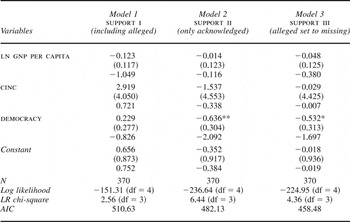
We begin our analysis with a core model of the country-level control variables to see if macro characteristics help explain support for rebel groups; then, we include our variables of interest to test our hypotheses. First, do macro-level country variables explain external support? The results, displayed in Table 1, quite clearly suggest that the answer to this question is “no.” Model 1 includes the support i version of the dependent variable, which codes cases of alleged support as 1; none of the estimated coefficients are significantly different from 0, and the model overall is not statistically significant. The coefficient for the log of GDP per capita is negative, but not significantly different from 0. The CINC variable has a positive estimated coefficient rather than a negative one, as would be expected if stronger states can deter support for rebels, but the estimate is not statistically significant. Democracy also fails to provide much explanatory power. Models 2 and Models 3 in Table 1 include the support ii (alleged support = 0) and support iii (alleged support dropped) versions of the dependent variable, respectively. These models provide generally similar results, with the exception that the negative coefficient for democracy now becomes significant in Model 2. This indicates that rebel groups in democratic states may be less likely to receive explicit military support from other states, but this is sensitive to the specification of the dependent variable.
Logistic regression estimates, control variables only

Notes: Table lists variable coefficient, with standard error in parentheses, followed by Z value. AIC = Akaike Information Criterion. LR is likelihood ratio.
** p < 0.05;
* p < 0.1.
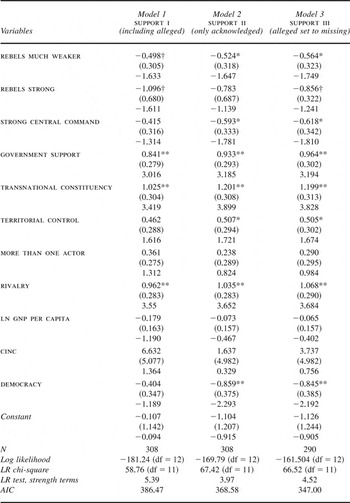
Table 2 contains estimates of a logistic regression model adding the transnational linkages and group characteristics. We will focus first on Model 4, which is based on the comprehensive support i variable. As can be seen from the likelihood ratio (LR) chi-square for Model 4, the overall model is now statistically significant, indicating that transnational and group characteristics provide helpful information in predicting support over and beyond country characteristics. With regard to our hypotheses, we can see that the terms for the strength of rebel movements relative to governments—with “moderate strength” as the baseline—is consistent with our hypothesis, as the strongest and weakest rebels appear to be less likely to receive external support. Whether or not individual coefficients for polychotomous variables split up into dummies are different from 0 will depend on the designation of the baseline. As such, the most appropriate test here is to consider the joint significance of the two terms for the variable. This is reported below the table of coefficients. As can be seen from Model 4 in Table 2, the LR chi-square is 5.39, which has a p-value of about 0.067, reaching statistical significance. We thus conclude that H1 is supported, reaching statistical significance at the 0.1 level, although we note that the support is weaker in Model 5.
Logistic regression estimates of support for rebel groups

Notes: Table lists variable coefficient, with standard error in parentheses, followed by Z value. AIC = Akaike Information Criterion. LR is likelihood ratio.
** p < .05;
* p < .1; † joint significance in 0.1 test.
Our results for other group characteristics are somewhat mixed. H2 predicted that groups with a strong central command should be more likely to receive external support. This hypothesis receives no support from these results. The estimated coefficients are negative, contrary to our expectations, and weakly significant. We had expected states to find groups with strong organizational structures to be more reliable agents. One possible interpretation of this result is that some groups with strong central command may be more effective in gaining revenue domestically and so they have less need for external support. We leave this for future research, as for now, we are hesitant to draw firm conclusions about this feature based on these findings alone.
Irrespective of the external support measure, we find that groups that have territorial control are more likely to receive external support, rather than less, as postulated by H3. We had expected that territorial control and the ability to turn to domestic sources for funding would free rebels of the need to secure outside resources. However this expectation was not supported. The ability to control territory may attract foreign supporters since rebels are proven to be viable and local resources—particularly mineral wealth—may be desired by outside actors. However, this is still a conjecture that warrants future research. In any case, although this variable is not strongly significant, it is clearly in opposition to the expected direction, and so we cannot claim support for H3.
Consistent with H4, we find strong support for the proposition that external support is more likely when groups have transnational constituencies. Indeed, the coefficient implies an influence on the log odds of conflict that is greater than any of the other categorical variables. This holds irrespective of the specification of the support measure. Groups with transnational ethnic kin, such as Serbian rebels in Bosnia-Herzegovina, and groups with transnational ideological appeal, such as Hezbollah, are more likely to receive support from external backers than groups with relatively parochial interests.
H5 postulates that transnational support should be more likely for groups located in states that have an external rival. As can be seen from Table 2, we find strong evidence for this proposition, and this holds for all the support measures. Therefore, the analysis supports the conjecture that supporting insurgencies is an alternative method of undermining international enemies that falls short of international war.Footnote 57
Our H6, stating that external support for rebels is more likely if the state also receives external backing, is strongly supported by our regressions. Indeed, military support for the government side in a civil war increases the odds that rebels will receive external support by a factor of between 2.3 and 2.6, depending on the support measure specification. Many cases of intervention on one side, therefore, appear to be designed to counterbalance support for the other side.
The results for the other country-level control variables are generally similar to those reported in Table 1, even when we add the transnational features and group characteristics. Neither state strength nor logged GDP per capita are reliable predictors of whether or not rebels receive external support. However, we find that democracy is negatively related to external support in Models 5 and 6, suggesting that democracies may be less likely to be targeted by externally-sponsored rebel groups. Groups such as the Irish Republican Army and Basque separatists in Spain may have had sympathy from external actors but did not receive significant governmental assistance.
Before moving on to a discussion of the substantive significance of these results, two further issues are worth considering. First, as discussed earlier, the analysis here considers whether or not rebel groups receive support from any external state. This means that cases where rebels are supported by multiple states are treated the same as those where they are only supported by one. In that sense, we are excluding some cases of intervention because we focus on the group.
It may very well be, however, that the same factors that affect whether or not groups receive support would affect how many states support them and that these decisions are not independent of one another. To look at this issue, we conducted a negative binomial regression of the number of states supporting each rebel group (using the support i variable). That analysis yielded results that were similar to Model 4, and were even stronger in terms of statistical significance.Footnote 58 We find that rebel groups that are at parity with the state receive support from more states than those that are weaker and stronger, as do rebels who control territory. Rebels with a strong central command receive less support than those without. Rebel groups are also likely to receive support from more states if they have transnational kin, fight a state in a rivalry, and if the government also receives support. Thus, our results hold up quite well to this alternative specification.
Second, one consequence of our focus on the rebel group as the unit of analysis is that interpreting the findings for H4 and H5 can be difficult. We predicted that rebels would receive more support when they had transnational kin or operated in states that were engaged in an international rivalry, and those predictions were supported. Our analysis, however, does not allow us to say whether the states supporting these groups are in fact the rivals or the states that host the transnational constituent group.
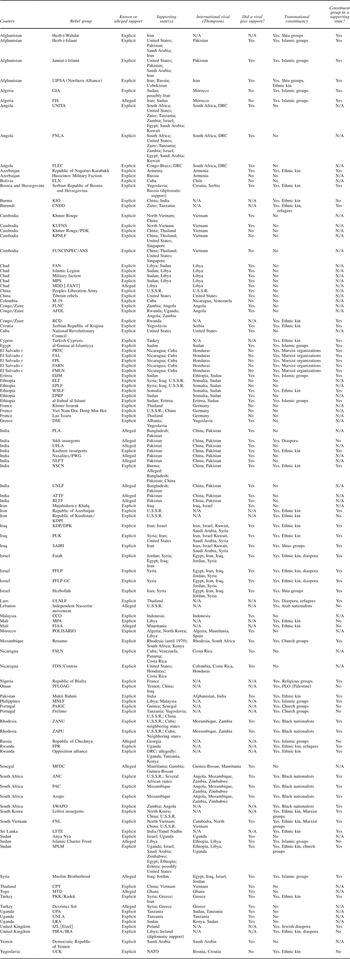
To address this, we have created Appendix A, which looks at all cases where rebels received support and either: (1) operated in a state that was part of an international rivalry, or (2) had a transnational constituency. We then examine whether the states that provided support were rivals of the rebels' host state or had a transnational tie. We find that, in most cases (80.5 percent), they did. More discussion is provided in Appendix A at the end of this article.
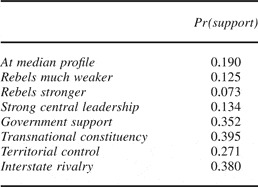
To interpret the substantive effects of our estimates, we consider in Table 3 the effects of our key factors, based on the estimates for Model 4, for an observation with the median/modal value of the right-hand side variables. This implies an observation profile for a country with a GDP per capita value of $1,977, a CINC score of 0.002, and a regime that is not democratic, as well as a single rebel organization with moderate strength, that is, neither stronger nor much weaker than the government. We set the value of all the other terms to 0, which is the median value for all the other key explanatory factors (except for interstate rivalry, which is present in 52 percent of the observations). The first row of Table 3 reports the implied probability of support for the median profile, while the subsequent rows show the change in the predicted probability of support from changing each of the key factors, keeping the other right-hand side values the same. The median profile has a predicted probability of support of 0.190. Consistent with our claims, changing the relative strength of the rebel group to much weaker or stronger yields a notable decline in the predicted probability of support. A strong central leadership has little influence on the likelihood of support, while we see very large increases in the predicted probability of support following government support, transnational constituencies, interstate rivalry, and to a lesser extent, for organizations that exercise territorial control.
Substantive effects of variables in Model 4

One possible critique of our approach relates to the relationship between rebel strength and foreign support. It may be the case that external sponsors cause rebels to grow strong, which suggests reverse causality: support predicts strength, rather than the other way around. However, we note that the strongest rebels are less likely to have external support, which helps attenuate such fears. One way to deal with this issue is through an instrumental variable approach, although we are skeptical that reliable instruments—factors that are related to the independent variable but orthogonal to the error terms—can be found. Another approach is to examine whether or not rebel strength can be considered a function of factors associated with foreign ties. In regressions not shown,Footnote 59 we use rebel strength as the dependent variable and transnational constituencies and international rivalries as our main independent variables. We estimate these models with and without all other right-hand side variables. Our results suggest that external factors are indeed negatively related to rebel strength, and are statistically insignificant when other control variables are included. That is, transnational constituents and foreign rivalries—which explain foreign support—are not themselves positively related to rebel strength. Therefore, we can conclude that foreign ties are not predictors of the strength of rebel groups.
Evaluating the Results
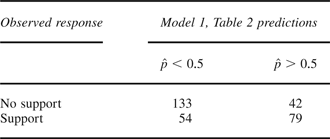
In order to ascertain the overall predictive power of our model, Table 4 compares the observed responses with those predicted by Model 1 in Table 2, dichotomized by whether the predicted values for support from the regression exceed 0.5. As can be seen, the estimates perform relatively well in terms of identifying the conflicts where we actually see external support. A total of 79 out of the 133 cases of support that we observe are correctly classified by the predicted values, while the overall success in the classifications of the model is about 70 percent. By contrast, a model with only the purely domestic characteristics (constrained to the same sample as Model 1) only identifies five cases of support for insurgent groups. This implies that the more limited model misses 128 out of the 133 cases with external support in our data. Thus we have a good deal of confidence that our regressions, while not perfect, increase our predictive ability considerably for when external support is more likely to occur than no support.
Predictions for Model 1 in Table 2 by observed response

A more systematic approach to evaluating the predictive performance of the model should consider the relative costs of false negatives (that is, missed cases of support) versus false positives (that is, incorrectly predicted instances of support). While a lower prediction threshold minimizes the missed events, this also risks generating more false positives. King and Zeng suggest evaluating models across a range of plausible thresholds rather than just a single prediction threshold through a Receiver-Operating-Characteristic (ROC) plot.Footnote 60 An ROC plot graphs a continuous curve comparing the share of true and false positives from a model for a given prediction threshold. The performance of a model relative to a random guess based on the share of events in the sample can be assessed by comparing the height of the curve to a forty-five degree line. As can be seen from Figure 1, the dashed line for the purely domestic model deviates little from the forty-five degree line, or the success that we would expect from a random guess. The solid line for Model 4, incorporating international and transnational linkages, however, is much higher, and this provides strong evidence that transnational characteristics provide important information as to what insurgent groups are more likely to see external support.
Receiver-Operating-Characteristic plot comparing Models 1 and 4

An additional value of our modeling approach is that we can clearly differentiate between various insurgent groups. Rather than predicting support for “rebels” in a civil war, we can assess predictions for particular insurgencies or organizations. For instance, our model gives a predicted probability of insurgent support of more than 80 percent for several groups, and each of these groups indeed received external assistance. These groups are listed in Table 5. Two of these groups, the Hezb-i-Islami and the Jamiat-i-Islami, fought in Afghanistan and had external ideological appeal for a broad anti-Soviet and Islamic constituency, and received support from Saudi Arabia, Pakistan, and the United States. The Sudan People's Liberation Movement had the highest predicted level of support and received assistance from several African states as well as backers from outside the region. We also had a high prediction of external support for the Rally for Congolese Democracy (RCD), a largely Tutsi group in the Democratic Republic of the Congo, which was assisted by its ethnic kin in Rwanda; acrimonious relationships between the two states also encouraged support. As a final example, our regressions highly predicted support for the Ethiopian Liberation Front. While the Ethiopian government was assisted by the United States and Israel, countervailing assistance was offered by Syria, Iraq, and the U.S.S.R.
Insurgent groups with predicted probability of support > 0.8

Our model can also distinguish between various groups within a single conflict. For instance, three main groups fought against the government of the Philippines for an independent Muslim homeland on the island of Mindanao: the Moro National Liberation Front (MNLF), the Moro Islamic Liberation Front (MILF), and the Abu Sayyaf group. Of these groups, only the MNLF received substantial outside assistance, primarily from Libya, but also from Malaysia. For these three groups, our model gives us predicted probabilities of support as follows: 68 percent for MNLF, 58 percent for MILF, and 45 percent for Abu Sayyaf.Footnote 61 The predictions for the latter two groups are substantial, but not far from assigning equal odds to the two outcomes, while we had strongly predicted support for the MNLF. Abu Sayyaf was classified as much weaker than the state, which partly explains its lack of support. The key difference between the MNLF and the MILF is that the Philippines was much more democratic when the MILF started its insurgency in the 1990s (Polity = 8), than when the MNLF began (Polity = −9). Therefore, our approach, which emphasizes conflict dyads rather than the civil war as a whole, provides potentially strong predictive power with respect to particular groups, although we stress that further modeling is needed to improve the accuracy of our predictions.
Conclusion
In this article we applied a principal-agent perspective to understand why some rebel groups receive and accept outside support while others either do not receive support or are reluctant to accept it. Our empirical analysis, using new disaggregated data on rebel group characteristics and external linkages, suggests considerable support for our arguments regarding the supply and demand for foreign assistance. We find that external support is less likely when rebel groups are very strong and very weak, although we find less evidence for our indicators of rebel group cohesion and demonstrating territorial control. Moreover, we find that transnational linkages and interstate rivalries are very important for support for rebel groups, and that conflicts where the government side has external support are much more likely to also see support for the rebels. By contrast, traditional country characteristics often believed to be important for the outbreak of civil war, such as income and geopolitical power, appear to be largely unrelated to whether rebel groups receive external support.
We believe that future research on civil war should take the characteristics of rebel groups more seriously. Due largely to data constraints, previous quantitative research on civil war has focused on macro-structural attributes of the country as a whole and characteristics of the government actor. As we demonstrate in this article, incorporating data on rebel actors in civil wars can significantly improve our understanding of civil war. We also believe that future research on conflict and political violence should look closely at circumstances where the lines between civil and international war are blurred.Footnote 62 Civil and international wars are often intertwined processes as rebels benefit from outside assistance and civil conflicts give rise to international disputes. Treating these phenomena as separate areas of inquiry, in our opinion, often obscures much of the conflict dynamic.
Finally, gaining a better understanding of state sponsorship of insurgent groups is likely to yield more effective counter-insurgency strategies. While states can take steps to disrupt rebel operations at home, groups with foreign ties are often much more difficult to confront. Therefore, diplomatic efforts to resolve international disputes can help to ameliorate the conditions that facilitate civil conflict. Rather than focusing on rebel organizations alone, states facing armed opposition groups must also put pressure on foreign backers as well as take steps to mend relations with their international enemies.
Appendix A: Rivals, Transnational Constituencies, and External Support
In this Appendix, we examine the relationship between international rivalries, transnational kin groups, and external support more closely. We have argued that rebel groups fighting governments with international rivals and those with transnational constituencies are more likely to receive external support. However, it is important to determine whether or not it was actually the rival state or a state with transnational ties that provided such assistance, or if the correlation is spurious.
In Table A1, we list all cases in our regression analysis where rivalry = 1 and/or transnational constituencies = 1, and there was foreign support for the rebel group (using the Support I variable). The name of the rival state(s), the nature of the transnational actor, and the state(s) that offered support are listed. Without extensive qualitative research, it is difficult to determine whether or not the rivalry relationship and/or the kin group were decisive factors in the supporting state's decision to provide aid. Therefore, we simply report the observed correspondence and leave the assessment of whether rivalries or kin were decisive to the reader. However, we do note whether at least one of the rival states offered support to the rebel actor. We also note whether the transnational constituent group resides within a supporting state.
Rivalries, Transnational Constituencies, and Support

Notes: In 26.5 percent of cases, both conditions are true. In 54 percent of cases, one condition is true. In 19.5 percent of cases, neither condition is true.
At the bottom of the table we provide summary statistics on whether one, both, or none of the conditions are true (that is, a rival state provided support; a country where a constituent group resides provided support). As can be seen, in the vast majority of cases (80.5 percent), the relationship between rivalry, transnational constituents, and foreign support for the rebel group, are properly attributed. In other words, in only 19.5 percent of the cases neither the rival state nor the state with transnational ties provided assistance. However, for most of the cases where the relationship was spurious, the external support came from a major power. If we exclude major power interventions, we note that the vast majority of support relationships are correctly attributed to transnational constituencies and/or rivalries.