Immigration, particularly of low-skilled workers, has generated political conflict in many industrialized countries. Anti-immigrant parties have gained strength in Austria, Denmark, the Netherlands, Norway, and Switzerland, whereas riots linked to immigration have occurred in Australia, Belgium, France, Italy, Spain, and Sweden. Because of this increase in social conflict, politicians across developed democracies—a key destination for the world's migrants—have produced a wide array of policies to limit migration. These policies, including increasing border security, mandating language proficiency, and elevating minimum skills requirements, have done little to decrease the demand for entry into the world's industrial democracies. These same destination countries spend more than $1 billion annually on official development assistance.Footnote 1 Given this overlap, it is important to ask whether migration preferences influence foreign aid policy in donor states.
Donor migration preferences are not the only reason to expect a link between foreign aid and migration. Migrant communities often play a role in influencing the foreign policy choices of their host government, including their allocation of development assistance. Migrants have the ability to lobby host country governments, and a particular incentive to do so when policy relates to their country of origin. Powerful ethnic lobbies, such as those associated with Armenia, India, and Israel, have been successful in pressing the US Congress on policies toward their homelands.Footnote 2
Both donors' desire to curb immigration and the mobilization of migrants living in the donor state lead to the expectation that migration will influence the allocation of foreign aid. Long neglected by scholars of both migration and foreign aid, recent studies have begun to examine potential links between these two areas. Hatzipanayotou and Michael and Azam and Berlinschi argue that donors may use aid to decrease unwanted migration, but these studies do not account for policymakers' changing preferences over time.Footnote 3 In contrast, we argue that the magnitude of the aid-migration relationship increases when donor preferences toward migration become more restrictive. Lahiri and Raimondos-Møller and Berthelemy, Beuran, and Maurel argue that ethnic lobbying by migrants in the donor country can explain foreign aid allocation, but they do not account for differences in incentives and ability for mobilization across migrant groups.Footnote 4 We hypothesize that migrants' ability to affect aid flows varies based on their access to the political system in their host country and the level of engagement between the home country and its diaspora. We contribute to this scholarship both by allowing for variance within each of these pathways and by empirically testing them in the same study. We do not expect them to be mutually exclusive.
The hypotheses are tested on a dyadic data set of twenty-two Organisation for Economic Cooperation and Development (OECD) aid donors and more than 150 aid recipients for the period from 1993 to 2008. The general link between aid and migration is found to be statistically significant and substantively important. Controlling for other determinants of aid allocation, including multiple dyadic measures of the relationship between donor and recipient (for example, trade, distance, former colonial status), the number of migrants from a recipient living in a donor is an important factor explaining aid allocation patterns. We find that donors increasingly target aid toward potential sources of future migration as their overall desire to limit migration increases. Additionally, when the incentive and opportunity for mobilizing on behalf of their homeland increase, migrant populations' impact on aid for their homelands also increases. These results hold simultaneously: controlling for one pathway does not decrease the importance of the other. As a final step, we use similar models to test the relationship between refugees from a recipient living in a donor and aid allocation from the donor to the recipient. This relationship differs in predictable ways from the migration-aid relationship, lending further credibility to the main findings.
This article contributes to the literature on aid allocation by demonstrating the important role that migration flows from a recipient to a donor play in influencing the allocation of foreign aid.Footnote 5 It is surprising, given the focus on donor interests in the allocation literature, that issues related to immigration have been largely ignored in analyses of dyadic aid allocation.Footnote 6 The results also add to existing scholarship regarding the effectiveness of a home country's diaspora in shaping the policies of the host countryFootnote 7 by expanding this logic to include the policy area of foreign aid. Similarly, they contribute to the literature that views migrant networks as a conduit for international economic flows.Footnote 8 Finally, the analysis creates a bridge between two topics—immigration and foreign aid—that evolved for a long time autonomously in political economy scholarship. As such, the argument is in keeping with a growing number of studies that reach across traditional dividing lines, such as the work of Milner and Tingley comparing domestic support for both trade and foreign aid policies and that of Leblang analyzing the impact of migrant networks on cross-border capital flows.Footnote 9
Foreign Aid and Migration: The Arguments
The two arguments we advance—that foreign aid is used by policy-makers who wish to limit immigration and that it is influenced by immigrant political pressure—both suggest a positive association between the migrant population from an aid recipient living in a donor country and the level of dyadic aid commitments. They also suggest that the relationship between migrant population and aid is not constant: it should vary over time as the preferences of policy-makers in donor countries toward migration change and/or migrants' incentive and ability to mobilize change.
Aid as a Tool of Immigration Policy
During the past two decades governments across developed democracies have implemented policies designed to decrease immigration, particularly that of low-skilled migrants coming from developing countries.Footnote 10 Although current levels of international migration are not unprecedented, de Haas points out the rise of South-North migration in recent decades.Footnote 11 A primary driver of immigration is the existence of immigrant networks, created by past migration of co-ethnics, friends, and family. This “chain migration” provides potential migrants with information and social support that decrease the costs and risks associated with moving to a new country.Footnote 12 Thus, a good predictor of future migration is the number of migrants from a sending country currently living in the host country. Policy-makers wishing to decrease future migration with aid are likely to focus their efforts in geographic areas from which they have received large numbers of migrants in the past.
Unwanted migrants
Although some studies suggest a positive net effect of immigration for the host country economies, groups within industrialized countries are concerned with negative effects associated with migration—whether they are real or perceived.Footnote 13 Immigration from poorer states to developed countries can cause distributional conflicts by driving down the wages of unskilled workers in the host country,Footnote 14 leading such workers to demand policies that limit migrant inflows.Footnote 15 Migrants may also create fiscal strain through the use of publicly provided services, which may, in turn, lower support for immigration among the native population.Footnote 16 Hostility toward migrant populations has led to the rise in popularity and electoral success of radical right partiesFootnote 17 and driven policy-makers to enact increasingly strict immigration policies.Footnote 18
Poor socioeconomic conditions for migrant groups led to riots in France in 2005 and 2007, and the closing of an Islamic center led to violent clashes between youth and police in Sweden in 2008. Australia experienced multiple riots at immigrant detention centers in 2011, Belgium saw rioting after the killing in 2002 of a Moroccan-born teacher, and violence erupted between African migrants and native populations in southern Italy in 2010 and in southern Spain in 2008. In Britain, a 2008 poll shows that 60 percent of those surveyed thought the UK had too many immigrants; an even larger number agreed that there was at least a “fair amount” of tension between different races or nationalities, and that this was at least “fairly likely” to result in violence.Footnote 19 Citizens of host countries often worry about the influence of migration on local culture and seek to limit its impact. A recent survey in France, Germany, Britain, and Spain found that majorities across the left-right political spectrum in these countries support legislation banning wearing the burqa in public.Footnote 20
Foreign aid as migration policy
Official actions to restrict immigration, such as border fences, domestic language proficiency requirements, nationality tests, and skills requirements decrease but do not stop the flow of foreign workers. Migrants are often driven by a desire to enhance the well-being of themselves or their families.Footnote 21 Without addressing the root causes of migration from poorer to wealthier states, border restrictions and other restrictive policies will remain of limited effectiveness. Governments may view foreign aid, with its potential to increase wages, expand essential services, and decrease inequality in recipients, as a means to lower the expected increase in utility from emigration, therefore decreasing demand for entry.Footnote 22
Government statements and actions provide anecdotal evidence of broad policies linking immigration to development assistance. For example, in 2008 the Agence Française de Développement (AFD; French foreign aid agency) signed a partnership agreement with the French Ministry of Immigration, Integration, National Identity, and Inclusive Development (MIINDS). As part of the agreement, the MIINDS was given a seat on the board of directors of AFD. MIINDS created the strategy of “inclusive development” to give support “for the development of migrants' home countries or regions to ensure that migration does not become the only way for local populations to survive or live decently.”Footnote 23 The European Community has explicitly linked development and migration, including the principle that “migration policies should be incorporated in a structural manner into policies on health, education and human capital, and into social and economic development strategies” as part of their “Global Approach” toward migration.Footnote 24 A deputy prime minister in the UK claimed that “not only is [giving foreign aid] the right thing to do morally … but also it is in our interests … if you want to stop people upping sticks and moving across continents and coming to settle in Europe and here, you have got to make sure the circumstances are better for them.”Footnote 25 Similarly, de Haas quotes former Prime Minister Poul Rasmussen of Denmark justifying foreign aid by arguing that “if you don't help the third world … then you will have these poor people in our society.”Footnote 26
Although donor motivations regarding migration influence aid policy, it is not this article's task to evaluate the effectiveness of aid in stemming migration. Rather, we follow in the well-established tradition in aid literature that uses allocation patterns to examine donor motivations separately from questions of effectiveness.Footnote 27 There are reasons to be skeptical that development will decrease migration in the short term. The relationship between income and migration may follow the pattern of an inverted-U: when initial income is low then increases in income will lead to increases in migration, whereas the opposite is true for somewhat higher levels of income.Footnote 28 Berthelemy, Beuran, and Maurel claim that aid increases migration for these reasons, whereas Gaytán-Fregoso and Lahiri model the ability of aid to either increase or decrease illegal migration, depending on which of these two effects dominates.Footnote 29 De Haas also argues that aid is unlikely to decrease migration, although he presents numerous examples to suggest that donor governments may still be (mistakenly) pursuing this policy option.Footnote 30 Interestingly, he argues that one reason aid is unlikely to be effective at stemming migration is because “Official Development Assistance (ODA) is generally not concentrated on migrant-sending countries”—a proposition we test (and reject).Footnote 31
Targeted Aid
Careful targeting of aid suggests that donors may also be skeptical of the ability of broad-based development programs to stem migration. Indeed, there is evidence that donors focus on programs designed to enhance well-being in aid-recipient communities from which the donor has received sizable inflows of migrants. Although this evidence is anecdotal, the precision of the programs speaks to donor motivations.
For example, the German development agency (GTZ) initiated the Pilot Program to Promote Migrant Organization Projects, which offers a subsidy of up to 100 percent for migrants' charitable investments in the social infrastructure of their country of origin.Footnote 32 If development assistance is targeting the poorest and most needy within a country, this approach makes little sense: Why target aid funds to areas already receiving outside assistance in the form of remittances, rather than using that money in more isolated areas with less access to foreign funds? However, viewed through the lens of immigration policy the rationale is clearer. Areas within a recipient state that have access to outside funds and are linked to networks of existing migrants in the donor state have an increased likelihood of outmigration. To keep them from following in their predecessors' footsteps, donor countries such as Germany target aid at specific communities where emigration has been historically high, to increase their current well-being and decrease the net benefits of migration.
An additional strategy that donors follow is to fund specific types of programs, such as job creation and wage support initiatives, which may have a relatively short-term impact on the desire to emigrate. These programs also focus on areas from which previous migration has been high. The European Commission claims that “migration and development policies should … focus much more on economic reform and job creation and on improving the working conditions and the socioeconomic situation in low-income and middle-income countries, and in regions characterised by high emigration pressures.”Footnote 33 In the United States, a top destination for Armenian emigrants, the US Agency for International Development (USAID) understands “the importance of migration and remittances for Armenia's development” and so is working “toward improving the internal situation in the country [Armenia], including labor market development and promotion of Armenia's competitiveness so that there are enough competitive and well-paid jobs within the country to support Armenian families.”Footnote 34 French aid is used to finance co-development programs in Mali and Senegal where assistance is provided directly to migrants to help them return to their country of origin.Footnote 35 The targeting of aid to groups likely bound for a particular donor may mitigate, although will unlikely completely eliminate, the ability of one donor to free-ride off development assistance provided by other donors.Footnote 36
Migrant Mobilization
Donor government immigration policy objectives are unlikely to be the only factor driving the relationship between migration and aid. Foreign aid choices, such as those that govern all policy choices over scarce resources in a democracy, are subject to intense competition between interested parties.Footnote 37 In addition to indicating the potential for future migrant flows, the size of an aid recipient's migrant population living in a donor state is one measure of that group's ability to influence the host government to direct increased foreign aid toward its homeland.Footnote 38
It is not unambiguous that migrant groups in donor countries will be willing to mobilize on behalf of their country of origin. Home countries and their overseas populations have a long and storied relationship: emigrés have been referred to as “traitors” and have been treated as “prodigal sons and daughters who had abandoned their national family and who therefore should not be allowed to retain their original nationality.”Footnote 39 During the past three decades this anti-emigrant tide has turned as states increasingly see their diasporas as an asset. Countries such as the Philippines and Mexico have established hometown associations to connect with their external citizens. India and China, following international incidents, actively court their diasporas by offering incentives for home country investment.Footnote 40 In some cases, for example, Mexico, Morocco, and China, emigrés have come to be celebrated as national heroes, whereas in others politicians travel abroad to establish relationships with their expatriates.Footnote 41 These strategies attempt to create, recapture, or cultivate feelings of membership in the nation. As Fitzgerald notes, “migrants are outside state territorial borders but within the boundaries of the imagined nation;”Footnote 42 Shain claims that governments work to “promote and sustain the attachment of the people to the motherland.”Footnote 43
Political rights
Increasingly, governments of migrant-sending states allow dual citizenship for their migrants abroad. Dual citizenship policies are designed to evoke a feeling of inclusion in the homeland.Footnote 44 Itzigsohn and Goldring argue that the extension of dual citizenship should enhance migrants' feeling of connection to their country of origin, a feeling that should lead them to advocate on behalf of their home country.Footnote 45 The extension of dual citizenship is often used instrumentally by home governments to encourage expatriates to naturalize in their host countries. Jones-Correa and Mazzolari use microlevel data and find ample evidence to support this conjecture, based on Latin American immigrants to the United States.Footnote 46
Dual citizenship allows migrants to become part of the formal political process in their adopted country without severing citizenship ties to their homeland. Encouraging naturalization is a strategic decision aimed at strengthening the link between home country and the expatriate's country of residence. Freeman and Ogelman argue that “sending countries are likely to be strategic and to be directed toward such goals as enhancing their control and influence over their nationals living abroad and, through them, increasing their influence over the foreign and domestic policies of receiving states.”Footnote 47 Ostergaard-Nielsen shows that the Turkish government attempted to engage its diaspora to facilitate entry into the European Union,Footnote 48 and multiple scholars examine the impact of ethnic lobbies in the United States.Footnote 49
Mobilization will be enhanced when migrants feel included in their homeland and have access to the political system in their host country. We account for both of these factors in our construction of an appropriate variable to measure immigrant political engagement.
Hypotheses
A larger migrant population from a recipient means both that a donor can expect relatively large future migration from that country because of chain migration and that there is the potential for the group to have significant political voice in the donor. Therefore, both of the pathways hypothesized in this article create the expectation of a positive relationship between aid and migration.
The first hypothesis reflects this expected aggregate relationship:
H1
There will be a positive association between the size of the migrant population from a recipient residing in a donor and the donor's commitment of aid dollars to the recipient.
Testing this empirical connection is an important first step, but not in itself sufficient to establish a causal link between migration and aid. To better understand the contributing factors to the relationship and to deal with potential bias or endogeneity, interactive hypotheses are used to test the role of donor migration policy and migrant mobilization. If the magnitude of the relationship is conditional on overall migration policy and/or migrants' incentive and ability to influence policy, then it is much less likely that the link between migration and aid is spurious or endogenous, a point to which we return in the results later.
Donor immigration policy
Foreign aid can be used as one tool in achieving immigration goals, and these goals change in a donor over time. The use of aid to further migration goals means that less aid is available for pursuing other donor policy objectives. Thus, given that aid is a scarce resource, more should be allocated toward migration goals when the intensity of policy-makers' preferences to restrict immigration increases. This leads to the following hypothesis:
H2
When a donor country's policies toward migrant entry become more restrictive, the effect of recipient country migrant population on aid flows will increase.
H2 tests whether the response of aid to migration varies with changes in donor entry policy toward migrants. This is an interactive effect. Donors who adopt more restrictive immigration policies may increase, decrease, or not alter total aid flows. For instance, one could imagine a situation in which a right-wing government seeks to decrease aid and immigration, but allocates more of the remaining aid to programs designed to decrease migration. This finding would be consistent with H2, which hypothesizes that despite any effect on aggregate aid flows, restrictive immigration policies are associated with an increase in the importance of migrant populations from recipients in determining how the pot of aid money is allocated across countries.
Mobilized migrants
In addition to donor governments using aid to further migration policy, migrants might pressure their host government to increase development assistance to their home countries. Although any migrant group can seek an increase in funding, some groups are likely to be more energized to act on behalf of their homelands and/or have greater access to the political process in their host countries. We use the extension of dual citizenship rights by the migrant sending/aid recipient state as a measure of the incentive migrants will have to mobilize on behalf of their home country. Although there are many ways in which migrants may influence policies, we use the extension of voting rights to migrants living within the donor as a measure of political access. This variation across migrant groups in both incentive and ability to effectively mobilize for their home country provides a way to test the responsiveness of aid allocation to differences in migrant mobilization. We hypothesize the following:
H3
In dyads where the aid recipient allows its migrants abroad to hold dual citizenship and the aid donor grants voting rights to migrants, the link between migrant population and aid flows will be stronger than when these conditions are not met.
Again, the hypothesis concerns the interactive effect; the direct relationship between dual citizenship or voting rights and aid allocation may be positive, negative, or neither. The measure of migrant mobilization used in the empirical analysis is coded 1 if the donor provides migrants with voting rights and the aid recipient country provides migrants with dual citizenship rights; it is coded 0 otherwise. This measure is imperfect but has characteristics that make it useful for testing our hypothesis. It incorporates both incentive for mobilization and access to the political process. Furthermore, the coding of dual citizenship is based on recipient countries' policies and is not driven by donor preferences: in any year it does not vary across donors for a given recipient. This allows us to be confident that it is not merely another reflection of differences in donor policies toward migrants—a situation that would make it difficult to distinguish evidence supportive of H2 and H3. We are not suggesting that migrants will successfully mobilize only when they have both dual citizenship and voting rights in the donor. Rather, one should expect a greater impact when both of these conditions are met—hence the hypothesized interactive effect between mobilization and migrant population.
Sample and Data
Our main analysis examines dyadic aid commitments for the period 1993 to 2008. We begin our analysis in 1993 because multiple scholars have suggested a changing role for aid following the end of the Cold War.Footnote 50 We have data on bilateral foreign aid from all twenty-two OECD donors to 159 recipient countries.
Dependent Variable: Aid Commitments
For the dependent variable we use dyadic data on foreign aid commitments taken from the OECD's online database, reported in constant (2008) dollars.Footnote 51 The natural log of (1 plus) the aid value is used as the dependent variable.
Key Explanatory Variables
Because of concerns of endogeneity, explanatory variables are lagged by one period.
Migrant population
Our first key explanatory variable, migrants, is the log of (1 plus) the population of migrants from a recipient country residing in a donor country at time t−1. We use the data on the size of a donor's migrant population collected by Fitzgerald, Leblang, and Teets who rely on information from national statistical offices to produce measures of dyadic migrant stocks and flows for twenty-two destination (donor) countries from 210 source countries.Footnote 52
Donor migration policy
Immigration policy is notoriously difficult to measure because countries differ significantly not only in how immigrants are treated once they arrive but also in how open their borders are to those who wish to enter. We use three different measures of migration policy to lessen concerns that the results are driven by choice of measure. Our preferred variable, migration policy, directly codes changes in a country's entry policy. For each country-year we code whether entry policy—quotas, family reunification, recruitment of workers, etc.—moves in a more liberal (−1) or restrictive (+1) direction. We take 1980 as the base year and give it a value of 0. For each subsequent year we add or subtract one if there is a change in policies governing the entry of immigrants; higher values on this variable indicate more restrictive policies. Because countries differ in terms of the overall liberalness or restrictiveness of their policies we always include a set of donor-country indicator variables. We have data on migration policy for all of our donor countries with the exception of Greece, Ireland, Luxembourg, New Zealand, and Portugal. These data are available through 2005; the range on this variable is from −4 to 5. This measure is constructed using the measures of migration policy restrictiveness from Fitzgerald, Leblang, and Teets.Footnote 53
As a robustness check we alternatively use a measure of donor entry policy based on bi-decade surveys of respondents from immigration offices around the world, carried out by the United Nations' Population Division in the Department of Economic and Social Affairs, World Population Policies. This publication provides the results of surveys of government officials who are the titular head of the agency responsible for immigration policy. We draw on the question that asks whether government policies regarding the level of immigration should remain the same, be raised, or be lowered. We code a variable, un policy , equal to 1 if the response indicates that policies should be designed to lower the level of immigration, −1 if the response is in favor of increasing migration, and 0 when policies are desired to keep migration the same. As a second robustness check, we replace the migration policy variable with a variable measuring the vote share for far-right parties in the most recent election (far right vote). Since anti-immigrant sentiment and policies are usually a key component of the platform of far-right groups, increases in vote share for these parties represent increasingly negative public attitudes toward the immigrant population.Footnote 54
Migrant mobilization
Migrant mobilization is more likely in situations where (1) home (recipient) countries allow migrants to maintain home country rights even when naturalizing abroad and (2) host (donor) countries provide migrants with voting rights. When both conditions hold, our measure of migrant mobilization equals 1; otherwise it is coded as 0.Footnote 55
Control Variables
We include measures of income (gross domestic product per capita) and population; if donors are focusing on need for development assistance then we would expect aid to be decreasing in income and increasing in population. Data for both variables come from the Penn World Table version 6.3Footnote 56 and each variable is logged.
We recognize that relationships between donors and recipients are complex, with migration being one component that might influence aid flows. Therefore, we are interested in controlling for “connections” between the donor and recipient other than immigration. We include the log of exports from the donor to the recipient based on the International Monetary Fund's Direction of Trade Statistics and converted to constant dollars using the US gross domestic product deflator.Footnote 57 We control for the log of distance between donor and recipient capital cities as reported in EUGene v. 3.2 software.Footnote 58 We also have an indicator variable that is 1 if the recipient is a former colony of the donor, which is coded from the CIA World Factbook.
To measure military importance we include the log of (1 plus) military assistance a recipient receives from the United States taken from the USAID Greenbook (us military).Footnote 59 Ideally this would be a dyadic measure, however military assistance data are available for the United States only. As a proxy for overall military importance these figures for US military aid are included as a control for all donors, given the alliance ties between OECD donor countries; this is obviously an imperfect measure for donors other than the United States. A measure of recipient democracy is included based on data from the Freedom House's Freedom in the World data set; this is the average of a recipient's score on the civil liberties and political rights variables, inverted so that 1 is least democratic and 7 most democratic.Footnote 60
Two variables are included to control for emergency need in a recipient that could lead to changes in aid flows. An indicator variable, civil war, takes the value of 1 if the UCDP/PRIO Armed Conflict Dataset codes the country as having a civil war.Footnote 61 To account for the impact of disasters on a recipient, we include a measure of the number of people affected by a natural disaster.Footnote 62
Results
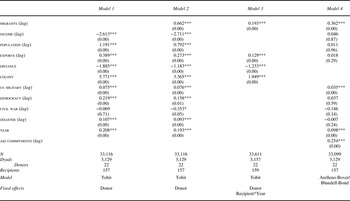
Models and calculations of substantive effects for H1 are shown in Tables 1 through 3. Unless otherwise noted all equations are estimated using a Tobit modeling specification with left censoring at 0 and robust standard errors clustered on dyad.Footnote 63 A Tobit model was chosen because for approximately one-third of the observations the dependent variable takes a value of 0.Footnote 64 This is mainly driven by smaller aid donors, which tend to focus their aid on fewer recipients.
Impact of immigration on aid flows, 1993–2008

Notes: The dependent variable is the log of (1 plus) aid commitments from the donor to the recipient; the unit of analysis is a dyad-year and p-values are in parentheses. Models 1 to 3 use a Tobit estimation with standard errors clustered on dyad, and report the marginal effect calculated as the effect on the latent variable multiplied by the probability of being uncensored. Model 4 employs the Arelleno-Bover/Blundell-Bond estimator. * p < .10; ** p < .05; *** p < .01.
Table 1 shows results relating the migrant population to foreign aid. For the sake of comparison, we present Model 1 as a benchmark, without the inclusion of the migrants variable. Unless otherwise noted, all models include a set of donor fixed effects.Footnote 65 The coefficient estimates reported for Models 1 to 3 are the marginal effects, calculated as the effect of the independent variable on the latent (unobserved) variable, multiplied by the probability of being uncensored.Footnote 66 Consistent with existing literature, Model 1 shows that bilateral aid commitments in this period are lower with higher levels of per capita income and larger bilateral distances. Aid commitments are increasing with higher exports from donor to recipient, and when the recipient has a larger population, receives more military aid from the United States, was a former colony of the donor, is more democratic, or has experienced a natural disaster.
In Model 2 we add the number (logged) of migrants from an aid-recipient country residing in a donor country in t-1. The coefficient on the variable, migrants, is positively signed and statistically significant. The marginal effect is substantively large as well: a 10 percent increase in the size of the migrant population from a particular recipient residing in a donor country increases aid commitments to that recipient by nearly 7 percent.
The next models in Table 1 establish the robustness of this finding. Model 3 drops the variables that measure recipient characteristics and replaces them with a complete battery of recipient × year fixed effects, a practice that controls for unmeasured attributes of aid recipients that are either constant or that vary over time. This specification, like the others, still includes a set of donor fixed effects so the estimated model includes only variables capturing bilateral donor-recipient linkages.Footnote 67 The results using this very conservative specification remain broadly consistent with those in Model 2: coefficients on exports, distance, and colonial history continue to be statistically significant and in the expected direction. The parameter estimate measuring the impact of the size of the migrant community from a recipient in a donor is still positive and statistically significant. The demanding nature of this specification results in a considerable decrease in magnitude on this coefficient; however, a 10 percent increase in migrant population is still associated with an increase in bilateral aid commitments of about 2 percent.
In the last column of Table 1 we alter our estimation strategy and deploy the dynamic panel system estimator developed by Arellano and Bond as extended by Arellano and Bover, and Blundell and Bond.Footnote 68 This procedure models the dynamics of foreign aid allocation by estimating the model in differences and through the inclusion of a lagged dependent variable. Differencing the model eliminates unmeasured origin and recipient (as well as dyadic) fixed effects, while the use of a lagged dependent variable captures unmeasured and temporally dependent processes that may influence the allocation of aid. This estimator also addresses the possibility that the stock of migrants in an aid donor may be endogenous to the allocation of foreign aid. This could occur if migrants follow aid flows rather than the other way around. The dynamic panel estimator deployed in this study deals with the potential for endogeneity through the use of internal instruments constructed as deviations from lagged independent variables.Footnote 69 The parameter estimates from the dynamic panel system estimator are broadly consistent with those obtained from the earlier models and confirm both the statistical and substantive importance of migrant populations in driving the cross-national allocation of foreign aid.
Robustness
We test the robustness of our findings to different modeling techniques and the inclusion of additional variables.Footnote 70 Using the data from Model 2 in Table 1, we alternatively analyzed these using a Hausman-Taylor model, a negative binomial model, and an ordinary least squares (OLS) model with fixed effects for dyads. Each of these have some drawbacks related to the Tobit results reported earlier, but in every case the relationship between migrant stock and aid commitments remains positive and significant (p < 0.001). Robustness to the inclusion of additional explanatory variables was also tested. Using Model 2, the addition of a measure for affinity in UN voting records between donor and recipient,Footnote 71 membership in common defensive alliances,Footnote 72 or economic growth in the recipient countryFootnote 73 did not detract from findings on the variables of interest.
Aggregate results
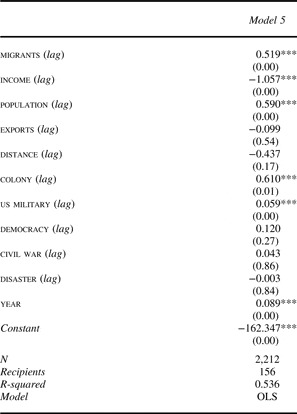
The dyadic analysis in Table 1 examines the relationship between migrant population and aid commitments in donor-recipient pairs. However, a recipient country may send migrants to multiple OECD donors, and we are also interested in the aggregate impact of this out-migration on the foreign aid it receives. Thus, it is important to ask whether total emigration to OECD countries increases total bilateral aid to a recipient summed across bilateral OECD donors. Aggregation will also allow us to determine if increased foreign aid from Donor A to a recipient simply crowds out foreign aid from Donor B. For instance, if France gives more money to Country X because Country X has sent it many migrants, does Country X receive more aid overall or do other donors decrease their aid to X to compensate for the increased French aid? To help answer these questions, Model 5 in Table 2 is constructed similarly to Model 2 except that the unit of analysis is a recipient-year, rather than dyad-year. Data from Model 2 are used to construct the aggregate values for variables as follows: aid commitments (the dependent variable), migrant stock, and exports are summed across OECD donor countries for each recipient; distance reflects the mean distance of the recipient from donors; and colony takes the value of 1 if the recipient was ever the colony of any donor in the analysis. An ordinary least squares (OLS) model is specified since 0 values on the dependent variable are not an issue when aid is aggregated across donors. As the results show, the impact of aggregate immigration on aggregate aid flows is positive and significant, suggesting that higher overall emigrant stock living abroad in OECD countries increases aid flows to a recipient.Footnote 74
Impact of immigration on aggregate OECD bilateral aid, 1993–2008

Notes: The dependent variable is the log of (1 plus) aid commitments to the recipient aggregated across all OECD donors. The unit of analysis is a recipient year and p-values are in parentheses; robust standard errors (not shown) calculated by clustering on recipient. Observations from Model 2 were used to calculate aggregate values. * p < .10; ** p < .05; *** p < .01.
Substantive effects
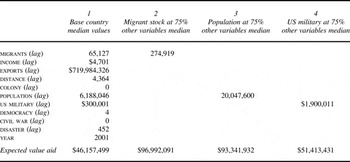
To gain a sense of the magnitude of the effect of migration on aid, substantive effects are calculated using the aggregate data from Model 5 and the Clarify software.Footnote 75 First, we create a base country by setting all variables at their median value. This base country has 65,127 migrants living in OECD countries and the expected value of its aid is $46,157,499. Column (1) in Table 3 shows these values as well as the median values for all other variables in the analysis. In column (2), all variables are kept at their median except for migrant population, which is raised to its value at the 75th percentile (274,919). Doing this raises the expected value of aid commitments to $96,992,091, a 110 percent increase. This represents an increase of $242 for each additional migrant sent to OECD countries.
Substantive effects calculations

Notes: Based on Model 5 from Table 2. All variables at median value unless otherwise noted.
Although it can be problematic to compare effects across variables, it is interesting to see the changes in aid produced by similar manipulations of other explanatory variables. In column (3) migrant population is returned to its median value but population is increased to its value at the 75th percentile. This allows us to compare the effect of general increases in population with the effect of increasing emigrants living in OECD countries. The result in column (3) is a large increase in aid (about 102 percent), but each additional person represents only a $3.40 increase, compared with the initial average of $7.46 per capita, so aid per capita decreases as regular population increases. Column (4) increases US military aid to its value at the 75th percentile with all other variables set at their median value. The resulting increase in aid is much less than that produced by the increase in migrant population in column (2).
Results by donor
Table 1 is a dyadic analysis across twenty-two OECD donors with fixed effects for each donor. It is also worthwhile to run the same analysis for the individual donors. This allows us to address any potential concerns that may arise from pooling across heterogenous donors, or from different data coverage across donors. When a model analogous to Model 2 is estimated by donor with standard errors clustered on recipients, there is a positive and significant (p < 0.05) relationship between the size of the dyadic migrant population and aid commitments for Australia, Austria, Belgium, Finland, France, Germany, Greece, Italy, Japan, Luxembourg, the Netherlands, New Zealand, Norway, Sweden, and Switzerland; for no country is there a significant, negative coefficient on migrant population. When year fixed effects are included, the coefficient on migrant stock is positive and significant for each of these donors and for Spain.Footnote 76
Aid and Immigration Policy
Our second hypothesis suggests that the use of foreign aid by a donor to decrease migration will not be constant across time. If foreign aid is a part of the donor country's overall migration strategy, then its link with migration should vary accordingly. To test this hypothesis we include a variable, migration policy , measuring the donor country's policy regarding the entry of labor migrants. The variable takes on higher values when entry restrictions are intensified and lower values when entry restrictions are liberalized. This variable is also interacted with migrants. Support for H2 is found if the impact of migration on aid commitments is stronger in the presence of more restrictive immigration policies, that is, if the interactive effect is positive.
The interactive nature of H2 (and H3) also addresses concerns that the overall relationship between migration and aid may be due to an omitted variable that varies with both migration and aid (making the observed relationship spurious) and/or that causality runs solely in the opposite direction (from aid to migration). If the relationship between migration and aid varies with migration policy, it is much less likely that the observed relationship between migration and aid is being driven by an omitted variable. Similarly, although one might argue that aid could cause migration, it is unlikely that aid causes migration policy; a significant interactive effect thereby assuages concerns of reverse causality. Similar arguments can be advanced for the testing of H3.
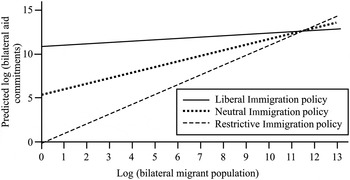
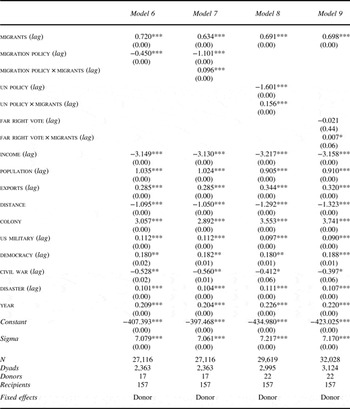
The effects of interaction terms over a range of possible values are always difficult to interpret. This problem is augmented when the specified model is nonlinear since there are issues with direct interpretation of the coefficient on the interaction term.Footnote 77 As an alternative, Greene suggests graphically showing the effects separately for different values of the key variable of interest, in this case migration policy. Figure 1 shows the predicted values of aid commitments separately for three values of migration policy: liberal (-3), neutral (0), and restrictive (3).Footnote 78 Migrant population is allowed to vary and other variables are held constant at their means.
Interaction between bilateral migrant population and donor migration policy

The different slopes are evident in the graph. As the migrant population from a recipient in a donor increases, governments with restrictive immigration policies respond by increasing foreign aid at a faster rate (steeper slope) than governments with more liberal immigration policies, in keeping with our expectation from H2. Although we posited no ex ante hypothesis regarding the direct effect of migration policy on overall aid flows, it is evident in Figure 1 that for a large portion of the distribution of migrants, governments that adopt more restrictive immigration policies also lower foreign aid. This is consistent with a scenario in which a government with a more negative view of “foreigners” restricts entry and reduces aid (lower intercept), but focuses the remaining aid more intently on further reducing the flow of migrants to achieve immigration goals (steeper slope).
Given the different intercepts and donors' tendency to target aid toward achieving migration goals to a varying degree in liberal and restrictive environments, it is not surprising that these two effects on the migration-aid relationship offset each other for some portion of the distribution. Indeed, when the log of migrant population is above 9.5 (less than one-fifth of observations), the effect of migrants on aid is not significantly different under liberal or restrictive migration policies. Donors with restrictive immigration policies tend to also lower aid, but their stronger desire to use aid as migration policy means that the initial differences in aid across policy preferences are overcome when migration is sufficiently high. The finding is consistent with previous work documenting links between increased migration and increased restrictiveness in immigration policies.Footnote 79 The results here find evidence of another component: more restrictive policies also increase the relevance of migration concerns in foreign aid decisions.
The regression underlying this figure is reported in Model 7 in Table 4, which also presents results for our two alternative measures of migration policy: un policy and far right vote.Footnote 80 As Models 8 and 9 show, the same pattern holds when using either of these alternative measures of migration policy: when either is interacted with the number of migrants from a recipient in the donor, the coefficient on the interaction term is positive and significant. These relationships also show up graphically.Footnote 81
Examining the impact of migration policy

Notes: Tobit estimation with standard errors clustered on dyad; p-values are in parentheses. Donor indicator variables included but not shown. The analysis runs from 1993–2006 in Models 6 to 8 and from 1993–2008 in Model 9. * p < .10; ** p < .05; *** p < .01.
Aid and Migrant Mobilization
Our third hypothesis provides a different lens through which to interpret the relationship between a country's immigrant population and its distribution of foreign aid. All else equal, we hypothesize that migrants are more likely to be mobilized in support of their homelands when their homelands provide dual citizenship rights and when they have the ability to vote in their host country. When both of these conditions are met, the variable mobilization is coded 1; it is 0 otherwise. Once again the key test for our hypothesis relies on an interaction effect, in this case the interaction between migrant mobilization and the size of the immigrant population. Our expectation is that the relationship between migration and foreign aid will be higher when both components of our migrant mobilization are true and the variable is equal to 1.
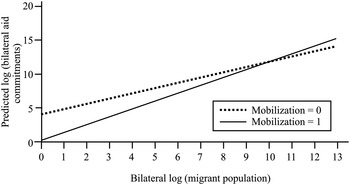
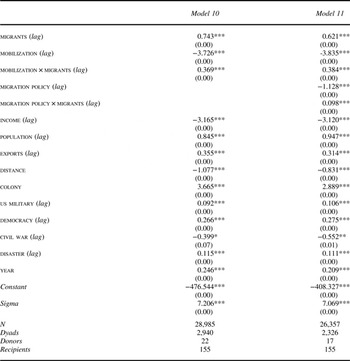
Model 10 in Table 5 shows the results of the Tobit analysis for the mobilization hypothesis alone; Model 11 includes this with the migration policy hypothesis (H2). As before, it is best to examine this effect graphically, as shown in Figure 2. When home countries grant dual citizenship and the host country extends voting rights (mobilization = 1), then increasing the size of the bilateral migrant population has a larger impact on bilateral aid commitments, as the steeper slope in Figure 2 indicates. The relationship between migration and aid varies with the level of mobilization, providing support for H3. Furthermore, including the interaction term for both migration policy × migrants and mobilization × migrants (Model 11) shows continued strength for both interaction terms. Thus, it appears that these two effects can simultaneously influence aid-allocation decisions.
Migrant mobilization and foreign aid commitments

Examining the impact of migration policy and mobilization

Notes: Tobit estimation with standard errors clustered on dyad; p-values are in parentheses. Donor indicator variables included but not shown. The analysis runs from 1993–2006. * p<.10; ** p < .05; *** p < .01.
Although H3 posits only that the effect of migrant population on aid will vary with mobilization (that is, that the slopes will differ), it is clear from Figure 2 that the intercepts also differ. One plausible explanation for the lower intercept when Mobilization = 1 concerns dual citizenship. Migrant-sending states may disproportionately feel the need to grant dual citizenship when their emigrants are not being particularly active in lobbying for their homeland, in the hopes that this will spur them to action. If dual citizenship is granted to get more aid, it appears to be working. Within a donor, migrant stock has a greater impact when dual citizenship and voting rights are present than when either is absent: this is the evidence from the interaction term with donor fixed effects in the model.Footnote 82 Further investigation into this relationship is an interesting topic for future research.
Refugee Analysis
The analysis so far has been confined to groups defined as migrants. To better understand the mechanisms at work, it is worth thinking about how one might expect them to apply to a different, but related, group—international refugees living in donor countries. First, at the aggregate level: it is likely that a large refugee population from a recipient country living in a donor country is associated with lower levels of bilateral aid. The granting of refugee status by a donor makes a statement about the sending state's government—one that is unlikely to be rewarded with increased aid. Although donors often choose to continue giving aid in refugee-generating situations, they may choose to confine this aid to emergency relief granted through international organizations; this decreases the scope of aid provision and limits the number of channels through which aid can be given. Thus, we expect a negative relationship between the size of the refugee population from a recipient in a donor and the allocation of aid from the donor to the recipient.
It is also worthwhile to examine the interactions between refugee populations and both immigration policy and mobilization. According to H2, as donor attitudes toward migrants become more restrictive they will try to decrease migration by increasing aid to migrant-sending countries. We would expect to see the same interactive relationship with refugees. Although donors likely give less aid overall to recipient governments generating large refugee flows, their efforts to stem the flow of refugees with humanitarian relief will likely increase as the desire to stem migration becomes stronger. Thus, we hypothesize a positive coefficient on the interaction between refugees and migration policy; this is the same directional effect that we expected on the interaction term between migration policy and migrant stock.
Unlike the variation with migration policy, we do not expect the interaction between mobilization and refugees to be similar to the interaction between mobilization and migrant population. Although many migrant groups may mobilize on behalf of their country of origin, refugees who have fled from a government are unlikely to lobby to increase the resources available to that government. Consider the case of Cubans residing in the United States: this group has a long history of lobbying the US government to enact measures against their homeland.Footnote 83
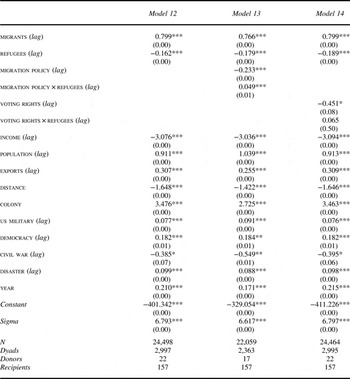
Table 6 reports results similar to those in Tables 4 and 5 but includes a measure of refugees from the recipient living in the donor.Footnote 84 As Model 12 shows, the overall relationship between refugees and aid allocation is negative—the opposite relationship to that observed between migrants and aid flows. Model 13 introduces the interaction term migration policy × refugees. The interaction between migration policy and refugees is positive and significant, similar to that observed in the interaction between migration policy and migrant stock in Table 4.Footnote 85 Model 14 tests the relationship between the interaction of voting rights and refugees and foreign aid allocation. Instead of using the mobilization measure from Table 5, this analysis uses only one of the components of that measure, voting rights, excluding the measure of dual citizenship.Footnote 86 Although the interaction between mobilization and migrants in Table 5 is positive and significant—signifying that migrant mobilization is associated with increased aid—the same is not true for the interaction between voting rights and refugees. The insignificant coefficient on voting rights × refugees suggests that unlike other migrants, there is no evidence that refugees mobilize to increase aid to their country of origin.Footnote 87
Examining the impact of refugees on aid

Notes: Tobit estimation with standard errors clustered on dyad; p-values are in parentheses. Donor indicator variables included but not shown. The analysis runs from 1996–2006. * p < .10; ** p < .05; *** p < .01.
Conclusion
Migration and foreign aid are each important contributors to the relationship between developing countries and their wealthier counterparts. The analysis in this study shows that they are also interconnected. Donor countries use aid as part of their broader immigration strategy, seeking to foster development abroad and decrease the push factors for migration. Additionally, migrants living in the donor country mobilize to increase funding for their homelands.
Our empirical analysis shows a strong, positive relationship between the number of migrants from a recipient country living in a donor country and aid allocation from the donor to the recipient. The magnitude of the link between migrants and foreign aid increases as a donor's policies toward migrant entry become more restrictive. This supports the hypothesis that donors incorporate concerns about migration when making decisions on foreign aid. The impact of migration on aid allocation also increases when migrant groups have increased incentives to lobby for their homeland and access to the formal political system in their host country, in keeping with the idea that migrant mobilization plays a role in determining the cross-country distribution of aid. These findings add to scholarly work on both aid allocation and the role of migrants in fostering the relationship between host and home country.
Aid donors have often been criticized for focusing on their own self-interest at the expense of development. This is partially a false dichotomy: using aid to enhance migration goals is self-interested, but it is also development oriented. An increasing use of aid to meet immigration goals should result in more development-focused aid. However, the most likely migrants are not usually the poorest of the poor, but rather those who have enough income to be mobile. Thus an immigration-motivated focus on development may not coincide with increased well-being for the poorest countries or regions within countries. In fact, it could potentially lead to increasing marginalization of some countries and groups, as those already connected to the international community by migration further increase their connections through foreign aid, at the expense of more isolated populations. Future work on aid allocation should incorporate the importance of migration, and should examine other potential areas in which donor self-interest and development promotion may coincide.
These results also suggest an important generalization to existing case studies of immigration we noted earlier: home countries play an important role in “activating” their external populations through policies that make them feel connected to their homeland. Although these connections are an important part of generating remittances and return migration, our results demonstrate that home countries can also be successful in leveraging their diasporas. Our measure of this type of expatriate engagement policy—a variable based on the existence of dual citizenship—is an imperfect proxy for the range of strategies that countries use to maintain ties to their diasporas; future work should explore these policies in more detail. The results also speak to the importance of further analyzing the political activity of immigrants within their host countries. We find empirical support of differences for labor migrants and for refugees, suggesting that more detailed analysis of the political preferences of these different types of foreign-born communities is warranted.
From a political economy perspective, the analysis shows the importance of crossing topical dividing lines when studying economic relations between states. The literatures on migration and foreign aid have evolved almost exclusively independently. Yet migration goals and foreign aid policy are not set by governments in isolation from each other, and the same is true of many international policy areas. This study contributes to the relatively small, but increasing, body of scholarly work that looks at interconnections between different research areas that have traditionally been pursued separately.
Supplementary Material
Supplementary material for this article is available at <http://dx.doi.org/10.1017/S0020818315000119>.