


Section 1: Assistance programmes and environmental management
ICRC Assistance Programmes aim to preserve or restore acceptable living conditions for people affected by armed conflict and other situations of violence. These victims can be highly vulnerable and are in most contexts highly dependant on their local environment for their livelihoods, health and security. As such, human health, livelihood and survival are intertwined with environmental concerns. Environmental concerns are thus directly relevant to ICRC assistance activities and must be part of them.
As a leading humanitarian organisation, the ICRC has a key role to play in issuing a clear message that allows for consideration of environmental issues that affect the victims of armed conflict while ensuring that the victims themselves remain central to ICRC Assistance Programmes.
This document aims to define environmental issues in the context of ICRC's operations. It also aims to provide useful and practical guidance to Assistance delegates and national staff on two levels:
• how to understand the relationship between Assistance activities and the environment upon which victims of armed conflicts depend; how to consider the potential positive or negative impacts of Assistance activities, without in any way compromising the rapidity and effectiveness of ICRC action;
• how to continue to develop an environmentally alert mindset and to enable environmental issues to be systematically integrated into the balance of factors that need to be considered to produce an efficient, effective and rapid ICRC response.
This framework for environmental management in Assistance Programmes is a first step towards formalizing an ICRC approach to environmental issues related to the victims of armed conflict and other situations of violence. The framework fits into the broader environmental concern of the institution as a whole. It encourages field operations to systematically assess, identify and understand the potential environmental impacts and implications of their activities and to take reasonable and feasible initiatives to reduce these impacts and enhance the efficiency, appropriateness and quality of Assistance Programmes.
1.1 Understanding environmental issues
This section explores some key questions regarding environmental issues from its definition to its linkage with humanitarian work.
A. Definitions
There are many different definitions and interpretations of the environment and environment-related terms. It is important to define a few terms related to the environment considered within the context of armed conflict and other situations of violence.
Environment: The definition of the environment in the context of ICRC activities focuses on human beings and their relationships with all the elements, natural or man-made, that directly or indirectly affect their living conditions. These include physical elements such as air, water, soil, natural resources, flora, fauna, but also consider socio-economic factors, beliefs, practices, political positions, law and policies that affect the livelihood.
Environmental impact: The direct and indirect effects of a project or ICRC presence on human beings (including social impact), fauna and flora, soil, water, air, climate and the landscape, the interaction of these factors, and on material assets and the cultural heritage.Footnote 1
Environmental impact assessment: The identification, description and assessment of environmental impacts, together with project alternatives and mitigation measures.
Environmental mitigation measures: Environmental mitigation measures encompass all the measures undertaken to reduce the negative environmental impacts of a project. These measures can include the modification or elimination of some activities, the choice of alternatives or the implementation of compensation measures.
Environmental management plan: Process made of specific activities, built into the project to ensure the identification and implementation of environmental mitigation (and enhancement) measures. It can contain baseline data, analysis of the impacts, residual impacts, monitoring and reporting processes.
These definitions place the human being at the centre of all interactions between biological, inanimate and human factors. It includes available and accessible resources and their mode of exploitation, available assets, and existing relationships with other persons and groups.
The term climate change is frequently mentioned in parallel to the term environment. It is widely mentioned as one of the factors that could contribute to future conflicts and exacerbate existing ones. It is however important to note that climate change is only one of several causes to the degradation of the environment. Bad governance, corruption or deficiency in private and public sources, population growth and density, and competition over resources are and will remain key contributing factors.
B. Classification of environmental issues
Four different types of environmental issues are frequently mentioned within the scope of humanitarian work:
1) Environmental issues that fuel tension
These issues refer to competition over resources such as natural resources (water, farming land, grazing land, forest, mines, wildlife) and other strategic assets (communication routes, cities, etc).
It is the responsibility of national and international policy-makers to lay the foundations of comprehensive environmental management. The scope of most of these issues goes beyond the ICRC mandate and expertise but a good comprehension of the environmental issues fuelling the conflict can enable ICRC to avoid exacerbating these dynamics.
2) Environmental issues created by conflicts
These can be direct impacts affecting populations, perpetrated by armed forces. They include amongst others:
— destruction of water supply and irrigation systems;
— destruction of shelter and other civil infrastructures;
— disruption of health services and health related problems including death;
— weapon and chemical contamination;
— surface water and aquifer contamination;
— impacts on fauna and flora.
These impacts are of interest to the ICRC as they directly relate to its mandate. They have to be assessed and understood in order to design appropriate assistance programmes to assist the populations affected by them.
— These can also be indirect impacts perpetrated by the victims of armed conflict themselves, related to their displacement or the constraints caused by adaptation to a situation of conflict such as high population densities. They may include:
— deforestation (firewood collection, charcoal production),
— spread of diseases,
— surface and subsurface pollution,
— over-exploitation of water,
— over-fishing,
— over-grazing,
— desertification.
As above, these issues must be assessed and understood in order to design appropriate assistance programmes to assist the displaced and host populations.
This framework provides insight into direct and indirect environmental issues caused by conflicts and highlights the importance of including these concerns into the design of assistance programmes.
3) Environmental issues created by humanitarian presence
Humanitarian agencies themselves can contribute to the overall degradation of the local environment as a consequence of their presence and activities. This includes:
— water and soil contamination from the poor disposal of waste;
— air pollution (exhaust fumes);
— fluctuation of price and availability of local products and services (including lodging);
— exacerbation of indirect issues listed above in contexts where the presence of humanitarian organisations encourages an increase in population density.
These issues are important and sensitive considerations, but are not covered in this document.
4) Environmental issues related to assistance programmes
Assistance Programmes aim to address the needs of populations affected by conflicts. By their very definition, they both depend on and affect the environment of these populations. How they affect the environment will depend on a careful assessment of all aspects of the situation at the beginning of ICRC's intervention, and a balance between immediate needs and longer-term consideration of the impacts on the local populations. If, for various reasons, the environmental issues surrounding the activity are not properly assessed or managed, it can potentially have a detrimental impact on the local environment and the beneficiary populations that the activities are designed to assist.
These impacts and interactions are complex and can include:
— overuse of farming land (fertility loss, deforestation, soil erosion);
— overgrazing / overfishing;
— overuse or pollution of water resources;
— pollution due to waste disposal (for example medical waste);
— loss of biodiversity or introduction of invasive species;
— detrimental effects on social or economical mechanisms.
Examples of environmental issues to consider during the design of a project, potential positive and negative impacts, suggestions to mitigate them and key points to consider as part of an overall assessment to find the most appropriate solution form part of Section 2, 3 and 4.
1.2 Rationale for the integration of environmental considerations into assistance programmes
According to the Assistance Policy paper,Footnote 2 the following principles guide all Assistance activities. This section explores how these principles relate to environmental considerations.
A. Taking the affected group and its needs into account
“The ICRC seeks to work in close proximity to the affected group. The organization must take account of the local value systems and the group's specific vulnerabilities and perception of its needs”.Footnote 3
The affected population will be best aware of its interactions with the local environment and consequences of any negative impact upon it. In cases of population displacement for example, the host community must be consulted to identify their main concerns relating to existing environmental issues and potential future environmental issues related to the displaced population.
→ Consult with victims of armed conflict, either displaced or host populations
B. Effective humanitarian assistance of high quality
“ICRC programmes must be planned, implemented and monitored in accordance with the highest professional standards. If the ICRC is to preserve its capacity to provide high quality and effective assistance, it must analyse and develop professional standards in conjunction with academic institutions and other relevant bodies”.Footnote 4
This includes being aware of current issues and legislation related to the environment, natural resources and land management in the countries where ICRC is present and consulting with the appropriate authorities.
→ Know and understand existing legislation and consult with relevant authorities
C. Ethical norms
“When providing assistance, the ICRC must respect certain ethical standards, namely the applicable principles of the Movement, the principle of do no harm, and the principles set out in the relevant codes of conduct. The best interests of those suffering the consequences of armed conflict and other violent situations must always guide the ICRC's activities”.Footnote 5
The Red Cross/Red Crescent Code of Conduct, Principle 8, clearly states that “[w]e will pay particular attention to environmental concerns in the design and management of relief programmes. We will also endeavour to minimise the negative impact of humanitarian assistance …”.Footnote 6 As members of the movement, ICRC has a moral responsibility to set an example and ensure that it does everything possible and feasible, within the limits of each situation, to integrate key environmental issues into its programmes and activities.
→ Integrate environmental concerns in the design and implementation of Assistance Programmes
D. Responsibilities within the Movement
“As a component of the Movement, the ICRC must discharge its responsibilities in compliance with the Seville Agreement and the Statutes of the Movement currently in force. During armed conflict or internal disturbances and in their direct aftermath, the ICRC has a dual responsibility: its responsibility as a humanitarian organization for carrying out the specific activities arising from its mandate and its responsibility for coordinating the international action taken by any components of the Movement involved in an operation or wishing to contribute to it. The ICRC must provide effective coordination and information in relation to both types of responsibility”.Footnote 7
Communication and collaboration with National Red Cross societies is an opportunity to advocate for more respect for the local environment where needed and to build capacity in this field, where and when appropriate. National societies can also provide valuable information on local environmental issues and national legislation. It is also an opportunity for the ICRC to ensure that the impact of joint activities on the local environment is managed by all members of the Movement.
→ Promote environmental advocacy and capacity building with National Societies
E. Partnerships with other humanitarian actors
“The ICRC must take particular care to associate with humanitarian actors whose working methods and policies are compatible with its own principles and work”.Footnote 8
Other humanitarian partners may share similar environmental concerns and be able to exchange useful additional information and advice.
→ Exchange environmental information with other actors and share our environmental concerns
1.3 Assistance strategies: Overall analysis of the situation and needs
“The ICRC conducts an overall analysis of each situation in which it is involved (security and economic, political, social, environmental and cultural aspects) in order to identify the problems and needs of the affected groups in terms of resources and services and their relationship with the various actors involved. … This analysis, regularly updated at the local, regional and international levels, enables the ICRC to draw up, adapt or alter its operational strategies. Finally, the ICRC analyses each situation and assesses risks in relation to expected impact. This is the basis on which the organization determines its own course … ”.Footnote 9
The ICRC adapts its response to the situation and consideration of environmental issues should be no exception to this rule:
Acute Crisis:
• In acute emergencies, the first priority is to address the immediate needs of the victims of armed conflict and ICRC seeks to maintain a rapid response operational capacity. Some environmental damage may be unavoidable due to time constraints and urgency of the situation. However, the implementation of mitigation measures should be considered as soon as feasible. Assistance delegates should be able to clearly justify their decisions and demonstrate the reasons behind them in an assessment report.
Pre-Crisis:
• ICRC supports existing systems or mobilises other entities to do so to prevent a disaster in humanitarian terms. Delegates should ensure that the delegation is aware of existing environmental issues at a local and national level, existing legislation and the relationships between populations and the environment.
Chronic Crisis:
• ICRC focuses on finding sustainable solutions to the problems it encounters, by handing over, and building capacities of authorities. Environmental issues and environmental management are key to finding sustainable solutions. Where national legislation does not exist or is not implemented, ICRC can use its experience to highlight the environmental issues that it encounters and build capacity where appropriate.
Post-Crisis:
• In contexts where it has a residual responsibility, the ICRC continues its activities and shoulders its responsibilities.
Consideration of environmental factors should not affect the above response patterns but should become a systematic, documented, and integral part of them.
1.4 Role of assistance programmes in addressing environmental issues
Humanitarian organisations as a whole cannot address environmental issues in a country without appropriate national environmental and natural resource management legislation and policies. However, there are measures that can be taken to enhance ICRC assistance response, to adhere to the “do no harm” principle and to reduce potential additional negative impacts on already vulnerable populations. A sound coordination done in consultation with local and national authorities, the affected populations as well as other national and international humanitarian agencies is essential.
Knowledge of the local environment, national environmental legislation and collaboration with local communities are essential. In many cases, national environmental legislation may exist and must be respected even if they are not respected locally by the local population.
Environmentally sound solutions are often logical, practical and feasible. It is not always necessary to be an environmental expert to find solutions that have the added benefit of being environmentally sustainable. It requires design and implementation of activities with an understanding of their environmental impact and active efforts to minimise these impacts wherever practical and feasible. A wide variety of activities can be developed expressly to contribute to improve the local environment while enhancing the situation of the local population. There is no sustainability of projects without a sustainable environment.
As a leading humanitarian organisation, the ICRC has a key role to play in issuing a clear message that allows for consideration of environmental issues that affect the victims of armed conflict while ensuring that the victims themselves remain central to ICRC Assistance Programmes.
Section 2: Water and habitat and environmental managementFootnote 10
Water and Habitat programmes are designed to ensure access to safe water and to a healthy living environment. The ultimate aim is to help reduce the rates of mortality and morbidity and the suffering caused by the disruption of the water supply system, the lack of sanitation or damage to the habitat.
In a situation of acute crisis:
• ICRC ensures access to water and safe environmental sanitation conditions and helps basic health care facilities by means of emergency action and support for existing facilities.
In situations of emerging, chronic and post-crisis:
• ICRC's priority is to support and strengthen existing structures through specific programmes that meet the needs of the population in a viable, sustainable manner.
Water and Habitat field of activities are:
• supply, storage and distribution of drinking water;
• environmental sanitation and waste management;
• energy supply for key installations such as hospitals, water treatment plants and water distribution networks and appropriate technologies for cooking and heating;
• construction and reconstruction, including health structures and temporary shelter; rehabilitation of existing structures when destroyed;
• technical advice to administration department on ICRC premises interventions.
The above activities can take place in both urban and rural settings and in detention places.
2.1 Environmental challenges of water and habitat activities
Current Water and Habitat assistance activities do not only take the environment into account, but in many cases propose solutions that respect or enhance it in order to achieve their purpose of reducing the rates of mortality and morbidity of victims of armed conflict. In many instances, these activities are inherently environmentally friendly.
When supporting an urban water treatment and distribution authority, for example, the project will include rationalisation of the use of existing resources taking into account their yearly fluctuations in order to ensure an adequate and continuous supply to affected populations.
Participatory approaches in hygiene promotion and sanitation activities enhance local awareness and understanding of the interactions between the local environment and the health of the affected population; and encourage communities themselves to manage their local environment in a way that is beneficial to them.
However, Water and Habitat programmes can also on occasion have a negative impact on the environment. Provision of additional equipment to a community or a water distribution body can change water consumption habits that were well-adapted to local conditions. Extensive construction programmes can contribute to localised depletion of resources, such as excessive wood consumption for brick-making, and the disposal of waste generated from construction programmes can be hazardous to local communities. Spring catchments, if not properly assessed can dry up streams and have a detrimental impact on crops and fisheries.
The Water and Habitat delegate must take these positive and negative factors into account when designing and evaluating programmes; combine them with the local context and come up with a solution that meets the needs of the affected population.
Some environmental challenges and considerations faced by Water and Habitat delegates when designing and implementing Water and Habitat activities are detailed in Section 2.3. It is not an exhaustive list of potential impacts and mitigation measures for all Water and Habitat activities, but can be useful to address key issues.
2.2 Case studies
The following two Water and Habitat case studies highlight the variety of environmental considerations that might arise during projects.
A. Biogas in prisons, Nepal
During the armed conflict between Maoist rebels and government forces, many people were detained in relation to the conflict.
Since 2004, the ICRC Nepali delegation supported detention authorities to ensure that detainees held in civilian jails had access to improved infrastructure by providing technical expertise and assistance. To date, the WatHab department has carried out rehabilitation and improvement works in 21 jails in Nepal.
Nepali jails generate several different types of waste with poor waste treatment systems available. This has the potential to create health problems both inside the prison and for the surrounding population.
The consumption of traditional fuels such as wood and kerosene as energy sources are also problematic. The excessive use of wood contributes to local deforestation and environmental degradation. Wood used in inappropriate stoves and in the kitchen causes significant indoor air pollution, raising health risks such as acute respiratory infections and conjunctivitis. These diseases are among the top ten for medical consultation. Kerosene is subject to the increase of fuel prices and puts additional pressure on the daily allowance of the detainees.
Biogas systems are already well known in Nepal with over 1 million people served by biogas. Local knowledge and experts are available.
ICRC decided to install biogas systems in three district jails. These systems were completed in May 2008. Three additional biogas systems are planned.
A combination of factors led to the Wathab department choosing biogas systems as a solution:
• available local knowledge;
• reduce health risks by reducing use of wood in kitchens;
• reduce pressure on detainee daily allowance by reducing need to purchase traditional fuels;
• reduce environmental impact on surrounding areas and local livelihoods by reducing need to purchase wood.
The objective of the installation of the biogas plants were to:
• improve the waste water treatment and consequently reduce health risks for detainees and surrounding population;
• provide renewable energy sources to reduce dependency on traditional fuels such as wood, kerosene and reduce health risks by improving prison kitchen environments;
• use biogas slurry as fertiliser;
• promote construction of biogas plants at an institutional level.
ICRC used a local expert partner to install the three biogas systems in the three jails of a total population of approximately 484 detainees.
After installation of the biogas systems, ICRC contracted an international expert to evaluate their performance, cost-effectiveness and user acceptance of these systems. The study aimed to draw lessons learnt and recommendations. The methodology included site visits, sampling and interviews.
The conclusions of the study highlight that, where and when appropriate, environmentally friendly technologies can be effective and contribute to an improved response from ICRC. Documented monitoring, evaluation and implementation of any ensuing recommendations will help ICRC to provide feedback and lessons learned from such projects.
B. Wells in Mali
ICRC has been working in Mali since 1991. A WatHab programme with the Belgian Red Cross began in 1996. The objective of the programme was to provide access to clean water to Health Centre users in Bougrem. The objectives were then widened to include provision of clean water to returnees following the end of the rebellion as well as to nomads who has to adapt their lifestyles and remain sedentary for part of the year.
A mission took place in 1997 to evaluate the WatHab programme objective and technical choices; to prioritise next steps; to support field programmes and to harmonise actions between the Belgian Red Cross, ICRC field delegation and ICRC head office in Geneva.
Providing water to semi-nomadic populations particularly in grazing areas, where water is essential to survival of populations and their livestock presents several logistical constraints, particularly difficulties finding workers to dig the wells due to:
• low population numbers;
• communities unused to participating in such manual work;
• populations are frequently on the move, following grazing land exploitation patterns so not necessarily present at all times.
In fact, consultation with nomadic populations revealed that grazing land and surrounding areas often do not have wells. This is out of choice to avoid overgrazing. They only move to these particular lands during the rainy season. The lack of water means that no one is able to stay year-round. Construction of water points and increasing access to water in these areas may in fact create additional tension between communities.
This example highlights the fact that populations adapt to their surrounding environment and that an effective ICRC response must consult with communities to accustom itself with local habits and consider this in the design of an appropriate solution.
2.3 Examples of potential impacts and mitigation measures for Water and Habitat activities
Note: It is the responsibility of the projects designers and implementers to strive to reduce the environmental impact of their activities. These activities, impacts and measures cannot be expected to cover each and every possible situation. Their users are expected use their common sense, environmental awareness, technical knowledge and creativity.
Water and sanitationFootnote 11

IrrigationFootnote 12

Construction related activitiesFootnote 13

ShelterFootnote 14

Section 3: Economic security and environmental managementFootnote 15
The Economic Security Unit held a seminar in Nairobi from September 29th to October 3rd 2008 on the topic of “Agro Programmes and the Environment”. Its objective was to raise awareness of environmental issues and include these issues, where possible, into its agricultural and other interventions. A report on the outcome of this seminar has been written and was made available in February 2009.Footnote 16 The feedback from this seminar forms an important and integral part of this framework.
The main purpose of economic security programmes is to preserve or restore the ability of households affected by armed conflict to meet their essential needs.
Acute crisis:
• ICRC provides the relief (food and essential household items) needed to sustain life and resume production, mainly through the distribution of agricultural equipment and supplies.
Emerging crisis, chronic crisis and post-crisis:
• ICRC's priority is to support and bolster the means of production through programmes tailored to the local economy. These programmes mainly concern: reviving agriculture, livestock health and management, and microeconomic initiatives.
Economic security main field of activities are:
• distribution of food rations;
• distribution of essential household items;
• distribution of seed, farming tools, fertilizer and fishing tackle;
• rehabilitation of agriculture and irrigation;
• livestock management;
• revival of small trades and handicrafts.
The above activities can be in both urban and rural settings and in detention facilities.
3.1 Environmental challenges of economic security activities
Agricultural assistance activities for example, not only take the environment into account, but propose solutions to enhance it, in order to achieve their purpose of preserving or restoring the ability of households to meet their essential needs.
Improved seed multiplication programmes or the distribution of drought tolerant varieties enable greater production on less land. Irrigation programmes rationalise the use of water; and seed distributions reduce household dependency on unsustainable livelihoods such as charcoal production.
However, agro-programmes can also have negative impacts on the environment: irrigation programmes can accelerate soil salinisation process, large-scale seed distributions may reduce the local crop biodiversity, amongst others.
The Economic Security delegate must consider these positive and negative factors when designing and evaluating programmes, combine them with the local context and come up with a solution that meets the needs of the victims of armed conflict.
The environmental challenges and considerations faced by Economic Security delegates when designing and implementing main agro and agro-economic activities are detailed in Section 3.3. This is not an exhaustive list of potential impacts and mitigation measures for all Economic Security activities, but can be useful to address key issues.
3.2 Case studies
The following two case studies present two very different examples where the Economic Security Unit has dealt with environmental factors in its response.
They highlight the fact that the environment is indeed an integral part of all operations; that there is no unique solution to a particular problem and that the efficiency of a solution depends on the context and many other factors.
A. Cassava and conflict in Democratic Republic of Congo
This particular case study highlights how conflicts and the ensuing population movement can serve to propagate environmental problems that were originally specific to one area, to much larger areas.
Since 1993, conflicts in the Democratic Republic of Congo, Rwanda and Burundi have resulted in more than five million deaths and have generated hundreds of thousands of refugees and internally displaced people.
When people are displaced following conflict, their fields are abandoned or sometimes looted. They become overgrown with weeds, and crops die out. When villagers come back, the harvest is often very poor and they remain impoverished.
When displaced, people often take food and animals with them including cassava stems which can then be replanted. Cassava is particularly well adapted to times of crisis as stems can be replanted, fields demands relatively low maintenance, the roots are energy-rich and leaves are protein rich. Cassava often represents people's only means of survival as well as a way back into fragile economic livelihoods.
However, the cassava plant traditionally used in eastern DRC was susceptible to the mosaic virus, which can decimate entire crops. The ongoing displacement and return of populations in this area has caused a spread of the disease and widely affected cassava crops.
ICRC provided a new mosaic-resistant type of cassava plant to local associations to plant in communal fields. Cassava leaves and roots were harvested as food, and 70% of the stems redistributed or sold within the respective associations, while the remaining 30% were returned to ICRC for distribution to other farmers associations in the area.
ICRC provided initial stems of the mosaic-resistant cassava plants as well as training and planting materials. The project was run with partners such as Research Institutes, national Red Cross societies and the Ministry of Agriculture. ICRC has been able to handover several such projects, entirely to individual associations where this activity has continued to sustain itself.
This project has had the following results:
(1) significant improvement of economic security of association members though healthy and resistant cassava stem sales;
(2) setting up a lucrative system (without need for further ICRC support) which encourages associations to continue to produce cassava plants and stems;
(3) availability of healthy cassava plant stems to a large population over vast zones allowing each household to either start over or enhance their cassava production;
(4) setting up a quality production system thanks to partnerships with research institutes and national organisations.
B. Pastoralists and livelihoods in the Horn of Africa
Emergencies in the Horn of Africa are related to natural, economic, political or social causes; livestock owners are vulnerable to all these factors.
The horn of Africa currently accounts for the ICRC's greatest operations in the world and half the region's population relies on animals to a significant extent for its survival. This region faces increasingly harsh climatic conditions. Where conflict in the past has often aimed at expanding the attacker's own herds and, thus, his power and influence, it is today aggravated by climatic parameters.
Competition over natural resources is widespread. The human population of sub-Saharan Africa is growing faster than the capacity of the livestock sector to support it and tensions are likely to escalate. However, conflict over natural resources is just one of the causes of conflict and many other causes have also been identified.
The ICRC Livestock study in the Greater Horn of Africa was conducted in 2005 order to contribute to ICRC's understanding of the circumstances and current challenges faced by a significant proportion of the population in one of its major operational areas.
The main aims of the study were:
(1) to provide a comprehensive picture of the current livestock / pastoralist situation and any anticipated future developments and a working basis / reference for the next five years.
(2) to design and submit regional livestock assistance guidelines and a proposed course of action for the ICRC at both regional and country level.
The study provides background information, past interventions, lessons learned and proposes a course of action with specific recommendations for livestock interventions in each country. By undertaking a regional approach, considering environmental issues amongst others, and incorporating cross-border issues, this addresses ICRC's attempts to harmonise its approach to observed needs; to improve regional coherence and to reduce potential double standards in its response mechanisms in the Horn of Africa.
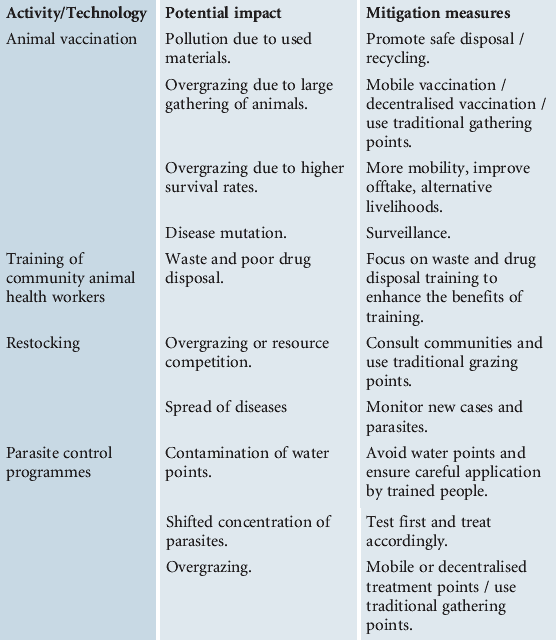
3.3 Examples of potential impacts and mitigation measures for economic security activities
The following table lists some succinct suggestions for mitigating potential negative impacts of agro-economic and agro activities. This is not intended to list all possible impacts and mitigation measure, rather to highlight some examples. These tables were compiled at the Nairobi Agro Workshop by Economic Security Coordinators.Footnote 17
Note: It is the responsibility of the projects designers and implementers to strive to reduce the environmental impact of their activities. These examples, impacts and measures cannot be expected to cover each and every possible situation. Their users are expected use their common sense, environmental awareness, technical knowledge and creativity.
Agronomy and agro-economics

Livestock activities
Section 4: Health and environmental managementFootnote 18
The health needs of people in armed conflict or other situations of violence are met according to defined minimum packages of health services/care. Curative and preventative health actions remain at the heart of our projects. Saving lives and alleviating suffering is the central objective of health assistance.
Emerging and acute crisis:
• the ICRC provides support for pre-hospital care (first aid and medical evacuation), basic health care and emergency hospital care (treatment of war wounded and other essential surgery), when access to medical facilities and the provision of health care are at risk.
Chronic crisis and post-crisis:
• the ICRC may consider providing support for a broader range of primary health care activities than those cited above. It may also take steps to strengthen other hospital services such as paediatrics, obstetrics and gynaecology (O&G), internal medicine and hospital management.
Main health activities are:
• first Aid;
• primary health care;
• emergency hospital care (war and essential surgery, paediatrics, O&G, internal medicine, hospital management);
• physical rehabilitation services;
• health in detention.
4.1 Environmental challenges of health activities
Human health is directly related to environmental conditions. The deterioration of the health of conflict-affected populations is linked to the deterioration of their local environment. ICRC health activities as listed above, more often provide support to existing medical facilities, and as such, do not generally directly consider environmental issues in the design of their activities.
Some primary health care activities, however, promote awareness of the link between local environmental conditions and health. The success of anti-malaria campaigns, for example, directly depends on community understanding and management of environmental conditions.
Health activities can also have direct negative impacts on the environment. Disposal of healthcare waste is of particular concern in countries where healthcare waste legislation does not exist or is not implemented, or where local practices may cause localised pollution to air, watercourses, aquifers or soils, thus further affecting the health of local populations.
The Health delegate must consider these factors when designing and evaluating programmes, particularly in the strengthening of hospital management, combine them with the local context and come up with a solution that meets the needs of the victims of armed conflict without, as far as possible, causing additional harm to the environment.
The environmental challenges and considerations faced by Health delegates when designing and implementing their main activities are detailed in the annexes of this document. This is not an exhaustive list, nor does it attempt to provide detailed healthcare waste management guidance. This would be best covered in a separate, specific document.
4.2 Case studies
The following case studies aim to highlight examples of how Health delegates in different situations have sought to deal with healthcare waste issues.
A. Lopiding Hospital waste management, Kenya
Lopiding was an independent ICRC hospital for conflict-wounded from South Sudan. It began to operate in 1987. The principal activity was war surgery and included services such as an orthopaedic workshop, physiotherapy, x-ray, pharmacy, laboratory, laundry, kitchen, maintenance and administration. In 2001 the ICRC commissioned the Institute of Occupational Health Sciences to conduct a waste management evaluation. In this case, the ICRC recognised that external expertise was required to identify the best possible solution.
The independent evaluation covered medical waste management from the creation of waste to its disposal. It made specific recommendations for improvements in several areas: waste minimization, separation and identification, handling, collection, transport and storage, treatment, final disposal, assignment of responsibilities and workers training and safety. The recommendations were implemented.
The main objectives of the evaluation were to:
1) observe and describe current health-care waste management from the creation of the waste to their final disposal, including collection, transport, intermediate storage and treatment;
2) analyse the risks generated by the actual health care waste management to the general population and ICRC employees;
3) to provide recommendations for future improvements.
After the evaluation, observation and interviewing of key staff, local authorities and other local health centres; a final report was produced covering the following topics:
1) types and quantities of waste;
2) containers and labelling;
3) collection, transport and storage;
4) pre-treatment;
5) final disposal;
6) waste water treatment;
7) health and safety practices;
8) responsibilities and training;
9) legislation, regulation and policies.
Although it was concluded that waste management in Lopiding did not result in extreme hazardous situations for either the surrounding population or hospital staff; several recommendations for future improvement were issued on the different stages as listed above.
After the peace agreement in 2006, ICRC withdrew from Lopiding hospital and handed it over to the Kenyan Health Ministry.
Although these recommendations may have been followed, there is no documented evidence of any follow-up or implementation. This is something that should be considered in any future assessment or evaluation initiatives.
B. Physical rehabilitation – prosthesis recycling
ICRC has commissioned a study to find an improved design process for its polypropylene trans-tibial prosthesis in Cambodia. The study takes into account economic and technical constraints but also considers user needs and environmental impact of the product.
A Life-Cycle Assessment was used to evaluate the environmental effects of the production, use and recycling phases of the prosthesis. This will enable ICRC to decide which aspects of the different stages of the product life may need to be improved from an environmental perspective.
This project resulted from a cooperation agreement between a PhD student at the Norwegian University of Science and Technology and the ICRC Physical Rehabilitation Programme Health Unit and is still ongoing.
The researcher was asked to investigate the current polypropylene technology used by ICRC in Cambodia and to suggest further development of the current prosthesis for children to produce and user-test a prototype of the suggested solution.
A large majority of current ICRC supported projects are already recycling polypropylene scraps in crutches handles, however, there are no formalised schemes for ensuring recycling of the materials used in the production of prosthetic appliances and it is unknown how each ICRC supported centre is currently managing its material waste.
This study is currently investigating the following trends:
— current levels of collection / disposal and re-use of different components;
— existing efforts to find new ways of recycling or reusing materials from returned or used prosthesis.
The results of the study to date have indicated a general lack of awareness of possibilities of recycling or reuse and of proper disposal methods in physical rehabilitation centres in Cambodia.
This study will contribute to the overall effort of improving final product cost-efficiency, user satisfaction and well-being, and as such contributing to the improvement of the quality of ICRC assistance to victims of conflict in Cambodia.
4.3 Types of health waste arising and main impacts
As there is much in-depth guidance on disposal of healthcare waste, this section will not detail the impacts or mitigation areas. It is beyond the scope of this framework to provide specific healthcare waste disposal guidance. It defines the types of waste that can arise, types of disposal, main possible impacts and outline the minimum elements of a waste management plan.
Note: It is the responsibility of the projects designers and implementers to strive to reduce the environmental impact of their activities. These examples cannot be expected to cover each and every possible situation. Their users are expected use their common sense, environmental awareness, technical knowledge and creativity.
Main impacts of healthcare wasteFootnote 19
• Disease transmission, through infectious waste, sharps, and contaminated water.
• Chemical and toxic threats, through chemical and pharmaceutical exposure.



