





Management Implications
The competitive dominance of Bothriochloa ischaemum (yellow bluestem, King Ranch bluestem) observed in this study has important implications for grassland restoration. Because Schizachyrium scoparium (little bluestem) reached peak biomass at moderate intraspecific density, restoration should emphasize moderate planting densities—providing sufficient space for tillering and microbial colonization—while maintaining moderate to high overall seeding rates to ensure rapid cover and minimize opportunities for B. ischaemum establishment. Management efforts should focus on maintaining low soil fertility and restoring native soil microbiomes to enhance native competitiveness. Because S. scoparium relies strongly on beneficial soil biota, microbial inoculation or the incorporation of native soil amendments may be particularly valuable for reestablishing native dominance and improving restoration success.
Introduction
Yellow bluestem [also King Ranch bluestem; Bothriochloa ischaemum (L.) Keng var. songarica] often forms near-monocultures in invaded grasslands, reducing plant diversity, arthropod biomass, and wildlife habitat quality (Hickman et al. Reference Hickman, Farley, Channell and Steier2006; Robertson and Hickman Reference Robertson and Hickman2012). Its success has been attributed to tolerance of grazing, morphological plasticity, and possible allelopathic effects, though the ecological importance of these compounds remains debated (Greer et al. Reference Greer, Wilson, Hickman and Wilson2014). Disturbance regimes also shape the dominance of B. ischaemum, which often acts as a “back–seat driver” of ecosystem change by capitalizing on disturbance events that suppress native competitors. The effects of mowing and prescribed burning depend strongly on the phenological state of B. ischaemum at the time of disturbance rather than on season alone, with mistimed or short–term disturbances frequently facilitating rapid post–disturbance recovery of B. ischaemum. Studies of seasonal mowing and burning indicate that early–season disturbance can enhance B. ischaemum performance and reduce species richness, whereas sustained late–season management is more effective at maintaining native diversity and limiting reinvasion (Dee et al. Reference Dee, Thomas, Thompson and Palmer2016; Havill et al. Reference Havill, Schwinning and Lyons2015; Ruckman et al. Reference Ruckman, Schwinning and Lyons2012).
Little bluestem [Schizachyrium scoparium (Michx.) Nash] is a dominant native C₄ grass across much of the central United States and is commonly used in prairie restoration, making it an ecologically and management–relevant native comparator for B. ischaemum. Previous studies demonstrate that S. scoparium responds strongly to nutrient availability and soil microbial interactions and can be a strong competitor under low–fertility conditions (Bush and Van Auken Reference Bush and Van Auken2010; Van Auken and Bush Reference Van Auken and Bush1988). In a greenhouse study assessing competitive dynamics between B. ischaemum and native perennial grasses, B. ischaemum outcompeted S. scoparium under conditions of shared resources (Schmidt et al. Reference Schmidt, Hickman, Channell, Harmoney and Stark2008). Together, these findings identify B. ischaemum–S. scoparium interactions as a useful system for investigating the mechanisms that drive invasive dominance in grassland ecosystems, including nutrient limitation, soil microbiota, and resource–use efficiency.
The soil microbiome—comprising bacteria, fungi, archaea, and viruses—plays a central role in mediating plant growth and competitive interactions through its influence on nutrient cycling and plant–soil feedbacks (van der Heijden et al. Reference van der Heijden, Bardgett and Van Straalen2008; Xi et al. Reference Xi, Dean and Zytynska2024). Recent evidence suggests that invasion by B. ischaemum can lead to persistent belowground patterns that are decoupled from aboveground plant recovery following invader removal. In a long–term removal experiment, Leander et al. (Reference Leander, Reemts, Nash and Wolf2025) found that native plant richness and cover recovered within several years after B. ischaemum removal, whereas soil microbial diversity and composition did not differ among invaded, removal, and native–dominated plots. This apparent lack of change in the soil microbial community indicates resistance to invasion effects rather than persistence of an invasion–altered microbial assemblage. Thus, the “legacy” observed reflects a disconnect between aboveground vegetation dynamics and relatively stable soil microbial communities shaped by broader land–use history, rather than retention of a distinct microbial community created by B. ischaemum invasion. Under these conditions, soil nutrient availability may regulate microbial function and plant–soil feedbacks more strongly than microbial species composition itself, thereby influencing competitive interactions between native and invasive grasses. Disentangling the interacting roles of soil nutrients, plant competition, and microbial function is therefore critical for understanding invasion success and predicting community structure.
Quantifying plant competition is essential for understanding invasion dynamics and the role of soil biota in mediating these processes. Experimental approaches such as monoculture biomass comparisons, replacement series, and additive or target–neighbor designs have long been used to evaluate inter– and intraspecific competition (de Wit Reference de Wit1960; Grace Reference Grace1995; Harper Reference Harper2010). These approaches have consistently revealed strong competitive asymmetries between invasive Bothriochloa species and native prairie grasses. For example, Schmidt et al. (Reference Schmidt, Hickman, Channell, Harmoney and Stark2008) demonstrated that B. ischaemum and Caucasian bluestem [Bothriochloa bladhii (Retz.) S.T. Blake] significantly reduced the growth of native species, including S. scoparium, whereas native species exerted little reciprocal effect. This asymmetric suppression suggests that Bothriochloa species possess a strong competitive advantage, potentially driven by belowground resource acquisition or plant–soil interactions.
In this series of three studies, we examined the competitive dynamics between the invasive B. ischaemum and the native S. scoparium under controlled greenhouse conditions. Specifically, we evaluated intraspecific and interspecific competition under low–nutrient soil conditions and assessed how the presence of the soil microbiome influenced plant growth and competitive ability. We used three complementary greenhouse experiments because competitive dominance can arise from distinct mechanisms that cannot be resolved with a single approach, including density–dependent self–limitation, dependence on soil microbial communities, and direct interspecific interactions. Accordingly, Experiment 1 quantified density–dependent intraspecific competition to establish baseline growth responses for each species, Experiment 2 examined dependence on soil microbiota by comparing growth in sterilized and non–sterilized soils, and Experiment 3 used a replacement–series design to evaluate direct interspecific competition. Together, these experiments allowed us to distinguish self–limitation, microbial mediation, and direct competitive interactions. We hypothesized that B. ischaemum, owing to its invasive traits, would be more competitive under nutrient–poor conditions and that differences in plant–microbiome interactions would further enhance its advantage over S. scoparium.
Materials and Methods
We conducted three experiments to evaluate the growth, competition, and soil microbiota dependency of S. scoparium and B. ischaemum. We used three complementary experiments, because competitive outcomes can arise from different mechanisms that cannot be resolved with a single approach. Experiment 1 quantified density-dependent intraspecific competition for each species to establish baseline growth responses and identify density thresholds at which self-limitation occurs. This step was necessary to distinguish species-specific growth constraints from effects caused by interspecific interactions. Experiment 2 isolated the role of soil microbial communities by comparing plant performance in sterilized versus non-sterilized soils, allowing us to determine the degree to which each species depends on soil biota for growth under low-nutrient conditions. Experiment 3 then evaluated direct interspecific competition using a replacement-series design, integrating insights from the first two experiments to determine how density effects and soil microbiome dependence translate into competitive outcomes when both species co-occur. Together, this sequential design allowed us to separate density limitation, microbial mediation, and direct species interactions as drivers of competitive dynamics.
Plant and Soil Collection for All Experiments
We collected tiller clumps of S. scoparium and B. ischaemum in October from a disturbed grassland beneath a powerline right-of-way in northern Bexar County, TX (29.586278°N, −98.613333°W). Soil (upper 25 cm) was collected from the same site, air-dried, homogenized, and sieved (6.44 mm) before use. The soil is classified as a Patrick series Mollisol (Typic Calciustoll), characterized by alkaline pH and a calcic horizon typical of central Texas grasslands (Soil Survey Staff 2025). Soil chemical properties were consistent with low-nutrient conditions: C = 7.5 g kg−1, total N = 1.0 g kg−1, P = 12 mg kg−1, K = 138 mg kg−1, Ca = 11.6 g kg−1, Mg = 1.3 g kg−1, and S = 196 mg kg−1 (Bush and Van Auken Reference Bush and Van Auken2010). These values reflect nutrient-poor grassland soils typical of the region (Hook et al. Reference Hook, Burke and Lauenroth1991; Schimel et al. Reference Schimel, Stillwell and Woodmansee1985).
Greenhouse Preparation and Planting for All Experiments
After collection, tillers were cleaned of soil, hydrated in buckets of tap water, and transported to a greenhouse. We trimmed both the roots and stems to ∼10-cm lengths and then stored them in – 15 cm-deep plastic pot lined with a plastic bag (to prevent leaching) and filled with 1,400 g of air-dried, sieved (6.44 mm) soil.
Plants were grown in a fiberglass greenhouse without temperature control during the summer. The average temperature during the summer of the experiments was 32 C, with the average maximum temperature reaching 49 C. Photosynthetically active photon flux density (400 to 700 nm) averaged 760 ± 96 µmol m− 2 s−1 inside the greenhouse and 2,090 ± 139 µmol m−2 s−1 outside at solar noon on a clear day, measured with a LI-COR LI-188 integrating quantum sensor (Lincoln, NE, United States). Plants were watered daily with reverse-osmosis water to maintain field capacity.
After 25 wk, aboveground biomass was harvested at the soil surface and dried to constant mass at 110 C. Belowground biomass was extracted by washing soil from roots and drying them similarly.
Experiment 1: Intraspecific Competition
In this experiment, we investigated the effect of plant density on intraspecific competition for each species under the low-nitrogen conditions of this soil. For each species, we planted pots at one of five densities: 1, 2, 4, 8, or 16 plants per pot. There were five replications of each treatment. We analyzed total dry mass per pot and per plant using one-way ANOVA, with plant density as the main factor. The assumptions of normality or homogeneity of variance (as assessed with Shapiro-Wilks and Bartlett tests) for all measures except the total dry mass per pot and per plant of S. scoparium were not met, so we used Box-Cox transformations (Box and Cox Reference Box and Cox1964). We conducted post hoc comparisons using Tukey’s honest significant difference (HSD) (Sall et al. Reference Sall, Lehman, Stephens and Loring2017).
Experiment 2: Soil Sterilization and Soil Microbiome Dependence
To evaluate the role of soil microbial and fungal communities, we compared plant growth in sterilized and unsterilized soils. Patrick soil was air-dried, sieved (6.44 mm), and then either left untreated or autoclaved in a large metal tray at 100 C for 1 h. After 15 min, soil was immediately weighed into plastic bag-lined pots (1,400 g soil) and planted with one plant of either S. scoparium or B. ischaemum. We did not cover the soil surface, so spore contamination could have occurred. There were five replications of each.
We analyzed differences in aboveground, belowground, total biomass, and root-to-shoot mass ratios using a two-way ANOVA with species (two levels) and soil treatment (two levels: sterile, non-sterile) as factors. The interaction terms for aboveground dry mass and root:shoot ratios were not significant (P > 0.05) and were removed from the model. The variances for the root:shoot ratios were unequal, so Box-Cox transformations were used (Box and Cox Reference Box and Cox1964).
Experiment 3: Interspecific Competition (Replacement Series)
To evaluate competitive interactions between species, we conducted a replacement series design (Harper Reference Harper2010). Using the results from the intraspecific competition experiment, which showed intraspecific competition at densities between 4 and 6 plants per pot, we planted the following species proportions: 6:0, 5:1, 4:2, 3:3, 2:4, 1:5, and 0:6 (S. scoparium: B. ischaemum). There were five replications (pots) of each proportion.
We measured aboveground, belowground, total dry mass, and number of flowering pedicels per plant. Data were analyzed using one-way ANOVA with species proportion as the main factor. The assumptions of normality or homogeneity of variance (as assessed with Shapiro-Wilks and Bartlett tests) for all measures except belowground dry mass of S. scoparium were not met, so we used Box-Cox transformations (Box and Cox Reference Box and Cox1964; Sall et al. Reference Sall, Lehman, Stephens and Loring2017).
We calculated relative competitive intensity (RCI) to determine the intensity of the competition between the two species (Harper Reference Harper2010).
 $\small{{\rm{RCI}} = {{\left( {{\rm{Monoculture}}\;{\rm{biomass}}\;{\rm{per}}\;{\rm{plant}} - {\rm{Mixture}}\;{\rm{biomass}}\;{\rm{per}}\;{\rm{plant}}} \right)} \over {{\rm{Monoculture}}\;{\rm{biomass}}\;{\rm{per}}\;{\rm{plant}}}}}$
We used t-tests to compare RCI between species at each proportion.
We calculated the relative yield (RY) to determine whether growth in the mixture affected the relative yield of each species at each proportion (Harper Reference Harper2010).
 ${\rm{RY}} = {{{\rm{Biomass}}\;{\rm{per}}\;{\rm{plant}}\;{\rm{in}}\;{\rm{mixture}}} \over {{\rm{Biomass}}\;{\rm{per}}\;{\rm{plant}}\;{\rm{in}}\;{\rm{monoculture}}}}$
We evaluated whether RY differed significantly from 1 by assessing whether the 95% confidence interval excluded the value 1. Values >1 indicate stronger intraspecific competition, while values <1 indicate stronger interspecific competition. Only B. ischaemum flowered, so we analyzed flowering pedicels using one-way ANOVA across species proportions, with transformed data when variances were unequal.
Additional Observations: Root Morphology
During harvest, we observed differences in root morphology between species. To quantify this, we measured the diameter of the primary root just below the rhizome in monoculture-grown plants (n = 30) using a caliper (Mitutoyo Digimatic, Mitutoyo America Corporation, Kawasaki (Takatsu-ku), Kanagawa Prefecture, Japan). Because the data violated assumptions for parametric tests (even after transformation), we applied the nonparametric Steel-Dwass test to assess species differences.
Results and Discussion
Experiment 1: Intraspecific Competition and Growth for Experiment 1
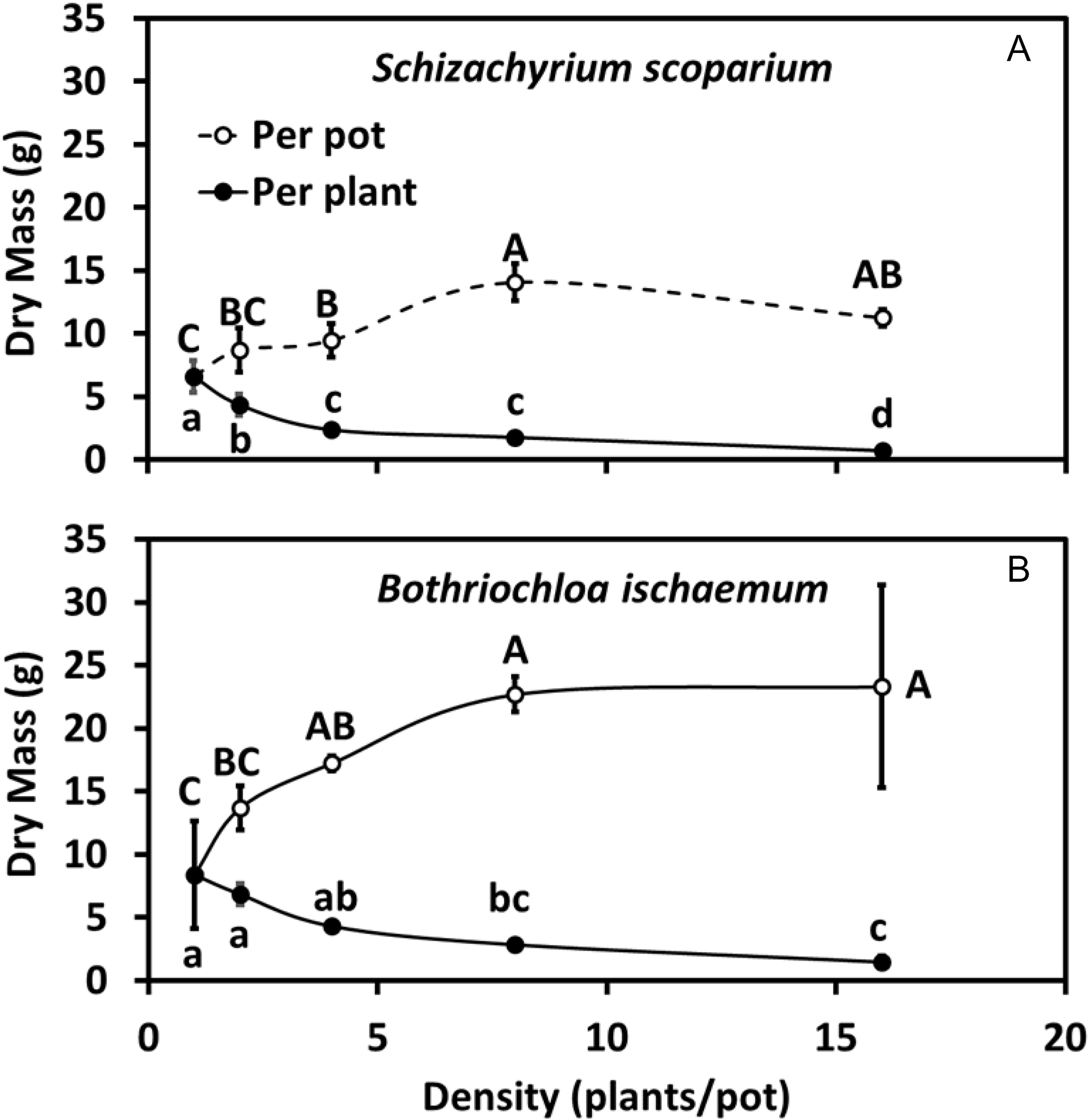
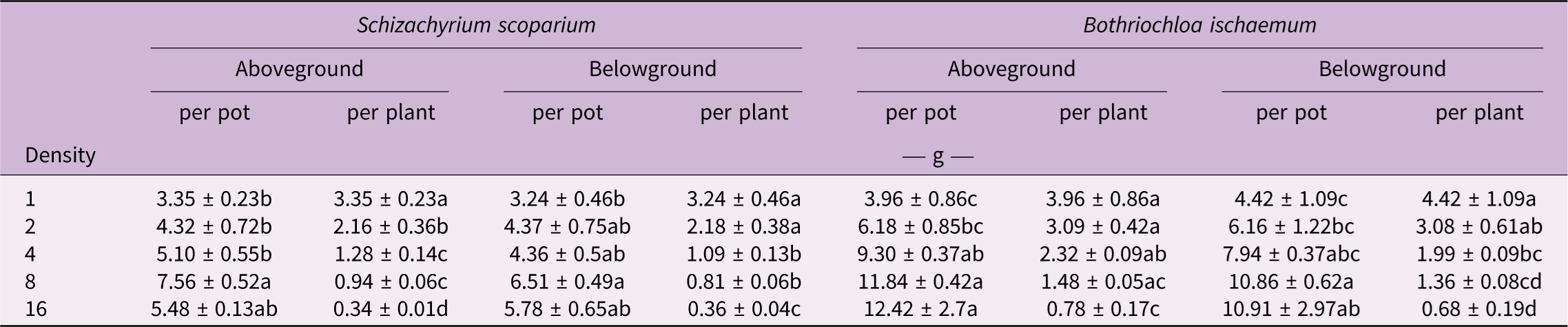
Our findings indicate that S. scoparium experiences intraspecific competition at relatively low densities. Total dry mass per plant declined by 34% when pot density increased from one to two plants, primarily due to reduced aboveground biomass (Figure 1; Table 1). In contrast, B. ischaemum showed a delayed onset of competition, with significant reductions in total dry mass (48% to 66%) occurring only between densities of four and eight plants per pot. Maximum biomass in S. scoparium occurred at eight plants per pot (14.07 g total dry mass), while B. ischaemum reached a higher overall biomass at its peak density of 8 plants per pot (23.33 g total dry mass). These results demonstrate species-specific thresholds of density-driven intraspecific competition, with B. ischaemum tolerating higher initial densities before experiencing resource limitation.
Mean (A) Schizachyrium scoparium and (B) Bothriochloa ischaemum dry mass per pot and dry mass per plant when grown intraspecifically. Error bars are 1 SE. Means with the same uppercase or lowercase letters are not significantly different for dry mass per pot or dry mass per plant, respectively (ANOVA, Tukey HSD, P ≤ 0.05).

Figure 1. Long description
Panel A: A line graph shows the dry mass of Schizachyrium scoparium per pot and per plant at varying densities. The x-axis represents density (plants per pot) ranging from 0 to 20, and the y-axis represents dry mass in grams ranging from 0 to 35. The graph includes two data series: one for dry mass per pot (open circles) and one for dry mass per plant (filled circles). Error bars indicate 1 standard error. Means with the same uppercase or lowercase letters are not significantly different for dry mass per pot or dry mass per plant, respectively. Panel B: A line graph shows the dry mass of Bothriochloa ischaemum per pot and per plant at varying densities. The x-axis represents density (plants per pot) ranging from 0 to 20, and the y-axis represents dry mass in grams ranging from 0 to 35. The graph includes two data series: one for dry mass per pot (open circles) and one for dry mass per plant (filled circles). Error bars indicate 1 standard error. Means with the same uppercase or lowercase letters are not significantly different for dry mass per pot or dry mass per plant, respectively.
Comparison of mean aboveground and belowground dry mass per pot and per plant (± SE) for Schizachyrium scoparium and Bothriochloa ischaemum grown at various densities in a intraspecific experiment. a

Table 1. Long description
For S. scoparium, total biomass per pot increased to a maximum at intermediate density and declined at the highest density, while per‑plant biomass decreased steadily with increasing density, indicating strong intraspecific competition. In contrast, B. ischaemum maintained higher total biomass per pot across densities and showed weaker declines in per‑plant biomass, reflecting greater tolerance of crowding. Statistical groupings indicate significant differences among densities within species and plant components.
a Means with the same letter within a column are not significantly different (P ≤ 0.05, ANOVA, Tukey’s multiple comparison test).
The ability of B. ischaemum to maintain growth at higher densities indicates a competitive advantage that facilitates its dominance in disturbed or nutrient-poor grasslands, consistent with other invasive grasses that exhibit traits enhancing resource acquisition and competitive success under stress (Gioria and Osborne Reference Gioria and Osborne2014; Vilà and Weiner Reference Vilà and Weiner2004).
Experiment 2: Soil Sterilization and Soil Microbiome Dependence
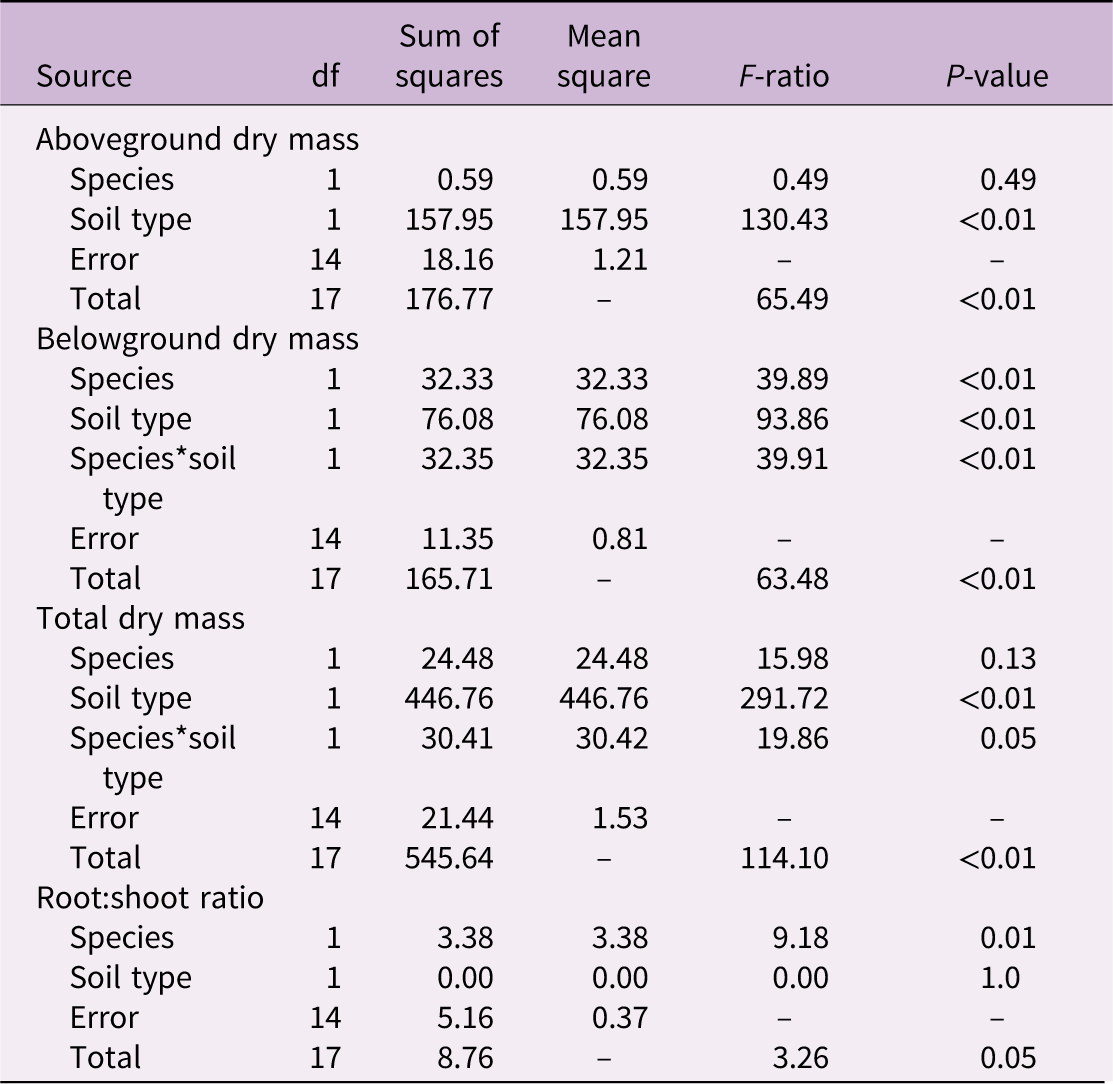
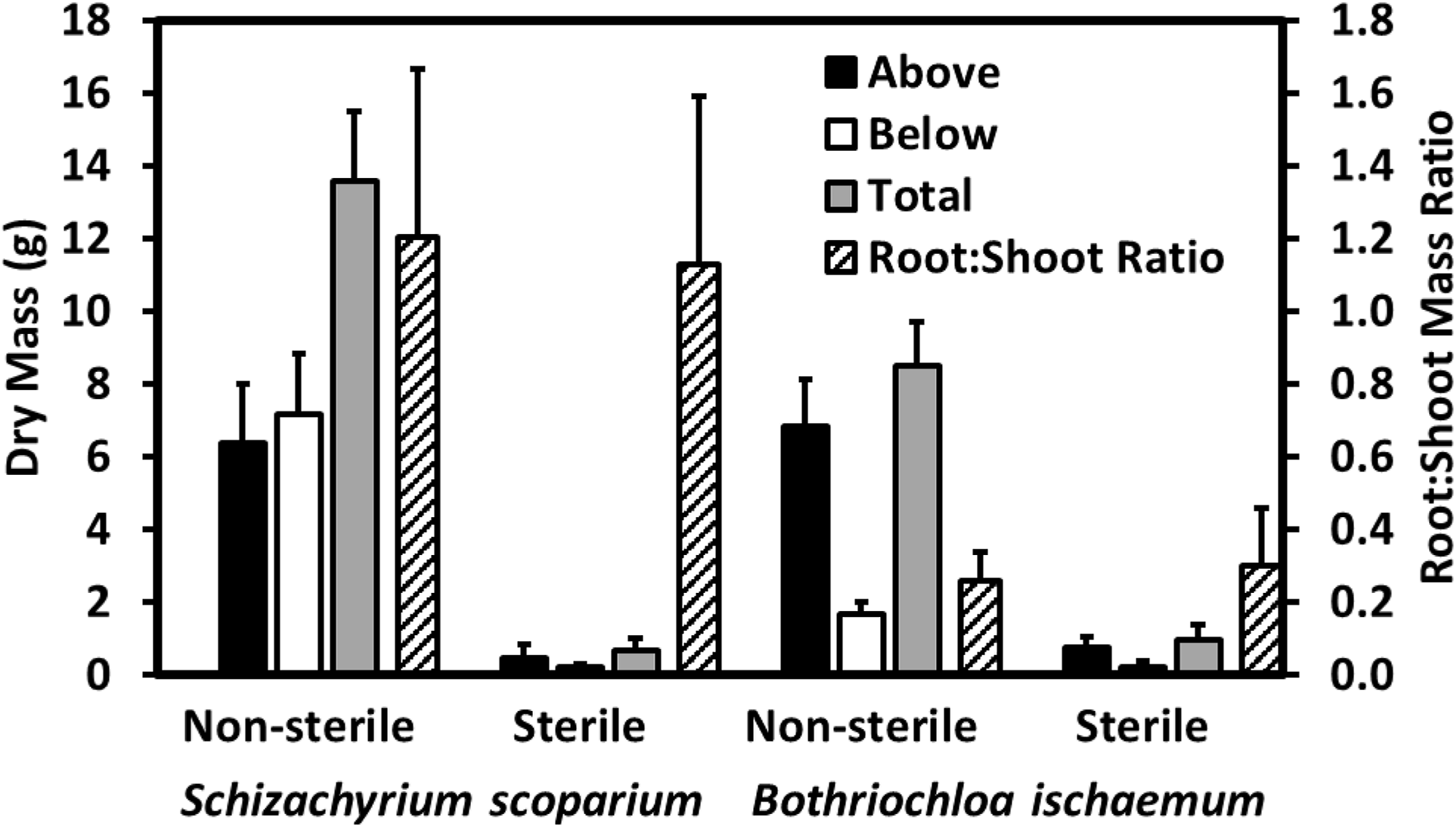
Both species showed significant reductions in aboveground biomass when grown in sterilized soil, indicating a reliance on soil microbial communities (Table 2; Figure 2). Although aboveground biomass was not significantly different between species across the soil treatments (Figure 2), the responses of belowground and total biomass to soil treatment varied depending on the species evaluated, as shown by the significant interaction terms in Table 2. In non-sterile soil, S. scoparium (7.89 g) produced four times more root biomass than B. ischaemum (1.85 g), suggesting greater microbiome benefit or reliance for S. scoparium root growth. In sterile soil, this advantage disappeared and B. ischaemum (0.98 g) only slightly outperformed S. scoparium (0.70 g) in terms of total biomass (Figure 2). Root-to-shoot mass ratios were significantly higher for S. scoparium (non-sterile = 1.24, sterile = 0.50) under both treatments when compared with B. ischaemum (non-sterile = 0.27, sterile = 0.32), reinforcing S. scoparium’s greater allocation of resources belowground.
Degrees of freedom, sum of squares, mean square, F-ratio, and P-value of ANOVAs evaluating the effects of species (Schizachyrium scoparium and Bothriochloa ischaemum) and soil type (non-sterile and sterile) on aboveground, belowground, and total dry mass, and root:shoot ratio. a

Table 2. Long description
Table 2 presents the results of analyses of variance evaluating the effects of plant species (Schizachyrium scoparium vs. Bothriochloa ischaemum) and soil type (non‑sterile vs. sterile) on four response variables: aboveground dry mass, belowground dry mass, total dry mass, and root‑to‑shoot ratio. For each response variable, the table reports degrees of freedom, sum of squares, mean square, F‑ratio, and P‑value for main effects and interactions where applicable. For aboveground dry mass, soil type had a strong and significant effect, with biomass substantially reduced in sterile soil. Species identity had no significant effect, and the species‑by‑soil interaction was not significant and therefore excluded from the model. For belowground dry mass, species identity, soil type, and their interaction were all significant, indicating that the two grasses responded differently to soil sterilization belowground. For total dry mass, soil type had a strong significant effect, while species alone was not significant. The interaction between species and soil type was marginally significant, suggesting species‑specific responses to soil sterilization when above‑ and belowground biomass were combined. For root‑to‑shoot ratio, species identity was significant, indicating consistent differences in biomass allocation between the two grasses. Soil type had no significant effect on root‑to‑shoot ratio, and no interaction term was included. Overall, the table shows that soil microbial presence strongly influences biomass production for both species, with particularly pronounced effects on belowground and total biomass, while species differences are most evident in belowground allocation patterns and root‑to‑shoot ratios.
a The interaction was not significant for aboveground dry mass and root:shoot ratio and was removed from the model.
Mean aboveground, belowground, and total dry mass and root:shoot ratios of Schizachyrium scoparium and Bothriochloa ischaemum grown in non-sterile and sterile soil. Error bars represent 1 SE. We show the results of the ANOVA in Table 2.

Figure 2. Long description
Figure 2 displays mean aboveground dry mass, belowground dry mass, total dry mass, and root‑to‑shoot ratios for the native grass Schizachyrium scoparium and the invasive grass Bothriochloa ischaemum grown in non‑sterile (live) and sterile soil under greenhouse conditions. Error bars represent one standard error. Statistical results summarizing species, soil, and interaction effects are provided in Table 2. Across all biomass components, both species produced substantially less aboveground, belowground, and total biomass when grown in sterile soil compared with non‑sterile soil, indicating a strong dependence on soil microbial communities for growth. Differences between soil treatments were especially pronounced for total biomass. Species differed most strongly in belowground allocation: S. scoparium consistently produced greater root biomass and higher root‑to‑shoot ratios than B. ischaemum, particularly in non‑sterile soil. In contrast, B. ischaemum exhibited lower root‑to‑shoot ratios and smaller reductions in belowground biomass between soil treatments, indicating differences in biomass allocation and microbial dependence between the species.
The importance of the soil microbiome for plant growth is consistent with other studies that demonstrate the positive effects of microbial diversity on plant productivity (Soudzilovskaia et al. Reference Soudzilovskaia, van Bodegom, Terrer, Mvt, McCallum, Luke McCormack, Fisher, Brundrett, de Sá and Tedersoo2019; Tedersoo et al. Reference Tedersoo, Bahram and Zobel2020; van der Heijden et al. Reference van der Heijden, Bardgett and Van Straalen2008). Numerous studies have documented that S. scoparium and Bothriochloa species are strongly mycorrhiza-dependent (Hartnett and Wilson Reference Hartnett and Wilson1999; Wilson et al. Reference Wilson, Hickman and Williamson2012). In short-term greenhouse systems such as ours, where nutrient pools are small and spatially confined, the loss of arbuscular mycorrhizal fungi (AMF) symbiosis typically has a stronger negative effect on plant growth than slower nutrient-cycling processes (van der Heijden et al. Reference van der Heijden, Bardgett and Van Straalen2008).
Both species exhibited reduced growth in sterilized soil, consistent with dependence on soil microbial communities—particularly AMF, which facilitate nutrient uptake in low-fertility conditions (Hartnett and Wilson Reference Hartnett and Wilson1999; van der Heijden et al. Reference van der Heijden, Bardgett and Van Straalen2008; Wilson et al. Reference Wilson, Hickman and Williamson2012). Schizachyrium scoparium produced substantially greater root biomass than B. ischaemum in live soil, indicating stronger reliance on AMF, whereas this advantage disappeared after sterilization. This pattern contrasts with earlier findings where S. scoparium sometimes performed better in sterilized or nutrient-rich soils (Cerligione et al. Reference Cerligione, Liberta and Anderson1988; Meredith and Anderson Reference Meredith and Anderson1992), likely reflecting differences in nutrient status and soil origin. Under the low-nutrient conditions of this study, mutualistic microbes appear to outweigh pathogenic effects, emphasizing that nutrient context mediates the role of the microbiome in shaping competitive outcomes. These findings suggest that microbiome-mediated nutrient dynamics may influence competitive interactions between S. scoparium and B. ischaemum.
Experiment 3: Interspecific Competition
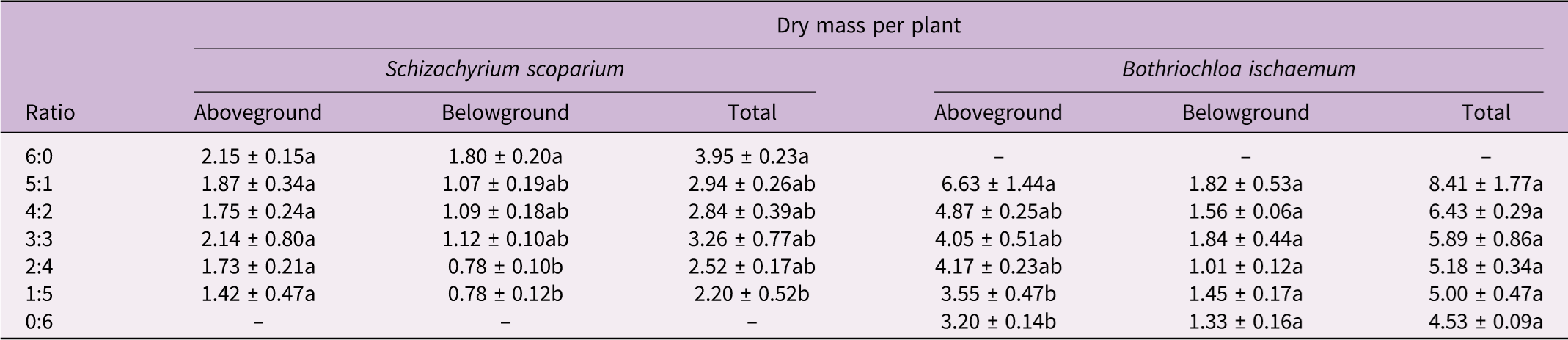
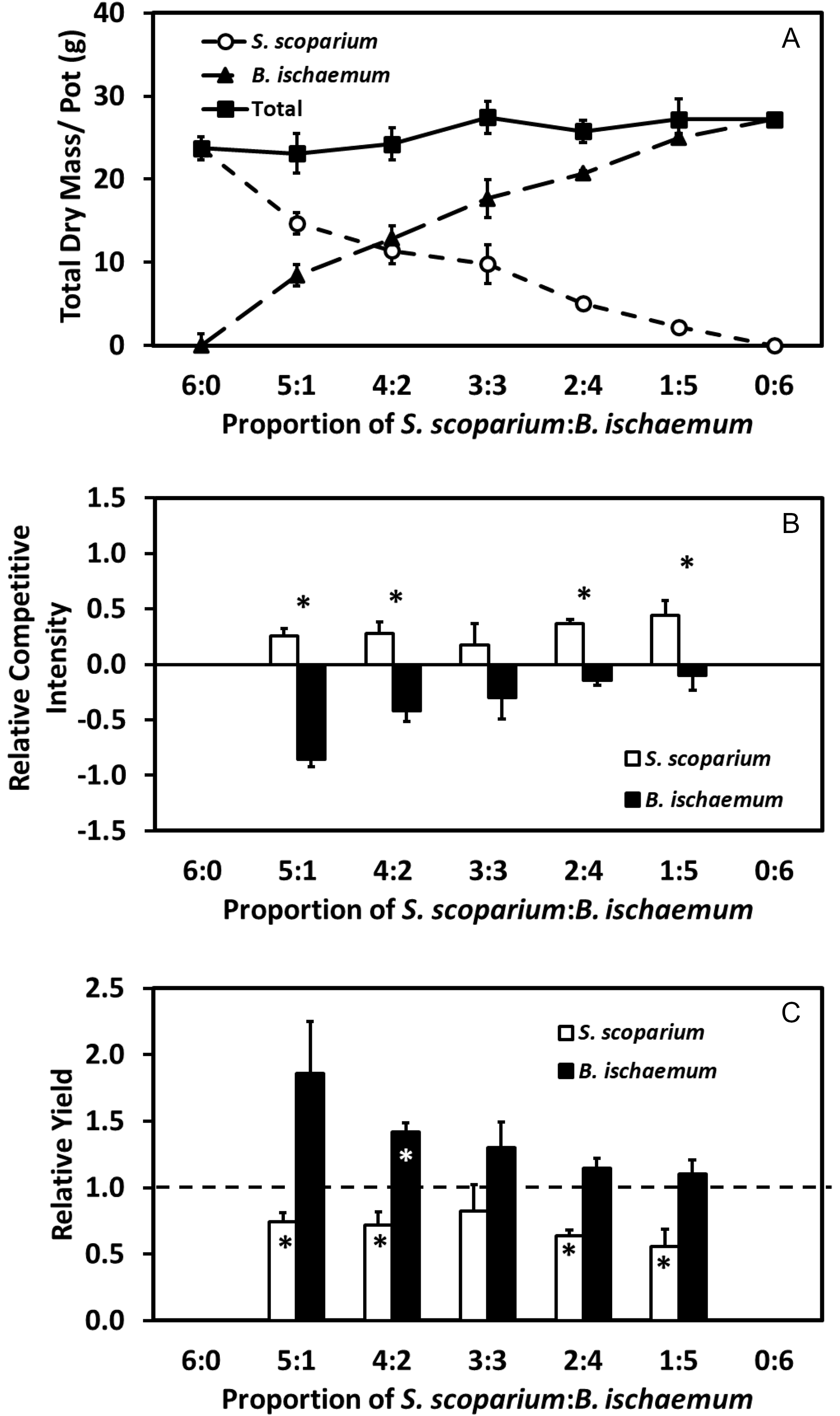
In mixed-species pots, we found no significant differences in the aboveground dry mass per plant of S. scoparium across the various proportions of the two species and only slight differences in belowground and total dry mass per plant (Table 3). For B. ischaemum, we found only slight differences in aboveground dry mass per plant and no significant differences in belowground and total dry mass per plant (Table 3). At equal proportions (3:3), B. ischaemum accounted for 64% of the total pot biomass (Figure 3A), and at a 2:4 ratio (S. scoparium:B. ischaemum), both species produced equivalent total biomass, supporting B. ischaemum’s ability to outcompete S. scoparium at lower B. ischaemum density when compared with S. scoparium density.
Comparison of mean aboveground, belowground, and total dry mass per plant (± SE) for Schizachyrium scoparium and Bothriochloa ischaemum grown at various ratios of the two species in a replacement experiment. a

Table 3. Long description
Table 3 reports mean aboveground, belowground, and total dry mass per plant (± standard error) for the native grass Schizachyrium scoparium and the invasive grass Bothriochloa ischaemum grown together at varying species ratios in a replacement‑series experiment. Species proportions range from monocultures of each species to equal mixtures, with a constant total plant density. Statistical groupings indicate significant differences among treatments within each column. For Schizachyrium scoparium, aboveground biomass per plant shows little variation across species ratios and does not differ significantly among most treatments. In contrast, belowground and total biomass per plant decline as the proportion of B. ischaemum increases, with the lowest total biomass occurring when S. scoparium is rare in the mixture. These patterns indicate increasing competitive suppression of the native species as the invasive grass becomes more dominant. For Bothriochloa ischaemum, aboveground, belowground, and total biomass per plant remain relatively high across most mixtures and decline only slightly as its proportional abundance decreases. Even when present at low density, B. ischaemum maintains biomass comparable to that in monoculture, indicating weak sensitivity to interspecific competition. Overall, the table demonstrates asymmetric competition between the two species: S. scoparium experiences substantial reductions in biomass when grown with B. ischaemum, whereas B. ischaemum shows little reduction in growth across species mixtures. This pattern supports the conclusion that B. ischaemum is competitively dominant under the conditions of the experiment.
a Means with the same letter within a column are not significantly different (P ≤ 0.05, ANOVA, Tukey’s multiple comparison test).
(A) Total dry mass per pot of Schizachyrium scoparium and Bothriochloa ischaemum, (B) relative competitive intensity (positive values indicate interspecific competition is greater than intraspecific competition, negative values indicate intraspecific competition is greater than interspecific competition), and (C) relative yield across various proportions of the two species grown together in a replacement experiment. Error bars represent 1 SE. For relative competitive intensity, asterisks indicate significant differences between the two species for a given proportion. For relative yield, asterisks indicate significant differences from 1 (shown by the dashed line) when the growth in the mixture would equal growth in monoculture. Values >1 indicate stronger intraspecific competition, while values <1 indicate stronger interspecific competition.

Further support for the competitive dominance of B. ischaemum is shown by the RCI values, which were consistently positive for S. scoparium (indicating suppression) and negative for B. ischaemum, except at equal proportions (Figure 3B). Similarly, S. scoparium experienced significant growth suppression in mixtures relative to monocultures, whereas B. ischaemum growth was largely unaffected by the presence of S. scoparium (Figure 3C).
Schizachyrium scoparium experienced strong competitive suppression when grown with deeper-rooted brownseed paspalum (Paspalum plicatulum Michx.), particularly in deeper soils where belowground resources were more accessible (Van Auken et al. Reference Van Auken, Bush and Diamond1994). In that study, the roots of S. scoparium were concentrated in the upper soil layers, limiting its ability to exploit deep nutrient or water reserves. Schizachyrium scoparium can be a strong competitor in resource-poor environments or when disturbance is low, as it effectively limits the establishment of the woody legume honey mesquite (Prosopis glandulosa Torr.) (Van Auken and Bush Reference Van Auken and Bush1988) and outperforms silver bluestem [Bothriochloa laguroides (DC.) Herter], even under moderate and severe defoliation (Hendon and Briske Reference Hendon and Briske2002). However, its dominance declines when nutrient availability increases or when co-occurring species exhibit greater belowground plasticity, as observed in competition with buffalograss [Buchloe dactyloides (Nutt.) J.T. Columbus] under nutrient enrichment (Bush and Van Auken Reference Bush and Van Auken2010). Collectively, these findings suggest that S. scoparium’s competitive success is tightly coupled to soil resource distribution and nutrient status.
Building on these patterns, our results demonstrate that the invasive B. ischaemum can outcompete S. scoparium under nutrient-limited greenhouse conditions, suggesting that physiological or microbial adaptations acquired outside its native range enhance its competitive capacity. Experimental and field studies reinforce this interpretation: B. ischaemum increases soil enzyme activity and microbial diversity over time (Jia et al. Reference Jia, Cao and Wang2018); dominates nutrient-enriched grasslands but declines under xeric, nutrient-poor conditions (Szentes et al. Reference Szentes, Penksza, Saláta-Falusi, Sipos, Kozma-Bognár, Hoffmann and Wagenhoffer2025); and maintains high water-use efficiency through fine-root proliferation and carbon reallocation during drought (Liu et al. Reference Liu, Li, Xu, Xiao, Ren and Li2017). Together, these results indicate that B. ischaemum’s advantage arises from a combination of microbial facilitation and physiological plasticity that enable it to persist across heterogeneous soil and moisture regimes.
Observations from its native range further clarify this ecological pattern. In northern China and Central Asia, where it co-occurs with other C₄ and C₃ grasses, B. ischaemum primarily functions as a co-dominant species, contributing to ecosystem stability rather than acting as an aggressive invader (Cao et al. Reference Cao, Ai, Dang, Chen, Wang, Li, Deng, Liu, Li and Zhao2025). The contrast between its coexistence in native grasslands and dominance in North American prairies underscores the role of evolutionary history and ecological release. Bothriochloa ischaemum may escape specialized pathogens and face reduced competition from functionally similar natives such as S. scoparium. Its advantage may therefore derive not only from resource-use efficiency and root proliferation but also from its capacity to alter or exploit soil microbiome associations that diminish mutualistic benefits for co-occurring species. Wilson et al. (Reference Wilson, Hickman and Williamson2012) found that invasive B. bladhii reduced arbuscular mycorrhizal colonization and biomass of native grasses. Similarly, S. scoparium’s loss of growth advantage in sterilized soils supports the potential for invasive Bothriochloa species to disrupt soil symbioses that sustain native prairie grasses.
Competitive outcomes among plants are strongly influenced by environmental conditions, soil microorganisms, and disease interactions, which may favor species with physiological and morphological traits that enhance resource acquisition and conservation under limited resources (Funk Reference Funk2013). These patterns are consistent with findings across many systems, where invasive grasses outcompete native species due to their superior resource-use efficiency (Tecco et al. Reference Tecco, Díaz, Cabido and Urcelay2010); however, invasive grass species do not consistently outcompete native species in replacement experiments. Instead, competitive outcomes depend on the specific native and invasive species involved, the environmental conditions (nutrients, soil microorganisms), the temporal factors (phenology, life cycle timing) (see Cleland and Wolkovich Reference Cleland and Wolkovich2024), and the presence of additional stressors or facilitators (see Aschehoug et al. Reference Aschehoug, Brooker, Atwater, Maron and Callaway2016; McPeek Reference McPeek2025). Our research implies that while some invasive grasses can be strong competitors under certain conditions, native species often possess competitive advantages, particularly when their coevolved soil microbial partnerships remain intact and environmental conditions favor their particular ecological strategies.
Root Morphology and Competitive Mechanisms
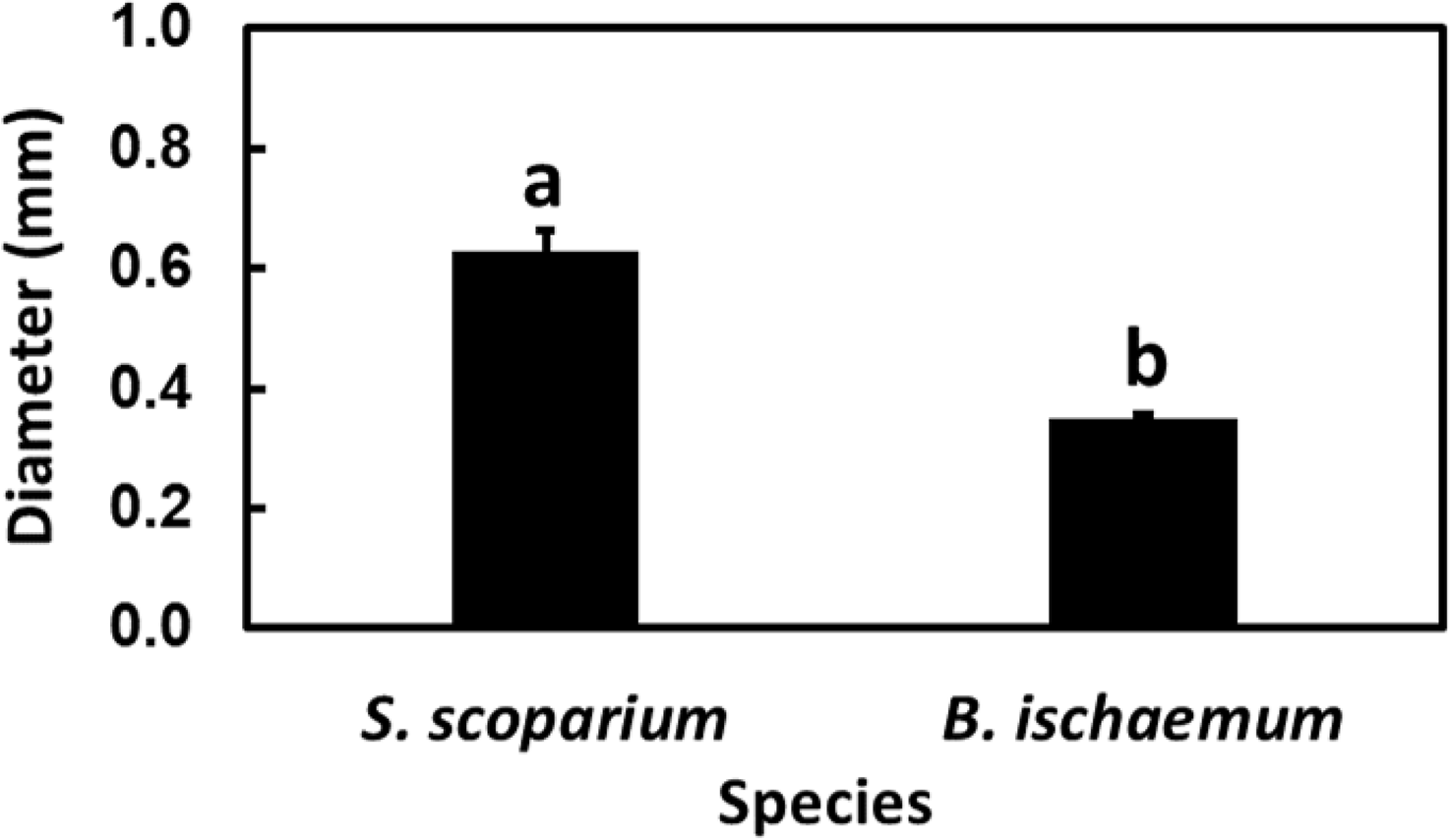
We observed striking differences in root anatomy that may explain competitive asymmetries. Schizachyrium scoparium had significantly larger root diameters, 14.9 times greater than those of B. ischaemum (Figure 4). In contrast, the belowground dry mass-to-root diameter ratio was greater for B. ischaemum (22.9) than S. scoparium (18.5), implying a finer, more expansive root system and potentially greater absorptive surface area. The ability to occupy belowground space depends on several root characteristics, including relative growth rates, biomass, fine root density, and total surface area, which are altered by changes in local soil resource levels (see Casper and Jackson Reference Casper and Jackson1997; Lynch et al. Reference Lynch, Strock, Schneider, Sidhu, Ajmera, Galindo-Castaneda, Klein and Hanlon2022). These changes can then impact competitive outcomes. Although we did not measure total root surface area or depth, B. ischaemum’s finer, more proliferative roots likely enhance nutrient uptake across a broader soil volume, contributing to its competitive superiority under resource limitation.
Mean primary root diameter (mm) for Schizachyrium scoparium and Bothriochloa ischaemum. Error bars represent 1SE. We found that the means were significantly different (Steel-Dwass all pairs nonparametric text, P ≤ 0.05).

Ecological and Management Implications
The ability of B. ischaemum to thrive under low-nutrient conditions highlights the importance of manipulating soil fertility and microbial function in restoration. Although microbial inoculation from native prairies can enhance the establishment of native grasses (Duell et al. Reference Duell, O’Hare and Wilson2023), long-term studies suggest that soil communities may recover naturally once invaders are removed (Leander et al. Reference Leander, Reemts, Nash and Wolf2025). Restoration success will depend on maintaining low-fertility substrates and reintroducing native mycorrhizal communities while employing moderate-density seeding of S. scoparium and other native competitors to offset early suppression by B. ischaemum.
Conversely, early restoration on sterilized or microbially depleted soils could inadvertently favor B. ischaemum, which tolerates weaker mycorrhizal associations. Restoration efforts should prioritize seeding density, soil fertility management, and microbiome compatibility over disturbance-based approaches. High-density sowing of S. scoparium or other native competitors could offset early suppression by B. ischaemum, while maintaining oligotrophic conditions may limit the invader’s advantage.
Traditional controls such as fire (Gabbard and Fowler Reference Gabbard and Fowler2007; Pyke et al. Reference Pyke, Brooks and D’Antonio2010) and herbicides (Harmoney Reference Harmoney2016, Reference Harmoney2022) are nonselective and can harm native species. Adaptive grazing that aligns livestock use with B. ischaemum’s growth stages may offer a more targeted management tool (Casey Reference Casey2014). Overall, restoration approaches that emphasize soil fertility control and microbial compatibility appear to be the most sustainable. Our study did not investigate microbial community shifts following the invasion of B. ischaemum. Such changes could influence microbiome functioning and interspecific interactions over time (Soudzilovskaia et al. Reference Soudzilovskaia, van Bodegom, Terrer, Mvt, McCallum, Luke McCormack, Fisher, Brundrett, de Sá and Tedersoo2019; Tedersoo et al. Reference Tedersoo, Bahram and Zobel2020). The resilience or decline of native grasses, such as S. scoparium, may ultimately depend on both abiotic conditions and biotic interactions such as root morphology (including depth), microbial associations, and disturbance regimes. This study highlights the superior competitive ability of the invasive B. ischaemum over the native S. scoparium under low-nutrient conditions. The observed dominance is not due to differential dependency on soil microbiomes but likely stems from morphological and physiological traits that enhance resource acquisition. Overall, B. ischaemum’s success reflects its tolerance of high density, fine-root foraging efficiency, and reduced dependence on mycorrhizal partners, whereas S. scoparium relies heavily on microbial symbioses that enhance nutrient uptake under low fertility. Integrating soil–microbiome management and nutrient control into restoration frameworks can help shift competitive balances toward native species and strengthen grassland resilience.
Acknowledgments
We want to thank Stuart Foote for his input, Jason Gagliardi for assistance with some of the statistical work, Kimberley Gay for adjusting the figures to the proper resolution, and Steve Quezada for helping with the autoclaving of the soil. AI assistance was used in the preparation of this article. The AI Tool ChatGPT-5 was used from November 1 to 3, 2025, to check for clarity and redundancy. All AI-generated content and insights were critically reviewed, verified against empirical evidence and domain expertise, and revised by the JKB and OWVA, who takes full responsibility for the final content and conclusions.
Funding statement
This research received no specific grant from any funding agency or the commercial or not-for-profit sectors.
Competing interests
The authors declare no conflicts of interest.

 Open access

