





Management Implications
Pastinaca sativa (wild parsnip) is an invasive perennial that has invaded much of the midwestern United States. Research suggests that it can compete with native forbs, reducing cover and survival. While effective management options are known, few approaches are used in widespread invasions in tallgrass prairies due to the lack of safety to native forbs. Florpyrauxifen-benzyl is a potential option that could be broadcast, as it has been suggested to be effective on P. sativa while causing minimal damage to native forbs. To address this, the effectiveness of florpyrauxifen-benzyl applied in spring to P. sativa at the rosette stage was evaluated. Results confirmed that florpyrauxifen-benzyl was effective in controlling P. sativa at low rates (≤3 g ai ha−1) and that one application prevented any seed production for 2 yr. However, florpyrauxifen-benzyl applied at higher rates (14.7 g ha−1) reduced native forb cover 1 yr after treatment. The impact, however, was specific to only three of the eight common species, and lower rates and time reduced this injury. While further research is needed to understand which native forb species are susceptible to this herbicide, reduced rates of application (≤3 g ha−1) show promise for further limiting injury to native forbs while still providing P. sativa control.
Introduction
Tallgrass prairies are an important ecosystem in the United States and provide a myriad of services. Foremost, they are biodiversity hotspots that support rare and endangered plants and animals (Harmon-Threatt and Chin Reference Harmon-Threatt and Chin2016; Swengel et al. Reference Swengel, Schlicht, Olsen and Swengel2011). Additionally, tallgrass prairies are carbon sinks (Jobbagy and Jackson Reference Jobbagy and Jackson2000), reduce soil erosion, and provide a space for cultural practices (Bengtsson et al. Reference Bengtsson, Bullock, Egoh, Everson, Everson, O’Connor, O’Farrell, Smith and Lindborg2019). These services have been reduced on the landscape, as >95% of land area that was historically tallgrass prairie has been converted to other ecosystems (e.g., farmland and urban areas) that do not provide these services (Samson and Knopf Reference Samson and Knopf1994; Samson et al. Reference Samson, Knopf and Ostlie2004). To offset this loss, efforts to conserve remnant prairies and creation of new prairies have been occurring over the past 50 yr (Bach and Kleiman Reference Bach and Kleiman2021; Samson and Knopf Reference Samson and Knopf1994).
Invasive plant species are a major threat to remnant and new tallgrass prairies and the ecosystem services they provide. They reduce biodiversity in prairies (Vitousek et al. Reference Vitousek, D’Antonio, Loope, Rejmánek and Westbrooks1997) by interfering with the establishment and growth of native plants (Pearson et al. Reference Pearson, Ortega, Eren and Hierro2018). Invasive plants can also impact other ecosystem processes, including soil erosion control (Castro-Díez et al. Reference Castro-Díez, Vaz, Silva, van Loo, Álonso, Aponte, Bayón, Bellingham, Chiuffo, La Porta, Marchante, Maule, Mayfield, Matcalfe and Monteverdi2019), nutrient cycling (Vilà et al. Reference Vilà, Espinar, Hejda, Hulme, Jarošík, Maron, Pergl, Schaffner, Sun and Pyšek2011), fire regimes (Brooks et al. Reference Brooks, D’Antonio, Richardson, Grace, Keeley, DiTomaso, Hobbs, Pellant and Pyke2004), and hydrology (Levine et al. Reference Levine, Vilà, D’Antonio, Dukes, Grigulis and Lavorel2003). Their presence is particularly troublesome when attempting to establish/restore native species to this and other ecosystems (Erskine Ogden and Rejmánek Reference Erskine Ogden and Rejmánek2005; Paz-Kagan et al. Reference Paz-Kagan, Silver, Panov and Karnieli2019).
Wild parsnip (Pastinaca sativa L.) is an invasive plant that is problematic to tallgrass prairies of the Midwest. It is a monocarpic perennial, native to Eurasia (Averill and DiTommaso Reference Averill and DiTommaso2007) that is widespread throughout the Midwest with more than 23,000 observations documented in public record (EDDMapS 2025). Many habitats are susceptible to invasion, but grasslands are particularly vulnerable, including tallgrass prairies (Jorgensen and Renz Reference Jorgensen and Renz2021). In these areas, it forms large infestations (Thompson and Price Reference Thompson and Price1977; Zangerl and Berenbaum Reference Zangerl and Berenbaum2005). If P. sativa becomes established, it can compete with native species, reducing their cover (Cain et al. Reference Cain, Darbyshire, Francis, Nurse and Simard2010). Pastinaca sativa also threatens human health, as it can cause phytophotodermatitis when sap comes in contact with skin (Averill and DiTommaso Reference Averill and DiTommaso2007).
Several management options are available to control P. sativa. For example, properly timed mowing and hand-pulling/cutting crowns below the soil surface are effective (Lorenzi and Jeffrey Reference Lorenzi and Jeffey1987; Panke and Renz Reference Panke and Renz2012). The high amount of labor required for hand removal/cutting limits the use of this management tool in widespread infestations in tallgrass prairies. While mowing is also effective, it must be repeated for 3 to 5 yr to reduce the populations (Panke and Renz Reference Panke and Renz2012). This frequency of mowing can also impact many desirable forbs in tallgrass prairies. Several herbicides are efficacious on P. sativa and can provide multiple years of control with one application. For example, triclopyr, picloram, 2,4-D, dicamba, and glyphosate broadcast in the spring can control second-year rosettes and seedlings that will flower in subsequent years (Cain et al. Reference Cain, Darbyshire, Francis, Nurse and Simard2010; Panke and Renz Reference Panke and Renz2012). While these herbicides are effective on P. sativa, and all but glyphosate will not harm established native grasses, they injure and often eliminate native forbs that are growing nearby (e.g., Lym et al. Reference Lym, Becker, Moechnig, Halstvedt and Peterson2017). Therefore, herbicides need to be applied to individual plants to minimize injury to desirable forbs. While this may be feasible for small, scattered populations it is not a viable option for prairies that have widespread, dense P. sativa invasions. Interest exists in finding herbicides that have limited injury to native forbs while providing control of P. sativa. If found, broadcast applications in tallgrass prairies could be utilized to minimize the impact of P. sativa.
Florpyrauxifen-benzyl is a selective herbicide that may fit this application. This synthetic auxin (WSSA Group 4) is currently used as a broad-spectrum broadleaf herbicide in rice (Oryza sativa L.) and aquatic habitats; initial reports suggest it is very selective at low rates (Velásquez et al. Reference Velásquez, Bundt, Camargo, Andres, Viana, Hoyos and De Avila2021). Florpyrauxifen-benzyl was recently registered for use in terrestrial areas (SiteVue™ VM) and is reported to be effective on plants in the Apiaceae (carrot family) at low rates (USEPA 2017). Others have shown variable tolerance of broadleaf plants at low rates (Greene et al. Reference Greene, Hagood, Tracy, Abaye and Flessner2022), which suggests it may be well suited for tallgrass prairies. While recent research has found seedlings of native forbs to be sensitive to florpyrauxifen-benzyl (Woody-Pumford et al. Reference Woody-Pumford, Bertucci, Richardson, Philipp and Wright-Smith2025), no research has evaluated tolerance of established native forbs in field studies. To address this information gap, experiments were conducted at multiple locations with the objectives of evaluating the efficacy of florpyrauxifen-benzyl in controlling P. sativa and determining the tolerance of native forbs in infested tallgrass prairies.
Materials and Methods
Experiment 1: Efficacy of Florpyrauxifen-Benzyl on Pastinaca sativa and Tolerance of Native Forbs
An initial study was conducted to determine whether florpyrauxifen-benzyl is effective in controlling P. sativa and whether native forbs display tolerance to effective rates. The experiment was established in 2022 in a 5-yr-old planted prairie near New Richmond, WI (45.16°N, 92.49°W). The soil type was a Sattre (fine‑loamy over sandy or sandy‑skeletal, mixed, superactive, mesic Mollic Hapludalfs) (10% clay, 57% silt, 3% organic matter, 5.9 pH) and common plants present were smooth brome (Bromus inermis Leyss.), Kentucky bluegrass (Poa pratensis L.), and native forbs including wild bergamot (Monarda fistulosa L.), golden alexanders [Zizia aurea (L.) W.D.J. Koch], and yellow coneflower [Ratibida pinnata (Vent.) Barnhart]. Pastinaca sativa had average spring density of 1.3 plants m−2 when the experiment was initiated.
The experiment was established in a randomized complete block design with three replications, and plots were 3.0 by 7.6 m (10 by 25 ft). Florpyrauxifen-benzyl (SiteVue™ VM, 25.2 g L−1, Corteva (Indianapolis, IN, USA)) was applied at 0, 3.7, 7.4, 11.0, and 14.7 g ai ha−1 on May 27. A CO2-pressurized 3-m (10-ft) boom sprayer, delivering 187 L ha−1 (20 GPA) through 8 TeeJet® XR 11002VS nozzles spaced 381 mm (15 in.) apart (Glendale Hights, IL, USA), was used. A methylated seed oil was added at 1% v/v to all treatments.
Pastinaca sativa density and cover were measured to determine the effectiveness of treatments. Density was determined 2 mo after application (July 2022) by counting all plants within each plot and categorizing individuals as non-flowering or flowering P. sativa. Cover was also visually estimated at this timing and separated into P. sativa, native broadleaf, non-native broadleaf, native grasses, non-native grasses, woody plants, and debris. Density of flowering P. sativa was also evaluated 1 yr after treatment (1 YAT) to evaluate the treatment efficacy in preventing flowering over a 2-yr timeframe. While parameters are structured, this initial experiment’s objective was to determine whether this herbicide was effective and inform future dose–response curve fitting (Experiment 2). Therefore, a two-way ANOVA was performed using a linear model on functional groups cover and on P. sativa cover and density at each timing with significance level of α = 0.05, and means were separated by LSD when the F-test was significant. This analysis was performed using R statistical software utilizing the aov function (v. 4.3.1; R Core Team 2025).
Experiment 2: Florpyrauxifen-Benzyl Rate Response
Experiments were conducted in 2023 and repeated in 2024 for a total of 2 site-years to determine what rate reduces P. sativa density 95% along an infested roadside near Prairie Du Sac, WI (PDS) (43.34°N, 89.75°W). The soil type was a Richwood (fine‑silty, mixed, superactive, mesic Typic Hapludalfs) (21% clay, 71% silt, 3% organic matter, 6.4 pH) and common plants were B. inermis, P. pratensis, spotted knapweed (Centaurea stoebe L.), and sweetclover [Melilotus officinalis (L.) Lam.]. Pastinaca sativa was common in both years with average spring densities of 3.9 and 1.5 m−2 in 2023 and 2024, respectively.
Florpyrauxifen-benzyl was applied at a range of rates in a randomized complete block design, with four replications with plot size of 3.0 by 7.6 m (10 by 25 ft). Treatments were applied on May 3 in both 2023 and 2024 in a separate location using application equipment and parameters identical to those of Experiment 1. Pastinaca sativa was in the rosette stage and seedling stage at this time of application, with plants ranging from 2- to 20-cm tall. Nine rates of florpyrauxifen-benzyl between 3.7 and 29.4 g ha−1 were used in 2023 in addition to a nontreated control. Results from the 2023 study informed 2024 rates of florpyrauxifen-benzyl, which included 0.0, 0.9, 1.8, 2.8, 3.7, 7.4, 14.7, 22.1, and 29.4 g ha−1 (Table 1). A methylated seed oil was added at 1% v/v to all treatments.
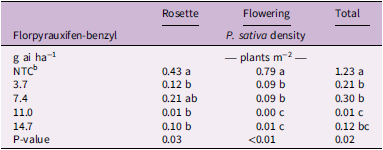
Density of flowering and non-flowering Pastinaca sativa 2 mo after broadcast of florpyrauxifen-benzyl to seedlings and rosettes in spring (May 27, 2022) at New Richmond, WI a

Table 1. Long description
A table comparing the density of flowering and non-flowering Pastinaca sativa under different treatments of florpyrauxifen-benzyl. The table has 7 rows and 4 columns. Column headers are Rosette, Flowering, and Total, with units in plants per square meter. Row labels include NTC, 3.7, 7.4, 11.0, 14.7, and P-value. Row 1: NTC, 0.43, 0.79, 1.23. Row 2: 3.7, 0.12, 0.09, 0.21. Row 3: 7.4, 0.21, 0.09, 0.30. Row 4: 11.0, 0.01, 0.00, 0.01. Row 5: 14.7, 0.10, 0.01, 0.12. Row 6: P-value, 0.03, less than 0.01, 0.02.
a Means followed by the same letter within a column are not different based on Fisher’s LSD (α = 0.05).
b NTC, nontreated control.
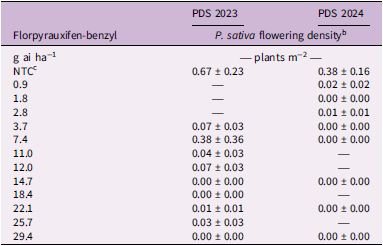
Similar to Experiment 1, P. sativa density was counted at 2 mo and 1 YAT, and the effective rate that removed 95% of P. sativa plants was determined. Dose–response curves were fit to the total and flowering P. sativa density data 2 MAT from both years using a Mikela Mentis model with two parameters in the drc package (Ritz et al. Reference Ritz, Baty, Streibig and Gerhard2015) in the open-source statistical software R v. 4.4.2 (R Core Team 2025). Models evaluated rate of florpyrauxifen-benzyl (g ha−1) against percent of total and flowering P. sativa plants compared with the nontreated control. Given the substantial P. sativa removal observed, the effective dose at 95% (ED95) was calculated instead of the standard ED90, as it better captured the treatment response under these conditions. A similar method was attempted for percent of total and flowering wild P. sativa plants 1 YAT, but due to the high level of efficacy of all treatments (60% of experimental units had a value of zero, except the nontreated control), it was not possible to fit a curve or conduct an ANOVA; thus, means and standard errors are presented (Table 2).
Density of flowering Pastinaca sativa 1 yr after broadcast florpyrauxifen-benzyl in spring (May 3, 2023 and May 3, 2024) at two locations in Prairie du Sac, WI (PDS) a

Table 2. Long description
A table comparing the density of flowering Pastinaca sativa plants after treatment with florpyrauxifen-benzyl in 2023 and 2024. The table has 12 rows and 3 columns. The columns are labeled ‘Florpyrauxifen-benzyl’, ‘PDS 2023’, and ‘PDS 2024’. The rows are labeled with different application rates of florpyrauxifen-benzyl in grams per hectare (g ai ha⁻¹). The ‘PDS 2023’ and ‘PDS 2024’ columns show the density of flowering P. sativa plants in plants per square meter (plants m⁻²) with standard errors. Row 1: NTC, 0.67 ± 0.23, 0.38 ± 0.16. Row 2: 0.9, —, 0.02 ± 0.02. Row 3: 1.8, —, 0.00 ± 0.00. Row 4: 2.8, —, 0.01 ± 0.01. Row 5: 3.7, 0.07 ± 0.03, 0.00 ± 0.00. Row 6: 7.4, 0.38 ± 0.36, 0.00 ± 0.00. Row 7: 11.0, 0.04 ± 0.03,—. Row 8: 12.0, 0.07 ± 0.03,—. Row 9: 14.7, 0.00 ± 0.00, 0.00 ± 0.00. Row 10: 18.4, 0.00 ± 0.00, 0.00 ± 0.00. Row 11: 22.1, 0.01 ± 0.01, 0.00 ± 0.00. Row 12: 25.7, 0.03 ± 0.03,—. Row 13: 29.4, 0.00 ± 0.00, 0.00 ± 0.00.
a As 60% of plots did not contain Pastinaca sativa 1 yr after treatment, means and SEs are presented.
b A dash (—) indicates rate was not tested.
c NTC, nontreated control.
Experiment 3: Tallgrass Prairie Florpyrauxifen-Benzyl Application
The experiment was conducted from June 2023 through July 2025 (Erikson), in a 15-yr-old established tallgrass prairie near New Richmond, WI (45.09°N, 92.29°W). The predominant soil type at this location is Santiago (fine‑loamy, mixed, superactive, thermic Typic Haploxeralfs) and has the same characteristics as the New Richmond site (see Experiment 1). Erikson prairie contained 27 different native forb species that averaged 64% in cover and 6 native grass species that averaged 9% in cover. The most common native forb species (>5% cover) were asters (Aster spp.), cleavers (Galium aparine L.), M. fistulosa, R. pinnata, black-eyed Susan (Rudbeckia hirta L.), cup plant (Silphium perfoliatum L.), Canada goldenrod (Solidago altissima L.), and Z. aurea. The most common native grasses (>5% cover) were big bluestem (Andropogon gerardii Vitman) and Indian grass [Sorghastrum nutans (L.) Nash]. The most common non-native grasses were B. inermis and P. pratensis. While non-native forbs were uncommon, P. sativa was widespread, with cover estimated at 17% when the experiment was initiated.
Rates were selected based on results from Experiment 1 (2022), as results from Experiment 2 were not available at the time of initiation. Florpyrauxifen-benzyl at 14.7 g ha−1 was evaluated for P. sativa control. This rate was selected because it was the lowest rate evaluated that provided consistent control with low variability. A lower rate of florpyrauxifen-benzyl (11.0 g ha−1) combined with imazapic (35.0 g ae ha−1) was included, as imazapic is often recommended for weed control in areas that contain native forbs (Anonymous 2023), and florpyrauxifen-benzyl was recommended only in combination with other products for terrestrial weed control at the time of this experiment (J Crose, Corteva, personal communication). The treatments were arranged in a randomized complete block design, with four replications. A nontreated control was included for treatment comparison. The plot size was 15.2 by 3 m (50 by 10 ft). Treatments were applied on June 19 using a boomless nozzle (Boom Buster®, Millen, GA, USA) mounted to an ATV sprayer (Gator Pros, Horicon, WI, USA) at 253 L ha−1 (27 GPA). A methylated seed oil at 1% v/v was added to the treatments. Treatments were delayed 1 mo compared with the previous experiments, as a severe drought (57% lower precipitation than normal) was occurring at the location. Applications were delayed until precipitation occurred (June 11, 23 mm) to minimize this impact on treatment efficacy.
Pastinaca sativa density was evaluated 1 and 13 mo after treatment (MAT), and plant cover were measured 12 and 15 MAT to determine the effectiveness of treatments and impact on plants present. While the methods used to determine density were similar to those of Experiment 1, percent cover was estimated using the point intercept method, whereby each individual plant intercepting a point is recorded (Elzinga et al. Reference Elzinga, Salzer and Willoughby1998). To accomplish this, 90 points were established at 0.3-m intervals along a 15.2-m transect in each plot. Results are presented for common species that were in high abundance (>10%). Functional groups native forbs, non-native forbs, native woody, non-native woody, native grasses, and non-native grasses were also calculated from these data and analyzed. The quality of native plant habitat was also assessed utilizing a floristic quality index called the coefficient of conservatism (CoC). This approach determines a coefficient for each plant species between 0 and 10, with highly conserved species receiving high values and common/weedy species receiving low values. Non-native species by default received zero. The mean weighted C-values of the prairie were calculated by multiplying the cover of each species by the C-value, summing all of these values, and then dividing this value by the total cover of all plant species (Rooney and Rogers Reference Rooney and Rogers2002). A mean weighted C-value was determined for each plot with cover data collected 1 YAT. Species C-values were taken from the Online Virtual Flora of Wisconsin website (Wisflora 2025).
A two-way ANOVA was performed on functional groups cover, P. sativa cover, C-value and density at each timing with significance level of α = 0.05, and means were separated by LSD when the F-test was significant. This analysis was performed using R statistical software utilizing the aov function (v. 4.3.1; R Core Team 2025).
Results and Discussion
Experiment 1: Efficacy of Florpyrauxifen-Benzyl on Pastinaca sativa and Tolerance of Native Forbs
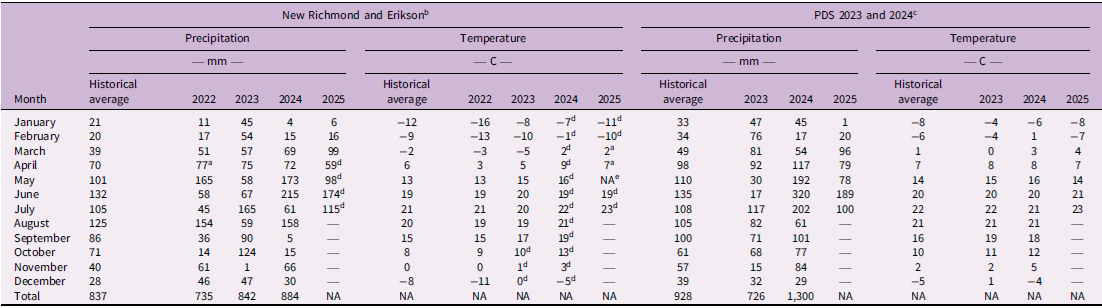
While temperatures during both years were similar to the 20-yr average during the growing season, precipitation was atypical throughout the experiment (2022 to 2023). Total precipitation in 2022 began above normal with 65% more rainfall in May but drought conditions developed throughout the rest of the growing season, resulting in 39% less precipitation between June and October compared with the 20-yr average. Drought conditions continued in May and June of 2023 as 54% of typical precipitation was observed, but this was alleviated with rainfall in July (+57%), when the experiment was concluded (Table 3).
Monthly average temperature and total precipitation and 20-yr historical averages at New Richmond (2022–2025) and Prairie Du Sac (PDS) (2023–2025), WI. a

Table 3. Long description
A table comparing monthly average temperature and total precipitation at New Richmond and Prairie Du Sac, WI. The table has 15 rows and 14 columns. The columns are divided into two main sections: New Richmond and Erikson, and PDS 2023 and 2024. Each section has sub-columns for Precipitation (mm) and Temperature (C) for different years and historical averages. Row labels include months from January to December and a Total row. Key data points include historical averages, specific yearly data from 2022 to 2025, and notable variations in precipitation and temperature. The table provides a detailed comparison of climate data over multiple years
a Source: NOAA-NWS (2025).
b Data taken from a nearby weather station in Baldwin, WI. New Richmond and Erickson experiments were within 1 km of each other.
c PDS 2023 and 2024 data was taken from a weather station 11 kilometers away.
d Data was not available at the closest station therefore was collected from station 37 kilometers away.
e No air temperature data was available from any of the nearby weather stations for this month.
Despite the abnormal precipitation patterns observed across locations, P. sativa was reduced by all treatments in this initial experiment at 2 MAT. Total P. sativa density was reduced by 75% with 3.7 and 7.4 g ha−1 of florpyrauxifen-benzyl, while 11 and 14.7 g ha−1 resulted in >90% reduction (P = 0.02; Table 1). Reductions in flowering P. sativa plants followed the similar pattern as total density, with 11 and 14.7 g ha−1 nearly eliminating all flowering plants. Despite differences in effectiveness of florpyrauxifen-benzyl on P. sativa density, all treatments reduced P. sativa cover to ≤1% at 2 MAT (Table 4).
Relative cover of Pastinaca sativa and functional groups 2 mo and 1 yr after broadcast florpyrauxifen-benzyl in spring (May 27, 2022) at New Richmond, WI a

Table 4. Long description
A table comparing the cover of different plant groups after treatment with florpyrauxifen-benzyl. The table has 7 rows and 11 columns. The columns are labeled as Treatment, P. sativa 2 MAT, P. sativa 1 YAT, Native forbs 2 MAT, Native forbs 1 YAT, Non-native forbs 2 MAT, Non-native forbs 1 YAT, Native grasses 2 MAT, Native grasses 1 YAT, Non-native grasses 2 MAT, Non-native grasses 1 YAT, and Debris. The rows are labeled as g ai ha^-1, NTC, 3.7, 7.4, 11.0, 14.7, and P-value. Row 1: g ai ha^-1, NTC, 3.7, 7.4, 11.0, 14.7, P-value. Row 2: P. sativa 2 MAT, 4, 1, 1, 0, 0, <0.01. Row 3: P. sativa 1 YAT, a, b, b, c, bc, -. Row 4: Native forbs 2 MAT, 8, 3, 2, 2, 1, 0.15. Row 5: Native forbs 1 YAT, 30, 20, 10, 15, 13, 0.07. Row 6: Non-native forbs 2 MAT, 38, 17, 18, 18, 12, 0.26. Row 7: Non-native forbs 1 YAT, 17, 12, 12, 12, 12, 0.80. Row 8: Native grasses 2 MAT, 18, 3, 2, 7, 2, 0.10. Row 9: Native grasses 1 YAT, 1, 5, 4, 14, 4, 0.68. Row 10: Non-native grasses 2 MAT, 5, 22, 21, 19, 20, 1.00. Row 11: Non-native grasses 1 YAT, 20, 55, 61, 48, 65, 0.10. Row 12: Debris, 29, 54, 63, 53, 65, 0.02. Row 13: Debris, b, a, a, a, a, 0.62.
a Cover was visually estimated for each functional group and P. sativa; therefore total cover for any plot equaled 100%. Means followed by the same letter within a column are not different based on Fisher’s LSD (α = 0.05). MAT, month after treatment; NTC, nontreated control; YAT, year after treatment.
b P. sativa cover was accidentally not taken 1 YAT.
Responses of functional group cover to treatments were minimal. Cover of native forbs was not affected by florpyrauxifen-benzyl application 2 MAT and 1 YAT (P > 0.05; Table 4). Varying efficacy was expected on forbs based on results from aquatic herbicides trials. Howell et al. (Reference Howell, Hofstra, Heilman and Richardson2022b) found that watermilfoil (Myriophyllum triphyllum Orchard) was highly sensitive, while species like oxygen-weed [Lagarosiphon major (Ridley) Moss] and Canadian waterweed (Elodea canadensis Michx.) were less sensitive. They also found that Brazilian waterweed (Egeria densa Planch.) was very tolerant to florpyrauxifen-benzyl. While others have evaluated native forb response to florpyrauxifen-benzyl and found high levels of injury on all forbs evaluated (species included ashy sunflower (Helianthus mollis Lam.), R. hirta, butterfly milkweed (Asclepias tuberosa L.), false indigo bush (Amorpha fruticosa L.), Illinois bundleflower [Desmanthus illinoensis (Michx.) MacMill. ex B.L. Rob. and Fernald], upright praririe coneflower [Ratibida columnifera (Nutt.) Wooton and Standl.], and purple coneflower [Echinacea purpurea (L.) Moench]), the experiment was conducted on seedlings in a greenhouse and not perennials in a field setting (Woody-Pumford et al. Reference Woody-Pumford, Bertucci, Richardson, Philipp and Wright-Smith2025). Selectivity to herbicides is known to be heavily influenced by the age and stage of development; thus it is likely that more established species are more tolerant (Abu-Nassar and Matzrafi Reference Abu-Nassar and Matzrafi2021; Sosnoskie Reference Sosnoskie2017). Native and non-native grass cover was also not impacted by florpyrauxifen-benzyl at 2 or 12 MAT. While florpyrauxifen-benzyl has activity on both grasses and broadleaf weeds in rice at 30 g ai ha−1 (Beesinger et al. Reference Beesinger, Norsworthy, Butts and Roberts2022; Miller and Norsworthy Reference Miller and Norsworthy2018), no injury to grasses was observed in this experiment. The reduced rates applied in our experiments in combination with the perennial nature of grasses compared with annual grasses likely both contribute to this difference. Others have shown limited injury to perennial grasses from florpyrauxifen-benzyl when combined with 2,4-D (Greene et al. Reference Greene, Hagood, Tracy, Abaye and Flessner2022; Teló et al. Reference Teló, Webster, Blouin, McKnight and Rustom2019). Results from this experiment suggest florpyrauxifen-benzyl is active on P. sativa with potentially limited injury to native forbs and no injury to perennial grasses at the rates evaluated. Further experiments are needed to identify the appropriate rate to control P. sativa and the impact of effective rates on native prairie forbs.
Experiment 2: Florpyrauxifen-Benzyl Rate Response
While temperatures at PDS were similar to the 20-yr average during the growing season, precipitation was atypical across all 3 yr of the experiments (2023 to 2025). In 2023, a drought resulted in 81% less precipitation between May and June, but this location received 40% more precipitation the following spring to summer (May to July 2024) and in 2025 compared with 20-yr averages (Table 3).
Pastinaca sativa was effectively controlled at 2 MAT by florpyrauxifen-benzyl when broadcast in the spring at nearly all rates evaluated. The model selected produced a good fit (residual standard error = 0.77) with both parameters found significant (P < 0.01). At 2 MAT (July), 1.7 g ha−1 (SE = 0.44) controlled 95% of P. sativa plants (ED95) compared with the nontreated controls (Figure 1). Thus florpyrauxifen-benzyl appears to be as effective as other herbicides at controlling P. sativa (e.g., 2,4-D, aminocyclopyrachlor, dicamba, glyphosate, and metsulfuron; Panke and Renz Reference Panke and Renz2012) but at substantially lower rates. As P. sativa is a monocarpic perennial, it is dependent on seed production for its populations to persist. It was hypothesized that reduced rates of florpyrauxifen-benzyl may not control all plants but would prevent flowering, which would eliminate seed production. Contrary to this hypothesis, the effectiveness on flowering P. sativa at 2 MAT was similar (ED95 = 2.5 g ha−1) (SE = 0.52) to all P. sativa plants (Figure 1). As P. sativa plants do not flower until at least 1 yr after germination (Baskin and Baskin Reference Baskin and Baskin1979), it was also of interest to determine whether broadcast applications applied in spring after seedling emergence can prevent seed production the year after treatment when these seedlings typically flower. While results could not be analyzed due to the high proportion of zero values (60%), flower production the following year was nearly eliminated by all rates (Table 2). As P. sativa seeds have been estimated to persist in the soil bank for at least 2 yr (Hendrix and Trapp Reference Hendrix and Trapp1992), additional control would not be needed until the third year with florpyrauxifen-benzyl broadcast treatments and potentially could eliminate populations with that application if no additional seed was introduced to the site.
Percent reduction of nontreated control (NTC) total (A) and flowering (B) Pastinaca sativa 2 mo after broadcast florpyrauxifen-benzyl in spring (May 3, 2023 and May 3, 2024) at rates between 0 and 29.4 g ha−1 at Erikson prairie in western Wisconsin. Herbicide treatments were applied in May 2023 (red circle) or 2024 (blue triangle) when seedlings and rosettes were present. Astrix represents ED95, where 95% of total (1.7 g ha−1) and flowering (2.5 g ha−1) P. sativa was eliminated.

These results highlight the sensitivity of P. sativa to florpyrauxifen-benzyl compared with other weeds/invasive plants. Effective control of aquatic species ranged between 30 and 80 g ai ha−1 (Chadha et al. Reference Chadha, Florentine, Dhileepan, Turville and Dowling2022; Howell et al. Reference Howell, Hofstra, Heilman and Richardson2022a; Inci et al. Reference Inci, Leinfelder-Miles and Al-Khatib2024). In rice, florpyrauxifen-benzyl has been found to suppress annual grass and broadleaf weeds at 30 g ai ha−1 (Beesinger et al. Reference Beesinger, Norsworthy, Butts and Roberts2022; Miller and Norsworthy Reference Miller and Norsworthy2018). Lower rates (9 g ai ha−1) have been found to be effective at controlling annual broadleaf weeds in pastures, but 2,4-D (560 g ai ha−1) was added to this treatment (Greene et al. Reference Greene, Hagood, Tracy, Abaye and Flessner2022). These results provide strong evidence that low rates (<3 g ha−1) applied in the spring are effective at controlling P. sativa.
Experiment 3: Case Study in Invaded Tallgrass Prairie
Temperature during both years was similar to the 20-yr average at Erikson; however, precipitation was atypical. In 2023, there was 46% less precipitation in May to June, while July received 57% more than the 20-yr average. In 2024, there was 67% more precipitation in May to June, while July received 42% less precipitation than the 20-yr average (Table 3). Temperature was also similar at 2 YAT (through July 2025), but precipitation was abnormally lower (50% lower than 20-yr averages).
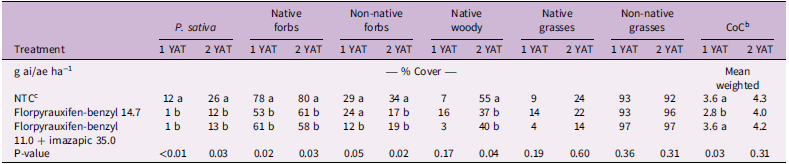
In this study, P. sativa was controlled with florpyrauxifen-benzyl alone or when combined with imazapic. Both treatments reduced total P. sativa density by 55% to 62% at 1 MAT, but flowering P. sativa was only reduced when florpyrauxifen-benzyl was combined with imazapic (Figure 2A). Control of P. sativa continued at 1 YAT, as reductions in density were observed in total (82% to 90%), rosette (91% to 95%), and flowering (74% to 86%) compared with the nontreated control (Figure 2B). Pastinaca sativa cover was similarly reduced by both treatments, as cover was 1% at 1 YAT (Table 5). Control of P. sativa in this trial was not as effective as in Experiment 1 or 2 the year of treatment (Table 1; Figure 1). Treatments were sprayed later in the year in this experiment when plants were larger and at a different phenological stage (June; bolting) than in Experiments 1 and 2 (May; rosettes). Also, native plants were taller and could have intercepted more herbicide, resulting in less herbicide deposition on P. sativa than in Experiment 1. These factors and the drought stress likely accounted for the reduced effectiveness. Despite these differences, P. sativa populations were extremely low the year after treatment, confirming the high level of efficacy of florpyrauxifen-benzyl on P. sativa at 1 YAT. Pastinaca sativa began to return 2 YAT; however, cover and density was still 50% less than in nontreated controls (Table 4; Figure 2C). These results highlight the need for a multiyear approach to eradicate populations of P. sativa in tallgrass prairies.
Pastinaca sativa flowering (yellow) and non-flowering (green) density m−2 at 1 mo (A), 1 yr (B), and 2 yr (C) after treatment of florpyrauxifen-benzyl (F) and F + imazapic (I) at Erikson prairie in western Wisconsin. Herbicide treatments were broadcast in spring (June 20, 2023) when P. sativa seedlings, rosettes, and bolting plants were present. Total, flowering, and non-flowering density were each analyzed separately using Fisher’s LSD (α = 0.05). Treatments with the same letter are not different, with total denoted with uppercase letters and flowering and non-flowering with lowercase letters. No differences in non-flowering P. sativa density were observed 2 mo after treatment (MAT; P = 0.06). Data were collected before flowering (May) at the 2 yr after treatment (YAT) timing; therefore, only non-flowering densities are presented.

Cover of Pastinaca sativa and functional groups 1 and 2 yr after broadcast florpyrauxifen-benzyl in spring (June 20, 2023) at Erikson prairie in western Wisconsin a

Table 5. Long description
The table presents data on the cover of Pastinaca sativa and various plant groups after different treatments. It has 5 rows and 13 columns. The columns are labeled as follows: Treatment, P. sativa 1 YAT, P. sativa 2 YAT, Native forbs 1 YAT, Native forbs 2 YAT, Non-native forbs 1 YAT, Non-native forbs 2 YAT, Native woody 1 YAT, Native woody 2 YAT, Native grasses 1 YAT, Native grasses 2 YAT, Non-native grasses 1 YAT, Non-native grasses 2 YAT, and Mean weighted. The rows are labeled as follows: g ai ha-1, NTC, Florpyrauxifen-benzyl 14.7, Florpyrauxifen-benzyl 11.0 + imazapic 35.0, and P-value. Row 1: g ai ha-1, NTC, Florpyrauxifen-benzyl 14.7, Florpyrauxifen-benzyl 11.0 + imazapic 35.0, P-value. Row 2: 12, a, 26, a, 78, a, 80, a, 29, a, 34, a, 7, a, 55, a, 9, a, 24, a, 93, a, 92, a, 3.6, a, 4.3. Row 3: 1, b, 12, b, 53, b, 61, b, 24, a, 17, b, 16, b, 37, b, 14, b, 22, b, 93, b, 96, b, 2.8, b, 4.0. Row 4: 1, b, 13, b, 61, b, 58, b, 12, b, 19, b, 3, b, 40, b, 4, b, 14, b, 97, b, 97, b, 3.6, a, 4.2. Row 5: <0.01, 0.03, 0.02, 0.03, 0.05, 0.02, 0.17, 0.04, 0.19, 0.60, 0.36, 0.31, 0.03, 0.31.
a Cover was estimated using the point intercept method. As the prairies consisted of multiple species within different levels of the canopy, total cover can exceed 100%. Means followed by the same letter within a column are not different based on Fisher’s LSD (α = 0.05). YAT, year after treatment.
b CoC, coefficient of conservation.
c NTC, nontreated control.
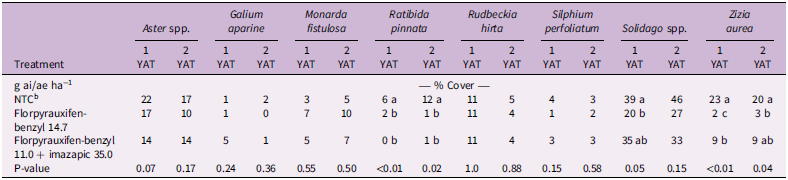
Native forbs were injured by florpyrauxifen-benzyl in the year of application. Injury was specific to the species and ranged from 13% to 100% among common forbs 1 MAT (data not shown). While injury symptoms were not observed after the treatment year, total native forb cover was reduced 35% and 19% from florpyrauxifen-benzyl (14.7 g ha−1) at 1 and 2 YAT (P ≤ 0.03; Table 6). Total native forb cover responded similarly to the reduced rate of florpyrauxifen-benzyl (11.0 g ha−1) + imazapic (35 g ae ha−1) at 1 and 2 YAT (Table 5). Individual native forbs, however, responded differently to treatments. Cover of R. pinnata and Z. aurea was nearly eliminated by both treatments 1 YAT, while Solidago spp. cover was half of nontreated plots from the florpyrauxifen-benzyl–only treatment at 1 YAT. However, Aster spp., G. aparine, M. fistulosa, R. hirta, and S. perfoliatum cover was not reduced by either treatment at 1 or 2 YAT (Table 6).
Cover of individual species 1 and 2 yr after broadcast florpyrauxifen-benzyl in spring (June 20, 2023) at Erikson prairie in western Wisconsin a

Table 6. Long description
A table comparing the cover of various plant species after different treatments. The table has 8 columns and 5 rows, including headers. Columns are labeled as Treatment, Aster spp., Galium aparine, Monarda fistulosa, Ratibida pinnata, Rudbeckia hirta, Silphium perfoliatum, Solidago spp., and Zizia aurea. Each species has two columns for 1 Year After Treatment (1 YAT) and 2 Years After Treatment (2 YAT). Row 1: Treatment, 1 YAT, 2 YAT, 1 YAT, 2 YAT, 1 YAT, 2 YAT, 1 YAT, 2 YAT, 1 YAT, 2 YAT, 1 YAT, 2 YAT, 1 YAT, 2 YAT. Row 2: NTC, 22, 17, 1, 2, 3, 5, 6, 12, 11, 5, 4, 3, 39, 46, 23, 20. Row 3: Florpyrauxifen-benzyl 14.7, 17, 10, 1, 0, 7, 10, 2, 1, 11, 4, 1, 2, 20, 27, 2, 3. Row 4: Florpyrauxifen-benzyl 11.0 + imazapic 35.0, 14, 14, 5, 1, 5, 7, 0, 1, 11, 4, 3, 3, 35, 43, 9, 9. Row 5: P-value, 0.07, 0.17, 0.24, 0.36, 0.55, 0.50, <0.01, 0.02, 1.0, 0.88, 0.15, 0.58, 0.05, 0.15, <0.01, 0.04.
a Cover was estimated using the point intercept method. As the prairies consisted of multiple species within different levels of the canopy, total cover can exceed 100%. Means followed by the same letter within a column are not different based on Fisher’s LSD (α = 0.05). YAT, year after treatment.
b NTC, nontreated control.
While there is no research on established native forb tolerance to florpyrauxifen-benzyl, varying injury to native forbs has been observed from broadcast applications with other herbicides. Mikkelson and Lym (Reference Mikkelson and Lym2013) found that azure aster [Symphyotrichum oolentangiense (Riddell) G.L. Nesom], E. purpurea, and closed bottle gentian (Gentiana andrewsii Griseb.) were the most tolerant to aminopyralid, while R. pinnata, great blue lobelia (Lobelia siphilitica L.), harebell (Campanula rotundifolia L.), and white prairie clover (Dalea candida Michx. ex Willd.) were the most susceptible. Similarly, Carter and Lym (Reference Carter and Lym2018) found native forb tolerance to aminocyclopyrachlor also was species specific.
As the value of native forbs varies considerably among species, the mean weighted CoC values were used to evaluate whether treatments impacted the overall floristic quality of this prairie. A 22% decrease in mean weighted CoC from the florpyrauxifen-benzyl–only treatment was observed 1 YAT compared with the nontreated control (Table 5). This is likely driven by the reduction in cover of Z. aurea, as it was common (>15% cover) and its CoC value (7) was the highest of the species observed at the Erikson prairie. However, the reduction was not observed when florpyrauxifen-benzyl was applied at a lower rate or was combined with imazapic. This suggests that lower rates may limit the impact on highly conserved species 1 YAT. While grass cover (native and non-native) was not reduced by treatments, non-native forbs (excluding P. sativa) were also reduced (59% at 1 YAT) but this also did not persist at 2 YAT (Table 5).
Results demonstrate that florpyrauxifen-benzyl is an effective chemical tool for controlling P. sativa in native forb–rich prairies. When P. sativa was broadcast in spring to rosettes (May), populations were reduced 95% with 1.7 g ha−1. Later applications to bolting plants (June) were not as effective, but >85% reduction was still observed 1 YAT. While applications at rates of 11.0 to 14.7 g ha−1 were safe to perennial grasses, some forbs were sensitive to these rates and were reduced in cover. While lowering the rate of florpyrauxifen-benzyl below 11 g ha−1 may mitigate the injury to desirable forbs, altering the application method (e.g., individual plant treatment) may also be needed to limit contact with the sensitive species. Further research is needed to understand which native forbs are being affected and whether rates can be reduced enough to prevent injury while maintaining control of P. sativa. The lack of increase in native forb or native grass cover 1 and 2 yr after P. sativa control may be attributed to the injury from florpyrauxifen-benzyl. More research is also needed to elucidate the lack of increase in forb cover after effective P. sativa control, as results are from one field study with a specific combination of native forbs and a moderate infestation (17% P. sativa cover).
Acknowledgments
The authors would like to thank John Zaborsky for assisting with the botanical analyses and the many students (Collin Cheney, Arthur Franco, Stefania Casamitijana-Cartoni, Martha Swanson, Michelle Kenton, and Tess Gillingham) who assisted with data collection. The St Croix Wetland Management District (specifically Chris Trosen, Tracy Ronnander, and Alex Bouthilet) provided access to several sites and supported the project establishment and maintenance. Corteva provided the herbicide for this experiment, and we thank Lee Shambeau from 4-Control for spraying the Erikson prairie.
Funding statement
The research leading to these results received funding from the U.S. Fish and Wildlife Service Invasive Species Strike Team Funds via grant F22AC01822-00.
Competing interests
The authors declare no competing interests.




 Open access

