



No CrossRef data available.
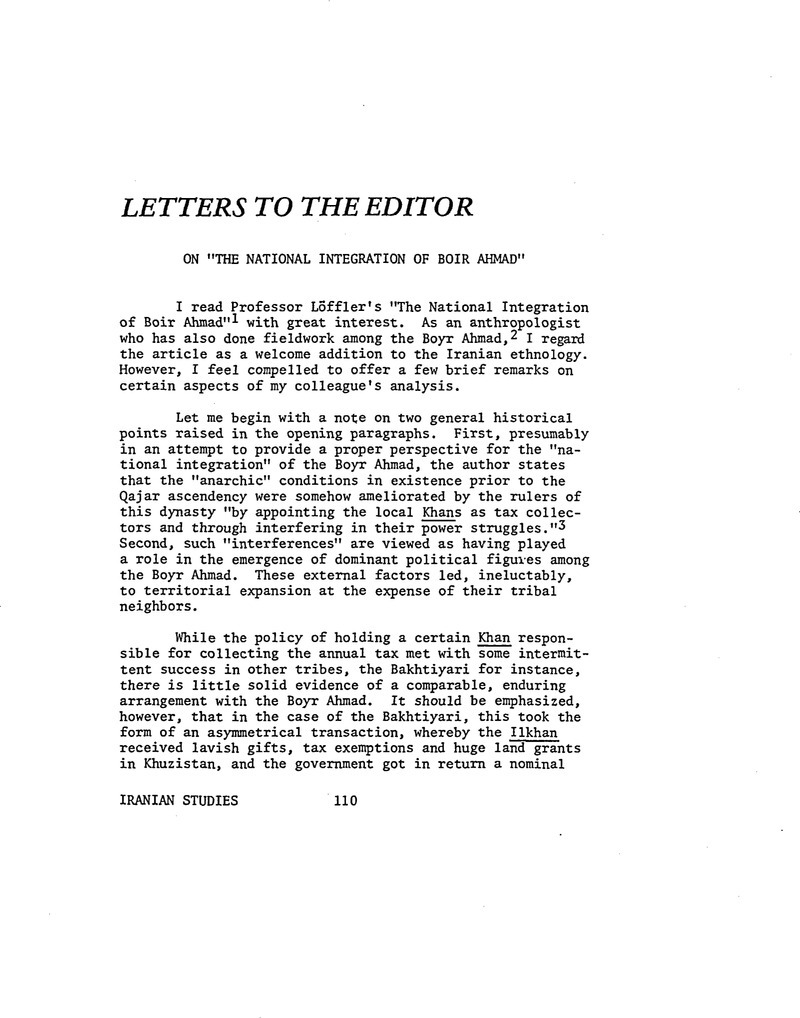
The National Integration of Boir Ahmad
Published online by Cambridge University Press: 01 January 2022
Abstract
An abstract is not available for this content so a preview has been provided. As you have access to this content, a full PDF is available via the ‘Save PDF’ action button.
Information
- Type
- Letters to the Editor
- Information
- Copyright
- Copyright © Association For Iranian Studies, Inc 1975
Footnotes
1. Löffler, Reinhold, “The National Integration of Boir Ahmad,” Iranian Studies, Vol. VI, Nos. 2-3 (Spring-Summer, 1973), pp. 127–135.
2. Field study among the Boyr Ahmad was carried out for a period of nineteen months between 1968-70, supported by a National Institute of Mental Health research grant and fellowship.
3. R. Löffler, op. cit., p. 127.
4. Garthwaite, Gene R., “The Bakhtiyāri Khans, the Government of Iran, and the British, 1846-1915,” Int. J. Middle East Studies, Vol. 3, No. 1 (n.d.), pp. 24–44.
5. Reza Fazel, G., “The Encapsulation of Nomadic Societies in Iran,” in Nelson, Cynthia, ed., The Desert and the Sown: Nomads in the Wider Society, Research series, No. 21 (Institute of International Studies, University of California, Berkeley, 1973), pp. 129–143.
6. Bavar, Mahmud, Kuhgiluyeh and its Tribes (Gachsaran, 1944; in Persian), p. 31.
7. M. Bavar, op. cit., pp. 95, 98-99.
8. M. Bavar, op. cit., p. 42.
9. R. Loffler, op. cit., p. 128.
10. Lambton, Ann K. S., The Persian Land Reform 1962-1966 (Oxford: Clarendon Press, 1969), pp. 20–23.
11. Cf. G. Garthwaite, op. cit., p. 26; and Barth, Fredrik, Nomads of South Persia: The Basseri Tribe of the Khamseh Confederacy (Oslo University Press, 1961), Ch. V.
12. Cf. Spooner, Brian “Politics, Kinship, and Ecology in Southeast Persia,” Ethnology, Vol. VIII, No 2 (1969), pp. 139–152.
13. Löffler, R., “The Representative Mediator and the New Peasant,” American Anthropologist, Vol. 73, No. 5 (October, 1971), pp. 1077–1091.
14. Dalton, George, “How Exactly Are Peasants Exploited?”, American Anthropologist, Vol. 76, No. 3 (September, 1974), pp. 553–561.
 You have Access