Introduction
Moral and ethical concerns, alongside moral and ethical norms, rules, and principles, seem to have co-emerged with the earliest hominids and evolved (in the sense of manifesting evermore aspects of their latent potentials) with the evolution of the Hominidae.Footnote 2 Anthropologists have corroborated that all human societies subscribe to some common codes of morality.Footnote 3 As such, universal concepts—such as right, wrong, good, bad, just, and unjust—are used in all societies, even though there may be differences among members of different cultures concerning the specific instantiation or application of each of these general categories.
Like members of all other cultures and civilizations, Muslims have been keen to not only observe and promote virtues and codes of moral behavior, but also develop theories to help them better understand the intricacies of moral and ethical ideas and ideals. In fact, as a number of scholars have argued, the Quran and Prophetic tradition (as well as the tradition of Imams in the case of Shi‘a Islam) have been two main sources for encouraging Muslims to take moral and ethical concerns seriously and try to develop deeper understandings of various aspects of what can be termed as “the universe of morality and ethics.”Footnote 4 The Prophet Mohammad had famously stated, “Verily, I have been sent to perfect noble conduct and the virtuous character.”Footnote 5 Muslim scholars of the classic period, as Fakhry and several others have argued, had developed elaborate systems of ethics in response to the constantly changing situation and newly emerging problems in their societies.Footnote 6 A quick look at the classificatory schemes introduced by Fakhry and others reveals the close connection between the moral and ethical concerns of Muslim ethicists and wider problems in their societies. Fakhry has categorized the moral theories (i.e., second-order studies of morality), which were developed by Muslims in the pre-modern era, in the following way: Scriptural Morality, Theological Ethics, Philosophical Ethics, and Religious Ethics.Footnote 7
However, it seems there is a good deal of overlap between the first and last categories, as both heavily rely on the two main sources of Islamic doctrines, the Quran and the Tradition of the Prophet (and the Imams in the case of Shi‘a Islam). There are also some substantive differences between the two approaches. The earliest generations of Muslims, who had not yet studied the views of the Greek and Hellenistic philosophers and sages from other ancient cultures, such as Persia and India, had constructed some basic theories to make sense of the message of the Quran. The theoretical depths of these theories were, inevitably, low (i.e., close to the level of observables) in this case, close to what can be termed as “the literal meaning” of Quranic verses and hadiths of the Prophet.Footnote 8 This was due to the fact that the earliest generations of Muslim scholars who faced the challenge of developing theoretical frameworks to deal with moral and ethical issues did not yet have advanced theoretical tools at their disposal. What they had were their personal experiences, a book as their main guide, and certain instructions from the Prophet (and Imams in the case of Shi‘a Muslims).Footnote 9
The advocates of Religious Ethics, on the other hand, had been exposed to the sophisticated ideas developed in other cultures and civilizations, which had been made available to Muslims through translations. These advocates’ approach to ethics was, therefore, much more sophisticated than their predecessors, in that they consciously intended to develop ethical ideas that were, in their view, free from the influences of other cultures. Since Scriptural Morality is less sophisticated than Religious Ethics, the former can be regarded as a less-developed subset of the latter.Footnote 10
One of the first and vexing theoretical issues, which preoccupied the earliest generations of Muslims and resulted in the emergence of opposing theological views, was the compatibility, or otherwise, of God’s omnipotence, omniscience, and humans’ freedom. Notwithstanding the decidedly theological character, this issue also had serious moral and ethical implications: was man responsible for his actions or was he nothing but a puppet being played by a supreme puppet master?Footnote 11 The above issue caused a rift among Muslims: one group, who soon became known as the Mu‘tazilites but called themselves ahl-ol-adl wal tawhid (followers of justice and monotheism), argued that God called Himself adel (just) and His justice entails that He punishes the guilty and rewards the righteous, not vice versa.Footnote 12 Another group of Muslims, the Ash‘arites, who called themselves ahl-ol-sonnah wal Jamāah (followers of tradition and consensus), argued that to claim that God is obliged to rule according to the canons of justice is to deny God’s omnipotence, and this is tantamount to blasphemy.Footnote 13
However, despite the fact that Muslim scholars have tried to develop second-order studies of ethics since the early Islamic period, it should be said that such studies—as compared to other disciplines developed in the intellectual ecosystem of the Islamic civilization, such as fiqh and uṣul al-fiqh—have remained underdeveloped.Footnote 14
The issues discussed here, however, relate to Muslims’ philosophical approach to the study of ethics. My aim is to compare and critically analyze the ethical theories of two Muslim philosophers, Nasir al-Din Tusi and Abdolkarim Soroush, one of whom is from the period known as the golden age of Islamic thought (eighth to thirteenth centuries CE) and the other a contemporary thinker. Both philosophers maintain that ethics/morality plays an important role in the lives of both individuals and societies; explore the relations between ethics/morality, politics, and economics; and recognize, while making use of the canons of philosophical thinking for exploring the nitty-gritty of ethical ideas, the central role of the Islamic teachings in shaping the views (including the ethical views) of Muslim men and women.
A brief account of Nasir al-Din Tusi’s system of ethics
Mohammad ibn Mohammad ibn al-Hasan al-Tusi, better known as Khawaja Nasir al-Din al-Tusi (597/1201–672 /1274), was born in Tus, a city in the northwest of present-day Iran, which also produced other great scholars such as Abou Hamed Mohammad (Tusi) Ghazzali (1058–1111) and Aboulghasm Ferdowsi Tusi (940–1020).Footnote 15 Nasir al-Din was one of the greatest Muslim scholars of the classic period. He was a first-rank astronomer, philosopher, logician, mathematician, theologian, administrator, politician, and vizier, authoring a large number of scholarly works (150 altogether, of which twenty-five are in Persian and the rest in Arabic) in these disciplines.Footnote 16
In the field of ethics, Nasir al-Din wrote several books and treatises, including Awsaf Al Ashraf (the Attributes of the Noble), Risalah dar tawalla va tabarra (A Treatise on Friendship [with God’s Friends] and Repudiation [of God’s Enemies]), Akhlaq-e Mohtashami (The Ethics of Nobility), Risalah fi al-Khilafat (A Treatise on Caliphate), Risalah dar Ahwal-e Pādeshahan-e Qadim (A Treatise on the Life and Deeds of the Ancient Kings), Nasihat-Nameh (Book of Advice), and a Persian translation of Ibn Moghaffa’s al-Adab al-Vajiz Lil-Wald al-Saghir (A Brief Account of Moral Etiquette for a Young Child).Footnote 17 His most famous contribution to ethics, however, is Akhlaq-e Naseri (Nasserian Ethics), which is written in Persian.Footnote 18 This work, which is one of the most important sources of classical ethics in Muslim civilizations, is still used as a textbook in many Muslim seminaries, especially in Shi‘a religious schools. Nasir al-Din states in the book’s introduction that he used Miskawayh’s Al-Tahdhib al-Akhlaq (The Refinement of Character) as a model for his work, and the first part of Akhlaq-e Naseri is, in essence, a revised and enlarged adaptation of Al-Tahdhib.Footnote 19
In this first part of Akhlaq-e Naseri, which deals with developing the kind of moral character conducive to performing right moral actions, Nasir al-Din added two new parts not included in al-Tahdhib: one on home economics and the other on politics.Footnote 20 These three sections are subdivided into thirty chapters. The first seventeen chapters are arranged into two main sections: the first seven chapters deal with the basic principles of ethics and the remaining ten deal with the objectives. In the Preamble, Nasir al-Din explains to his readers the circumstances that led to his composition of the book and gives an informative classification of various branches of theoretical and practical knowledge known in his day. In completing this part of his book, Nasir al-Din had benefited from Farabi’s masterpiece, Ihsa al-Ulum. Footnote 21 Akhalq-e Naseri, therefore, offers not only a rich source for classical ethical and moral ideas among Muslims up until the thirteenth century, but also a picture of all branches of science of his day.
Nasir al-Din begins his discussion of ethics with an elucidation of the notion of the soul. He explains the rationale for this choice of topic in the following way:
Now since this [topic] … with which we shall begin, is a science concerned with how the human soul can acquire a disposition such that all its acts, proceeding from it by its will, may be fair and praiseworthy, the subject-matter of this science is thus the human soul, inasmuch as from it can proceed, according to its will, acts fair and praiseworthy, or ugly and to be condemned. This being so, it must first be known what the human soul is, and wherein lies the acme of its perfection; what are its faculties, by which (if it uses them properly) it attains what it seeks, namely perfection and felicity; what, again, it is that prevents it from reaching that perfection. In sum, (one must know) in what consists its purification and in what its seduction, themselves inevitably bringing about either its prosperity or its failure.Footnote 22
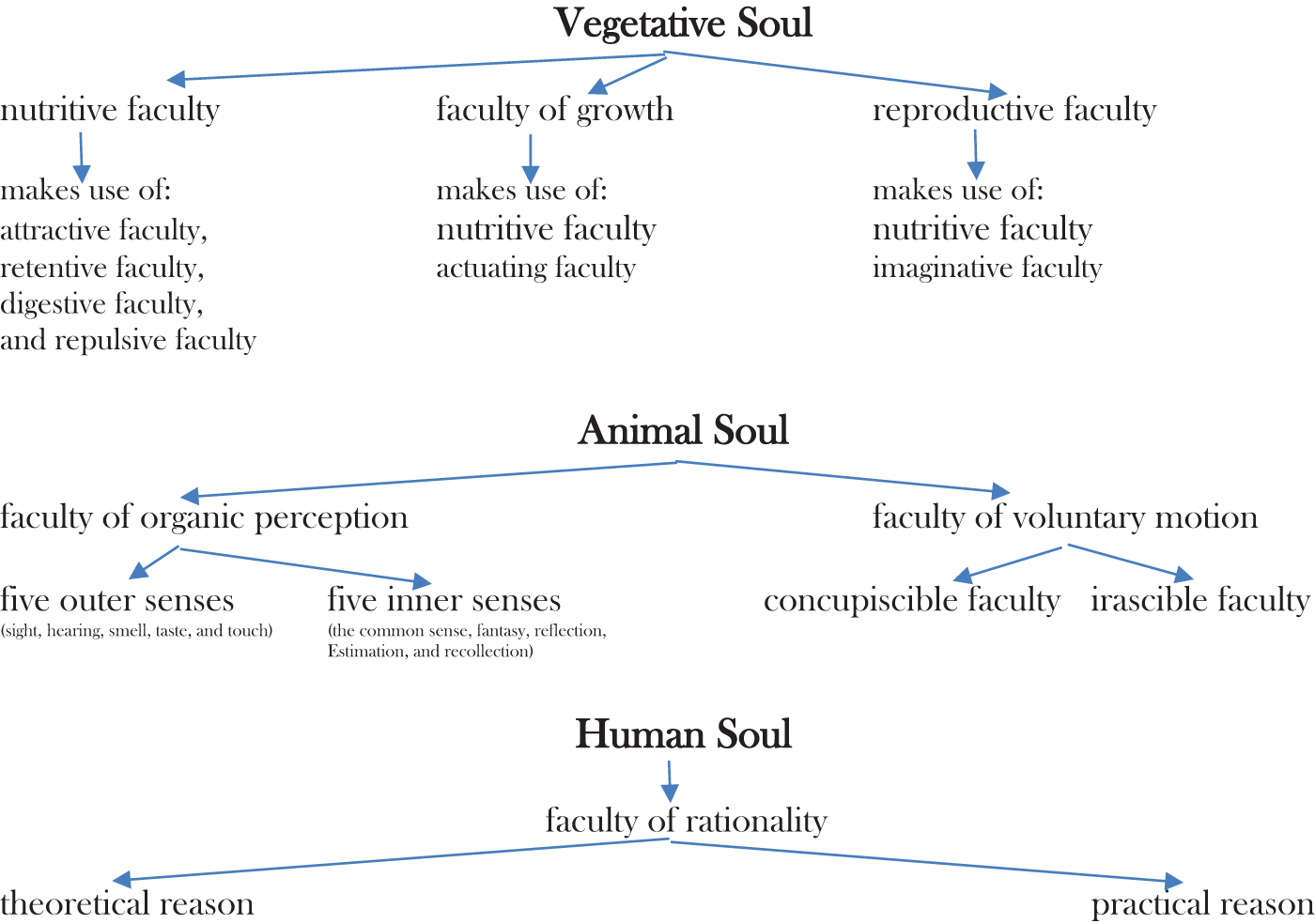
The soul, Nasir al-Din explains, is a simple substance capable of comprehending the intelligibles by itself and managing and controlling our bodies by means of various faculties and organs. He then goes on to demonstrate the reality of the soul, its substantiality, simplicity, immateriality, self-awareness, capability of exploiting organs, and its not being sensed by any of the five senses.Footnote 23 The third chapter of the first section of the first part of the book deals with identifying the types of the soul and the powers that each type possesses. Here, Nasir al-Din, following Ibn Sina’s approach, presents a hierarchical order, which is depicted in the following schematic diagram (Figure 1).
Various aspects of the human soul.Footnote 24, Footnote 25

Figure 1 Long description
Faculties of the soul divided into three categories: Vegetative Soul, Animal Soul and Human Soul. Vegetative Soul includes: - Nutritive faculty, which makes use of the attractive faculty, retentive faculty, digestive faculty and repulsive faculty. - Faculty of growth, which makes use of the nutritive faculty and actuating faculty. - Reproductive faculty, which makes use of the nutritive faculty and imaginative faculty. Animal Soul includes: - Faculty of organic perception, which is divided into five outer senses (sight, hearing, smell, taste and touch) and five inner senses (the common sense, fantasy, reflection, estimation and recollection). - Faculty of voluntary motion, which is divided into concupiscible faculty and irascible faculty. Human Soul includes: - Faculty of rationality, which is divided into theoretical reason and practical reason.
Having explained various aspects of the human soul from the point of view of the powers and the faculties they have, Nasir al-Din goes on to examine the soul from the point of view of its varieties. He introduces three kinds of the soul that form a hierarchy: the Bestial Soul, which is the meanest kind; the Savage Soul, which is the intermediate kind; and the Angelic Soul, which is the noblest kind.Footnote 26 The characteristic power of the first soul is concupiscence, “which is the principle of the appetites, of the search for nourishment, and of yearning for pleasure by way of foods and drinks and women.”Footnote 27 The characteristic power of the second soul is irascibility, “which is the principle of … courage, of advancing to meet perils,” and the characteristic power of the third soul is notq, “which is the principle of reflection and distinction, and of the yearning to see into the realities of things.”Footnote 28 He draws a parallel between these three souls and the three souls introduced in the Quran: the Imperative Soul, the Reproachful Soul, and the Peaceful Soul. The first two souls are means for the development of the third soul, which is the soul that is becoming of man.Footnote 29
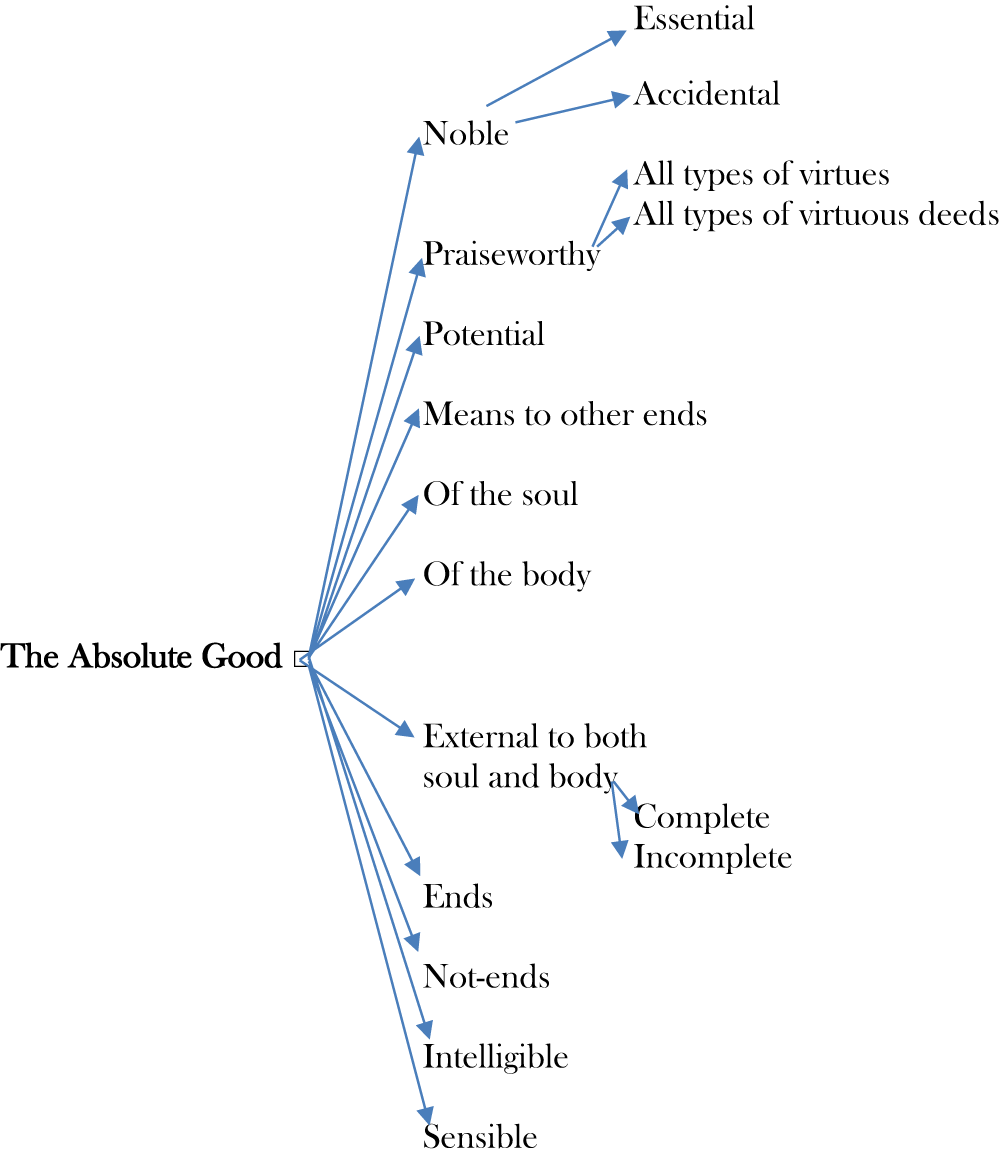
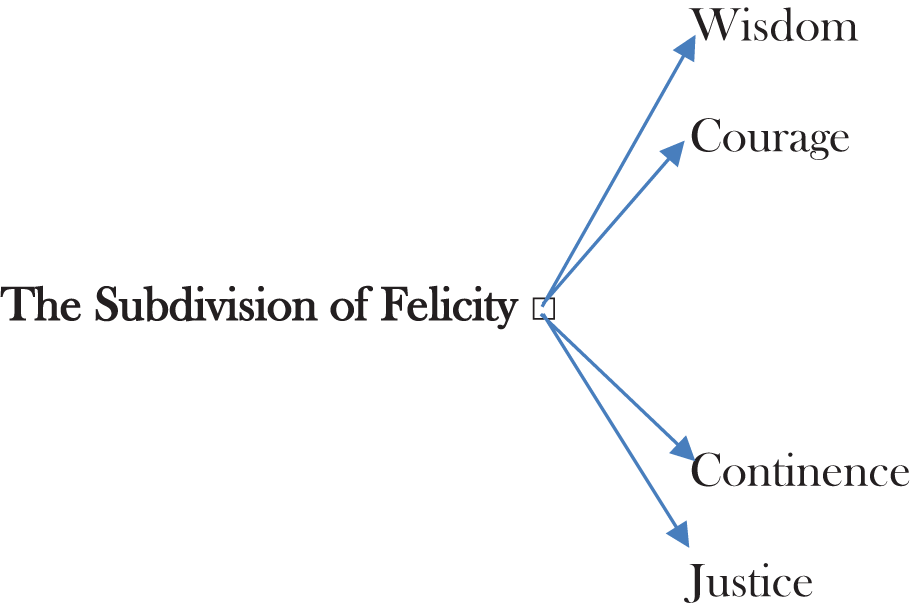
Following his explanation of the defects and perfections of man’s soul, Nasir al-Din argues that the raison d’être of man’s soul is to acquire good, achieve felicity (happiness/flourishing), and arrive at perfection.Footnote 30 Good is either absolute or relative. The former is the end of all ends, while the latter is a means conducive to the former. Felicity is like good, only that it is relative to each individual, whereas good is the same for all. The following diagrams (Figure 2 and Figure 3) present various types of good and felicity according to Nasir al-Din.Footnote 31
The subdivisions of Absolute Good.

Figure 2 Long description
The Absolute Good subdivides into Noble, Praiseworthy, Potential, Means to other ends, Of the soul, Of the body, External to both soul and body, Ends, Not-ends, Intelligible and Sensible. Noble subdivides into Essential and Accidental. Praiseworthy subdivides into All types of virtues and All types of virtuous deeds. External to both soul and body subdivides into Complete and Incomplete.
The subdivisions of Felicity.

In chapter two of the second section of part one of the book, Nasir al-Din argues that “the noblest of disciplines is that of the Correction of Dispositions” and goes on to explain, in chapters three and four of this section, various species of the four main genera of virtues that together make the excellent character: wisdom, courage, continence, and justice.Footnote 32 These are depicted in Figure 4 below.
The main genus and types of virtues.

Figure 4 Long description
Virtues are categorized into four main types: Wisdom, Courage, Continence and Justice. Wisdom includes traits like quick-wittedness, speed of understanding, clarity of mind, ease of learning, excellence of intellect, retention and recall. Courage encompasses greatness of soul, bravery, high-mindedness, perseverance, mildness, calmness, vigor, long-suffering and sense of honor. Continence is associated with shame, meekness, right guidance, peaceableness, tranquility, fortitude, contentment, gravity, moderation, order, freedom and munificence, which further includes generosity, preference, forgiveness, manliness, charity, supererogation and lenity. Justice involves sincerity, amity, fidelity, concern, care of kin, requital, good fellowship, fair judgment, affection, acceptance, reliance and devotion.
Chapter five of this section deals with the eight main vices. Nasir al-Din explains that, contrary to the prima facie expectation that opposite to each virtue a vice could be identified, the situation is more complex than that.
[E]ach virtue has a limit, the transgression of which, in the direction either of excess or of shortcoming, leads to a vice. Indeed, whenever a regulation delimiting a virtue is neglected despite its repute, or observed notwithstanding its lack thereof, that virtue becomes a vice. Thus every virtue is, so to speak, a middle-point, with the vices corresponding to it in the position of peripheries….Footnote 33
According to Nasir al-Din, while the number of virtues is limited, there is an infinite number of vices because the condition of deviation from virtues for any individual, just like the condition of the deviation of the body of that individual from equilibrium and health, differs from one individual to another. However, in general, there are two types of deviation from each virtue, one in the direction of excess, the other in the direction of neglect. Therefore, there are eight vices for the four cardinal virtues. These are depicted in Table 1 below.
The main virtues and their corresponding vices

In the rest of this chapter, Nasir al-Din provides further examples of the vices for some of the subdivisions of the four virtues. However, his general recommendation to his readers is to apply the same procedure of finding the corresponding vices for any subdivision of any of the main virtues. The ability to discern vices and virtues in a proper manner is of utmost importance, as one ought to acquire the main virtues and their subdivisions to achieve felicity. It is also important to bear in mind that of the four main virtues, only one—wisdom—depends on theoretical reason and the rational soul. The other three virtues depend on practical reason, which deals with the realm of action in which the body plays the main part.Footnote 34 Since there are many actions with only a surface resemblance to the genuine activities conducive to the desired virtues, it is incumbent upon whomever wishes to achieve true felicity to be able to distinguish between real virtues (and their subdivisions) and their simulacra.
Chapter seven in the second section of part one of the book is dedicated to a discussion of “the superiority of Justice over other virtues and an exposition of its states and divisions.”Footnote 35 Nasir al-Din’s theory of justice is the same as Aristotle’s doctrine of the mean with a dash of Neo-Platonic ideas. He equates justice with equity/equality, arguing:
… [T]he word “Justice” denotes the idea of equity/equality; but to conceive of equity/equality without regard to unity is impossible.Footnote 36 Now, inasmuch as unity is particularized and distinguished as the remotest rank and the highest degree of superiority and perfection –the permeation of its operations from the First Principle (which is truly One) throughout all numerables being like the diffusion of the lights of existence from the First Cause (which is absolutely Existent) throughout all existent things– so, the nearer one is to unity the nobler one’s existence. This being so, no relationship is nobler than that of equity/equality, … and, among virtues, none is more perfect than the virtue of Justice, as is obvious in the discipline of Ethics, for the true mid-point is Justice, all else being peripheral to it and taking its reference therefrom.Footnote 37
From the above, Nasir al-Din concludes that “The just man is the one who gives proportion and equivalence to disproportionate and inequivalent things,” and that three components should be present to have a just society: Divine commandments, which are the source of unity; a human arbiter (i.e., a ruler), who guarantees the enforcement of the Divine commandments; and a medium for the exchange of goods and services (i.e., money).Footnote 38 He attributes this view to Aristotle in his Nechomachian Ethics and then connects this “Aristotelian thesis” to Quranic wisdom: “And We sent down with them the Book and the Scale so that men might hold the balance; and We sent down iron, containing great harm and also benefits to men.”Footnote 39
Nadir al-Din, following Aristotle, argues that “justice is not a part of virtue, but all virtue in its entirety.”Footnote 40 The opposite of justice is tyranny, and it is not “a part of vice but all vice in its entirety.”Footnote 41 He also quotes Plato’s view about justice:
[T]he centrality [i.e., occupying the middle position] of justice is not like the centrality of other virtues, because both peripheries of justice are tyranny, whereas in no other virtue do both peripheries coincide in one vice. … and although each virtue, from the standpoint of centrality, requires equilibrium, justice is general, comprehending all equilibria.Footnote 42
Parallel to the three main types of justice, pertaining to the Divine commandments, the just rule, and the just system of exchange of goods and services based on money, there are three main kinds of tyranny: one that opposes the Divine commandments, one the opposes a just ruler, and one that opposes a just monetary system of exchange. The first kind of tyranny is “the Most Monstrous,” the second one is “the Average,” and the last is “the Petty” kind.Footnote 43 Justice preserves individuals and societies from all sorts of harm, the causes of which are limited to four kinds: “first, appetite, a consequence of which is depravity; secondly, malice, a consequence of which is tyranny; thirdly, error, a consequence of which is grief; fourthly, anguish and perplexity associated with baseness, a consequence of which is anxiety.”Footnote 44
Nasir al-Din then goes on to introduce various types, or divisions or categories, of justice. The first type of justice pertains to people’s obligations towards God, as His servants. The second concerns people’s responsibilities with regard to the rights of other people, respect for the authorities, and “the discharge of trust and fair-dealing in transactions,” and the third is about paying what is due to their predecessors.Footnote 45 In the rest of this long chapter, Nasir al-Din explains in some detail the ways in which the three divisions of justice can be satisfied. He concludes this chapter by emphasizing that the just man is God’s vice-gerent on Earth and hence highlights the importance of this particular virtue.
Since the principal objective of ethics is the attainment of felicity, and given the close relationship between felicity and the virtues, Nasir al-Din introduces, in a general way, the three genera of felicity in the eighth chapter of this section: felicity of the soul, bodily felicity, and civic felicity. In the rest of the book, he tries to provide practical instructions for achieving the various kinds of felicity belonging to the above three genera by means of acquiring their related virtues.
A brief account of Soroush’s system of ethics
Abdolkarim Soroush (1945–) is a contemporary Iranian philosopher. He studied at the University of Tehran (Pharmacology), the University of London (Philosophy of Science), and is well-versed in Islamic Philosophy. He is a prolific writer and has published more than thirty titles, mostly in Persian, in the fields of philosophy of science, philosophy of religion, and moral and political philosophy. He developed his moral and ethical views in Akhlaq-e Khudayan (The Ethics of gods).Footnote 46 This book is an anthology of eight separate, interlinked papers, which constitute the book’s eight chapters. In the introduction, Soroush provides a brief account of each chapter.
In the first chapter, “The Ethics of gods: There is No Superior Ethics,” the content of which is discussed in further detail below, Soroush develops two principal theses: 1) justice is the most fundamental virtue and ethics is only about this one basic virtue; and 2) there are no universal moral principles. Chapter two, “On Livelihood and Virtue,” further expands the points discussed in chapter one, particularly the idea that there exist two types of values (master and servant values) and one metaethical principle. Master values, such as the goodness of justice, self-sacrifice, and bravery, for whose sake we live, are immutable and eternal. Servant values, whose function is to serve us, on the other hand, are changeable, admit exceptions, and constitute all virtues and vices, such as the goodness of telling the truth, abiding by the laws, fairness, … and the badness of lying, theft, murder. The metaethical principle states that “people ought to live a moral life.” The third chapter, “Freedom as a Method,” offers a normative recommendation to those in positions of power: even if you do not wish to grant freedom to those under your rule, use freedom as a method for successful governance.
To successfully manage the affairs of the people under their control, rulers need to have knowledge of the behavior of those over whom they rule. This aim can be best achieved if rulers grant the ruled freedom. In the absence of freedom, people try to hide themselves and their affairs from the rulers as much as possible. Chapter four, “On Emancipation from Certainty and the Certainty of Emancipation,” deals with the relationship between positive and negative freedoms and religiosity, indicating that it is possible to have a “liberal” reading of religion. Such a reading allows the faithful to develop a way of understanding and interpreting religious teachings that regard the religious form of life as a right rather than an obligation; a form of life that people can choose freely and without coercion, if they wish. The next chapter, “Faith and Hope,” further develops the discussions in chapter four and argues that liberalism, which is frowned upon in many Muslim societies, conveys an epistemological message: certainty is not achievable and all people are fallible.
The corollary of this is that people will be better off if they follow the verdicts of collective reason and reject all types of epistemological, political, and religious despotism:
Even if in a fiqh-based society, the critique of religious teachings and doubting in faith are impossible, neither is impossible in the sphere of personal faith. One should not consider faith as a type of dogmatic creed. What is anti-faith is despair, not doubt.Footnote 47
Chapter six, “Types of Religiosity,” separates some types of faith—such as fatalistic, cause-based (in contrast to reason-based) faith, faith based on imitation, and ritual-driven faith—from faith chosen by individuals, based on free choice and proper investigation. Soroush further argues that, just like ethics, religion also has two types: one that is merely one aspect of our collective life, while the other encompasses one’s life and is not subject to pragmatic expediencies. It is this latter type of religion that Soroush recommends.
The seventh chapter, “The Confused Mentality, The Confused Identity,” argues the case for what the author dubs “national and cultural equilibrium.” Such an equilibrium requires equilibrium between the forces of wonder (poetry, mysticism, etc.) and the forces of precision (science, logic, analytic philosophy, and philosophical theology). The last chapter of the book, “The Relationship Between Justice and Law,” emphasizes the status of the law as a product of collective reason and popular consent. This chapter contrasts the law with fiqh-based rulings, which are the products of a faqih’s personal certainty or conjectural understanding and thus do not enjoy the same status as a social law.
As stated above, since Soroush has developed the main aspects of his moral theory in the first chapter of the book, I mostly limit my introduction and discussion of his views to what he says in this chapter and only occasionally refer to some of the views expressed in the second chapter. I also make use of the views expressed in two of his other papers, which are not included in the above book.Footnote 48 Soroush’s main argument is that ethical norms and rules are only applicable in this world and not in all possible worlds. In a world or society different from ours, other sets of rules are at work.Footnote 49 In other words, there is no moral rule/principle that is generally or universally valid.Footnote 50 All alleged universal moral principles/rules have exceptions. Each particular form of life or profession has its own morality/ethics.Footnote 51 Morality, in any society, is shaped by the collective social life of that society and is subject to its rules and characteristics. In this sense, morality is post-societal. Individuals, however, are free to act according to the dictates of their society’s morality or to refrain from doing so.Footnote 52
To develop his theory of ethics, Soroush asks the following question: why are there exceptions in the application of moral rules and principles? For example, to tell a lie is not bad in all circumstances, and the same is true for “being modest.” Soroush suggests that, traditionally, ethicists and philosophers of ethics have offered three types of replies to the above question.
The first reply is that the exceptions are “apparent.” In reality, there is no exception: if we take into consideration all the necessary and sufficient conditions for the applicability of moral laws, they will be applied without exception. In response to this, Soroush provides five different arguments, which are, more or less, variations on the following theme: since not all the conditions are known, suggesting that we must take all the conditions into consideration to be able to apply a certain rule is tantamount to making that rule inapplicable.Footnote 53
The second reply is that moral principles are neither eternal nor necessary; they are applicable in the majority of cases. There are exceptions, but they are rare.Footnote 54 The world is such that people’s adherence to moral virtues rather than moral vices will always better help them to achieve perfection. In other words, according to the advocates of this second position, it would never be the case that “lying and theft make a society more stable and people more perfect.”Footnote 55
Soroush’s reply to this suggestion by asking: what if those rare exceptions become rules on certain occasions? There is no reason why this scenario could not be realized. In Soroush’s view, the appeal to a cosmological, sociological, and psychological assumption stating that the world, or the society, has made people in a way that they act morally most of the time does not help. He argues that neither the claim that humans’ fixed nature (fitrah) is the guarantor of the universality of moral principles nor the famous principle that Muslim philosophers, including Nasir al-Din, have used to justify the validity of inductive arguments—namely, the principle stating that “whatever is incidental can neither be permanent nor frequent”—are of any help to those arguing for the universality of moral principles.Footnote 56 In the first place, to claim that the world is such that people, in general, observe moral norms needs proper empirical evidence and cannot be upheld simply by appeal to fitrah. Moreover, fitrah is like a primordial matter to which many different forms can be attached. Therefore, the appeal to fitrah can explain neither the form of societies nor the form of their morality.
To bring the above point home, Soroush makes use of the “Tower of Babel” example:
the faculty of language and the desire to communicate [with others] is perhaps the most powerful and well-entrenched disposition in people, and yet there are more than two thousand languages in the world, all stemming from that same desire and faculty, each is like a form attached to the same primaeval matter.Footnote 57
Secondly, Soroush continues, if we accept, for the sake of argument, the validity of the above-stated principle, and accept that since the wrongness of a moral vice—such as lying—is accepted most of the time by most people, there is, therefore, a necessary relationship between lying and wrongness, it does not follow that lying is wrong in all possible worlds.Footnote 58 Ethics is our servant, not our master; it is here to respond to our needs. As such, ethics is sensitive to specific contexts and situations.Footnote 59 Soroush maintains that ethics is the product of lifestyles. Each lifestyle or mode of production gives rise to a particular code of ethics.Footnote 60 Soroush concludes his argument against the second position a follows:
The fact that ilm-e Akhlaq (the theory of ethics) results from [people’s] way of life and its following of it [people’s way of life], does not clash with [people’s] responsibility and the praise or condemnation of values or allowing them to rule in [people’s] life.Footnote 61 Yes, moral theory is an effect whose whole being is due to its cause and is harmonious with it and posterior to it and appears and disappears without people’s permission, knowledge, and intention, but people are free in acting according to its rulings and responsible for their actions. That which is praiseworthy and blameworthy is people’s free action. And that which brings about virtuousness or unvirtuousness is the knowledge of the goodness of an action and acting freely in accordance with it or in discordance with it. None of these is against the claim that each nation’s ethics (and ethical theory) is the product of its way of life and is consonant with it. This claim is neither inconsistent with free will nor with the praise or blame [of values]. Ethics is subject to a collective mode of living but is also master over each individual act.Footnote 62
Advocates of the third traditional position of ethicists and philosophers of ethics divide actions into ethical and non-ethical (natural) groups. Both groups, however, should be subjected to moral judgements. Making judgements about each group of actions differs with respect to the ways in which they are named. Their difference, therefore, is a linguistic one, but this difference, Soroush submits, is of huge importance. It is akin to naming the days and months; until we name them, it is not clear what their attributes are. But as soon as we learn that a day is “Friday,” we realize that it is a holiday (according to the Muslim calendar).Footnote 63 Soroush distinguishes between three types of names: non-moral, moral, and morally neutral.
All voluntary actions bear names belonging to the category of non-moral names. The names of actions—such as buying, sewing, cutting, laughing, etc.—are all non-moral. In other words, these names do not signify the goodness or badness of what they signify. We can have a moral type of laughing and an immoral one. Moral names, on the other hand, are those that bear their own goodness and badness (either on an a priori or a synthetic a priori basis) and, therefore, are not divided into two groups. To do justice, to be chaste, etc. belong to this category of names and we, therefore, do not have good and bad justice, good and bad chastity, etc. Justice is what is good and immodesty is what is bad. There is also a third group of names whose moral status is not clear. Are lying and truth-telling moral or non-moral? Do they differ in this respect from eating and sleeping?Footnote 64
In Soroush’s view, as a result of our habits and social conditioning, we have come to regard actions such as lying, hurting (people), insulting, and envy as immoral and bad. In reality, however, these actions belong to the category of voluntary actions, which are named by natural names. Even the classic moral philosophers maintained that there are two types of lying: good and bad. This means that they would endorse the fact that “lying” is the natural name of this action and not its moral name; it informs us about the action’s external (phenomenological) aspects and not its moral attributes. Lying means to say something that does not correspond to reality. There is no moral element in this definition.Footnote 65
Soroush argues that if we add many adjectives to the natural name of an action, the end result will still be a natural name. To reach a verdict concerning the morality or immorality of an action, we need moral names (or titles).
Moral names are not the names of any specific natural action or character, but their attributes. “Justice” is not the name of any natural action, in the way that “honesty,” “kind-heartedness,” “verbosity,” “ennui,” and “selfishness” are the names of actions or characters. “Bravery,” “chastity,” and “wisdom” are the same (they are the names of various types of virtues). A just or unjust man does nothing but giving, taking back, usurping, removing, … etc. But in one case, the giving and taking are just, and in another, unjust. It is why, while the verdicts concerning taking and removing are not clear, the verdicts concerning taking and removing in an unjust manner are clear, and there are no ifs and buts about it.Footnote 66
According to Soroush, placing natural names under the category of moral names is one of the causes of confusion and misunderstanding in moral judgements, and explains why the classic moral philosophers had difficulty ascertaining the exact moral status of poverty and self-sufficiency (being free of wants). They would sometimes resort to strange arguments, such as self-sufficiency is better than poverty since God is self-sufficient and free from all wants. But “poverty” and “self-sufficiency” are natural names, and unless they are placed under the category of moral names, their moral status is not known.Footnote 67
Soroush then suggests:
Justice, according to the students of ethics, contains all of the virtues. “Courage,” “chastity,” and “wisdom” (which are the virtues of the three faculties of anger, lust, and reason) are moral names for the moral application of [these] faculties. Therefore, in truth, they come under the name of “justice” and are of its troops.Footnote 68
After explaining the views of the advocates of the third position at some length, Soroush goes on to expose its weaknesses. He argues that while it is true that “justice,” “chastity,” and their ilk are not the names of any particular natural action, this means that all types of action can be done under these names. An invitation to justice is not an invitation to any particular natural action and, as such, all types of action can be proudly committed under its name.Footnote 69 He goes on to argue:
It is not difficult to accuse someone of committing [certain concrete action such as] killing people, but it is not easy to accuse him of unjust killing. No one has much disputed the definition of lying, insulting, slandering, etc. But the same cannot be said about the definition of justice, right, and inequity. If the judgements concerning the first group of actions are unclear, their definitions, instead, are clear, and while the judgements concerning justice and right and inequity are clear, defining them (and even worse, determining them) is very difficult. And if the predicament of ethics could be resolved by combining the above two sets so that the clarity of one compensates for the obscurity of the other, alas, we have to acknowledge that the obscurities [in the above definitions] have cooperated to scare off the clarities [in them]. This is analogous to the situation of a beautiful maid who decided to wed an ugly sage in the hope that their offspring would be as beautiful as she is and as wise as his father, but in the end, she got a child who was as wise as she was and as beautiful as his dad!Footnote 70
Soroush further elaborates on the Achilles heel of the third approach in the following way:
We said that each society has its own particular ethics that suits it, and if its morality differs from ours, we cannot blame it for being immoral and virtueless, and a society that is full of lies and disloyalty can also be moral and virtuous (on the condition that exceptions become norms, something that is not rationally impossible). … Now, we reiterate the same point in another way. What happens if justice requires killing people justly, and to frame people justly, and lie justly, and justly deprive the accused people of defending themselves and justly torture them and justly promote piosity and hypocrisy and pretentiousness and panegyric and justly silence people’s voice and …? Is such a society immoral and virtueless? One must not say that justice is contrary to lying or torture. If it is possible to kill justly, then it would be possible to torture justly and lie justly and exercise piosity justly (let’s not forget that “torture,” “lying,” “piosity,” and … are the names of natural actions). … The invitation to justice excludes neither kindness nor unkindness, neither providing comfort nor torture, neither veracity nor lying, neither panegyric nor scurrility, neither promoting the truth nor distorting the truth, nor praising violence or aggression nor denouncing violence or aggression. All these could be brought under the flag and cover of justice, be adopted and convince others to adopt them. Taking refuge in [adopting the law of] the golden mean in defining justice and moderation also has never helped to untie any knot, but itself has turned into an inextricable knot that requires its own independent solution.Footnote 71
In the last section of his paper, Soroush presents his own solution to the problem of developing a proper moral theory free from the defects he highlights in other theoretical approaches to ethics. He begins by asking a fundamental question: “What happens if we disagree with a society in its totality, along with the type of morality that is in tune with it?”Footnote 72 His answer to this question is that the only way forward is to appeal to a metaethical principle, which states:
[E]ven if we assume that exceptions become rules, and even if we assume that lying, forsaking [one’s nearest and dearest], breaking promises, waging war, and the shedding of blood, become permissible, and even if we assume that the society’s order is dependent on the promulgation of these “vices,” and even if we assume that justice would endorse the order in question, the totality of such society, with such a damned network of relations, is morally objectionable and reprehensible. It is as if we are faced with two levels of moral judgements: one about each and every one of [moral] actions, the other about the set of all these actions. It is possible that each one of persecutions, tortures, and bloodshed [in this set] is “just” and right, but a set that consists of “just” persecutions and tortures should not be regarded as moral and acceptable. The metaethical principle in question says this same point: we do not want a system that is based mostly on vices rather than on virtue, even if those vices have a place in the system and are in tune and consonant with it and are the support of its durability and subsistence.Footnote 73
In further developing his desired approach, Soroush reiterates his point:
there is no superior and more accurate ethics than this “existing ethics,” and by the “existing ethics” I mean these existing moral principles that admit exceptions. And acting according to these moral values is the best guarantor of social justice and chastity.Footnote 74
Based on these conceptions, Soroush goes on to criticize both socialist/Marxist and capitalist ethics for creating hell on earth while promising the creation of utopias. Soroush concludes his critical account by summarizing the main points of his approach in the following way:
Firstly, if there is a utopian ethics, it is this same existing ethics. Secondly, this existing ethics, though in need of improvement, cannot be eliminated. Thirdly, if one wants to invite people to morality, one should invite them to these same tangible and accessible moral rulings, and not abstract moral dicta that accept all conceivable forms and provide solutions to no moral problem. Fourthly, if one should engage in a moral campaign, one should fight against the foundations and causes that turn ethical exceptions into general rules and fight the views that give rise to a superior ethics. And fifthly, if one should pass judgement, such an act of passing judgement should be based on principles of such an ethics as provide the most explicit responses with regard to the most cunning cases of covering the truth and deceits, in the most generous and truthful manner.Footnote 75
A critical comparison between Nasir al-Din Tusi’s and Soroush’s systems of ethics
There are interesting similarities and differences between the moral theories of the two Muslim scholars Whose views were briefly introduced above. In what follows, I compare and contrast some of the main aspects of their theories and make some critical remarks concerning possible shortcomings in their adopted views.
Firstly, both Soroush and Nasir al-Din approach ethics and discuss its various aspects from a rational, not religious, point of view. However, Soroush subscribes to a modern critical epistemology in which “certainty” is not regarded as an epistemic value. His theory of ethics is heavily influenced by a certain type of particularist approach to ethics (discussed in more detail below). Nasir al-Din, on the other hand, belongs to a pre-modern epistemological paradigm in which “certainty” is the ultimate aim of all knowledge pursuits. His moral theory is heavily influenced by the views of Peripatetic and Neo-Platonic philosophers such as Aristotle and Ibn Sina.
Secondly, Nasir al-Din’s moral theory belongs to the family of theories collectively known as virtue ethics, which has made a comeback in recent decades.Footnote 76 The basic tenet of all virtue ethics is that human beings are endowed with certain character traits that should be developed into proper moral virtues to turn human beings into competent moral agents. Nasir al-Din, like Aristotle, subscribed to an essentialist theory of human nature. In this sense, Nasir al-Din’s theory could be categorized as a realist theory (but see below). One of the major shortcomings of all theories of virtue ethics is that making moral decisions based on placing the virtues of individuals in a hierarchical order can become a subjective process: according to virtue ethicists, the right action, in a particular moral situation, is what a virtuous agent does in such a situation.Footnote 77 Some theories of virtue ethics—e.g., Plato’s and Aristotle’s (and to a lesser extent Nasir al-Din’s)—seem discriminatory against some social classes and strata, such as women and members of the lower classes: only certain classes of people are capable of developing noble virtues. Moreover, virtue ethics can become exclusivist, in that such proponents may claim that virtues are determined through the exclusive consensus of those who subscribe to a particular paradigm or tradition.Footnote 78 Further, in light of possible incommensurability between paradigms (at least according to Thomas Kuhn and his followers), this approach to ethics can also lead to relativism.Footnote 79
Thirdly, Soroush, as a modern philosopher of ethics, has tried to develop a moral theory that stands against both natural law theory (i.e., the theory maintaining that moral principles are grounded in human nature) and theories that ground moral principles in higher/transcendental authorities, such as gods or God. Soroush’s alternative theory is a particularist theory in line with the views of particularists, such as Jonathan Dancy, who maintain that there are no general moral principles and, therefore, no universal systems of ethics.Footnote 80 According to Soroush, ethics is a sui generis discipline not reducible to either sociology or behavioral psychology.Footnote 81 This is important, as it clearly shows that Soroush wishes to emphasze that, in ethics, “reasons”—not “causes”—are at work. At the same time, he maintains that all moral/ethical norms are society sensitive and differ from one society to another. According to Soroush, this approach to morality and ethics makes it possible for people to deal with ethical norms in concrete and tangible ways, avoiding entanglement in abstract reasoning, discussions of abstract ideas, and the appeal to higher transcendental principles or entities. In Soroush’s approach, morality is what people of each society have—through long historical experiences—learned, developed, and passed on to future generations about moral conduct.
The distinction that Soroush, following modern philosophers of ethics, suggests concerning moral acts, facts, and properties vs. non-moral/morally neutral acts, facts, and properties, alongside separating the names (i.e., the linguistic representations) of these two groups, is a useful tool in helping to avoid confused arguments about morality. Perhaps one of Soroush’s most important contributions to modern discussions of ethics is that, following philosophers such as Popper and Blumenberg, he argues that ethics provides a powerful tool for critically assessing the performance of political regimes and scientific claims in modern times. A modern society is one in which critical assessments from a moral point of view are important.Footnote 82
It seems that Soroush’s approach to determining moral norms is, on the face of it, similar to Nasir al-Din’s suggestion concerning the role of the ‘urf (i.e., societies’ common beliefs and practices) for the same purpose. However, while Nasir al-Din fully subscribes to the theory of innate common character traits (fitrah) as the basis of individuals’ moral virtues, Soroush seems to maintain that people are products of the societies in which they are born and bred, with no pre-determined factors playing a role in the development of people’s moral outlooks. As a result, while Nasir al-Din could talk about universal values and norms, which are related to people’s fitrah, Soroush seems to both reject the existence of such principles and argue against essentialist theories of ethics. However, Soroush’s approach seems to face a serious difficulty. But why?
Soroush, as we have seen, maintains:
The fact that ilm-e Akhlaq (the theory of ethics) results from [people’s] way of life and its following of it [people’s way of life], does not clash with [people’s] responsibility and the praise or condemnation of values or allowing them to rule in [people’s] life.Footnote 83
But is this so? Suppose, in a particular society, exceptions have become rules; this society, according to Soroush, even if it is “full of lies and disloyalty can be moral and virtuous.”Footnote 84 Now, it can be asked why the citizens of such a society should reject norms regarded as moral norms in their society? To be able to do so, they must have access to independent moral standards, but such standards are not available to them according to Soroush’s theory.Footnote 85 Soroush’s solution is to suggest that we should look at people’s choices, preferences, and practices at any given time and try to improve upon them. However, this solution appears to be circular.
Fourthly, Soroush’s particularist approach to ethics is also open to the charge of relativism: there are no universal norms, and ethical norms are relative to each society.Footnote 86 To avoid the pitfall of relativism, Soroush, as we have seen above, has introduced a metaprinciple stating that “people ought to live a moral life.” However, the status of this metaprinciple is problematic. Firstly, it is against the particularist approach, which rejects all universal principles. Secondly, it is not clear from where this principle attains its normative force. In other words, why should people subscribe to it? As previously noted, Soroush answers this question as follows:
The metaethical principle in question says this same point that we do not want a system that is based mostly on vices than virtue, even if those vices have a place in the system and are in tune and consonant with it and are the support of its durability and subsistence.Footnote 87
But this “argument” does not seem valid: to identify some particular moral act or character as a vice, in a universal manner, one needs to rely on an Archimedean point, so to speak: a position outside particular frameworks. However, a particularist, such as Dancy or Soroush, does not acknowledge the existence of such a universal point.
Fifthly, both Nasir al-Din and Soroush regard justice to be the supreme virtue, representing the sum total of all other virtues. However, the method that each uses to determine the extensions of justice differs. Soroush maintains that “justice” is not the name of any particular action, and this means that people can use it to name whatever action they like.Footnote 88 In a paper entitled “The Relationship Between Justice and Truth,” Soroush describes his method for determining justice in the following way:
We look at the implications of things. You may not consider despotism or slavery or even justice itself in a direct way, but pay attention to what they entail. You may choose some of the general implications of the notion you have in mind and develop a theory about it.Footnote 89
Soroush further emphasizes this approach in the second chapter of his book. There, he refers to Bernard Mandeville (1670–1737), the British physician who argues in The Fable of the Bees that “private vices are public benefits.”Footnote 90 To the above, Soroush approvingly adds: “The subtitle of his [Mandeville’s] book, which captures the essence of his argument, is as follows: ‘Some essays for demonstrating that human vices … are sometimes useful for the civil society and therefore can replace moral virtues.’”Footnote 91
However, Soroush’s proposed method is deficient. His suggestion that we look at the consequences of some actions to develop a theory about them, apart from its unfortunate similarity to the positivists’ discredited method of developing theories on the basis of observation of facts, brings his particularist approach close to consequentialist ethics.Footnote 92 A consequentialist approach to ethics, due to its reliance on pragmatic considerations, is relativist in its ethos. This is because people judge consequences according to their preferences, and such preferences could vary from one individual to the next. As such, a relativist theory of ethics is no ethics at all.
Nevertheless, in fairness to Soroush, it should be added that he also suggests that there is some sort of connection between the notions of truth and justice. Furthermore, he says that freedom is also closely related to justice, and democracy also represents the political aspect of justice.Footnote 93 In this way, he has tried to further clarify his understanding of justice.
Nasir al-Din’s method of determining justice, as we have seen, is to use the Aristotelian theory of the mean. However, this theory is also fraught with difficulties. Kenneth Hamilton has summarized these difficulties in the following way:
Every appeal to the Mean has as its motive the wish to demonstrate how the good is to be recognised and virtue achieved. But it is a wish that can never be given substance. There is no straight and narrow path between right and wrong. No lukewarm middle way can be found to abolish the demand that we should be either hot or cold: moral choice cannot be made on the basis of Goldilocks’ sampling of the three bowls of porridge and rejecting the extremes. Instrumental action is eternally different from action involving ethical evaluation and decision, as we shall understand well enough unless we are dazzled by the false glitter of the Golden Mean.Footnote 94
Sixthly, Soroush’s analysis of some actions also appears to be problematic. Soroush, as we have seen, seems to maintain that lying is neither a moral nor a non-moral act. He compares lying with truth-telling and states: “lying means to say something that does not correspond to reality. And in this definition, no moral category is involved to bring with a moral judgement.”Footnote 95 But lying is not simply the opposite of truth-telling. The latter does not, in the first instance, belong to a moral category, whereas lying means to say something with the deliberate intention of misleading, which clearly involves moral considerations. Moreover, contrary to what Soroush seems to suggest, it is not the case that a society in which lying is an accepted “virtue” or “norm” could survive: such a society, as Kant argued, would collapse due to the elimination of trust between the members of that society.Footnote 96
At this stage, one may object that although Soroush’s particularism seems to lead to relativism, it seems that relativism is also inevitable, as the status of moral actions, as Soroush explains, change in different contexts and circumstances. For example, lying can become moral in some situations. The above objection can be answered by appeal to a universalist-pluralist theory of ethics, which is a realist (but not essentialist) theory. According to the universalist-pluralist theory, there are real universal moral principles with indefinitely rich capacities that we discover in the course of our experiences in the sphere of “the human condition,” and there is no hierarchical order among these principles: in each moral situation, the moral agents should weigh the relative weight of (their best conjectural understanding of) each principle in that particular situation to ascertain which one trumps another within it. Of course, all of our moral judgements, in each particular moral situation, remain open to further revision in light of critical assessment in the public arena.Footnote 97 The moral duty of moral agents, in any particular situation, is to act according to their conjectural understanding of the requirements of the moral principle they have determined, as a result of their deliberation in that situation, to be the dominant principle. This approach is immune to the moral relativism that afflicts other moral theories.
Consider, for example, the issue of lying. Soroush maintains that it can be regarded as a moral act in certain situations. A universalist-pluralist, on the other hand, argues that one first needs to distinguish between lying (i.e., making claims with the intention of misleading), which is always an immoral act, and not disclosing all one knows. Further, in all situations in which other moral principles trump the moral principle of telling the truth, e.g., a situation in which to do so would lead to the loss of innocent lives, the moral agent, while they should avoid lying, is not obliged to disclose all they know.
However, even if the moral agent is left with no other option but to lie in order to save the life of an innocent individual, the act of lying does not metamorphose into a moral act. What happens in any particular moral situation, according to the universalist-pluralist approach, is as follows: when the moral agent determines which moral principle trumps all others in that particular moral situation, all other moral principles and their opposites—e.g., truth-telling and lying in a situation in which saving the life of an innocent individual trumps all other moral principles—turn into non-moral/morally-neutral facilitators/catalysts in the service of the dominant principle in that situation. The analogy with chemistry is apt: while catalysts are proper chemical agents in their own right with certain powers and properties, when they act as catalysts, they do not perform their usual functions and instead act as facilitators of certain reactions, at the end of which they retain their original status. This solution, however, is not available to Soroush.
Acknowledgements
The author would like to thank Jeremy Shearmur and Hossein Paya for their assistance in improving various aspects of earlier drafts of this article. Needless to say, the author alone is responsible for any mistakes that may appear in this article.
Author Contribution Declaration
The author (Ali Paya) declares that this manuscript is his own work and it has no co-author.
The corresponding author is therefore the author himself, Ali Paya.
Disclosure Statement
The author reports no competing interests to declare.
AI Assistance Statement
To make the formal aspects of the text as user friendly as possible, as well as help experts find their bearings without difficulty, whenever a non-English term that requires a transliterated form is introduced in this article, I provide its transliteration in footnote and thereafter use the plain, non-transliterated script in the main text.
The above rule does not apply to the names of modern non-European authors or the titles of (most of) the contemporary non-English books.
I have used the freely available versions of ChatGPT and Gemini only sparingly, primarily for occasional editing and translation tasks.